China to USA shipping cost and shipping rates from China to the USA depend on more than the first freight number shown on a quotation. In practice, the final amount can change with shipping method, chargeable weight, cargo volume, supplier location, U.S. destination ZIP code, customs scope, duties, destination handling and final delivery.
As a broad planning reference, express courier may cost about USD 6–15/kg, standard air freight about USD 4.5–8/kg for suitable general cargo, Air DDP about USD 5.2–8.2/kg on reviewed routes, and Sea DDP about USD 1.9–3.9/kg for suitable dense cargo or USD 85–150/CBM on selected routes.
Therefore, these figures are useful for early budgeting, but they are not live booking offers. The important question is not only “What is the rate per kg or per CBM?” It is also “What will I actually pay to receive the cargo at the final U.S. destination?”
For a complete overview of routes, freight methods, customs responsibility and delivery options, see our shipping from China to the USA page.
Need an accurate shipping-cost estimate? Send the product name, carton quantity, final dimensions, gross weight, cargo value, supplier city and U.S. delivery ZIP code through our contact page. VoltFreight can compare express, air, LCL, FCL, DDP and importer-cleared options using the same route scope.
Quick Answer: How Much Does Shipping from China to USA Cost?
The table below gives a practical starting point for common China-to-USA shipping rates for suitable general cargo. These are planning ranges rather than live booking prices, and the final rate can change with carrier capacity, season, cargo density, product restrictions, customs treatment and final delivery conditions.
| Shipping Method | Pricing Basis | Broad Planning Range | Typical Transit Time | Best Starting Point |
|---|---|---|---|---|
| Express Courier | Chargeable weight | About USD 6–15/kg | About 3–7 business days | Samples, urgent parcels and lightweight commercial goods |
| Standard Air Freight | Chargeable weight | About USD 4.5–8/kg for suitable general cargo | About 3–7 days airport-to-airport; often 5–12 days door-to-door | Urgent commercial inventory and higher-value cargo |
| Air DDP | Chargeable weight or all-in rate | About USD 5.2–8.2/kg on suitable reviewed routes | About 7–12 days | Commercial cartons requiring coordinated customs and delivery |
| LCL Sea Freight | CBM or weight/measure | Base freight is normally quoted by CBM; destination charges may be separate | About 25–45 days or longer | Commercial cargo that does not fill a container |
| Sea DDP | Per kg, per CBM or all-in quotation | About USD 1.9–3.9/kg for suitable dense cargo or USD 85–150/CBM on selected routes | About 30–50 days or longer | Heavy cartons, planned inventory, FBA and 3PL replenishment |
| Sea Door-to-Door, Importer Cleared | CBM or shipment quotation | Quoted after ZIP code, customs scope and delivery conditions are confirmed | About 30–50 days or longer | Importers using their own U.S. customs broker |
| 20ft, 40ft or 40HQ FCL | Per container and port pair | Requires a current route-specific quotation | About 20–40 days port-to-port; longer door-to-door | Large-volume cargo and shipments near or above the LCL/FCL crossover |
How to Read These Shipping Rates
- Air and express: the carrier normally uses chargeable weight, so final carton dimensions matter as much as gross weight.
- Sea DDP: per-kilogram rates generally apply to suitable dense cargo and may have minimum shipment requirements.
- LCL: a low base CBM rate may exclude destination deconsolidation, customs brokerage, warehouse release and trucking.
- FCL: container rates change by port pair, shipping line, market week and inland destination, so one fixed online price cannot represent every China-to-USA route.
For route-specific 20ft, 40ft and 40HQ pricing factors, use our container shipping cost from China to USA guide. For schedule planning, see China-to-USA shipping time.
Last reviewed: September 2, 2026.
What Is Included in a China-to-USA Shipping Quote?
Two freight quotations can look very different even when both are reasonable. Usually, the difference is the service scope.
Before comparing prices, first confirm where the quotation starts, where it ends and who handles customs and final delivery.
For example, a quote may begin at:
- the supplier’s factory under EXW terms
- a VoltFreight warehouse in China
- a Chinese port under FOB terms
- a Chinese airport
Meanwhile, it may end at:
- a U.S. port or airport
- a customs-cleared terminal or warehouse
- a commercial address
- a 3PL warehouse
- an Amazon FBA receiving location
- a suitable residential destination
Before accepting a low rate, ask whether the quotation includes:
- supplier pickup in China
- China warehouse and export handling
- international freight
- destination terminal or warehouse handling
- customs brokerage
- customs bond or ISF-related services where applicable
- import duties and additional tariffs
- drayage, LTL, FTL or parcel delivery
- Amazon or 3PL appointments
- residential, liftgate or limited-access surcharges
- storage, customs examination or redelivery charges
For example, a port-to-port quote may appear much cheaper than a door-to-door quote because it leaves most U.S. destination costs to the importer.
Likewise, door-to-door does not automatically mean duties are included. If you are comparing DDP with importer-cleared service, check the customs structure and written exclusions before deciding which offer is actually cheaper.
For detailed importer responsibility and DDP structure, see our DDP shipping from China to USA guide.
Supplier Shipping Quote vs Independent Freight Quote
A supplier’s shipping quote is not automatically cheaper or more expensive than a quotation from an independent logistics provider. In many cases, the two offers simply cover different stages.
For a fair comparison, use the same cargo data and confirm:
- the same final carton quantity, dimensions and gross weight
- the same shipping method
- the same EXW, FOB or other origin starting point
- the same U.S. destination ZIP code
- the same port, airport or door-to-door scope
- the same customs-clearance responsibility
- whether duties and additional tariffs are included
- whether destination handling and final delivery are included
- residential, appointment, liftgate or limited-access conditions
- the same expected transit-time range
For example, a factory may quote freight only to a U.S. port, while another quotation includes customs coordination and delivery to the importer’s warehouse. The first number can look cheaper even though the importer still has several costs to arrange after arrival.
Therefore, compare the complete route rather than assuming that a supplier quote or an independent freight quote will always be cheaper.
China-to-USA Landed Cost Formula
The international freight line is only one part of the logistics cost.
A practical landed-logistics formula is:
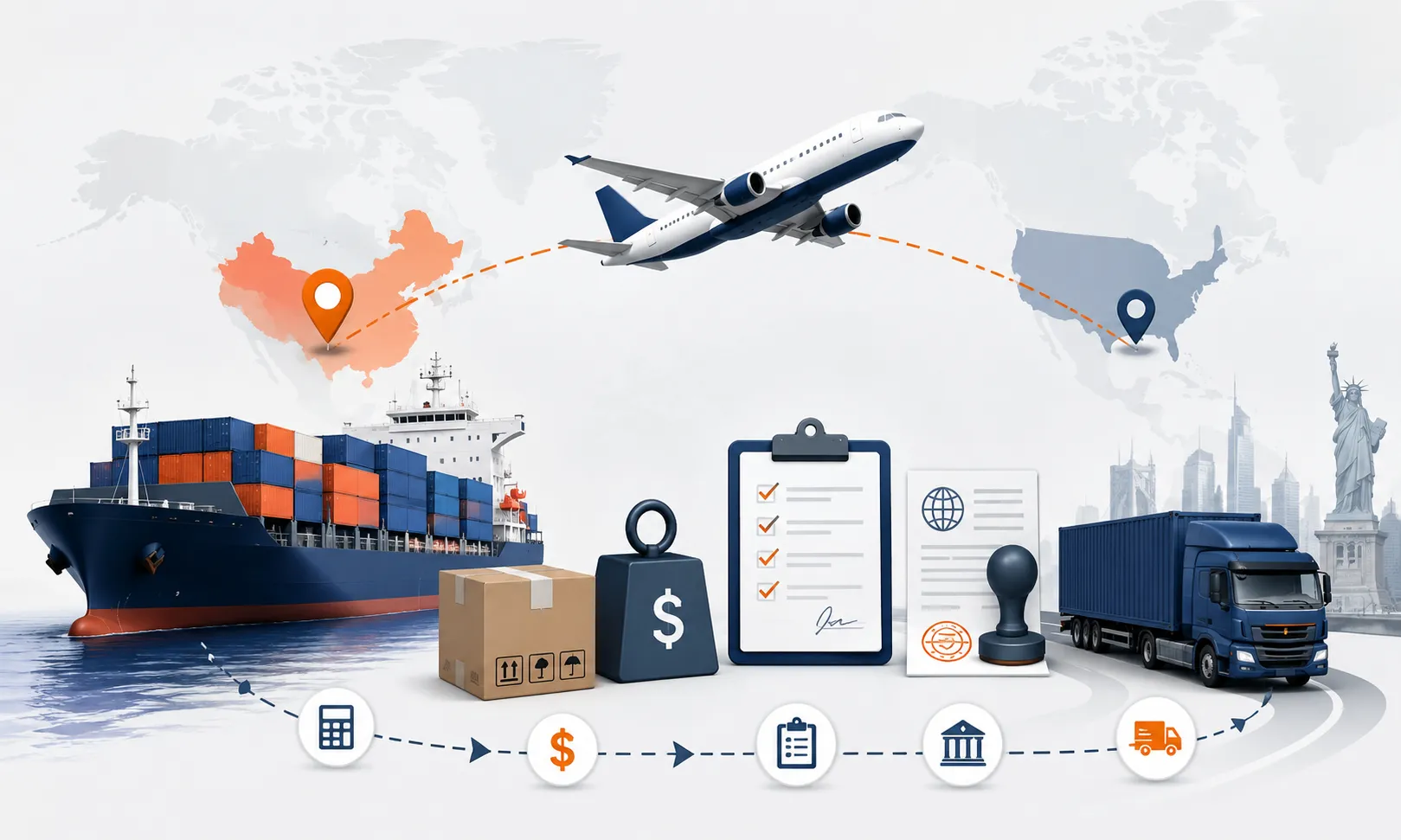
China pickup + origin handling + international freight + destination handling + customs brokerage + duties and tariffs + customs fees + final delivery + insurance and special handling.
When calculating the complete commercial landed cost, the importer should also include the product value.
How Incoterms Change the Cost
In addition, the cost structure changes according to the supplier’s Incoterm and the freight service being quoted.
For example:
- EXW: the buyer’s logistics plan may begin with factory pickup and China export handling.
- FOB: the supplier normally completes the agreed origin responsibilities before the international freight portion begins.
- Port-to-port: most U.S. destination services may remain separate.
- DAP: delivery may be arranged to the named destination while import duties and taxes remain with the importer.
- DDP: duties and delivery may be included under the confirmed quotation scope.
Therefore, an EXW quote should not be compared directly with an FOB or DDP quote unless the missing stages are added back into the calculation.
For a deeper comparison of supplier terms, see EXW vs FOB shipping from China.
Calculate Logistics Cost per Product Unit
As a result, importers should also calculate freight cost at the product level:
Total landed logistics cost ÷ sellable units = logistics cost per unit.
For example:
USD 4,000 ÷ 10,000 units = USD 0.40 logistics cost per unit.
This calculation makes the air-versus-sea decision more commercial. A higher air-freight bill can still make sense if it prevents a stockout, while sea freight may protect margin when inventory can be planned several weeks in advance.
Shipping Cost per KG, CBM and Container
China-to-USA freight does not use one universal pricing unit. The pricing basis changes with the shipping method.
Shipping Cost per Kilogram
For air-based services, express courier, standard air freight and many Air DDP channels use chargeable weight.
The carrier compares:
- actual gross weight
- volumetric weight calculated from carton dimensions
The higher result normally becomes the chargeable weight.
For example, a shipment may physically weigh 80 kg but occupy enough aircraft space to produce 120 kg of volumetric weight. In that case, the quotation may use 120 kg.
As a result, final carton dimensions are essential before confirming an air or express price.
For detailed airline pricing and route planning, use our air freight from China to USA guide.
Sea Freight Cost per CBM
By contrast, LCL sea freight commonly uses CBM or weight/measure.
However, the base CBM rate may exclude:
- origin warehouse receiving
- export documentation
- container consolidation
- destination deconsolidation
- customs brokerage
- warehouse release
- final delivery
In addition, LCL can have minimum charges. A shipment below one CBM is therefore not always proportionally cheap.
For CFS handling and consolidation details, see our LCL sea freight from China guide.
20ft, 40ft and 40HQ Container Cost
Meanwhile, FCL is quoted by the complete container and route.
The total can include:
- factory trucking or container loading in China
- origin terminal charges
- ocean freight
- destination port charges
- customs brokerage
- duties and tariffs
- chassis and drayage
- inland delivery
- waiting time, detention or demurrage
When cargo approaches roughly 12–15 CBM, compare LCL with a 20ft container. Once minimum fees and destination deconsolidation are included, LCL is not automatically cheaper.
For detailed FCL pricing factors, see our container shipping cost from China to USA page.
China-to-USA Shipping Cost by Weight and Volume
There is no universal weight or volume cutoff that makes one method cheapest for every shipment. However, these ranges show where different China-to-USA pricing models usually become worth comparing.
| Shipment Size | Methods to Compare | Main Cost Issue |
|---|---|---|
| Under 21 kg | Express priority and economy courier | Minimum air-freight charges may make standard air impractical |
| 21–45 kg | Express courier | Courier discount level and volumetric weight |
| 45–100 kg | Express vs standard air freight | Destination handling and delivery can change the result |
| 100–300 kg | Standard air vs Air DDP | Compare freight-only pricing with customs and delivery scope |
| 300–500 kg or more | Standard air, Air DDP or split air-and-sea shipment | Inventory urgency and logistics cost per product unit |
| Approximately 1–10 CBM | LCL vs Sea DDP | Minimum charges and destination handling |
| Approximately 10–15 CBM | LCL, Sea DDP and 20ft FCL | LCL-to-FCL crossover and cargo density |
| Larger commercial volume | 20ft, 40ft or 40HQ FCL | Container utilization and inland delivery |
These ranges are pricing decision points rather than carrier rules. Product type, cargo density, destination ZIP code and urgency can move the economical crossover.
China-to-USA Shipping Cost by Method
Each freight method has a different pricing logic. This section focuses only on what affects the cost; detailed routes and operations belong on the specialist service pages.
Express Courier Cost
Express courier normally uses chargeable weight. Although the per-kilogram rate can be higher than standard air freight, the complete price may still be competitive for a small shipment because courier service combines more handling stages into one network.
In addition, the final express rate can rise when:
- cartons are volumetrically large
- the destination is remote
- the shipment needs special handling
- the delivery address is residential
- the goods require additional carrier review
For courier calculations and carrier comparison, see express shipping from China to USA.
Standard Air Freight Cost
Standard air freight is normally quoted by chargeable weight and weight break. As shipment weight increases, the applicable rate per kilogram may change, while volumetric cargo can remain expensive even when its gross weight is low.
However, service scope also changes the comparison. An airport-to-airport rate may exclude China pickup, destination handling, customs brokerage, duties and final trucking. Therefore, compare it with Air DDP only after both quotations cover the same stages.
LCL Sea Freight Cost
LCL is commonly quoted by CBM or weight/measure, but the ocean-freight component is only one part of the final cost. Minimum charges, destination deconsolidation, customs brokerage, warehouse release and local delivery can materially change the total.
For detailed LCL/FCL operations and U.S. port planning, see sea freight from China to USA.
FCL Container Cost
FCL pricing starts with the container and port pair, then adds the origin, destination and inland stages required by the shipment. The lowest ocean rate does not always produce the lowest total cost because a cheaper arrival port can require more expensive drayage or inland trucking.
Therefore, compare the complete route from the supplier to the final U.S. ZIP code, especially when deciding between LCL and a 20ft container.
Air DDP, Sea DDP and Door-to-Door Cost
DDP and broader door-to-door quotations combine more logistics stages, which can make budgeting easier.
Even so, a very low all-in price may depend on:
- a minimum chargeable weight
- a dense-cargo requirement
- limited product acceptance
- excluded residential or appointment fees
- excluded customs examinations
- an incomplete duty assumption
For this reason, confirm the cargo value, dimensions, destination, customs structure and written exclusions before accepting the rate.
Can You Trust a Flat DDP Rate per KG?
A flat DDP rate per kilogram can be a legitimate pricing model for a reviewed shipping channel. However, a rate that claims to include import duties should still be based on enough cargo information to support the customs and cost assumptions.
Before accepting a duty-paid rate, ask the provider to confirm:
- the product description and intended use
- the HS or HTS classification used for the quotation
- the declared customs value or value assumption
- the country of origin
- the Importer of Record arrangement
- whether normal duties and additional tariffs are included
- whether normal destination handling is included
- whether customs examinations, storage and redelivery remain excluded
- whether import-entry records can be provided when applicable
A provider does not need to show every internal cost component in a simple per-kilogram quotation. Nevertheless, if the rate includes duties, the product and customs assumptions should be clear enough for the importer to understand what the price actually covers.
For detailed DDP customs responsibility, see our DDP shipping from China to USA guide.
What Affects Shipping Rates from China to USA?
The same shipment can receive several different China-to-USA shipping rates because freight pricing depends on more than distance.
Cargo Weight and Dimensions
Actual weight affects handling and carrier capacity, while carton dimensions affect volumetric weight, CBM and container utilization.
Therefore, final warehouse measurements are often more reliable than a supplier’s early estimate. Consequently, a packaging change can also change the final freight price.
Product Type
Additional review may be required for batteries, liquids, powders, chemicals, food, cosmetics, wireless electronics, textiles, wood products, medical-related goods and branded products.
These goods may need different carriers, documents, packing or customs handling. As a result, they may not follow a general-cargo planning range.
Supplier Location in China
Pickup costs differ between Shenzhen, Guangzhou, Foshan, Dongguan, Yiwu, Ningbo, Shanghai, Qingdao and other sourcing regions.
In addition, if you buy from several suppliers, consolidation at one China warehouse can reduce repeated pickup and handling.
U.S. Destination ZIP Code
A shipment delivered near Los Angeles or Long Beach can have a very different inland cost from one going to Chicago, Dallas, Houston, Atlanta, Miami, New York or an inland Amazon warehouse.
Moreover, address type also matters. Possible surcharges include:
- residential delivery
- liftgate service
- limited-access delivery
- appointment delivery
- inside delivery
- waiting time
- redelivery
Therefore, provide the exact ZIP code and address type before comparing rates.
Season, Capacity and Required Speed
Rates can move during peak shipping periods, Chinese holiday closures, inventory-replenishment seasons, carrier-capacity shortages, port disruption and weather events.
Faster transport usually costs more. However, the commercial cost of waiting also matters. If an urgent shipment prevents lost sales or production downtime, air freight may still produce a better business result.
Real China-to-USA Shipping Cost Examples
For example, the cases below illustrate recurring cost problems in freight operations. Product and company identities are omitted, and the numbers are examples rather than fixed VoltFreight quotations.
Example 1: A USD 90/CBM LCL Rate Became Expensive After Arrival
An importer compared quotations for a 3 CBM shipment and selected an ocean rate of USD 90/CBM.
The international freight component looked like:
3 CBM × USD 90 = USD 270
However, the quotation did not include:
- destination deconsolidation: USD 420
- documentation and warehouse release: USD 180
- customs brokerage and bond support: USD 220
- final delivery: USD 480
- storage caused by delayed release: USD 150
The illustrative logistics total therefore became:
USD 270 + USD 420 + USD 180 + USD 220 + USD 480 + USD 150 = USD 1,720
In addition, import duty was still separate.
Therefore, the lesson is simple: never compare LCL quotations using the ocean CBM component alone.
Example 2: Approximately 15 CBM of Furniture — LCL or 20ft FCL?
In another example, an importer planned approximately 15 CBM of furniture from Foshan to an inland U.S. destination.
An illustrative LCL comparison looked like:
- LCL freight and origin handling: USD 1,800
- destination deconsolidation and release: USD 1,550
- customs and local handling: USD 450
- final inland delivery: USD 1,650
Illustrative LCL total: USD 5,450 before duties.
The 20ft FCL example included:
- container movement and ocean freight: USD 3,250
- origin and destination handling: USD 850
- customs and release: USD 350
- drayage and final delivery: USD 850
Illustrative FCL total: USD 5,300 before duties.
In this example, the price difference was small, while FCL reduced cargo-handling stages. The actual result changes with container rates, cargo density, port choice and inland destination, but shipments near 12–15 CBM should normally compare both options.
Example 3: Carton Dimensions Increased the Air Freight Charge
A supplier initially estimated one carton at 57 × 41 × 51 cm with a gross weight of 21 kg.
Estimated volumetric weight:
57 × 41 × 51 ÷ 6,000 = approximately 19.86 kg
Therefore, the estimated chargeable weight was 21 kg.
After warehouse receiving, the carton measured 52 × 58 × 45 cm and weighed 21.78 kg.
Revised volumetric weight:
52 × 58 × 45 ÷ 6,000 = approximately 22.62 kg
The chargeable weight therefore increased from 21 kg to 22.62 kg.
Using an illustrative air rate of USD 5.80/kg:
- Original estimate: 21 kg × USD 5.80 = USD 121.80 per carton
- Revised charge: 22.62 kg × USD 5.80 = approximately USD 131.20 per carton
- Difference: approximately USD 9.40 per carton
For 20 similar cartons:
USD 9.40 × 20 = approximately USD 188 additional freight.
This is why final warehouse measurements can materially improve quotation accuracy.
Example 4: Two “All-In” Rates Covered Different Services
An importer received two apparently similar door-to-door quotations.
Quotation A had a lower per-kilogram rate but excluded:
- import duties
- residential delivery
- customs examinations
- redelivery
Quotation B had a higher rate but included customs coordination, normal destination handling and commercial-address delivery.
Importantly, the lower price was not necessarily wrong. However, the two quotations could not be compared until their service scopes were made identical.
Customs Duties and Import Fees That Affect Landed Cost
Freight cost and customs cost should be separated so the importer can see what the quotation actually covers.
Depending on the shipment, landed cost may include:
- normal customs duty based on HTS classification
- additional tariffs when applicable
- Merchandise Processing Fee
- Harbor Maintenance Fee for applicable ocean imports
- customs bond and brokerage charges
- government-agency processing
- inspection, storage or examination fees
However, different products can have very different tariff exposure. Therefore, do not apply one general duty percentage to every China-origin shipment.
This page focuses on how customs affects shipping cost. For HTS classification, duties, tariffs, MPF and HMF in more detail, use our import tax from China to USA guide. For the normal broker, bond and entry process, see USA customs clearance from China.
How to Reduce Shipping Cost from China to USA
The most effective savings usually begin before the cargo leaves the supplier.
- Consolidate supplier orders. Combining cargo can reduce repeated pickup and handling.
- Optimize carton dimensions. Less unused space can reduce volumetric weight and improve container utilization.
- Confirm final packing data. Accurate dimensions and weight reduce later quotation adjustments.
- Compare identical service scopes. Port-to-port freight should not be compared directly with DDP.
- Check the LCL-to-FCL crossover. Cargo near 12–15 CBM should be compared with a 20ft container.
- Split urgent and planned inventory when practical. Send urgent units by air and the main order by sea.
- Provide the exact U.S. ZIP code. A cheaper arrival port may create higher inland delivery cost.
- Review the HTS code early. Duties and tariffs can materially change landed cost.
- Prepare invoice and packing data correctly. Accurate documents reduce amendments and avoidable delays.
- Plan before peak demand. Earlier booking usually gives more route and carrier choices.
Ultimately, a low quotation is not a saving if unpriced costs appear after arrival.
What Information Is Needed for an Accurate Shipping Quote?
A freight quotation is only as accurate as the shipment information provided.
Send:
Product name:
Material and intended use:
HS code or HTS code if available:
Product photos or supplier link:
Supplier city and pickup address:
Supplier Incoterm: EXW / FOB / FCA / other
Carton or pallet quantity:
Dimensions of each package type:
Total gross weight:
Total CBM:
Cargo value:
Cargo-ready date:
U.S. delivery address or ZIP code:
Delivery type: business / residential / warehouse / 3PL / Amazon FBA / port / airport
Need customs clearance: yes or no
Need duty-paid service: yes or no
Need cargo insurance: yes or no
Special cargo: battery / liquid / powder / magnet / food / textile / wood / branded goods / other
If production is not finished, VoltFreight can prepare an estimated quotation first. However, the price should be reconfirmed after final packing data becomes available.
For air and express shipping, inaccurate carton dimensions can change chargeable weight. In LCL shipments, incorrect dimensions change the billed CBM. Larger shipments may even require a different container recommendation when the final volume changes.
How VoltFreight Helps Compare China-to-USA Shipping Cost
VoltFreight reviews the shipment as one complete cost route rather than quoting only a generic per-kilogram or per-CBM number.
Our China-side support can include:
- pickup from Chinese factories and trading companies
- China warehouse receiving
- multi-supplier consolidation
- carton measurement and weight verification
- CBM and chargeable-weight calculation
- express, air, LCL and FCL comparison
- DDP and door-to-door feasibility review for suitable cargo
- commercial invoice and packing-list coordination
- customs and tariff information collection
- delivery planning for businesses, residences, 3PLs and Amazon fulfillment centers
- quotation-scope review before booking
- shipment tracking from China pickup to final delivery
Instead, we compare cargo size, urgency, carrier acceptance, customs feasibility, destination ZIP code and the complete service scope before recommending an option.
If you already have a supplier or freight quotation, you can send it together with the packing information. We can compare the pricing basis, route scope, customs responsibility, destination charges and final-delivery assumptions before you decide which offer is actually cheaper.
Request a China-to-USA shipping cost estimate from VoltFreight.
FAQ: China-to-USA Shipping Cost
How much does shipping from China to USA cost?
As a broad planning reference, express courier may cost about USD 6–15/kg, standard air freight about USD 4.5–8/kg for suitable general cargo, Air DDP about USD 5.2–8.2/kg on reviewed routes, and Sea DDP about USD 1.9–3.9/kg for suitable dense cargo or about USD 85–150/CBM on selected routes. The final cost depends on the actual cargo and service scope.
What are typical shipping rates from China to USA?
Typical China-to-USA shipping rates vary by method. Courier and air services usually use chargeable weight, LCL commonly uses CBM or weight/measure, and FCL uses a route-specific container rate. Because carrier capacity and market conditions change, use published ranges for budgeting and confirm the live rate with the final packing list before booking.
How much does air freight from China to USA cost per kg?
Standard air freight may broadly cost about USD 4.5–8/kg for suitable general cargo. Air DDP may cost around USD 5.2–8.2/kg on reviewed routes. The actual rate depends on chargeable weight, weight break, cargo type, airline capacity, customs scope and final U.S. destination.
How much does sea freight from China to USA cost per CBM?
LCL base freight is normally quoted by CBM or weight/measure. However, the base CBM rate may exclude destination deconsolidation, customs brokerage, warehouse release and final delivery. Sea DDP may broadly range around USD 85–150/CBM for suitable cargo on selected routes.
When should I compare LCL with a 20ft container?
As a planning rule, shipments approaching roughly 12–15 CBM should normally compare both LCL and 20ft FCL. The actual crossover depends on cargo density, current container rates, destination charges, port choice and inland delivery.
Why is one China-to-USA shipping quote much cheaper than another?
The quotations may cover different service stages. One price may include only international freight, while another includes China pickup, destination handling, customs coordination and final delivery. Compare the same route scope before deciding which shipping rate is actually lower.
Does shipping cost from China to USA include customs duties?
Not always. Standard freight quotations commonly exclude duties and tariffs. A DDP quotation may include them when the cargo, customs structure and exact service scope are confirmed in writing. Always check whether customs examinations, storage or redelivery remain excluded.
Why would a DDP quote need my product value and HTS code?
Because a duty-paid quotation depends on customs assumptions as well as transportation cost. The product description, classification, origin and customs value can affect duty exposure. Therefore, if a DDP rate claims to include duties, the provider should collect enough information to support that pricing assumption.
What is the cheapest way to ship from China to USA?
Sea freight is usually the cheapest method per product unit for large, heavy and planned cargo. LCL may suit smaller commercial shipments, while FCL can provide better value as volume approaches container level. For a very small urgent parcel, express courier may still produce the lowest complete cost.
How can I get an accurate China-to-USA shipping rate?
Provide the product description, supplier address, carton quantity, final dimensions, gross weight, cargo value, special-product information and U.S. delivery ZIP code. Once packing is final, confirm the rate again before pickup because changes in dimensions or weight can affect chargeable weight, CBM and the recommended shipping method.
Get a China-to-USA Shipping Cost Estimate
A useful quotation should connect the Chinese supplier, international transport, customs responsibility and final U.S. destination.
Before requesting the final price, confirm:
- final carton or pallet data
- product description and cargo value
- supplier Incoterm and pickup address
- U.S. ZIP code and delivery type
- customs and duty responsibility
- required delivery deadline
Send VoltFreight your packing list and destination information. We can compare express, standard air freight, Air DDP, Sea LCL, Sea FCL and reviewed door-to-door options using the same service scope.
Contact VoltFreight for a China-to-USA shipping quote.
Important notice: Freight rates, customs rules, tariffs, carrier capacity and delivery costs can change. Confirm the final quotation and included service scope before the supplier releases the cargo.