USA customs clearance from China is one of the most important parts of importing goods into the United States. A shipment can move quickly by sea freight, air freight or express courier, but it can still face delays, extra duties or customs exams if the HTS code, declared value, importer information or product documents are not clear.
Many importers focus only on freight cost. However, U.S. customs clearance can change the real landed cost of a shipment. HTS codes, import duties, Section 301 tariffs, MPF, HMF, customs bond requirements, de minimis changes, importer of record responsibility and product compliance can all affect the final result.
This guide explains how customs clearance from China to USA works, who is responsible for import entry, how HTS codes affect duty, what documents importers need, how sea freight, air freight, express shipping, DDP and Amazon FBA customs clearance differ, and what information you should prepare before shipping.
If you are still comparing freight and duty together, read our guide to China to USA shipping cost. If you need a full delivery solution, compare this article with our guide to DDP shipping from China to USA.
Need help reviewing customs details before shipping? Send your product name, product photos, material, use, HS or HTS code if available, cargo value, packing list, supplier city, destination address and preferred shipping method. Then, contact VoltFreight to review the customs scope, freight option and delivery plan.
Quick Answer: How Does USA Customs Clearance from China Work?
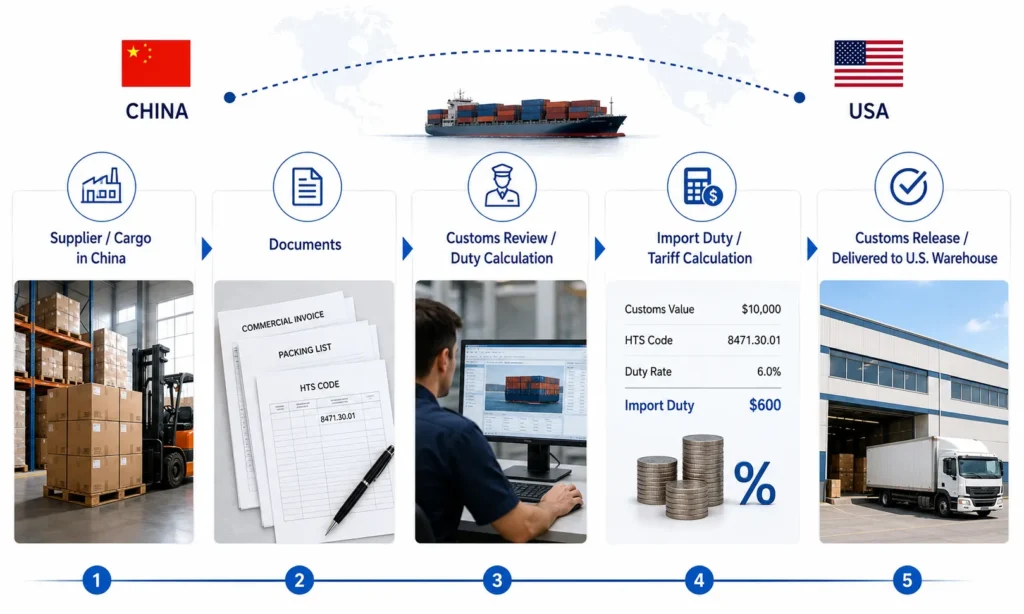
USA customs clearance from China starts before the cargo arrives in the United States. The importer or its appointed customs broker prepares import data, checks the HTS code, reviews the commercial invoice and packing list, confirms the importer of record, and submits the customs entry when required.
U.S. Customs and Border Protection reviews the import entry, product description, declared value, country of origin, HTS classification and compliance documents. If everything is acceptable, CBP releases the cargo. However, customs may request more documents, review the entry, inspect the shipment or refer the product to another government agency.
| Question | Practical Answer |
|---|---|
| Who handles customs clearance? | The importer of record or appointed customs broker usually handles the import entry |
| What decides the import duty? | HTS code, declared value, country of origin and applicable tariff measures |
| Can Amazon act as importer? | Amazon fulfillment centers do not act as importer of record for FBA inventory |
| Is a low-value shipment always duty-free? | No. Importers should not assume low-value shipments can always enter duty-free |
| What documents are usually needed? | Commercial invoice, packing list, bill of lading or air waybill, importer details and product documents |
| What causes customs delays? | Wrong HTS code, vague product description, missing documents, low declared value, product compliance issues or customs exam |
USA Customs Clearance from China at a Glance
Customs clearance is not a single document. It is a process that connects product classification, import responsibility, duty calculation, compliance review and cargo release.
| Customs Item | Why It Matters | What Importers Should Check |
|---|---|---|
| HTS code | Determines duty rate and tariff category | Product material, use, function, structure and technical details |
| Declared value | Used to calculate duty and customs value | Commercial invoice, payment terms and realistic transaction value |
| Importer of record | Responsible for the import entry and compliance | Business details, EIN, customs bond and broker authorization |
| Country of origin | Affects duty, tariffs and trade measures | Manufacturing origin and product origin documents |
| Import documents | Support customs entry and cargo release | Invoice, packing list, B/L, AWB, arrival notice and product documents |
| PGA compliance | Some products need review by other agencies | FDA, FCC, EPA, CPSC, USDA, DOT or other requirements |
| Shipping method | Changes customs documents and fees | Sea freight, air freight, express, DDP or FBA delivery |
Who Is Responsible for Customs Clearance?
The importer of record is responsible for the import entry, declared value, product classification, duty payment and compliance with U.S. import rules. A freight forwarder can help coordinate documents and transport, but the importer must understand its own customs responsibility.
A customs broker can submit the entry and help communicate with CBP. However, the broker still needs accurate information from the importer or seller. If the product description is vague or the HTS code is wrong, the customs entry can face delays or later corrections.
Common Parties in a Customs Clearance Process
| Party | Role |
|---|---|
| Importer of record | Responsible for import entry, duties, compliance and customs information |
| Customs broker | Files entry documents and communicates with customs on behalf of the importer |
| Freight forwarder | Coordinates shipment movement, documents and logistics process |
| Supplier or manufacturer | Provides product details, commercial invoice, packing list and origin information |
| Carrier | Moves cargo by ocean, air or express network |
| Warehouse or final receiver | Receives cargo after customs release and final delivery |
Importer of Record: Why It Matters
The importer of record, often called IOR, is one of the most important concepts in customs clearance from China to USA. The IOR is responsible for the accuracy of import information, duty payment and compliance with U.S. import laws.
For U.S. companies, the importer of record may use an EIN and customs bond when required. For non-U.S. sellers, importer responsibility needs careful planning before shipping. A delivery address, warehouse address or Amazon FBA address does not automatically become the importer of record.
Why Importer of Record Problems Cause Delays
- The customs broker may not be able to file the entry without valid importer details.
- The shipment may wait at port, airport or warehouse while the importer information is corrected.
- Amazon FBA shipments can face refusal or delivery problems if the seller assumes Amazon will act as importer.
- DDP shipments can become unclear if the quote does not explain who handles import responsibility.
HTS Code: The Key to Import Duty
The HTS code is the key to import duty from China to USA. HTS means Harmonized Tariff Schedule. The code helps determine the base duty rate, additional tariffs, statistical category and sometimes the import requirements for a product.
Importers should not classify goods only by product name. The same general product name can have different HTS codes depending on material, function, structure, use, technical features and whether the product forms part of another item.
Why HTS Codes Matter
| HTS Impact | What It Can Affect |
|---|---|
| Base duty rate | The normal import duty for the product category |
| Section 301 tariffs | Additional tariff exposure for many China-origin goods |
| PGA requirements | Possible review by FDA, FCC, EPA, CPSC or other agencies |
| Entry type | Formal or informal entry handling may depend on value and product type |
| Customs risk | Wrong classification can cause delays, corrections, duty changes or exams |
HTS Code Classification Example
HTS classification requires product details. A short product name is not enough. For example, “LED light” may sound simple, but customs classification may depend on design, use, material, electrical specifications and whether it is a finished lamp, component, strip light, decorative light or lighting fixture.
| Product Detail | Why It Matters |
|---|---|
| Product name | Gives a starting point but does not decide the final HTS code alone |
| Material | Plastic, aluminum, steel, glass or mixed materials can affect classification |
| Function | Indoor lighting, vehicle lighting, decorative lighting or industrial use may differ |
| Electrical specifications | Voltage, power and components may matter for some products |
| Finished product or part | A complete item and a component may not share the same classification |
| Product photos and datasheet | Help customs broker review the product more accurately |
This example does not assign a final HTS code. Instead, it shows why importers should provide product details before shipping. If the classification is uncertain, the importer should ask a qualified customs broker or seek a formal ruling when necessary.
Import Duties, MPF, HMF and Section 301 Tariffs
China to USA customs duties may include more than one cost item. Importers often think only about the base duty rate, but the full import cost may also include MPF, HMF for ocean freight, Section 301 tariffs, customs bond fees, broker fees and exam-related charges if customs selects the cargo for review.
Base Import Duty
The base import duty depends on the HTS code and customs value. Some products have low duty rates, while others have higher rates. Product classification should be reviewed before shipping, especially when the order value is high.
Section 301 Tariffs
Many China-origin products may face additional Section 301 tariffs. A normal duty rate may not represent the full duty exposure. Therefore, importers should check whether the product appears under applicable tariff measures before confirming landed cost.
MPF and HMF
MPF means Merchandise Processing Fee. HMF means Harbor Maintenance Fee. HMF usually matters for ocean imports. These fees can affect landed cost, especially when importers compare sea freight, air freight and express shipping.
Landed Duty Cost Formula
A practical duty estimate should include more than the base duty rate. The formula below helps importers understand what may affect the customs side of the landed cost.
| Cost Component | What It Means |
|---|---|
| Customs value | The declared value used for customs entry and duty calculation |
| Base import duty | Duty calculated by HTS code and customs value |
| Section 301 tariff if applicable | Additional tariff that may apply to certain China-origin goods |
| MPF | Merchandise Processing Fee where applicable |
| HMF for ocean freight | Harbor Maintenance Fee for many ocean imports |
| Customs bond or broker fee | Cost for entry filing and import compliance support |
| Exam or storage fee if any | Extra cost when cargo faces customs exam or release delay |
| Final delivery if included | Truck delivery, warehouse delivery, FBA delivery or DDP final mile cost |
This formula is useful when comparing quotes. A quote with a low freight rate may not be cheaper if it excludes duties, broker fees, port charges, airport handling or final delivery.
De Minimis Changes: Why Low-Value Shipments May Not Be Duty-Free
Importers should not assume that shipments valued at $800 or below can always enter the United States duty-free. U.S. de minimis rules and carrier processes have changed, especially for e-commerce shipments and China-origin goods.
This matters for express shipping, air freight, small parcel imports, Amazon sellers and online retailers. A shipment that previously moved with a simple low-value process may now require duty review, tariff calculation, more complete product data or a different entry process.
What Importers Should Check
- HTS code before shipping
- Declared value and transaction value
- Country of origin
- Duty and tariff exposure
- Carrier duty billing process
- Importer of record responsibility
- Product compliance documents
The safest approach is simple: confirm duty treatment before shipping instead of assuming that low-value cargo will clear without duties.
Required Customs Documents for Imports from China
Customs documents must match the real shipment. Incorrect product descriptions, missing values, inconsistent carton data or unclear importer information can slow down clearance.
| Document | Purpose |
|---|---|
| Commercial invoice | Shows seller, buyer, product description, value, currency, incoterms and origin details |
| Packing list | Shows carton quantity, weight, dimensions, packing details and cargo breakdown |
| Bill of lading | Used for ocean freight shipments |
| Air waybill | Used for air freight shipments |
| Arrival notice | Provides arrival and release information for many freight shipments |
| HTS code | Used for classification, duty and tariff calculation |
| Importer information | Needed to identify the importer of record |
| Customs bond | May be required for formal entries |
| ISF data | Required for many ocean shipments before vessel loading |
| Product compliance documents | May be needed for FDA, FCC, EPA, CPSC, DOT, USDA or other agency review |
Customs Clearance by Shipping Method: Sea, Air, Express, DDP and FBA
Customs clearance changes by shipping method. Sea freight, air freight, express courier, DDP and Amazon FBA shipments all have different document flow, cost structure and risk points.
| Shipping Method | Customs Focus | Common Risk | Related Guide |
|---|---|---|---|
| Sea Freight | ISF, bill of lading, customs bond, MPF, HMF, port release and final delivery | Late ISF, customs exam, demurrage, detention and port storage | Sea Freight from China to USA |
| Air Freight | Air waybill, airport terminal handling, customs entry, duty billing and final truck delivery | Wrong chargeable weight, sensitive cargo review, customs delay and airport storage | Air Freight from China to USA |
| Express Shipping | Carrier entry process, duty billing, product data and recipient information | Unexpected duty bill, de minimis change, wrong HS code and delivery hold | Express Shipping from China to USA |
| DDP Shipping | Who handles importer responsibility, duties, taxes, customs review and final delivery | Unclear DDP scope, low-value declaration risk, product restriction and exam cost dispute | DDP Shipping from China to USA |
| Amazon FBA | Importer of record, customs documents, FBA labels, delivery appointment and warehouse rules | Assuming Amazon is IOR, missing labels, wrong warehouse code or refused delivery | Amazon FBA Shipping from China to USA |
Customs Clearance for Amazon FBA Shipments
Amazon FBA customs clearance needs careful planning because Amazon fulfillment centers do not act as the importer of record. Sellers must arrange import responsibility, customs documents, duty payment and delivery requirements before inventory enters the United States.
In addition, customs clearance is only one part of the FBA process. Sellers also need correct FBA box labels, pallet labels when required, shipment ID, warehouse code, delivery appointment and LTL or FTL delivery planning.
FBA Customs Checklist
- Confirm importer of record before shipping
- Prepare commercial invoice and packing list
- Check HTS code and duty exposure
- Confirm customs bond if needed
- Confirm FBA warehouse code and delivery address
- Apply FBA labels correctly
- Confirm appointment or delivery method
- Plan customs release before final delivery to Amazon
DDP Customs Clearance from China to USA
DDP customs clearance from China to USA can be useful when the buyer wants a landed delivery scope. However, DDP must be reviewed carefully because it mixes freight, customs, duties and final delivery into one quote.
A reliable DDP quote should explain what it includes and what it excludes. It should also clarify product suitability, HTS code, declared value, importer responsibility, duties, taxes, customs exam handling and final delivery conditions.
DDP Customs Risk Checklist
| DDP Question | Why It Matters |
|---|---|
| Are duties included? | A DDP quote should clearly state whether duties and tariffs are included |
| Who handles importer responsibility? | Unclear IOR structure can create customs and compliance risk |
| Who confirms the HTS code? | Wrong classification can change duty cost and customs outcome |
| Who pays customs exam fees? | Exams can create extra cost and delay |
| Is the declared value realistic? | Low or incorrect values can trigger review and penalties |
| Is the product suitable for DDP? | Some regulated, branded or sensitive goods may not fit standard DDP service |
| Can the final address receive the cargo? | Warehouse rules, FBA rules, liftgate needs and appointment requirements matter |
Common Customs Exam Types and Delays
Customs exams are a normal part of import risk. An exam does not always mean the shipment has a problem. However, it can increase cost and delay the release of goods.
| Exam or Review Type | What It Usually Means |
|---|---|
| Document review | Customs or broker reviews documents before release |
| X-ray exam | Cargo is scanned without fully unloading every carton |
| Tailgate exam | Container or truck is opened for a basic inspection |
| Intensive exam | Cargo may move to an exam site for deeper inspection |
| CET exam | Contraband Enforcement Team may inspect cargo for enforcement reasons |
| PGA review | Another government agency reviews product compliance |
What Customs Exams Can Cause
- Release delays
- Exam fees
- Warehouse or storage charges
- Demurrage or detention for ocean shipments
- Airport storage for air shipments
- Delivery appointment changes
- Additional document requests
Products That Need Extra Compliance Review
U.S. customs clearance is not only about CBP. Some products may need review by Partner Government Agencies, often called PGAs. The exact requirement depends on product type, material, use, ingredients and regulatory category.
| Agency or Area | Possible Product Examples |
|---|---|
| FDA | Food, cosmetics, medical devices, health-related goods and some electronic products |
| FCC | Radio frequency devices, wireless electronics and communication equipment |
| EPA | Chemicals, engines, pesticides and certain regulated environmental products |
| CPSC | Children’s products, toys, consumer goods and safety-regulated products |
| DOT | Vehicle parts, tires, automotive products and transport-related items |
| USDA / APHIS | Wood products, plant materials, agricultural goods and animal-origin products |
| Fish and Wildlife | Products containing certain animal materials or wildlife-related components |
If your product includes batteries, wireless functions, food-contact materials, cosmetics, chemicals, children’s use, wood packaging, branded goods or restricted materials, confirm compliance requirements before shipping.
How to Estimate Import Duty Before Shipping
Importers can estimate import duty before shipping, but the estimate depends on accurate product details. The process should not start with freight price only. It should start with product classification and declared value.
Duty Estimate Process
- Collect product name, photos, material, use and technical details.
- Check HS or HTS code based on product details.
- Review base duty rate in the HTS.
- Check whether Section 301 or other additional tariffs apply.
- Confirm customs value and commercial invoice value.
- Add MPF, HMF for ocean freight, broker fee and bond cost if applicable.
- Review PGA compliance documents if the product is regulated.
- Compare customs cost together with freight and final delivery.
Customs Clearance Decision Table
The table below helps importers decide what to check before choosing a shipping method.
| If You Ship By | Check First | Main Risk |
|---|---|---|
| Sea freight | ISF, HTS code, customs bond, MPF, HMF, port release and final delivery | Late ISF, port storage, demurrage, detention and customs exam |
| Air freight | AWB, chargeable weight, airport release, duty billing and sensitive cargo review | Airport storage, customs delay and unexpected duty cost |
| Express shipping | Carrier duty billing, de minimis status, HS code and recipient details | Delivery hold, unexpected duty bill or wrong classification |
| Amazon FBA | Importer of record, FBA labels, delivery appointment and customs documents | Amazon will not act as IOR, and delivery can fail if labels or appointment are wrong |
| DDP shipping | Duty inclusion, IOR structure, product suitability and exam cost handling | Unclear responsibility if customs asks for documents or selects the shipment for exam |
Before You Ship: Customs Clearance Checklist
A strong customs plan starts before cargo leaves China. Prepare the following information before booking freight.
| Information | Why It Matters |
|---|---|
| Product name | Starts the classification and compliance review |
| Product photos | Helps identify function, material and possible restrictions |
| Material and use | Important for HTS classification |
| HS or HTS code if available | Helps estimate duties and customs requirements |
| Commercial invoice | Shows seller, buyer, value, currency and transaction details |
| Packing list | Shows carton count, weight, dimensions and packing data |
| Declared value | Used for customs value and duty calculation |
| Country of origin | Affects tariffs and product origin review |
| Importer information | Needed for customs entry and importer of record review |
| EIN, SSN or foreign importer details | May be required depending on importer type and entry process |
| Customs bond | May be required for formal imports |
| Shipping method | Sea, air, express, DDP and FBA each need different planning |
| Destination address | Needed for delivery, FBA, 3PL or warehouse release planning |
| PGA documents | Needed for regulated products |
| Battery, liquid, wood or brand notes | Helps identify restricted cargo or compliance risk |
Common Customs Clearance Mistakes
Many customs problems are avoidable. Importers can reduce risk by preparing accurate product and shipment information before booking.
- Using vague product descriptions. Descriptions such as “parts,” “accessories” or “gift” can create customs questions.
- Guessing the HTS code. Wrong classification can change duty, tariff and compliance requirements.
- Declaring an unrealistic value. Low or inconsistent values can trigger review.
- Assuming Amazon is the importer. Amazon fulfillment centers do not act as importer of record for FBA inventory.
- Ignoring Section 301 tariffs. Many China-origin goods may have additional tariff exposure.
- Forgetting ISF for sea freight. Late or missing ISF can create customs risk and penalties.
- Not checking product compliance. FDA, FCC, EPA, CPSC, DOT or USDA rules may apply to some goods.
- Assuming DDP covers every risk. DDP scope must clearly define duties, importer responsibility and exam handling.
- Only comparing freight cost. Duties, broker fees, exams, storage and final delivery can change the real landed cost.
How VoltFreight Helps with USA Customs Clearance from China
VoltFreight helps importers review customs and shipping details before cargo leaves China. Our goal is to reduce avoidable delays, unclear costs and delivery problems by checking the shipment scope early.
Our support can include:
- Commercial invoice and packing list review
- Product information collection for customs review
- HS or HTS code discussion based on product details
- Import duty and tariff planning support
- DDP suitability review for suitable general cargo
- Sea freight, air freight and express customs process comparison
- Amazon FBA customs and delivery planning
- Importer of record and customs document coordination
- ISF data coordination for ocean shipments
- Delivery planning to warehouse, 3PL, Amazon FBA or business address
- Alternative route recommendation when customs or product risk is high
VoltFreight is a freight forwarder, not a law firm or customs ruling authority. For final legal classification or binding customs decisions, importers should consult a licensed customs broker or request official guidance when necessary. However, we can help organize the shipping and customs information needed for a safer import plan.
Get Customs Clearance Support for China to USA Shipping
Related China to USA Shipping Guides
- China to USA Shipping Cost
- DDP Shipping from China to USA
- Amazon FBA Shipping from China to USA
- Express Shipping from China to USA
- Sea Freight from China to USA
- Air Freight from China to USA
- Shipping from China to the USA
- Customs Clearance Service
FAQ: USA Customs Clearance from China
What is USA customs clearance from China?
USA customs clearance from China is the process of submitting import data, product details, value, HTS classification, importer information and documents to U.S. customs so the cargo can be legally released for delivery.
What documents do I need for customs clearance from China to USA?
Common documents include commercial invoice, packing list, bill of lading or air waybill, arrival notice, HTS code, importer information and customs bond details if required. Some products may also need FDA, FCC, EPA, CPSC, DOT, USDA or other compliance documents.
How do I know the import duty from China to USA?
Import duty depends on the HTS code, customs value, country of origin and applicable tariff measures such as Section 301 tariffs. Importers should review product details before estimating duty.
What is an HTS code?
An HTS code is a U.S. tariff classification code used to determine import duty and statistical category. The correct HTS code depends on product material, use, function, structure and other details.
What is Section 301 tariff for China imports?
Section 301 tariffs are additional tariffs that may apply to many China-origin products. Importers should check whether their HTS code is affected before shipping.
Can Amazon act as importer of record for FBA shipments?
No. Amazon fulfillment centers do not act as importer of record for FBA inventory entering the United States. Sellers must arrange importer responsibility and customs clearance before delivery to Amazon.
Does DDP shipping include customs clearance?
DDP shipping can include customs clearance and duties if clearly agreed. However, the quote should explain duties, taxes, importer responsibility, product suitability, customs exam handling and final delivery terms.
Why does customs hold a shipment?
Customs may hold a shipment because of document review, wrong HTS code, unclear product description, low declared value, missing importer information, compliance review, customs exam or other agency requirements.
Do low-value shipments from China still enter duty-free?
Importers should not assume low-value shipments from China can always enter duty-free. De minimis rules and carrier processes have changed, so importers should confirm duty treatment, HTS code, declared value and entry method before shipping.
Useful Official Sources
- U.S. Customs and Border Protection: Basic Importing and Exporting
- U.S. Customs and Border Protection: E-Commerce FAQs
- U.S. Customs and Border Protection: End of De Minimis Enforcement Update
- USITC: Harmonized Tariff Schedule of the United States
- USTR: Presidential Tariff Actions
- Amazon Seller Central: Delivering Imports to Amazon