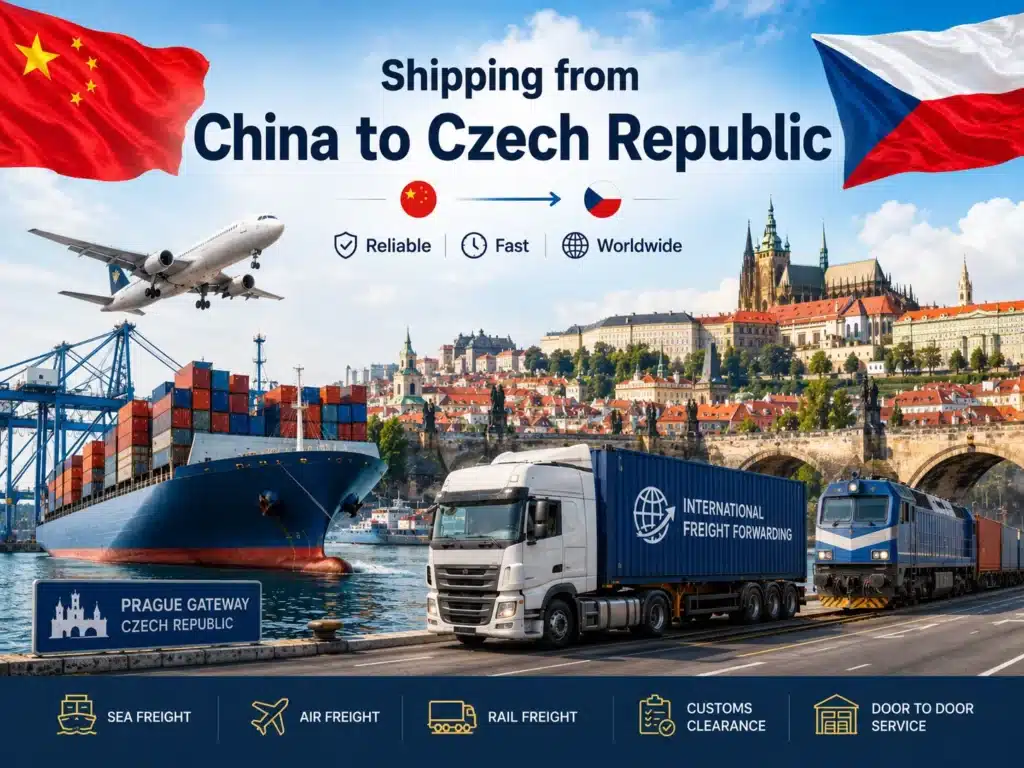
Quick answer: Compare sea, rail, air and express freight using the same Chinese handover point and Czech delivery address. The Czech Republic has no seaport, so sea freight also needs a European gateway and an inland leg. A port rate alone is not the delivered cost to a warehouse in Prague, Brno or Ostrava.
VoltFreight helps Czech importers arrange supplier pickup, China warehouse consolidation where needed, international freight and delivery to a named Czech address. A realistic comparison depends on product type, package dimensions, cargo-ready date, the importer and customs arrangement, and the receiving warehouse’s requirements. The cost and time sections below give the figures and the conditions behind them before explaining each route.
If you have an invoice and packing list, send us the Chinese pickup city, product, cartons or pallets, dimensions, gross weight, cargo-ready date and Czech postcode through our freight enquiry form. We can compare eligible options on an agreed origin, destination and list of included charges.
How Much Does Shipping from China to Czech Republic Cost?
Cost to where? A sea rate to Hamburg, a rail rate to an EU terminal, an air rate to Prague Airport and a duty-paid delivery to a Czech warehouse cover different work. Compare the same cargo, Chinese handover point, Czech postcode, customs arrangement and included charges before deciding which offer is cheaper.
Historical June 2026 market price references
A third-party Czech-route guide published the following figures for June 2026. They are historical market references, not VoltFreight prices or door-delivery quotes. The origin, destination and included charges are not consistent across modes. Use them to frame questions, then request a current quote for your actual cargo and Czech address.
| Mode | June 2026 published figure | Check before using it for a Czech budget |
|---|---|---|
| Sea LCL | USD 45 per m³ | Confirm chargeable CBM or weight/measure minimum, origin CFS, European deconsolidation and Czech delivery. |
| Sea FCL, 20GP | USD 2,448–2,968 | Historical ocean reference via European gateways; not an all-in price to Prague or Brno. |
| Sea FCL, 40GP | USD 4,480–5,440 | Confirm port, equipment, surcharges, terminal charges and inland movement separately. |
| Rail container, 20ft | USD 4,039–4,936 | Confirm the Chinese rail terminal, European arrival terminal and whether Czech trucking is included. |
| Rail container, 40ft | USD 5,875–7,180 | Do not compare with a sea-to-port rate until both include the same Czech delivery scope. |
| Air freight | USD 5.70 per kg | The guide associates this rate with cargo above 1,000 kg; confirm chargeable weight and the pricing bracket. |
| Express | USD 10.28 per kg | Historical reference only; actual parcel band, fuel, remote-area and clearance charges vary. |
That guide also reported an approximately 60% month-on-month increase in June ocean rates. It did not provide a comparable May quote for the same route and scope. Its rail container figures exceed its sea line items, so the table does not support a blanket claim that rail is cheaper. For today’s decision, compare complete offers to the same Czech address.
Build the delivered cost in the right order
- China origin: supplier pickup if needed, receiving or consolidation, export handling and transport to the loading port, airport or rail terminal.
- International movement: ocean, rail, air or express transport, plus the surcharges and chargeable unit specified in the offer.
- EU arrival: port or airport terminal charges, container or cargo release, LCL deconsolidation, inspections if they occur, and the agreed customs or transit procedure.
- Import and Czech delivery: the applicable duty and import VAT under the actual declaration, customs-broker charges, inland rail or truck transport, delivery appointment, unloading and any agreed special handling.
For example, imagine a Czech wholesaler buying one 20GP container from a supplier near Ningbo for delivery to a warehouse in Brno. An ocean line item to Hamburg does not yet price a Brno delivery. Ask the forwarder to price Hamburg release and the inland rail or truck leg. Check whether the receiving warehouse can unload a container or needs palletized delivery. For FOB Ningbo, check which origin charges the supplier includes. For EXW, also price China pickup and export handling. This is a quotation method, not a claim that one gateway always wins.
A worked comparison for a Czech e-shop replenishment
Suppose 40 cartons of one product are ready in Shenzhen. Each carton measures 60 × 50 × 40 cm and weighs 12 kg gross. The shipment is 4.8 m³ and 480 kg gross. For sea LCL, give the forwarder both figures. Ask for its weight/measure rule, minimum, origin and destination CFS charges, and delivered cost to the warehouse.
For air freight, use a 6,000 divisor solely for this illustration. Each carton measures 20 kg volumetrically. Across 40 cartons, that becomes 800 kg volumetric weight, which may be chargeable instead of 480 kg gross. The historical USD 5.70/kg reference belongs to a reported 1,000-kg-plus weight break. It does not price this shipment by itself. If you urgently need half the stock, request a split proposal. Send an eligible portion by air and the balance by sea. Use the same Czech warehouse delivery point on both offers. These are sample cargo figures to explain the comparison, not a VoltFreight shipment or price offer.
How Long Does the Shipment Take?
First agree when the clock starts and stops. Airport-to-airport time is different from supplier pickup to Czech warehouse delivery. These are route-planning windows, not a confirmed booking schedule. Only the express row uses business days. Request the day-counting basis, departure, EU arrival, customs plan and final delivery date on each offer.
| Service and measurement | Planning window | What may still add time |
|---|---|---|
| Express courier to a Czech address | About 3–7 business days | Pickup cutoff, parcel screening, customs questions and local delivery exceptions. |
| Traditional air freight, airport to airport | About 3–8 days | Export handling before departure and import clearance or truck delivery after airport arrival. |
| Air DDP / agreed door delivery | About 6–12 days | Warehouse receiving, customs procedure, eligibility checks and delivery appointment. |
| Rail DDP or rail plus truck | About 18–35+ days | Origin consolidation, corridor transfers, border processing, European terminal and final truck leg. |
| Selected all-road service | About 15–30+ days if available | Border route, vehicle allocation, cargo restrictions and customs scope. |
| Sea DDP or sea plus Czech inland delivery | About 35–55+ days | Sailing and transshipment, EU port release, LCL unpacking, clearance and Czech delivery. |
The June 2026 third-party guide gave 25–32 days for sea plus road, 26–36 for LCL and 12–17 for rail. It listed 5–7 for air and 5–8 for express. The guide did not give these modes a common start and end point. If a supplier says “30-day shipping,” establish whether that runs from factory release, departure or loading to port arrival, customs release or signed delivery.
Which Shipping Method Fits Your Czech Shipment?
| Method | A practical reason to consider it | Question to settle before booking |
|---|---|---|
| Express courier | Samples, a few urgent cartons or replacement parts that can use an eligible parcel service. | Is the chargeable weight, customs charge and Czech address surcharge included? |
| Air freight to airport | Urgent commercial cargo when the importer has a broker and can arrange collection or onward delivery. | Does the price end at Prague Airport or another EU airport, and who pays terminal and local delivery charges? |
| Air door-to-door / Air DDP where eligible | Stock or parts that need faster delivery to a Czech business address. | Who is the legal importer, and are duty, VAT, clearance and final delivery included in writing? |
| China–Europe rail plus Czech truck delivery | Eligible commercial cargo where sea is too slow and air exceeds the transport budget. | Which rail corridor, European terminal and customs procedure are in the proposed route? |
| Sea LCL plus inland delivery | Cartons or pallets that do not justify a dedicated container and have time for consolidation. | What are the destination CFS, deconsolidation, minimum and truck-delivery charges? |
| Sea FCL plus inland rail or truck | A large, heavy or regular shipment that can use its own container. | Which European port, container return point, free time and Czech unloading arrangement apply? |
Do not treat “truck” as one more independent speed class without a route. Many sea, rail and air shipments use a truck only for the final Czech leg. A China-to-Europe all-road service is a separate proposal. Its border route, vehicle capacity, cargo eligibility and customs conditions differ. VoltFreight will check availability for your shipment before quoting it.
What Are Czech Companies Bringing in from China?
This route serves more than small online orders. The Czech Embassy in Beijing lists smartphones, data-processing machines and lithium-ion accumulators among key 2024 imports from China. It also lists telecommunications equipment, static converters and processor or controller circuits. Its list describes national merchandise trade, not VoltFreight’s customer mix. The CzechTrade and Foreign Ministry’s 2026 China trade profile likewise identifies information and communication technology as a significant part of imports.
Which Czech import shipments need different handling?
Three possible shipment situations call for different freight details:
- A Czech e-shop or wholesaler replenishes inventory. The buyer may take cartons from one Chinese factory or combine orders from several suppliers. Confirm SKU counts, carton labels, the delivery warehouse’s receiving rules and the date stock is needed. The Czech E-commerce Association’s market data shows electronics are a leading category in Czech online retail, but those figures do not establish where each e-shop sources its stock. Bulk replenishment into a Czech warehouse is a different job from shipping individual marketplace parcels to consumers.
- An industrial buyer orders a machine or replacement parts. One heavy crate may have a modest CBM but require forklift handling, secure bracing or a suitable vehicle at the receiving site. Ask for the packed dimensions, gross weight per piece, lifting points, delivery hours and whether a truck can reach the factory. Do not quote it as an ordinary parcel simply because there is only one piece.
- An importer orders electronics or batteries. First establish whether the battery travels alone, with equipment or inside equipment. Then obtain its chemistry, specifications, test summary and transport documents before selecting air, rail or sea freight. A supplier’s claim that an item is “electronic goods” is not enough to classify a battery shipment or confirm carrier acceptance. The IATA battery guidance explains why lithium-battery test information and correct dangerous-goods documentation matter for air transport.
How does the supplier hand over the goods?
If you purchase through Alibaba, a sourcing agent or directly from a factory, the platform name alone does not determine your shipping cost. Start with the supplier’s actual handover term. Under EXW, include pickup and export arrangements in the quote. Under an agreed FOB named port sale, check which China origin charges the supplier already covers. Send the sales term and named place with your enquiry to avoid paying for the same origin work twice.
How Does Sea Freight Reach a Landlocked Czech Destination?
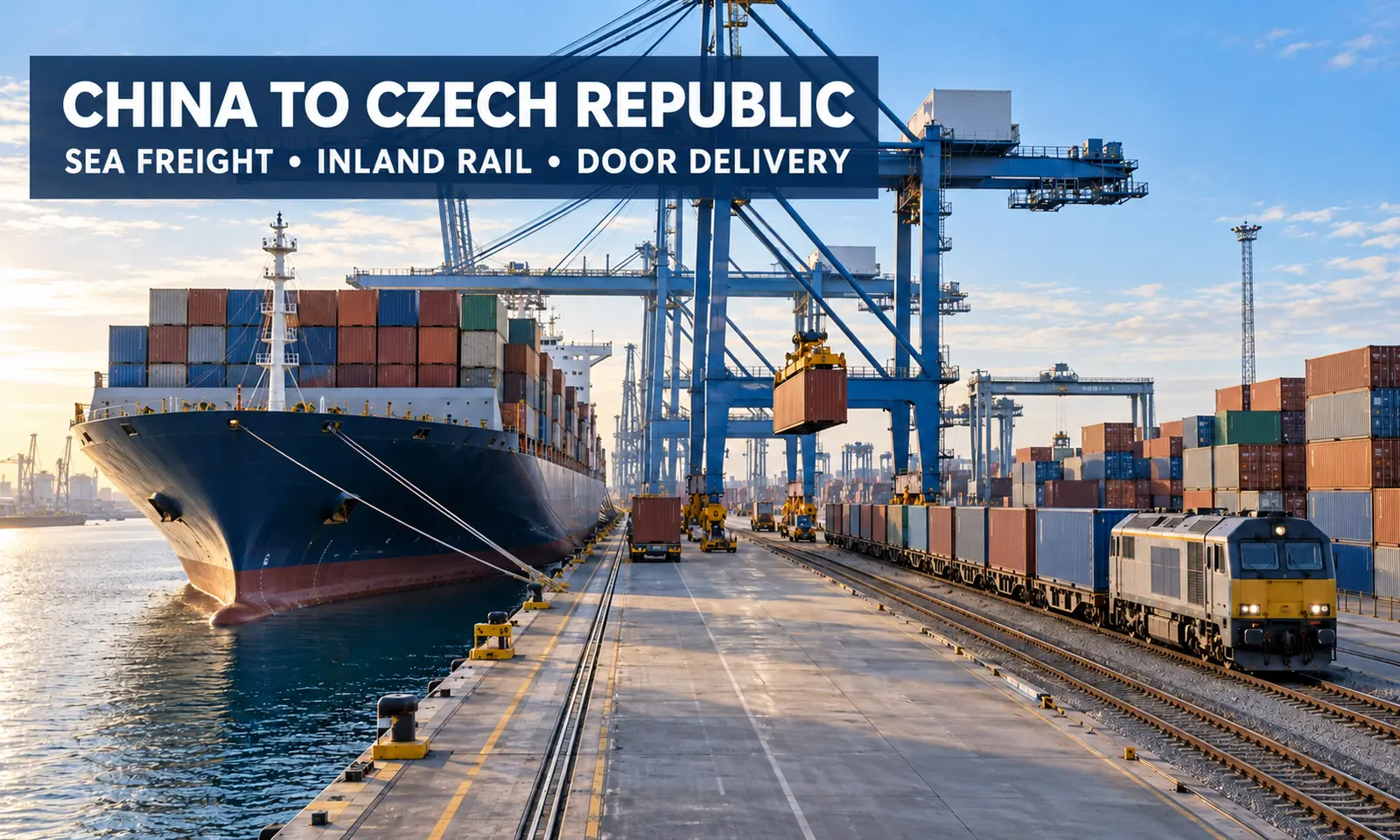
For sea freight, the international leg ends at a European seaport. A practical route might be Shanghai, Ningbo or Shenzhen to Hamburg, Rotterdam or Koper, then rail or truck to a Czech inland terminal or the final receiving address. These are route options, not a statement that every origin has a direct sailing to every gateway. Hamburg has a longstanding Czech hinterland connection; Port of Hamburg’s Prague office describes its role in Czech trade, and METRANS publishes intermodal connections involving Hamburg, Rotterdam and Czech terminals.
When LCL is the useful answer
If a Czech retailer has a few CBM of packaged home goods or spare parts from two Chinese suppliers, the factories can deliver to an agreed China consolidation warehouse, or VoltFreight can review collection. At the consolidation warehouse, the team counts cartons, measures dimensions and weight, then loads the cargo into a shared container. At the European destination CFS, the operator unpacks and releases the LCL goods before Czech delivery. A quoted USD-per-CBM line without a named destination CFS, minimum charge and deconsolidation charge is not a usable delivered-price comparison.
Ask both suppliers for an invoice and packing list describing the actual goods. If the goods have different HS/TARIC classifications, keep the item descriptions, values, quantities and carton references identifiable after consolidation. One generic invoice line such as “accessories” makes import review harder; putting several suppliers’ cartons on one pallet does not erase the need for accurate product-level documentation.
When FCL deserves its own quote
A dedicated 20GP or 40GP may make sense for a full-volume wholesale order, machinery or regular replenishment. FCL can avoid LCL deconsolidation, but the buyer still needs to plan the European port release, customs procedure, inland move, container or empty return, and unloading at the Czech site. For a heavy machine, send the packed size and weight of each crate, not just the total cargo weight. A forwarder may estimate the freight while the factory builds the crates. Use final packed dimensions and lifting details for the booking.
Gateway choice is a total-route decision. Hamburg may pair well with established Czech rail links; Rotterdam or Koper may be suitable on a different sailing and inland schedule. Compare the vessel arrival date, port charges, train or truck connection, customs plan and delivery postcode. A lower ocean rate can lose its advantage if a later arrival or a costly inland leg puts stock into Prague or Ostrava too late.
When Is China–Europe Rail Useful for Czech Importers?
There are two different “rail” segments to distinguish. China–Europe rail freight uses a rail corridor for the main international movement before transfer at a European terminal. Sea plus European rail puts the container on a vessel first and uses a train only after the seaport. They do not share the same transit clock, cost basis or border process.
A Czech industrial parts buyer may need a faster option than ocean freight without paying for air. Ask for a China–Europe rail proposal that names the Chinese origin hub, corridor and European arrival terminal. A rail quote ending at a terminal still needs customs handling and a Czech truck delivery if the factory is not at that terminal. Rail space, transloading, product acceptance and route conditions need checking against the cargo-ready date.
For sea freight arriving at a European port, rail can be an inland option. METRANS lists Prague-Uhříněves as a Czech intermodal hub and publishes other Czech terminal connections. If the consignee is in Brno, Ostrava or a smaller town, the question is not simply “does rail reach Czechia?” but which terminal hands the load to which truck, on what date, and who pays for that final move? For a broader explanation of rail corridors, see our China–Europe rail freight guide.
Should You Use Air Freight, Air DDP or Express?
VoltFreight can quote traditional air freight from a Chinese airport to Prague Airport. Another EU air hub plus a truck may suit the schedule and final address better. Prague Airport describes its cargo terminals, but airport arrival does not mean customs has cleared the goods or a truck has delivered them. If your Czech company uses its own customs broker, request an airport-to-airport quote and separately arrange terminal release, import formalities and collection. If you want delivery to a Czech warehouse, request an explicitly defined door-to-door quote.
Airfreight uses the carrier’s applicable chargeable weight, which may be higher than gross weight for bulky cartons. In the 40-carton calculation above, the shipment weighs 480 kg gross but 800 kg volumetrically using the illustrated 6,000 divisor. Confirm the carrier’s divisor, rounding rule, minimum and weight break rather than multiplying gross weight by an advertised per-kg rate.
Express courier may be sensible for a replacement circuit, product samples or a few urgent cartons. Before booking, confirm parcel eligibility and who pays duty and VAT. Check fuel, remote-area and nonstandard-size surcharges too. The courier quote should name its service, destination coverage and delivery window.
For standalone lithium batteries, do not simply switch to express when a normal air-cargo quote is unavailable. Tell us whether the cells or batteries travel by themselves or with equipment and provide specifications and available UN 38.3 test information before we confirm a permitted carrier and route. The same early review applies to liquids, chemicals, medical-related goods or other products with special transport or import requirements.
What Does DDP Mean for a Czech Business Delivery?
“Door-to-door” tells you where transport starts and ends; it does not by itself say who handles EU import formalities or pays import taxes. Under the ICC’s explanation of DDP and DAP, DDP places import-clearance and duty/tax responsibilities on the seller, while DAP leaves import clearance with the buyer. The sales contract’s named place and the practical ability to perform the import obligations matter. A forwarder coordinating freight does not automatically become the legal importer simply because a quotation says “DDP.”
- If your Czech company wants to import in its own name: provide its EORI, broker arrangement and VAT details. Ask for separate freight, delivery, duty and tax lines. Confirm whether the broker will declare the goods at the first EU entry point or move them under transit to a later clearance point.
- If the seller offers DDP: identify who will actually make the import declaration, the named DDP delivery point, which duties and taxes are included, who supplies product-compliance records and who unloads at the destination. Confirm these points before the cargo leaves China.
- If a quote says “Truck DDP”: ask whether it means a genuine China-to-Europe road movement or simply the Czech delivery truck after a sea, rail or air leg. The mainhaul and its transit-time assumptions must appear in the proposal.
Air DDP: urgent stock and commercial cartons
For eligible electronics, spare parts, samples or urgent e-shop replenishment, ask VoltFreight for a China pickup-to-Czech address proposal. Identify the air arrival airport, clearance arrangement and who pays duty, VAT, airport handling and the last truck leg. Air DDP is a different scope from an airfreight quote ending at Prague Airport.
Sea DDP: larger or heavier deliveries
For home goods, furniture, machinery or wholesale stock, the route normally uses a European seaport followed by Czech inland rail or truck delivery. Tell us whether the final site accepts a container, needs pallets or requires an unloading appointment. Have the quote state the ocean gateway, LCL destination charges or FCL container-return terms, duty and VAT scope, and the final address.
Rail DDP: eligible cargo needing an intermediate timetable
Compare China–Europe rail for stock or industrial parts when sea takes too long and air costs too much. Confirm the origin rail terminal, corridor, EU arrival point, customs procedure and Czech delivery truck; a rail terminal arrival is not a completed door delivery.
Truck DDP: clarify which road movement is being sold
“Truck DDP” alone does not tell you whether the proposal is a China-to-Europe all-road movement or a Czech delivery truck following a sea, rail or air leg. Ask VoltFreight to identify the main route, border or gateway, customs scope, vehicle suitability and final receiving point before confirming price or time.
The EU allows goods to move from an entry point under a customs transit procedure to a later point of clearance. Therefore, “via Hamburg” does not on its own prove that import VAT was accounted for in Germany rather than under another valid arrangement. We must agree the customs route and importer before stating which country’s VAT treatment applies. VoltFreight can coordinate the chosen freight service and document handoff. Record each party’s import responsibilities in the quotation and sales arrangement.
What Must Be Ready for Czech Customs, VAT and Product Compliance?
For a normal Czech commercial import, start with a specific commercial invoice and packing list: seller and buyer, real transaction value and currency, goods described by item, quantity, country of origin as supported by the goods, carton or pallet count, net and gross weights, and the agreed sales term. Add the relevant bill of lading, sea waybill, rail or air transport document when it is issued. A broker may also need power of attorney and product-specific declarations or permits. The responsible importer or declarant needs an EORI; the Czech Customs Administration explains local EORI registration.
There is no reliable blanket rate for “electronics,” “clothes,” “toys” or “machinery.” Czech Customs tells importers to determine the tariff classification first and check TARIC or TARIC-CZ for the applicable duty and import conditions. Product origin, exact construction and any additional trade measure can change the result. A broad product-category percentage found in an online shipping guide cannot determine the landed tax for your specific order.
The Czech standard VAT rate is 21%; a 12% reduced rate applies where the legal conditions for the particular goods or services are met. The Czech public administration portal explains both rates. The European Commission explains that the import-VAT base includes customs value, duties and applicable extra expenses. Relevant transport and insurance may enter that base if the customs value does not already include them. A VAT calculation that ignores separately chargeable transport can understate the amount due.
An illustrative USD 15,000 customs calculation
Illustration only: Assume a particular item of machinery has a verified 2% duty rate, USD 15,000 is its complete customs value for this simplified example, the applicable VAT rate is 21%, and no other charge has to be added to the VAT base. Duty is USD 15,000 × 2% = USD 300. The illustrative VAT base is USD 15,300, giving VAT of USD 15,300 × 21% = USD 3,213. Illustrative duty plus VAT: USD 3,513. The calculation changes if you must add transport, insurance or other costs, or if the actual tariff code carries another rate. This USD example is arithmetic for comparing quotations, not a customs assessment or a general 2% machinery tariff.
Check saleability as well as freight eligibility
Shipping an item into the EU and placing it on the Czech market are related but separate checks. Before committing to a large order of electrical products, toys or machinery, obtain the model details, relevant conformity documents and labeling from the supplier. The Czech Trade Inspection Authority explains importer responsibilities for applicable CE assessment, product identification and Czech-language instructions or safety information where required. Do not assume that a photograph of a CE mark settles whether the documentation matches the exact model. Freight routing cannot fix a product-compliance gap discovered at import or before sale.
How Does Delivery to Prague, Brno or Ostrava Actually Finish?
A Czech destination is more specific than a country name. Prague-Uhříněves or another inland terminal may suit a container. A pallet for Brno, a production machine for Ostrava and e-commerce cartons each need a different final delivery plan. The final quote needs the postcode, site name, address type and receiving contact, not just “Czech Republic.”
Which Czech delivery area and receiving site?
We can plan named-address delivery across Prague and Central Bohemia (including Kladno), Brno and South Moravia, Ostrava and Opava, Plzeň and Karlovy Vary, Liberec and Jablonec nad Nisou, and the Olomouc, Hradec Králové and Pardubice areas. These destination groups help us plan a quote; they are not fixed price zones. The postcode, pallet size, truck access and unloading equipment determine the last leg.
What should happen before the Czech delivery truck arrives?
- Before China pickup: confirm which supplier has the goods, whether several suppliers must be combined, when the cargo is packed, the shipment dimensions and whether the invoice correctly identifies each product.
- Before international booking: choose the port, airport or rail terminal and customs route; check space, cargo acceptance, transport documents and a realistic arrival window. For a machine or battery shipment, complete the packing and product review first.
- Before EU release: the importer and broker should have the EORI, classification, value and compliance documents needed for the agreed declaration. If the goods arrive at an EU port but will be cleared later, document the transit handover.
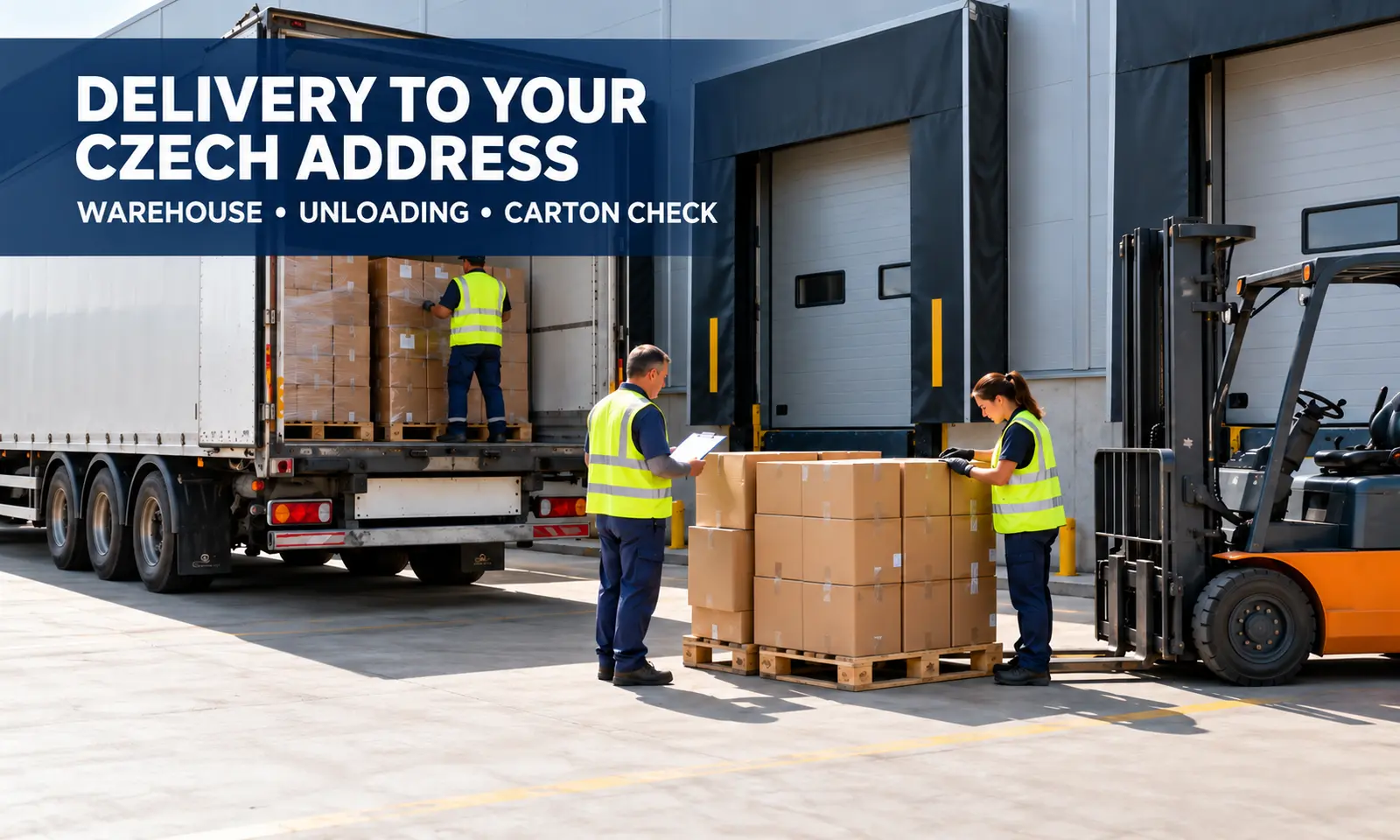
- Before the Czech delivery truck is sent: agree the delivery appointment, pallet count, tail-lift or forklift requirement, vehicle access, unloading responsibility and any container-return timing. This is where a low international freight quote can still become an expensive failed delivery.
For regular e-shop replenishment, tell us whether the Czech warehouse accepts loose cartons, requires pallets or asks for carton-level SKU labels. For industrial equipment, send a packing drawing or photos after crating. Include the heaviest piece’s weight, on-site unloading equipment, vehicle restrictions and delivery hours. These details change the operational plan even when the international route is the same.
What Should You Send VoltFreight for a Comparable Quote?
Send the information below once and ask each provider to state the same Chinese handover point and Czech delivery point. You can request two proposals, such as sea LCL versus rail door delivery, without asking either provider to guess your cargo details.
- Product name and what the item does; model or product photos for batteries, electronics, machinery or regulated goods.
- HS/TARIC code if known, invoice value and currency, supplier invoice and packing list if already prepared.
- Number of cartons, pallets or crates; dimensions and gross weight per package; total CBM and total gross weight if known.
- Chinese supplier city, pickup address or handover port/airport, plus the agreed EXW, FOB, FCA or other sales term and named place.
- Czech destination address and postcode, whether it is a business warehouse or private address, receiving hours and unloading equipment.
- Cargo-ready date, required arrival date, whether part of the order should move faster, and whether the buyer will clear in its own name or needs an agreed DDP solution.
- Where relevant: EORI and broker contact, CE or other product documents, battery chemistry and UN number, UN 38.3 test summary, SDS, and any packaging or loading constraints.
When you receive a quote, ask the forwarder to identify its included origin services, international leg, EU terminal or CFS charges, clearance scope, duty/VAT treatment, Czech inland delivery, excluded events and validity date. A complete quote may exceed a port-only headline rate yet cost less by the time the goods reach your warehouse. VoltFreight can review supplier pickup, consolidation, ocean freight, air freight, door-to-door service and an eligible rail option for your shipment. Send your cargo details for a China-to-Czech Republic quote.
Frequently Asked Questions About China-to-Czech Republic Freight
Can I use the June USD 45/m³ LCL figure to budget delivery to Prague?
No. The June 2026 USD 45/m³ line is an LCL reference, without a confirmed origin pickup or Prague delivery. Ask for the minimum, origin and destination CFS charges, customs handling and final road transport to your postcode.
Does sea freight go directly to a Czech port?
No. The Czech Republic is landlocked. The ocean leg arrives at a European seaport such as Hamburg, Rotterdam or Koper on a suitable service; the shipment then needs an agreed inland rail or truck leg and the appropriate customs arrangement.
My supplier offers FOB Ningbo. What must I still arrange?
Confirm the named FOB port and exactly which export and port charges the supplier covers. Then compare international freight, European arrival charges, import or transit formalities and final Czech delivery. If your supplier’s term is actually EXW, China pickup and export handling need separate attention.
Is a Prague Airport airfreight quote a door-delivery quote?
No. Airport-to-airport freight ends at the airport under its stated terms. If the goods must reach Brno or a Prague warehouse, add airport release, customs clearance and the road leg, or request an agreed door-delivery quote from the start.
Does a Czech company need an EORI even if a freight forwarder files the customs declaration?
The legal importer or declarant arrangement determines whose EORI is needed; hiring a broker does not remove the identification requirement for the relevant economic operator. Confirm the importer’s identity and authorization with the broker before dispatch.
Should a Czech e-shop ship every customer order directly from China?
That is a separate consumer-parcel model. If you are importing replenishment stock for your Czech business, compare a consolidated commercial shipment to your warehouse with the parcel model using the same inventory and delivery goals. The customs, VAT, product-labeling and fulfillment responsibilities must be evaluated for the chosen model; this page focuses on commercial freight into Czechia.
Can VoltFreight quote machinery and standalone batteries?
We can review the cargo and the available routes. For machinery, send the final packed dimensions, weight per crate, lifting and delivery-site information. For batteries, send the exact chemistry and configuration, Wh rating where applicable, UN classification, test information and available transport documents. VoltFreight must confirm carrier acceptance and service availability for the actual goods.
Related routes: If your distribution plan includes neighboring countries as well as Czechia, compare the separate delivery and import arrangements for Poland, Germany and Slovakia. A rate or VAT arrangement for one country is not automatically the same for a Czech delivery.