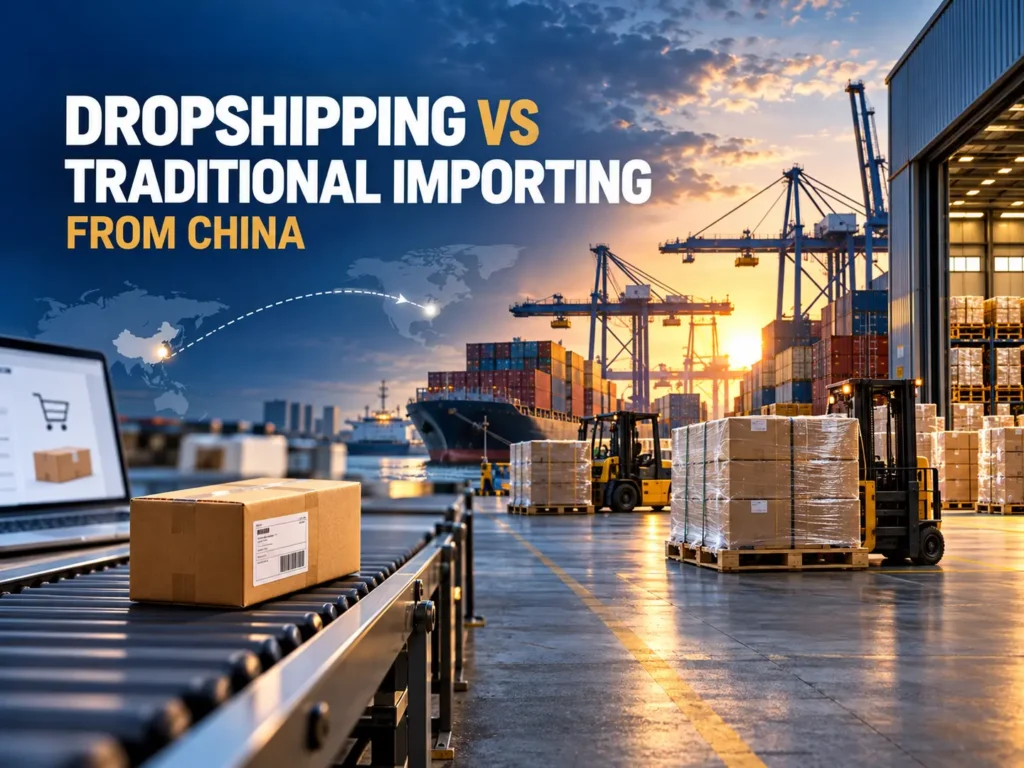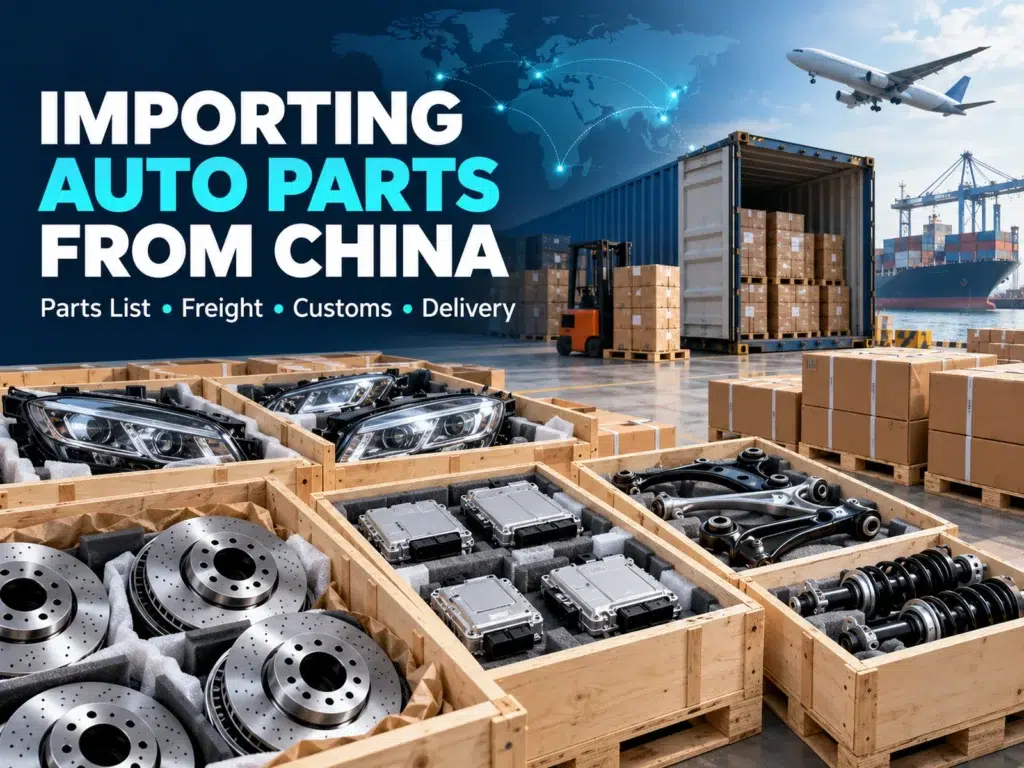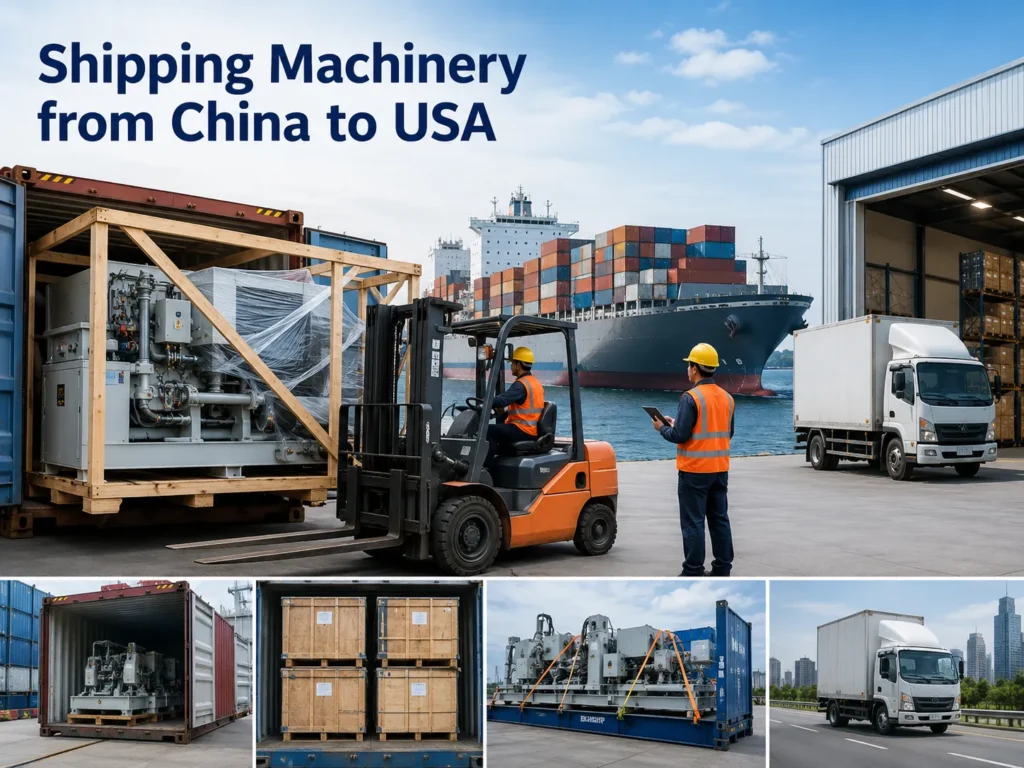
Quick answer: Dropshipping from China is usually better for testing products with limited inventory risk, while traditional bulk importing is usually better for proven products that need lower unit logistics costs, faster local delivery and stronger quality control. Many growing sellers use both: dropship new SKUs, then import stable sellers in bulk.
The right model depends on more than the purchase price. Sellers should compare the complete cost per delivered order, delivery promise, return process, product risk, working capital and level of control required. A freight forwarder can coordinate parts of either model, but the seller and importer still need clearly defined commercial and compliance responsibilities.
Last reviewed: September 2026. Customs requirements, platform policies, carrier acceptance and available delivery services vary by product and destination. Confirm the current requirements before shipping.
What Is Dropshipping from China?
Dropshipping is a retail fulfillment model in which the seller does not purchase and hold the product as inventory before receiving the customer’s order. A supplier or agreed fulfillment partner holds or sources the stock, prepares the order and ships it directly to the customer.
When a seller purchases inventory in advance and stores it in a China warehouse for order-by-order dispatch, the arrangement is better described as China-based fulfillment rather than pure dropshipping. When an order ships directly from China, the seller must still consider customs information, product legality, delivery performance and returns.
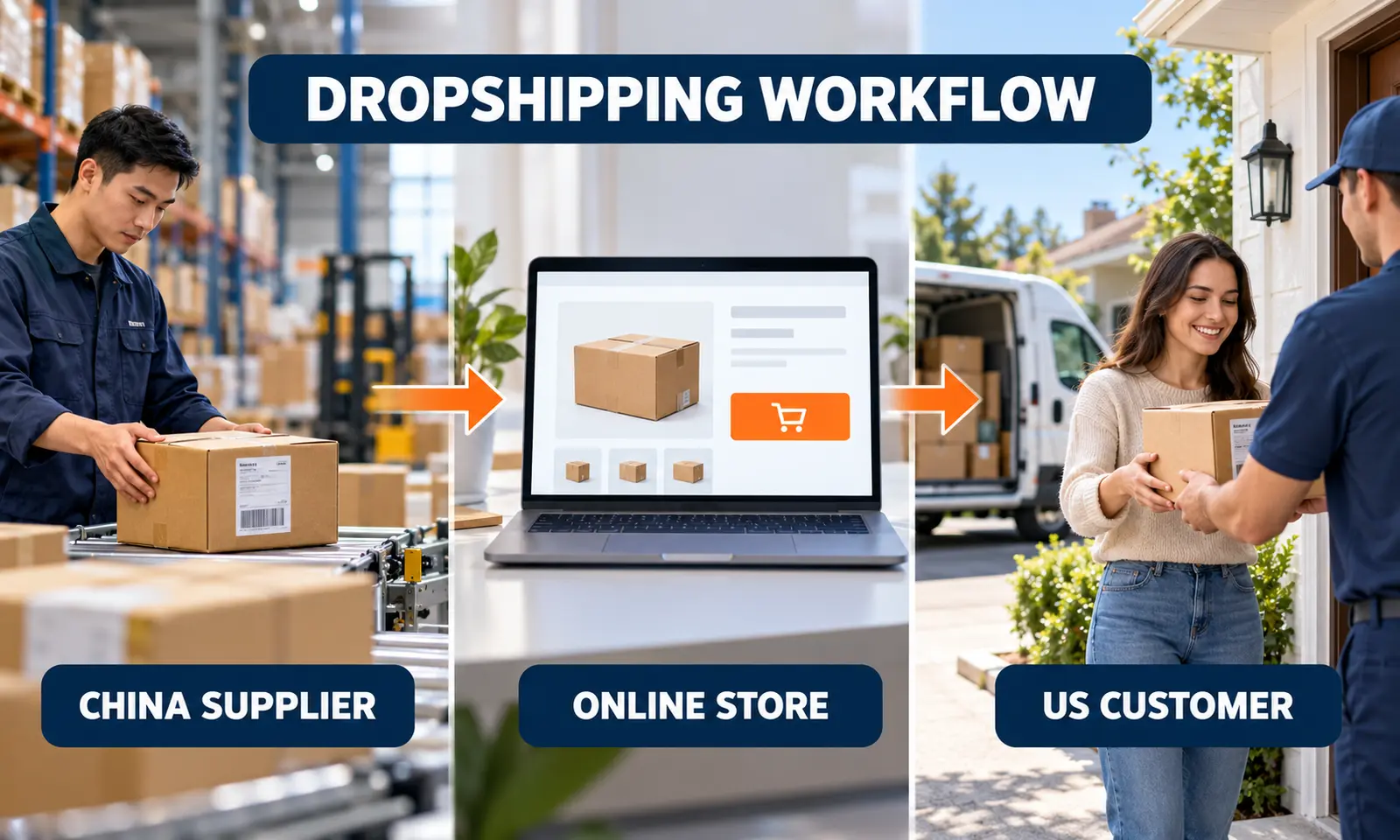
Typical China dropshipping order flow
- The seller lists an approved product and receives a customer order.
- The seller sends the SKU, quantity, address and packing instructions to the supplier or fulfillment partner.
- The supplier or warehouse confirms stock, picks the item and prepares the parcel.
- The parcel moves through an accepted international delivery channel, with customs processing handled according to the service and destination.
- The seller receives tracking information and manages customer communication, delivery exceptions and returns.
Common dropshipping arrangements
- Supplier-direct dropshipping: the supplier packs and dispatches each order. This is simple, but the seller has limited control over packaging, stock accuracy and carrier selection.
- China-based inventory fulfillment: the seller purchases stock in advance and stores it with a China warehouse for order-by-order dispatch. This can resemble dropshipping from the customer’s perspective, but it is not pure no-inventory dropshipping because the seller already owns the stock. Receiving, storage, handling and parcel fees must be included in the margin.
- Hybrid fulfillment: initial orders ship from China, while proven products later move in bulk to a destination-country warehouse or 3PL.
What Is Traditional Bulk Importing from China?
Traditional importing means purchasing a planned quantity of goods and moving that inventory into the destination market before fulfilling individual customer orders. The shipment may move by express courier, air freight, LCL ocean freight or FCL ocean freight. After clearance, a local warehouse, distributor, 3PL or approved fulfillment center holds the stock.
This model requires demand forecasting and more working capital. In return, the buyer gains more control over production, inspection, packaging, freight planning and local delivery.
Typical bulk-import order flow
- The buyer forecasts demand, confirms product specifications and places a purchase order.
- Suppliers manufacture or prepare the agreed quantity.
- The buyer approves the goods and arranges inspection where required.
- The forwarder collects or receives the cargo, confirms final packing data and consolidates compatible supplier orders.
- The appointed parties arrange export, international freight and destination customs preparation.
- After clearance, the inventory moves to a local warehouse for domestic order fulfillment.
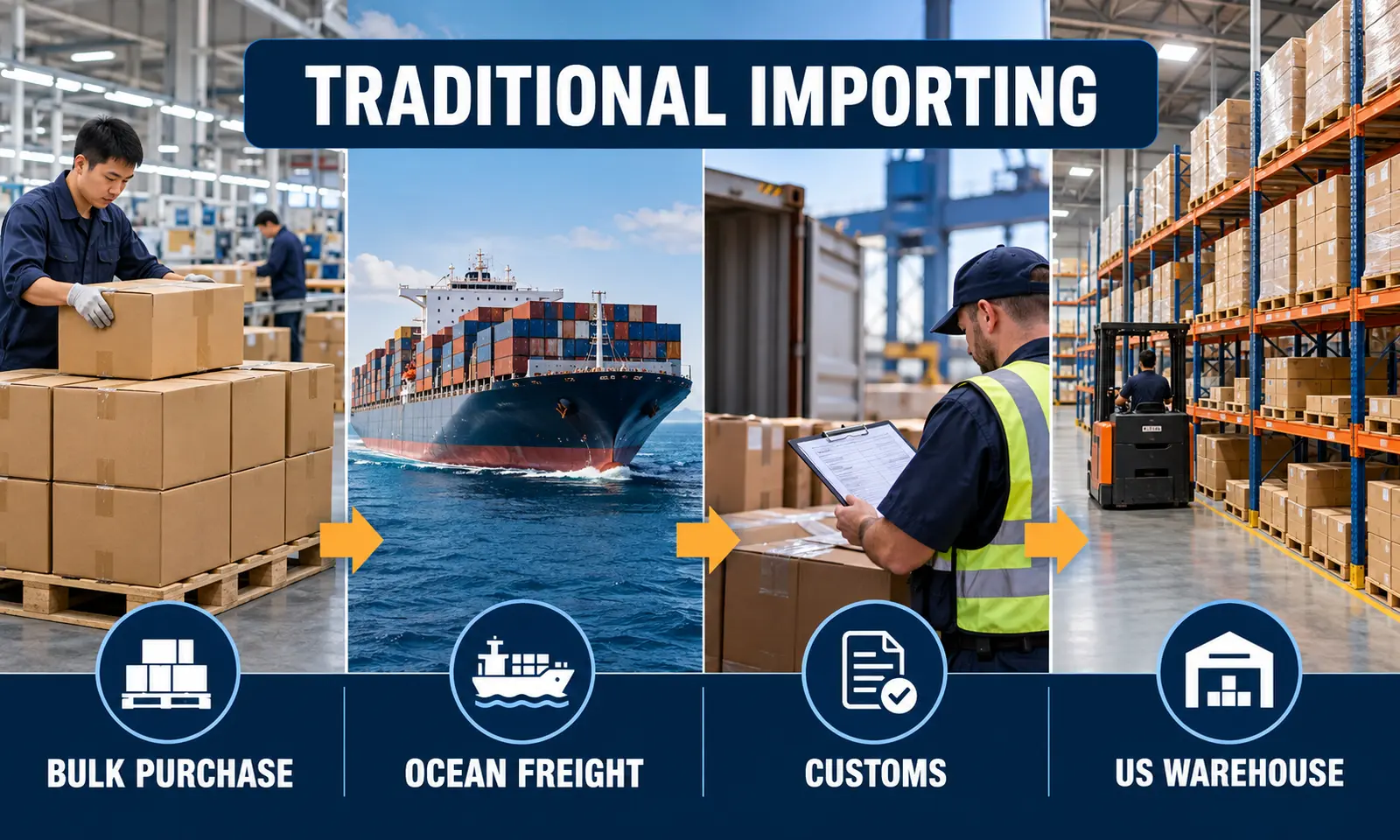
A buyer does not need to perform every logistics task internally. A freight forwarder can coordinate supplier pickup, warehouse receiving, packing data, consolidation, booking and document handoff under the agreed service scope.
Dropshipping vs. Importing from China: What Are the Main Differences?
The main distinction is when the business commits to inventory, where it stores the goods and how each customer order reaches the buyer. The following comparison uses the same commercial objective: delivering a compliant, saleable product to the intended customer.
| Decision factor | Dropshipping from China | Traditional bulk importing |
|---|---|---|
| Inventory commitment | Lower initial commitment; useful when demand remains uncertain. | Inventory is purchased before all units have been sold. |
| International shipping pattern | Individual parcels or small customer-order batches. | Consolidated express, air, LCL or FCL shipments. |
| Logistics cost per unit | Usually higher because each order carries handling and last-mile costs. | Usually lower when fixed costs are spread across more saleable units. |
| Delivery experience | Each customer waits for an international delivery. | Longer replenishment lead time, followed by faster local fulfillment. |
| Quality control | Checks may happen order by order or through warehouse sampling. | The buyer can inspect a completed production batch before export. |
| Packaging control | Depends on the supplier, warehouse instructions and parcel channel. | Greater control over retail packaging, cartons, pallets and labels. |
| Returns | International returns can be slow or uneconomical without a local solution. | A destination warehouse can receive and inspect returns locally. |
| Main commercial risk | High delivery cost per order, inconsistent fulfillment and weaker control. | Cash tied up in inventory and the possibility of unsold stock. |
| Best fit | Product testing, uncertain demand and wide catalogs with low-volume SKUs. | Stable sellers, recurring demand, wholesale orders and products that need local stock. |
How Do Dropshipping and Bulk Importing Costs Compare?
Dropshipping is not automatically the cheaper model. It usually reduces the amount of cash committed to inventory, but it can increase the logistics cost attached to every completed order. Traditional importing requires more money before sales occur, yet it may reduce the product and freight cost per unit.
Dropshipping cost per completed order
Dropshipping cost per order = product cost + China receiving or sourcing fee + pick-and-pack + packaging + international parcel freight + applicable duty and tax + payment or platform fees + expected return or reshipment cost.
A parcel quotation is incomplete if it excludes the charges that regularly affect the order. Check fuel adjustments, remote-area delivery, address correction, customs handling, tax collection, signature services and the process for failed delivery or return.
Traditional importing landed cost per unit
Bulk landed cost per unit = product value + China pickup and consolidation + inspection and export packing + export handling + international freight + insurance + destination charges + duty and taxes + customs brokerage + warehouse delivery, divided by the saleable units received.
Domestic storage, pick-and-pack, returns and final-mile delivery still belong in the complete fulfillment calculation. A shipment is not financially complete merely because it has reached the destination port.
Compare both models at the same endpoint
Do not compare a door-to-door dropshipping parcel with an LCL quotation that ends at a port. One includes final delivery while the other may leave customs, destination handling and inland transport unpaid. Compare the expected cost to the same customer or warehouse endpoint and under the same responsibility scope.
For bulk cargo, compare suitable air freight from China and ocean freight from China options when the deadline allows. Growing importers should also compare repeated LCL shipments with the point at which FCL becomes operationally and financially more practical.
Which Model Fits Your Products and Sales Stage?
No single model fits every SKU. A seller can use dropshipping for one product and bulk importing for another, even when both come from the same supplier.
Dropshipping is usually more suitable when:
- The product is new and demand has not been proven.
- The catalog contains many variations with low sales per SKU.
- The product is compact enough to support an acceptable parcel-delivery cost.
- The seller cannot yet justify a large inventory commitment.
- The supplier or warehouse can follow consistent packing and dispatch instructions.
- Customers accept a realistic international delivery window.
The main advantage is flexibility. The seller can test demand without filling a local warehouse. The main weakness is that every customer order depends on international fulfillment. Slow tracking, failed delivery, poor packaging or an expensive return can remove the margin from an otherwise attractive product.
Traditional bulk importing is usually more suitable when:
- The product has stable sales and a measurable replenishment pattern.
- Customers expect fast domestic delivery.
- The product is heavy, bulky or expensive to send as an individual parcel.
- The buyer needs consistent branding, packaging or batch-level inspection.
- Wholesale customers, installers or distributors require local stock.
- The business can fund a sensible reorder quantity without creating excessive inventory risk.
Bulk importing gives the seller more control, but that control requires planning. The buyer must align production, inspection, cargo-ready dates, freight booking, customs preparation and warehouse capacity. A low factory price does not justify a large order when the seller lacks reliable sales data.
When Should You Switch from Dropshipping to Bulk Importing?
The decision does not need to be permanent or apply to the entire catalog. Many growing sellers use dropshipping to validate demand, then move proven products into local inventory.
Signals that a SKU may be ready for bulk importing
- Sales have remained stable across several ordering cycles.
- International parcel freight consumes too much of the gross margin.
- Customers increasingly expect faster and more predictable delivery.
- The supplier can reproduce the approved product and packaging consistently.
- The seller understands the main return reasons and expected return rate.
- Sales data supports a realistic reorder point and safety-stock level.
- A local warehouse or 3PL can receive, store and fulfill the product.
A practical hybrid transition
- Test: fulfill initial orders from China and record the real delivery, return and customer-service cost.
- Measure: identify products with repeat sales, acceptable margins and stable supplier performance.
- Import: move proven SKUs in a consolidated air or ocean shipment to a destination warehouse.
- Keep testing: continue dropshipping new products and low-volume variations.
- Rebalance: review sales velocity and move SKUs into or out of local inventory when the data changes.
Do not switch merely because a factory offers a lower unit price at a high MOQ. The expected sales velocity, storage cost, cash-flow effect and risk of obsolete inventory must support the larger purchase.
How Can a Freight Forwarder Support Either Model?
A freight forwarder can coordinate the movement and preparation of accepted cargo, but the exact service must be agreed before goods reach the warehouse. Traditional freight forwarding does not automatically include an ecommerce fulfillment system, unlimited storage, customer-service work or international returns.
Support for dropshipping or small-order fulfillment
Depending on the product, order volume, destination and warehouse arrangement, China-side support may include supplier pickup, warehouse receiving, carton checks, labeling, repacking, consolidation and access to a suitable parcel or express channel. Order-by-order picking, SKU storage and tracking-data exchange require a specifically confirmed fulfillment scope.
This distinction matters when several factories supply the same store. A China warehouse can provide one receiving point and may consolidate products from multiple suppliers, but the seller must still provide clear SKU references, order data, stock instructions and packing rules.
Support for traditional bulk importing
For bulk shipments, a forwarder may coordinate EXW pickup, supplier communication, warehouse receiving, final measurement, consolidation, export packing, booking and transport-document handoff. The shipping plan can compare express, air, LCL and FCL according to the finished cargo, destination and required delivery window.
After booking, the destination scope may include broker coordination and final delivery when these services appear in the quotation. Port-to-port freight does not automatically include customs clearance, duty, destination handling or delivery to the final warehouse.
Who provides the shipping and customs information?
The supplier and buyer should provide supported product descriptions, quantities, values, origin and commercial information. A receiving warehouse can confirm the final cartons, dimensions and gross weight. The forwarder can use the confirmed data for booking and agreed export coordination. At destination, the importer and appointed broker must review the information required for the import entry.
The service provider should not invent a product description, value, origin or compliance status. Before dispatch, the parties should agree on the Incoterm, named place, customs responsibility, delivery endpoint and charges included in the quotation.
What Customs and Compliance Responsibilities Remain in Both Models?
Dropshipping and bulk importing use different inventory flows, but neither model removes the need for lawful products and accurate commercial information. The seller should confirm the specific product name, material, function, model, quantity, value and origin instead of relying on vague descriptions such as “accessories,” “samples” or “gift.”
Products containing batteries, liquids, powders, aerosols, magnets, wireless functions or other sensitive components may require additional carrier review or documents. Branded products may require evidence of authentic sourcing and resale rights. These checks should happen before the seller promises a delivery method or purchases a large quantity.
Marketplace policy and customs compliance are separate. A shipment may clear customs and still breach a platform’s seller, packaging, authenticity or delivery-performance rules. For example, sellers using Amazon should review its current dropshipping guidance before asking a third party to fulfill orders.
DDP or another door-to-door arrangement also does not make a restricted, unsafe, counterfeit or incorrectly labeled product compliant. The parties must identify the seller, importer of record and other responsible entities where applicable. Those roles should be clear before the first order ships.
Conclusion: Dropshipping, Bulk Importing or Both?
Dropshipping from China is useful when a seller needs to test demand and limit initial inventory exposure. Traditional bulk importing becomes more attractive when a product has stable sales, parcel freight is reducing the margin and customers expect faster local delivery. Neither method is universally better.
For many growing businesses, a hybrid model offers the most practical path. Keep uncertain products in controlled China fulfillment, then import proven SKUs in bulk when the sales data, working capital and warehouse plan support the change.
Frequently Asked Questions
Which is cheaper: dropshipping from China or bulk importing?
Dropshipping normally requires less cash at the beginning because the seller does not purchase a large inventory before testing demand. However, parcel freight, pick-and-pack, returns and reshipments can make the logistics cost per unit higher. Bulk importing requires more upfront capital but often lowers unit freight cost when demand is stable. Compare the complete cost at the same delivery endpoint.
When should a seller switch from dropshipping to bulk importing?
Consider bulk importing when a SKU has maintained stable sales, international parcel freight is reducing the margin, customers expect faster delivery and the supplier can reproduce the approved product consistently. The business should also have enough working capital, demand data and warehouse capacity to order a reasonable quantity without creating excessive unsold inventory.
Can a freight forwarder support both dropshipping and traditional importing?
Yes, but the service scope differs. For accepted cargo, a freight forwarder may coordinate supplier pickup, China warehouse receiving, consolidation, labeling and suitable parcel or bulk freight options. Order-by-order fulfillment, SKU storage and returns require separate confirmation. The forwarder does not automatically become the seller, importer of record or party responsible for product compliance.
Not sure whether to keep shipping individual orders or move a proven product in bulk? VoltFreight is most relevant when you need supplier pickup, China warehouse receiving, multi-supplier consolidation or a bulk air or ocean freight plan for proven SKUs. If you need order-by-order fulfillment from China, send us your SKU count, expected daily or monthly order volume, parcel weight and dimensions, main destination countries, required warehouse services and any order-data integration requirements. Contact us through our contact page so our team can confirm the available service scope and freight options for your shipment plan.