LCL sea freight from China is usually most practical for general commercial cargo of approximately 1–8 CBM. Shipments around 8–15 CBM should also be compared with FCL, while very small cargo may work better by air freight or courier.
LCL transit normally takes several weeks, depending on the origin port, destination, sailing schedule, transshipment, customs clearance and final delivery. The complete cost may include China pickup, CFS handling, ocean freight, destination deconsolidation, customs charges and inland delivery.
Importers should pay particular attention to minimum charges, destination CFS fees, W/M calculations and non-stackable cargo. A low ocean rate does not always produce the lowest landed cost.
This guide explains how LCL shipping from China works, how chargeable volume is calculated, when LCL is better than FCL and what information is required for an accurate quotation.
For a broader comparison of container shipping options, read our complete guide to sea freight from China.
Quick Answer: What Is LCL Shipping from China?
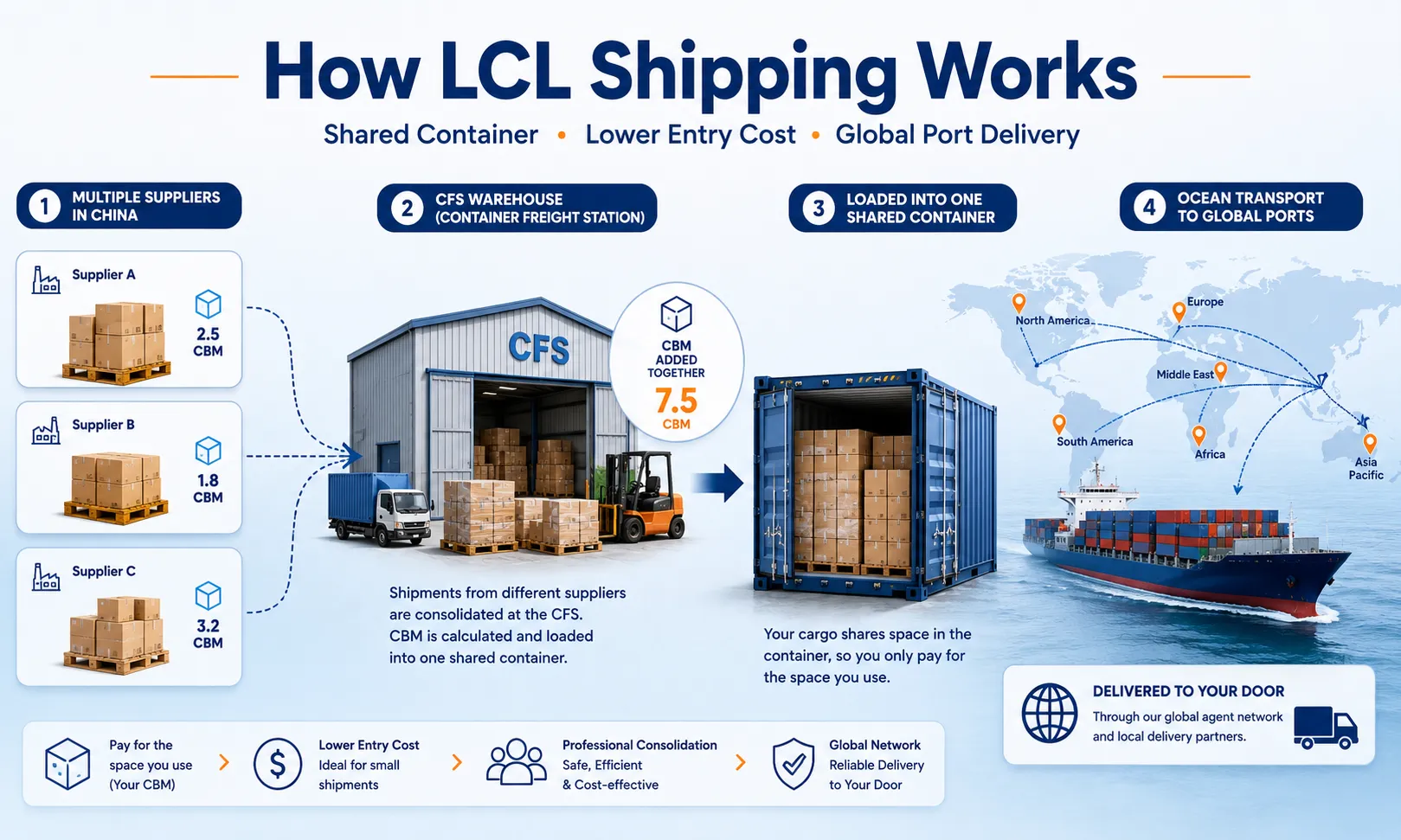
LCL means Less than Container Load. Several importers place their cargo inside one shared ocean container instead of each importer booking a complete container.
Each shipment is identified by its own shipping marks, documents and house bill of lading. At the destination, the shared container is unpacked at a CFS warehouse, and each shipment is released separately.
LCL usually works well when:
- The cargo does not fill a complete container.
- The shipment is too large for economical express or air freight.
- The importer wants to ship smaller orders more frequently.
- Goods from several suppliers need to be combined.
- The buyer is testing a new supplier or product.
- The cargo is general, stackable and packed in strong cartons.
Nevertheless, LCL involves more handling than FCL. The cargo passes through origin receiving, measurement, consolidation, container loading, destination deconsolidation and final release.
As a result, packaging quality, shipping marks and accurate documents are especially important.
How LCL Sea Freight from China Works
A typical LCL shipment involves several coordinated warehouse, customs and transportation stages.
Supplier Pickup or Warehouse Delivery
First, the Chinese supplier completes production and packing. Depending on the Incoterm, the supplier may deliver the goods to the forwarder’s CFS warehouse, or the freight forwarder may arrange factory pickup.
Before collection, the forwarder normally confirms:
- Supplier name and pickup address
- Cargo-ready date
- Carton, pallet or crate quantity
- Gross weight
- Package dimensions
- Product name
- Shipping marks
- Whether the cargo is stackable
China CFS Receiving
After the cargo reaches the China CFS warehouse, the warehouse team checks the package quantity, visible packaging condition, dimensions, gross weight and shipping marks.
Supplier estimates are not always accurate. Therefore, the final measured CBM may differ from the original packing list and may change the freight quotation.
The warehouse may also take receiving photos, reinforce weak cartons, apply labels or prepare pallets when these services are agreed in advance.
Measurement and Consolidation
Next, the forwarder calculates the shipment volume and weight. Suitable cargo is then grouped with other shipments moving to the same destination CFS or regional consolidation hub.
The consolidator prepares the loading plan according to:
- Destination route
- Cargo dimensions
- Weight distribution
- Stackability
- Packaging strength
- Special handling requirements
Export Customs and Container Loading
The export team prepares the booking and China customs-declaration information. Afterward, the CFS warehouse loads several compatible shipments into one container.
Cargo that is hazardous, leaking, poorly packed or incorrectly declared may be rejected before loading. Consequently, special cargo should be reviewed before it reaches the warehouse.
Ocean Freight and Destination Deconsolidation
Once loaded, the shared container moves by vessel to the destination port. The route may be direct or may involve transshipment through another port.
After arrival, the container usually moves to a destination CFS warehouse. The warehouse then unpacks the container and separates each house shipment.
Customs Clearance and Final Delivery
The importer or customs broker completes customs clearance using the commercial invoice, packing list, HS code, bill of lading and other required documents.
After customs and warehouse release, the cargo can be collected or delivered to a warehouse, business address, Amazon facility or another final destination.
How LCL Shipping Costs Are Calculated
LCL shipping cost from China is usually affected by cargo volume, gross weight, origin CFS, destination CFS, shipping route and service scope.
Port-to-port LCL freight commonly uses a weight-or-measurement calculation, often shown as W/M. However, the exact calculation and minimum charge depend on the consolidator, route and destination agent.
CBM Calculation
CBM means cubic meter. It measures the space occupied by the cargo.
The standard calculation is:
Length × Width × Height × Number of Packages = Total Volume
When measurements are provided in centimeters, divide the result by 1,000,000 to convert it into cubic meters.
For example:
60 cm × 50 cm × 40 cm × 10 cartons ÷ 1,000,000 = 1.2 CBM
Carton dimensions should include the outer packaging. Moreover, pallets, wooden cases and protective frames increase the final volume.
W/M and Revenue Ton
W/M means weight or measurement. On many traditional LCL routes, the forwarder compares:
- 1 CBM of volume
- 1,000 kg of gross weight
The higher result becomes the chargeable revenue ton.
For example, a shipment of 3 CBM and 800 kg may be charged as 3 revenue tons because the volume is higher.
Meanwhile, a shipment of 1.5 CBM and 2,000 kg may be charged as 2 revenue tons because the weight is higher.
However, not every route uses the same conversion. Door-to-door consolidated services may use another chargeable-weight formula. Therefore, the quotation should state the exact calculation method.
Minimum LCL Charges
Very small shipments may be subject to minimum freight, CFS or documentation charges.
For example, a shipment measuring only 0.3 CBM may still be billed at a one-CBM minimum or another minimum amount, depending on the route.
Consequently, cargo below one CBM should also be compared with air freight or express courier.
How Non-Stackable Cargo Changes the Cost
Non-stackable cargo may occupy more space than its physical CBM because other goods cannot be placed above it.
This commonly applies to:
- Fragile machinery
- Open-top pallets
- Unprotected furniture
- Irregular equipment
- Cargo with “Do Not Stack” requirements
Therefore, importers should disclose non-stackable cargo before booking and provide photos, package dimensions and top-load restrictions.
| Shipment Example | Physical Volume | Gross Weight | Possible Chargeable Unit |
|---|---|---|---|
| General cartons | 3 CBM | 800 kg | 3 revenue tons because volume is higher |
| Dense machinery parts | 1.5 CBM | 2,000 kg | 2 revenue tons because weight is higher |
| Very small shipment | 0.4 CBM | 120 kg | May be subject to a minimum charge |
| Non-stackable pallet | 2 CBM physical volume | 500 kg | May be charged according to occupied space or route-specific rules |
Important: These examples explain common calculation logic only. The final W/M rule, density conversion and minimum charge must be confirmed for the actual route.
LCL Origin, Ocean and Destination Charges
A complete LCL quote should show more than the basic ocean rate. Importers should compare the cost from the Chinese supplier to the final delivery address.
China Pickup and Origin Charges
China-side costs may include:
- Factory pickup
- Domestic trucking
- Warehouse receiving
- Carton counting
- Weight and dimension measurement
- Temporary storage
- Repacking or palletization
- CFS handling
- Export customs declaration
- Documentation
EXW and FOB shipments do not include the same origin scope. Therefore, confirm the supplier Incoterm before comparing quotations.
Ocean Freight Charges
The ocean section may include the LCL freight rate and carrier-related surcharges.
Rates can change according to:
- Origin and destination ports
- Direct or transshipment service
- Consolidator capacity
- Sailing frequency
- Fuel-related surcharges
- Peak-season demand
- Rate validity
Because rates may change by sailing week, the quotation should state its validity period.
Destination CFS and Release Charges
Destination charges are one of the most important parts of an LCL shipment.
Possible fees include:
- Deconsolidation
- Destination CFS handling
- Documentation
- Delivery order
- Warehouse release
- Port-security charges
- Storage
A very low ocean freight rate may be paired with high destination charges. As a result, importers should ask how the destination agent charges before confirming the booking.
Customs and Inspection Charges
The importer may also need to pay:
- Customs-broker fees
- Import duty
- VAT, GST or other taxes
- Customs examination
- Permit or certificate fees
- Document-amendment charges
Customs charges depend on the destination country, HS code, customs value and product requirements.
Final Delivery Charges
Door-delivery costs depend on:
- Distance from the destination CFS
- Cargo dimensions and weight
- Delivery postcode
- Commercial or residential address
- Delivery appointment
- Tail-lift requirements
- Forklift availability
- Remote-area surcharges
Therefore, a complete postcode and address type are required for an accurate door-to-door quote.
LCL vs FCL: When Should You Use a Full Container?
The choice between LCL and FCL should not depend on CBM alone. Cargo value, weight, packaging, destination charges and handling risks also matter.
Below 1 CBM
For cargo below one CBM, compare LCL with air freight and express courier. Minimum LCL and destination charges can make sea freight inefficient for very small shipments.
About 1–8 CBM
LCL normally works well for general commercial cargo in this range. The importer can access ocean freight without paying for an entire container.
About 8–15 CBM
At this volume, compare the complete LCL and FCL costs carefully.
LCL may still work, especially on competitive routes. However, destination deconsolidation and handling charges may make a 20ft container more attractive.
About 15 CBM or More
FCL should normally be reviewed first. Nevertheless, the correct choice still depends on container rates, cargo weight, destination charges and loading efficiency.
Heavy Cargo
Dense machinery parts, metal goods, tiles and similar products may be charged by weight ton. In addition, warehouse and road-weight restrictions may affect the route.
Fragile or High-Value Cargo
FCL may be safer for fragile, high-value or easily damaged cargo because it generally involves fewer handling stages.
Non-Stackable Cargo
Non-stackable cargo can use more shared-container space than its measured CBM. Therefore, FCL may become attractive earlier than expected.
High Destination CFS Charges
Some destinations have high LCL deconsolidation and handling fees. Consequently, a full container may provide a better total cost even before the cargo reaches the usual FCL volume threshold.
Multiple-Supplier Consolidation in China
Many importers buy products from several Chinese factories. Shipping each order separately can create repeated pickup, documentation, warehouse and destination charges.
VoltFreight can receive goods from multiple suppliers and combine suitable cargo into one LCL shipment.
How Supplier Consolidation Works
- Each supplier receives a warehouse address and shipping mark.
- The suppliers deliver the cargo, or VoltFreight arranges pickup.
- The warehouse records each supplier shipment separately.
- Cartons are counted, measured and photographed.
- The importer confirms that all orders have arrived.
- Compatible cargo is combined into one export shipment.
- One consolidated packing plan and shipping-document set is prepared.
Why Shipping Marks Matter
Every carton or pallet should carry the correct shipping mark. Otherwise, the warehouse may not be able to identify the customer, supplier or purchase order.
Clear shipping marks also reduce the risk of cartons being mixed during receiving and consolidation.
Customs Compatibility
Products from different suppliers can often share one shipment. However, they must be compatible with the same carrier route and destination customs process.
For example, general cargo should not be combined blindly with undeclared batteries, chemicals, liquids or restricted products.
When Consolidation May Not Reduce Cost
Consolidation is not automatically cheaper in every case.
Costs may increase when:
- Suppliers are located far from each other.
- Some cargo needs special warehouse handling.
- Orders become ready at very different times.
- Long storage is required.
- Products cannot use the same route.
Therefore, the forwarder should compare the total pickup, warehouse and shipping plan before confirming consolidation.
Packaging and Cargo Protection for LCL Shipments
LCL cargo passes through more handling stages than FCL. Strong packaging therefore helps reduce damage, lost labels and warehouse disputes.
Use Strong Export Cartons
Cartons should be dry, rigid and suitable for long-distance ocean transportation. Soft, crushed or reused cartons may fail during consolidation or destination handling.
Use Pallets When Appropriate
Pallets can help protect heavy, fragile or mixed cartons. However, palletizing normally increases CBM.
Therefore, compare the additional packaging volume with the handling benefit before using pallets.
Protect Against Moisture
Ocean freight can involve humidity and temperature changes. Waterproof wrapping, moisture barriers and desiccants may help protect sensitive goods.
Label Every Package
Each carton, pallet or crate should carry the required shipping mark. Moreover, old or conflicting labels should be removed or covered.
Declare Non-Stackable Cargo
If nothing can be placed above the goods, tell the forwarder before quotation. Do not rely only on a “Do Not Stack” label after the cargo reaches the warehouse.
Check Wood-Packaging Requirements
Solid wood pallets, cases and supports may require appropriate treatment and marking under destination-country biosecurity rules.
LCL Transit Time from China
LCL transit time from China includes more than the vessel voyage.
Origin Processing Time
Before departure, time may be required for:
- Supplier pickup
- Warehouse receiving
- Cargo measurement
- Export documentation
- Consolidation
- CFS cutoff
- Container loading
Ocean Transit Time
Ocean transit depends on the origin port, destination port, shipping line and direct or transshipment route.
Nearby Asian routes may take several days, while routes to Europe, North America, Africa, Oceania or Latin America may take several weeks.
Destination Processing Time
After arrival, additional time is needed for:
- Container discharge
- Transfer to the destination CFS
- Deconsolidation
- Customs clearance
- Warehouse release
- Final delivery
Why LCL Can Take Longer Than FCL
LCL cargo must wait for consolidation before departure and deconsolidation after arrival. Therefore, it may take longer than FCL even when both shipments use the same vessel.
Common Delay Risks
Possible delays include:
- Supplier production delays
- Missing shipping marks
- Incorrect cargo measurements
- Missed CFS cutoff
- Customs-document errors
- Vessel rollover
- Transshipment delays
- Port congestion
- Customs inspection
- Late cargo collection
Port-to-Port and Door-to-Door LCL Shipping
LCL shipping can be arranged under different service scopes. Therefore, the importer should confirm where the forwarder’s responsibility begins and ends.
Port-to-Port or CFS-to-CFS
This service covers the main ocean movement between the origin and destination facilities.
The importer normally handles destination charges, customs clearance, cargo release and final delivery.
Door-to-Port
Door-to-port service adds China supplier pickup and origin handling before the international shipment.
However, the importer still manages destination customs and local delivery.
Port-to-Door
Port-to-door service combines ocean transportation with delivery after arrival.
The quotation should clarify whether customs brokerage, duties and taxes remain the importer’s responsibility.
Door-to-Door LCL
Door-to-door service may include supplier pickup, China warehouse handling, ocean freight, destination coordination and final delivery.
This option reduces the number of providers the importer must manage. Nevertheless, the inclusions and exclusions should be listed in writing.
Reviewed DDP LCL
DDP LCL may include a wider customs and tax scope for suitable cargo and destinations.
Before confirmation, the forwarder should review:
- Product name
- HS code
- Commercial value
- Importer requirements
- Duty and tax treatment
- Product permits
- Final delivery address
For more information, review our door-to-door shipping from China service.
Documents Required for LCL Shipping
LCL documents should match the actual cargo and warehouse measurements.
Commercial Invoice
The invoice should show:
- Seller and buyer
- Detailed product description
- Quantity
- Unit price
- Total value
- Currency
- Country of origin
- Incoterm
Packing List
The packing list should show carton or pallet quantity, gross weight, net weight, dimensions and shipping marks.
If the final warehouse measurements differ significantly, the packing list may need to be updated.
House Bill of Lading
Because LCL cargo shares a master container, the forwarder normally issues a house bill of lading for the individual shipment.
The importer should check the shipper, consignee, notify party, cargo description, package quantity and release method before departure.
HS Code and Additional Documents
Depending on the product, additional documents may include:
- Certificate of Origin
- Import permit
- MSDS
- UN38.3 report
- Product certificate
- ISPM 15 documentation
- Brand authorization
For document planning, visit our customs clearance support page.
When LCL May Not Be the Best Option
LCL is flexible, but it does not suit every shipment.
Urgent Cargo
Samples, replacement parts and stockout inventory may arrive faster by air freight from China or express courier.
Large Shipments
When cargo volume grows, FCL may provide a lower unit cost and fewer handling stages.
Fragile Cargo
Glass, ceramics, stone, fragile furniture and sensitive equipment may require wooden cases, pallets or a complete container.
High-Value Cargo
High-value goods may need stronger security, reduced handling and additional insurance planning.
Oversized Cargo
Cargo that cannot fit normal CFS handling equipment may require FCL, Open Top, Flat Rack or another project-cargo solution.
Dangerous or Restricted Cargo
Batteries, chemicals, liquids, powders and hazardous goods require carrier and consolidator approval. Some LCL services do not accept these products.
Non-Stackable Cargo
If the cargo occupies a large amount of unusable space above the package, the chargeable volume may make FCL more economical.
Worked Example: 6.5 CBM from Three Chinese Suppliers
The following example explains route planning only. It is not a live freight quotation.
Assume an importer purchases:
- 2 CBM of electronics accessories from Shenzhen
- 3 CBM of display furniture from Foshan
- 1.5 CBM of packaging products from Yiwu
The combined estimated volume is 6.5 CBM.
Option One: Ship Each Order Separately
Each supplier could send an individual shipment. However, this may create three pickup arrangements, three minimum freight charges, several documentation fees and repeated destination handling.
Option Two: Consolidate in One China Warehouse
The importer could ask the suppliers to deliver to one consolidation warehouse, or VoltFreight could arrange pickup.
The warehouse would:
- Record each supplier shipment.
- Check the shipping marks.
- Measure the final carton dimensions.
- Confirm the combined CBM.
- Check whether the cargo can use the same route.
- Prepare one consolidated LCL shipment.
Issues to Check
The furniture may be fragile or non-stackable. In addition, the Yiwu pickup cost may be higher if the selected consolidation warehouse is in South China.
Therefore, the forwarder should compare:
- Pickup costs from all three suppliers
- Warehouse location
- Final measured CBM
- Non-stackable space
- LCL destination charges
- Whether FCL becomes practical after all orders are combined
This example shows why supplier consolidation should be based on the complete route rather than the ocean freight rate alone.
Where Can You Ship LCL Cargo from China?
LCL services from China are available to many destinations in North America, Europe, the United Kingdom, Australia, New Zealand, the Middle East, Africa, Latin America and Asia.
Mexico-bound importers can compare destination cities, CBM, customs responsibility and last-mile delivery in our China-to-Mexico LCL and sea shipping guide.
However, not every China CFS provides direct consolidation to every overseas port. Some routes use transshipment hubs or regional feeder services.
For Middle East shipments, importers can review our shipping from China to Bahrain route for LCL, FCL, air freight and door-delivery planning through Bahrain.
Cargo moving through Beirut or requiring inland delivery can also be planned through our shipping from China to Lebanon service, subject to current port, customs and final-delivery conditions.
The best destination port depends on:
- Final delivery city
- Destination CFS charges
- Customs-broker location
- Inland delivery cost
- Sailing frequency
- Direct or transshipment service
For country-specific routing, customs and delivery information, visit the VoltFreight shipping region page.
What We Need for an LCL Freight Quote
Complete cargo information helps the forwarder calculate the correct CBM, route and service scope.
Please provide:
- Product name and detailed description
- Product photos
- HS code if available
- Supplier city and pickup address
- Destination port or complete delivery postcode
- Carton, pallet or crate quantity
- Dimensions of each package type
- Total gross weight
- Estimated total CBM
- Cargo-ready date
- Supplier Incoterm, such as EXW or FOB
- Commercial value
- Port-to-port or door-to-door requirement
- Stackable or non-stackable status
- Pallet details
- Delivery appointment and unloading requirements
Also disclose whether the cargo contains:
- Batteries
- Liquids
- Powders
- Chemicals
- Magnets
- Fragile goods
- Branded products
- Used goods
- Oversized cargo
- Dangerous goods
Incomplete information may cause a rate change after warehouse receiving and measurement.
Why Choose VoltFreight for LCL Shipping from China?
VoltFreight helps importers arrange LCL shipments from Chinese suppliers to global destinations.
Supplier Pickup Across China
We can coordinate pickup from factories, trading companies and warehouses in Shenzhen, Guangzhou, Foshan, Dongguan, Yiwu, Ningbo, Shanghai, Suzhou, Qingdao, Tianjin, Xiamen and other manufacturing regions.
Multiple-Supplier Consolidation
Goods from several suppliers can be received, identified, measured and combined into one suitable shipment.
Warehouse Receiving and Checking
Our China warehouse can support carton counting, shipping-mark checks, cargo measurement, receiving photos and basic packaging review.
CBM and W/M Review
We confirm the measured volume, gross weight and route-specific chargeable method before final shipment planning.
Origin and Destination Cost Review
VoltFreight helps importers compare China pickup, CFS handling, ocean freight, destination charges and final delivery rather than only the first freight number.
LCL and FCL Comparison
When cargo volume grows, we can compare the complete LCL result with a 20ft or other suitable FCL container.
Door Delivery Planning
Where service is available, we can coordinate destination customs support and final delivery under the confirmed scope.
For commercial ocean transport services, you can also visit our ocean freight services from China page.
FAQ About LCL Sea Freight from China
What does LCL shipping from China mean?
LCL means Less than Container Load. Several shippers share one ocean container, while each importer pays according to the shipment’s chargeable volume, weight or revenue ton.
How is LCL shipping cost calculated?
Many traditional LCL routes compare one CBM with 1,000 kg and charge whichever produces the higher revenue ton. However, the exact W/M rule, minimum charge and destination fees depend on the route and consolidator.
How many CBM should I ship by LCL?
LCL commonly works for smaller shipments, especially around 1–8 CBM. Between approximately 8 and 15 CBM, compare LCL and FCL carefully. Nevertheless, the correct choice depends on the route, weight, cargo type and destination charges.
Why does LCL have destination charges?
The shared container must be unpacked at a destination CFS warehouse. Deconsolidation, handling, documentation, warehouse release, customs and final delivery can therefore create additional charges.
Can VoltFreight consolidate goods from multiple suppliers?
Yes. VoltFreight can receive goods from several Chinese suppliers, check shipping marks, measure the cargo and combine suitable goods into one LCL or FCL shipment.
Get an LCL Sea Freight Quote from China
LCL sea freight from China can provide a flexible and economical solution for trial orders, smaller wholesale shipments, e-commerce stock and multi-supplier consolidation.
However, the final result depends on CBM, W/M, minimum charges, origin CFS costs, destination deconsolidation, customs clearance and final delivery.
Send VoltFreight your product name, supplier city, destination, carton quantity, dimensions, gross weight, CBM and cargo-ready date.
Our team will compare the LCL route, chargeable unit, destination fees, door-delivery options and whether FCL may provide better value.
Contact VoltFreight for an LCL sea freight quote from China.
Important note: LCL rates, W/M calculations, minimum charges, CFS fees, destination costs, transit times, customs requirements and door-delivery availability vary by route and shipment. Confirm the final calculation and service scope before sending cargo to the warehouse.