Shipping from China to Austria
Get a tailored freight route from China based on your cargo details, destination, timeline and budget. VoltFreight supports pickup, consolidation, customs guidance and final delivery planning.
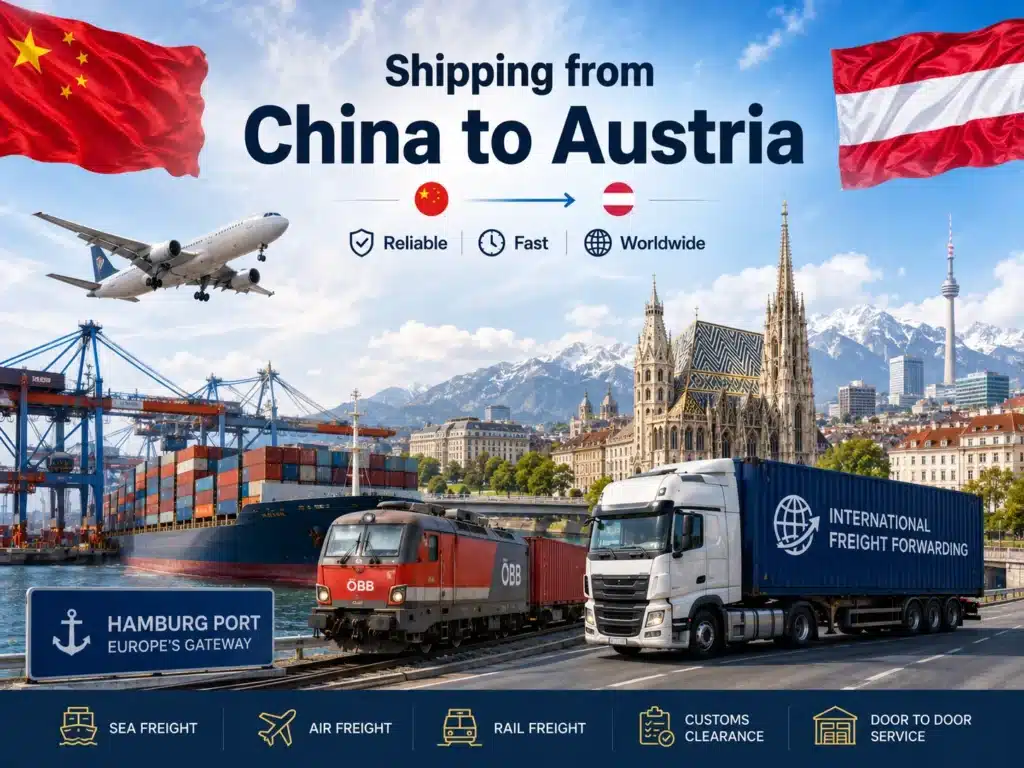
Shipping from China to Austria can be arranged by air freight, sea freight, rail freight, truck freight, express delivery, DDP and door-to-door shipping. VoltFreight helps importers compare suitable routes based on cargo weight, volume, delivery timeline, customs requirements and destination city in Austria.
Whether you need air freight to Vienna Airport, Sea DDP through a European port, Rail DDP for balanced cost and speed, or truck delivery to Vienna, Graz, Linz, Salzburg or Innsbruck, our team can review your cargo details and provide a clear China-to-Austria freight quote.
- Supplier pickup and warehouse receiving in China
- Cargo consolidation from multiple suppliers
- Customs document review and final delivery planning
Review available freight options, route details, customs notes and planning information for this destination.
Shipping from China to Austria requires a different freight plan from shipping to a coastal European country because Austria has no seaport. Importers need to consider the European entry point, customs model, VAT responsibility, final delivery postcode and service scope before choosing air, sea, rail, express or DDP shipping.
For standard freight, cargo normally enters the European Union through an airport, seaport or rail terminal. The Austrian importer then uses its own EORI number, VAT arrangement and customs broker to complete import clearance.
DDP shipping can follow a different route. Depending on the shipping method and cargo, customs clearance may take place through a selected EU gateway before the goods move through an EU hub and continue to Austria for final delivery.
VoltFreight helps importers, e-commerce sellers, wholesalers and B2B companies compare China-to-Austria freight options based on cargo weight, dimensions, CBM, product type, HS or TARIC code, declared value, supplier city, Austrian postcode and delivery deadline.
Quick answer: Express shipping from China to Austria commonly takes about 3–7 business days, standard air freight about 3–8 days airport to airport, Air DDP about 8–15+ days, Rail DDP about 20–35+ days and Sea DDP about 35–55+ days. Express works for samples, air freight for urgent commercial cargo, rail freight for medium-volume shipments and sea freight for large or cost-sensitive goods.
Need a China-to-Austria freight quote? Send the product name, photos, carton quantity, gross weight, dimensions, supplier city, cargo value and Austrian delivery postcode through our contact page. VoltFreight will compare suitable routes, customs scope, transit time and final delivery options before booking.
Compare China-to-Austria Shipping Methods
Different shipping methods solve different logistics problems. The best option depends on cargo size, urgency, available importer setup, customs responsibility and final delivery requirements.
Standard import is usually more suitable when the Austrian consignee already has an EORI number, VAT arrangement and customs broker. By contrast, a reviewed DDP route may suit importers that want one coordinated landed-delivery plan.
| Shipping Method | Best For | Typical Route | Planning Notes |
|---|---|---|---|
| Standard Air Freight | Urgent cargo, high-value goods, samples and spare parts | China airport to Vienna Airport or another suitable EU air hub | Best when the importer has an EORI number, VAT arrangement and customs broker. |
| Standard Sea Freight | Large cargo, heavy goods, LCL, FCL and wholesale stock | China port to a European port, followed by inland delivery to Austria | Austria has no seaport, so truck or rail delivery is required after port arrival. |
| Rail Freight | Medium-volume cargo, e-commerce inventory and B2B replenishment | China-Europe rail service, EU terminal handling and final delivery | Offers a balance between air-freight speed and sea-freight cost. |
| EU Gateway DDP | Importers seeking one coordinated landed-delivery plan | China pickup, EU gateway clearance, hub transfer and Austrian delivery | Availability depends on product type, HS or TARIC code, value and final postcode. |
| Express Shipping | Documents, samples and small urgent parcels | China pickup to an Austrian address through a courier network | Fast and simple for small cargo, but costly for heavy or bulky cartons. |
| Truck / Final Delivery | Pallets, warehouses, business addresses and oversized cargo | European terminal, airport or port to the final Austrian address | Postcode, appointment, unloading and address type affect final cost. |
Air Freight from China to Austria
Air freight from China works well for urgent, high-value or time-sensitive shipments to Austria.
Importers commonly use air freight for:
- Electronics and components
- Industrial spare parts
- Samples and prototypes
- Fashion goods
- Seasonal products
- Replacement parts
- E-commerce replenishment
- Medical-related equipment subject to compliance review
Standard Air Freight to Vienna Airport
Vienna Airport is the main Austrian air-cargo gateway. Its cargo facilities operate within a bonded environment and provide direct apron access for cargo handling.
You can review current airport information on the Vienna Airport Air Cargo Centre page.
Standard airport-to-airport freight is best suited to importers that already have:
- An EORI number
- An Austrian or EU customs broker
- A VAT arrangement
- A clear customs-entry plan
- Local delivery after airport release
Depending on airline space, cargo type and delivery location, VoltFreight can arrange freight to Vienna Airport or another suitable EU air hub.
Air DDP to Austria
Air DDP from China to Austria may use an EU gateway for import clearance rather than direct Austrian customs clearance for every shipment.
After customs release, the cargo may move through an EU transfer hub before reaching Austria by courier, parcel network or local delivery partner.
Air-freight pricing follows chargeable weight. The carrier compares actual gross weight with volumetric weight and uses the higher result. Therefore, accurate carton dimensions are just as important as gross weight.
Sea Freight from China to Austria
Ocean freight from China usually provides the best cost control for large, heavy or non-urgent cargo moving to Austria.
Common sea-freight products include:
- Furniture
- Machinery
- Building materials
- Home and kitchen products
- Packaging materials
- Industrial components
- Wholesale inventory
- Larger e-commerce shipments
Why Sea Freight to Austria Requires a European Port
Because Austria is landlocked, sea freight normally moves from a Chinese port to a European seaport before continuing to Austria by truck or rail.
Depending on the shipping line, destination city and service scope, possible European gateways may include:
- Hamburg
- Bremerhaven
- Koper
- Trieste
- Rotterdam
- Antwerp
- Gdańsk
- Another suitable EU gateway selected for the shipment
The most suitable port should be selected according to the vessel schedule, inland distance, customs model, destination charges and final Austrian postcode.
LCL Shipping from China to Austria
LCL means Less than Container Load. It is suitable when the cargo does not fill an entire container.
LCL can work well for:
- Smaller commercial shipments
- Mixed orders from several suppliers
- Regular wholesale replenishment
- Pallets or cartons that are not urgent
- Importers testing a product before moving to FCL
LCL freight normally follows CBM or revenue-ton pricing. The complete route may also include China warehouse handling, consolidation, destination deconsolidation, customs processing and inland delivery.
FCL Shipping from China to Austria
FCL means Full Container Load. It normally suits shipments large enough to use a dedicated 20ft, 40ft or 40HQ container.
FCL may provide:
- Fewer cargo-handling stages
- Better loading control
- Improved unit cost for larger orders
- More suitable protection for machinery or fragile goods
- A clearer loading and delivery plan
The final container route still requires inland movement from the European port to Austria.
Rail Freight from China to Austria
Rail freight from China to Europe can be useful when air freight is too expensive and sea freight is too slow.
Rail freight may suit:
- Medium-volume commercial cargo
- E-commerce inventory
- Automotive and industrial components
- Machinery parts
- Regular B2B replenishment
- Goods that need a balance between speed and cost
Standard Rail Freight
A standard rail shipment may include China-Europe rail transport, terminal handling, import customs clearance and final truck delivery to Austria.
Under a standard import model, the Austrian importer or its customs broker normally controls EORI, VAT, customs clearance and import duty.
Rail DDP to Austria
Rail DDP may use an EU gateway terminal for clearance and hub transfer before the cargo continues to Austria by parcel network or truck.
Before recommending rail freight, VoltFreight checks:
- Current route availability
- Terminal handling
- Border and capacity conditions
- Product restrictions
- Customs inspection risk
- Final delivery postcode
Express Shipping from China to Austria
Express shipping from China is generally the fastest option for documents, samples, spare parts and small urgent cartons.
DHL, UPS, FedEx, DPD, EMS or another courier network may be used depending on the product, declared value, destination address and carrier acceptance rules.
Express shipping works best when:
- The shipment is small and urgent
- The product is accepted by the courier
- The commercial invoice is clear
- The cartons are within courier size limits
- The destination is covered without excessive remote-area charges
Express becomes less economical for heavy cartons, high volumetric weight, multiple boxes or palletised commercial cargo. In those cases, air freight, rail freight, LCL or DDP may provide better cost control.
DDP Shipping from China to Austria
DDP shipping from China to Austria can provide one coordinated freight, customs and final-delivery plan for suitable cargo.
However, Austria DDP does not always mean that import customs clearance occurs directly in Austria. Depending on the route, the shipment may first clear through a selected EU gateway country.
After release, the goods may move through an EU hub before reaching Austria by courier, parcel delivery or local truck.
| Austria DDP Method | Typical Route Logic | Final Delivery |
|---|---|---|
| Air DDP | Air freight to an EU gateway for customs clearance | Courier, parcel network or local delivery to Austria |
| Rail DDP | China-Europe rail route to an EU terminal for clearance and transfer | Parcel delivery or truck delivery to Austria |
| Sea DDP | Sea freight to an EU gateway port for customs clearance | EU hub transfer followed by Austrian delivery |
| Truck / Land DDP | European land route under a reviewed customs and delivery model | Warehouse, business address or approved final address |
| Express / Courier | Courier route based on product and customs requirements | Courier or local delivery network |
What DDP Should Clarify
DDP does not mean customs rules disappear. The quotation should clearly explain:
- Which shipping method is being used
- Where customs clearance is expected to occur
- Whether customs brokerage is included
- Whether import duty and VAT are included
- Whether EU hub transfer is included
- Which final-delivery method is included
- How inspections, storage and redelivery are charged
DDP May Be Suitable When
- The importer wants one coordinated shipping plan.
- The product is accepted by the available route.
- The cargo documents and declared value are accurate.
- The final delivery is to an approved warehouse, business address or other suitable location.
- Customs, VAT and delivery responsibilities are agreed before booking.
Products That Need Additional Route and Compliance Review
Some products may still be transportable, but they require more detailed review before DDP or standard freight can be confirmed.
- Batteries and battery-powered goods
- Liquids, powders, magnets and chemicals
- Branded products
- Cosmetics
- Toys and children’s products
- Electronics and CE-regulated goods
- Textiles and footwear
- Medical-related goods
- Food-related products
- Products subject to anti-dumping or special import measures
- Dual-use or sanctions-sensitive products
Importers should provide product photos, material details, HS or TARIC code, labels, certificates, safety reports and brand authorisation where relevant.
Truck Freight and Final Delivery in Austria
Door-to-door shipping from China often relies on truck or parcel delivery after the cargo enters Europe.
Truck delivery may be required after:
- Air arrival
- Rail-terminal handling
- Sea-freight arrival at a European port
- EU gateway customs clearance
- EU hub transfer
Courier and Parcel Delivery
Parcel delivery normally works best for cartons, e-commerce inventory and smaller commercial shipments.
Before booking, confirm:
- Maximum carton weight and dimensions
- Number of cartons
- Delivery-address type
- Remote-area charges
- Whether signature or appointment delivery is required
Local Truck and Pallet Delivery
Pallets, machinery, oversized cargo and warehouse deliveries often require a local truck rather than a parcel network.
The quotation should confirm:
- Pallet quantity and dimensions
- Total gross weight
- Delivery appointment requirements
- Tail-lift requirement
- Forklift or unloading availability
- Waiting-time rules
- Private, residential or commercial address status
Remote and Alpine Delivery
Rural and alpine delivery may require postcode review because access, delivery time and truck cost can differ from major commercial areas.
This is especially important for:
- Tyrol and alpine destinations
- Oversized goods
- Heavy pallets
- Private addresses
- Sites requiring delivery appointments
- Locations with limited truck access
Austria Customs Clearance, EORI, TARIC and VAT
This section mainly applies to standard import shipments where the Austrian importer uses its own EORI number, VAT arrangement and customs broker.
For a DDP shipment, clearance may take place through a selected EU gateway before final delivery to Austria.
EORI for Standard Austrian Imports
When goods enter the European Union under a standard commercial import, the importer or customs declarant normally needs an EORI number for customs operations.
Austria’s Federal Ministry of Finance explains that EORI registration is handled through the Austrian customs administration. Review the Austria BMF EORI page.
The European Commission also provides general guidance on the EU EORI system.
TARIC and Import Duty
Import duty depends on product classification, customs value, origin and applicable EU trade measures.
Importers should confirm the correct HS or TARIC code before shipping. The European Commission’s TARIC guidance explains the EU tariff-classification system.
Austria VAT
Austria’s general VAT rate is 20%, while reduced rates may apply to selected goods and services.
Official information is available on the Austria business service portal VAT page.
Final VAT treatment depends on the product, importer status, customs value and declaration model.
Documents for Standard Austria Import Clearance
- Commercial invoice
- Packing list
- Bill of Lading, Sea Waybill, Air Waybill or rail document
- HS code or TARIC code
- EORI number
- Certificate of Origin where required
- CE or product-conformity documents where applicable
- Import licence or special permit for regulated goods
- Power of attorney for the customs broker where needed
For general importer preparation, document review and customs coordination, see our customs clearance services.
Shipping Cost from China to Austria
The shipping cost from China to Austria depends on the complete route rather than one freight rate.
Main cost factors include:
- Shipping method: Air, sea, rail, express and DDP follow different pricing structures.
- Weight and dimensions: Air and express use chargeable weight, while sea and rail also depend on CBM and pallet handling.
- LCL or FCL: LCL suits smaller shipments, while FCL may offer better unit cost for larger orders.
- China pickup city: Supplier location affects domestic trucking, warehouse receiving and consolidation.
- Austrian postcode: Vienna, Graz, Linz and remote alpine areas require different delivery plans.
- Customs scope: Standard import and EU gateway DDP include different responsibilities.
- Gateway and hub transfer: Clearance, sorting, storage and handover can affect DDP cost.
- Delivery method: Parcel, courier and truck delivery follow different weight and size limits.
- Product type: Batteries, branded goods, electronics, cosmetics and regulated products require additional review.
- Capacity and season: Airline space, vessel schedules, rail availability and peak season can change rates.
Fixed online prices can become outdated quickly. For an accurate quote, provide final carton dimensions, weight, CBM, product information and delivery postcode.
Shipping Time from China to Austria
Shipping time depends on supplier pickup, warehouse handling, export processing, carrier schedule, EU gateway clearance, terminal handling, hub transfer and final delivery.
| Shipping Method | Estimated Planning Time | Best Use Case |
|---|---|---|
| Express Shipping | About 3–7 business days | Documents, samples and small urgent parcels |
| Air Freight to Airport | About 3–8 days airport to airport | Importers with their own customs broker and delivery plan |
| Air DDP to Austria | About 8–15+ days | Urgent cartons, e-commerce goods and commercial shipments |
| Truck / Land Route | About 15–30+ days | Selected DAP, DDP or door-to-door cargo |
| Rail DDP to Austria | About 20–35+ days | Medium-volume cargo balancing cost and speed |
| Sea DDP to Austria | About 35–55+ days | Commercial stock and larger cost-sensitive shipments |
| Sea Freight plus Inland Delivery | About 35–60+ days | Large, heavy or standard-import cargo |
These are planning ranges rather than guaranteed delivery times. Carrier changes, customs inspection, missing documents, remote delivery and appointment requirements can extend the final timeline.
Delivery Areas, Warehouses and E-commerce Addresses
Austria delivery planning should not stop at the European port, airport or rail terminal. The final postcode affects inland distance, delivery method, warehouse access and possible remote-area surcharges.
| Delivery Area | Common Cities or Regions | Planning Notes |
|---|---|---|
| Vienna / Lower Austria | Vienna, Schwechat, St. Pölten and nearby logistics zones | Often suitable for air freight, DDP, warehouse delivery and B2B cargo. |
| Graz / Styria | Graz and nearby industrial areas | Truck and B2B delivery should be reviewed by postcode. |
| Linz / Upper Austria | Linz, Wels and surrounding logistics areas | Suitable for warehouse, industrial and pallet-delivery planning. |
| Salzburg | Salzburg and western Austria | Regional truck cost and delivery time should be checked in advance. |
| Innsbruck / Tyrol | Innsbruck and alpine areas | Alpine delivery may require additional time, access review or surcharge. |
| Klagenfurt / Carinthia | Klagenfurt and southern Austria | Final truck delivery depends on postcode, cargo size and address type. |
For e-commerce, third-party warehouses and commercial addresses, importers should also provide:
- Warehouse name and postcode
- Carton or pallet labels
- Delivery appointment rules
- Pallet specifications
- Receiving hours
- Contact person and phone number
- Unloading requirements
What VoltFreight Can Help With
- Compare standard import and EU gateway DDP routes
- Arrange supplier pickup across China
- Receive goods from multiple suppliers
- Measure cartons and calculate chargeable weight or CBM
- Consolidate cargo before export
- Review commercial invoices and packing lists
- Arrange air, sea, rail, express and reviewed DDP services
- Check DDP feasibility based on product, value and postcode
- Coordinate EU hub transfer for selected routes
- Arrange parcel, pallet or local truck delivery in Austria
- Explain which services are included and excluded from the quotation
What We Need for an Accurate Freight Quote
To prepare a reliable China-to-Austria freight quote, please send:
- Product name and photos
- HS code or TARIC code if available
- Carton, pallet or crate quantity
- Gross weight
- Dimensions of each package type
- Total CBM for sea or rail freight
- Supplier city and pickup address in China
- Austrian destination city and postcode
- Full delivery address and address type
- Preferred method: air, sea, rail, express, DAP or DDP
- Cargo-ready date
- Declared value
- EORI and VAT information for standard imports
- Battery, liquid, powder, branded or regulated-product details
Send VoltFreight your shipment details to compare the available route, customs model, delivery time and final-delivery method.
Related Central Europe Freight Routes
- Shipping from China to Germany
- Shipping from China to Italy
- Shipping from China to Hungary
- Shipping from China to Czech Republic
- Shipping from China to Slovakia
- Shipping from China to Slovenia
FAQ: Shipping from China to Austria
What is the best shipping method from China to Austria?
The best method depends on cargo size, urgency, budget and customs scope. Express suits small urgent parcels, air freight suits time-sensitive commercial cargo, rail offers a balance between speed and cost, and sea freight works for large or cost-sensitive shipments.
How long does shipping from China to Austria take?
Express commonly takes about 3–7 business days, air freight about 3–8 days airport to airport, Air DDP about 8–15+ days, Rail DDP about 20–35+ days and Sea DDP about 35–55+ days.
How does DDP shipping from China to Austria work?
For suitable cargo, DDP may use an EU gateway for customs clearance before the shipment moves through an EU hub and reaches Austria by parcel network, courier or local truck. The exact route depends on the shipping method, product, declared value and delivery postcode.
Do I need an EORI number for standard import into Austria?
For standard commercial imports into the European Union, the importer or customs declarant normally needs an EORI number for customs operations. Confirm the setup with your Austrian customs broker before shipment.
What documents are needed for Austria customs clearance?
Common documents include a commercial invoice, packing list, transport document, HS or TARIC code, EORI number, Certificate of Origin where required, CE or product-compliance documents and permits for regulated products.
Get a clear freight quote for your cargo.
Send us your cargo details, supplier location and destination address. We will help review the suitable route and prepare a clearer quote.
Popular Freight Routes from China
Explore related China-to-destination shipping services for air freight, sea freight, customs support and door-to-door delivery.