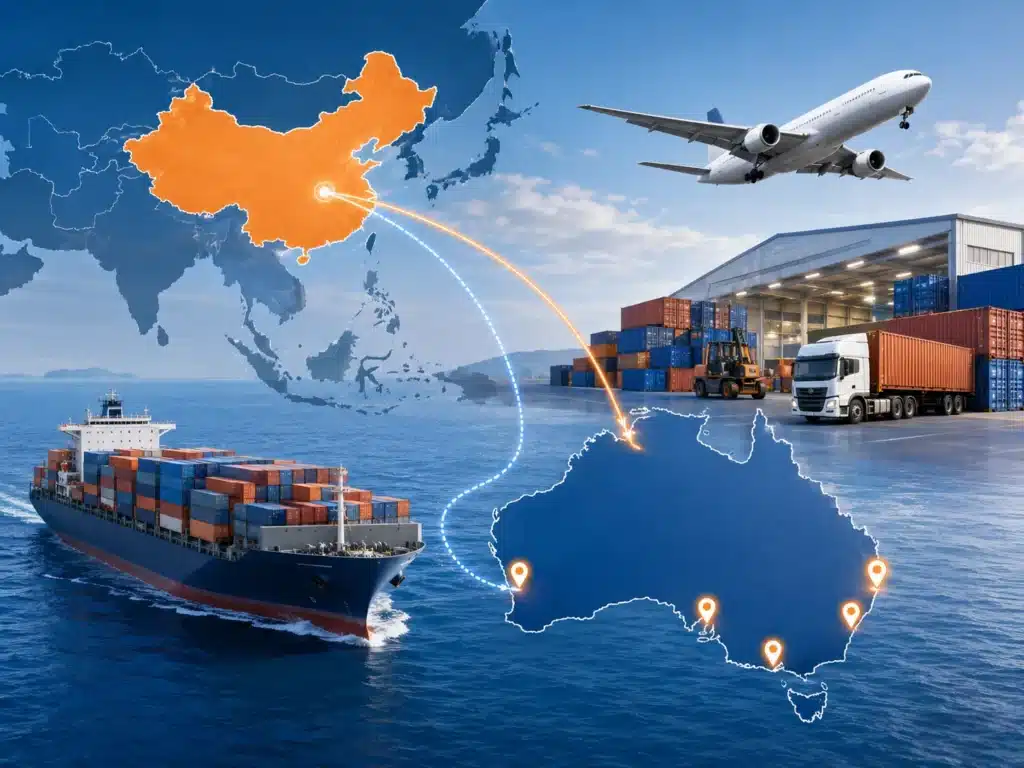
Shipping from China to Australia is straightforward only when the shipment is defined. A supplier may offer an attractive ocean rate, while another provider quotes a higher price for pickup, import coordination and delivery to your warehouse. Those are different services. Before choosing a carrier, an Australian importer needs to know what is moving, when it will be ready, where it must arrive and who will handle each step.
VoltFreight works as a freight forwarder from China to Australia for commercial importers, wholesalers and e-commerce businesses. We can arrange supplier collection, warehouse receiving and consolidation, sea or air freight, express courier and agreed delivery in Australia. We compare routes against the packed cargo, total shipment cost, delivery deadline and Australian import requirements. You can use this page to make an initial choice and then send us the details for a shipment-specific quote.
Ask VoltFreight for a China-to-Australia shipping quote
Which shipping option should you compare first?
The quickest way to narrow the options is to ask three questions: How many cartons or pallets are there after packing? When must the goods reach the Australian receiver? Will the shipment go to a port, a business warehouse or another address? Product type matters too: a carrier that accepts ordinary clothing may need a separate review for batteries, chemicals or food.
| Cargo situation | Start by comparing | Check in the quote |
|---|---|---|
| Samples and a few urgent cartons | Express courier | Chargeable weight, product acceptance and delivery-area charges |
| Urgent commercial inventory or production parts | Air freight | Airport versus door delivery, weight break and Australian arrival charges |
| Several pallets or a medium-sized order with a flexible deadline | LCL sea freight | Consolidation, destination depot charges and delivery from the depot |
| A larger order or cargo needing a dedicated loading plan | FCL sea freight | Container size, port pair, trucking and unloading at destination |
These are starting points, not universal weight thresholds. A dense shipment of metal parts and a similarly weighted shipment of lightweight furniture may produce very different air charges. A small LCL shipment may face minimum handling charges that make another service worth comparing. The final decision comes from comparing complete quotations for the same origin, destination and delivery scope.
DDP and DAP can be discussed for an eligible air or sea route. They describe delivery and import responsibilities, not another way of moving the goods. We address those responsibilities separately below because the words on a quote must match the actual importer arrangement.
What does shipping from China to Australia cost?
There is no reliable single China-to-Australia rate per kilogram or cubic metre for all goods. Price changes with the packed size, chargeable weight, carrier capacity, collection point, destination, commodity and service included. A rate obtained before a supplier has finished packing may be useful for budgeting, but the chargeable quantity can change when the final cartons are measured.
Understand the five parts of the total
A useful quote identifies which of these parts it covers:
- China collection and preparation: factory pickup, transfer to a consolidation warehouse, receiving, measurement, pallets or repacking when agreed, export handling and transfer to the carrier.
- International freight: the airline, courier or ocean movement, including the carrier charges specified in the quotation.
- Australian arrival: airport or port handling, LCL deconsolidation if applicable, customs-broker work and any required biosecurity process.
- Import charges: applicable customs duty, GST and government charges according to the goods and the agreed import arrangement.
- Final delivery: trucking or parcel delivery to the named postcode, plus any applicable appointment, remote-area, tail-lift, waiting or unusual unloading service.
The international freight line can be only a small part of a low-volume LCL shipment’s final bill. An ocean rate quoted per CBM may leave destination unpacking, broker fees and local trucking to the Australian buyer. Likewise, an airport-to-airport air rate cannot be compared directly with an air door-to-door price. Before calling one quotation cheaper, ask each forwarder to state exactly where the service begins, where it ends and what would trigger additional charges.
How each mode calculates the chargeable quantity
| Service | Common basis | A detail that changes the result |
|---|---|---|
| Courier | Carrier chargeable weight | Carton dimensions, carrier divisor, product and destination surcharges |
| Air freight | Applicable actual or volumetric weight | Final packing, weight break, airline and routing |
| LCL sea freight | Applicable weight/measurement rule and minimum charges | Total CBM, individual pieces and origin/destination handling |
| FCL sea freight | Container type and route | Origin loading, Australian trucking and container return |
Consider an illustrative order of 20 cartons, each measuring 60 × 40 × 40 cm and weighing 12 kg. The actual gross weight is 240 kg. Each carton occupies 0.096 CBM, so the shipment occupies 1.92 CBM before pallets or other packing are added. Using an illustrative air divisor of 6,000 cm³ per kg, each carton has a volumetric weight of 16 kg and the shipment totals 320 kg volumetrically. Under a service using that divisor, the air chargeable weight would be based on 320 kg rather than 240 kg, subject to the carrier’s full rating rules. A courier may use a different divisor.
This is a calculation example, not an actual VoltFreight booking or price. It demonstrates why a supplier’s gross-weight estimate is insufficient for an air quote. For LCL, the same shipment needs a quote for its measured volume and the relevant minimum and destination charges. For FCL, the question is whether a dedicated container makes sense once the order, loading method and full delivery cost are known. The shipping mode cannot be chosen responsibly from the cargo weight alone.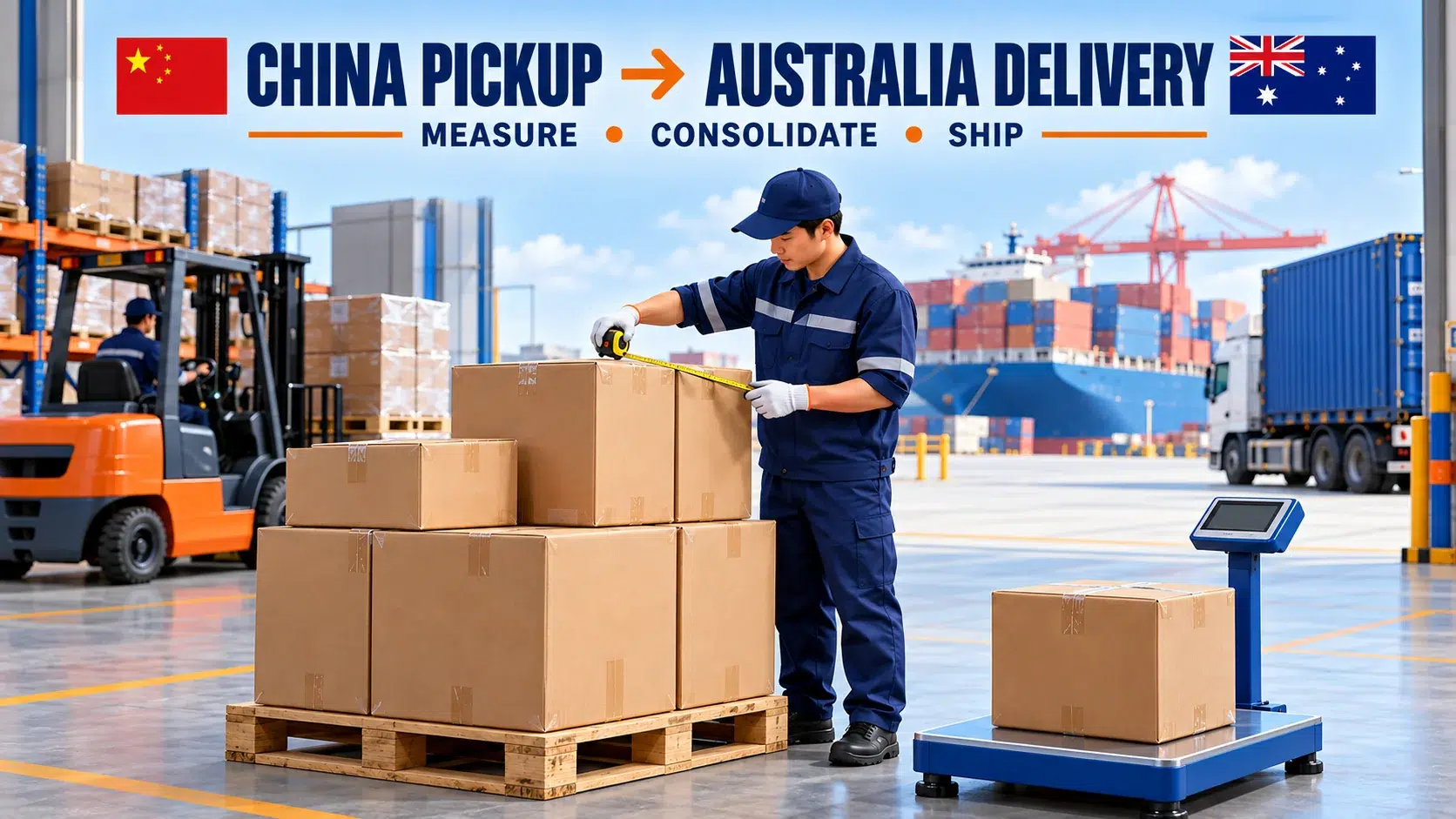
What would a 20% saving look like on published route prices?
VoltFreight’s China-side collection, consolidation and route planning give us opportunities to control the freight cost. For suitable shipments, we can quote around 20% below a comparable marketplace offer when the cargo and service scope match. The figures below show the arithmetic using Freightos public Shanghai–Sydney, Shanghai–Melbourne and Shenzhen–Perth starting prices viewed on 24 September 2026. The comparison figure is the published starting price multiplied by 0.80; it is not a confirmed VoltFreight rate for an unidentified shipment.
| Route and example load | Freightos published starting price | Illustrative figure at 20% less |
|---|---|---|
| Shanghai to Sydney: LCL, 1 CBM | $619 | About $495 |
| Shanghai to Sydney: air, 100 kg | $902 | About $722 |
| Shanghai to Sydney: 20ft FCL | $3,310 | $2,648 |
| Shanghai to Melbourne: 20ft FCL | $3,345 | $2,676 |
| Shenzhen to Perth: LCL, 1 CBM | $661 | About $529 |
How to read this table: Freightos displays these prices with a dollar sign; confirm the quotation currency before comparing it with an offer in AUD or another currency. Its starting prices are public route references, not a quote for your exact commodity, pickup address and delivery postcode. The air example also needs its chargeable weight checked after packing. The right-hand figures are calculated examples, not live offers, guaranteed minimums or a promise that every shipment qualifies for a 20% saving. The service endpoints and included fees on a Freightos booking may also differ from ours. GST, duty, biosecurity work, insurance and final delivery must be compared according to the actual quotations.
If you already have a Freightos offer, send us its date, currency, cargo details and full breakdown. We will price the same packed shipment against the same pickup point, destination, transport mode and import responsibilities. That gives you a meaningful answer to whether VoltFreight can reduce your total cost, and by how much, before you book.
Send your packing list and comparison quote
How long does shipping from China to Australia take?
Transit times need a start and end point. A vessel may reach an Australian port on schedule while the cargo still awaits unloading, customs release or a delivery appointment. An aircraft’s flight time is shorter than the time required to collect, screen, export and deliver commercial air cargo. Ask whether an estimate means port-to-port, airport-to-airport or supplier pickup to final address.
| Service | Broad planning reference | What the reference covers |
|---|---|---|
| Express courier | About 3–7 business days | Carrier handover to delivery for accepted cargo in ordinary conditions |
| Commercial air freight | About 3–8 days | Airport-to-airport; collection, clearance and local delivery take longer |
| FCL sea freight | About 18–35+ days | Port-to-port planning; pickup, loading and Australian delivery are extra stages |
| LCL sea freight | About 25–45+ calendar days | Origin consolidation through Australian depot availability; delivery takes longer |
The express estimate is expressed in business days; the sea estimates are calendar-day planning references. The air estimate should be checked against the carrier’s stated calendar. None is a sailing schedule or delivery guarantee. The actual service depends on the origin city, available carrier, cargo-ready date, port or airport pair and Australian destination. A door-to-door DDP or DAP schedule should be checked separately because it includes work on both sides of the international journey.
Build the schedule from the cargo-ready date
First establish when the goods will be fully packed and available for collection. Then allow for supplier pickup, warehouse receiving or consolidation, export preparation and the carrier’s cut-off. Add the international leg, Australian arrival, import and biosecurity release where applicable, and the final delivery booking. If several suppliers are involved, the last supplier to finish may determine when a consolidated shipment can leave.
Chinese public holidays can affect collection, factory output and carrier cut-offs. A delivery appointment at an Australian warehouse or a remote final address can add time after the goods are released. Missing invoices, inconsistent product descriptions and untreated packing material can create a much larger delay than a difference of one day between two sailings. Tell us both the expected ready date and the date by which the receiver needs the goods, so we can assess the whole schedule.
Sea freight from China to Australia: LCL or FCL?
Sea freight normally makes sense when goods are heavy, bulky or less urgent. The choice within sea freight is whether to share container space or plan an entire container. The answer depends on volume, destination handling, packaging, delivery and the cost of delay, as well as the ocean rate.
LCL: what an Australian importer should check
Less than container load (LCL) combines cargo from several shippers in one container. The goods are received and consolidated in China, then the container is unpacked at an Australian depot. This gives importers with a smaller order access to ocean freight without paying for a dedicated container.
That extra handling is the reason an LCL quote should be read carefully. Ask where the supplier delivers the cargo; whether origin receiving, export and documentation are included; how the shipment is measured; and which Australian terminal, unpacking and depot charges apply. Clarify when storage can begin and who books delivery after the cargo is released. A low ocean-only rate per CBM may be a valid offer, but it is not a delivered freight price.
Packaging can also influence the choice. LCL cargo travels with other shipments and passes through additional handling points. Fragile pieces, heavy single packages or goods that cannot be stacked may need stronger packing, separate handling or a different service. Tell us the weight of each large piece rather than supplying only the shipment total.
FCL: when a dedicated container helps
Full container load (FCL) reserves a container for your shipment. Importers commonly compare 20ft, 40ft and 40HQ equipment according to packed volume, weight, loading configuration and available equipment. A dedicated container can provide a simpler loading plan and avoid shared-container unpacking, but it brings its own origin, port, trucking and empty-return requirements.
There is no universal CBM point where FCL always becomes cheaper than LCL. A quote comparison needs the same collection point, Australian destination and service scope for both options. A large light shipment, a smaller shipment of heavy machinery and an order requiring special loading may each produce a different answer. We compare the total payable route rather than applying a fixed switch-over number.
For an FCL booking, confirm who loads the container in China and whether the factory can meet the carrier’s collection and return schedule. At destination, confirm whether the receiver can accept a container, has a forklift or loading dock, and can unload within the agreed time. Detention, demurrage, storage or a failed delivery can change the final cost if the container or goods cannot be released and handled on time.
Choose the Australian port with the delivery address in mind
China-origin containers commonly move through major gateways such as Shenzhen/Yantian, Guangzhou/Nansha, Ningbo and Shanghai, depending on the supplier and carrier service. Australian delivery may involve Sydney, Melbourne, Brisbane, Fremantle or Adelaide. The best gateway is not automatically the port with the lowest advertised ocean charge. A receiver in Perth, for example, should compare a suitable Western Australian arrival with the cost and time of moving the goods across the country from an eastern port.
Air freight and express for urgent orders
Air services are useful when the business cost of waiting outweighs the additional freight charge. That may be the case for replacement components, a production stoppage, a product launch or inventory that must be replenished before a confirmed sales period. The size and urgency of the shipment decide whether to compare courier or commercial air freight first.
Courier for samples and smaller urgent parcels
Express courier usually offers an integrated parcel service with collection, tracking and delivery. It is convenient for samples, spare parts and a few urgent cartons. Check the carrier’s dimensional-weight rule, remote-area charge and acceptance conditions. As cartons grow in number or size, the quoted courier weight can become much higher than the scale weight.
Commercial air freight for larger shipments
Commercial air cargo is generally quoted by applicable chargeable weight and may have separate airport, terminal, clearance and delivery charges. A lower airport-to-airport rate can still result in a higher delivered cost than expected if Australian charges and final trucking are not included. Ask about the available route, expected departure, direct or connecting service, and whether the cargo can meet the airline’s packing and documentation requirements.
Products containing lithium batteries, liquids, powders, magnets, chemicals or aerosols require a route review. Carrier acceptance depends on the actual product and its packing, not the category name alone. Product photos, specifications, battery information and safety documents, where relevant, should be supplied before space is requested. For airport-by-airport detail and weight-break discussion, use our dedicated air freight from China to Australia guide. Smaller urgent consignments are covered by our express freight service.
How VoltFreight coordinates supplier pickup and delivery
Many overseas buyers ask for a shipping quote while their suppliers are still producing the order. A usable freight plan begins by identifying what each supplier will actually do. Is the purchase EXW with pickup required at the factory? Will the supplier deliver the packed goods to a China warehouse? Are several orders arriving on different dates? These answers affect both the price and the earliest possible departure.
Pickup and consolidation in China
VoltFreight can review supplier collection, warehouse receiving and consolidation under the agreed service. Give us the city and ready date for every supplier. Goods from more than one factory can be brought together where the product types, delivery deadlines and documentation are suitable. We can then plan a shared export shipment or advise when an urgent portion should move separately.
Receiving several orders into one warehouse does not turn them into one indistinguishable product. The cartons should be identifiable by supplier, and the commercial information must accurately describe what is inside. Inconsistent carton counts or a product that differs from its invoice should be resolved before the cargo leaves China. If the supplier’s quoted dimensions are provisional, the final packing should be measured before confirming the chargeable quantity.
Documents and transport booking
Common starting documents include a commercial invoice and packing list with matching quantities, values, product descriptions, weights and dimensions. A bill of lading, sea waybill or air waybill will be prepared according to the transport service. Other documents depend on the goods, the claimed origin treatment, packaging and Australian import conditions. We coordinate the China-side freight preparation and work with the agreed destination arrangements; the relevant Australian importer and broker must be identified for the import entry.
Arrival updates and delivery planning
Tracking information should be interpreted by stage. “Arrived at port” does not mean “released for delivery,” and “customs cleared” does not necessarily mean that a separate biosecurity process has finished. For a commercial receiving address, tell us its delivery hours, booking procedure and unloading equipment in advance. This helps prevent a shipment from reaching Australia only to wait for a delivery appointment or suitable truck.
DDP, DAP and what door-to-door really includes
Door-to-door describes where a shipment travels. It does not settle who is the importer, who lodges an Australian declaration or who pays duty and GST. The delivery term and written quotation need to address those questions explicitly.
DDP where a workable import arrangement exists
Under Incoterms® 2020 DDP, the seller delivers the goods to the named destination cleared for import and is responsible for applicable import duty and taxes. A freight forwarder can arrange parts of that service, but the commercial parties must first establish who can legally act in the import process and how the entry and taxes will be handled. A quote marked DDP should therefore name the delivery point and set out the actual scope instead of treating “DDP” as a vague promise of no further costs.
DAP for importers managing their own entry
Under DAP, the seller arranges transport to the named destination while the buyer normally handles import clearance and applicable duty and taxes. This may be a practical option for an Australian company that already uses its own customs broker and wants the import entry managed under its established arrangements.
For either service, ask how a biosecurity inspection, treatment direction, storage delay, unsuccessful delivery or special unloading requirement will be handled. We review those possible events before confirming the quotation. If a proposed DDP structure cannot be supported for the goods or importer, the service and responsibilities need to be agreed under an appropriate alternative before booking.
What must be checked before the goods enter Australia?
Australia’s customs and biosecurity processes answer different questions. Customs documentation concerns the importer, goods, value, classification and applicable taxes. Biosecurity assessment concerns risks associated with the commodity, packaging and contamination. A carrier accepting the freight does not establish that the goods can be released into Australia.
Import declaration, GST and tariff classification
The Australian Border Force states that an Import Declaration is required for a consignment with a combined value over AUD 1,000 entered for home consumption. Air or sea cargo valued at AUD 1,000 or less generally uses a Self-Assessed Clearance declaration. The value threshold does not remove product permits or biosecurity conditions. Confirm the entry and the importer details with the Australian broker for the actual goods.
GST on a taxable importation is generally 10% of the value of the taxable importation. The ABF explains that this value includes the customs value, applicable duty, transport and insurance to Australia, and any other relevant component such as wine equalisation tax where applicable. Classification and value need to be correct before the broker can determine the applicable charges. A rate offered by a forwarder is not itself a calculation of import GST.
ChAFTA may change the duty calculation
Some qualifying goods can receive preferential duty treatment under the China–Australia Free Trade Agreement. The importer must check the tariff classification, the applicable rule of origin and the supporting documentation. Goods are not automatically entitled to a zero-duty rate just because they were bought in China. Australia’s Department of Foreign Affairs and Trade describes the Certificate and Declaration of Origin that may support a claim.
Check the product and its packaging in BICON
The Australian Government’s BICON system identifies whether a product can be imported and what biosecurity conditions, documents, treatment or permits may apply. Materials of plant or animal origin, food, timber, bamboo and some used equipment deserve review before the supplier ships the goods. The check is product-specific: a general statement that “Australia requires fumigation” is not a substitute for the conditions applying to the particular shipment.
Packaging is a separate practical risk. Solid timber or bamboo pallets, crates and dunnage used to support other goods can have their own declarations and treatment requirements. Ask the supplier what the packaging is made from and whether it has the evidence required under DAFF timber and bamboo packaging guidance. Replacing unsuitable material or arranging proper treatment before loading is usually easier than resolving a problem after arrival.
Used machinery may require thorough cleaning because soil, seeds or plant and animal material can remain in difficult-to-reach areas. A machine that was field-tested may be treated differently from a genuinely unused product. Check the applicable DAFF cleanliness guidance and BICON conditions when quoting this type of cargo.
Seasonal brown marmorated stink bug measures may affect certain goods, routings or vessels. China-origin goods do not automatically require blanket treatment. Check the current DAFF measures for a shipment that may be affected.
Delivery to Sydney, Melbourne, Brisbane, Perth and beyond
Australia’s size makes the final postcode an important part of a freight quote. Port Botany may be relevant for a Sydney-area warehouse, while Fremantle and Perth should be considered for Western Australian cargo. Melbourne, Brisbane and Adelaide each have their own available carrier routes and delivery networks. We compare the arrival gateway with the receiver’s location instead of selecting an international rate in isolation.
| Destination | Delivery detail to provide |
|---|---|
| Sydney / New South Wales | Compare a suitable Sydney arrival with trucking to the final postcode; check warehouse booking and unloading |
| Melbourne / Victoria | Check whether a Melbourne arrival avoids extra inland transfer and whether the receiver can accept pallets or a container |
| Brisbane / Queensland | Compare an available Brisbane arrival with east-coast transfer from another gateway |
| Perth / Fremantle / Western Australia | Compare a suitable western arrival with eastern-port freight plus cross-country delivery |
| Adelaide / South Australia | Check the available international service and any connecting domestic leg |
| Regional or remote address | Postcode, vehicle access, tail lift, appointment and receiving arrangements |
A pallet cannot be delivered as though it were a small parcel. Tell us whether the receiving site has a dock or forklift and whether it can accept a large truck or container. A container receiver should be ready to unload within the arranged period and allow for empty return. A residential recipient may need an appointment or different vehicle. These conditions should be known before a delivered price is confirmed.
We can also review eligible deliveries to an Amazon fulfilment centre, subject to the shipment and the seller’s receiving instructions. Amazon is not a replacement for the seller’s importer arrangement. Detailed labelling and receiving requirements belong in our Amazon FBA shipping guide.
How to compare two quotations for the same order
Imagine an importer has three pallets ready at a factory in Guangzhou for a Melbourne warehouse. One offer says “LCL sea freight per CBM.” The other says “door delivery.” A comparison of the headline numbers would be misleading until both providers answer the same questions. This is an illustrative decision example, not a record of a customer shipment.
- Same cargo? Confirm the final pallet dimensions, gross weight, stackability, product description and value. A change in packing changes the comparison.
- Same starting point? One provider may begin at the factory under an EXW collection plan; the other may begin only when the supplier delivers to a China depot.
- Same endpoint? An Australian port or LCL depot is not the Melbourne warehouse. Ask for local delivery and unloading costs.
- Same import responsibility? Identify the importer, broker, duty and GST arrangement. Clarify biosecurity inspection and storage terms.
- Same time measurement? Compare supplier release to warehouse receipt, not one provider’s ocean transit with another provider’s full journey.
After the scope matches, the importer can assess price, expected delivery, handling risk and service communication. A cheaper quote may still be the right choice if the excluded services are already arranged by the buyer. The purpose is to know what is being purchased and who must complete the remaining work.
Get a shipment-specific China-to-Australia quote
For an initial comparison, send the product name, carton or pallet count, gross weight, packed dimensions, supplier city, Australian postcode and expected cargo-ready date. Tell us whether the delivery address is a warehouse, business, residence or fulfilment centre. If a fixed arrival date matters, include it from the start.
A packing list, product photos, declared value and HS code help us refine the route. For batteries, liquids, powders, chemicals, food, wood products, used machinery and other special cargo, include the relevant specifications or safety documents you already have. We will identify any additional information needed before a service can be confirmed. A preliminary comparison can begin with estimated packing, but the final quote depends on the goods as packed and the available service at booking.
Send your cargo details to VoltFreight
Frequently asked questions
Can you collect goods from several suppliers in China?
Yes, we can review supplier pickup or warehouse receiving and plan consolidation where the goods and dates are suitable. Give us a separate ready date and packing estimate for each supplier. We will assess whether the orders should depart together or whether one urgent portion should be shipped earlier.
Can VoltFreight always quote 20% below a Freightos price?
No fixed discount applies to every cargo or service. We can aim for a saving of around 20% on suitable comparable quotes, subject to the available carrier, final packed size, collection and delivery points, and import scope. Send us the dated Freightos quote and packing list so we can compare the same service and confirm the actual VoltFreight price before booking.
Is sea freight always the cheapest option?
Sea freight often has a lower international transport cost for larger non-urgent shipments, but LCL minimums, destination handling and final delivery matter. A small shipment may be better served by another option. Compare the total cost to the same address rather than the ocean rate alone.
Does door-to-door automatically mean duty and GST are paid?
No. Door-to-door identifies a delivery destination; the agreed import term and quotation determine customs and tax responsibility. We clarify the importer, broker, duty and GST arrangements before confirming a DDP or DAP service.
What if Australian biosecurity selects my shipment for inspection?
Inspection, treatment or a request for documents may extend release time and create additional charges. The outcome depends on the goods and current Australian conditions. We review known risks before dispatch and explain how those events are handled under the agreed quotation, while the relevant Australian authority makes the final determination.