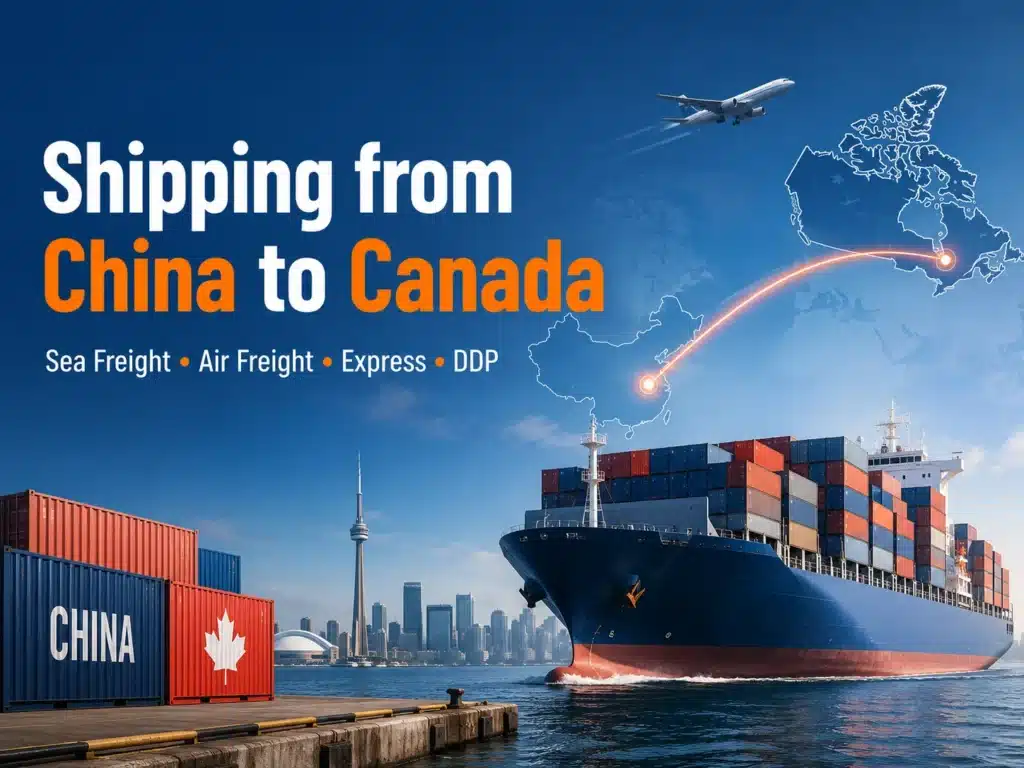
Shipping from China to Canada is not one fixed price or transit time. An urgent sample may reach a Canadian address by express in about 3–6 business days; commercial cartons can move by air; and non-urgent inventory usually travels by LCL or a full ocean container. What matters is the complete journey: collection from the Chinese supplier, export handling, the international leg, Canadian customs and delivery to the actual postal code.
VoltFreight helps Canadian importers compare these routes for real cargo, not just a headline rate. We can coordinate supplier pickup and consolidation in China, arrange express, air, LCL or FCL transport, work with the agreed Canadian clearance arrangement, and plan delivery to a business, 3PL or Amazon warehouse. The guide below explains where each method works, what the dated price references include, and what to confirm before booking.
For a route-specific quote, send the product name, supplier city, cartons or pallets, gross weight, packed dimensions, cargo-ready date and Canadian delivery postal code. Include the commercial value and tell us whether you want your own broker to handle import clearance.
China-to-Canada Shipping Methods: Cost, Time and Best Use
The following figures are September 2026 planning references in USD, not a standing rate card. A transit estimate is useful only when you know where its clock starts and stops: the flight or voyage, port-to-port movement and completed door delivery are different measurements.
| Method | Planning freight reference | Indicative timing and measurement | Usually fits |
|---|---|---|---|
| Express courier | Approximately USD 6–16 per chargeable kg | Approximately 3–6 business days for eligible door-to-door parcels | Samples, documents, replacement parts and small urgent orders |
| Standard air freight | Approximately USD 4.50–9.50 per chargeable kg; terminal and delivery costs can be separate | Approximately 4–8 days airport-to-airport after acceptance; allow roughly 5–9+ days for a straightforward commercial shipment before final delivery | Time-sensitive cartons and higher-value stock |
| Air DDP | Quote against the product, weight, declared value and written delivery scope | Approximately 7–12+ days door delivery for accepted goods | Eligible inventory when coordinated clearance and delivery are needed |
| Ocean LCL | Approximately USD 60–190 per CBM as an illustrative base-freight band; minimum and local charges extra | Approximately 25–45+ days for a typical consolidated shipment; origin, CFS and inland legs matter | Non-urgent orders smaller than a practical full-container load |
| Ocean FCL | Live rate for a 20GP, 40GP or 40HQ container and its specific inland route | Approximately 14–25 days China to Vancouver port-to-port; an eastern port voyage can take about 28–42 days port-to-port | Higher-volume or easier-to-control shipments |
| Sea DDP or sea door delivery | Quote the approved product and complete door-service scope | Approximately 30–50+ days, often longer for inland or remote destinations | Non-urgent goods needing coordinated final delivery |
Why transit estimates can differ
These ranges overlap because the services do not buy the same thing. A carrier can offer a quick sailing to Vancouver while customs release, rail and a receiving appointment still take additional days. Likewise, a cheaper air-freight rate may end at the airport; an express price may include parcel transport to the address but exclude duty and tax. Confirm the service start and end points in writing.
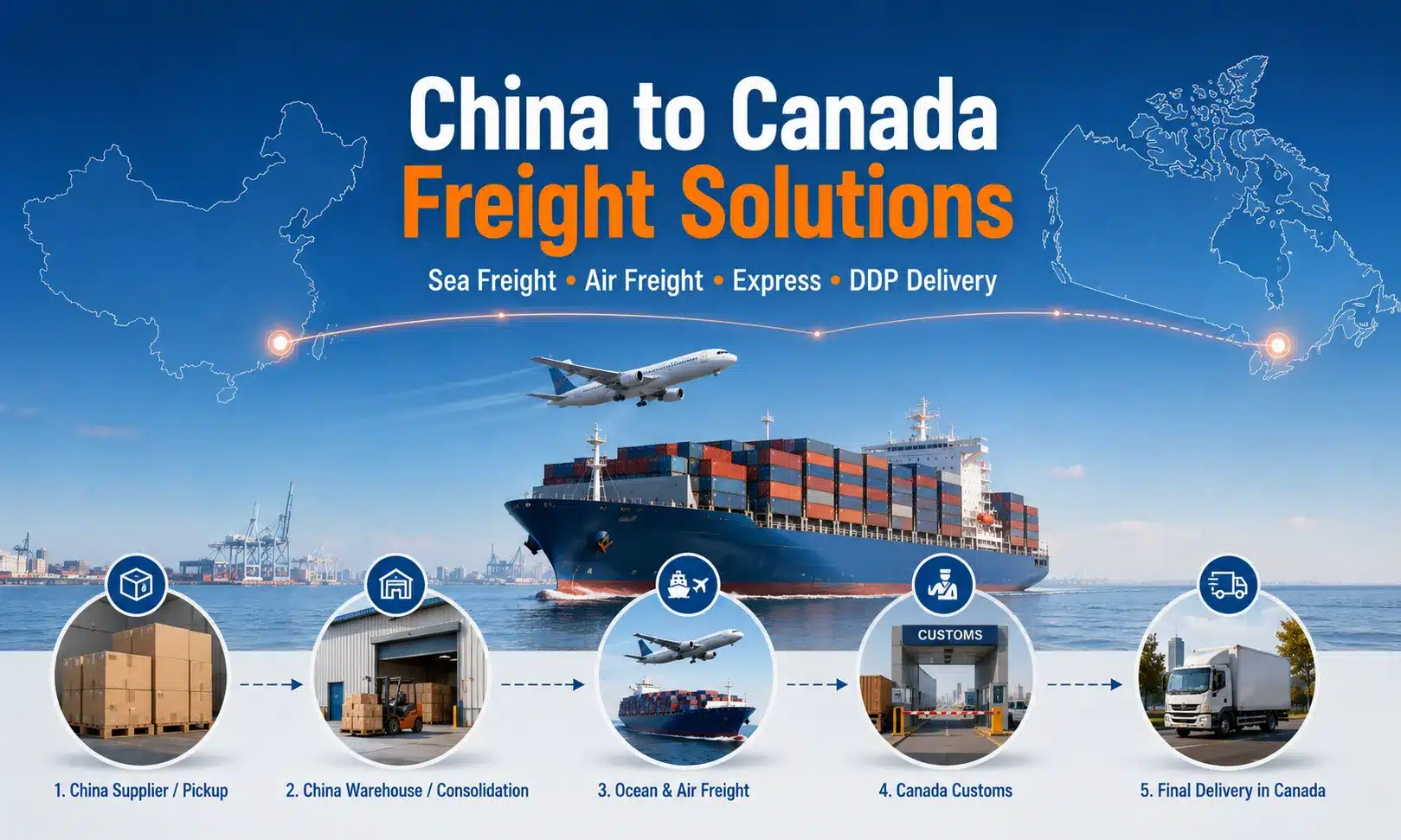
How Should You Ship Your Cargo from China to Canada?
Begin with the product, the deadline and the packed cargo measurements. Then compare complete quotations for the methods that can actually accept the goods. An air booking is not automatically better because a shipment weighs under a certain number of kilograms, and LCL does not automatically win because it occupies less than half a container.
Samples, small parcels and urgent replacement parts
For a few light cartons, express courier can remove several handoffs: the courier collects the parcel, carries it through its network and delivers to the receiver. Before choosing it, check the declared value, product restrictions, volumetric weight and whether the courier will bill the Canadian recipient for brokerage, duty, GST or a disbursement fee. Postal services may suit low-value, non-urgent samples where tracking and handling meet your needs; they are generally less suitable for a sizeable commercial replenishment requiring a predictable warehouse appointment. Sending a small trial shipment can also help verify packaging and paperwork before a larger first order.
If the supplier proposes China Post, EMS or another postal product, compare the complete delivered service against a courier quote. Postal acceptance limits, tracking events, compensation, delivery attempts and customs collection can differ from DHL, UPS or FedEx. A postal estimate of one to two weeks in an older route study is a historical planning example, not a promise for a specific Canadian postal code. Confirm the available service and the receiver’s ability to deal with any charges or collection before sending commercial stock through a parcel channel.
Urgent commercial cartons: express versus standard air
Once a shipment grows beyond a small parcel, compare an express door quote with standard air freight plus origin handling, Canadian terminal charges, brokerage and local delivery. Historical rules of thumb sometimes place the comparison around 150–500 kg, but these are quoting prompts, not carrier thresholds. Standard air can be more economical for larger, compact commercial consignments if the importer can arrange Canadian clearance and local transport. When only part of the order is urgent, shipping priority SKUs by air and the balance by sea may protect a launch or prevent a stockout without paying air rates for everything.
Air cargo is billed on the greater of scale weight and volumetric weight. One widely used calculation is length × width × height in centimetres ÷ 6,000 per carton; some services use a different divisor. For example, eight cartons measuring 60 × 50 × 40 cm each have a combined volumetric weight of 160 kg at the 6,000 divisor. If the cartons weigh only 120 kg in total, the example is billed at 160 kg before rounding or any carrier-specific rule. Tightening oversized packaging can therefore lower the quote without changing the product.
A carrier’s lower per-kilogram price at a larger weight break does not mean a lower total invoice. In the earlier route notes, about 150 kg was a useful point to begin comparing courier with freight, and 300–500 kg was a useful point to test consolidated air against sea. In each case, final weight, cubic volume, urgency and destination decide the result. Ask the forwarder to show the chargeable kilograms and accessorial charges rather than applying one historical price to every carton. A stockout, production stoppage or contracted launch date may justify paying an air premium for only the urgent units.
Non-urgent stock: LCL versus a dedicated container
LCL charges for shared space, generally by the greater of cubic metres or a weight-equivalent unit, subject to a minimum. The goods must be received and consolidated at a container freight station (CFS) in China, then deconsolidated after arrival in Canada. FCL buys the container and avoids that shared-cargo handling, even if you do not fill every cubic metre. It often gives more control over seals, loading and the final handover.
An earlier China–Canada route study placed the LCL-versus-20ft comparison around 13–15 CBM. Treat that as a trigger to request both options, not as a universal cut-off: the origin, Canadian CFS, commodity weight, container availability, minimum LCL charge and inland route can move the break-even point. A 1–13 CBM order often starts with LCL; as volume approaches 15 CBM, ask for a complete FCL comparison. A heavy machine or fragile product may justify its own container before that volume if handling risk outweighs the rate difference.
What Changes When You Switch from LCL to FCL?
In LCL, the China warehouse receives the shipment, checks its packing and shipping marks, then hands it to a consolidation facility for a shared container. At the Canadian gateway, the facility breaks down the container and releases the individual consignments after the required handling and customs steps. This extra touchpoint may mean another fee, a later availability date or higher damage exposure for weak packaging. With FCL, the shipper can plan a dedicated 20GP, 40GP or 40HQ load, record the seal number and arrange one container-level delivery, although Canadian drayage, unloading and empty return still need attention.
FCL is not a guarantee that every shipment will be faster or damage-free; the difference comes from the actual sailing, handling and delivery arrangement. For a 12 CBM order, request both an LCL quote including CFS and final trucking and a 20GP quote including the same final delivery. If two suppliers’ goods can be combined without violating product or document requirements, consolidation may change the comparison. If one supplier is late, however, waiting to fill the container may cost more in lost sales than the freight saving.
Ocean Freight Routes: Vancouver, Prince Rupert and Eastern Canada
Sea freight from China to Canada is normally the cost-controlled choice for furniture, machinery, auto parts, building materials, packaging, consumer stock and other heavy or bulky goods with a workable lead time. The Chinese load port should follow the factory location and vessel service: Shanghai, Ningbo, Shenzhen/Yantian, Guangzhou/Nansha, Qingdao, Xiamen and Tianjin are among the practical options. A factory near Shenzhen should not be hauled across China simply because another port shows a lower ocean-only number.
Match the Chinese load port to the supplier and sailing
Shanghai and Ningbo are practical comparisons for factories across the Yangtze River Delta; Shenzhen/Yantian and Guangzhou/Nansha serve many Pearl River Delta origins; Qingdao, Tianjin and Xiamen can suit suppliers closer to those export regions. These are starting points, not rigid factory-to-port rules. Ask which terminal receives the cargo, how long the truck takes from the factory, whether the order needs an export agent, and whether the proposed vessel calls directly at the Canadian gateway or changes ships. When suppliers are in different provinces, compare sending each order separately with receiving and combining them at an agreed China warehouse.
In the earlier route study, a 40ft shipment from Shanghai to Vancouver was planned around 14–18 days on the water. The same notes listed an illustrative 13–18-day window for selected South China–Prince Rupert FCL routings, plus extra time for CFS handling on LCL. They are specific port-to-port research examples, not guaranteed transit bands for every 2026 carrier or for delivered cargo. Confirm the booked vessel, cut-off, transshipment and destination availability when comparing them.
Vancouver and Prince Rupert for the Pacific route
Vancouver is a common gateway for British Columbia and a rail gateway for inland Canada. One researched Shanghai–Vancouver FCL service took about 14–18 days port-to-port; the broader planning band is 14–25 days because the vessel, origin port and sailing pattern vary. That clock starts at the Chinese port and ends at the Canadian port, not at a factory door in Dongguan or a distribution centre in Ontario.
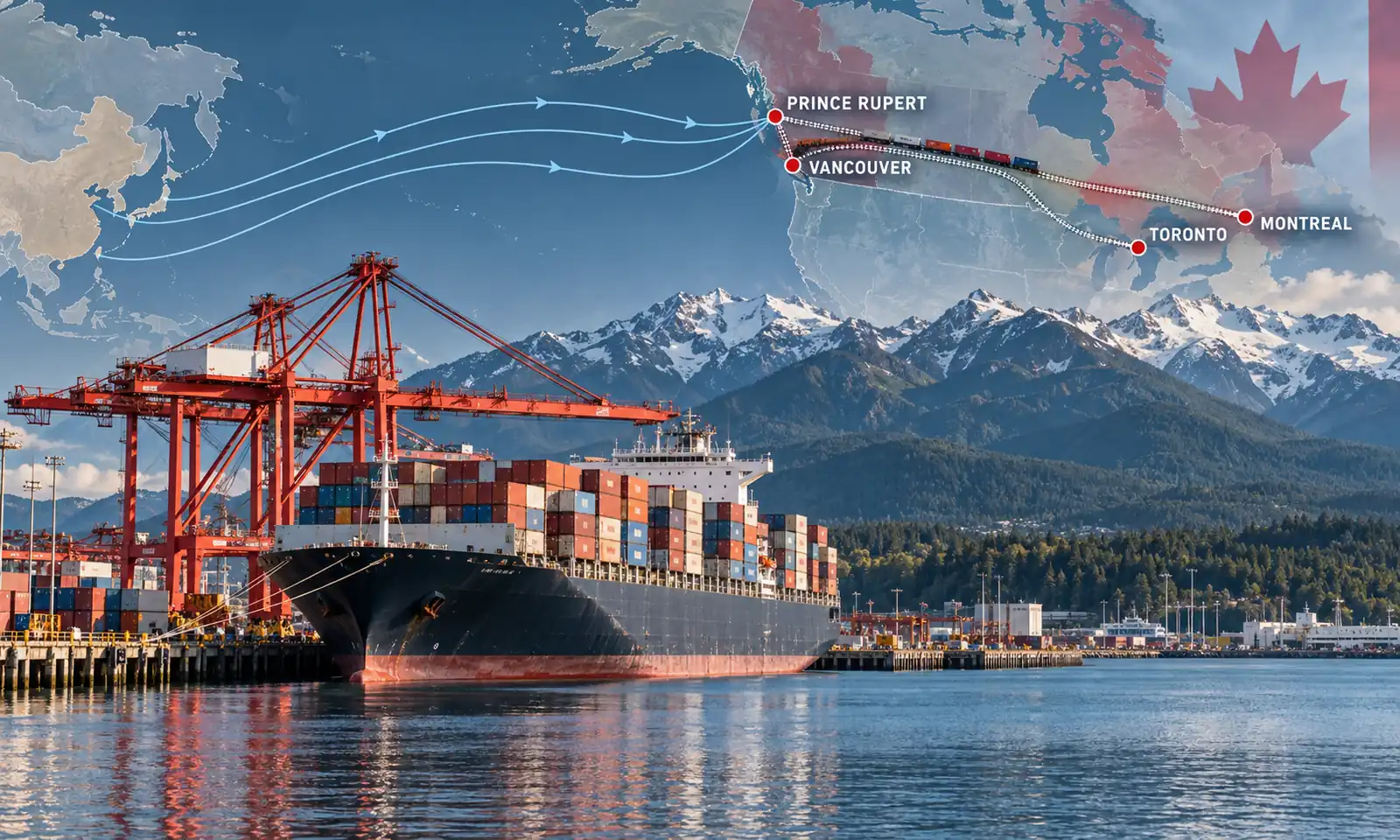
Prince Rupert is another Pacific gateway worth evaluating when the carrier offers a suitable call and inland connection. Its rail connectivity can make the route competitive for some Toronto- or Montreal-bound containers, but the shortest water leg does not guarantee the shortest completed delivery. Compare the specific sailing, rail transfer, terminal dwell and destination drayage. The Port of Prince Rupert’s route overview explains its Pacific and inland-rail position.
The port authority describes Prince Rupert as approximately 500 nautical miles closer to Asia than other Pacific Northwest ports and connected to eastern Canada by CN rail. That geographic advantage can shorten a water leg on a suitable service; rail capacity, container availability and terminal timing still determine the completed trip. For a Toronto-bound container, ask for separate estimates via Vancouver plus inland rail, Prince Rupert plus inland rail, and a viable eastern port. Compare the same inland terminal and delivery postal code in all three offers.
Toronto, Montreal, Halifax and inland delivery
A Toronto or Mississauga order may enter Canada via a Pacific port and move inland by rail, or use an eastern ocean routing where schedules and price justify it. Montreal and Halifax are also gateways for eastern cargo; an all-water service to Montreal can involve transshipment and may take substantially longer at sea than a direct Pacific sailing. Compare China origin to final Canadian address, not merely the distance between the named port and the buyer. Montreal’s port container-network information is a useful starting point for the eastern gateway.
Earlier route research suggested about 22–30 days for some Pacific-port-plus-rail movements into a Toronto/Montreal area terminal. That is not a guaranteed factory-to-door time. For an eastern all-water port voyage, allow a different port-to-port band; then add customs release, rail or trucking and a warehouse appointment. Calgary, Edmonton and Winnipeg similarly need an inland plan after arrival at the coastal gateway. There is no direct China-to-Canada rail freight service across the Pacific: when we discuss rail here, we mean Canadian inland rail after the ocean leg.
East Coast Vessel or Pacific Port Plus Rail?
The original research also described all-water Montreal routings taking 30 days or more on some schedules, while a Pacific arrival followed by rail could be competitive for Ontario and Quebec. Either pattern can change with the carrier and season. Montreal or Halifax can be the right choice for an eastern address when the actual arrival, local charges and drayage align; do not select Halifax simply because the cargo is oversized without first checking the vessel, terminal handling and inland equipment. A Canadian rail estimate normally ends at an inland terminal, so the consignee still needs clearance, rail availability, container pickup and a delivery appointment.
| Canadian delivery area | Routes worth comparing | What can decide the result |
|---|---|---|
| Vancouver / Lower Mainland | Pacific arrival at Vancouver; Prince Rupert only when its inland plan makes sense | Direct sailing, terminal handling, local drayage and unloading |
| Calgary / Edmonton / Winnipeg | Pacific port with rail or truck onward | Rail connection, inland terminal and final postal code |
| Toronto / Mississauga / Brampton | Vancouver or Prince Rupert plus rail; an applicable eastern-port service | Total port-to-inland-terminal time, customs and warehouse appointment |
| Montreal / Ottawa / Atlantic Canada | Montreal or Halifax ocean service; Pacific port plus inland rail where viable | Transshipment pattern, rail/truck availability and final delivery cost |
For LCL, add the origin CFS cut-off and Canadian deconsolidation to the vessel schedule. A short FCL sailing does not mean a shared-container shipment will arrive at the buyer’s warehouse just as quickly. For FCL, ask who pays terminal handling, container pickup, drayage, unloading, empty return, detention and demurrage. These details often decide whether the apparently cheaper port rate is actually the better offer.
Air Freight and Express into Canada
Air freight from China to Canada can work through Chinese origins such as Shanghai Pudong (PVG), Guangzhou (CAN), Beijing (PEK), Shenzhen (SZX) and, when the export and road-transfer arrangement makes sense, Hong Kong (HKG). Common Canadian gateways include Vancouver (YVR), Toronto Pearson (YYZ) and Montréal–Trudeau (YUL). The right pairing depends on flight availability, cargo acceptance, customs handling and onward delivery—not just the shortest map distance.
The earlier route study recorded a roughly 4–8-day airport-to-airport air planning window and approximately 3–5 days door-to-door for eligible express parcels. The broader table above allows for more service variation; it does not turn an airport arrival into delivery to the Canadian warehouse. Standard air may need China-side trucking, screening, an air waybill, destination release, local trucking and an appointment. Express generally handles the parcel network as one service, though customs charges can still be billed separately.
Do not hand a battery product, liquid, powder, magnet, aerosol or chemically treated item to the factory’s courier without a product-acceptance check. Carrier and aircraft rules depend on the actual formulation, battery specification and packaging. Provide photographs, a precise description and safety documentation when requested; some goods will need a specialist service or may be refused on a particular air route. Compare airport-to-airport and door quotes on the same cargo and destination. For a deeper air-only breakdown, see our China-to-Canada air freight guide.
What Happens Before an Air Shipment Reaches the Canadian Airport?
For standard air freight, the supplier first confirms the finished packing and releases the cartons for pickup or delivery to the China warehouse. The forwarder measures the freight, checks whether the airline can accept the commodity and individual pieces, arranges export and security handling, and books the service against the cargo-ready date. After the flight, the Canadian broker or appointed importer deals with the necessary release process before a truck collects the goods from the destination facility. A price to YVR or YYZ does not automatically include those Canadian steps.
If the customer is considering Hong Kong as an alternative departure airport, factor in the transfer from the mainland factory, separate export arrangements, acceptance rules and available flight capacity. Hong Kong is an option to investigate for suitable cargo, not a blanket solution for every item an airline in mainland China will not accept. For temperature-sensitive, fragile or high-value products, tell the forwarder about the required handling before a rate is issued. Packaging photographs, a product specification and an SDS or other carrier-requested document can prevent a rejected booking or a last-minute route change.
From a Chinese Factory to a Canadian Receiving Address
Every booked shipment involves more than choosing a vessel or flight. A practical China-to-Canada freight plan follows these stages:
Before the supplier releases the cargo
- Confirm the purchase and the shipping term. Agree the Incoterm and named place with the supplier before goods are ready. Under FOB, the seller normally handles delivery and export work up to the named loading port; under EXW, the buyer must plan much more of the China origin movement; under DAP or DDP, the stated destination and import responsibility change again. No single term is always best. Choose it according to who can arrange the origin leg, control the Canadian import and obtain clear cost records.
- Review the goods before collection. Send the product name, intended use, material, value, country of origin, photos and any battery, liquid, chemical or other regulated-product information. Confirm carton quantity, gross weight, dimensions and cargo-ready date. For multiple factories, decide whether goods should be collected individually or delivered to one China warehouse.
- Prepare and check the China export documents. The supplier and its appointed export agent need matching commercial information for the export declaration. A commercial invoice, packing list and bill of lading or air waybill form the core transport-document set. A permit, product certificate or other supporting document is added when that specific cargo requires it. Do not promise an export VAT refund as a freight discount: eligibility and records belong to the qualifying exporter and its transaction.
After the cargo is ready
- Pack for the selected route. Reinforce cartons for repeated LCL handling, protect corners and fragile components, and make pallet dimensions match the booking. If you use solid-wood pallets or crates from China, check treatment and the required ISPM 15 marks before loading; see the Canadian Food Inspection Agency wood-packaging requirements. Engineered-wood packaging and other materials can be treated differently; ask about the actual packaging rather than assuming all wooden material is exempt.
- Book the international and Canadian legs together. Confirm the CFS cut-off or container loading day, flight or sailing, Canadian gateway, customs broker and delivery type. A container to Vancouver with rail to Toronto is one coordinated journey with several chargeable legs. Keep the transport documents and commercial information consistent across those legs.
- Clear customs and complete delivery. The agreed importer or its customs broker arranges the Canadian entry using accurate invoice and product data. Once released, freight can move to a port-side warehouse, a 3PL, an Amazon facility or another postal code. Track the container or air waybill, and confirm the delivery appointment before the truck is dispatched.
Packaging, Marks and Label Checks Before China Pickup
Packaging has to survive the movements in the route actually booked. An LCL pallet may be loaded at the supplier, handled again at a China CFS, stowed with unrelated freight and separated after arrival in Canada. Use cartons strong enough for their packed weight, protect glass or vulnerable corners, and ask about moisture protection on a long ocean movement. For heavy machinery, check crate construction, centre of gravity, forklift access and the restraint plan. Standard cardboard that works for a single domestic courier trip may not withstand those transfers.
Agree carton marks with each supplier before collection: supplier name or reference, purchase-order or shipment identifier, carton sequence such as 1 of 12, gross weight, dimensions and any handling instruction that the carrier accepts. Use a matching packing list for each supplier and a consolidation record for the combined load. If FBA or a 3PL requires its own carton labels, keep those receiving labels separate from the supplier’s internal identification. A warehouse carton count confirms what arrived; it does not automatically certify that the contents match the order, so arrange product-level inspection separately if needed.
Which Shipment Updates Matter During Transit?
Ask the forwarder which events it can actually report. For ocean cargo, useful milestones include supplier collection, China warehouse receipt, CFS or container loading, export departure, vessel arrival, customs release, rail or inland-terminal availability and final delivery. For air cargo, the comparable points are cargo acceptance, flight departure, airport arrival, customs release and collection by the Canadian carrier. Express couriers provide parcel scans through their own networks; scans can appear later than the physical handoff, particularly when another carrier completes the final leg.
Tracking is most valuable when it triggers a decision. If the supplier misses an LCL cut-off, ask for the next consolidation date before promising the Canadian warehouse a new arrival. If the container is available but the consignee cannot unload it, arrange a realistic appointment and container return to avoid avoidable detention or storage. Keep the commercial invoice, packing list, booking confirmation and any agreed packing photographs together so the importer and broker can resolve a discrepancy quickly.
What Should the Supplier Put on the Commercial Invoice?
At minimum, ask the supplier for the buyer and seller names and addresses, an accurate product description, units and quantities, price paid or payable, currency, country of origin and the sale terms. Match the carton counts and weights to the packing list and transport booking. The Canadian broker may require further information for classification and valuation. A Canada Customs Invoice (CI1) is not automatically mandatory merely because goods exceed CAD 2,500: a commercial invoice containing the prescribed details can be acceptable. The CBSA invoice-requirements memorandum explains the permitted invoice formats.
Compare the Landed Cost, Not Only the Ocean or Air Rate
Two quotations that both say “China to Canada” may cover different handover points. Before accepting a lower number, request a line-by-line scope:
| Cost or service | Question to ask |
|---|---|
| China supplier pickup and export | Is trucking from each factory, receiving, export documentation and origin terminal/CFS handling included? |
| Main freight and surcharges | Does the rate cover the booked ocean or air service, fuel/security charges, equipment and rate validity? |
| Canadian terminal or CFS | Who pays unloading, destination terminal handling, storage and LCL deconsolidation? |
| Brokerage and customs | Who files the entry, under whose importer account, and are broker fees, duty and import GST included? |
| Inland rail and final delivery | Does the quote end at Vancouver/YYZ, an inland terminal, a 3PL dock or the actual Canadian postal code? |
| Special and event-based charges | Are inspection, remote delivery, residential access, liftgate, appointment, demurrage, detention and redelivery excluded? |
For example, multiplying 6 CBM by an observed USD 190/CBM LCL base yields USD 1,140 of base LCL freight; it does not give the six-cubic-metre shipment’s landed Canadian cost. Add the applicable collection, origin charges, CFS, customs, duties and taxes, inland trucking and address-specific delivery. An FCL quotation with inland rail may look more expensive at first glance because it already includes a leg missing from the LCL offer. Ask each provider to identify exactly what its line item buys.
Recorded 2026 China-to-Canada Freight Price Examples
Our route research also recorded the more specific references below. They show how cargo size, container type and destination affect the planning figure. They are not interchangeable live VoltFreight quotations: the earlier research and the September sample were collected at different times and do not document identical origins, rate validity or included local charges.
| Research reference | Recorded USD figure | How to read it |
|---|---|---|
| Earlier 2026: China to Vancouver, 20ft FCL | USD 2,500–4,500 | Indicative container freight for that gateway; not a delivered Canadian price |
| Earlier 2026: China to Vancouver, 40ft/40HQ FCL | USD 3,800–8,300 | Indicative Vancouver container range, with season and carrier variation |
| Earlier 2026: China to Toronto/Montreal, 40ft FCL | USD 4,500–9,500 | Research reference includes an inland-rail element; check which rail point and final truck leg a new offer includes |
| Earlier 2026: China to Canada, LCL | USD 40–90 per CBM | Base-freight example before shipment minimums, CFS and Canadian destination charges |
| September 2026 sample: Canadian port gateways, 20GP / 40HQ | USD 6,660–8,140 / USD 7,740–9,460 | Container-price observations into Vancouver or Montreal; the original sample does not establish an all-in door scope |
| September 2026 sample: LCL | USD 190 per CBM | Observed base LCL rate, not a landed cost |
| September 2026 sample: air / express | USD 7.47 per kg at 1,000 kg or more / USD 15.48 per kg express | Air figure is for the specified high-weight bracket; do not apply it to a small consignment or assume duties are included |
Why China-to-Canada Rates Can Differ So Much
A 20ft container at one date cannot prove that an apparently dearer 20GP sample at another date is a rate increase: routing, carrier, equipment, origin haulage and surcharges may differ. Nor can an LCL ocean-only price be compared with a full-container rate that includes inland rail. Use these figures to ask for a current like-for-like quotation; do not treat an earlier observation as this week’s booking price.
An Illustrative Canadian Duty and GST Calculation
A worked example shows why import charges belong in a landed-cost budget. This is a CAD illustration, not a tariff quote: if the value for duty is CAD 10,000 and the product’s actual tariff rate were 5%, duty would be CAD 500. For this simplified example, GST at 5% on the CAD 10,500 duty-paid value would be CAD 525, bringing duty plus import GST to CAD 1,025 before brokerage, freight, handling and any other applicable charge. The applicable duty, valuation and tax treatment must be established for the actual product and importer; see the CBSA commercial-import duty and tax guide.
DDP, DAP and the Canadian Importer of Record
Door-to-door delivery is not necessarily DDP. A forwarder may collect at a Chinese factory and deliver to a Canadian warehouse under DAP, leaving import clearance, duty and taxes with the buyer. Under the formal Incoterms meaning of DDP, the seller takes responsibility for import clearance and the applicable duties and taxes up to the named place; the parties still need to agree who handles unloading. A freight forwarder’s marketed “DDP service” must therefore spell out its actual contractual parties, importer arrangement and exclusions, rather than rely on the label alone. The ICC’s DAP-versus-DDP explanation is useful when setting the sale term.
DDP may simplify an eligible shipment where a coordinated price and handover matter most. However, an established Canadian importer might prefer DAP or a standard freight arrangement so its own broker, Business Number and customs records remain central. Before paying for either service, obtain written answers to these questions:
- Who is the legal seller, buyer and Importer of Record on the Canadian declaration?
- Whose BN/RM account will the broker use, and who retains the customs-entry records?
- Are customs brokerage, assessed duty, import GST, delivery and the agreed address type actually included?
- Will the buyer receive the import documents it needs for tax and accounting purposes?
- Who pays for a customs examination, corrected invoice, remote-area surcharge, missed appointment or storage?
These questions matter especially when someone offers a surprisingly cheap “tax-included” rate. The CBSA’s Importer of Record memorandum describes the liability rules effective January 1, 2026, including potential joint responsibility for duties. The buyer should agree on the named importer and record flow before the cargo leaves China, not after a shipment is held. Our door-to-door shipping service explains how final-delivery scope can be coordinated.
What CARM, duty and Canadian import tax mean for a freight booking
A business importing commercial goods under its own Canadian account needs to organise its Business Number, RM import-export program account and CARM Client Portal registration; it can delegate authority to a customs broker. Release Prior to Payment and financial-security arrangements should be discussed with that broker when relevant. A non-resident importer also needs an appropriate import structure. The CBSA’s current commercial-import setup guide describes the accounts and delegation process.
Canadian import charges are not a single tax rate applied to every shipment. Duty depends on the exact tariff classification, origin, customs value and any applicable trade-remedy or other measure. Most taxable commercial imports are assessed the 5% federal GST component at importation on the applicable value-for-tax calculation; provincial or harmonised sales-tax treatment depends on the facts. Some registered businesses may qualify for an input tax credit when they have the required records. Confirm the specific product against the 2026 Canadian Customs Tariff and the CRA’s import GST/HST guidance; let the Canadian broker or tax adviser determine the applicable treatment.
Delivery to Vancouver, Toronto, Montreal and Other Canadian Addresses
A Canadian postal code can have more impact on the completed quote than the choice between two similar ocean sailings. Goods bound for Vancouver, Richmond or Surrey may have a relatively short movement after a Pacific arrival. A shipment for Toronto, Mississauga or Brampton needs an inland connection or another suitable gateway, then a local truck or courier. Montreal, Laval, Ottawa, Calgary, Edmonton, Winnipeg, Halifax and Atlantic destinations each need the corresponding carrier service and delivery window. Northern or remote postal codes can involve a separate network, surcharge or longer transit.
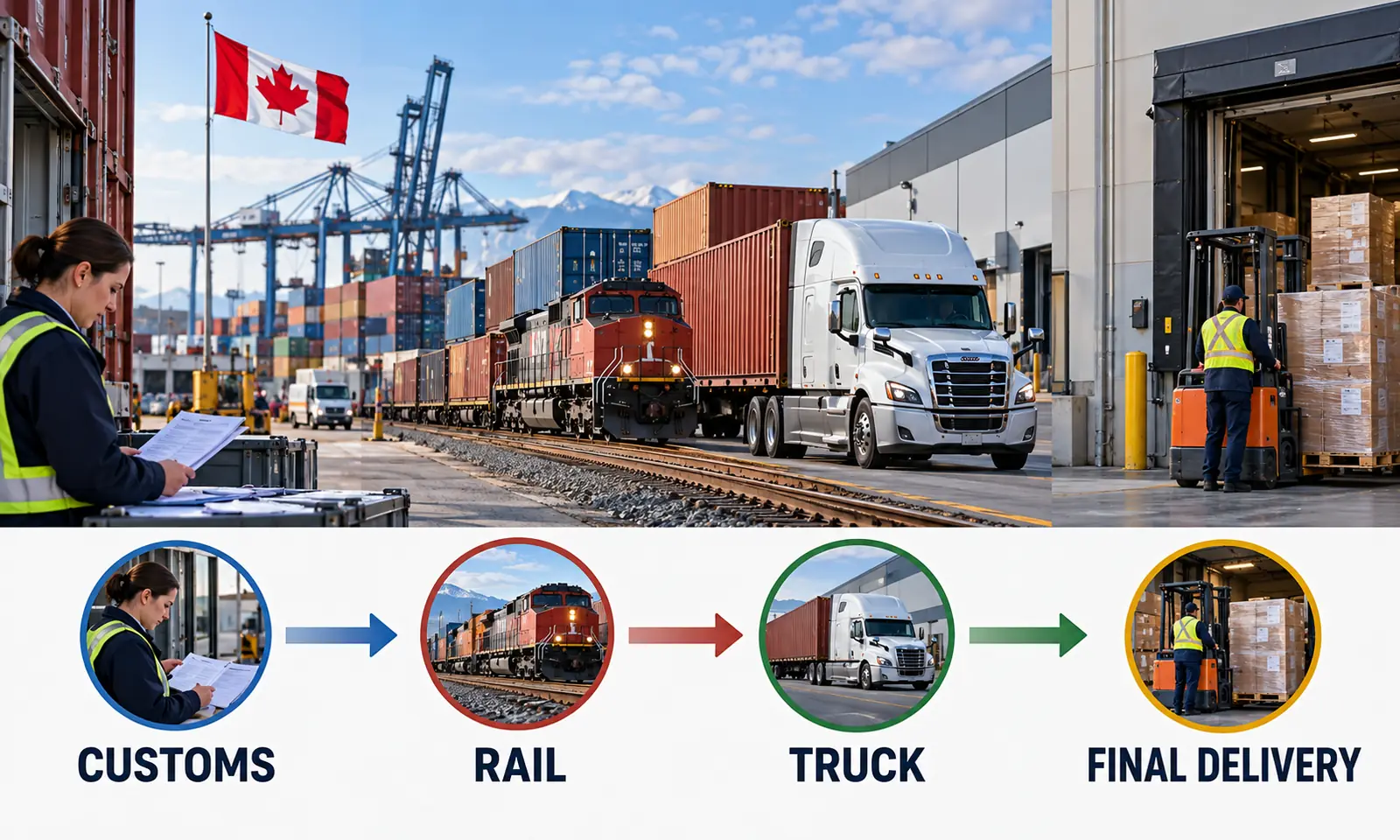
Tell the forwarder whether the receiving location is a residence, shop, construction site, factory, 3PL or distribution centre. A pallet arriving at a warehouse may require an appointment, purchase-order number, dock-height vehicle or unloading equipment. A residential receiver may instead need a liftgate and a smaller truck. If a full container cannot be unloaded promptly, container waiting time and return arrangements should be agreed in advance. For Canadian cities served by more than one ocean or air gateway, request the total time and price to the postal code rather than assuming the nearest port wins.
Can cargo move from a China supplier straight to Amazon FBA Canada?
Yes, for eligible products and a compliant import and receiving plan. The seller must set up the Amazon shipment, confirm the assigned Canadian fulfilment centre, supply the shipment reference and prepare any required FNSKU, carton and pallet labels. Arrange the importer and duty/tax payment before departure: Amazon is not the Importer of Record for the seller’s shipment and will not pay freight or import charges at the receiving dock. Review Amazon’s import delivery requirements for the seller account.
VoltFreight can coordinate agreed China-side receiving, carton checks, consolidation, relabelling or repacking and delivery planning for FBA stock. Actual prep work depends on the written service order and the current Amazon requirements. A 3PL delivery needs its own receiving hours, appointment rule, carton or pallet limits and contact details. Learn more about FBA preparation if those checks are part of your shipment.
How VoltFreight Manages Suppliers and Consolidation in China
For Canadian importers buying from several factories, the point of a freight forwarder is not merely to reserve space on a vessel. A factory in Yiwu may finish a week before a supplier in Dongguan; cartons from Ningbo may use different markings from those arriving from Shenzhen. If the bookings are made independently, you can pay repeated collection fees and discover incompatible delivery dates only after cargo reaches the ports.
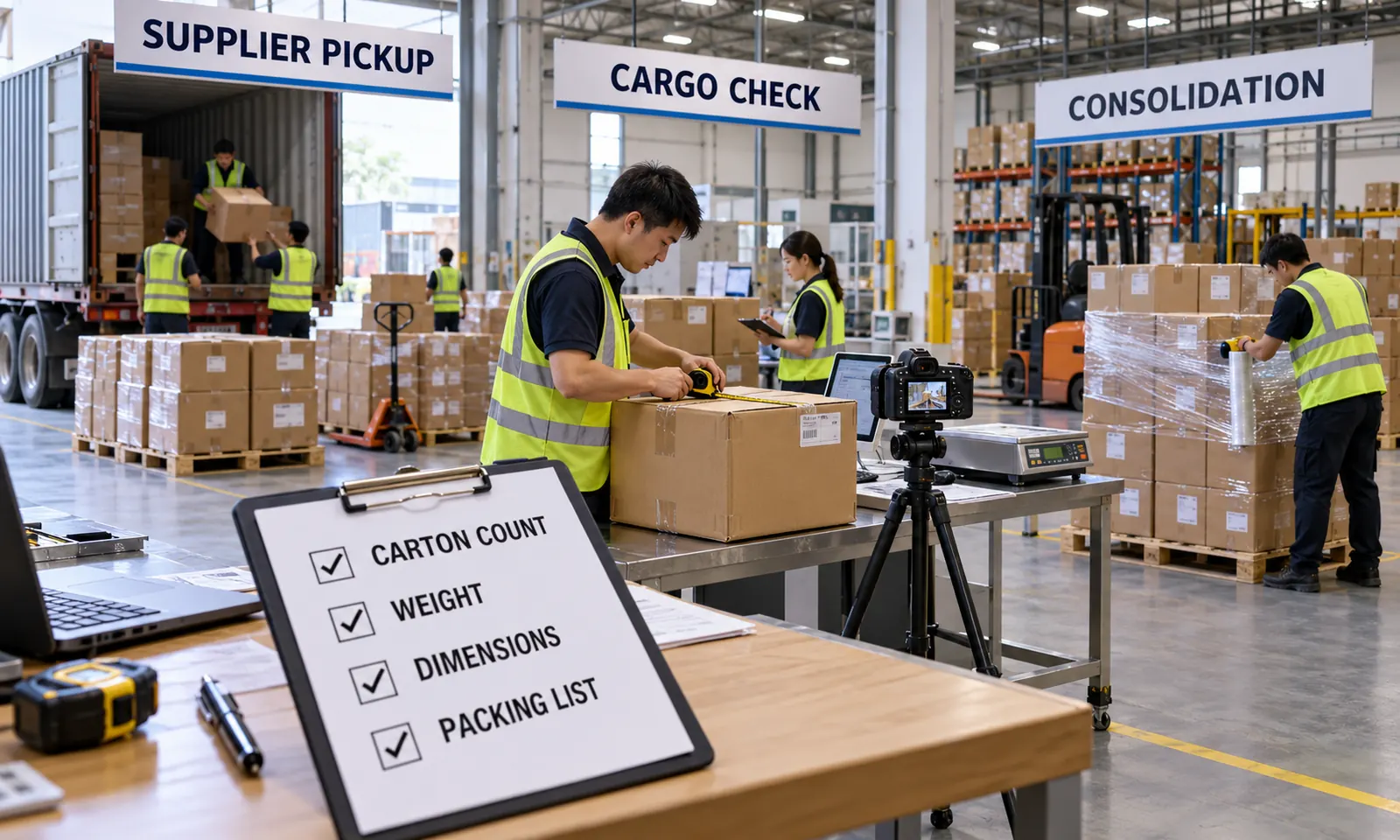
VoltFreight draws on more than 10 years of China freight-forwarding experience to coordinate the handoffs between supplier, China warehouse, international carrier and Canadian destination. What we can confirm in a quotation depends on the product and route: warehouse receiving, photographs, relabelling, export coordination, customs-broker arrangement and final delivery should each be stated in the agreed scope rather than assumed from a generic service list.
VoltFreight can review the supplier list and proposed shipping terms, arrange collection or warehouse receiving, count and measure cartons, photograph visible packaging conditions where agreed, and bring compatible goods into a coordinated air or ocean movement. We can review whether an LCL consolidation makes sense, whether the total volume justifies FCL, and whether part of the order should ship ahead by air. We then align the cargo-ready date, export documents, Canadian gateway and final-delivery plan. Consolidating products does not eliminate individual product descriptions, country-of-origin information, classification or safety requirements.
For a single factory, we can still compare the quotation from its gate against the same shipment delivered by the supplier to a China port or warehouse. This makes the practical effect of EXW, FOB and a quoted door service visible, so the buyer can decide who should control each leg. Our ocean freight service covers LCL and FCL options when sea transport is the right fit.
How to Compare China-to-Canada Freight Forwarders
Ask each provider who will receive cargo from the Chinese supplier, who books the international leg, which Canadian broker or importer arrangement applies and who arranges the last truck. Then compare a written quote covering the same product, cargo dimensions, gateway and postal code. A useful quote identifies the Incoterm, the rate basis, the estimated transit clock, the customs and tax scope, the receiving address, validity dates and charges that arise only if something goes wrong. A forwarder who quotes the ocean leg alone should label it clearly rather than allow an importer to mistake it for a delivered price.
Check the operational fit as well as the number: Can the provider receive cartons from different suppliers on different dates? Can it photograph a visible carton discrepancy, arrange agreed repacking and explain whether those services add a fee? Who updates the Canadian buyer if a flight is rejected, an LCL cut-off is missed or a receiving appointment changes? If the goods require refrigerated handling, unusual lifting equipment or dangerous-goods acceptance, confirm the actual channel before treating a general-cargo quote as usable. VoltFreight can review these questions against the shipment details and provide a written service boundary.
Example: Two Suppliers, One Canadian Order
Consider an illustrative order with 7 CBM ready in Dongguan and another 5 CBM due in Ningbo. A buyer in Toronto needs only several replacement cartons urgently; the rest can wait for sea freight. The practical comparison is to verify the suppliers’ completion dates, collect packing lists separately, quote the urgent cartons by air, and compare LCL with a 20GP for the remaining compatible goods. A warehouse can count and measure arrivals, record carton marks and plan a combined shipping instruction. If the Ningbo cargo misses the sailing cut-off, the buyer can decide whether waiting for a full consolidated movement still beats sending the first lot separately.
This example is a decision workflow, not a claim that a particular customer paid a particular rate. Its purpose is to show what a China freight forwarder must coordinate before promising a Canadian delivery date. Alibaba or another sourcing platform can help the buyer find factories; it does not resolve carton readiness, China pickup, customs documentation or the final Toronto receiving appointment by itself.
How to Reduce Shipping Costs and Prevent Avoidable Delays
- Quote the final destination early. Give the complete Canadian postal code, address type and unloading conditions; otherwise, the inland leg is an estimate based on missing information.
- Measure cargo after packing. Carton dimensions set air chargeable weight and LCL CBM. A change from loose cartons to oversize pallets can change either price.
- Compare LCL and FCL near the break-even range. Around 13–15 CBM, ask for both landed options, including Canadian CFS fees or container return—not just the basic ocean rate.
- Allow time for the real calendar. The period before Lunar New Year, the early-October China holiday and major retail replenishment cycles can affect factory readiness, cut-offs and capacity. When an order has a hard delivery date, enquire about space several weeks ahead and build in a buffer; an earlier research guideline was three to four weeks for a planned ocean booking, not a guaranteed reservation window.
- Send accurate documents before sailing or flight. Resolve discrepancies in product descriptions, value, origin, invoice totals and carton count while the supplier can still correct them.
- Review restricted products and wood packaging in advance. A late battery disclosure or unmarked solid-wood crate can force a route change or inspection.
- Price the cost of a stockout. If a small number of SKUs are urgent, compare a split air-and-sea shipment with air-freighting the entire order.
- Agree insurance and incident handling. A freight booking and cargo-insurance coverage are different. For valuable machinery or high-risk cargo, ask what can be insured, on what terms, and what photos and packing records should be kept for a claim.
Seasonal Planning for China-to-Canada Orders
These recurring periods can affect factory schedules, cargo cut-offs or Canadian warehouse appointments. Use the calendar as a planning prompt, not a forecast that a rate will rise or a port will be congested in every year:
| Planning period | What can affect the shipment | Practical action |
|---|---|---|
| Lunar New Year, date varies | Factory output, trucking and cargo-ready dates may change around the break | Confirm completion and warehouse receiving before requesting a vessel cut-off |
| Dragon Boat Festival, usually in June | Some China-side offices or facilities may work a shorter schedule | Check the actual holiday timetable if the cargo is due that week |
| Early October China holiday | Production and export handoffs can bunch on either side of the closure | Arrange collection and document review before the relevant cut-off |
| Retail replenishment and year-end holidays | Air space, vessel allocations and Canadian receiving appointments may tighten | Plan stock against the longer end of the transit range and confirm the final receiving calendar |
For planned FCL freight, begin the space discussion roughly three to four weeks before cargo readiness when the production schedule allows it. This is a planning habit, not a promise that an advance request locks the price or confirms equipment. Ask when the carrier’s quoted rate expires and what happens if the factory completion date changes. Past capacity shocks, including the pandemic-era disruptions, do not predict today’s sailing schedule or available space; confirm both for the shipment at hand.
Request a China-to-Canada Freight Quote
To compare practical routes, send VoltFreight one concise shipment brief:
- Product name, material, purpose, photos, HS code if known and any battery, liquid, powder or regulated-product details.
- Each supplier’s city and pickup address, the cargo-ready date and the agreed purchase/shipping term.
- Number of cartons or pallets, gross weight and outside dimensions of each packing type, plus total CBM if available.
- Commercial invoice value, currency, country of origin and the name of the intended Canadian importer.
- Canadian destination city, full postal code, address type, receiving hours and appointment or unloading rules.
- Required delivery date and whether you want an airport/port quote, DAP delivery or an eligible, clearly defined DDP option.
With those details, we can assess express, standard air, LCL, FCL and the relevant door-delivery options on a common scope. Send your shipment details to VoltFreight for a China-to-Canada quote.
China-to-Canada Shipping FAQs
How much does it cost to ship from China to Canada?
For initial planning, express parcels may fall around USD 6–16 per chargeable kg and standard air around USD 4.50–9.50 per chargeable kg. A base LCL reference may run around USD 60–190 per CBM, while a container needs a live 20GP or 40GP/40HQ quotation. None of those figures alone establishes customs, import tax or Canadian final delivery. Use the actual cargo, dates and postal code for a written landed-cost comparison.
How long does shipping from China to Canada take?
Eligible express shipments may take roughly 3–6 business days; standard air can take around 4–8 days airport-to-airport; and a China-to-Vancouver FCL ocean movement may take about 14–25 days port-to-port. LCL consolidation, Canadian rail, customs release and final trucking add time. For many sea door movements, budget approximately 30–50+ days, depending on the route and address.
When should I choose LCL rather than FCL?
LCL often works for a smaller commercial order that will not fill a dedicated container. Request both prices as the order approaches roughly 13–15 CBM, and earlier if it is heavy, fragile or sensitive to repeated handling. Include China collection, destination CFS charges and delivery in the comparison.
Can I use Prince Rupert instead of Vancouver for Toronto delivery?
Sometimes. Compare a specific China sailing and Canadian rail plan through Prince Rupert with the available Vancouver and eastern-port options. The right choice depends on vessel calls, rail capacity, customs arrangements, inland charges and the receiving appointment—not simply the advertised distance to Asia.
Is DDP the same as door-to-door shipping?
No. Door-to-door describes the physical collection and delivery points; DDP also allocates import-clearance and tax responsibility under an agreed term. A DAP quote can still be door-to-door while leaving Canadian clearance and duty/tax with the buyer. Ask who is the Importer of Record and what the rate includes.
Does a Canadian business need CARM before importing?
A commercial importer using its own Canadian import account should establish the appropriate BN/RM and CARM setup, then delegate authority if a customs broker will act for it. Confirm the exact process, security and payment arrangement with that broker before booking, especially for a first shipment or a non-resident importer.
Which documents should I ask my Chinese supplier for?
Start with a complete commercial invoice and packing list; the carrier or forwarder then produces the bill of lading or air waybill. Add permits, safety information, origin evidence or other documents only where the product and planned route require them. Check that the invoice matches the physical cargo and the importer’s customs instructions.
Rate and timing note: Route examples and research samples above reflect information available for 2026 planning. Freight markets, flight and sailing schedules, tariff measures, product acceptance and delivery charges change. Nothing on this page replaces a current shipment-specific quotation or advice from the responsible Canadian customs and tax professionals.