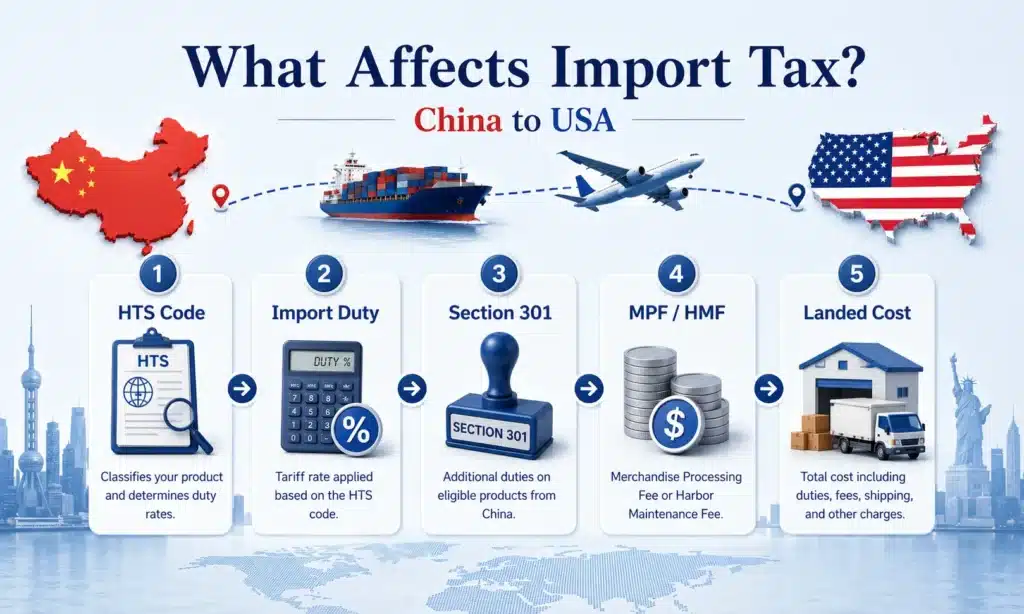
Last verified: July 22, 2026. Import tax from China to USA is not one fixed percentage applied to every shipment. Instead, the final amount depends on the product’s U.S. HTS classification, customs value, country of origin, normal duty rate, applicable Chapter 99 measures, entry type and shipping method.
For many commercial imports, the government charges may include normal customs duty, an additional Section 301 tariff, Merchandise Processing Fee and, for qualifying ocean imports, Harbor Maintenance Fee. Meanwhile, customs-broker fees, bond premiums, carrier advancement fees and delivery charges are service costs rather than import duty.
Therefore, importers should calculate each charge separately. A freight quotation only explains transportation costs unless it clearly includes customs duty, additional tariffs, customs entry and final delivery under a defined DDP or landed service.
This guide shows how to find a U.S. HTS code, read the tariff result, check Chapter 99 and Section 301 treatment, calculate Duty, MPF and HMF, and distinguish low-value, informal and formal entries. For transportation rates, read the separate China to USA shipping cost guide.
Need a freight and import-cost estimate? Send the product name, photos, material, intended use, commercial value, supplier location, carton details, shipping method and U.S. ZIP code through the VoltFreight contact page. When available, also provide the proposed HTS code for review by the U.S. importer or licensed customs broker.
Quick Answer: How Much Import Tax Will You Pay?
You cannot determine the import tax from the product value alone. First, identify the correct 10-digit U.S. HTS code. Next, confirm the customs value and country of origin. Afterwards, check the normal duty rate and any applicable Chapter 99 measures, including Section 301 or other current trade remedies.
A practical calculation may include:
- Normal customs duty: Customs value multiplied by the HTS duty rate
- Section 301 or another additional tariff: Customs value multiplied by the applicable additional rate
- MPF: A CBP processing fee calculated differently for formal and informal entries
- HMF: A port-use fee that applies to many qualifying ocean imports
- Customs bond: A separate surety cost that many formal entries require
- Broker fee: A service charge for preparing and submitting the customs entry
For example, a product may carry a normal duty rate of 5% and an additional Section 301 rate of 25%. In that case, the importer may pay both charges on the same customs value, plus MPF and any other applicable fees.
However, the example does not mean every China-origin product has a combined 30% tariff. Some products have no normal duty, some face different additional rates, and certain goods may qualify for a current exclusion. The importer must check the exact HTS and Chapter 99 treatment before entry.
Last Verified Policy Information
U.S. tariff and entry rules change frequently. Therefore, this page records the information checked during the latest review.
- Verification date: July 22, 2026
- Current HTS version checked: 2026 HTS Revision 11, published July 1, 2026
- Formal-entry MPF: 0.3464% of merchandise value, with a fiscal-year 2026 minimum of USD 33.58 and maximum of USD 651.50
- Manual-entry surcharge: USD 4.03 where applicable
- Informal-entry MPF: A fixed amount that can be USD 2.69, USD 8.06 or USD 12.09, depending on the processing method
- HMF: 0.125% of the value of qualifying commercial cargo loaded or unloaded at a covered U.S. port
- Low-value commercial shipments: Low value does not automatically mean duty-free under the current rules
- Selected Section 301 exclusions: Certain exclusions have been extended through November 10, 2026
Because USITC, CBP and USTR can publish further changes, importers should recheck these items immediately before customs entry.
Import Tax vs Shipping Cost: What Is the Difference?
Import tax and shipping cost are separate parts of the transaction. Mixing them together makes quotations difficult to compare.
Shipping Cost
Shipping cost pays for moving the goods. Depending on the quotation, it may include:
- China supplier pickup
- Origin warehouse handling
- Export customs support
- Sea freight, air freight or express transportation
- Destination handling
- Final truck or courier delivery
Import Tax
Import tax generally refers to government charges connected with importing the merchandise. These can include:
- Normal customs duty
- Section 301 tariffs
- Other applicable Chapter 99 tariffs
- Merchandise Processing Fee
- Harbor Maintenance Fee
Customs Service Costs
Customs service costs are not the same as government duty. They may include:
- Customs-broker fee
- Single-entry or continuous bond premium
- Courier duty-advancement fee
- Document preparation fee
- Government-agency filing support
Landed Cost
Landed cost combines the product price, origin costs, international freight, import charges, customs service costs and delivery to the final address.
Consequently, a USD 2,000 freight quotation and a USD 2,000 customs-value calculation answer different questions. Use the China to USA shipping cost page for transportation planning and this page for import-charge calculations.
What Charges Can Apply to Imports from China?
| Charge | Basic Calculation | When It May Apply | Type of Cost |
|---|---|---|---|
| Normal Import Duty | Customs value × HTS duty rate | When the applicable HTS subheading carries a duty rate | Government charge |
| Section 301 or Other Chapter 99 Tariff | Customs value × applicable additional rate | When the product, origin and Chapter 99 provision meet the tariff conditions | Government charge |
| Formal-Entry MPF | Customs value × 0.3464%, subject to current minimum and maximum | Many formal consumption entries | CBP user fee |
| Informal-Entry MPF | Fixed fee based on processing method | Eligible informal entries | CBP user fee |
| HMF | Customs value × 0.125% | Many qualifying commercial ocean imports through covered U.S. ports | Port-use fee |
| Customs Bond | Quoted by broker or surety | Many formal entries and certain regulated shipments | Surety or service cost |
| Customs-Broker Fee | Quoted according to entry scope | When a licensed broker prepares or submits the entry | Professional service cost |
Important: Customs exams, port storage, demurrage, detention and final delivery are not import-tax formulas. They are event-based logistics expenses that may occur during clearance or delivery.
How to Find the Correct U.S. HTS Code
The HTS code controls the normal duty rate and often determines whether an additional tariff applies. Therefore, finding the correct classification is the first step in any China tariff calculation.
Step 1: Describe the Product Precisely
Start with a clear commercial description. Avoid vague terms such as “parts,” “accessories,” “samples” or “electronic products.” Instead, explain:
- What the product is
- What material or materials it contains
- Its primary function
- Its intended user or application
- Whether it forms part of another machine or product
- How the buyer sells or uses it
For example, “stainless-steel mounting bracket for solar panels” provides more classification information than “metal parts.”
Step 2: Collect Technical Information
Depending on the product, prepare:
- Product photos
- Material composition
- Technical specification
- Model number
- Power rating or voltage
- Dimensions
- Manufacturing method
- Product manual
- Supplier product link
- Explanation of end use
Apparel may require fibre composition, gender, garment type and construction method. Machinery parts may require the machine type, component function and material. Electronics may require technical function, battery details and communication features.
Step 3: Search the Official USITC HTS
Open the official USITC Harmonized Tariff Schedule search. Enter a specific product term rather than the supplier’s generic description.
For instance, searching “plastic storage box” may provide more useful results than searching “household products.” Try relevant synonyms when the first search produces no clear result.
Step 4: Review the Four-Digit Heading
The four-digit heading identifies a broad product family. Read the heading text and relevant Section and Chapter Notes before selecting a narrower subheading.
The notes matter because they may exclude a product that appears to match the heading name. Classification follows the legal tariff language, not only keyword similarity.
Step 5: Follow the Hierarchy to the 10-Digit HTS
Continue through the six-digit and eight-digit subdivisions until you reach the applicable 10-digit U.S. statistical reporting number.
Do not select the first result merely because the wording sounds close. Compare alternative provisions and review material, function and product-specific requirements.
Food products require more than an HTS duty check because FDA facility registration, Prior Notice, ingredient and labeling requirements, and possible USDA controls may also apply. For the broader compliance and shipping process, review our guide to food imports from China to the USA.
Step 6: Read the Duty and Chapter 99 Information
After locating the likely HTS code, check:
- General duty rate
- Special duty treatment
- Column 2 rate
- Applicable footnotes
- Chapter and Section Notes
- Any Chapter 99 references
- Additional tariff measures
Step 7: Confirm the Classification
The importer remains responsible for using reasonable care. Therefore, send the proposed code and supporting product information to a licensed customs broker or qualified classification specialist.
When classification remains uncertain or commercially important, the importer may consider requesting a binding ruling from U.S. Customs and Border Protection.
How to Read a USITC HTS Search Result
The USITC result contains several columns and legal levels. Understanding them prevents common calculation errors.
HTS Number and Description
The number identifies the tariff provision, while the description defines the goods covered by that provision. Indentation shows the hierarchy from broad headings to specific subheadings.
Unit of Quantity
The tariff may require reporting by units such as kilograms, number of pieces, square metres or another measurement. Although the quantity unit may not determine the ad valorem duty, the customs entry still needs accurate reporting.
General Duty Rate
The General rate usually applies to goods from countries that receive normal trade relations treatment, subject to other applicable tariff measures.
A rate may appear as:
- Free
- A percentage of customs value
- A specific amount per unit
- A compound rate combining a percentage and a specific charge
Special Duty Rate
The Special column covers qualifying goods under specific trade programmes or agreements. China-origin goods do not automatically qualify for a special rate merely because the supplier claims one.
Column 2 Rate
Column 2 applies to designated countries under different tariff treatment. It is not the standard rate used merely because the goods originate in China.
Chapter 99
Chapter 99 contains temporary, additional or special tariff provisions. A product may have a normal classification in Chapters 1–97 and also require one or more Chapter 99 lines.
Therefore, reading only the normal HTS duty rate may understate the actual tariff. Always check current Chapter 99 treatment and trade-remedy instructions.
Customs Value: What Amount Is Taxed?
Importers calculate ad valorem duties from customs value, not automatically from the full delivered or CIF price.
Transaction Value
CBP generally prefers transaction value when the transaction qualifies. In simple terms, it starts with the price actually paid or payable for the merchandise when sold for export to the United States.
Possible Additions
Depending on the transaction, customs value may require additions for items such as:
- Packing costs incurred by the buyer
- Selling commissions
- Assists supplied by the buyer
- Certain royalties or licence fees
- Proceeds that later return to the seller
Assists can include moulds, tools, components, design work or production materials that the buyer provides free or at reduced cost for manufacturing the imported goods.
International Freight and Insurance
International freight and insurance are generally not part of the value declared to CBP when the importer can identify and support them separately.
Therefore, a CIF invoice should not automatically become the customs value. Ask the supplier or forwarder to separate the product price, international freight and insurance clearly.
Do Not Undervalue the Shipment
Customs value should reflect the legitimate transaction and applicable valuation rules. Artificially reducing the invoice value to lower duty can create penalties, delayed clearance and additional liability.
Moreover, a DDP quotation does not give the seller or forwarder permission to declare an inaccurate value.
How to Check Section 301 and Other Additional Tariffs
Section 301 is an additional tariff programme that affects selected China-origin products. However, importers should not assume that every Chinese product carries the same extra rate.
1. Confirm the Normal HTS Classification
Begin with the correct 10-digit HTS number. Section 301 checking cannot replace normal classification.
2. Review Current USTR and CBP Guidance
Use the official USTR China Section 301 tariff actions page and current CBP trade-remedy instructions.
3. Identify the Applicable Chapter 99 Provision
If the product falls within a Section 301 list, the customs entry usually reports both:
- The normal product HTS code
- The applicable Chapter 99 tariff number
The Chapter 99 number tells CBP which additional measure applies.
4. Check the Additional Rate
Different products can face different additional rates. Therefore, do not copy a 7.5% or 25% rate from another product without checking the legal provision.
5. Check Current Exclusions
Certain products may qualify for a valid exclusion when their descriptions and conditions match. As of the verification date, USTR has extended 178 exclusions through November 10, 2026.
However, an exclusion does not apply merely because the product appears similar. The importer must compare the exact exclusion wording, HTS scope and effective dates.
6. Check Other Chapter 99 Measures
Section 301 may not be the only additional measure. Depending on the product and current policy, other Chapter 99 tariffs or trade remedies can apply.
Consequently, an online calculator that checks only the normal duty rate and Section 301 can still miss part of the customs liability.
Import Duty Calculation Formula
Once the importer confirms the HTS code, customs value and additional tariff treatment, the calculation becomes more structured.
Normal Duty
Normal Duty = Customs Value × General Duty Rate
Section 301 or Another Ad Valorem Tariff
Additional Tariff = Customs Value × Applicable Additional Rate
Formal-Entry MPF
Calculated MPF = Customs Value × 0.3464%
Next, apply the fiscal-year minimum and maximum:
- If the calculated result is below USD 33.58, use USD 33.58.
- If the calculated result is between USD 33.58 and USD 651.50, use the calculated amount.
- If the calculated result exceeds USD 651.50, use USD 651.50.
- Add the USD 4.03 surcharge when a manual formal entry requires it.
HMF for Qualifying Ocean Imports
HMF = Customs Value × 0.125%
HMF generally relates to qualifying cargo that moves through covered U.S. ports. It does not normally apply to cargo arriving by air.
Estimated Government Customs Charges
Estimated Government Charges = Normal Duty + Applicable Chapter 99 Tariffs + MPF + HMF
Finally, add the customs bond, broker fee, carrier charges and transportation costs to estimate the broader landed cost.
Three Import Tax Calculation Examples
The following examples use hypothetical duty and additional-tariff rates to demonstrate the formulas. They do not assign a real tariff to a specific product. Confirm the actual HTS and Chapter 99 treatment before entry.
Example 1: Air Freight Commercial Shipment
Assume a China-origin product arrives by air with:
- Customs value: USD 10,000
- Hypothetical normal duty rate: 5%
- Hypothetical Section 301 rate: 25%
- Entry type: Formal
- Shipping method: Air freight
Normal Duty
USD 10,000 × 5% = USD 500
Section 301 Tariff
USD 10,000 × 25% = USD 2,500
MPF
USD 10,000 × 0.3464% = USD 34.64
The result exceeds the fiscal-year minimum and remains below the maximum. Therefore, MPF equals USD 34.64.
HMF
The shipment arrives by air, so this example does not add HMF.
Estimated Government Customs Charges
USD 500 + USD 2,500 + USD 34.64 = USD 3,034.64
The total does not include the customs-broker fee, bond premium, airline terminal charges or final delivery.
Example 2: Ocean Freight Formal Entry
Assume a China-origin ocean shipment has:
- Customs value: USD 50,000
- Hypothetical normal duty rate: 2.5%
- Hypothetical additional tariff rate: 7.5%
- Entry type: Formal
- Shipping method: Sea freight
Normal Duty
USD 50,000 × 2.5% = USD 1,250
Additional Tariff
USD 50,000 × 7.5% = USD 3,750
MPF
USD 50,000 × 0.3464% = USD 173.20
HMF
USD 50,000 × 0.125% = USD 62.50
Estimated Government Customs Charges
USD 1,250 + USD 3,750 + USD 173.20 + USD 62.50 = USD 5,235.70
Again, customs-broker, bond, port, ISF, drayage and delivery costs remain separate. For ocean-process details, review sea freight from China to USA.
Example 3: Low-Value Informal Air or Courier Entry
Assume an eligible shipment has:
- Customs value: USD 1,200
- Hypothetical normal duty rate: 4%
- Hypothetical additional tariff rate: 25%
- Entry type: Informal
- Shipping method: Air or express courier
Normal Duty
USD 1,200 × 4% = USD 48
Additional Tariff
USD 1,200 × 25% = USD 300
Informal-Entry MPF
Depending on the processing method, CBP’s fixed fee may be USD 2.69, USD 8.06 or USD 12.09.
Estimated Government Charges
USD 48 + USD 300 + applicable informal MPF = approximately USD 350.69–360.09.
This example shows why a shipment valued below USD 2,500 can still owe duty. Informal entry describes a simplified entry process; it does not automatically create a duty exemption.
Low-Value, Informal and Formal Entries
Importers should separate three concepts: low value, informal entry and duty-free treatment. They do not mean the same thing.
Low Value Does Not Automatically Mean Duty-Free
Under the current policy environment, importers should not assume that a commercial shipment receives duty-free treatment merely because its value falls below USD 800 or USD 2,500.
CBP stated in June 2026 that shipments valued at USD 2,500 or less currently remain subject to applicable duties, except for qualifying genuine gifts valued at USD 100 or less.
Informal Entry
CBP commonly uses informal entry procedures for eligible personal or commercial shipments valued below USD 2,500.
However, some products cannot use the simplified process. Quota merchandise, antidumping or countervailing duty goods, restricted items and shipments subject to certain agency requirements may require formal entry regardless of value.
Formal Entry
Shipments exceeding USD 2,500 generally require formal entry. In addition, CBP may require formal entry for regulated or specially treated merchandise below that value.
Formal entry commonly requires:
- Importer information
- Customs bond
- Commercial invoice
- Packing list
- HTS classification
- Entry summary
- Applicable agency filings
Gift Exception
A genuine personal gift is not the same as commercial merchandise, an online order, a sample for business use or inventory split into small parcels.
Therefore, importers should not describe commercial goods as gifts to avoid duty or entry requirements.
Sea Freight vs Air Freight vs Express Customs Charges
The shipping method normally does not determine the underlying HTS duty rate. Nevertheless, it affects the entry process and some additional fees.
Sea Freight
Sea freight may involve:
- Normal duty
- Section 301 or other Chapter 99 tariffs
- MPF
- HMF
- Customs bond and broker fee
- ISF filing
- Port and terminal charges
HMF and ISF are closely associated with ocean imports, but neither replaces normal duty or Section 301.
Air Freight
Air cargo can still owe normal duty, additional tariffs and MPF. However, the calculation normally excludes HMF because the shipment does not arrive through a vessel port.
Airline terminal, storage and final-delivery fees remain logistics charges rather than import duty.
Express Courier
DHL, UPS and FedEx may advance duties and taxes to CBP and then bill the receiver. As a result, the courier invoice can include:
- Duty and additional tariffs
- Informal or formal processing charges
- Duty-advancement or disbursement fee
- Brokerage or special-entry fee
A courier’s advancement fee is not a government tariff. It is a carrier service charge.
For small-parcel route planning, review express shipping from China to USA.
Is Import Tax Included in DDP Shipping?
DDP shipping can include import duty and tax, but importers should never assume that every DDP quotation uses the same customs scope.
Before accepting a DDP price, ask:
- Who acts as the Importer of Record?
- Which HTS code supports the quotation?
- Does the price include normal duty?
- Does it include Section 301 and other applicable Chapter 99 tariffs?
- Does it include MPF and HMF where applicable?
- Does it include customs bond and broker service?
- Does it include final delivery to the confirmed ZIP code?
- Who pays for customs exams, storage or re-delivery?
- What happens if CBP changes the classification or customs value?
A transparent DDP provider should separate the customs assumptions from the freight assumptions. Moreover, the provider should not rely on vague product descriptions or artificial invoice values.
For a complete service-scope explanation, read DDP shipping from China to USA.
Common Import Tax Calculation Mistakes
Using the Supplier’s China HS Code Without Review
A Chinese export code may provide a starting point, but the U.S. importer must classify the goods under the U.S. HTS.
Reading Only the Normal Duty Rate
The General rate may show “Free” while Chapter 99 adds a separate tariff. Therefore, always check additional measures.
Assuming Every China Product Has a 25% Tariff
Section 301 treatment varies by classification, list, effective date and exclusion status. Applying one rate to every product produces unreliable estimates.
Forgetting the MPF Minimum or Maximum
Multiplying customs value by 0.3464% is only the first step. Afterwards, compare the result with the current minimum and maximum.
Adding HMF to Air Freight
HMF relates to qualifying port use and generally should not appear in a standard air-freight tax calculation.
Treating Broker and Bond Fees as Duty
A broker fee and bond premium affect landed cost, but they are not the product’s customs-duty rate.
Using the Full CIF Total as Customs Value
When supported and shown separately, international freight and insurance generally do not form part of the declared merchandise value.
Assuming Informal Entry Means Duty-Free
A shipment below USD 2,500 may use informal procedures while still owing normal duty and additional tariffs.
Using an Old HTS Version
USITC can publish several revisions during one year. Always check the current release and effective date before entry.
Ignoring Country of Origin
Shipping from China does not always prove Chinese origin, while routing China-origin goods through another country does not automatically change their origin.
Under-Declaring the Invoice
An artificially low value can trigger questions, delays, additional duty and enforcement action.
How VoltFreight Supports Freight and Import-Cost Planning
VoltFreight coordinates transportation from Chinese suppliers to U.S. ports, airports, warehouses and business addresses. Although a freight forwarder does not replace the importer or licensed customs broker, early logistics planning can improve the accuracy of the customs review.
Product Information Collection
Our team can collect the product description, photos, material, use, model and supplier information required for broker review.
Commercial Document Review
Before departure, VoltFreight can check whether the commercial invoice and packing list match the cargo information provided for transportation.
Freight and Tax Separation
We separate international transportation charges from estimated import charges so that the importer can compare quotations under the same scope.
DDP and Non-DDP Comparison
Where suitable, VoltFreight can compare a DDP route with a non-DDP shipment in which the buyer uses its own Importer of Record and customs broker.
Customs-Broker Coordination
For non-DDP shipments, we can coordinate documents and arrival information with the importer’s appointed U.S. customs broker.
Final Delivery Planning
After customs release, VoltFreight can arrange delivery to a commercial warehouse, 3PL, Amazon facility or another confirmed address, subject to local service availability.
For detailed entry procedures, bonds, documents and Importer of Record responsibilities, visit USA customs clearance from China.
Information Needed for a Freight and Tax Estimate
- Specific product name
- Product photos and link
- Material and composition
- Function and intended use
- Model and technical specification
- Proposed HS or HTS code
- Country of origin
- Commercial invoice value and currency
- Carton quantity, dimensions and weight
- Supplier address in China
- Shipping method
- Final U.S. ZIP code
- Battery, liquid, chemical or regulated-product information
- Existing customs broker and bond information
Once these details are available, the importer or broker can review classification and tariffs while VoltFreight prepares the transportation plan.
Related China-to-USA Guides
- Shipping from China to USA — Compare the main transportation options.
- China to USA Shipping Cost — Compare sea, air, express and delivery costs.
- USA Customs Clearance from China — Understand IOR, customs bonds, entry documents and release.
- Sea Freight from China to USA — Review FCL, LCL, ISF, ports and ocean delivery.
- Express Shipping from China to USA — Plan courier and low-value commercial shipments.
- DDP Shipping from China to USA — Check duty-paid scope and importer responsibility.
- Package Stuck in Customs from China — Understand document requests, inspections and clearance delays.
- Request a Freight and Import-Cost Estimate — Send product, cargo and destination information.
FAQ About Import Tax from China to USA
How much is import tax from China to USA?
There is no single tax rate for every China-origin product. The amount depends on the U.S. HTS code, customs value, normal duty rate, applicable Chapter 99 tariffs, MPF, HMF and entry type. Broker and bond fees may also increase landed cost, although they are not customs duty.
How do I find the correct HTS code?
Prepare the product name, material, function, use, technical information and photos. Next, search the official USITC HTS, review the headings and legal notes, follow the hierarchy to the 10-digit code and check the duty and Chapter 99 information. Finally, ask the importer or licensed customs broker to confirm the classification.
How do I calculate Duty, Section 301, MPF and HMF?
Multiply customs value by the normal duty rate, then calculate any applicable additional tariff separately. For a formal entry, calculate MPF at 0.3464% and apply the current minimum and maximum. For a qualifying ocean import, calculate HMF at 0.125%. Add the results to estimate government customs charges.
Are low-value shipments from China duty-free?
Do not assume so. Under current CBP policy, low-value commercial shipments can still owe applicable duties. Eligible shipments below USD 2,500 may use informal entry procedures, but informal entry does not automatically mean duty-free treatment.
Does DDP include all U.S. import taxes?
It depends on the written quotation. Confirm whether the DDP price includes normal duty, Section 301 and other Chapter 99 tariffs, MPF, HMF, customs bond, brokerage and final delivery. The quote should also identify the Importer of Record and explain responsibility for customs exams or extra charges.
Conclusion
Import tax from China to USA starts with product classification, not with the freight rate. First, identify the correct U.S. HTS code. Next, confirm customs value and country of origin. Then, check the normal duty rate, Chapter 99 measures, Section 301 treatment and any current exclusion.
Afterwards, calculate each charge separately. Normal duty and additional tariffs use the applicable customs value. Formal-entry MPF uses its percentage, minimum and maximum, while HMF applies to many qualifying ocean imports.
Low value does not automatically mean duty-free, and informal entry does not remove applicable tariffs. Likewise, DDP does not guarantee that every tax or customs expense appears in the price unless the quotation clearly defines the scope.
To prepare a more reliable shipment plan, contact VoltFreight with the product details, invoice value, cargo information, supplier address, shipping method and final U.S. ZIP code.
Official Information Sources
- USITC: Current Harmonized Tariff Schedule Search
- USITC: HTS Revision Announcements
- USTR: China Section 301 Tariff Actions and Exclusions
- USTR: Section 301 Exclusions Extended to November 2026
- CBP: Merchandise Processing Fee
- CBP: Harbor Maintenance Fee
- CBP: Informal Entries Below USD 2,500
- CBP: Current Low-Value Shipment Processing
- CBP: Customs Value and CIF Freight
- CBP: E-Commerce and Formal Entry Requirements
Important disclaimer: This guide provides general freight and import-cost planning information. It is not legal, tax or customs-classification advice. HTS classification, customs value, country of origin, Chapter 99 treatment, tariff exclusions, agency requirements and entry type depend on the facts of each shipment and current U.S. rules. Always confirm the final entry with the Importer of Record, licensed customs broker or qualified trade-compliance adviser before shipping.