Shipping from China to Singapore
Get a tailored freight route from China based on your cargo details, destination, timeline and budget. VoltFreight supports pickup, consolidation, customs guidance and final delivery planning.
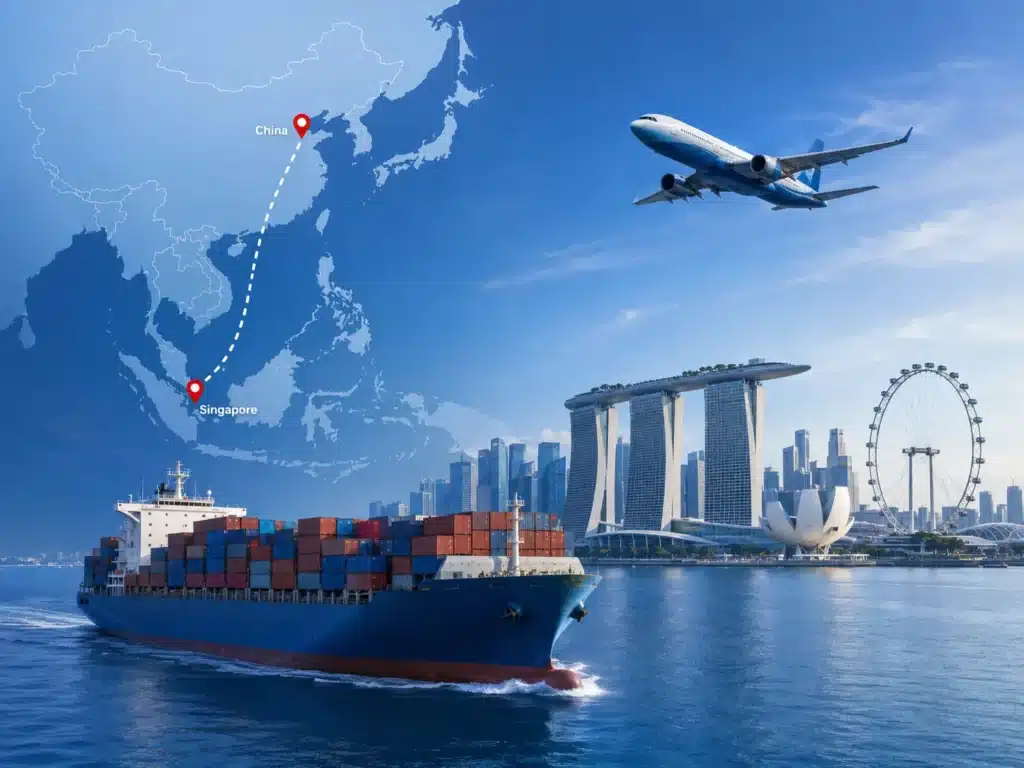
Shipping from China to Singapore by sea freight, air freight, express courier, DDP and door-to-door delivery. VoltFreight helps importers compare the right China-to-Singapore freight route, arrange supplier pickup, consolidate cargo, prepare customs documents and plan delivery to Tuas, Jurong, Woodlands, Changi, CBD and Singapore warehouse addresses.
Send your cargo name, weight, carton dimensions, supplier city and Singapore delivery address. Our team will help review LCL, FCL, air freight, express courier, GST scope, import permit requirements and final delivery options before booking.
- Supplier pickup and warehouse receiving in China
- Cargo consolidation from multiple suppliers
- Customs document review and final delivery planning
Review available freight options, route details, customs notes and planning information for this destination.
Shipping from China to Singapore: Build the Right Freight Plan Before You Book
Shipping from China to Singapore can be arranged by sea freight, air freight, express courier, DDP and door-to-door delivery. The right method depends on cargo size, urgency, product type, chargeable weight, GST scope, import permit requirements, supplier location in China and the final Singapore delivery address.
Although Singapore is close to China, choosing the wrong freight method can still increase cost or create unnecessary handling. Small urgent parcels may work better by courier, urgent commercial cargo may suit air freight, while larger or regular inventory often moves more economically by LCL or FCL sea freight.
VoltFreight helps importers, wholesalers, e-commerce sellers, manufacturers and B2B buyers compare practical China-to-Singapore routes before booking. We review cargo weight, CBM, carton dimensions, HS code, product description, declared value, supplier city, customs responsibility and the Singapore delivery location before recommending a route.
Get a China-to-Singapore Freight Quote Before Booking
Not sure whether sea freight, air freight, express courier or DDP is better for your shipment? Send us the product name, carton quantity, gross weight, carton dimensions, supplier city and Singapore delivery address through our contact page. VoltFreight can compare the freight method, estimated transit time, customs scope and final delivery plan before you book.
You can also review our related services for ocean freight from China, air freight from China, express freight and door-to-door shipping from China.
Compare Shipping Methods from China to Singapore
The best shipping method is not always the lowest rate on paper. Shipment size, cargo value, urgency, customs readiness, product category and final delivery requirements can change the real landed cost.
| Shipping Need | Recommended Method | Why It Makes Sense |
|---|---|---|
| Large inventory or factory orders | Sea Freight / FCL | Better for larger cargo volume, regular replenishment and lower unit freight cost. |
| Smaller commercial cargo | LCL Sea Freight | Useful when the cargo does not fill a container but is too large for normal courier pricing. |
| Urgent replenishment | Air Freight | Suitable for time-sensitive stock, spare parts, electronics and higher-value commercial cargo. |
| Documents, samples and small parcels | Express Courier | DHL, FedEx, UPS and other courier networks can provide fast parcel delivery. |
| E-commerce stock | Air / Sea / DDP Review | The right route depends on chargeable weight, CBM, deadline, GST scope and final address. |
| Goods from several suppliers | China Consolidation + Sea or Air | Combining cargo in China can reduce repeated freight costs and simplify export coordination. |
| Controlled or sensitive products | Route Review Before Booking | HS code, product details, permits and carrier acceptance may need review first. |
Need Help Choosing the Route?
Send the final packing details before paying for freight. VoltFreight can compare LCL, FCL, air freight, courier and door delivery based on the actual shipment instead of using a one-size-fits-all recommendation.
Sea Freight from China to Singapore: FCL and LCL for Commercial Cargo
Sea freight from China to Singapore is usually the first option to compare for heavy, bulky or non-urgent commercial cargo. It can work well for machinery, furniture, building materials, home goods, industrial parts, packaging materials, pallets, wholesale stock and regular e-commerce replenishment.
Singapore is one of the world’s major maritime hubs. The Maritime and Port Authority of Singapore reported record container throughput of 41.12 million TEUs in 2024. For China exporters, this strong port network supports frequent container and LCL connections into Singapore.
Common China origin ports include Shenzhen, Guangzhou, Ningbo, Shanghai, Qingdao, Tianjin and Xiamen. The best port depends on supplier location, cargo volume, sailing schedule, container availability and the final Singapore delivery area.
FCL Shipping from China to Singapore
FCL shipping means Full Container Load. A dedicated 20ft, 40ft or 40HQ container can be practical when the cargo volume is large enough or when the importer wants fewer mixed-cargo handling steps.
- Factory orders and regular B2B inventory
- Palletized cargo, machinery, furniture and building materials
- Large retail or e-commerce stock
- Cargo that benefits from container sealing and fewer handling steps
- Orders where the total CBM justifies a dedicated container
Before booking FCL, confirm the total CBM, gross weight, container type, loading method, HS code, commercial invoice, packing list and final delivery requirements. Warehouse appointments and unloading conditions in Singapore should also be checked before the container moves inland.
LCL Shipping from China to Singapore
LCL shipping means Less than Container Load. Your cargo shares container space with other shipments, so it can reduce cost when the volume does not justify a full container.
- Small and medium commercial shipments
- Regular B2B stock that is not extremely urgent
- Multi-supplier orders consolidated in China
- Goods that are too large or costly for courier service
- Importers that want lower cost than air freight without waiting for a full container
LCL may not be ideal when the goods are urgently required, extremely high-value, very fragile or difficult to handle in a shared consolidation environment. VoltFreight compares CBM, gross weight, packing method and delivery deadline before recommending LCL instead of air or courier.
Air Freight from China to Singapore: Cost, Changi Airport and Transit Time
Air freight from China to Singapore is a strong option for urgent commercial cargo that needs faster delivery than sea freight but is too large, heavy or valuable for normal courier pricing. Importers commonly use air freight for electronics, spare parts, fashion goods, machinery components, samples, product-launch stock, urgent replenishment and other time-sensitive cargo.
Singapore Changi Airport (SIN) is the country’s main international air-cargo gateway. Changi Airport Group describes its cargo zone as an integrated logistics gateway with a 24/7 Free Trade Zone, dedicated freighter infrastructure and substantial warehouse capacity. That concentration makes Singapore different from markets where several competing destination airports must be compared.
When Air Freight Makes Sense
- Sea freight is too slow for the required delivery date.
- The shipment contains urgent replenishment or production parts.
- The cargo is higher-value and the inventory cost supports air freight.
- The shipment has several commercial cartons and courier rates are becoming expensive.
- The importer has a Singapore customs and pickup arrangement and wants airport-to-airport service.
- The buyer needs a faster airport-to-door or reviewed air DDP solution.
Air Freight Cost from China to Singapore
Air freight is quoted by chargeable weight. Larger shipments normally receive a lower rate per kilogram, while small shipments may face airline and terminal minimum charges.
The table below is a market-planning reference only based on public China-to-Singapore general-cargo ranges observed during May to July 2026. It is not a live VoltFreight quotation and should not be used as a booking price.
| Chargeable Weight | Broad Planning Range | Typical Use |
|---|---|---|
| 45–99 kg | About USD 2.50–4.50/kg | Urgent cartons, samples and higher-value commercial cargo |
| 100–299 kg | About USD 2.20–4.00/kg | Electronics, spare parts and inventory replenishment |
| 300–499 kg | About USD 2.00–3.50/kg | Medium commercial shipments |
| 500 kg+ | About USD 1.80–3.30/kg | Larger commercial air cargo |
Actual rates can move quickly because of airline space, fuel surcharge, peak season, cargo density, routing, product restrictions and departure airport. Sensitive cargo, batteries, oversized pieces and non-stackable freight may follow different pricing or acceptance rules.
China Airports to Singapore Changi SIN
The best China departure airport is not always the airport geographically closest to the supplier. We compare trucking distance, airline capacity, cargo acceptance, cutoff time and the final chargeable weight before booking.
Shanghai PVG → Singapore SIN: useful for suppliers in Shanghai, Suzhou, Kunshan, Hangzhou, Ningbo and the wider Yangtze River Delta. PVG offers extensive international cargo capacity and is often worth comparing for larger commercial shipments.
Guangzhou CAN → Singapore SIN: practical for cargo from Guangzhou, Foshan and nearby South China factories. It can be especially convenient when the supplier is already located in the Guangzhou manufacturing area.
Shenzhen SZX → Singapore SIN: a natural option for Shenzhen, Dongguan and Pearl River Delta electronics, components and e-commerce cargo. Domestic trucking to the airport can be short when suppliers are located in Shenzhen or nearby industrial cities.
Hong Kong HKG → Singapore SIN: can be reviewed when Hong Kong airline capacity, special-cargo acceptance or routing makes commercial sense. However, mainland China cargo needs additional trucking and cross-border handling into Hong Kong, so the total origin cost must be compared with SZX or CAN.
Other China gateways: Beijing, Zhengzhou, Xiamen, Wuhan and other airports may also be used when supplier location, airline service or cargo characteristics support the route.
Airport-to-Airport vs Airport-to-Door Air Freight
Airport-to-airport air freight is often suitable for experienced Singapore importers that already have a local declaring agent, import permit process and delivery provider. VoltFreight coordinates the China export side and international air movement to Changi, while the importer controls Singapore customs clearance, terminal release and pickup according to the agreed scope.
Airport-to-door service adds destination coordination and local delivery after arrival. A reviewed Air DDP service may also be available for suitable cargo when the customer wants a broader landed-delivery structure. These services should not be confused with a simple airport freight rate because customs, GST and final delivery responsibilities are different.
Importers that already manage their own customs and trucking can also review our airport-to-airport air freight service.
Chargeable Weight: Actual Weight vs Volumetric Weight
Airlines compare actual gross weight with volumetric weight and normally charge the higher figure. For general air-cargo planning, a common calculation is:
Length × Width × Height in cm ÷ 6,000 = volumetric weight in kg
Example: 10 cartons measuring 80 × 60 × 55 cm each:
80 × 60 × 55 × 10 ÷ 6,000 = 440 kg volumetric weight.
If the actual total weight is 320 kg, the planning chargeable weight becomes 440 kg because the volumetric weight is higher. This is why final carton dimensions matter before booking.
You can also use our CBM and volumetric weight calculator for early shipment planning.
What Happens After Air Cargo Arrives at Changi?
After the aircraft arrives at Singapore Changi Airport, the cargo moves through the airline or ground-handling process and becomes available for customs and terminal release. The exact workflow depends on the service scope, importer arrangement and cargo type.
- The airline or handling agent processes the arriving cargo and arrival data.
- The Singapore importer or appointed declaring agent prepares the required customs declaration and import permit through TradeNet.
- GST, duty where applicable, and any required Competent Authority approval are handled under the importer’s customs arrangement.
- After customs and terminal requirements are complete, the cargo can be released.
- The consignee, local trucker or VoltFreight delivery partner collects the shipment and arranges final delivery under the agreed service.
Air cargo can reach Singapore quickly, so customs readiness should be checked before the flight departs China. Missing importer details, permit requirements or product approvals can erase the time advantage of air freight after arrival.
Express Shipping to Singapore: DHL, FedEx and UPS for Small Urgent Cargo
Express shipping from China to Singapore works well for documents, samples, replacement parts and small urgent commercial parcels. Courier networks can be easier than traditional air freight when the shipment is lightweight and the consignee wants integrated parcel delivery.
Courier Is Usually Better When
- The shipment is small and urgent.
- The consignee wants direct parcel delivery.
- You are shipping documents, samples or replacement parts.
- The product does not need complex cargo handling.
Compare Courier with Air Freight When
- The shipment contains many cartons.
- The chargeable weight is increasing quickly.
- You want airport-to-airport commercial air freight.
- The shipment needs a more structured customs and delivery plan.
VoltFreight can review DHL, FedEx and UPS options based on product type, declared value, weight and delivery address. Batteries, liquids, powders, cosmetics, branded goods, medical-related products, wireless devices, dangerous goods and controlled items may need additional review before acceptance.
DDP and Door-to-Door Shipping from China to Singapore
DDP shipping from China to Singapore and other door-to-door services can combine supplier pickup, export handling, international freight, customs coordination and final delivery under an agreed service structure. However, DDP should not be treated as a universal solution for every shipment.
When DDP May Be Useful
- You want one coordinated route from China pickup to Singapore delivery.
- The product information, HS code and declared value are clear.
- The GST, customs and delivery responsibilities can be confirmed before booking.
- The cargo is eligible for the reviewed DDP channel.
When DDP Needs Extra Review
- The goods are controlled or require a Competent Authority approval.
- The shipment contains batteries, liquids, food, cosmetics or wireless devices.
- The product description, HS code or declared value is unclear.
- The consignee is unsure which party should act as importer.
- The final delivery address has special unloading or appointment requirements.
For every DDP request, VoltFreight checks the product category, HS code, declared value, importer arrangement, GST scope, permit requirements and final delivery address before confirming whether a route is suitable.
Singapore Customs Clearance: Import Permit, TradeNet, GST and Controlled Goods
Singapore customs preparation should begin before the goods leave China. Commercial importers normally need accurate product information, HS classification, invoice data, packing details, consignee information and the correct import-permit arrangement.
UEN, Customs Account and TradeNet Import Permit
Singapore Customs states that importers must obtain the necessary Customs Import Permit through TradeNet. A business generally needs a Unique Entity Number (UEN) and an activated Customs Account before the permit application process. The importer can appoint a Declaring Agent to submit permits on its behalf or, if eligible and properly registered, make declarations through the TradeNet system.
Official reference: Singapore Customs – Obtain a Customs Import Permit.
Documents for China-to-Singapore Commercial Imports
The exact document set depends on the cargo and permit type, but commercial shipments commonly use:
- Commercial invoice
- Packing list
- Bill of Lading, Air Waybill or courier waybill
- HS code and clear product description
- Consignee and importer information
- Declared value and currency
- Import permit details
- Product licences, certificates or approvals when required
Product names such as “parts”, “accessories” or “samples” may be too vague when a more accurate description is available. Matching the invoice, packing list, HS code and real goods reduces the risk of permit or customs problems.
GST on Imported Goods in Singapore
The current Singapore GST rate is 9%. Singapore Customs explains that non-dutiable goods generally incur GST, while dutiable goods may incur both duty and GST. The final tax treatment depends on customs value, product type and the importer’s applicable GST arrangement.
Official references: IRAS current GST rate and Singapore Customs import procedures.
Dutiable Goods in Singapore
Singapore Customs identifies four main categories of dutiable goods: intoxicating liquors, tobacco products, motor vehicles, and petroleum products / biodiesel blends. Other goods may be non-dutiable but still subject to GST unless an exemption or approved scheme applies.
Official reference: Singapore Customs – Duties and Dutiable Goods.
Controlled Goods and Competent Authority Approval
Controlled goods may require approval, licence, certificate or other authorisation from the relevant Singapore Competent Authority. Importers should identify the correct HS code and check whether a Competent Authority requirement applies before the permit is submitted.
Official reference: Singapore Customs – Controlled Items and Competent Authorities.
Check Import Readiness Before Shipping
- Clear product name and intended use
- HS code or classification reference
- Commercial invoice and packing list
- Declared value and currency
- Singapore importer or consignee details
- UEN / Customs Account / declaring-agent arrangement
- TradeNet import permit responsibility
- GST and duty responsibility
- Controlled-goods status if applicable
- Final delivery address and contact person
Need help reviewing the shipping scope? Send the product name, HS code if available, invoice value and Singapore delivery address. VoltFreight can help identify the freight and documentation questions that should be clarified before booking.
Shipping Cost from China to Singapore: What Changes the Final Price?
The shipping cost from China to Singapore depends on the freight method, cargo weight, CBM, chargeable weight, China pickup city, product type, customs scope, GST arrangement, carrier capacity and the final delivery location.
| Cost Factor | Why It Matters |
|---|---|
| Shipping method | Sea, LCL, FCL, air, courier and DDP use different pricing structures. |
| Weight and dimensions | Air and courier use chargeable weight; sea freight depends more on CBM, container type and handling. |
| FCL or LCL | FCL may offer better control for larger cargo, while LCL can reduce cost for smaller volumes. |
| China pickup city | Supplier location affects domestic trucking and consolidation cost before export. |
| Singapore delivery area | Tuas, Jurong, Woodlands, Changi, CBD and appointment warehouses may require different local delivery planning. |
| Customs and GST scope | Airport-to-airport, port-to-port, DAP and DDP services allocate customs and tax responsibilities differently. |
| Product type | Batteries, controlled goods, oversized cargo and other special products may require additional review or handling. |
| Delivery requirements | Appointments, unloading, lift access, tail-lift requirements and restricted delivery hours can affect local cost. |
For an accurate quote, send the cargo name, carton quantity, gross weight, carton dimensions, supplier city, Singapore address and preferred service. Final packed data is more reliable than estimated production dimensions.
Shipping Time from China to Singapore
Transit time depends on pickup, warehouse receiving, export handling, sailing or flight schedule, customs readiness, permit approval, GST arrangement and final delivery. Use the following ranges for planning rather than as guaranteed delivery promises.
| Shipping Method | Planning Time | Best Use Case |
|---|---|---|
| Express Courier | About 2–5 business days | Documents, samples and urgent small parcels |
| Air Freight to Changi Airport | About 2–6 days | Urgent commercial cargo and importers with their own Singapore clearance / pickup arrangement |
| Air DDP / Air Door Delivery | About 4–10+ days | Urgent commercial cargo needing broader customs and final-delivery coordination |
| Sea Freight / LCL / FCL | About 7–18+ days | Larger, heavier or less urgent cargo |
Customs inspections, missing product details, permit delays, carrier capacity, airline space, port handling, holiday periods and delivery appointments can extend these ranges.
Singapore Delivery Areas: Tuas, Jurong, Woodlands, Changi and CBD
Freight planning should not stop at the port or Changi Airport. The final delivery address affects local trucking, appointment requirements, building access and unloading arrangements.
| Singapore Area | Common Cargo / Delivery Type | Planning Note |
|---|---|---|
| Tuas | Factories, industrial cargo, warehouses and heavier B2B shipments | Check vehicle access, unloading method and appointment requirements. |
| Jurong / Jurong East / Jurong West | Industrial, commercial and warehouse deliveries | Common for pallet, LCL, container and regular B2B inventory. |
| Woodlands | Northern warehouses, manufacturing and commercial addresses | Cost depends on cargo size, address type and unloading access. |
| Changi | Air cargo, express, electronics and airport-side logistics | Useful for urgent air freight and airport-related delivery. |
| Tampines / Paya Lebar | Commercial, retail and e-commerce deliveries | Address type and delivery restrictions should be checked. |
| CBD / Downtown Core | Offices, showrooms and small commercial deliveries | Parking, loading-bay and delivery-time restrictions may apply. |
| Pasir Panjang / Keppel | Port-related, logistics and warehouse cargo | Often relevant to sea-freight and distribution operations. |
Shipping from Alibaba, 1688 and Chinese Suppliers to Singapore
Singapore buyers often source goods from Alibaba, 1688, Yiwu, Shenzhen electronics suppliers, Guangzhou and Foshan factories, Ningbo manufacturers and other China trading or production centers.
How China Consolidation Helps
- Receive goods from several suppliers at one China warehouse
- Reduce repeated international freight bookings
- Check carton quantity, gross weight and dimensions before export
- Compare LCL, FCL, air freight and courier after all cargo is ready
- Coordinate export documents under a clearer shipment plan
VoltFreight can arrange supplier pickup, warehouse receiving and consolidation in China. Before combining the shipments, we check the product type, carton data and whether any goods need special transport or customs review.
Cargo That Needs Extra Review Before Shipping to Singapore
Some products are not suitable for a standard general-cargo route without additional review. This does not automatically mean they cannot be shipped; it means the freight, airline, carrier, permit or compliance requirements should be checked before booking.
- Batteries and dangerous goods: battery-powered products, standalone batteries, chemicals and other regulated cargo may need transport documents and carrier acceptance.
- Wireless and telecom products: product type and Singapore Competent Authority requirements may need review.
- Food, cosmetics and medical-related products: local product regulation or import approval may apply.
- Branded or high-value goods: invoices, product descriptions and authorisation may need additional checking.
- Oversized and heavy cargo: airline acceptance, special handling, forklift, crane or local delivery planning can affect the route.
- Controlled products: check the HS code and relevant Singapore Competent Authority requirements before shipping.
For detailed permit and controlled-goods information, refer to the Singapore Customs section above rather than relying on a general freight quotation.
Why Singapore Importers Use VoltFreight
VoltFreight helps customers compare the complete route instead of looking only at a headline freight rate. Our China operations can coordinate supplier pickup, warehouse receiving, consolidation, final cargo measurement, export handling and international freight before the goods leave China.
- Supplier pickup from major China manufacturing cities
- China warehouse receiving and multi-supplier consolidation
- FCL, LCL, air freight and express route comparison
- Airport-to-airport air freight to Singapore Changi
- Sea freight and container planning to Singapore
- DDP and door-delivery review for suitable cargo
- Customs-document reminders before shipment
- Chargeable-weight and CBM review before quotation
- Delivery planning for Tuas, Jurong, Woodlands, Changi and other Singapore areas
- Special-cargo review before booking
The goal is to choose the route that fits the cargo, deadline and importer setup rather than forcing every shipment into the same service.
What We Need for an Accurate China-to-Singapore Freight Quote
Please send the following information when requesting a quote:
- Product name and detailed description
- Product photos and intended use if available
- HS code if available
- Number of cartons, pallets or crates
- Gross weight of each package type
- Carton dimensions
- Total CBM if known
- Supplier city and pickup address in China
- Singapore delivery address and postcode
- Preferred method: sea, LCL, FCL, air, express, DAP, DDP or door delivery
- Cargo ready date
- Declared value and currency
- Importer / consignee information if already confirmed
- Special cargo details such as batteries, liquids, powders, wireless products, cosmetics, food-related products, branded goods or controlled items
Contact VoltFreight for a China-to-Singapore freight quote.
FAQ: Shipping from China to Singapore
How much does shipping from China to Singapore cost?
The cost depends on freight method, weight, CBM, chargeable weight, China origin, product type, customs scope and the final Singapore delivery address. Air and courier usually price by chargeable weight, while LCL uses CBM and FCL uses container-based pricing.
How long does shipping from China to Singapore take?
Express courier is commonly planned at about 2–5 business days, airport air freight at about 2–6 days, air door delivery at about 4–10+ days and sea freight at about 7–18+ days. Actual timing depends on carrier schedules, customs, permits and final delivery.
Is air freight or sea freight better from China to Singapore?
Air freight is usually better for urgent, higher-value or time-sensitive commercial cargo. Sea freight is normally more economical for larger, heavier or less urgent shipments. Compare the value of faster delivery with the difference in freight cost.
How much does air freight from China to Singapore cost?
Published 2026 market references vary by shipment size and service level. As a broad planning guide, general cargo above 45 kg may fall around USD 2.50–4.50/kg, while larger 500 kg+ cargo may receive lower per-kilogram rates. Final quotes depend on chargeable weight, departure airport, airline space and product type.
What does a Singapore importer need before cargo arrives?
Commercial importers should confirm the importer entity, UEN / Customs Account arrangement, declaring agent, TradeNet import permit, HS code, invoice, packing list, GST responsibility and any Competent Authority requirement that applies to the product.
Do I need a TradeNet import permit?
Singapore Customs requires import permits for commercial imports unless a specific exemption applies. The importer or appointed Declaring Agent normally submits the import permit through TradeNet.
How does Singapore GST work on imported goods?
The current GST rate is 9%. Non-dutiable imported goods generally incur GST, while Singapore’s dutiable product categories can involve both duty and GST. The exact treatment depends on the customs value, product and importer arrangement.
Can VoltFreight arrange DDP shipping to Singapore?
VoltFreight can review DDP or other door-delivery routes for suitable cargo. We need the product name, HS code if available, declared value, cargo measurements, importer situation and final delivery address before confirming the service scope.
Can you ship batteries or controlled goods to Singapore?
Selected battery-powered, special or controlled products can be reviewed before booking. Acceptance depends on the exact product, transport classification, documents, carrier restrictions and Singapore import requirements.
Can you deliver to Tuas, Jurong, Woodlands, Changi or a Singapore warehouse?
Yes, local delivery can be reviewed to industrial areas, warehouses, business addresses and other Singapore locations. Final cost depends on cargo size, address type, unloading requirements and whether the delivery needs an appointment.
Get a clear freight quote for your cargo.
Send us your cargo details, supplier location and destination address. We will help review the suitable route and prepare a clearer quote.
Popular Freight Routes from China
Explore related China-to-destination shipping services for air freight, sea freight, customs support and door-to-door delivery.