
Shipping from China to USA is not one service with one price. An urgent sample may fit express courier, commercial cartons may fit air freight, smaller non-urgent loads may fit LCL sea freight, and a larger order may justify a full container. The right choice depends on the finished cartons, the required U.S. receiving date, the import arrangement, and the final ZIP code.
VoltFreight helps U.S. importers move commercial goods from Chinese suppliers to ports, airports, businesses, third-party logistics warehouses, and Amazon fulfillment centers. Depending on the agreed service, we can coordinate supplier pickup, China warehouse receiving, consolidation, export handling, international transport, customs-broker handoffs, and U.S. delivery. Send us your product, packed weight and dimensions, supplier city, cargo-ready date, and U.S. delivery address to compare routes on the same service basis.
Request a China-to-USA freight quote · Send cargo details on WhatsApp
Compare Shipping Options from China to USA
Start with the goods as they will actually leave the supplier, not the weight shown on a product listing. Compare the same origin, the same U.S. endpoint, and the same customs and delivery responsibilities for every option. The planning windows below describe eligible ordinary cargo moving to the final receiving address; they are not guarantees, and a port-to-port or airport-to-airport quote uses a different clock.
| Method | When to compare it | Usual billing basis | Broad door-delivery planning window | Check in the quote |
|---|---|---|---|---|
| Express courier | Eligible samples, urgent parts, and compact cartons. | Chargeable weight, often assessed parcel by parcel. | About 3–7 business days for suitable services. | Parcel size, product acceptance, duty billing, remote-area and residential charges. |
| Air freight | Time-sensitive commercial cartons and pallets. | Chargeable weight plus the services included at origin and destination. | Often about 6–12 calendar days when a complete door service is arranged. | Airport handling, importer and broker setup, customs release, and final trucking. |
| LCL sea freight | Non-urgent cargo that does not require a whole container. | Weight or measure, minimums, and origin and destination charges. | Sea door service may take about 25–40 calendar days or longer; confirm the specific LCL route. | China and U.S. CFS charges, deconsolidation, customs, and inland delivery. |
| FCL sea freight | Substantial volume, recurring inventory, or cargo benefiting from a dedicated container. | Container size and port pair, plus origin and destination services. | Sea door service may take about 25–40 calendar days or longer, depending on route and endpoint. | Container pickup, drayage, chassis, unloading, free time, and empty return. |
One important distinction: Express, air, LCL, and FCL describe how goods travel. Port-to-port and door-to-door describe where a transport service starts and ends. DAP and DDP are Incoterms® rules for responsibilities in a sale. An air shipment can be airport-to-airport or delivered to a U.S. warehouse; an ocean shipment can also be arranged under different import and delivery responsibilities. Do not compare these labels as though they were five competing transport modes.
For a compact urgent order, ask for express and air door quotations. For planned cargo that does not fill a container, compare LCL and an eligible sea door option. When cargo begins to occupy a substantial share of a container—around 10–15 CBM can be a prompt—request both LCL and FCL delivered quotations. That volume is a reason to compare, not a universal break-even rule.
How Much Does Shipping from China to USA Cost?
There is no responsible single price per kilogram for shipping every product to every U.S. address. A quote for an EXW supplier pickup is not comparable with FOB port freight; an ocean rate ending at Los Angeles is not a price to deliver to a warehouse in Dallas. Start with the same cargo data and destination, then compare the total service and the charges left to the importer.
| Service | Rate to request | Common omissions to check |
|---|---|---|
| Express | Price based on each package’s actual or volumetric weight, whichever the carrier bills. | Fuel, remote delivery, oversized packages, duty advances, and import charges. |
| Air freight | Chargeable-kg rate for the named route, with airport-only and delivered scopes identified separately. | Pickup, origin handling, U.S. airport release, brokerage, and local delivery. |
| LCL sea freight | Weight/measure or CBM rate with minimums and both origin and U.S. local charges shown. | CFS handling, deconsolidation, documentation, entry, storage, and trucking. |
| FCL sea freight | 20ft, 40ft, or 40HQ container quote for a named port pair and final delivery scope. | Terminal, customs, drayage, chassis, detention, unloading, and empty return. |
| Duty-paid delivery | A cargo-specific proposal built on an underlying express, air, or sea route. | Which duties and additional tariffs are included, lawful entry party, examinations, and address restrictions. |
A dated ocean-market reference—not a VoltFreight price list
For context, Drewry’s World Container Index assessment dated September 17, 2026 reported USD 7,712 per 40-foot container from Shanghai to Los Angeles and USD 10,394 from Shanghai to New York. These were spot-market benchmarks for two port pairs on one assessment date. They are not a 20ft rate, an LCL or air rate, a VoltFreight offer, a duty-paid price, or a quote to a U.S. ZIP code. Check the linked assessment date and request a current booking quote before using any benchmark in a budget.
Worked packing example: why the physical kilograms are not the billed kilograms
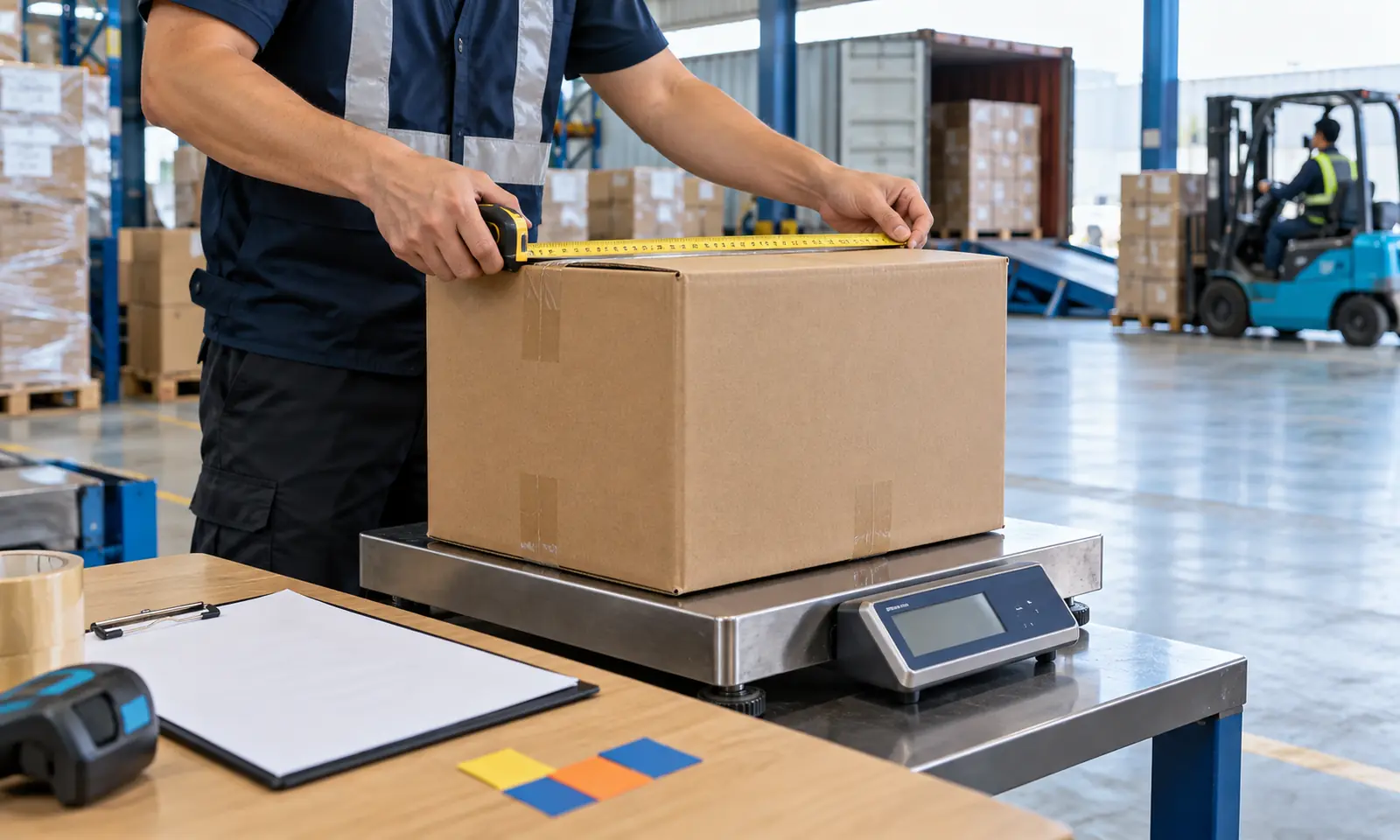
Imagine a buyer sending 15 cartons to a California business. Each finished carton is 63 × 43 × 45 cm and weighs 17 kg gross. The total gross weight is 255 kg, while the total volume is approximately 1.83 CBM. This is an illustrative packing list, not a real VoltFreight shipment or an actual transport quotation.
| Measurement | Calculation | Result before service-specific rounding |
|---|---|---|
| Actual gross weight | 15 × 17 kg | 255 kg |
| Cargo volume | 15 × 63 × 43 × 45 ÷ 1,000,000 | About 1.83 CBM |
| Illustrative air volumetric weight | 15 × 63 × 43 × 45 ÷ 6,000 | About 305 kg |
| Illustrative courier volumetric weight | 15 × 63 × 43 × 45 ÷ 5,000 | About 366 kg |
| Basic LCL W/M comparison | 1.83 CBM versus 0.255 metric ton | Volume side, about 1.83 W/M before minimums and local charges |
Divisors and rounding depend on the provider and service; a courier may calculate and round each carton separately. The example does not establish an air rate or LCL minimum. It shows why applying a published dollar-per-kilogram figure to 255 physical kilograms can understate the charge. Ask for the measured cartons, billing rule, final chargeable quantity, and included route.
Finally, separate international freight, U.S. import duty and fees, and the buyer’s wider landed cost. A useful written quotation names its validity date, China origin, final U.S. destination, cargo assumptions, customs responsibility, and exclusions. Ask how a customs exam, port storage, demurrage, redelivery, liftgate, or warehouse appointment would be billed if it occurs. For a deeper breakdown, see our China-to-USA shipping cost guide.
Sea Freight from China to USA: LCL or FCL?
Sea freight usually deserves the first comparison when a commercial shipment is bulky, heavy, or able to wait for ocean transport. The main decision is whether to use LCL, where goods share a container, or FCL, where the importer uses a dedicated container. Evaluate the delivered cost and handling plan, not only the ocean line item.
When LCL is the better starting point
LCL lets a buyer ship less than a container, but the cargo normally passes through a China consolidation facility and a U.S. container freight station (CFS). The quoted weight/measure basis, minimum, origin handling, deconsolidation, destination documentation, and CFS-to-door movement all matter. A low port-to-port LCL number may lose its advantage if the destination agent bills significant local charges or the cargo must travel far inland.
Before booking, ask which U.S. CFS will release the cargo, who pays the destination charges, whether customs clearance is arranged, and who collects the cartons after release. If the final receiver is a 3PL or warehouse, check whether palletization and an appointment are included.
When FCL deserves a comparison
FCL can suit a larger shipment, a recurring replenishment order, or products that benefit from fewer handling points. Compare 20ft, 40ft, and 40HQ only when the packing dimensions, weight, loading plan, and receiving location support those options. The buyer needs a plan for container pickup, drayage or rail, a suitable unloading location, chassis use, free time, and empty-container return.
At roughly 10–15 CBM, asking for both LCL and FCL may reveal a better option; it does not mean FCL automatically wins. The break-even point moves with cargo density, local CFS fees, the U.S. destination, and container handling. For port pairs, container selection, and detailed sea transit planning, see sea freight from China to USA.
Air Freight from China to USA
Air freight is useful when the stock cannot wait for an ocean arrival but is too large, too heavy, or too operationally complex for an ordinary courier parcel. A standard air quote may end at an airport; an air door quote adds the handoffs required to reach the receiver. Always establish which service is being priced before comparing it with express.
Compare the airport and the receiving ZIP code together
Flights into gateways such as Los Angeles, New York, Chicago, or Dallas are only one part of the journey. A lower flight rate into a distant airport can lose its advantage after U.S. airport handling and local trucking. Identify who acts as Importer of Record, who appoints the customs broker, when freight can be released, and who arranges the last leg.
Measure, screen, and document the cargo before booking
Airlines and consolidators use service-specific chargeable-weight rules and cargo-acceptance policies. Finished carton dimensions can change the billable kilograms substantially, as the example above shows. Tell the forwarder about batteries, magnets, liquids, powders, chemicals, aerosols, and unusual packaging before requesting a firm route. An SDS, battery test summary, transport classification, or other supporting document may be required depending on the actual product and carrier; none is a blanket permission to fly every shipment.
If only part of an order is urgent, compare flying the required units and sending the rest by sea. The split adds handling, entry, and delivery work, so it should solve a real deadline or stockout rather than be assumed cheaper. See our China-to-USA air freight guide for a fuller airport, chargeable-weight, and door-service comparison.
Express Shipping from China to USA
Express courier can be the simplest option for an eligible sample, replacement part, prototype, or urgent compact carton. A carrier can combine the international movement and final parcel delivery, but the shipment still needs a correct product description, valid entry arrangement, and a clear answer on who pays U.S. duties and carrier disbursement fees.
For a small order, compare the total delivered express charge with an air freight quote that also includes pickup, airport handling, customs arrangements, and U.S. delivery. An airport-to-airport air rate can look cheaper while leaving most of those steps unpriced. Ask whether the courier bills volumetric weight by individual parcel, applies a minimum, restricts a product, or adds remote-area, residential, oversized, or address-correction fees.
Do not assume that a low-value parcel enters the United States duty-free. The applicable entry treatment and charges depend on current U.S. rules and the specific shipment; review CBP’s current low-value import guidance before quoting a small parcel. Our China-to-USA express shipping guide discusses carrier choice and chargeable weight in more detail.
DDP and Door-to-Door Shipping from China to USA
Door-to-door names the transport endpoints; it does not by itself say who becomes the U.S. importer or pays duty. DDP and DAP are terms in the underlying sale contract, not substitutes for an air or sea method. The International Chamber of Commerce’s DAP/DDP comparison explains that the buyer handles import clearance under DAP, while the seller assumes that obligation under DDP.
| Arrangement | What it can cover | Question to settle before booking |
|---|---|---|
| Port- or airport-only freight | The named international transport and specified terminal services. | Who arranges entry, terminal release, charges, and delivery beyond the terminal? |
| Door service with buyer-controlled entry | International transport and final delivery after the buyer’s broker completes the agreed entry work. | Who is the Importer of Record, who appoints the broker, and when can the delivery provider collect the goods? |
| DDP sale, where a lawful structure is workable | Seller-responsible import formalities, duties, and delivery under the agreed named place and sale term. | Who legally acts as importer, which duties and additional tariffs are covered, and who receives the entry record? |
VoltFreight can review suitable duty-paid or importer-controlled transport proposals, but the phrase “DDP shipping” does not establish a lawful Importer of Record by itself. Give us the real commodity, declared transaction information, packing, and destination before we confirm that a channel fits. A written proposal should say whether it includes brokerage, bond arrangements, applicable duty and additional tariffs, ocean ISF coordination when required, destination services, and final delivery. It should also identify conditional examination, storage, redelivery, and special-handling charges.
If your U.S. business already has a customs broker and importer setup, ask for an importer-cleared door quotation alongside an eligible DDP proposal. Comparing them can make the party responsible for entry, records, and later corrections easier to understand. For the full service-model discussion, read DDP shipping from China to USA.
How Long Does Shipping from China to USA Take?
The useful shipping time is the interval between finished goods being ready in China and accepted delivery at the named U.S. location. A flight time stops at an airport; an ocean transit time stops at a port. Neither includes all supplier, customs, and inland-delivery work. The broad door-delivery windows in the comparison table are for early planning only.
Work backward from the U.S. receiving date
If a 3PL needs stock before a promotion, start with its latest usable delivery appointment. Allow time for U.S. trucking and appointment availability, customs and terminal release, main transit, China export handling, and the carrier cutoff. Then confirm when each supplier can actually release finished and labeled cartons with a final packing list. “Production complete Friday” does not automatically mean a Friday freight pickup.
Ask for milestones, not only an arrival estimate
A practical shipment schedule identifies China pickup or warehouse receipt, measurement, booking cutoff, departure, arrival, customs release, cargo availability, final dispatch, and proof of delivery. For LCL, add consolidation and destination deconsolidation. For FCL, add terminal availability, container pickup, unloading, and empty return. An arrival scan in the United States is not a promise that the buyer can use the stock that day.
Weather, rollovers, document corrections, CBP examinations, and appointment shortages can extend a schedule. A responsible update identifies the delayed stage, the next action, and the party handling it; nobody can promise a government release time. See our China-to-USA shipping time guide for mode-specific planning.
China-to-USA Ports, Airports, and Inland Delivery
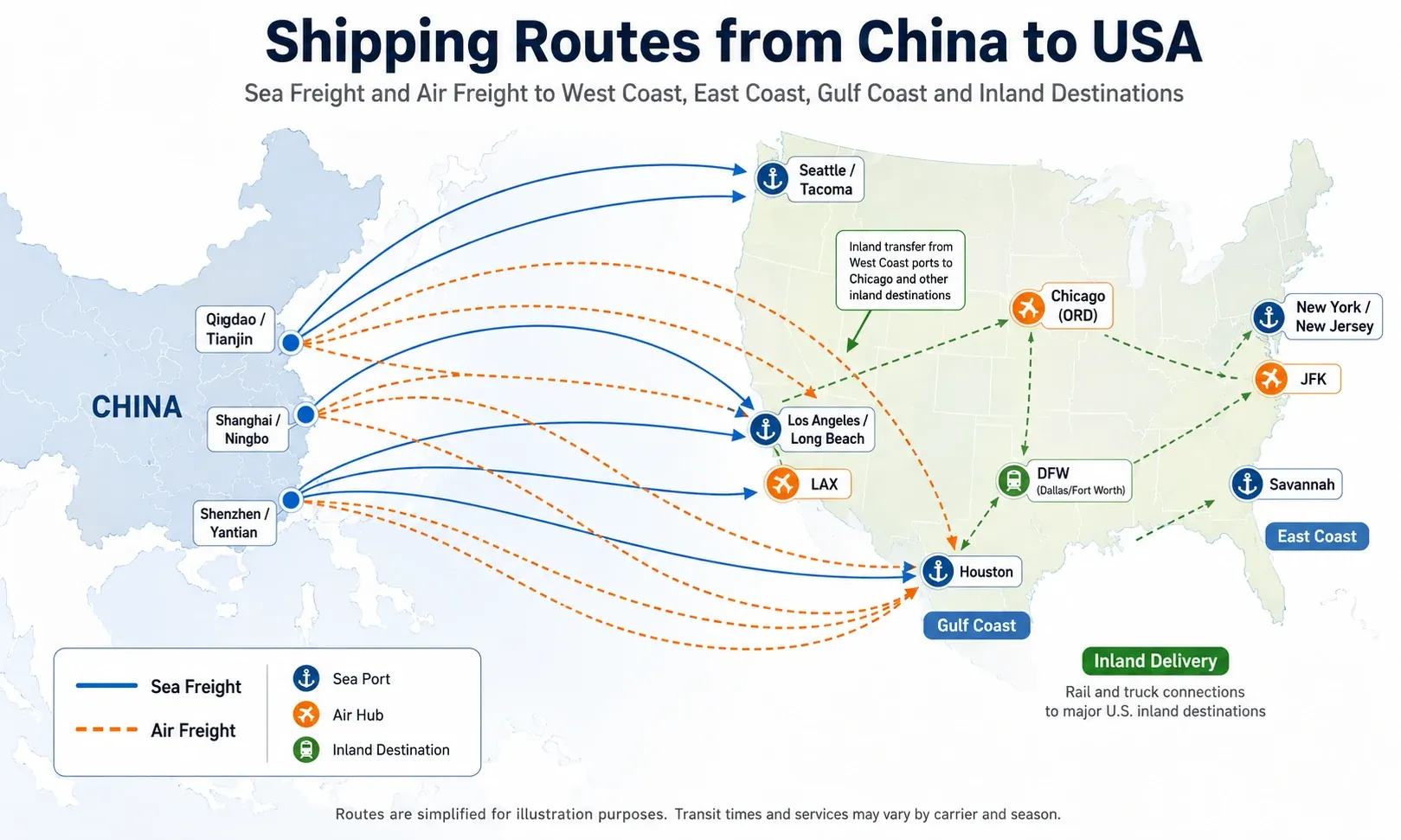
Route planning starts with both the supplier’s location and the final U.S. address. A factory in Shenzhen or Dongguan may use a South China gateway; cargo around Shanghai, Ningbo, or Yiwu may take a different origin route. The cheapest international linehaul is not always the cheapest way to deliver a shipment to its final ZIP code.
West Coast: Los Angeles and Long Beach are common gateways for California receivers and can connect to inland rail or trucking. East Coast: New York/New Jersey, Savannah, Norfolk, and other gateways may be more suitable for East Coast receivers even when the ocean leg is longer. Gulf and inland: cargo for Texas, the Midwest, or a southern distribution center needs a comparison of ocean or air arrival plus inland rail, truck, parcel, LTL, or FTL delivery.
For example, a quote ending at Los Angeles port should not be compared directly with one ending at a Dallas warehouse. For LCL, identify the destination CFS and final-mile handoff. For FCL, identify the discharge port, rail or drayage move, unloading address, and empty return. For air, check the landing airport and who collects the goods after release.
What Does VoltFreight Handle as a China-to-USA Freight Forwarder?
A freight forwarder from China to USA is useful when the journey includes several suppliers, a receiving warehouse, export handling, different transport providers, a U.S. broker, and final delivery. Shenzhen Qizhoutong Supply Chain Co., Ltd. operates VoltFreight. Our China-side role is to turn supplier information and the finished cargo into a route that the buyer can review before committing to shipment. The exact tasks depend on the written quotation.
Supplier pickup, receiving, and measurement
Where included, we can coordinate collection from Chinese suppliers or receive their cartons at an agreed China warehouse. The receiving process can record the number of outer packages, visible condition, actual gross weight, and dimensions. Supplier packing lists are often provisional; if 18 cartons arrive instead of the 15 originally quoted, the air chargeable weight, CBM, vehicle requirement, and price may all change. The buyer should see the revised cargo data before approving a changed booking.
A carton-count or visible-packaging check is not a certification of the products inside. Ask the supplier to verify product description, declared value, packing, and any required compliance records. When warehouse receiving is in the service scope, ask what evidence—such as receiving photographs, a carton tally, or final measurements—will be shared.
Multi-supplier consolidation and route selection
For orders from several factories, identify each supplier, cargo-ready date, invoice, packing list, and transport restrictions. We can review whether the goods may be collected and shipped together, or whether waiting for one unfinished order would hurt the buyer’s deadline. A battery-powered product and an ordinary general-cargo product may also need different channels. Consolidation should be recommended when the total shipment benefits, not automatically for every supplier combination.
After reviewing the goods and U.S. endpoint, compare suitable express, air, LCL, FCL, importer-cleared door, or eligible duty-paid arrangements. Before confirmation, the buyer should know where the quote begins and ends, who appoints the customs broker, who can authorize changes, which party arranges U.S. delivery, and what triggers an extra charge.

U.S. Customs and Product Checks Before Shipping from China
Confirm the importer, product, and entry information before cargo leaves China. The supplier’s commercial invoice should describe the actual goods and align with the final packing list. The importer and its licensed customs broker should review classification, country of origin, transaction value, quantities, and whether another U.S. agency regulates the products. CBP explains that the Importer of Record remains responsible for reasonable care in entry, classification, and valuation, even when a broker files on its behalf.
Do not estimate import duty from a broad label such as “electronics.” Use the official U.S. Harmonized Tariff Schedule and review relevant USTR Section 301 measures with the broker. Duty depends on the product, classification, origin, valuation, and applicable measures. Do not assume that the entire overseas freight-and-insurance-inclusive CIF price is automatically the U.S. customs value; ask the broker to review the actual transaction and supporting records.
Ocean ISF, entry documents, and regulated cargo
For applicable cargo arriving by vessel, agree who will collect and submit Importer Security Filing (ISF) information before the relevant loading deadline. CBP’s ISF guidance describes the advance filing requirement. Do not copy an ocean ISF requirement onto an ordinary air shipment. Common starting documents include the commercial invoice, packing list, transport document, importer details, and broker authorization; a bond, product records, or agency filings may also be needed for the specific entry.
Transport eligibility and permission to import or sell goods are different decisions. Flag these products before requesting a firm freight rate:
- Batteries and battery-powered equipment: disclose battery chemistry, whether installed or packed separately, specifications, package design, and available transport test information.
- Liquids, powders, chemicals, and aerosols: provide composition, intended use, packaging, and available safety documents for route screening.
- Food, supplements, cosmetics, medical-related goods, children’s products, and wireless devices: identify the exact SKU so the importer can review the relevant agency and product requirements.
- Branded, oversized, fragile, or high-value cargo: share authorization where relevant, photos, dimensions, handling requirements, cargo value, and insurance needs.
None of these categories automatically uses one document or one approved route. For an in-depth example, see our China-to-USA lithium battery shipping guide. For entry procedures, read U.S. customs clearance from China and import tax from China to USA.
Delivery to U.S. Businesses, 3PLs, and Amazon FBA
A ZIP code identifies a destination area but not the conditions for receiving freight. A staffed commercial dock may accept palletized LTL delivery; a small business may need a liftgate, an appointment, or help unloading. A 3PL may require pallet labels, a purchase order, an appointment reference, and specific receiving hours. Obtain these details before booking a route described as “door-to-door.”
For express, ask whether the address is commercial or residential and whether the package falls within standard carrier limits. For air freight, identify who arranges collection after airport release. For LCL, confirm which CFS releases the cartons and whether the provider includes palletization and final trucking. For FCL, check whether the site can receive and unload a container within its allowed free time.
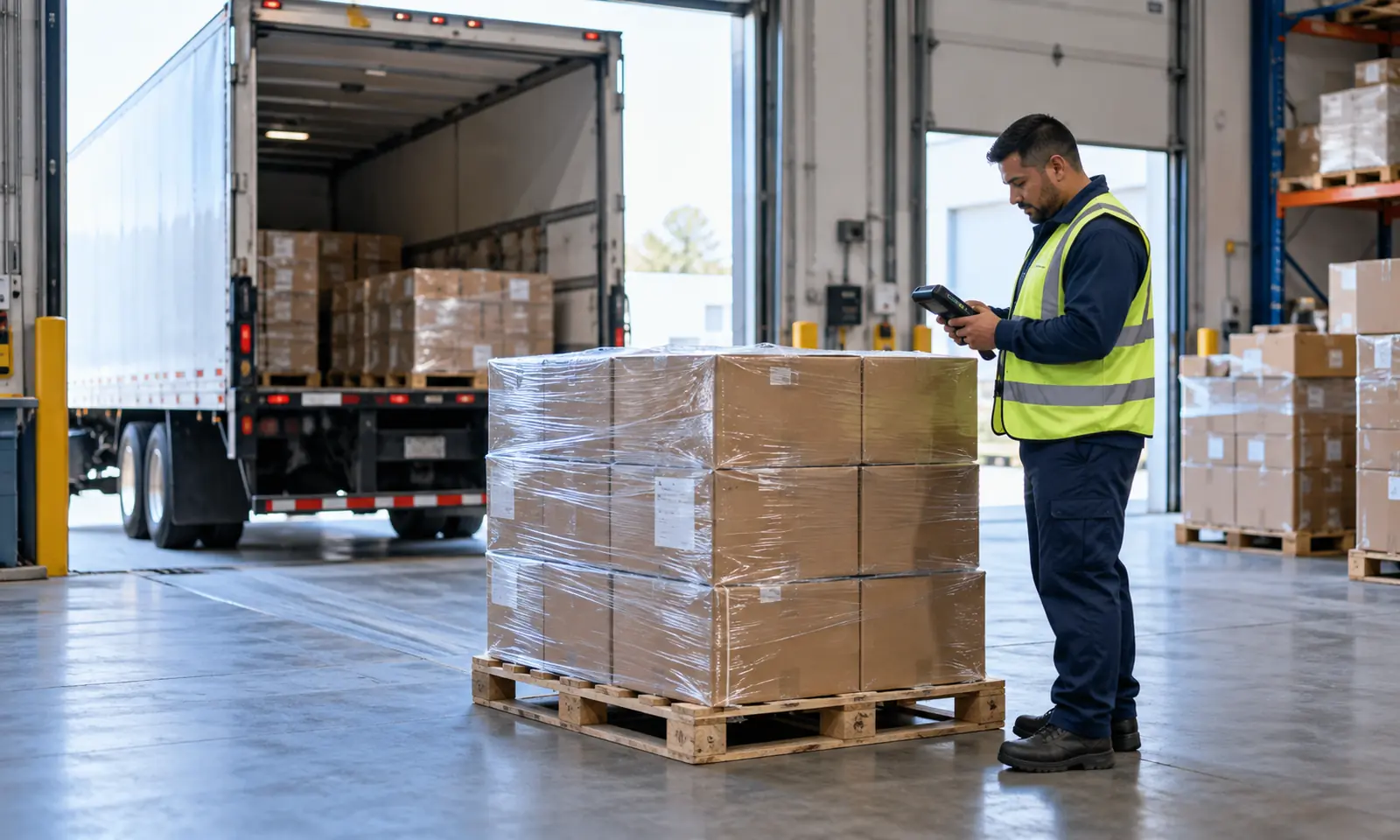
Amazon FBA requires the seller’s current shipping plan, assigned facility, carton or product labels, and the specified carrier and appointment instructions. A fulfillment center is a receiver, not automatically the Importer of Record. If an existing quote ends at a business or 3PL address, changing it to FBA can change the route and delivery cost. See shipping from China to Amazon FBA for that specialized workflow.
How a China-to-USA Shipment Moves from Supplier to Receiver
A workable freight plan identifies the owner of every handoff. The sequence below can help the importer find an unquoted step before it becomes a delay or surprise charge.
- Define the goods and delivery goal. The buyer provides product and value details, estimated cartons, supplier location, U.S. endpoint, and latest useful receiving date; suppliers confirm when finished goods can actually leave.
- Choose an accepted transport and service scope. VoltFreight reviews eligible express, air, LCL, or FCL routes and states whether the proposal includes China pickup, origin warehouse work, U.S. entry coordination, and final delivery.
- Receive and measure when included. Compare the delivered carton count, actual dimensions, and product details with the preliminary packing list. Review any change to the quoted weight, volume, channel, or price before booking.
- Book and prepare records. Confirm export handling, transport documents, importer and broker instructions, and applicable advance data such as ocean ISF. Send corrected supplier information before a carrier cutoff where required.
- Track departure, arrival, and customs release separately. A vessel or aircraft arriving in the United States does not mean the cargo is cleared or available to the trucker.
- Deliver and reconcile. Arrange the agreed last leg after release, obtain delivery confirmation, report visible loss or damage, and retain commercial and entry records.
An actionable delay update says what happened, which cartons or shipment stage it affects, who is handling the next action, and whether the delivery estimate or cost must change. For example, if only 12 of 15 expected cartons reach the China warehouse, the buyer needs to know whether to wait for the missing three or compare a separate urgent dispatch. That is a planning illustration, not a claim about an actual VoltFreight customer shipment.
What Do We Need to Quote Shipping from China to USA?
You can ask for a preliminary comparison before the supplier finishes packing. Identify estimates clearly; a confirmed booking still needs the finished cargo measurements, the carrier’s acceptance, and a written service scope. Send as much of the following as you know:
- Goods: exact product name, intended use, material or composition, photos, declared value, and any battery, liquid, powder, food, branded, or regulated content.
- Packaging: carton or pallet count, gross weight, outside dimensions per package type, total CBM if available, and whether the goods have been packed.
- China origin: each supplier’s city, pickup address or warehouse drop-off plan, contact, cargo-ready date, and supplier sale term if known.
- United States destination: full address or ZIP code, business/3PL/FBA/residential status, dock or liftgate access, receiving hours, labels, and appointment requirements.
- Import plan and deadline: known HS/HTS details, intended Importer of Record and broker, latest useful delivery date, and whether you want port-only, importer-cleared door, or an eligible duty-paid proposal.
Already have a supplier or competing freight quote? Send it with its named start point, endpoint, and inclusions. We can identify which route legs or import charges differ, then compare suitable options using the same finished cargo and receiving address. If a figure is unknown, say so rather than guessing; we will mark the initial comparison as provisional.
Send your China-to-USA cargo details to VoltFreight or ask for a route comparison on WhatsApp.
Questions Importers Ask Before Booking
Can I request a quote before the cartons are ready?
Yes. Provide estimated weight, dimensions, carton count, product details, supplier-ready date, and final destination. Label each estimate as provisional. Once the supplier finishes packing, the measured weight, volume, product acceptance, and service scope determine the confirmed route and price.
Can I use my own U.S. customs broker?
Yes, when the selected service supports importer-controlled entry. Identify the Importer of Record and broker early, then agree on the invoice, packing list, arrival information, terminal-release handoff, and party arranging delivery after customs release. Door delivery alone does not mean duties are prepaid.
Can goods from multiple suppliers travel in one shipment?
Often, if the goods, documents, cargo-ready dates, and transport channel are compatible. Send each supplier’s information separately. Consolidation may save repeated freight handling, but holding finished stock for a delayed factory can be more expensive than shipping the urgent part separately.
Who pays if CBP examines my shipment?
That depends on the written contract and the charges assessed by the facility, broker, or carrier. Ask before booking who receives the exam notice, who coordinates documents, and who pays conditional exam handling, storage, or redelivery charges. A forwarder cannot guarantee when CBP will release a selected shipment.
Is an Amazon fulfillment center the U.S. importer?
Do not assume so. The seller must arrange an appropriate importer and customs-entry structure, while the fulfillment center acts as the receiving location under its current shipping instructions. Confirm both arrangements before you book the freight.
Ready to compare shipping from China to USA? Send the product, finished or estimated package data, supplier city, required receiving date, and U.S. ZIP code. VoltFreight can review eligible transport options, explain what each quote includes, and clarify the customs and delivery handoffs before you book.
Content reviewed September 24, 2026. The Drewry figures above refer specifically to its September 17, 2026 assessment and should be updated or removed when they cease to be useful. Times and calculations are planning examples, not guaranteed schedules or live VoltFreight offers. Confirm current carrier acceptance, freight rates, U.S. duties, and final service terms for the actual shipment.