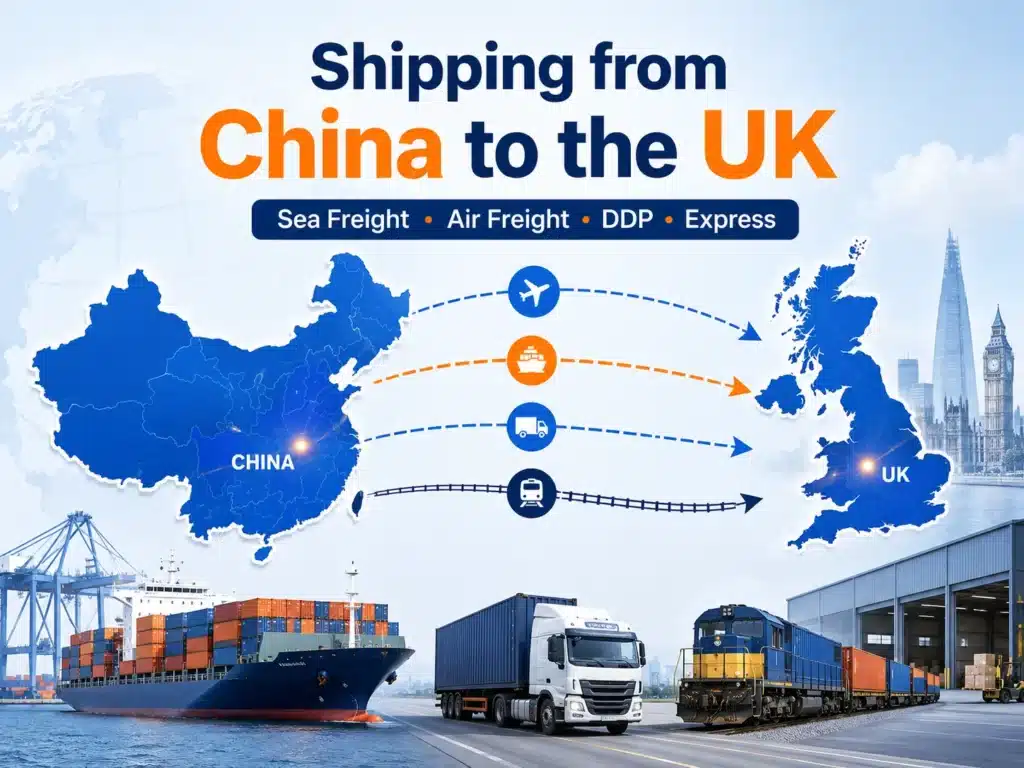
Shipping from China to the UK involves more than choosing the cheapest vessel or the fastest flight. VoltFreight is a Shenzhen-based freight forwarder that coordinates collection from Chinese suppliers, consolidation, sea and air freight, express delivery and the agreed UK customs and delivery handoff. The practical decision begins with your supplier’s location, the goods and their packed dimensions, your inventory deadline, the importer’s customs arrangements and the place where the goods must actually be delivered. This guide takes you from selecting a freight forwarder through sea, air, courier and combined transport, UK customs, e-commerce fulfilment, warehousing, insurance and ways to control cost and delay.
Quick answer: Express suits accepted urgent parcels; commercial air freight suits time-sensitive consignments; LCL sea freight suits smaller ocean loads; and FCL gives larger shipments a dedicated container. A rail-and-road option can be assessed when a current operating route fits the cargo and deadline. Ask for prices to the same UK endpoint: a port-to-port quote, airport release and cleared warehouse delivery are different services.
What Is the Best Way to Ship from China to the UK?
The best method delivers usable stock when you need it at a total cost you can justify. A dense 300 kg machine part, 300 kg of bulky textiles and ten urgently needed replacement components need different calculations. Look at chargeable weight or cubic metres, shipment handling, UK release, inland transport and the cost of missing a sales or production deadline.
Compare methods using the same delivery endpoint
The figures below use different timing endpoints: the courier reference ends at delivery, the air reference at normal UK cargo availability, and the sea figures are broad planning allowances whose start and final endpoint must be confirmed. Use them to shortlist a method, then request dates from the day the supplier has the packed goods ready to the same UK receiving address and appointment.
| Method | Typical use | Indicative planning time | Endpoint and scope to confirm |
|---|---|---|---|
| Express courier | Accepted samples, documents, replacement parts and urgent cartons | About 3–7 business days after carrier acceptance | Named address; confirm customs charges, clearance and any remote-area service in the quoted delivery. |
| Commercial air freight | Commercial cartons, components, replenishment stock and pallets | About 5–10 days to normal UK cargo availability | The reference ends at airport cargo availability; specify airport release, cleared cargo or final postcode and allow for the delivery leg. |
| LCL sea freight | Ocean shipments that do not justify dedicated equipment | About 35–55+ days for an overall plan | Confirm the planning start, CFS release and whether the quoted endpoint is DAP delivery or a reviewed DDP scope. |
| FCL sea freight | Larger, heavier or handling-sensitive loads | About 30–45+ days for an overall plan | Confirm the planning start, port release, container delivery, unloading and empty return. |
| Rail and road combination | Suitable cargo on a confirmed operating route | Quote against the actual route | Confirm transfers, border process, UK customs and final delivery in the live route plan. |
Start with the deadline and the goods
Ask the supplier when the packed goods will be ready, not simply when manufacturing ends. Obtain the commodity description, cartons or pallet count, measurements, gross weight and destination postcode. A sample may be best sent by express; a few hundred kilograms of urgent saleable stock may suit air; a larger planned order may be more economical by LCL or FCL. There is no universal weight boundary because packaging and local charges change the answer.
If only part of an order is urgent, price separate movements. A possible split is 20% by air and 80% by sea: the air portion protects immediate demand while the balance moves at ocean-freight cost. Those are planning proportions, not a guaranteed formula. The urgent portion needs its own packing list, customs values, delivery arrangement and realistic receiving date.
How Much Does Shipping from China to the UK Cost in 2026?
No single price per kilogram, CBM or container applies to every shipment. A quote depends on date, product, packed measurements, route, origin and destination handling, customs arrangement and delivery site. Use a public market reference to establish scale, then request a cargo-specific quote that includes the same start and end points.
| Method | Published reference | Items to confirm in a live quotation |
|---|---|---|
| 20GP ocean freight to major UK container gateways | USD 2,615–3,196 per container | Factory collection, specific origin and destination ports, UK local charges, tax and inland delivery |
| 40GP ocean freight to major UK container gateways | USD 4,095–5,005 per container | Equipment, weight limits, surcharges, customs, container haulage and empty return |
| LCL sea freight | About USD 55 per CBM as a headline reference | Minimums, weight-or-measure basis, CFS charges, UK clearance and delivery |
| Air freight to a UK airport | From about USD 4.50 per chargeable kg for a 1,000 kg+ general-cargo reference | Lower weight breaks, acceptance, security, terminal costs, customs and local delivery |
Source: a public China-to-UK rate guide reviewed in September 2026. Its container ranges describe UK gateways including Southampton, Felixstowe and London Gateway; they are not separate fixed rates for each port. These are third-party market-planning references, not VoltFreight rates or booking offers. The rows do not establish a consistent all-inclusive scope: request a new quotation for your actual cargo, shipping date, named China origin and UK endpoint.
Turn a headline rate into a UK delivery budget
For example, the 20GP market range in the table cannot be compared directly with a DAP quote to a UK warehouse. Put China pickup and export handling, ocean freight, UK port and document release, customs service, duty and VAT where due, container haulage, unloading and empty return on the same worksheet. State which items are included and which are conditional. Do the same for air or courier before deciding that its price is higher or lower.
Build up the full delivered cost
Add China pickup, consolidation and export documents; the international freight; UK terminal or CFS handling, release and customs service; applicable duty and import VAT; and delivery to the named UK site. Confirm insurance separately unless expressly included. Check possible inspection, storage, waiting, demurrage, detention, failed-delivery or extra-handling charges, and ask what conditions trigger a revised rate.
Rates can change with carrier space, fuel, equipment, seasonal peaks and route disruption. Batteries, liquids, powders, magnets, chemicals, food, cosmetics, branded goods and oversized pieces may need special acceptance or a different route. Never apply a general-cargo headline rate to such goods without telling the forwarder exactly what they are.
Understand EXW, FOB, CIF, DAP and DDP before comparing prices
Historical trade-term reference: An earlier route study reported 90% of its trade under FOB or EXW. Its sample and year were not specified, so this is not a current market share. Choose the contract’s rule and named place according to who handles Chinese export, main transport and UK import. The ICC Incoterms rules explain those responsibilities.
- EXW (Ex Works), named Chinese premises: the buyer takes on collection and much of the origin process, including export arrangements that can be difficult for a foreign buyer to manage. Its planning total is product price + China collection and export arrangements + main carriage + UK release, duty and VAT where due + final delivery.
- FOB (Free on Board), named Chinese loading port: under this maritime rule, the seller handles export and puts the goods on board; the buyer arranges main carriage and the subsequent destination process. Its planning total is FOB purchase price + main freight + UK charges, customs and tax + inland delivery. For container cargo delivered to a terminal before vessel loading, discuss whether FCA better matches the handoff.
- CIF (Cost, Insurance and Freight), named UK destination port: the seller contracts the main ocean carriage and the required insurance, yet UK import clearance and inland delivery are not thereby included. Confirm the insured scope rather than assuming complete protection.
- DAP (Delivered at Place), named UK place: the seller arranges movement to that place, ready for unloading; the buyer ordinarily handles import formalities and import charges.
- DDP (Delivered Duty Paid), named UK place: the seller takes on import obligations and charges under the sale term, provided the parties can implement a lawful declaration and tax arrangement. Verify the named importer, VAT records and written scope before accepting a duty-paid promise.
Reconcile the cost formulas with the named sale term
When assembling the total, assign China collection and export costs to the party responsible under the named term. The complete cost comparison includes origin logistics, China export, international freight, UK customs, domestic delivery, documents, warehouse entry and insurance as applicable. Whether supplier-arranged freight or an independent forwarder is cheaper must be decided from comparable delivered quotes, not from the Incoterm alone.
How Long Does Shipping from China to the UK Take?
State when the clock starts and where it stops. A flight time, an airline cargo-available date and a warehouse receiving date are three different measures; the same applies to vessel arrival, CFS release and doorstep delivery. The method table above gives broad planning ranges, not a guaranteed schedule. Define the supplier’s cargo-ready date, carrier acceptance, ETD (estimated time of departure), ETA (estimated time of arrival), UK customs release and final delivery window.
Allow for the work before departure
Production completion may be followed by carton labelling, final weighing, warehouse receipt, consolidation, inspection, export packing, document correction and collection. LCL has a consolidation cut-off. FCL needs a container, loading appointment and a return to the Chinese terminal before the carrier deadline. A planning example allows up to 7 days for origin-port loading; confirm the actual warehouse and vessel cut-offs rather than treating this as a fixed rule.
For Christmas inventory, consider ordering in August or earlier and allowing at least 3 months for made-to-order goods. That buffer helps planning but cannot guarantee a December selling date. Work backwards from the first day the stock must be usable, including inspection, customs, final delivery and warehouse check-in.
Allow for the work after arrival
UK arrival can be followed by terminal handling, document release, import declaration, payment or accounting instructions, inspection, LCL deconsolidation and a delivery appointment. A container on a vessel is not stock on a shelf. Ask what happens if a sailing rolls, a transshipment is missed or the recipient cannot accept the booked truck. Direct service may reduce one transfer risk; a routed service may have better space or price. Compare the actual schedule and recovery plan.
Need a route that meets a fixed receiving date? Send VoltFreight the packed dimensions, cargo-ready date, product and UK postcode through the contact page so the express, air and ocean options can be compared to the same delivery point.
How Do You Choose a Reliable Freight Forwarder for China-to-UK Shipping?
A freight forwarder coordinates transport and its handoffs on behalf of the shipper. Depending on the booking, that can mean arranging inland collection, warehouse receiving, export documents, carrier space, air or ocean carriage, tracking, UK customs coordination and final delivery. The forwarder may issue its own house bill of lading and arrange deconsolidation and document release at destination. Its job is to make each party’s responsibility and each payable charge clear before the freight moves.
For an occasional importer, this coordination matters because a factory, trucking company, airline or shipping line, UK broker and receiving warehouse may each hold a different piece of the journey. A forwarder should identify the missing information, offer workable routes and explain the trade-off between cost and arrival date. No operator can promise that customs never inspects cargo or that a carrier never changes its schedule.
What services should be included or offered?
Ask whether the forwarder will prepare or check export and transport documents; contact suppliers and arrange inland trucking; book and monitor carrier space; receive and store cargo; consolidate several suppliers’ shipments; negotiate freight with more than one carrier; arrange insurance and assist with claims; coordinate customs representatives; issue or obtain bills of lading or air waybills; manage destination deconsolidation; and release documents and collect freight charges. Some forwarders offer all of these; others subcontract particular steps. The quote must identify the actual provider and included scope.
Additional warehouse services may include carton checks, measurement, photography, repacking and Amazon preparation. Ask who checks the product itself, who can authorise repacking and who is responsible for UK customs data. A transport coordinator is not automatically a licensed product tester, customs declarant or insurer.
Should the forwarder be based in China or the UK?
A China-based forwarder can have an operational advantage at the origin: direct communication with factories in Mandarin or Cantonese, local pickup, warehouse inspection, supplier follow-up, export handling and access to local carrier capacity. That can be valuable when several suppliers need to deliver to one warehouse. Those advantages explain why many buyers begin their comparison with an origin-side forwarder.
For some buyers, a UK-based forwarder with a capable Chinese agent is equally workable, particularly when the importer’s priority is UK customs, domestic distribution or a single locally accountable contact. Compare who actually handles the China warehouse, who instructs the UK broker, who answers outside local office hours and how the two teams resolve exceptions. Geographic location alone does not prove a lower delivered cost or better service.
Six checks before you entrust a shipment
- Verify the business. Check the company’s registered identity and relevant Chinese business licence where applicable; match its quotation, invoice and payment details.
- Review its public presence. Read its website, service descriptions and independent customer feedback. A search ranking or positive reviews can support a check, but they are not proof that a proposed route and price are sound.
- Ask about insurance. Distinguish the forwarder’s own liability cover from a cargo insurance policy for your shipment. Request the proposed insurer, scope, insured value and exclusions.
- Test the tracking and updates. Ask which milestones it will report, who provides the container or air waybill number and who contacts you when a vessel rolls or paperwork is rejected. ‘Real time’ visibility depends on the booked carrier and event data.
- Request relevant experience. Ask for a recent comparable China-to-UK movement or a suitably redacted bill of lading and check whether the team understands your product and UK receiving site. Never request another customer’s confidential information.
- Assess the consultation. Prompt, specific explanations of the route, chargeable basis, customs handoff and possible extra charges are more useful than a generic assurance. For a new partner, a smaller trial consignment can expose process problems before a larger booking.
Which Chinese Origins and UK Gateways Fit Your Shipment?
Chinese suppliers are served by a large network of ports, but the nearest port is not automatically the best route. Compare the inland pickup, sailing or flight frequency, warehouse cut-off, available equipment, transshipment risk, UK terminal charges and road miles to your final postcode. A stronger service from a slightly more distant port can produce a better door-to-door result.
Principal export ports in China
Historical port data: The following 2018 TEU figures describe the scale of these gateways in that year. They do not indicate today’s sailing frequency, capacity or transit time. Choose a port from the current carrier schedule and total China-to-UK delivery route.
- Shanghai (CNSHA): an important Yangtze River Delta gateway. The shortened form “CNSH” appears in some legacy materials; use the full UN/LOCODE CNSHA when booking. Shanghai’s port history is traced to the 6th century, with an opening to international trade in 1842. The recorded 42 million TEUs in 2018 is a historical throughput reference, not a present-year volume.
- Ningbo (CNNGB): useful for many Zhejiang and nearby suppliers. A historical route reference recorded more than 26 million TEUs in 2018 and connections to over 600 ports in more than 100 countries; check today’s sailing for the shipment in question.
- Shenzhen (CNSZX): a southern China port group including terminals such as Yantian and Shekou. Its recorded throughput was more than 27 million TEUs in 2018.
- Other possible origins: Tianjin and Qingdao for northern suppliers, Xiamen for Fujian, Hong Kong for suitable movements and Guangzhou’s Nansha area for part of the Pearl River Delta. Confirm which named terminal the carrier is actually using.
Principal arrivals in the UK
Felixstowe (GBFXT) is a major container gateway; a historical route reference described over 4 million TEUs per year and links to over 700 ports worldwide. These figures provide context rather than a current-year service promise. Southampton (GBSOU) is an important deep-water gateway, while London (GBLON) and the London Gateway area can suit distribution towards southeast England. Other potential UK gateways include Immingham, Liverpool and Milford Haven; their suitability depends on the commodity and actual carrier service. For air cargo, compare Heathrow, Manchester, East Midlands and other available airports against UK ground delivery.
When you buy from several factories, give the forwarder every supplier city and ready date. Consolidating into one China warehouse may save duplicate export movements, but holding all cargo for a late supplier can delay the complete order. Set a warehouse cut-off and decide in advance which pieces can leave separately.
How Does Sea Freight from China to the UK Work?
For planned commercial volumes, sea shipping from China to the UK generally provides the most capacity at the lowest international transport cost. Choose between less than container load (LCL), in which several shippers share space, and full container load (FCL), in which one shipper books the equipment. Decide on the total UK delivery cost, required handling and deadline, not only the quoted ocean line.
Choose LCL for a smaller ocean shipment
A practical starting point is less than 15 CBM for LCL, but the economic boundary varies by route and local charges: near this volume, ask for both LCL and an FCL or consolidated-container alternative. LCL freight is measured in cubic metres (CBM) and may use a weight-or-measure tariff and minimum charge. Confirm how the warehouse computes volume, where it charges origin and destination handling and whether it will palletise or deconsolidate the goods.
LCL cargo passes through a China consolidation warehouse and a UK container freight station (CFS). The extra transfers make carton strength, edge protection, secure marks and a clear packing list especially important. After UK release, smaller consignments can be moved on a pallet network, local truck or suitable courier if their size and acceptance rules permit. The quotation should distinguish ocean arrival from CFS availability and final delivery.
Choose FCL when a dedicated container adds value
FCL pricing applies to the booked container rather than simply multiplying an LCL rate by your CBM. Indicative nominal internal volumes are 20 ft: 33 CBM; 40 ft: 66 CBM; 40 ft high cube: 76 CBM. These are not promises of usable load: equipment specification, maximum payload, pallet arrangement and packaging shape can constrain what fits.
Indicative door openings for 20 ft and 40 ft general-purpose containers are 2.34 × 2.28 m; a 40 ft high-cube opening is 2.34 × 2.58 m. Check the exact container specification before buying or crating an oversized item. A 20 ft unit is often considered for dense machinery, minerals, metals, paper, sugar or cement; a 40 ft unit can work for more voluminous furniture, pipes, cotton or packaged merchandise. Loading must also meet carrier weight limits and safe cargo-securing requirements.
For FCL, decide who obtains the empty container, loads and seals it in China, returns it before cut-off, arranges UK clearance and hauls it to the consignee. In the UK a container normally needs a suitable haulage vehicle and access to an unloading location; a site without space or equipment may need a warehouse transload into smaller vehicles. Ask about terminal free time, demurrage, truck waiting, detention and empty return.
Specify export packing and pallets in writing
Ocean freight can spend weeks in transit and move through factories, trucks, terminals, warehouses and the final delivery vehicle. One export-packaging specification uses five-layer inner cartons, five-layer outer cartons, plastic wrapping, clearly printed freight marks and ISPM 15-compliant wood pallets. Check each element against the actual goods rather than applying it automatically: a heavy machine needs engineered crating, while a light item may need water-resistant protection rather than an unnecessarily large box. Give the factory drawings or photographs showing how to protect corners, secure the product and mark each carton.
Common European pallet-size references are 1200 × 1000 mm or 1200 × 800 mm. For a UK shipment, agree the footprint accepted by the UK receiving warehouse and the transport plan. Solid-wood pallets, cases and crates entering Great Britain must satisfy applicable ISPM 15 wood-packaging rules. Plastic wrap can stabilise a pallet but cannot replace good internal cushioning, straps or a sound carton.
For comparison, common pallet-size references in other markets include Australia: 1140 × 1140 mm; United States: 40 × 48 in (1016 × 1219 mm). These dimensions are not UK receiving requirements.
Track the vessel and the actual container
ETD and ETA are estimates. Weather, port congestion, a changed service or missed transshipment can alter them. Obtain the shipping line, booking reference, bill of lading (B/L) and, after stuffing, the container number. The B/L normally identifies the parties, cargo and routing; booking and B/L references often appear in its header, while the container appears with cargo or marks information. The carrier’s tracking page—MSC is one example—can show equipment events. Have the forwarder explain whether the update means vessel arrival, discharged container, customs release or cargo ready for collection.
A standard container identifier includes an owner code, equipment-category letter, serial number and check digit. The category letters include U for freight containers, J for detachable container-related equipment and Z for trailers or chassis. Some legacy explainers label R as a refrigerated-container category. Under the container-number convention, a refrigerated freight container still uses the freight-container category; its refrigeration is shown in equipment type and specifications, so do not infer temperature control from a standalone “R” in a copied example. Confirm reefer settings and power arrangements in the booking.
For more detail on equipment, bookings and port-to-port services, see VoltFreight’s ocean freight from China service.
When Should You Use Commercial Air Freight?
Air shipping from China to the UK is useful when the value of earlier stock availability outweighs the higher carriage cost. A 300–500 kg shipment can be an air-freight candidate, particularly for high-value goods or urgent inventory. That weight range is a comparison prompt, not a rigid threshold: bulky goods can cost far more than their scale weight suggests. Commercial air cargo usually travels under an airline arrangement, with separate origin handling, cargo terminal release, import clearance and UK final trucking as needed.
Understand service tiers and endpoints
Example service tiers used in some freight comparisons are: economy 6–16 days for less urgent accepted cargo, standard 3–8 days, and emergency 4–5 days for a priority movement. These channel examples can have different commercial scopes; the emergency tier is not guaranteed to beat every standard routing. For a broader current plan, use about 5–10 days to normal UK cargo availability. Request a live flight plan that defines its start and endpoint, space status, cargo acceptance and the UK delivery leg. Temperature-controlled or perishable goods require a specifically accepted service rather than a generic priority label.
Ask whether the routing is nonstop or has a transfer, whether an airline capacity commitment exists and which warehouse cut-off applies. A charter or special uplift has a different price and acceptance process. Even after a flight lands, cargo needs terminal handling and customs release before a truck can collect it.
Calculate the chargeable weight before choosing air
Air freight normally compares actual gross weight with the dimensional weight under the booked tariff and charges the greater amount. A common planning example uses length × width × height in centimetres ÷ 6,000. For one foam item measuring 100 × 100 × 100 cm and weighing 20 kg, the result is about 167 kg dimensional weight. The arithmetic explains why transporting mostly air inside a large box is expensive; final rounding and minimums depend on the carrier.
For a second worked example, take ten cartons measuring 60 × 50 × 40 cm each, at 12 kg each. At a 6,000 divisor, each carton calculates to 20 kg volumetric weight. The shipment weighs 120 kg physically but totals 200 kg volumetrically, so a channel using that divisor would charge on 200 kg. Send measured packed dimensions, not the supplier’s planned empty-carton size, and ask whether the forwarder rounds each carton or the total.
Understand and use the air waybill
An air waybill (AWB) is a transport document and evidence of the air carriage contract. It supports tracking; it is not a negotiable document of title like some ocean bills of lading. An airline may have a two-character designator, but the standard master AWB number is a three-digit airline prefix + eight-digit serial, including its check digit; 123-12345678 illustrates the format only. Obtain the actual AWB number from your forwarder and enter it on the issuing airline’s tracking page; a house AWB may also have a separate forwarder reference.
Carrier or agent email alerts may help with milestone updates, but the forwarder should also explain what a status event means and tell you promptly when exceptions threaten the receiving date. See the detailed air freight from China to the UK guide for mode-specific preparation.
When Does Express Shipping from China to the UK Make Sense?
Express courier is often straightforward for documents, product samples, replacement parts and smaller accepted parcels. International networks such as DHL, FedEx and UPS typically integrate collection, air movement, tracking and address delivery. They still have product acceptance rules, customs procedures and charges for oversize pieces, remote postcodes or additional handling. Compared with commercial air freight, the carrier’s simple door-delivery quote may include more of the journey; always compare the exact same delivered result.
Follow the full express booking process
Use the following nine steps as an operating checklist, with any commercial commitments confirmed in the actual quotation:
- Submit the origin, destination, product and complete packed measurements for a quotation.
- Receive a written response; a 12-hour response target is one possible service standard, but confirm the response commitment with the quoted provider.
- Review and agree the service, price, importer details and exclusions before booking.
- Have the forwarder contact the supplier, recheck goods and reserve a suitable carrier service.
- Arrange supplier delivery to the agent’s warehouse or collection from the supplier.
- Verify packed dimensions, actual weight and the chargeable weight before confirming the final cost.
- Pay under the agreed quotation and payment terms.
- Hand accepted cargo and documents to the booked courier and obtain the tracking reference.
- Track customs and delivery events until the named recipient receives the shipment.
Ask who will contact you if the shipment is remeasured or a product is rejected. A tracking event alone does not explain whether customs has released the parcel or whether duties and VAT remain payable.
Calculate volumetric weight for courier cartons
For an illustrative courier calculation, use length × width × height in centimetres ÷ 5,000. A box of 50 × 50 × 50 cm with an actual weight of 10 kg has a calculated volumetric weight of 25 kg under that divisor. The booked channel would normally rate the higher figure, subject to its rules. Different carriers and rate accounts may use a different divisor, rounding and minimum billable weight. Reducing unused carton space while retaining adequate protection can save more than changing the carrier.
Compare express against other modes for accepted shipments under 500 kg rather than assuming courier will always be faster or cheaper. For a few documents that choice is easy; at hundreds of kilograms, request a side-by-side express, air-freight and possibly sea-freight quotation because a courier’s high chargeable weight may dominate the total cost.
Use seven courier checks before booking
- Compare prepaid and collect pricing. Some broker accounts offer a cheaper prepaid rate than a collect service. Verify the carrier, account and duties arrangement: today’s discounted contract may differ.
- Test weight breaks against live quotes. A historical account-specific comparison favoured DHL up to 5.5 kg, UPS 6–21 kg, DHL 21–100 kg and UPS over 100 kg. Those figures are not a current DHL-versus-UPS tariff; obtain both carriers’ prices for the actual chargeable weight and destination.
- Consider origin and coverage. Some route comparisons favoured FedEx from Southeast Asia and associated TNT primarily with Europe and the Middle East. Those observations are not China-to-UK carrier guarantees; obtain a route-specific service and acceptance check.
- Use appropriate supplier options. A large shipper may negotiate one main carrier contract; a smaller business can compare two or more carriers to maintain options when capacity or service changes.
- Check the piece’s size. A legacy length-and-girth example used length + 2 × width + 2 × height under 330 cm. Measure the packed piece and check the actual selected courier’s current length-and-girth, oversize and non-conveyable rules.
- Check handling weight. A legacy service example used under 70 kg per piece as a rate and handling target. It is not a universal carrier limit; request a parcel or freight service that explicitly accepts the true weight.
- Protect the goods. Use strong or reinforced cartons and suitable internal cushioning, mark fragile orientation where relevant, and photograph valuable or damage-sensitive goods before dispatch.
Confirm the actual courier delivery promise
Example express-service comparisons have grouped offers into economic 6–16 days, standard 3–8 days and emergency 4–5 days. Those overlapping service windows are not a present-day courier guarantee. For a new booking, the broad planning reference of about 3–7 business days after acceptance is only a starting point; confirm the product, postcode, customs scope and exact carrier commitment. See VoltFreight’s express freight from China page for service details.
Can Rail or a Hybrid Shipment Improve the Result?
A mixed transport plan can protect a deadline without paying an urgent rate for the entire order. One example splits 20% by air and 80% by sea; a different split may suit spare parts, launch inventory or safety stock. Compare the added document work and two deliveries against the sales protected by the faster portion. Combining ocean with inland trucking is routine; a rail-and-road route needs a current check of operating availability, border handoffs, insurance and UK customs.
Multimodal or combined transport uses at least two modes under a coordinated transport arrangement; the exact contractual responsibility depends on the transport document and service agreement. One coordinator may simplify instructions, tracking and carrier negotiation, but changes of mode can introduce transfer costs and handling risk. Obtain a breakdown showing who is responsible at each handoff rather than assuming the same contract covers every leg.
If air is too expensive for all the goods and sea too slow for the critical units, ask a forwarder for a split plan with a clear cargo allocation, separate packing lists and a common UK stock-availability schedule. Check railway freight from China only after the forwarder confirms a viable live route for your product and date.
Do You Need Port Release, Door-to-Door, DAP or DDP?
Agree the end of the transport service before judging its price. “Door-to-door” can mean collection and address delivery while leaving duty and import VAT for the recipient; it does not itself establish who acts as importer. A named place under DAP or DDP generally means goods ready for unloading, not automatically forklift labour, unpacking or movement through the consignee’s building. Record the precise UK postcode, site, Incoterm and customs responsibility.
| Scope | Transport endpoint | Import responsibility | Written checks |
|---|---|---|---|
| Terminal or CFS release | Named port, airport or freight station | Buyer or its appointed representative normally arranges import and collection | Local release, storage, customs, collection deadline and onward haulage |
| DAP, named UK address | Agreed place ready for unloading | Buyer normally handles import clearance, duty and import VAT | Importer, broker, appointment, vehicle, unloading and conditional charges |
| Reviewed DDP arrangement | Agreed UK place under the confirmed contract | Seller bears DDP import obligations under a workable tax and declaration structure | Actual importer arrangement, tax evidence, delivery access and exclusions |
A supplier’s CIF or FOB sale price is not automatically the delivered warehouse cost. Request an itemised quote to the same final destination. If a supplier offers DDP, ask for the actual declaration and VAT-record arrangement rather than relying on a vague “tax included” statement. VoltFreight can review a coordinated door-to-door shipping from China plan once the cargo and import position are known.
What Must Be Prepared for UK Customs, Duty and Import VAT?
Customs preparation for shipping from China to the UK starts before departure. Confirm the importer of record, destination in Great Britain or Northern Ireland, true product description, origin, transaction value and UK commodity code. For an import into England, Scotland or Wales the importer may need an EORI number beginning with GB. Northern Ireland movements can involve different customs and EORI arrangements, so identify the precise route and consignee before the cargo is booked.
Build the document pack for the actual product
- Commercial invoice: real seller and buyer, product descriptions, quantity, value, currency, origin and agreed sale terms.
- Packing list: carton or pallet count, contents, gross and net weights, dimensions and marks matching the physical cargo.
- Transport document: ocean B/L or sea waybill, airline AWB, or the relevant courier or multimodal reference.
- Carrier cargo manifest: transport-level details normally supplied by the carrier or its agent; the importer must still ensure consistent shipment information.
- Import licence, permit or product evidence if required: the need depends on the goods, not simply their Chinese origin.
- Importer and EORI details: the actual importing party, together with its broker instructions or agent authority.
- Customs guarantee only if applicable: certain deferred payments or special procedures may require security; there is no standard instruction to buy a UK “customs bond” a month before every ocean arrival.
- Arrival notice and release details: normally provided as the carrier and destination agent prepare the import handoff.
- Commodity-specific records: UK classification, origin evidence and any required safety, sanitary, technical, brand, timber, CITES or other product documents.
- Import VAT evidence after declaration: a C79 certificate may arise where import VAT is paid under the applicable method; when using postponed VAT accounting, the importer normally uses its monthly postponed VAT statement instead.
Not every item is a paper document you must physically send before shipment. For example, a carrier usually issues its manifest, and the C79 or postponed statement is a subsequent tax record. Ask the customs representative which records it needs in advance, who submits the declaration and who retains the resulting entry and VAT evidence.
Classify the goods and check the current duty measures
The international Harmonized System starts with a six-digit HS subheading, while a UK import entry can require a more detailed 10-digit commodity code. The supplier’s code is a useful starting clue, not an automatic UK classification. Use the official UK Trade Tariff with the item’s material, use and exact characteristics; a sample heading such as 3926 does not determine the code for every plastic article.
Duty depends on classification, origin, customs value, the import date and any applicable measure or valid relief. Declare the transaction and relevant freight or insurance elements correctly rather than reducing a value to minimise tax. Duty and import VAT are separate. If a VAT-registered importer is eligible to use postponed VAT accounting, that changes how import VAT is accounted for, not whether it exists. A business may recover input tax where the VAT rules allow and it holds the appropriate evidence; confirm the treatment with its tax adviser.
For VAT paid at import using the relevant arrangement, see HMRC’s C79 certificate guidance. For postponed accounting, use the monthly postponed import VAT statement. Certain qualifying works of art, antiques and collectors’ items have a special reduced import-VAT valuation; check the precise conditions before claiming it. Purchases of services from outside the UK follow separate VAT rules and should not be treated as part of a cargo import declaration.
Know which declaration belongs to the UK
Some older shipping checklists tell UK importers to register with CHIEF and file a US Importer Security Filing (ISF) for ocean cargo. Those instructions do not describe the UK process: the Customs Declaration Service (CDS) has replaced CHIEF for UK import and export declarations, while US ISF applies to US-bound ocean shipments. UK-bound cargo can require an entry summary declaration (ENS) under the applicable Great Britain or Northern Ireland safety and security system. Ask the carrier or appointed agent who is responsible for that filing and what shipment data it needs. The ENS is distinct from the customs import declaration.
An instruction to buy a “customs bond” at least one month before UK port arrival should not be applied to every import; HMRC’s guarantee guidance makes the requirement conditional on the procedure or payment arrangement. Ask your broker whether a guarantee is needed for your transaction rather than paying for one as a default.
Prepare for examination and product controls
A UK customs hold may involve a document query, a physical examination or a referral to another authority. Clearance delay can create storage and transport costs, so reconcile product names, carton count, values, origin and the transport references before departure. Customs release itself does not establish that a product meets UK safety, labelling, licensing or marketplace rules.
Goods requiring a product-specific review include animal skins and furs, antiques, asbestos, biological substances marked UN3373, dangerous goods, firearms and potential weapons, ivory, jewellery and perishables. These do not all have the same legal status. Asbestos may be prohibited; firearms, CITES goods or ivory can be heavily restricted; certain antiques, jewellery, perishable food or UN3373 shipments can move only if the actual item meets customs, product and carrier conditions. Check the government’s current prohibited and restricted goods guidance, the UK tariff and the booked carrier’s acceptance rules. Do this before purchasing the goods or arranging pickup.
How Does the Shipment Move from Supplier Pickup to UK Release?
A workable route has an accountable person at each handoff. The buyer, suppliers, forwarder, customs representative and UK receiving site should share the same description of goods, destination, delivery scope and deadline. Changes found after export are more difficult to fix than discrepancies identified in the Chinese warehouse.
- Define the brief: record every factory address, ready date, item, value, measured packing, importer, planned delivery site and any regulated feature.
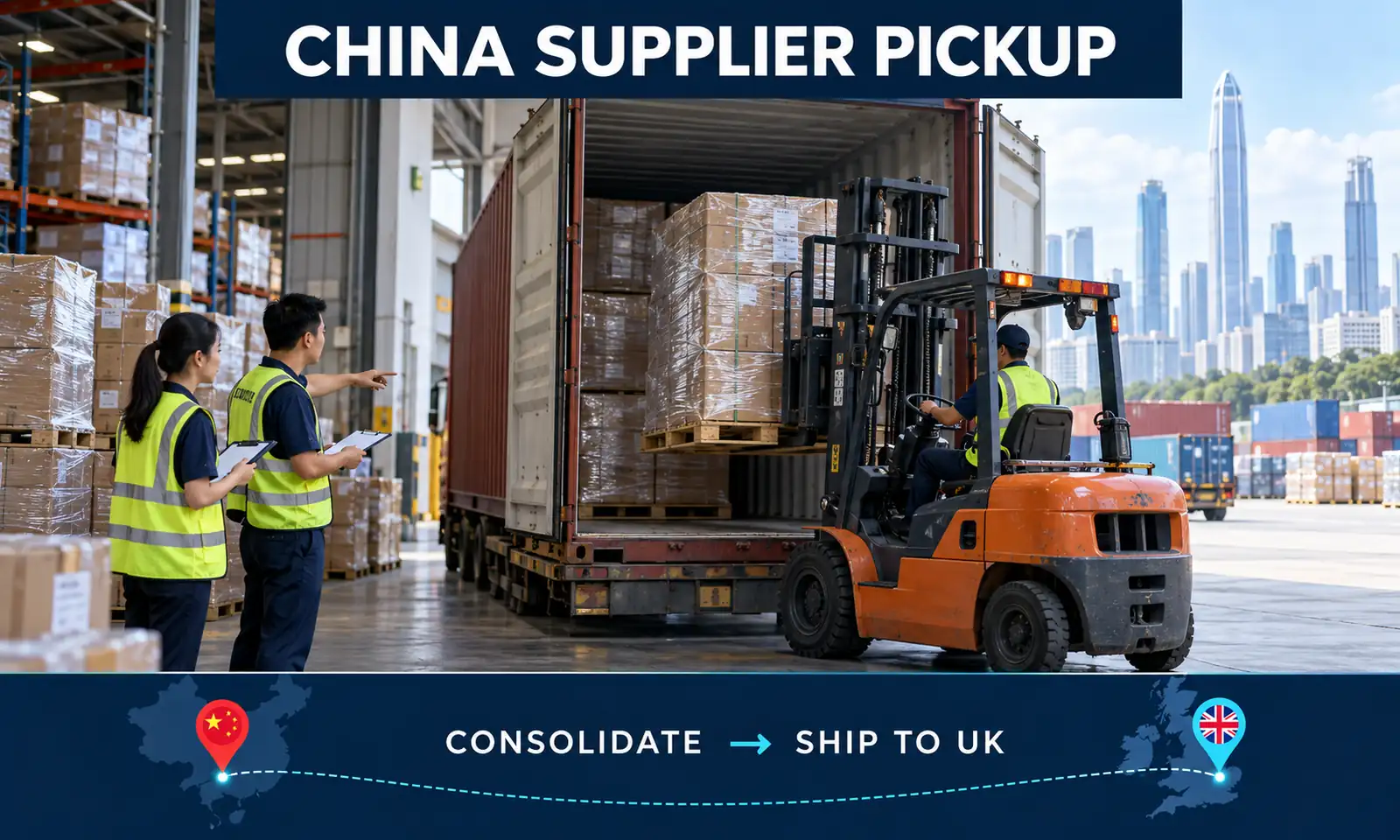
- Collect or receive the goods: issue each supplier a pickup time or a warehouse address and inbound reference; identify cargo by supplier so orders do not get mixed.
- Inspect the physical shipment: count cartons, photograph external condition when requested, compare labels and dimensions with the packing list and flag damage or undeclared items.
- Prepare export handling: consolidate, repack, label, palletise or load as agreed; check export data and whether the carrier will accept the goods.
- Book and hand over: confirm the quoted channel, cutoff, transport documents and final chargeable basis before courier, airline or ocean acceptance.
- Pre-alert the UK team: send the documents and importer instructions early enough to prepare release, tax treatment, possible inspection and a delivery appointment.
- Deliver and confirm receipt: after UK customs and terminal release, arrange the appropriate vehicle, obtain proof of delivery and record any visible loss or damage.
Resolve discrepancies before carrier acceptance
Request milestone messages when goods reach the warehouse, measurements are confirmed, the booking is accepted, the carrier departs, the cargo arrives, customs releases it and UK delivery is booked. A container or AWB number helps you look up events, but someone still needs to explain a document rejection, inspection or changed receiving appointment. If a supplier’s estimates differ from warehouse measurements, approve the new charge and packing plan before the carrier accepts the cargo.
How Should E-Commerce Sellers Ship from China to the UK?
For an e-commerce seller, the international shipping price is only one part of the result. The shipment must contain the correct units, arrive with usable labels and documents, clear UK import procedures and meet the receiving rules of Amazon, a third-party logistics provider (3PL) or the seller’s own warehouse. A supplier can arrange transport, but the seller should still see the packing, import and receiving plan and compare it with an independent forwarder’s delivered quotation.
Prepare cargo for Amazon UK
1. Collect and consolidate. Have each Chinese supplier deliver to an agreed receiving point or arrange separate pickups. The warehouse can hold the goods until a stated cut-off, identify each supplier’s inventory and combine compatible products for one larger freight movement. Consolidation only saves money when the extra warehouse work and waiting time are understood.
2. Inspect to an agreed scope. A warehouse can check the outside of cartons, count units, take photographs and look for damage. A product-quality inspection, functionality test or regulatory assessment is a separate service with a written sampling standard. Define exactly what happens if the count, appearance or labelling is wrong, and resolve it before the goods leave China.
3. Complete marketplace preparation. Check the current shipment plan and destination’s requirements for unit identifiers such as FNSKU where applicable, carton labels, poly bags, bubble wrap, pallet format and product packaging. Apply the required labels and protective materials in the China warehouse when that is permitted and economical. Do not assume one fixed Amazon standard: marketplace and receiving instructions can change, and the seller is responsible for its account and product compliance.
4. Choose the freight mode around stock availability. Courier or air can protect a product launch or low stock position; LCL or FCL can move a planned replenishment more economically. A UK warehouse, Amazon fulfilment centre and seller address have different appointments and unloading rules. Arrival at a carrier’s UK hub is not the same as Amazon receiving and checking in every unit. The dedicated China-to-Amazon FBA UK guide covers that final receiving workflow.
Plan dropshipping and single-order fulfilment separately
Sellers may source in China and sell through marketplaces such as eBay or Amazon, or through a Shopify store, while an agent holds goods and dispatches individual orders. This model can reduce the seller’s own warehousing work, but its economics depend on the product margin, delivery promise, returns, taxes and platform rules. The seller should specify whether products are stocked in a Chinese warehouse, a UK warehouse or both.
For one-piece dispatch, the fulfilment partner may link an order-management system to the seller’s store. When an order is placed, the partner picks the correct SKU, checks it, packs it, selects a permitted courier, produces tracking and hands it to the carrier. Confirm how the store passes customer data, how stock counts are reconciled, whether the partner can include branded inserts and how lost or returned parcels are handled. Logistics and customs are not magically included in every per-order fee: ask who is importer, what the customer pays on delivery and what the rate includes.
Shipping bulk inventory to a UK 3PL can make delivery to UK consumers faster than individual cross-border parcels, but it introduces a bulk import, storage charges, replenishment planning and domestic fulfilment fees. Compare the two models using the customer’s promised delivery time and complete landed cost per order, including returns.
What Warehousing Services Help China-to-UK Shipments?
A warehouse acts as a controlled pause between supplier production and the next transport leg. It may receive and identify goods, store them temporarily, group orders by SKU or destination, repack or label them, and dispatch either a consolidated international shipment or individual orders. Ask for the receiving process, evidence of quantities, storage time, fees, security and the handling instructions for damaged cartons.
Four practical warehouse functions
- Central receiving and temporary storage: hold goods from one or more factories at one address, record what arrived and release them when the buyer authorises shipment. A UK warehouse can also receive imported pallets, check arrival quantities and allocate stock for local distribution.
- One-piece order fulfilment: pick an individual customer’s order, group the required units, pack, check and dispatch it with tracking. Set rules for order cut-offs, customer address corrections and returns.
- Multi-supplier consolidation: combine goods made at different Chinese locations into a planned LCL, FCL, air or courier movement. Compare the saving against inbound trucking, warehouse fees, extra packing and the risk that one late supplier delays all others.
- Custom work and Amazon preparation: inspect outer cartons, count stock, photograph items, apply approved labels, pick mixed products or prepare packs and pallets for the intended UK receiving site. Confirm the exact instructions and the party that signs off any product changes.
Choose a China warehouse, a UK warehouse or both
Work done in China can catch a factory mistake before international freight is paid. Combining suppliers, checking cartons and preparing labels there can reduce repeated shipment minimums. Warehouse space and labour in China may be less expensive than a comparable UK service; request current prices because rent, service level and location vary by operator. Verify how long the forwarder will hold the goods and how it reports inventory.
A UK warehouse is closer to UK customers, retailers and Amazon sites. It can deconsolidate imported pallets, store safety stock and dispatch domestic orders without waiting for a new overseas consignment. Its fees may include inbound handling, pallet storage, picking, packaging, carrier collection and returns. For sellers with varied demand, a China consolidation site plus a UK fulfilment location can be sensible if the extra movement and inventory holding are justified.
How Is Freight Delivered to UK Warehouses, Businesses and FBA Sites?
The final postcode alone is not a delivery instruction. Tell the forwarder whether the address is a staffed dock, retail unit, construction site, farm, residential property, 3PL or Amazon centre. Add receiving hours, booking reference, road restrictions, vehicle access, pallet limits and whether there is a forklift or unloading crew.
Plan LCL, pallets and FCL against site access
LCL cargo needs destination deconsolidation and release before a local carrier collects it. The UK receiver may need a booked slot, pallet labels and an advance shipment reference. For pallet deliveries, supply pallet count, footprint, total height, weight and stackability. A site without a dock may require a tail lift or other handling equipment, subject to the actual pallet weight and access. Check what is included before paying for an unsuitable truck.
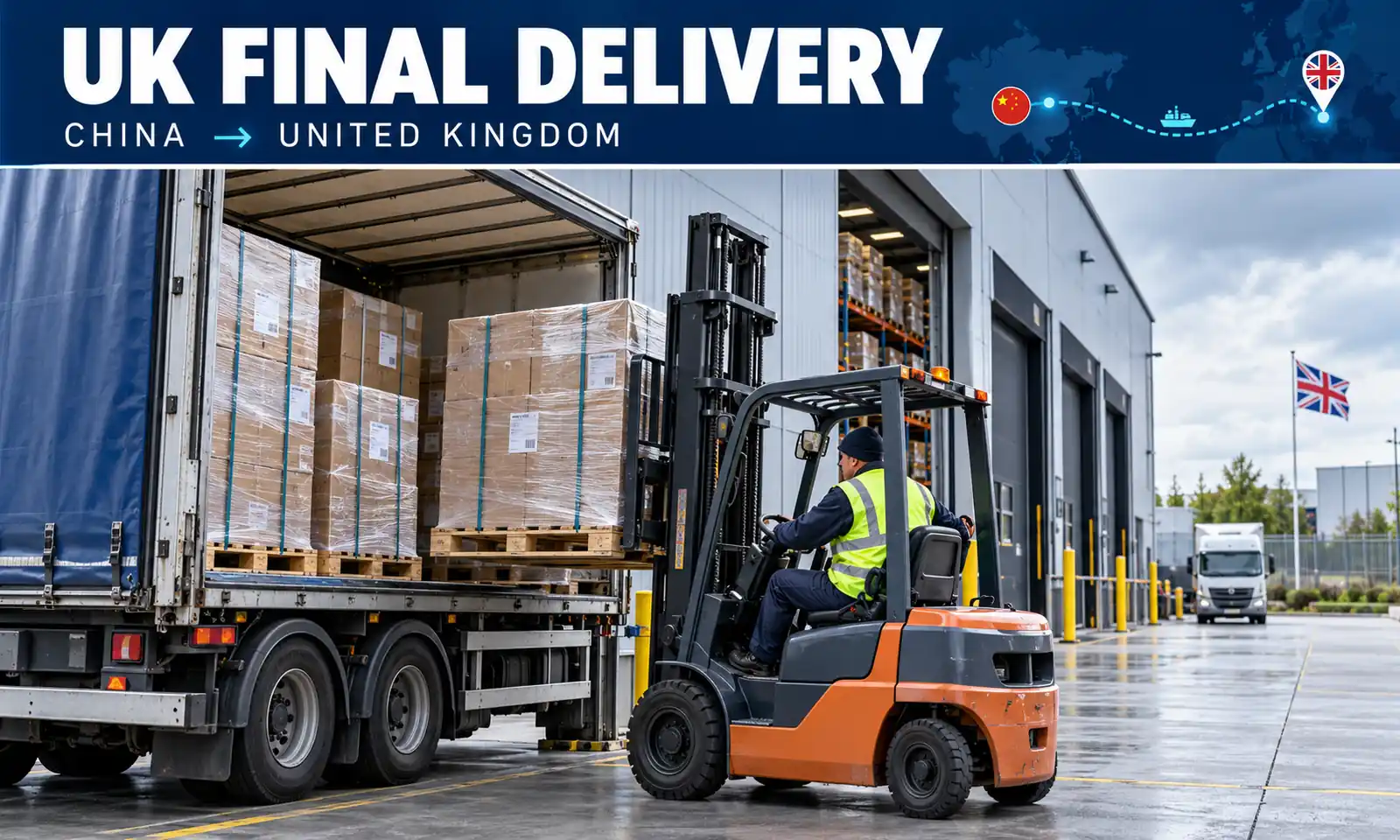
FCL delivery requires room for the container vehicle and enough time and labour to empty it safely. If the site cannot accept the equipment, arrange a warehouse transload and smaller vehicle delivery. Confirm who pays for waiting, failed appointments, storage, detention and the return of the empty container. A price that ends at the UK port does not include these steps unless expressly stated.
Confirm the real completion point
Amazon and 3PL sites may have current labels, shipment references, pallet rules and appointment systems. Check these instructions immediately before dispatch. Ask for a signed delivery note, carrier proof of delivery or warehouse receipt that fits the consignee’s process. A transport delivery signature does not prove every unit has been counted into inventory. Photograph visible damage or missing cartons, keep the outer packing and promptly preserve documents for a carrier or insurance claim.
Northern Ireland should be identified at the quotation stage. Its route and customs treatment can differ from a Great Britain postcode, especially when goods move through another jurisdiction or an onward distribution network. See government guidance on moving goods in and out of Northern Ireland for the relevant movement.
Do You Need Cargo Insurance from China to the UK?
Every movement involves handoffs: factory loading, road collection, warehouse receiving, vessel or aircraft handling, UK release and domestic delivery. Even a careful carrier can face an accident or damage. Cargo insurance is a policy that can compensate an insured party for covered physical loss or damage, subject to its declared value, terms, limits and exclusions. The buyer and seller should decide who has an insurable interest at each point under their sale agreement.
When should you buy cover?
Strongly consider it when the value of the cargo or a replacement delay would be difficult for your business to absorb. Small, fragile, high-value or temperature-sensitive goods may justify a closer review even if the freight charge is modest. Ask whether the policy applies from factory or warehouse pickup through UK delivery and temporary storage, and whether it covers loading, unloading and transshipment. If cover begins only at the Chinese port, the inland pickup may be outside it.
Do not confuse the carrier’s limited contractual liability, the forwarder’s business insurance and a cargo policy purchased for your goods. US federal trucking insurance rules do not govern the cover needed on a China-to-UK shipment. Request the policy summary, insurer, insured amount, valuation method, deductible and claim deadlines, then compare the premium with the commercial exposure.
What risks can be covered, and what may be excluded?
Depending on policy wording, cover may address external physical causes such as handling damage, vehicle accidents, bad weather, a natural disaster or piracy. War risks may need a separate endorsement. Cargo abandonment and customs rejection should not be promised as standard insured causes. Check whether a policy covers an actual physical loss connected with those events, rather than assuming that a customs refusal or a missed sales date automatically triggers payment.
Typical limitations can include loss caused by inadequate packing, inherent defect or faulty goods, delay without insured physical damage, excluded goods, sanctioned destinations, undeclared higher-value items or journeys and transport modes outside the insured route. Some electronics or other commodities may have special restrictions. Policies differ; ask the insurer or broker to confirm any unusual item in writing before dispatch. Keep the invoice, packing list, transport document, photographs and proof of delivery available for a claim.
How Can You Reduce China-to-UK Freight Cost?
1. Compare supplier-arranged freight with an independent quote
For a large order, do not assume that a supplier’s apparently convenient shipping offer is the cheapest delivered solution. Ask what the supplier has quoted—EXW, FOB, CIF, DAP or a workable DDP agreement—and request an itemised alternative from a forwarder acting for the buyer. Sometimes the factory has a competitive contract; sometimes its quote omits UK terminal charges, brokerage or inland delivery. Price both to the same address and the same importer arrangement.
2. Plan around production and seasonal capacity
Chinese New Year can interrupt factories, warehouses and trucking; Golden Week and Dragon Boat Festival can affect staffing and cut-offs. A planning example allows for a three-day Dragon Boat break, a week-long Golden Week closure for some businesses and heavier holiday-shopping demand across October–December for air and July–October for sea. Exact closure dates, prices and seasonal patterns vary by year; ask each supplier and carrier for the current calendar and reserve space early. The period after Chinese New Year and March–April can be more competitive in some years; obtain live quotes rather than assuming an annual rate dip.
3. Keep carrier alternatives available
A forwarder able to compare several shipping lines, airlines or truckers has more ways to respond when a vessel has no space or a flight is full. Ask for a primary and a realistic alternative where the deadline is critical. More carrier options are useful only when the forwarder also understands the product, cutoff and delivery obligations; the lowest headline rate can cost more after a missed sailing or terminal charge.
4. Consolidate without waiting forever
If you buy from different suppliers, one China warehouse can combine compatible orders into a shared ocean movement, an FCL load or a single air shipment. Calculate the warehouse receiving and storage charges, extra local trucking and final chargeable volume. Set a release date so one delayed factory does not hold all finished stock. For a new product, a partial urgent dispatch followed by a consolidated main order may protect sales while keeping the bulk freight economical.
5. Improve the transport mix and packaging
Compare a sea-and-air split, a current rail-and-road route or air for only the parts needed early. Account for handling and customs costs on each separate shipment. Ask suppliers to reduce empty space in cartons, secure fragile goods properly and use a pallet layout that fits the UK receiver. In ocean LCL, both volume and sometimes weight affect the tariff; FCL also has equipment and payload limits. Do not assume ocean weight “doesn’t matter”: unsafe or overweight containers create serious restrictions and cost.
How Can You Prevent Delays in China and on UK Arrival?
Before goods leave China
Confirm Chinese holiday closures, the supplier’s realistic finished-and-packed date and the carrier’s warehouse or terminal cutoff. Contact the supplier a few days before the declared ready date rather than discovering missing labels on collection day. Under FOB, confirm the seller’s export-document and on-board responsibilities; under other sale terms, specify who is handling export and pickup. Return a loaded FCL container before the vessel deadline, and send correct carton data before the space is booked.
Have the forwarder and supplier agree on commercial invoice details, sale terms, value, packing list, country of origin and the actual products. A good quality outer carton reduces the chance that a warehouse must stop and repack the cargo. Set payment and document-release deadlines in advance; a late supplier balance, unpaid freight or unreleased B/L can delay access to goods even after the carrier arrives.
Before the UK customs and delivery handoff
Give the UK customs representative the commercial invoice, packing list, transport reference, confirmed commodity code, EORI details, broker authority and any conditional licence or certificate ahead of arrival. Where the transaction needs origin evidence or a certificate of origin, ask for that specifically; it is not mandatory for every product. Resolve differences between the declared value, invoice and transport documents rather than allowing a preventable hold at the port.
Book the UK delivery vehicle and receiving appointment with realistic release time, unloading capability and the correct postcode. If HMRC or another authority examines the goods, keep the buyer updated and obtain the revised release and storage position. A customs guarantee is not a universal prerequisite for an ordinary UK import. Confirm any actual guarantee or tax-accounting requirement with the appointed broker.
For an urgent launch, consider sending 20% by air and 80% by sea and prepare separate documents for each movement. This can place some stock in the UK earlier, but “just one week” after production cannot be promised: actual air acceptance, customs release and UK receiving vary by route. Measure success from the day the stock can be sold or used.
What Should a China-to-UK Freight Forwarder Include in the Quote?
A useful quote for shipping from China to the UK lets you compare the same goods between the same locations with the same import obligations. A forwarder’s reliability matters most when it becomes a clear operating proposal, not simply an attractive price per kilogram.
Send a complete cargo brief
- All China supplier cities or pickup addresses, cargo-ready dates and any planned multi-supplier consolidation.
- Product name, material, use, pictures, origin, commercial value, commodity code if established and any battery, chemical, food, medical, timber, branded or other controlled characteristics.
- Carton, pallet and crate counts; each type’s packed length × width × height, gross weight, total CBM and largest single piece.
- Final UK postcode and site type, receiving hours, booking reference, vehicle access, unloading equipment and required usable-stock date.
- Sale term and named place, proposed importer, chosen broker if any, and whether you want terminal release, DAP or a reviewed DDP solution.
Compare quotations at the same endpoint
Place each offer on one worksheet. The following checks turn several carrier prices into a decision about usable UK inventory without assuming any one headline rate is all-inclusive.
| Check | Record for every option | Why it changes the decision |
|---|---|---|
| Rated cargo | Pieces, packed dimensions, actual weight, chargeable weight or CBM | A remeasurement can change the cost or even the best mode. |
| Total landed scope | China collection, freight, UK release, customs service, taxes and final delivery | A port or airport rate cannot be compared with warehouse delivery. |
| Useful stock date | Supplier-ready date, ETD, arrival, customs release, delivery and warehouse receiving | Carrier arrival does not mean the buyer can sell or use the goods. |
| Exception owner | Who approves new measurements, handles inspection, changes a booking and reports delays | An agreed handoff prevents unresolved issues from sitting between providers. |
Ask for the full proposed service in return
The response should name the mode, carrier or route where known, China collection and warehouse tasks, chargeable basis, planned cutoff and transit endpoint. It should identify included customs work, UK local charges, tax treatment, insurance option, inland delivery, unloading and proof of delivery. Request rate validity, payment point, space or equipment status and the circumstances that change price: remeasurement, product differences, failed collection, inspection, storage, waiting or a changed postcode.
VoltFreight can coordinate supplier pickup in China, warehouse receiving, consolidation, export handling, express, air or ocean carriage and an agreed UK customs and delivery handoff. We can compare workable options using the same endpoint when you provide the complete brief through our contact page. The written quotation will establish which specific services are included.
Conclusion: Plan China-to-UK Shipping Around Usable Stock
Successful shipping from China to the UK connects eight decisions: select a responsible freight forwarder; choose a realistic sea, air, express or combined route; prepare correct UK customs information; plan e-commerce requirements; place warehousing where it helps; insure the exposure you cannot comfortably absorb; remove avoidable cost; and protect the time between factory completion and usable stock. Historical port figures and worked examples in this guide provide useful planning checks, while the actual booking must reflect today’s carrier schedule, customs requirements, cargo and named destination.
Start with supplier addresses, measured packing, accurate product details, cargo-ready date, importer’s position and UK delivery postcode. A strong quotation will show where the freight changes hands, what each stage costs and how a delay or revised measurement will be handled. Send VoltFreight those details to receive a route and price you can compare line by line.