Shipping from China to Italy
Get a tailored freight route from China based on your cargo details, destination, timeline and budget. VoltFreight supports pickup, consolidation, customs guidance and final delivery planning.
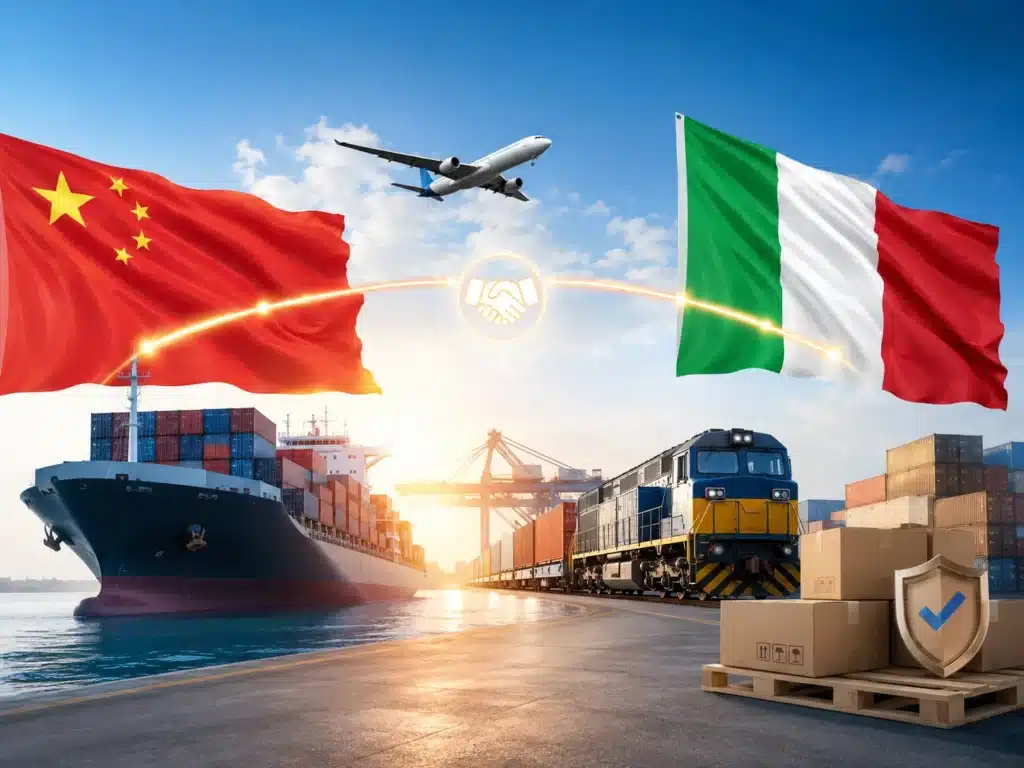
Shipping from China to Italy takes about 3–7 business days by express, 5–10 days by standard air freight, 8–15+ days by air DDP, 22–35+ days by rail DDP, and 35–55+ days by sea DDP.
Sea freight is usually better for large or non-urgent cargo, while air freight and express shipping suit urgent shipments. VoltFreight can also coordinate supplier pickup, EU gateway customs clearance and final delivery to Milan, Rome, Bologna, Turin, Naples, Sicily, Sardinia, Italian warehouses and Amazon FBA. Send your product name, weight, carton dimensions and destination postcode to compare routes and receive a clear freight quote.
- Supplier pickup and warehouse receiving in China
- Cargo consolidation from multiple suppliers
- Customs document review and final delivery planning
Review available freight options, route details, customs notes and planning information for this destination.
Shipping from China to Italy: Cost, Time and Best Route at a Glance
Shipping from China to Italy usually takes about 3–7 business days by express, 5–10 days by standard air freight, 8–15 days by air DDP, 22–35 days by rail or truck DDP, and 35–55 days by sea DDP. Standard ocean freight commonly takes about 28–50 days before final customs and inland delivery. Therefore, air or express works best for urgent cargo, while sea freight usually gives larger shipments a lower unit cost.
For budgeting, small-parcel express often starts around USD 8–15 per chargeable kilogram. Standard air freight may fall around USD 4–8 per chargeable kilogram, while selected air DDP services for eligible general cargo may fall around USD 6.5–9.5 per kilogram. Meanwhile, sea DDP for suitable cargo may fall around USD 2.5–4.5 per kilogram. These are broad planning ranges rather than a live tariff. Cargo type, declared value, HS or TARIC code, chargeable weight, season, customs scope and Italian postcode can change the final price.
China-to-Italy Freight Comparison
| Shipping Method | Typical Transit Time | Indicative Planning Range | Best For |
|---|---|---|---|
| Express courier | 3–7 business days | About USD 8–15/kg | Samples, documents, spare parts and small urgent parcels |
| Standard air freight | 5–10 days | About USD 4–8/kg | Urgent commercial cargo, usually 100 kg or more |
| Air DDP | 8–15 days | About USD 6.5–9.5/kg for eligible cargo | Urgent cartons that need coordinated customs and delivery |
| Rail or truck DDP | 22–35 days | About USD 3.5–5.5/kg for eligible cargo | Commercial stock that needs a balance between cost and speed |
| LCL sea freight | 28–50 days plus final clearance and delivery | Base ocean freight may be about USD 50–120/CBM | Shipments that do not fill a container |
| FCL sea freight | 28–50 days plus final clearance and delivery | About USD 2,000–4,000 for 20GP and USD 3,000–5,500 for 40GP/40HQ | Large orders, pallets, machinery and bulky goods |
| Sea DDP | 35–55 days | About USD 2.5–4.5/kg for eligible cargo | Cost-sensitive cartons and larger commercial shipments |
Important: LCL and FCL figures above represent broad transport-market references, not a guaranteed landed cost. Origin handling, destination charges, customs clearance, duties, IVA/VAT, inspections, storage, remote-area delivery and special-cargo surcharges may apply. Likewise, a DDP price is valid only when the written quotation identifies the included customs, tax and delivery scope.
Which Shipping Method from China to Italy Should You Choose?
The best route depends on the deadline, shipment size, product compliance and the party that will handle import clearance. First, decide whether the Italian buyer will act as importer and use its own EORI and customs broker. Then compare the total landed cost instead of comparing only the airport or port freight charge.
- Choose express for documents, samples and lightweight parcels that must arrive quickly.
- Choose standard air freight for urgent B2B cargo when the importer can manage customs clearance in Italy.
- Choose air DDP for suitable cartons when the customer wants one coordinated customs-and-delivery service.
- Choose rail or truck DDP when ocean freight is too slow but air freight is too expensive.
- Choose LCL sea freight when cargo is too large for air freight but does not fill a container.
- Choose FCL sea freight for high-volume cargo, pallets, machinery, furniture or a full production order.
- Choose sea DDP for eligible, non-urgent commercial cargo that needs door delivery under an agreed scope.
For example, a 60 kg urgent spare-parts shipment may fit express or air freight. In contrast, 8 CBM of furniture will usually fit LCL or FCL better. A 500 kg shipment of ordinary e-commerce stock may justify comparing air DDP, rail/truck DDP and sea DDP. VoltFreight compares the available routes after checking the cargo rather than forcing every shipment into one standard channel.
Sea Freight from China to Italy
Sea freight from China to Italy is usually the most economical choice for large, heavy or non-urgent commercial cargo. It suits furniture, machinery, building materials, household products, auto parts, packaging, wholesale stock and palletized goods. Common Chinese ports include Shanghai, Ningbo, Shenzhen, Guangzhou, Qingdao, Xiamen and Tianjin.
LCL Shipping to Italy
LCL means Less than Container Load. A consolidator combines your cargo with other shipments, so you pay mainly for the occupied volume and handling. However, LCL includes warehouse receiving, consolidation, port handling and destination deconsolidation. As a result, the lowest ocean rate per CBM does not always produce the lowest total landed cost.
LCL works well for roughly 1–15 CBM, although cargo density and route-specific charges can move the practical break-even point. If you need a deeper comparison, review our guide to LCL sea freight from China.
FCL Shipping to Italy
FCL means Full Container Load. Importers commonly use 20GP, 40GP and 40HQ containers. FCL gives larger shipments fewer consolidation touches and often lowers the cost per unit. Nevertheless, container loading, weight distribution, fumigated wood packaging, unloading equipment and destination demurrage require advance planning.
For standard imports, vessels may route to Genoa, La Spezia, Trieste or another suitable Italian port. The best port depends on the sailing schedule, final postcode, customs plan and inland trucking cost. Explore our main ocean freight from China service for additional FCL and port-to-port options.
Air Freight and Express Shipping from China to Italy
Air freight from China to Italy works well for electronics, spare parts, fashion stock, samples, high-value goods and seasonal products. Standard air freight may arrive through Milan Malpensa, Rome Fiumicino or another suitable airport. According to its official cargo information, Milan Malpensa Cargo City is Italy’s main air-cargo hub.
Standard Air Freight
Standard air freight normally becomes more economical than courier service as commercial weight increases. The quotation may cover airport-to-airport, airport-to-door or door-to-door service. Therefore, always confirm whether it includes pickup, export clearance, destination handling, customs brokerage and final delivery.
Express Courier
Express shipping from China to Italy commonly uses DHL, UPS or FedEx. It offers fast pickup and detailed tracking, but dimensional weight can make bulky cartons expensive. Moreover, the courier may collect import duty, IVA/VAT and a clearance fee from the receiver unless the agreed service covers them.
For urgent cargo, VoltFreight can compare courier, air freight from China and express freight instead of choosing only by the headline rate.
Rail and Truck Freight from China to Italy
Rail freight from China to Italy can provide a middle option between air and sea. Cargo normally travels from a Chinese rail hub to Europe and then continues by truck to Italy. This route may suit industrial parts, consumer goods, e-commerce inventory and time-sensitive replenishment that cannot justify air-freight cost.
Rail or truck DDP service requires more than a departure schedule. Border operations, terminal congestion, customs release, hub transfer and final delivery all affect the actual lead time. Therefore, importers should compare the complete door-to-door timeline with sea DDP rather than comparing only the main rail journey.
This route is not suitable for every product. Batteries, liquids, powders, chemicals, oversized cargo and regulated goods need route approval before pickup. In addition, disruptions along the selected corridor can change capacity or routing. Review our rail freight from China service or request a route check for your specific cargo.
DDP Shipping from China to Italy
DDP shipping from China to Italy can combine China pickup, export handling, international transport, import formalities and final delivery under one written service scope. However, “door-to-door” and “DDP” do not automatically mean the same thing. A door-to-door DAP shipment may still leave import clearance, duty and IVA/VAT to the buyer.
Under the DDP Incoterm, the seller takes responsibility for export, transit and import formalities up to the named destination, while the buyer normally unloads the arriving vehicle. The ICC explanation of DAP and DDP also notes that local import rules can make DDP difficult for a foreign seller. Consequently, the sales contract and the freight quotation should identify the importer arrangement and tax treatment instead of relying on the three letters alone.
How EU Gateway DDP Delivery to Italy Works
Selected VoltFreight DDP routes may use another EU country as the customs gateway before final delivery to Italy. For example, air DDP may clear through Belgium, rail DDP may clear through Poland, and sea DDP may clear through Belgium or the Netherlands. After release, the cargo may pass through a German or other EU transfer hub and continue to Italy by parcel network or truck.
This is not the route for every shipment, and it does not mean that customs or taxes disappear. Before booking, VoltFreight checks product eligibility, declared value, TARIC classification, consignee type, delivery postcode and the documents required for the selected route. Learn more about the commercial difference in our DAP vs DDP shipping guide.
What a DDP Quote Must Confirm
- The exact named delivery place and Italian postcode
- The transport mode and expected transit range
- Whether duty and IVA/VAT fall within the agreed price
- The importer or customs-declaration arrangement
- Whether the price covers pickup, customs, final delivery and fuel surcharge
- Remote-area, island, oversize, residential or appointment-delivery charges
- Excluded products, value limits and inspection-related costs
- Who handles unloading, storage, returns or failed delivery
How Shipping Costs from China to Italy Are Calculated
The shipping cost from China to Italy depends on more than kilograms. Freight forwarders check the chargeable weight, shipment volume, product risk, pickup city, Italian destination, delivery type and customs scope. Space availability, fuel, peak season and carrier surcharges also affect the live rate.
Air and Courier Chargeable Weight
Air freight and express carriers compare actual weight with volumetric weight and charge the higher number. A common air-freight formula is:
Volumetric weight (kg) = length × width × height in centimeters ÷ 6,000
Some courier services use a 5,000 divisor instead. Therefore, send carton-level measurements before accepting a rate.
Worked Air-DDP Budget Example
Suppose a shipment contains 8 cartons. Each carton measures 60 × 40 × 40 cm and weighs 15 kg. The actual weight is 120 kg, while the volumetric weight is 128 kg: 8 × 60 × 40 × 40 ÷ 6,000. The carrier would therefore rate 128 kg.
If an eligible air-DDP route used an indicative rate of USD 7.50 per chargeable kilogram, the initial transport budget would be USD 960. This is a calculation example, not a binding customer quotation. The final price may change after VoltFreight checks the product, declared value, tax scope, pickup address, remote postcode and carton limits.
Sea Freight Pricing
LCL normally uses CBM or a weight-to-measure rule, while FCL uses the container and route. A complete sea-freight comparison should include origin charges, ocean freight, destination handling, customs brokerage, duty, IVA/VAT, port storage, container demurrage and inland delivery. Therefore, a low port-to-port rate may cost more after arrival than a clearer door-to-door quotation.
Italy Customs Clearance: EORI, TARIC, Duty and IVA
For a standard import through an Italian port or airport, the Italian or EU importer normally needs an EORI number and a customs-clearance arrangement. The European Commission’s EORI guidance states that an EORI number is mandatory for customs operations in the EU customs territory.
Next, the importer should classify the product correctly. The EU TARIC database brings together customs-tariff measures, trade-defence measures and certain import restrictions. Importers can also use the European Commission’s Access2Markets portal to research product-specific import conditions.
Duty depends on the TARIC code, origin and any applicable trade measure. Italy also applies IVA/VAT, but the correct treatment depends on the transaction, customs value, importer status and product. Moreover, anti-dumping duty can materially change the landed cost of selected goods. For that reason, VoltFreight will not guess a tax amount from a product name alone.
Common Import Documents
- Commercial invoice with buyer, seller, currency, Incoterm and accurate value
- Packing list with carton count, net weight, gross weight and dimensions
- Bill of Lading, Sea Waybill, Air Waybill or rail transport document
- HS code or EU TARIC code
- Importer EORI and customs-broker authorization when required
- Certificate of origin when requested
- CE declaration, test report, label or technical file when applicable
- License, safety data sheet or other permit for regulated products
Product Compliance and Cargo That Needs Extra Review
Customs clearance does not replace product compliance. Before shipping, the importer should confirm whether EU rules require CE marking, labeling, responsible-person information, technical documentation, safety testing, energy labeling, packaging registration or another market-access obligation.
The following cargo needs additional review before VoltFreight confirms a standard or DDP route:
- Lithium batteries and battery-powered products
- Liquids, powders, magnets, chemicals and dangerous goods
- Cosmetics, food-contact products, supplements and medical-related goods
- Toys, children’s products, PPE, lighting and electrical equipment
- Wireless devices, electronics and products with plugs or chargers
- Textiles, footwear and goods that may face trade-defence measures
- Branded goods, luxury goods and products requiring authorization
- Oversized machinery, fragile cargo and goods that require special loading
Provide product photos, material details, battery specifications, brand information, intended use and available certificates at the quotation stage. As a result, the freight team can reject an unsuitable channel before the cargo reaches an export warehouse and avoid preventable delay or re-routing costs.
Main Ports, Airports and Final Delivery Areas in Italy
Route selection should follow the final delivery postcode rather than the country name alone. Genoa, La Spezia and nearby Ligurian gateways often suit cargo for Milan, Turin and northwestern Italy. Trieste can support selected routes to northeastern Italy, while other ports may fit central or southern destinations better. However, vessel schedule and total inland cost remain more important than distance alone.
For air cargo, Milan Malpensa commonly serves northern Italy and national distribution networks. Other airport options may include Rome, Bergamo or Venice, depending on airline capacity and cargo type.
Typical Final-Delivery Planning
- Milan, Lombardy and Piedmont: standard sea, air, DDP parcel and pallet delivery all work well for many B2B shipments.
- Bologna, Veneto and Emilia-Romagna: confirm warehouse appointments, pallet exchange and truck access.
- Florence, Tuscany and central Italy: compare La Spezia, air delivery and EU-gateway DDP by total cost.
- Rome and Lazio: compare air, sea and DDP according to shipment size and deadline.
- Naples and southern Italy: allow more time for inland delivery and verify carrier coverage.
- Sicily, Sardinia and remote postcodes: expect possible island or remote-area surcharges and a longer final-mile window.
For pallets or machinery, also confirm whether the receiver has a loading dock or forklift. Tail-lift delivery, an appointment, a limited-access vehicle or inside delivery may cost extra and must appear on the quote.
Shipping from Alibaba, 1688 and Multiple Chinese Suppliers to Italy
Many Italian buyers source from Alibaba, 1688, Yiwu wholesalers and factories in Shenzhen, Guangzhou, Foshan, Ningbo, Shanghai or other Chinese cities. When several suppliers ship separately, repeated pickup, export and minimum freight charges can increase the total cost.
VoltFreight can receive cargo at a China warehouse, check carton counts, record weights and dimensions, identify visible packaging problems and consolidate approved goods into one shipment. Consolidation can improve the chargeable weight and simplify delivery. Nevertheless, the importer should avoid combining incompatible cargo, such as general goods with undeclared batteries, chemicals or products requiring different customs documents.
The purchase term also changes responsibility. Under EXW, the buyer’s freight plan starts at the supplier’s premises, while FOB normally places more origin responsibility on the seller for sea freight. Read our EXW vs FOB guide before asking suppliers to quote different terms.
China-to-Italy Shipping Process
- Send cargo details. Provide the product name, photos, carton count, weight, dimensions, supplier address, cargo-ready date and Italian postcode.
- Review compliance and route eligibility. VoltFreight checks cargo type, battery or liquid status, HS/TARIC information, declared value and required service scope.
- Compare suitable options. We compare standard air or sea freight with express, rail/truck DDP, air DDP or sea DDP when available.
- Confirm the written quotation. The quote identifies the route, chargeable weight, transit range, customs scope, delivery type, validity period and exclusions.
- Collect or receive the cargo. We arrange supplier pickup or provide the China warehouse address for consolidation.
- Check export data and dispatch. The team verifies the available documents, books space and handles export operations within the confirmed scope.
- Complete the main transport and customs stage. Cargo moves by the selected mode and follows either standard Italian import clearance or the agreed EU-gateway route.
- Arrange final delivery. The shipment moves to the Italian business, warehouse, fulfilment centre or other approved address by courier or truck.
Tracking milestones vary by mode. Express offers frequent scans, while sea and rail often provide event-based updates. Customs inspections, incorrect documents, unpaid destination charges, storage, receiver absence or an invalid postcode can extend the delivery time.
What We Need for an Accurate China-to-Italy Freight Quote
A useful quotation needs enough information to identify both the transport cost and the customs risk. Please send:
- Exact product name, material, use and product photos
- HS or TARIC code if available
- Number of cartons or pallets
- Gross weight and dimensions of each package
- Supplier city and pickup address in China
- Cargo-ready date and preferred delivery deadline
- Full Italian postcode, city and delivery-address type
- Whether the receiver is a company, warehouse, Amazon FBA centre or private address
- Whether the importer has an EORI and customs broker
- Declared customs value and Incoterm with the supplier
- Battery, liquid, powder, magnet, chemical or brand information
- Required scope: port-to-port, airport-to-airport, DAP, DDP or full door-to-door
For Amazon or another fulfilment warehouse, also send the shipment plan, carton labels, pallet rules and appointment requirements. You can review our shipping from China to Amazon FBA service before preparing the booking.
Why Choose VoltFreight as Your Freight Forwarder from China to Italy?
A reliable freight forwarder from China to Italy should explain the route, cost boundary and customs responsibility before collecting the cargo. VoltFreight helps importers compare multiple modes instead of presenting one channel as the answer for every shipment.
- Pickup and supplier coordination across major Chinese sourcing regions
- Multi-supplier warehouse consolidation
- Air, sea, rail, truck, express, DAP and eligible DDP route comparison
- Chargeable-weight and carton-dimension review before booking
- Standard Italian import planning and selected EU-gateway delivery options
- Product-risk screening for batteries, liquids, branded and regulated goods
- Parcel, pallet, business-address, warehouse and Amazon FBA delivery planning
- A written quotation that identifies inclusions, exclusions and route validity
In addition, our team can explain when a cheaper freight line creates higher destination charges or greater compliance risk. That comparison helps importers choose a route on total landed cost, not on one attractive number.
Related China-to-Europe Freight Routes
If you distribute inventory across Europe, compare the Italian route with nearby markets before selecting a port, customs plan or regional warehouse:
- Shipping from China to Germany
- Shipping from China to France
- Shipping from China to Poland
- Shipping from China to Spain
- Shipping from China to Greece
FAQ About Shipping from China to Italy
What is the cheapest way to ship from China to Italy?
Sea freight is usually the cheapest method for large or heavy cargo. LCL works for smaller volumes, while FCL normally gives a lower unit cost when the shipment can use most of a container. Sea DDP may suit eligible cartons that need final delivery. However, compare origin charges, destination fees, duty, IVA/VAT and inland delivery before choosing the lowest headline rate.
How long does shipping from China to Italy take?
The typical shipping time from China to Italy is about 3–7 business days by express, 5–10 days by standard air freight, 8–15 days by air DDP, 22–35 days by rail or truck DDP, and 35–55 days by sea DDP. Standard sea freight commonly needs about 28–50 days before final clearance and delivery. Space, customs inspection, port congestion and remote delivery can extend these ranges.
How much does shipping from China to Italy cost?
Small-parcel express may cost about USD 8–15 per chargeable kilogram, while standard air freight may fall around USD 4–8 per kilogram. LCL base ocean freight may fall around USD 50–120 per CBM, excluding origin and destination charges. DDP and FCL require a live quote because route, product, declared value, customs scope and postcode materially change the total.
Can VoltFreight arrange DDP shipping to Italy?
Yes, VoltFreight can review air, rail/truck and sea DDP options for eligible cargo. Selected routes may clear through another EU gateway before final delivery to Italy. However, availability depends on product type, declared value, TARIC classification, delivery address and current route rules. The written quote must confirm duty, IVA/VAT, importer arrangement and exclusions.
Do I need an EORI number to import from China into Italy?
For a standard commercial import into the EU customs territory, the relevant economic operator normally needs an EORI number for customs operations. If you choose a coordinated DDP service, the import arrangement may differ, but the shipment still requires a lawful customs declaration. Confirm the importer and EORI arrangement before dispatch rather than after the goods arrive.
Get a Freight Quote from China to Italy
The right route should match your cargo, deadline, customs position and final postcode. Therefore, send VoltFreight the product name, photos, carton count, gross weight, dimensions, supplier location, declared value and Italian delivery address. We will compare the suitable sea, air, rail, truck, express and DDP options and explain the chargeable weight, transit range and service scope.
Ready to plan your shipment? Use the VoltFreight contact page to request a China-to-Italy freight quote. For the fastest review, include any battery, liquid, powder, brand or compliance information in your first message.
Get a clear freight quote for your cargo.
Send us your cargo details, supplier location and destination address. We will help review the suitable route and prepare a clearer quote.
Popular Freight Routes from China
Explore related China-to-destination shipping services for air freight, sea freight, customs support and door-to-door delivery.