Quick answer: Car parts can be shipped from China to the United States by express courier, air freight, LCL or FCL ocean freight. The right method depends on the exact part, packed weight and dimensions, order value, delivery deadline, U.S. ZIP code and whether the shipment contains batteries, fluids, gas, airbags or other controlled contents.
Small, urgent and high-value components may justify express or air freight. Dense replacement stock, engine components and planned wholesale orders normally move more economically by sea. Once an order approaches 10–15 CBM, importers should compare LCL with a full container instead of assuming shared-container freight will remain cheaper.
The cost of importing automotive parts has changed significantly since 2024. Based on shipments reviewed by VoltFreight, affected importers have experienced total landed cost increases of about 15%–23%, depending on the product, tariff treatment, packing, route and final delivery requirements. Classification errors, incomplete compliance records and unexpected destination charges can now cost more than the difference between two freight quotations.
This guide explains how to compare FCL, LCL, air freight and DHL, prepare automotive cargo for export, estimate U.S. landed cost, review tariff exposure and arrange delivery to a commercial warehouse, 3PL or Amazon FBA facility.
For a broader comparison of U.S. ports, air gateways, shipping methods and inland delivery options, see our shipping from China to the USA page.
Last reviewed: September 2026. Prices and transit times are planning references rather than guaranteed quotations. Confirm the current service, carrier acceptance and tariff treatment before booking.
Understanding FCL vs. LCL for Auto Parts Shipments
FCL and LCL suit different inventory strategies. FCL gives the importer control of an entire container and reduces the number of cargo-handling points. LCL allows a smaller order to share container space, but consolidation, deconsolidation, destination handling and minimum charges must be included in the comparison.
For suitable orders around 10–15 CBM and above, FCL may reduce the logistics cost per unit by 20%–30% compared with repeated LCL movements. This is not a fixed crossover point. Dense brake components may reach container weight limits before using all the available space, while bumpers and body panels may consume substantial CBM without approaching the container payload.
FCL, LCL and air freight planning references
| Shipping method | Common commercial profile | Shanghai to Los Angeles reference | Planning cost reference | Best suited to |
|---|---|---|---|---|
| 20ft FCL | Orders valued at USD 8,000–15,000 | 18–22 days port to port | Allocated main freight equivalent of USD 45–65/CBM when the container is used efficiently | Engine parts, suspension components, brake parts and dense inventory |
| 40ft or 40HQ FCL | Orders valued at USD 15,000–28,000 | 18–22 days port to port | Allocated main freight equivalent of USD 35–50/CBM when efficiently loaded | Mixed parts, wholesale replenishment, dealer inventory and FBA restocking |
| LCL ocean freight | Orders valued at USD 2,000–8,000 | 25–35 days port to port | USD 80–120/CBM before route-specific origin, destination and delivery charges | Trial orders, seasonal stock and smaller wholesale shipments |
| Air freight | Time-sensitive commercial orders, often valued above USD 5,000 | 5–7 days for the main coordinated movement | USD 4.50–7.00/kg for suitable general cargo | Emergency stock, high-margin components and parts needed to prevent a production or repair delay |
These figures cannot be compared without aligning the service scope. FCL is normally quoted per container, while LCL is calculated by chargeable volume or weight. Air freight uses the greater of actual weight and volumetric weight.
The table does not mean that every listed price includes supplier collection, China export handling, U.S. customs brokerage, duty, terminal charges and inland delivery. Request a written list of inclusions and exclusions before comparing providers.
Why more automotive importers are using FCL
VoltFreight’s review of more than 1,000 automotive parts shipment records from 2024 to 2026 shows a clear change in ordering strategy. In 2024, about 60% of the reviewed importers relied primarily on LCL for flexibility. By 2026, about 65% were using FCL for a larger share of their replenishment shipments.
The change is not driven by ocean freight alone. Importers also want to reduce repeated destination charges, consolidation delays, warehouse handling and cargo damage exposure. A dedicated container makes it easier to separate dense metal parts from lightweight body components and control pallet placement, securing and weight distribution.
If annual auto parts purchasing exceeds USD 80,000, compare two or three larger FCL movements with monthly LCL shipments. For suitable orders, quarterly consolidation may reduce total logistics expenditure by 18%–25%.
The calculation must still consider:
- Inventory-holding cost and available cash flow.
- Storage capacity at the U.S. destination.
- Production dates from different Chinese suppliers.
- The commercial cost of running out of an important SKU.
- Container payload and U.S. road-weight restrictions.
- Destination unloading equipment and labor.
VoltFreight coordinates regular departures from Shenzhen and Hong Kong, commonly every five to seven days, subject to the selected route and carrier schedule. Importers purchasing from several factories can deliver the cargo to one China warehouse for receiving, carton checks, repacking and consolidation.
Use packed volume—not purchase value alone—to choose the method
The order values in the comparison table describe common commercial profiles; they are not booking rules. Select the freight method from the finished cargo data:
- Total carton, crate and pallet count.
- Gross weight and outer dimensions of every package.
- Total CBM and weight concentration per pallet.
- Whether the packages can be stacked safely.
- Whether the cargo contains liquids, batteries, gas, airbags or other sensitive items.
- The acceptable arrival date and financial consequence of a delay.
- The U.S. port, warehouse, ZIP code and unloading conditions.
Ask for both LCL and FCL ocean freight quotations when the shipment approaches the likely crossover point. Compare the complete cost to the same U.S. receiving address rather than comparing an LCL door-delivery price with an FCL rate that stops at the port.
Can Car Parts Be Shipped from China to the USA?
Yes. Chinese-made automotive parts can enter the United States when the actual products, labels, supporting evidence and customs entry meet the applicable requirements.
“Auto parts” is not one customs or compliance category. A dry steel bracket, replacement lamp, diesel engine, brake-fluid bottle and airbag require different reviews even when they are intended for the same vehicle.
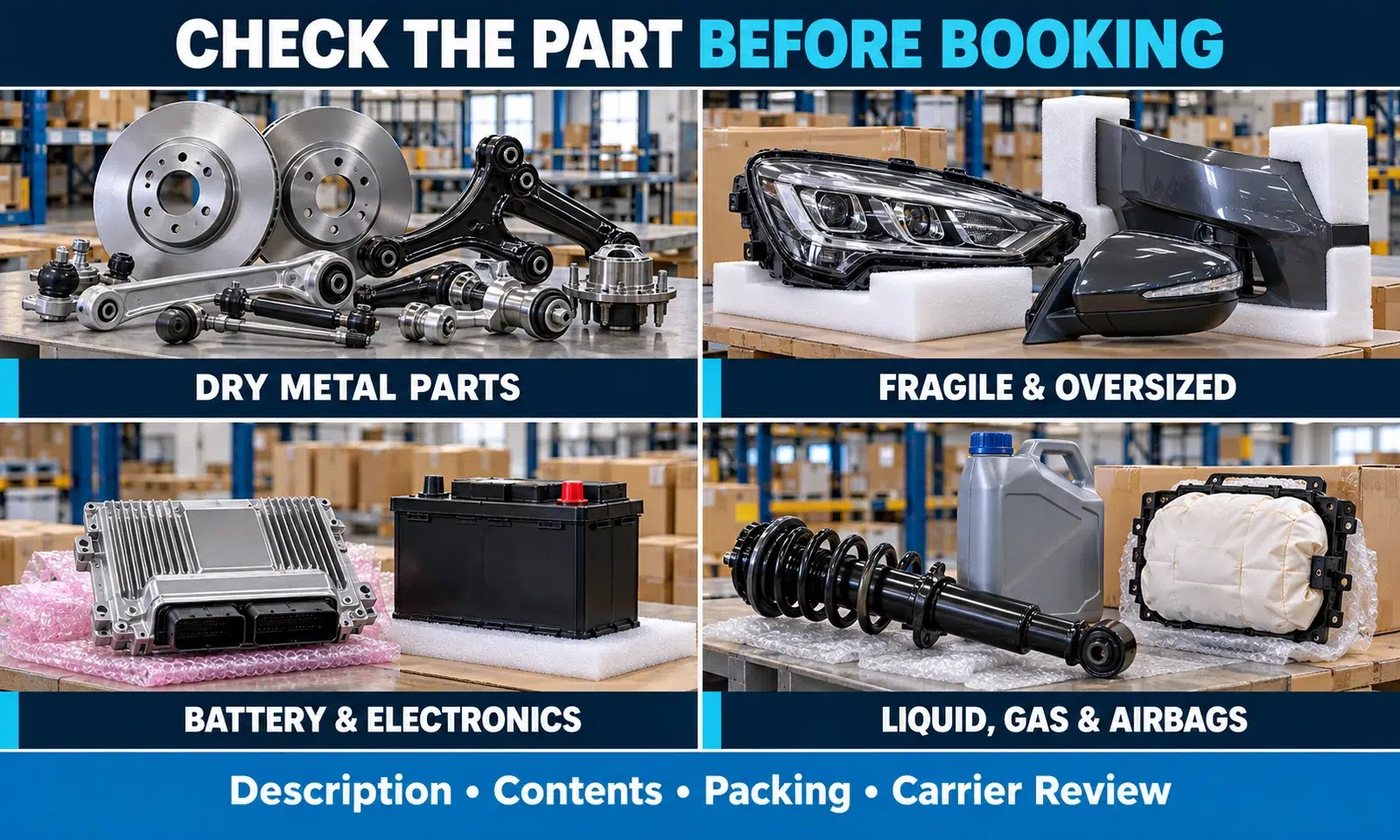
Classify the cargo profile before requesting a rate
| Product group | Information to check | Possible effect on the shipment |
|---|---|---|
| Dry metal and mechanical parts Brackets, gaskets, fasteners and some trim components |
Specific description, material, function, part number, origin and final packing | Usually accepted as general cargo, but still requires accurate classification and commercial documents. |
| Emission-related products Engines, catalytic converters and emission-control modules |
Product function, engine type, condition, manufacturer details and applicable EPA evidence | May require an EPA or customs review. Generic supplier paperwork does not automatically establish admissibility. |
| Safety-related equipment Brake hoses, lamps, tires, glazing and seat-belt assemblies |
Applicable FMVSS, manufacturer certification, product labels and test evidence | Equipment subject to an FMVSS must conform and be certified by its manufacturer. |
| Electronic parts Alternators, starters, cameras, control modules and connected accessories |
Voltage, installed battery, radio-frequency function, connector and technical specification | Carrier acceptance may change when a battery is present. Wireless products may need an FCC review. |
| Sensitive or dangerous contents Airbags, pretensioners, brake fluid, gas-filled parts and lithium batteries |
Exact contents, quantity, configuration, safety data and transport documents | Requires a specialist carrier review before express, air or standard ocean service is confirmed. |
| Large or fragile parts Bumpers, body panels, lamps and automotive glass |
Finished dimensions, support points, fragile surfaces and stacking restrictions | Packing volume and handling requirements may affect the price more than the product’s actual weight. |
Prepare a part-level specification file
Descriptions such as “car accessories,” “vehicle parts” and “automotive spare parts” do not provide enough information for a reliable carrier or customs review. Prepare one line for every distinct SKU and include:
- The specific English product name and function.
- The manufacturer’s part number, model or drawing number.
- The vehicle application or OEM cross-reference where relevant.
- The principal material.
- Whether the part is new, used or rebuilt.
- Any battery, liquid, oil, gas, chemical, magnet, wireless device or pyrotechnic component.
- The brand, aftermarket status and necessary trademark authorization.
- Quantity, unit value, total value and manufacturing origin.
- Pieces per carton, carton count, final gross weight and outer dimensions.
Compare “20 cartons of car parts” with “replacement exterior mirror assemblies with electric adjustment, no battery, packed 10 units per carton.” The second description gives the carrier and broker enough information to begin a meaningful review.
The importer and customs broker must still confirm the U.S. classification. Do not automatically reuse an HS code from a Chinese export declaration as the final U.S. HTS classification.
Check NHTSA, EPA and other product requirements
Chinese origin does not automatically disqualify a part. The important questions are what the product is, how it functions, how it is labeled and which U.S. requirements apply.
The NHTSA guidance for imported motor-vehicle equipment identifies products subject to Federal Motor Vehicle Safety Standards, including brake hoses, lamps, tires, brake fluid, glazing materials and seat-belt assemblies.
NHTSA does not issue a general advance “DOT approval” for every automotive product. The original manufacturer must manufacture and certify covered equipment as conforming to the applicable FMVSS. Non-compliant equipment cannot be made acceptable merely by changing the shipping route.
Engines and transmissions are not regulated as equipment under those particular NHTSA standards. However, engines and emission-related products may fall within EPA import requirements. Catalytic converters and other emissions products also require a product-specific review; one generic EPA letter does not cover every component.
An alternator or ordinary control module does not automatically require FCC authorization. However, an accessory that intentionally transmits radio-frequency signals may require a separate assessment.
Identify batteries, liquids, gas and airbags early
A carrier may treat two visually similar products differently because of what is inside them. An electronic module without a battery may move as general cargo. The same type of module with a lithium battery may require battery specifications, a UN 38.3 test summary, appropriate packing and a carrier acceptance review.
Airbags and certain pretensioners can contain pyrotechnic devices. Some dampers, struts and cylinders may contain gas or oil. Brake fluid and maintenance chemicals require identification before the booking is confirmed.
This screening does not replace dangerous-goods classification. Ask the supplier for the exact composition and supporting documents, then let the carrier or trained specialist review the proposed shipment. The IATA lithium-battery guidance explains why the battery configuration and packing method matter.
Verify the supplier and finished order
VoltFreight has coordinated pickup and consolidation from more than 50 automotive suppliers in Shenzhen, Guangdong and other Chinese manufacturing regions. Before booking, our team can request commercial documents and available compliance evidence, then pass the information to the importer, broker or carrier for review.
In VoltFreight’s 2025 shipment analysis, incomplete or inconsistent documentation affected about 12% of the reviewed auto parts shipments. The resulting delays averaged 18 days and created possible demurrage, storage and handling exposure of USD 3,000–8,000 per container.
A platform badge or attractive product listing does not prove that the finished shipment meets the buyer’s specification. Confirm the supplier’s legal company, factory or trading-company status, production address, invoice entity and receiving bank account.
IATF 16949 or ISO 9001 can support supplier due diligence, but neither certificate proves that a specific brake component, lamp or electronic module fits the intended vehicle or complies with every U.S. requirement. Check the certificate holder, production site, scope, issuing body and validity.
Whenever practical, approve a representative sample before mass production. Record the part number, revision, material, finish, dimensions, connector, packaging and agreed inspection points. Inspect the finished order against that specification before paying the final balance or releasing the cargo.
Will DHL Ship Car Parts?
DHL can transport many non-hazardous automotive parts, subject to the exact product, route, packing, account conditions and destination customs rules. A common planning range is USD 6–12/kg with transit of three to five business days for accepted express shipments.
Standard non-palletized parcels are commonly limited to around 70 kg per piece. Specialized heavyweight services may accept larger palletized pieces on eligible routes, so the limit must be checked for the selected origin, destination and DHL service.
Express courier is best suited to samples, replacement sensors, electronic modules and other high-value components needed urgently. It is rarely the most economical option for ordinary wholesale inventory.
Example: 500 alternator cores weighing 250 kg
| Option | Reference cost | Planning time | Main consideration |
|---|---|---|---|
| DHL Express | USD 1,750–3,000 | 3–10 days, depending on service and clearance | Fast and straightforward for accepted cargo, but expensive for commercial replenishment. |
| VoltFreight air freight | USD 1,125–1,750 | 5–7 days for the main coordinated movement | May reduce cost by 30%–40% compared with express when the shipment exceeds 100 kg. |
| Consolidated ocean freight | USD 180–280 for the referenced international freight component | 18–35 days before destination clearance and delivery | Suitable when the parts are not urgent; destination charges and final delivery must be added. |
This example compares the main transport options rather than three all-inclusive quotations. The ocean figure relates to consolidated freight or space allocated within a larger planned load, not a dedicated full-container booking for 250 kg.
The actual total depends on the supplier location, packed dimensions, product details, U.S. destination, customs scope and delivery requirements.
When air freight works better than express
Air freight from China becomes worth comparing when the shipment is too large for economical courier pricing but still too urgent for ocean freight. For accepted general cargo above 100 kg, a coordinated air service can often cost less than DHL, FedEx or UPS.
Do not compare only the headline price per kilogram. Ask whether the air quotation includes:
- Pickup from the supplier or delivery to the China warehouse.
- China export handling and customs declaration.
- Airport handling and airline security screening.
- U.S. customs brokerage.
- Import duty and government charges.
- Delivery to the final U.S. ZIP code.
- Residential, liftgate, appointment or limited-access surcharges.
Airlines generally charge on the greater of actual and volumetric weight. Large lightweight bumpers may therefore cost considerably more than their scale weight suggests. Dense sensors, bearings and compact electronic parts normally use aircraft space more efficiently.
Split the deadline instead of flying the entire order
A mixed order can be divided deliberately. Send only the SKUs needed to prevent a repair, production interruption or stockout by express or air. Move the planned replacement stock by LCL or FCL.
For example, assume an importer has 900 kg of brake discs and suspension hardware for regular inventory, plus 24 kg of control modules needed urgently. If the carrier accepts the modules, those cartons can move by air while the dense metal parts travel by sea.
Before splitting the shipment, include the cost of two origin handovers, two international movements, possible separate customs entries and two final deliveries. The additional handling should be justified by the commercial cost of waiting.
Navigating 2026 Tariffs and Cost Optimization Strategies
U.S. import duty cannot be calculated from the description “auto parts.” The final treatment may involve the ordinary HTS duty rate, China Section 301 duties, Section 232 treatment for covered automobile parts and other product-specific measures.
The result depends on the exact 10-digit U.S. HTS classification, manufacturing origin, entry date and current Chapter 99 provisions. Do not apply one tariff percentage to an entire mixed shipment.
Understand the different tariff layers
Under the Federal Register notice covering automobiles and automobile parts, certain automobile parts have been subject to an additional 25% Section 232 tariff since May 3, 2025. Many Chinese-origin products may also appear in the USTR Section 301 tariff actions. These measures are separate from the ordinary HTS duty rate.
An importer should therefore check:
- The ordinary duty rate under the precise 10-digit HTS code.
- Whether the Chinese-origin product appears on a Section 301 list.
- Whether the specific part falls within current Section 232 coverage.
- Whether an exclusion, special provision or other Chapter 99 treatment applies.
- Whether the declared country of origin is supported by the actual manufacturing process.
- Whether antidumping or countervailing duties apply to the particular product.
Observed effects on common automotive categories
VoltFreight clients reported the following approximate landed-cost effects during the reviewed period. These are operational observations, not universal statutory tariff rates:
| Product category | Observed landed-cost effect | Factors to review |
|---|---|---|
| Engine components associated with heading 8407 | About 18% higher | Exact engine or part classification, base duty, origin and applicable additional duties |
| Electrical and electronic components | About 22% higher | Whether the product falls under 8511, 8544, 8537 or another product-specific heading |
| Suspension and steering parts | About 12% higher | Whether the item falls under 8708 or a more specific material or component heading |
| Interior trim and related products | About 8% higher | Function, principal material and whether the product is classified as a vehicle part, textile article or another product |
These percentages may include changes in duty, freight, customs, handling and other landed-cost components. They should not be presented as the legal tariff rate for every product in the category.
1. Review the HTS classification legally
A correct classification can prevent both overpayment and underpayment. VoltFreight clients have identified differences of 3%–7% after brokers reviewed product descriptions, materials and functions more carefully.
This does not mean choosing whichever code offers the lowest duty. Classification must follow the actual merchandise and the tariff rules.
A screw or bolt used in a vehicle, for example, may remain classified as a fastener under heading 7318 rather than automatically becoming an automotive part under 8708. An automotive wiring harness is more likely to begin with heading 8544 than 8517, which generally covers telecommunications equipment.
For an uncertain or high-value product, provide the U.S. customs broker with:
- Product photographs and drawings.
- Material composition.
- Technical specifications.
- Vehicle application.
- Operating function.
- Manufacturing information.
- Available previous rulings or classification records.
Where the commercial exposure justifies it, the importer can consider requesting a binding ruling from U.S. Customs and Border Protection.
2. Verify origin instead of relying on transshipment
Sending Chinese goods through another country does not automatically change their origin or remove China-related duties. Origin generally depends on the applicable rule and the manufacturing performed, not the port shown on the final bill of lading.
A product processed in Korea may qualify under the U.S.–Korea Free Trade Agreement only when it satisfies the applicable product-specific rule, such as a required tariff shift or regional value content test. The percentage of Chinese material alone does not establish eligibility. Review the current U.S.–Korea FTA rules of origin guidance before making a preferential claim.
Keep production records, bills of materials and processing evidence. Ask the broker or qualified trade adviser to review the proposed origin claim before shipping.
3. Consolidate orders and use container volume efficiently
Moving from repeated LCL shipments at USD 80–120/CBM to efficiently loaded FCL capacity equivalent to USD 35–65/CBM can reduce the logistics portion of the unit cost by 35%–45% in suitable cases.
A larger shipment does not reduce an ad valorem duty percentage. It can, however, spread fixed collection, documentation, brokerage, terminal and final-delivery charges across more units. Consolidation may also reduce the number of customs entries and receiving appointments.
Collect final packing data from every supplier before deciding. Combining three factories is useful only when their production dates, cargo descriptions and documents can be aligned without making the first completed order wait too long.
4. Consider a bonded warehouse for eligible inventory
A U.S. Customs bonded warehouse may allow eligible imported merchandise to remain under customs control without immediate duty payment until it is withdrawn for consumption or exported. Merchandise can generally remain in a bonded warehouse for up to five years, subject to the applicable rules.
For importers holding substantial inventory, this can preserve cash flow and delay duty payment until the products enter the U.S. market. VoltFreight clients using an appropriate bonded storage strategy have reported working capital improvements of 20%–30%.
The facility must actually be authorized for bonded operations. An ordinary Los Angeles warehouse does not become bonded simply because imported cargo is stored there. Confirm the warehouse status, entry type, admissibility, permitted handling and withdrawal procedure with the broker and warehouse operator.
Calculate the complete landed cost
Use one consistent formula when comparing freight services:
Landed cost = product value + China pickup and consolidation + export handling + international freight + cargo insurance + U.S. destination charges + applicable duty and taxes + customs brokerage + final delivery + special services.
Some charges may already be included in a DDP or all-in quotation, so count them only once. A low ocean rate can become expensive when deconsolidation, port fees, chassis, pre-pull, demurrage, storage, appointments or unloading are added later.
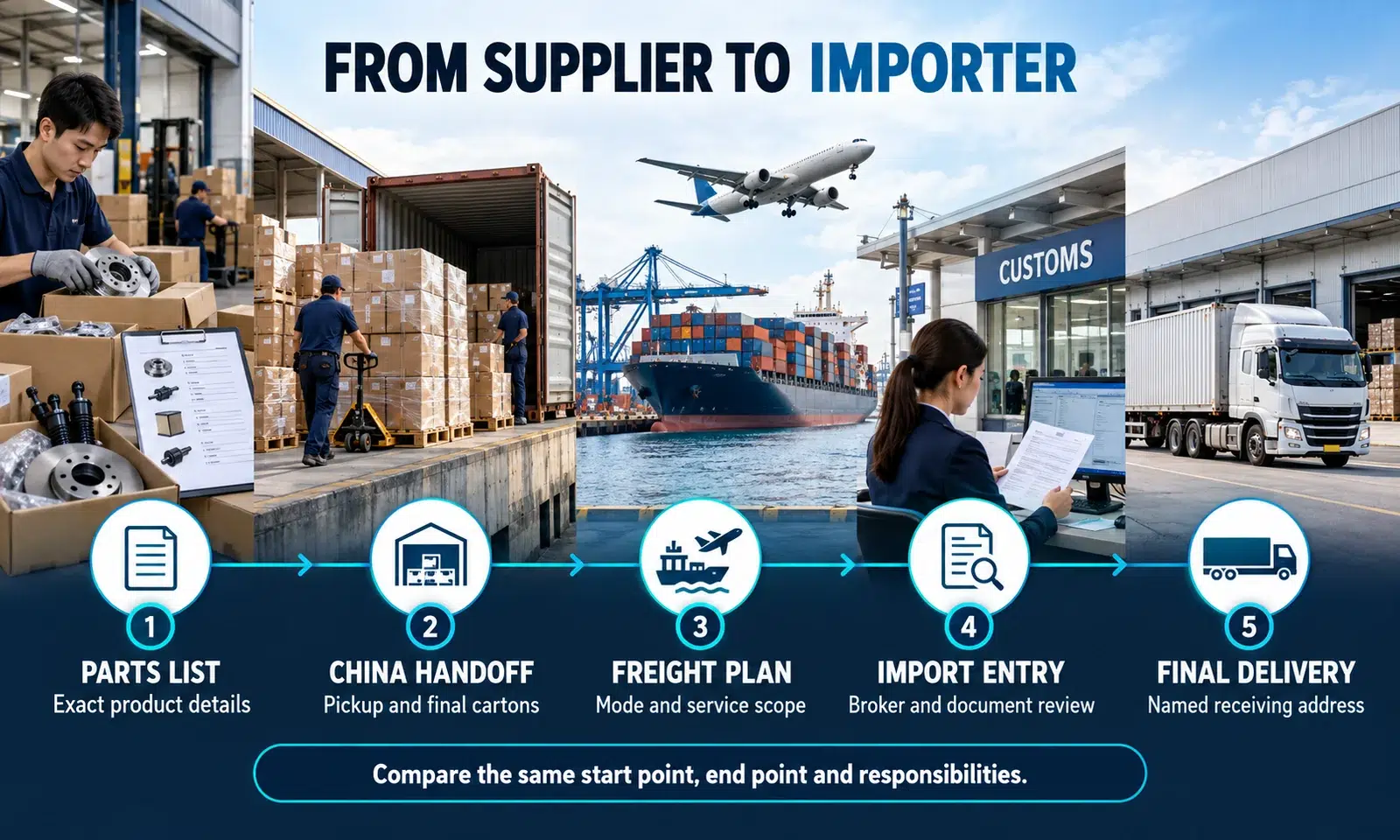
Confirm every handoff in writing
- Supplier handover: Which factory releases which cartons, from what address and on what date?
- China origin: Who arranges collection, consolidation, repacking, export documents and customs declaration?
- International transport: Does the quotation cover courier, airport-to-airport, port-to-port or door-to-door service?
- U.S. entry: Who acts as importer of record, appoints the broker, supplies product evidence and pays duties?
- Final delivery: Are terminal charges, inland transport, appointments, liftgate service and unloading included?
If purchasing EXW, clarify factory collection and China export arrangements. Under FOB, identify the named Chinese port. For U.S. delivery, distinguish DAP from a reviewed DDP arrangement. A DDP label does not remove the need for a lawful importer, accurate valuation and compliant product.
How VoltFreight Handles Fragile and Heavy Auto Parts
Automotive parts create very different physical risks. Engine blocks and brake components concentrate substantial weight in a small footprint. Bumpers and body panels occupy space and deform under pressure. Lamps and glass require impact protection, while electronic modules may need moisture and antistatic controls.
VoltFreight uses engineered packing, load planning, photographic records and optional tracking services for fragile and heavy cargo. Within the reviewed automotive parts shipment records, 99.2% arrived on time and without a recorded damage claim.
Match the packing to the cargo profile
| Cargo type | Main risk | Recommended control |
|---|---|---|
| Engine blocks and other dense assemblies | Concentrated weight, pallet failure and movement inside the container | Reinforced pallets or crates, verified lifting points, blocking, bracing and controlled load distribution |
| Transmissions and fluid-containing assemblies | Residual oil, leakage and unstable mounting | Confirm the condition, drain requirements and carrier acceptance; secure the unit in a fitted base |
| Brake rotors, suspension parts and metal hardware | Corrosion, carton failure and excessive pallet weight | Moisture barriers, VCI protection where appropriate, desiccants and planned weight per carton and pallet |
| Glass, lamps and electronic displays | Impact, vibration and pressure from adjacent cargo | Rigid internal supports, foam protection, separate loading zones and visible handling marks |
| Bumpers, dashboards and painted panels | Scratching, deformation and high volumetric weight | Custom frames, protected surfaces, controlled stacking and final measurements before booking |
| Electronic modules and cameras | Moisture, static electricity and undeclared batteries | Manufacturer-specified protection, sealed packing and confirmation of battery and wireless functions |
Plan pallet and container weight distribution
A 40ft container may carry 20–24 metric tons of suitable automotive cargo, but usable capacity depends on the container payload, crate design, road restrictions and distribution across the container floor.
A container should not be loaded by placing every heavy pallet at the front and filling the remaining space later. VoltFreight prepares the loading sequence from each package’s footprint, gross weight, center of gravity and unloading method.
Heavy pieces are secured against forward, backward and sideways movement. Lightweight and fragile products are isolated from pressure created by engine components, brake discs and other dense cargo.
Protect metal parts from moisture and corrosion
Ocean cargo may experience significant temperature and humidity changes. Suitable preparation can include:
- Moisture-barrier materials.
- Desiccant bags calculated for the packing volume and journey.
- VCI products where appropriate.
- Sealed inner wrapping.
- Protected machined surfaces.
- Corrosion-resistant export packing.
- Separation between metal parts that could strike each other.
Optional humidity or temperature monitoring may be arranged for suitable electronics and sealed assemblies. GPS tracking can also be used where the selected service supports it. When included in the handling plan, photographs are taken during warehouse receiving, packing, loading and arrival.
Why specialized loading time matters
A mixed 40ft container containing brake rotors, calipers and pads may require four to six hours of planned packing and loading. A general loading team may try to complete the same work in one or two hours.
The additional time allows the warehouse to separate different weights, reinforce pallets, protect finished surfaces, verify carton counts and secure the cargo properly. In VoltFreight’s reviewed cases, this specialized process prevented about 90% of damage incidents associated with weak packing and uncontrolled movement.
Inspect and photograph the finished cargo
Before dispatch, record:
- Part numbers and quantities by carton, pallet or crate.
- Final outer dimensions and gross weights.
- Carton marks and pallet identification.
- Photographs of the product before closing the package.
- Photographs of sealed cartons and finished pallets.
- Container-loading photographs.
- The condition of crates, lifting points and securing materials.
If solid wood pallets, crates or dunnage are used, confirm the applicable U.S. wood-packaging and ISPM 15 requirements before the supplier builds or dispatches the packing.
Ask what the cargo-insurance policy covers and which evidence is required for a claim. Ordinary freight liability does not necessarily reimburse the complete commercial value of damaged parts.
If visible damage appears at delivery, note it on the receiving record. Retain the product, outer carton, inner protection, pallet and photographs while the carrier or insurer reviews the claim.
Customs Clearance for Auto Parts: HS Codes and Documentation
Successful U.S. customs clearance depends on matching the customs entry to the products that were actually packed. VoltFreight prepares detailed shipment information before arrival and coordinates the document handoff with the importer and customs broker.
For eligible shipments, commercial documents and part-level data can be provided for pre-arrival review 48 hours before the vessel reaches the United States. This internal pre-clearance target is separate from the Importer Security Filing requirement.
For ocean cargo, the required ISF data generally needs to be submitted no later than 24 hours before the cargo is loaded aboard the vessel bound for the United States. See the current CBP Importer Security Filing guidance for the filing schedule and required data elements.
With complete descriptions and consistent documents, VoltFreight has reduced examination rates on reviewed shipments from a 15% industry reference to about 2%, helping avoid holds that can exceed 18 days. Actual CBP selection remains outside the control of any freight forwarder or customs broker.
Reference HS headings for common automotive products
| Reference heading | Typical product description | Indicative duty reference |
|---|---|---|
| 8407 | Spark-ignition reciprocating or rotary internal-combustion piston engines | 5%–10%, depending on the precise subheading |
| 8408 | Compression-ignition internal-combustion piston engines | 5%–10%, depending on the precise subheading |
| 8409 | Parts suitable for use solely or principally with engines of heading 8407 or 8408 | Product-specific |
| 8511 | Electrical ignition or starting equipment, generators and cut-outs used with engines | 5%–8% for affected classifications |
| 8544.30 | Ignition wiring sets and other wiring sets used in vehicles | Check the current 10-digit classification and additional-duty treatment |
| 8708 | Parts and accessories of motor vehicles of headings 8701–8705 | 2.5%–25%, depending on the component and applicable measures |
| 4011 | New pneumatic tires of rubber | About 4% for some classifications; confirm the exact tire type |
| 7318 | Screws, bolts, nuts, washers and related iron or steel fasteners | 5%–10% for affected classifications |
This table is a screening reference, not a classification decision. A four- or six-digit heading does not establish the final U.S. duty.
Review the current Harmonized Tariff Schedule of the United States, the complete 10-digit subheading, China tariff lists, Section 232 coverage and relevant Chapter 99 provisions.
Documents normally needed for U.S. import clearance
- Commercial Invoice: Include the seller, buyer, specific product names, part numbers, quantities, unit and total values, currency, Incoterm and origin information. Avoid using only “spare parts.”
- Packing List: Connect the products to the cartons, pallets or crates and show the package count, gross weight and dimensions.
- Bill of Lading or Air Waybill: Ensure the shipper, consignee, routing and package count agree with the commercial records.
- Origin information: Provide production evidence when origin or preferential treatment needs verification.
- Product-specific compliance evidence: Supply applicable EPA, FMVSS, FCC, battery, dangerous-goods or technical records.
- Purchase Order and payment evidence: Keep the signed order and transaction records available if customs requests valuation support.
- Manufacturer specifications or test reports: Provide these for regulated, safety-related or technically unclear products when required.
The invoice and packing list must describe the completed shipment, not the order the buyer expected several weeks earlier. If the factory changes the model, quantity, packing or battery specification, obtain revised documents before export.
Reconcile the packing list with the warehouse count
If one crate contains several SKUs, list the contents of that crate. When a supplier changes the number of cartons after issuing a draft packing list, request a final version before confirming the bill of lading or air waybill.
A useful check is simple: can the importer identify the exact products, quantities, values and packages without calling the factory for an explanation? If the answer is no, the documents are not ready.
Define the customs and delivery responsibilities
Confirm these points before departure:
- Who is the U.S. importer of record?
- Who appoints the customs broker?
- Who supplies the classification and compliance evidence?
- Who pays duty and other government charges?
- Who handles examination, storage or demurrage if CBP selects the shipment?
- Does the quotation include destination terminal charges?
- Does final delivery include an appointment, liftgate or residential service?
- Who unloads heavy crates or pallets at the destination?
VoltFreight can coordinate the transport and document handoff, but the importer and its customs adviser remain responsible for the U.S. entry. A different freight route cannot solve an undervaluation, origin, product-compliance or trademark problem.
Amazon FBA Logistics for Auto Parts Sellers
Amazon sellers importing automotive parts can use a coordinated door-to-door plan covering China pickup, consolidation, international freight, customs clearance and delivery to an approved U.S. destination.
After arrival in Los Angeles and completion of customs clearance, suitable shipments may be delivered to Amazon fulfillment centers across the western United States, including assigned locations in California, Nevada or Arizona, in three to five business days.
When the shipment plan, labels, appointment and cargo format are ready, direct delivery can remove an unnecessary warehouse handoff and reduce total supply chain time by up to 40% in suitable cases.
Advantages of a coordinated FBA shipment
- Customs clearance is completed before the Amazon delivery appointment.
- Freight, customs coordination and final delivery can appear on one logistics invoice.
- Carton, pallet and shipment identifiers can be checked in China.
- Incorrectly packed or labeled cartons may be identified before FBA intake.
- Inventory can be divided among FBA, a U.S. 3PL and the importer’s warehouse.
- Visible damage can be recorded before Amazon receives the inventory.
When a U.S. 3PL is still necessary
Direct FBA delivery is not suitable for every shipment. A 3PL may be required when:
- Amazon changes the assigned fulfillment center after the cargo departs.
- The order must be divided among several FBA destinations.
- Products require final labeling, bundling or inspection in the United States.
- The container cannot meet Amazon’s unloading or appointment requirements.
- The importer needs reserve stock outside the FBA network.
- A customs or freight delay causes the original delivery appointment to expire.
Before shipping, provide the FBA shipment plan, warehouse codes, carton labels, pallet requirements and latest acceptable delivery date. Do not book a container based only on an expected Amazon destination.
What Should You Do Now?
The 2026 import environment requires buyers to coordinate product information, customs planning and freight before the order leaves China.
- Audit the HTS classifications from your recent shipments. A legal classification review may identify errors, prevent overpayment and reduce the risk of an additional duty assessment.
- Calculate the FCL crossover. If shipment volume is growing, compare quarterly 20ft or 40ft shipments with monthly LCL instead of choosing a method from purchase value alone.
- Obtain compliance evidence before production finishes. EPA, FMVSS, battery and other product records can take 20–30 days to prepare when the supplier has not handled them in advance.
- Confirm 2026 pricing close to the booking date. Freight rates, capacity, tariff treatment and carrier acceptance can change. Use the figures in this article for planning, then request a shipment-specific quotation.
- Use air freight selectively. For accepted general cargo above 100 kg, coordinated air freight may cost less than DHL, FedEx or UPS while still meeting an urgent deadline.
Information to send for an accurate auto parts freight quote
- Specific English name and function of every part.
- Product photographs, model numbers and specification sheets.
- Whether the parts are new, used or rebuilt.
- Brand and authorization status.
- Declaration of batteries, liquids, gas, oil, magnets, airbags or other sensitive contents.
- Quantity and commercial value by SKU.
- Final package count, gross weight and outer dimensions.
- Whether crates and pallets can be stacked.
- Supplier pickup city, address and cargo-ready date.
- Whether the order comes from one supplier or several factories.
- Supplier Incoterm, such as EXW or FOB at a named port.
- U.S. arrival port or airport, if already selected.
- Complete final delivery ZIP code and address type.
- Required arrival date.
- Requested service scope: port, airport, DAP or reviewed DDP delivery.
Ask the forwarder to identify what the quotation includes at origin, during international transport and at destination. Confirm separately who will clear the cargo, pay duties, arrange an examination if required and complete final delivery.
If one provider quotes port-to-port LCL and another quotes door-to-door delivery, align the endpoints before comparing the totals.
Since 2015, VoltFreight has coordinated automotive parts shipments covering supplier pickup, China warehouse consolidation, international freight, customs document handoff and final delivery across the United States.
We can arrange supplier pickup, China warehouse consolidation, export packing, express courier, air freight, LCL, FCL, customs document coordination and delivery to a U.S. warehouse, dealer, 3PL or Amazon FBA facility.
Send your packing list, product photographs, China pickup location and U.S. ZIP code to request an auto parts shipping quote. We will compare the available methods and provide a shipment-specific quotation with the included charges, estimated transit time and document requirements clearly identified.