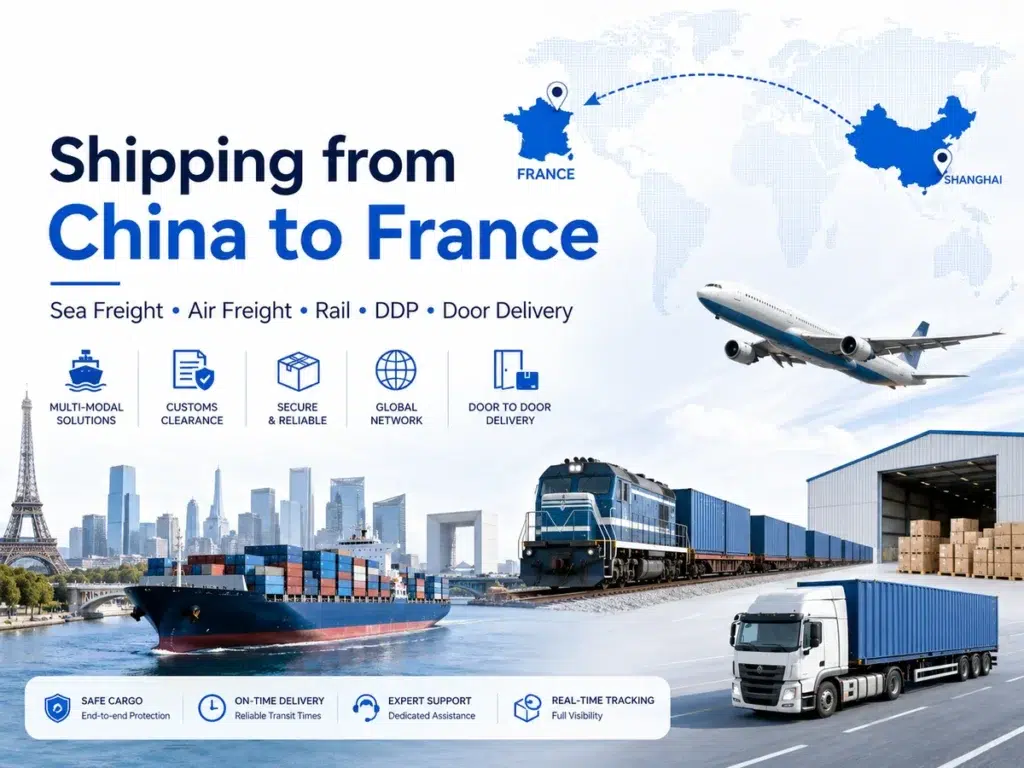
Shipping from China to France can take about 3–7 business days by express courier, approximately 5–10 days by standard air freight, around 7–12+ days by Air DDP, about 20–35+ days by rail freight, approximately 28–45+ days by FCL sea freight, and around 30–50+ days by LCL or Sea DDP under normal planning conditions.
The best route depends on cargo weight, CBM, urgency, product type, customs responsibility and the final French delivery postcode. The shipping cost from China to France and the total shipping time from China to France depend on the final cargo measurements, selected route, customs scope and delivery address. Express and air freight are normally charged by the higher of actual weight and volumetric weight. LCL sea freight is usually quoted by CBM plus applicable handling and inland-delivery charges, while FCL is quoted by container size, port pair and final-delivery scope. DDP pricing must also account for product acceptance, HS or TARIC code, declared value, duty, TVA/VAT, customs structure and delivery conditions.
As a freight forwarder from China to France, VoltFreight can coordinate supplier pickup, warehouse receiving, consolidation, export handling, express courier, air freight, rail freight, truck freight, ocean freight, DDP and final delivery to French warehouses, distributors, Amazon facilities, factories and commercial addresses.
Need a China-to-France freight quote? Send the product name, photos, carton quantity, gross weight, carton dimensions, supplier city, declared value and French delivery postcode through our contact page. We will review the actual cargo before recommending a route.
Last reviewed: September 17, 2026. Transit times and pricing methods are planning references. Carrier schedules, customs rules, TVA treatment, EORI requirements, product acceptance and final-delivery charges can change, so the final service must be confirmed before booking.
Quick Comparison: Shipping Options from China to France
The lowest freight rate is not always the lowest landed cost. Importers should compare the complete scope, including supplier pickup, China warehouse handling, export processing, international freight, French or EU customs clearance, duty, TVA/VAT responsibility, destination handling and final delivery.
| Shipping Method | Typical Planning Time | Pricing Basis | Best Starting Point |
|---|---|---|---|
| Express Courier | About 3–7 business days | Higher of actual or volumetric weight | Documents, samples, prototypes, urgent parts and small parcels |
| Standard Air Freight | About 5–10 days depending on route and handling | Chargeable weight, airport route and customs scope | Urgent commercial cartons and higher-value cargo |
| Air DDP / Air Door Delivery | About 7–12+ days | Chargeable weight, product review, duty, TVA and delivery postcode | Time-sensitive e-commerce stock and suitable commercial cargo |
| Rail Freight / Rail DDP | About 20–35+ days | Weight or volume, rail schedule, terminal handling and final delivery | Middle-speed inventory when air is too expensive and sea is too slow |
| Truck Freight / Truck DDP | About 15–25+ days when a suitable route is available | Weight, volume, route availability, border conditions and delivery scope | Selected commercial cargo requiring a land-based door-to-door route |
| LCL Sea Freight | About 30–50+ days | CBM plus origin, destination and delivery charges | Commercial cargo that does not fill a container |
| FCL Sea Freight | About 28–45+ days | 20GP, 40GP or 40HQ container plus route and delivery scope | Large orders, pallets, machinery, furniture and regular inventory |
| Sea DDP / Sea Door Delivery | About 35–50+ days | Weight or CBM for eligible cargo, customs scope and final delivery | Cost-sensitive cartons, FBA stock, 3PL inventory and B2B cargo |
Important: A quotation that only states a price per kilogram, CBM or container is incomplete unless it also explains what the rate includes and excludes. Minimum chargeable weight, minimum CBM, customs examinations, storage, demurrage, residential delivery, tail-lift service, limited-access delivery and redelivery may create additional charges.
Detailed Freight Services
- Ocean freight from China
- Air freight from China
- Railway freight from China
- Truck freight from China
- Express freight from China
- Door-to-door shipping from China
- Customs clearance support
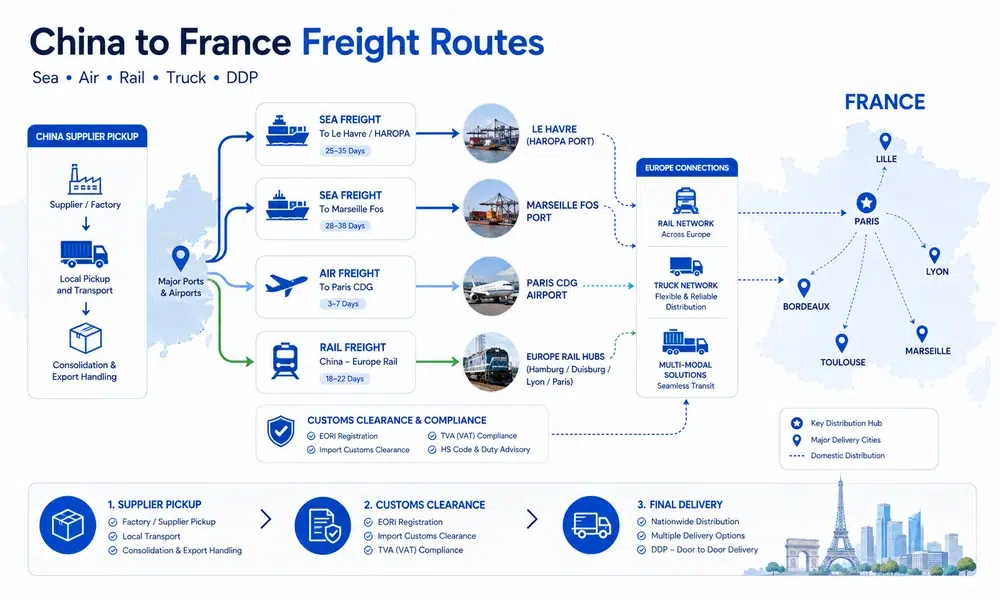
China-to-France freight planning should connect the cargo, shipping method, customs structure, French gateway and final delivery postcode.
How to Choose the Right Shipping Method
A practical route should match cargo size, delivery deadline, landed-cost target and customs responsibility. A fast method is not always the easiest customs solution. Likewise, a low ocean rate may become expensive after deconsolidation, customs brokerage and inland delivery.
Check Weight, Volume and Cargo Density
Express courier and air freight use chargeable weight. The carrier compares actual gross weight with volumetric weight and charges the higher number. Therefore, final carton dimensions should be measured before booking.
Sea freight depends more heavily on total CBM, container utilisation, port choice and final delivery. LCL works well for smaller commercial shipments, but destination handling can change the final cost. Once the cargo approaches an economical container volume, importers should compare LCL with a 20GP container rather than assuming LCL is automatically cheaper.
Before choosing a route, compare:
- Actual gross weight
- Volumetric or chargeable weight
- Total CBM
- Carton and pallet quantity
- Product density
- Delivery deadline
- Customs, duty and TVA responsibility
- Final postcode and address type
Compare Northern and Southern France
France should not be treated as one delivery zone. Cargo for Paris, Île-de-France, Rouen, Lille and northern France may fit a Le Havre or HAROPA strategy. By contrast, Marseille Fos may provide a more practical route for Marseille, Provence, Nice, parts of the Rhône corridor and other southern destinations.
The final decision should use the complete route rather than the port name alone. Vessel schedule, LCL or FCL handling, customs structure, inland trucking and warehouse appointment requirements all affect the result.
Confirm Port-to-Port or Door-to-Door Scope
A port-to-port or airport-to-airport rate may cover only the main international movement. It may exclude supplier pickup, China warehouse fees, French terminal charges, customs brokerage, duty, TVA, delivery-order fees, inland trucking, pallet delivery and warehouse appointments.
By comparison, a door-to-door quotation should identify the complete route from the Chinese supplier to the named French address. Still, door-to-door does not automatically mean DDP. Under some services, the importer clears the shipment and pays import charges before VoltFreight arranges delivery after release.
Sea Freight from China to France
Sea freight from China to France normally provides better cost control for heavy, bulky or non-urgent commercial cargo. Importers commonly use it for machinery, industrial equipment, furniture, building materials, auto parts, hardware, lighting products, textiles, retail inventory, pallets and wholesale orders.
Common departure ports include Shenzhen, Yantian, Guangzhou, Nansha, Ningbo, Shanghai, Qingdao, Xiamen and Tianjin. The most suitable origin usually depends on supplier location, factory pickup cost, export warehouse requirements and the carrier schedule.
FCL Shipping to France
FCL is suitable for cargo that can use a dedicated 20GP, 40GP or 40HQ container. Compared with LCL, a full container normally involves fewer cargo-handling steps and gives the importer more control over loading and unloading.
Before selecting FCL, confirm:
- Total volume and cargo weight
- Container size and payload limits
- Factory loading or warehouse loading
- Pallet and packaging requirements
- Le Havre, Marseille Fos or another entry route
- Drayage, unloading and delivery access
- Whether the receiver can unload the container
LCL Shipping to France
LCL works when the cargo does not fill a complete container. The shipment is consolidated with other goods in China and deconsolidated after arrival. Consequently, an LCL quotation may contain warehouse handling, documentation, deconsolidation and delivery charges in addition to the ocean freight.
LCL can work well for one to several pallets or approximately 1–15 CBM of commercial cargo. However, the economical crossover depends on density, port pair, destination charges and final postcode. For larger volumes, compare LCL, Sea DDP and 20GP FCL before booking.
Le Havre and Marseille Fos Sea Routes
Le Havre is a major gateway for Paris, Île-de-France, Rouen, Lille and northern France. HAROPA connects Le Havre, Rouen and Paris along the Seine logistics corridor, which can support port and inland distribution planning. Official background is available from HAROPA PORT.
Marseille Fos can be practical for southern France, Provence, Marseille, Nice, parts of the Lyon region and Mediterranean distribution. The route should still be compared against northern ports because vessel schedules and inland trucking can change the final result. Official port information is available from the Port of Marseille Fos.
France Entry Gateways and Final Delivery Regions
The best French gateway depends on the final postcode rather than the international freight rate alone. A port or airport that is closer to the consignee may reduce inland transport, handling and appointment complexity.
| Gateway or Region | Common Use | Typical Delivery Area | Planning Notes |
|---|---|---|---|
| Le Havre / HAROPA | FCL, LCL and sea door-to-door | Paris, Rouen, Lille, Île-de-France and northern France | Compare the Seine corridor, customs plan and inland trucking |
| Marseille Fos | FCL, LCL and Mediterranean sea routes | Marseille, Provence, Nice, southern France and selected Lyon deliveries | May reduce inland distance for southern destinations |
| Paris CDG | Standard air freight, Air DDP and urgent delivery | Paris region and nationwide truck or parcel delivery | Suitable when speed matters more than the lowest freight cost |
| Lyon / Rhône Corridor | Air, sea, rail or road transfer | Lyon, Grenoble, Saint-Étienne and surrounding distribution areas | Compare Marseille Fos, Le Havre and available inland routes |
| Northern and Eastern France | Sea, rail, truck or multimodal delivery | Lille, Strasbourg, Metz, Nancy and nearby industrial regions | Final route depends on terminal, gateway and delivery postcode |
| Western and Southwest France | Sea or air followed by inland delivery | Nantes, Rennes, Bordeaux, Toulouse and nearby regions | Compare international routing with the complete inland-delivery cost |
| EU Gateway DDP | Selected Air DDP, Rail DDP, Truck DDP or Sea DDP routes | French warehouses, FBA facilities and approved delivery addresses | Customs gateway depends on the route, cargo and agreed service structure |
Final Delivery Conditions
Before booking delivery, confirm whether the destination is a commercial warehouse, factory, distributor, Amazon facility, 3PL, project site or private address. The final quotation may change when the address requires:
- A delivery appointment
- Pallet or dock-high delivery
- Tail-lift service
- Limited-access delivery
- Inside delivery or unloading labour
- Private-address delivery
- Remote-area service
- Redelivery after a failed appointment
Air, Rail, Truck and Express Shipping from China to France
Sea freight is not suitable for every shipment. Urgent spare parts, seasonal inventory, replacement components, samples and higher-value cargo may require a faster route.
Air Freight via Paris CDG
Air freight from China to France suits time-sensitive commercial cargo that is too large for economical courier shipping but cannot wait for sea freight. Paris Charles de Gaulle is a primary cargo gateway, while Lyon, Marseille and other airports may support selected routes.
Common departure airports include Shanghai Pudong, Guangzhou Baiyun, Shenzhen Bao’an, Hong Kong, Beijing and Zhengzhou. The final airport depends on airline space, cargo type, departure city and final French destination.
Air freight pricing depends on chargeable weight, airline capacity, carton dimensions, product type, route and customs scope. Therefore, importers should provide final measurements before requesting a confirmed quotation.
Rail Freight to France
Rail freight can provide a middle-speed option for suitable B2B inventory. The route may combine China warehouse receiving, China-Europe rail movement, terminal handling and final truck delivery to France.
Rail should be checked case by case because capacity, terminals, customs structure, border conditions and final delivery can change. Fragile, dangerous, oversized or highly regulated cargo may require a different method.
Truck Freight to France
Truck freight can be considered for selected door-to-door or DDP cargo when a suitable China-Europe road route is available. It may offer a useful balance between air and sea for some commercial goods.
However, road transport depends on route availability, border conditions, vehicle capacity, driver scheduling, customs coordination and final delivery. For that reason, VoltFreight confirms the route only after reviewing the actual cargo.
Express Courier to France
DHL, UPS, FedEx and other courier services work well for documents, samples, prototypes, replacement parts and small urgent parcels. Express provides tracking and direct delivery, but it can become expensive for heavy or volumetrically large cartons.
Before booking express, confirm:
- Actual and volumetric weight
- Product description and HS code
- Declared value
- Duty and TVA payment responsibility
- Receiver EORI or importer information where required
- Battery, liquid, powder, magnet or branded-goods status
- Remote-area and oversized-package surcharges
DDP, DAP and Door-to-Door Shipping to France
DDP shipping from China to France can help eligible importers coordinate supplier pickup, export handling, international freight, customs clearance, duty, TVA and final delivery under one agreed service structure.
However, DDP is not a shortcut around customs rules. The route still requires accurate product descriptions, HS or TARIC codes, commercial values and compliance documents. Product acceptance and importer arrangements must be checked before cargo handover.
| Service Model | Customs Responsibility | Best For | What to Confirm |
|---|---|---|---|
| DDP | Handled under the agreed DDP service structure | Eligible importers seeking coordinated landed delivery | Importer arrangement, duty, TVA, entry records, exclusions and final delivery |
| DAP / Importer Cleared | French importer handles customs clearance, duty and TVA | Businesses with their own EORI, broker and tax arrangement | Customs handover, payment and release communication |
| Port-to-Port / Airport-to-Airport | Importer controls French clearance and local delivery | Experienced importers and established distributors | Destination charges, brokerage, terminal release and inland transport |
| Door-to-Door, Importer Cleared | Importer clears; forwarder arranges delivery after release | Importers retaining customs-entry control | Broker coordination and final-delivery timing |
What a France DDP Quote Should Explain
A clear quotation should identify:
- Accepted product and packaging type
- HS or TARIC classification used for planning
- Declared customs value
- Importer or customs-entry arrangement
- Whether customs duty and import TVA are included
- Whether customs-entry records are available
- French or EU gateway used for customs clearance
- Final UPS, DPD, DHL, FedEx, pallet or truck delivery
- Exclusions for inspection, storage, demurrage, return or redelivery
Goods That Require Additional Review
Additional approval or documents may be required for batteries, power banks, wireless products, electrical appliances, toys, cosmetics, food-contact products, medical-related goods, liquids, powders, chemicals, textiles, footwear, branded products, machinery, solar equipment and other regulated cargo.
These products are not automatically impossible to ship. Nevertheless, VoltFreight must review photos, specifications, labels and available documents before confirming DDP or another route.
French Customs, EORI, TARIC, TVA and Product Compliance
Commercial goods imported from China enter the European Union customs territory. Therefore, the importer should confirm the customs structure before the shipment leaves China. Missing EORI information, vague invoice descriptions or incomplete compliance documents can delay release.
EORI and French Customs
Businesses carrying out customs operations in France or another EU Member State generally need a valid EORI number. France is transitioning certain national customs applications from EORI SIRET to EORI SIREN during 2026, so importers should confirm the correct EORI format and its validity before shipment.
Current official guidance is available from French Customs.
Common customs documents and data include:
- Commercial invoice with accurate product descriptions
- Packing list with carton quantity, weight and dimensions
- Bill of Lading, Air Waybill, rail waybill or courier waybill
- HS or TARIC code
- Importer EORI and TVA information
- Customs broker authorisation where required
- Certificate of origin where applicable
- Product declarations, test reports, labels or permits where applicable
- Brand authorisation for controlled branded goods where required
TARIC, Duty and Customs Value
The TARIC database integrates EU tariff measures, trade-defence instruments, restrictions and other customs requirements. Accurate classification can affect duty, anti-dumping exposure, licences and product controls.
Importers can review official tariff information through the European Commission TARIC page.
Before booking, confirm:
- HS or TARIC classification
- Customs value and transaction value
- Base customs duty
- Additional trade measures where applicable
- Origin evidence where relevant
- Brokerage and customs-processing charges
TVA / Import VAT
The standard VAT rate in metropolitan France is 20%, while reduced rates may apply to eligible products or transactions. Import TVA treatment depends on product type, customs value, importer status and declaration structure.
Official tax information is available from France’s tax authority.
A DDP or door-to-door quotation should clearly explain whether import TVA is included, advanced, deferred or paid by the importer. A vague statement such as “tax included” is not enough without a clear customs and accounting structure.
CE and Product Compliance
Products subject to EU or French regulations may require CE marking, an EU declaration, test reports, technical documentation, French-language labels, responsible-person information or other approvals. The exact requirement depends on the product, intended use and importer role.
Examples that commonly need additional review include:
- Electrical and electronic equipment
- Wireless and telecom products
- Machinery and industrial equipment
- Toys, PPE and children’s products
- Medical-related products and cosmetics
- Food-contact products and kitchenware
- Batteries and battery-powered equipment
- Textiles, footwear and consumer goods
- Chemicals, liquids and powders
Amazon FBA, 3PL and Warehouse Delivery
China-to-France cargo may be delivered to a factory, distributor, retail warehouse, 3PL, Amazon facility or commercial address. Warehouse instructions should be confirmed before international departure because receiving requirements can affect the final-mile method and cost.
For warehouse delivery, provide:
- Full address and French postcode
- Contact person and telephone number
- Purchase order or warehouse reference
- Delivery appointment instructions
- Carton and pallet labels
- Pallet dimensions and total weight
- Dock-high, tail-lift or unloading requirements
- Receiving hours and restricted delivery dates
For Amazon FBA France, the seller should prepare the shipment plan, FNSKU labels, carton labels, destination warehouse code, pallet requirements and appointment information before pickup. Depending on cargo size, final delivery may use parcel delivery, pallet delivery, LTL or FTL.
For additional preparation, review our FBA prep service in China and shipping from China to Amazon FBA guide.
Supplier Pickup and Consolidation in China
VoltFreight can begin supporting the shipment at the Chinese supplier instead of only booking the international movement. This is useful when importers buy from Alibaba, 1688, Yiwu Market, factories or several Chinese suppliers.
Our China-side support can include:
- Supplier pickup from Shenzhen, Dongguan, Guangzhou, Foshan, Yiwu, Ningbo, Shanghai, Qingdao, Xiamen and other manufacturing cities
- Warehouse receiving and carton-count checking
- Receiving photographs and visible packaging checks
- Final weight, dimensions, CBM and volumetric-weight measurement
- Multi-supplier consolidation
- Carton labels, pallet labels and shipping marks
- Repacking or palletising when agreed
- Commercial invoice and packing-list coordination
- Export handling and carrier booking
Consolidation can reduce repeated export and international-booking costs. However, every product should still be described accurately on the invoice and packing list. Combining suppliers does not remove the need for correct values, HS codes and compliance documents.
China-to-France Route Planning Example
The following anonymised planning example combines recurring decisions from comparable commercial shipments. It is not presented as a single completed shipment. Instead, it shows how cargo urgency, compliance documents and the final French postcode affect the recommended route.
Planning Example: LED Lighting from Guangzhou to Lyon
A commercial importer needed to move approximately 70 cartons of LED lighting products from a supplier in Guangzhou to a warehouse near Lyon. The goods were general commercial inventory rather than an emergency replenishment, but the buyer needed a clear door-to-door structure and wanted to avoid managing several destination providers.
Before booking, the cargo required:
- Final carton dimensions and chargeable-weight confirmation
- Commercial invoice and packing-list review
- HS or TARIC classification check
- CE and product-label document review
- Confirmation of the warehouse postcode and receiving hours
- Comparison of Le Havre, Marseille Fos and available DDP routes
VoltFreight compared three planning structures:
- Air DDP for the complete shipment
- Sea DDP with coordinated customs and final delivery
- LCL sea freight with importer-controlled French customs clearance
Air DDP offered the shortest timeline, but its chargeable-weight cost was difficult to justify for non-urgent stock. LCL offered more customs-entry control, although the importer would need to coordinate clearance, TVA and delivery after release. Sea DDP provided a more coordinated landed-delivery structure for suitable cargo, subject to final product and customs approval.
The route comparison also considered whether Le Havre or Marseille Fos produced the more practical inland delivery to the Lyon region. The final lesson was simple: the international freight rate alone could not select the route. Product compliance, customs responsibility, gateway choice and warehouse delivery conditions all needed to be reviewed together.
China-to-France Shipment Support
Importers need more than a carrier booking. When choosing a China to France freight forwarder, they should compare cargo-data accuracy, quotation scope, customs coordination and the delivery method used for the final address.
VoltFreight can help with:
- More than 10 years of China freight-forwarding experience
- Supplier pickup and multi-supplier consolidation
- Warehouse measurement before final freight confirmation
- FCL, LCL, Air DDP, Sea DDP, rail, truck and express comparisons
- Le Havre, Marseille Fos, Paris CDG and inland-delivery planning
- Commercial invoice, packing-list and HS-code reminders
- DDP acceptance review before cargo handover
- Delivery to warehouses, factories, distributors, 3PLs and Amazon facilities
- Clear explanation of included and excluded charges
A useful quotation should explain which cargo data supports the rate, which customs structure is used, what final-delivery conditions are included and which events may create extra charges. Consequently, importers can compare total cost and responsibility rather than only the first quoted price.
Get a China-to-France Freight Quote
To prepare an accurate quotation, please provide:
- Product name and clear product photos
- Material and intended use
- HS or TARIC code if available
- Carton or pallet quantity
- Gross weight and carton dimensions
- Total CBM
- Declared commercial value
- Supplier city and pickup address in China
- Cargo-ready date
- French delivery city and postcode
- Warehouse, Amazon, factory, commercial or private address type
- DDP, DAP, port-to-port or door-to-door preference
- Importer EORI and customs-broker information if available
- Battery, liquid, powder, magnet, chemical, branded-goods or regulated-product status
Once these details are available, VoltFreight can compare express, air freight, rail freight, truck freight, LCL, FCL, Air DDP, Sea DDP and importer-cleared delivery.
Request a China-to-France freight quote from VoltFreight.
FAQ About Shipping from China to France
What is the best way to ship from China to France?
Express courier is normally best for urgent small parcels. Air freight suits time-sensitive commercial cargo, while rail or truck freight may provide middle-speed alternatives for selected goods. LCL or Sea DDP works for non-urgent cargo that does not fill a container, and FCL usually provides better control for large-volume shipments.
How much does shipping from China to France cost?
The cost depends on the shipping method, actual and volumetric weight, total CBM, product type, China pickup city, French gateway, customs scope, duty, TVA and final delivery postcode. Express and air are normally charged by chargeable weight, LCL by CBM and FCL by container. A confirmed quote requires actual cargo data.
How long does shipping from China to France take?
Express may take about 3–7 business days. Air freight may take approximately 5–10 days, while Air DDP may require about 7–12+ days. Truck freight may take around 15–25+ days when available, rail about 20–35+ days, FCL sea freight approximately 28–45+ days, and LCL or Sea DDP around 30–50+ days depending on the route, customs clearance and final delivery.
Can VoltFreight provide DDP shipping to France?
VoltFreight can review Air DDP, Sea DDP, Rail DDP and Truck DDP options for suitable cargo. Before confirmation, we need to check the product, HS or TARIC code, value, importer arrangement, duty, TVA, compliance documents and final delivery address.
Should I ship through Le Havre or Marseille Fos?
Le Havre often works well for Paris, Île-de-France, Rouen, Lille and northern France. Marseille Fos may be more practical for Marseille, Provence, Nice, southern France and selected Lyon-region deliveries. The final decision should compare vessel schedules, customs structure and inland trucking to the actual postcode.
Important notice: Freight rates, carrier schedules, customs requirements, TVA treatment, product acceptance and delivery charges can change. The final service must therefore be confirmed using the actual cargo details before booking.