In This Guide
Sea freight from China to USA is the main shipping option for large, heavy and non-urgent commercial cargo. Importers commonly use ocean freight for palletized goods, wholesale inventory, machinery, furniture, building materials, Amazon stock and full-container shipments that would cost too much by air.
China–USA ocean shipping usually moves as FCL or LCL. FCL gives one importer the use of a complete 20ft, 40ft or 40HQ container. By contrast, LCL combines cargo from several shippers inside one container and usually charges according to volume or revenue ton.
However, the ocean voyage is only one part of the process. A complete shipment may also involve supplier pickup, export customs, container loading, CFS handling, VGM, bill of lading preparation, ISF filing, carrier manifest submission, U.S. customs clearance, port release, chassis, drayage, rail transfer and delivery to the final warehouse.
For that reason, this guide focuses specifically on China–USA sea freight routes, FCL and LCL selection, port transit times, CY and CFS terms, key ISF and manifest checkpoints, U.S. destination operations and port-to-door delivery. For a comparison of sea, air, express and DDP pricing, review the separate China to USA shipping cost guide.
Need a live sea freight quote? Send the product name, supplier address, carton quantity, dimensions, gross weight, total CBM, cargo-ready date, declared value and final U.S. ZIP code through the VoltFreight contact page. VoltFreight can then compare LCL, FCL, port-to-port and port-to-door routes based on the actual shipment.

Quick Answer: How Does Sea Freight from China to USA Work?
Sea freight from China to USA starts with the supplier’s final packing information. First, the forwarder reviews the product, carton quantity, total CBM, gross weight, supplier location, Incoterm and final U.S. destination. Afterwards, the importer chooses between LCL and FCL and selects a suitable China departure port and U.S. discharge port.
For FCL cargo, the forwarder books a complete container and coordinates loading at the supplier, warehouse or container yard. Meanwhile, LCL cargo moves to a cargo freight station, where the consolidator combines it with other shipments.
Before departure, the parties prepare the commercial invoice, packing list, bill of lading information, export declaration and U.S. import data. In addition, the carrier or NVOCC transmits vessel-manifest information, while the ISF Importer or its authorized agent arranges the Importer Security Filing.
Once the vessel arrives in the United States, the importer completes customs clearance and settles any required duties, tariffs, government fees and destination charges. Finally, a trucker collects the container or LCL cargo and delivers it to the warehouse, 3PL, business address or another approved receiving location.
As a practical planning guide:
- Use LCL when the cargo does not justify a complete container and can tolerate consolidation and deconsolidation handling.
- Use FCL when cargo volume, weight, value or handling risk makes a dedicated container more practical.
- Choose a West Coast port when the final destination is in the western United States or when shorter ocean transit is the priority.
- Consider an East or Gulf Coast port when it reduces inland rail or trucking distance to the final warehouse.
- Select port-to-door service when the importer needs help coordinating port release, drayage and final delivery.
For a broad comparison of all transport methods, visit the main shipping from China to USA page.
FCL vs LCL Shipping from China to USA
FCL and LCL follow different loading, documentation and destination-handling processes. Therefore, importers should compare more than the ocean freight amount.
When LCL Shipping Makes Sense
Less than Container Load shipping works well for smaller commercial shipments that do not fill a complete container. In many cases, importers start with LCL when they have several cartons, a few pallets or approximately 1–10 CBM of cargo.
During the origin process, the supplier or forwarder delivers the cargo to a China CFS warehouse. Next, the consolidator receives, measures and groups the shipment with cargo from other exporters. After the vessel reaches the United States, a destination CFS warehouse unloads the shared container and separates each shipment.
Although LCL can reduce the initial shipping commitment, it normally creates more handling than FCL. Importers should therefore consider:
- Origin CFS receiving and handling
- Consolidation waiting time
- Destination deconsolidation
- Minimum freight charges
- Destination CFS fees
- Warehouse storage
- Final truck delivery
- Additional handling risk for fragile cargo
As a result, a low LCL rate per CBM does not always produce the lowest landed cost. For a deeper explanation of CBM, CFS charges and destination fees, review LCL shipping from China.
When FCL Shipping Makes Sense
Full Container Load shipping gives one importer a dedicated container. Depending on cargo weight, dimensions and loading efficiency, the shipment can use a 20ft, 40ft or 40HQ container.
Many importers begin comparing FCL when the cargo approaches approximately 10–15 CBM. Nevertheless, no universal break-even point exists because container rates, destination charges, cargo weight and CFS costs can change the result.
FCL may also be preferable below that volume when the cargo:
- Has a high commercial value
- Is fragile or difficult to handle
- Contains large individual pieces
- Needs stronger separation from other cargo
- Must follow a predictable loading plan
- Requires faster destination release than normal LCL
Moreover, FCL reduces consolidation and deconsolidation handling. In most cases, the container moves from an origin container yard to a U.S. container yard before a trucker collects it for delivery.
For current 20ft, 40ft and 40HQ planning ranges, visit the dedicated container shipping cost from China to USA page.
Practical FCL and LCL Decision Range
- 1–5 CBM: LCL normally deserves the first comparison.
- 5–10 CBM: LCL often remains practical, but destination CFS costs become more important.
- 10–15 CBM: Compare LCL with a 20ft FCL quotation.
- Above approximately 15 CBM: FCL often provides better cargo control and may reduce handling cost.
- Fragile or high-value cargo: Compare FCL even when the shipment has lower volume.
These figures provide planning guidance only. Ultimately, the real decision should use the same origin, destination, customs and delivery scope for both quotations.
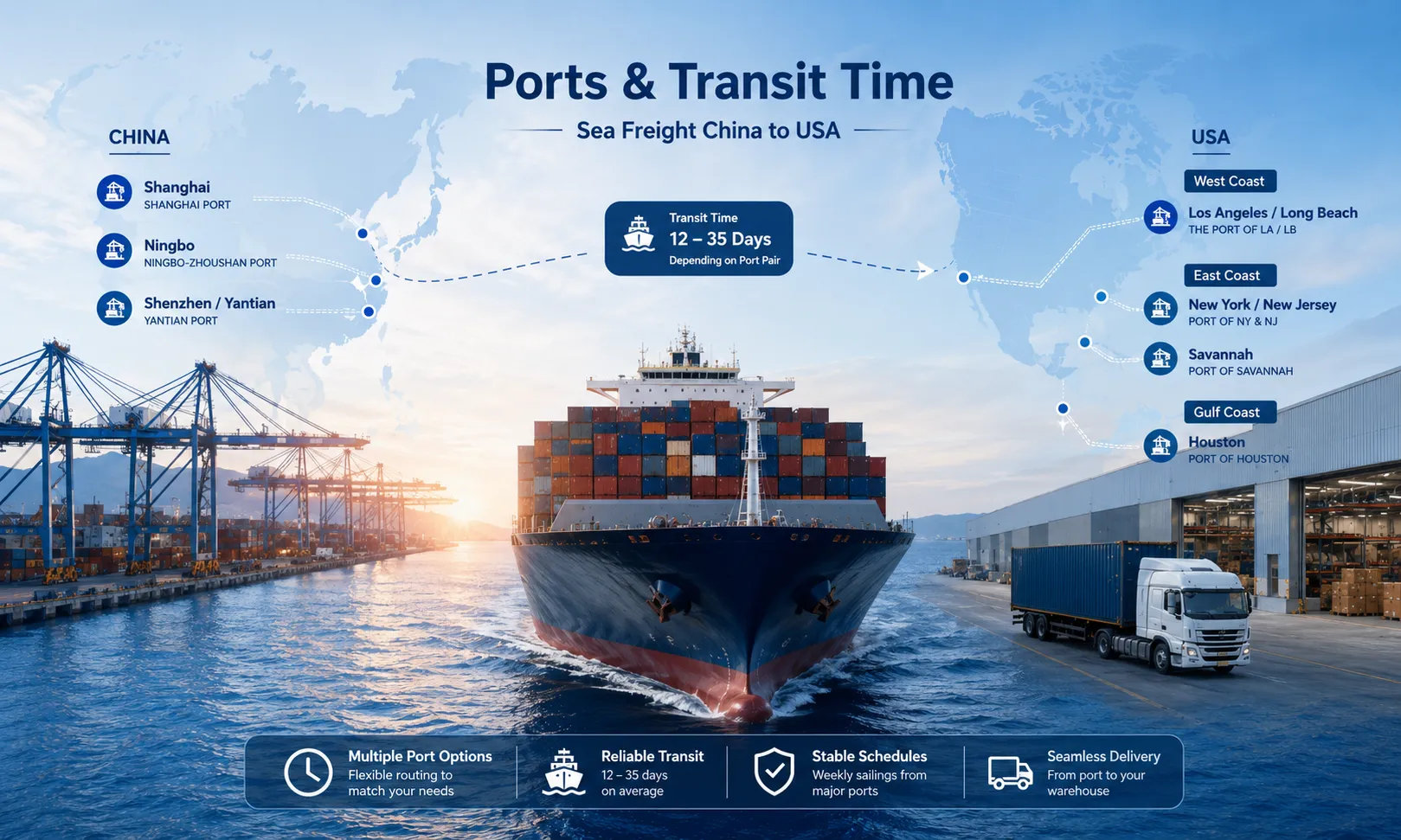
Main Sea Freight Routes from China to USA
China–USA ocean routes connect different manufacturing regions with West Coast, East Coast and Gulf Coast ports. However, the best route depends on the supplier city and the final U.S. ZIP code, not only the cheapest port-to-port rate.
| Common Route | Port-to-Port Planning Time | Best Final Region | Common Service | Main Planning Point |
|---|---|---|---|---|
| Shenzhen / Yantian to Los Angeles / Long Beach | About 14–22 days | California, Nevada, Arizona and western USA | FCL and LCL | Popular South China route with broad carrier coverage |
| Ningbo to Los Angeles / Long Beach | About 14–22 days | West Coast and inland rail connections | FCL and LCL | Suitable for Zhejiang and nearby East China suppliers |
| Shanghai to Los Angeles / Long Beach | About 13–21 days | West Coast distribution | FCL, LCL and selected faster ocean services | Frequent sailings, although capacity and port conditions still matter |
| Shanghai / Ningbo to New York / Newark | About 28–40 days | Northeast and Mid-Atlantic USA | All-water FCL and LCL | Longer ocean transit may reduce cross-country inland transport |
| Shanghai / Ningbo to Savannah / Charleston | About 28–42 days | Southeast USA | FCL and LCL | Useful for Georgia, the Carolinas, Tennessee and nearby markets |
| Qingdao / Shanghai to Houston | About 30–45 days | Texas, Gulf Coast and selected central destinations | Direct or connecting FCL and LCL | Can reduce inland distance for Texas and Gulf-region warehouses |
Transit-time note: These are port-to-port planning ranges rather than guaranteed vessel schedules. Blank sailings, transshipment, weather, port congestion and carrier changes can extend the voyage.
Shenzhen and Yantian Routes
Yantian is a major export gateway for Shenzhen, Dongguan, Huizhou, Guangzhou, Foshan and other South China manufacturing areas. Importers commonly use it for electronics, furniture, consumer products, e-commerce inventory and general commercial cargo.
Los Angeles and Long Beach offer frequent connections from South China. Even so, importers should compare terminal conditions, inland delivery distance and final warehouse requirements before choosing the route.
Ningbo and Shanghai Routes
Ningbo and Shanghai serve Zhejiang, Jiangsu and the wider East China manufacturing region. For example, Ningbo often works well for suppliers in Ningbo, Yiwu, Shaoxing and nearby cities. Shanghai, on the other hand, can support cargo from Shanghai, Suzhou, Kunshan, Wuxi and surrounding industrial zones.
Both ports offer services to the West Coast, East Coast and Gulf Coast. Consequently, the forwarder can compare direct and connecting options according to the final destination.
Qingdao and Northern China Routes
Qingdao handles machinery, industrial products, tires, textiles, building materials and other cargo from Shandong and northern China. Depending on the U.S. destination, the shipment may move to Los Angeles, New York, Savannah or Houston.
Tianjin can also serve northern suppliers, especially around Beijing, Tianjin and Hebei. Nevertheless, route selection should consider the available carrier schedule and inland pickup cost.
How to Choose the Best U.S. Destination Port
The cheapest ocean freight port does not always produce the cheapest complete route. Instead, importers should compare ocean freight, port operations, rail or trucking distance, delivery appointments and equipment availability.
Los Angeles and Long Beach
Los Angeles and Long Beach are major gateways for China-origin cargo. Because they offer shorter ocean transit and broad vessel coverage, these ports commonly serve:
- California warehouses
- West Coast distributors
- Arizona and Nevada destinations
- Selected inland rail routes
- West Coast Amazon and 3PL inventory
However, a lower West Coast ocean rate may lose its advantage when the final warehouse sits in New Jersey, Georgia or another eastern state. Cross-country rail, additional terminal handling and local delivery can increase both cost and time.
New York and Newark
New York and Newark can work better for warehouses in New Jersey, New York, Pennsylvania and the wider Northeast. Although the all-water sailing takes longer than a West Coast route, it may reduce inland transport complexity.
Therefore, importers should compare the complete cost to the final ZIP code before choosing between West Coast discharge and East Coast discharge.
Savannah and Charleston
Savannah and Charleston support Southeast distribution. In particular, they can serve Georgia, the Carolinas, Tennessee, northern Florida and nearby inland markets.
For example, a shipment destined for Atlanta may achieve a simpler route through Savannah than through Los Angeles plus cross-country rail.
Houston
Houston can be practical for Texas, the Gulf Coast and some central U.S. markets. Machinery, industrial products and project cargo often move through Gulf Coast routes.
Nevertheless, sailing frequency and transit time may differ from the major West Coast lanes. For that reason, the importer should compare the final schedule and total inland distance.
Oakland, Seattle and Tacoma
Oakland can suit Northern California distribution, while Seattle and Tacoma serve the Pacific Northwest and selected inland markets. In some cases, these ports provide useful alternatives when the final warehouse location supports them.
Before the forwarder selects the U.S. port, always provide the complete delivery ZIP code.
CY–CY, CFS–CFS and Port-to-Door Shipping Explained
Sea freight quotations often use service terms such as CY–CY, CFS–CFS and CY–Door. Essentially, these terms explain where the carrier or forwarder receives the cargo and where its quoted responsibility ends.
CY–CY Shipping
CY means Container Yard, and a CY–CY shipment normally applies to FCL cargo.
Under this structure:
- The carrier receives the loaded container at the origin container yard.
- Next, the vessel transports the container between the named ports.
- After arrival, the carrier makes the container available at the destination container yard.
- Unless the quote states otherwise, the importer separately arranges customs clearance, port pickup and final delivery.
Therefore, CY–CY does not mean factory-to-warehouse delivery. China trucking and U.S. drayage may appear as separate charges.
CFS–CFS Shipping
CFS means Container Freight Station, and a CFS–CFS shipment normally applies to LCL cargo.
In this case:
- The origin CFS receives individual cartons or pallets.
- Afterwards, the consolidator loads several shipments into one container.
- Once the container arrives, the destination CFS unloads and separates the cargo.
- Finally, the importer or trucker collects the released shipment from the destination warehouse.
As a result, CFS–CFS shipping can involve receiving, consolidation, deconsolidation and warehouse fees at both ends.
CY–Door Shipping
CY–Door normally combines an FCL ocean movement with delivery from the U.S. port or rail ramp to the final address. The service may include drayage, chassis and container delivery. However, the quotation must clarify customs and import charges.
CFS–Door Shipping
CFS–Door combines LCL ocean freight with delivery after deconsolidation. Once the destination CFS releases the cargo, a local carrier delivers the cartons or pallets to the receiver.
Door-to-Door Shipping
Door-to-door sea freight can include China pickup, export handling, international freight, customs coordination and U.S. delivery under one agreed scope. Even so, the importer should confirm whether duties, tariffs and customs-broker fees are included.
For general full-route information, review door-to-door shipping from China.
Sea Freight Transit Time: Port-to-Port vs Door-to-Door
Port-to-port transit time measures the main ocean voyage. By comparison, door-to-door lead time includes every stage from supplier pickup to final delivery. Therefore, the two figures should never be used interchangeably.
What Port-to-Port Time Includes
Port-to-port time generally starts with vessel departure from the China port and ends with vessel arrival at the U.S. discharge port. It does not normally include:
- Factory pickup
- China warehouse receiving
- Waiting for the booked vessel
- Export customs processing
- U.S. customs clearance
- Port release
- Rail or truck delivery
- Warehouse appointment
What Door-to-Door Time Includes
A door-to-door timeline may include:
- Pickup from the Chinese supplier
- Origin warehouse or container loading
- Export customs and port cutoff
- Ocean transit
- U.S. unloading and availability
- Customs entry and cargo release
- Port or CFS pickup
- Inland rail or truck movement
- Final warehouse receiving
Consequently, a vessel schedule of 16 days may result in a 25–35 day or longer total lead time, depending on the route and shipment conditions.
What Can Delay Sea Freight?
- The supplier misses the warehouse or container cutoff.
- The carrier cancels a sailing.
- The vessel rolls the container to a later departure.
- Transshipment takes longer than planned.
- Weather or congestion affects the port.
- ISF or customs data contains errors.
- CBP or another government agency selects the cargo for review.
- The importer does not arrange a customs bond or broker in time.
- Chassis or truck capacity becomes limited.
- The final warehouse cannot provide an appointment.
Importers should therefore add extra planning time before Chinese New Year, Golden Week and major U.S. inventory seasons.
China–USA Sea Freight Booking Process
1. Collect Final Cargo Data
The supplier provides the product name, carton quantity, dimensions, gross weight, total CBM and cargo-ready date. In addition, the importer confirms the final U.S. delivery ZIP code.
2. Confirm the Incoterm
EXW and FOB are common for China–USA sea freight. Under EXW, the forwarder normally arranges pickup and more of the China origin process. Under FOB, the supplier usually handles delivery to the agreed China port and export formalities under the sales agreement.
Before booking, review EXW vs FOB shipping from China.
3. Compare FCL and LCL
The forwarder compares cargo volume, weight, destination costs and handling requirements. Afterwards, the importer chooses the option that fits both cost and cargo risk.
4. Select the Origin and Destination Ports
The supplier’s city guides the China port choice, while the final ZIP code guides the U.S. port choice. Therefore, a complete comparison should include inland pickup and delivery, not only ocean freight.
5. Confirm the Booking and Cutoff
The carrier or NVOCC confirms the sailing, booking number, container or warehouse cutoff, documentation cutoff and estimated departure.
6. Prepare the Cargo
For LCL, the supplier delivers cartons or pallets to the CFS warehouse. By contrast, FCL requires the forwarder to arrange an empty container, loading, sealing and transfer to the port.
7. Submit VGM for FCL
The shipper must provide the Verified Gross Mass of a packed container before vessel loading. Accurate weighing supports safe vessel planning and, in addition, helps prevent loading problems.
8. Complete Export Customs and Documentation
The exporter or its agent submits the China export declaration. At the same time, the forwarder prepares bill of lading details and checks the invoice and packing list.
9. Submit U.S. Pre-Arrival Data
The ISF Importer or its authorized agent arranges ISF, while the carrier or authorized NVOCC transmits vessel-manifest data to CBP. Because these are separate pre-arrival requirements, the parties should verify the shipment information before loading.
10. Track Arrival and Customs Release
Before arrival, the importer confirms the customs broker, bond and entry data. After CBP releases the shipment, the destination team arranges pickup and delivery.
11. Return the Empty Container
For FCL shipments, the trucker returns the empty container to the designated depot within the allowed free time. Otherwise, delays can create detention charges.
ISF 10+2 and Vessel Manifest Filing
For U.S.-bound ocean freight, Importer Security Filing (ISF 10+2) and vessel-manifest filing are two separate advance-data requirements. The ISF Importer or its authorized agent provides importer-side security information to U.S. Customs and Border Protection, while the ocean carrier or an authorized NVOCC separately transmits vessel-manifest data, often called AMS filing in freight practice.
Importantly, one filing does not replace the other.
For standard covered U.S.-bound cargo, eight core ISF data elements generally must be submitted no later than 24 hours before the cargo is laden aboard the vessel destined for the United States. Meanwhile, container stuffing location and consolidator information should be provided as early as possible and within the applicable CBP timing requirements.
Therefore, importers should coordinate supplier, importer, HTSUS, stuffing and consolidation information before vessel loading rather than waiting until the cargo has departed.
For the complete requirements, all 10 data elements, filing responsibility, deadlines, ISF vs AMS, penalties and common mistakes, read our What Is ISF in Shipping? ISF 10+2 Guide.
Bill of Lading, Importer of Record and Customs Bond
Master Bill of Lading
The ocean carrier issues the Master Bill of Lading, or MBL, to the NVOCC, forwarder or direct shipper named in the carrier booking.
Among other details, the MBL identifies the main carrier movement, vessel, ports, container information and cargo description.
House Bill of Lading
The freight forwarder or NVOCC issues the House Bill of Lading, or HBL, to the individual shipper. When the forwarder consolidates several shipments, each importer may receive a separate HBL under one MBL.
For customs and release purposes, the HBL, commercial invoice and packing list should therefore describe the shipment consistently.
Original Bill, Telex Release and Sea Waybill
The release method affects how the consignee obtains the cargo:
- Original bill of lading: The consignee may need to present or surrender the required original document.
- Telex release: The origin office confirms that the shipper surrendered the original bill, allowing destination release.
- Sea waybill or express release: The carrier releases cargo to the named consignee without original bill surrender, subject to the agreed terms.
To avoid release delays, the shipper and buyer should agree on the method before vessel arrival.
Importer of Record
The Importer of Record, often shortened to IOR, holds responsibility for the import entry, classification, declared value, duty payment and compliance.
A customs broker can prepare and submit the entry. However, using a broker does not remove the importer’s ultimate responsibility for accurate information.
Moreover, a supplier, freight forwarder, delivery warehouse or Amazon fulfillment center does not automatically become the Importer of Record.
Customs Bond
Many formal commercial entries require a customs bond. A regular importer may use a continuous bond, while an occasional importer may use a single-entry bond where suitable.
The importer should confirm the bond before arrival. Otherwise, cargo release may face delays while destination charges continue to accumulate.
For detailed IOR, HTS, bond and entry guidance, visit the USA customs clearance from China page. For duty, Section 301, MPF and HMF details, review import tax from China to USA.
U.S. Destination Charges, Demurrage and Detention
A basic ocean rate usually does not include every U.S. destination cost. Consequently, importers should request a written list of inclusions and exclusions.
Common FCL Destination Charges
- Terminal handling or carrier destination fees
- Delivery order or release fee
- Customs brokerage
- Customs bond
- Duty, tariffs, MPF and HMF
- Chassis usage
- Drayage
- Pre-pull
- Yard storage
- Live-unload waiting time
- Drop-and-pick charges
- Empty-container return
Common LCL Destination Charges
- Destination CFS handling
- Deconsolidation
- Warehouse receiving
- Documentation and release fees
- Customs brokerage
- Storage after free time
- Pallet handling
- Final LTL or local truck delivery
What Is Demurrage?
Demurrage generally accrues when a container remains at the marine terminal beyond the available free time. For example, customs delays, missing documents or late pickup can contribute to the problem.
What Is Detention?
Detention generally applies when the trucker or importer keeps carrier equipment outside the terminal beyond the allowed free time. A warehouse that unloads too slowly, for instance, may delay the empty-container return.
What Is Storage?
Storage is a separate terminal, rail-ramp or warehouse charge for cargo or equipment that remains at the facility beyond the permitted period.
How to Reduce These Charges
- Appoint a customs broker before vessel arrival.
- Complete ISF and entry data accurately.
- Track the arrival notice and cargo availability.
- Confirm the terminal’s last free day.
- Book a truck and chassis early.
- Confirm warehouse receiving hours.
- Prepare forklift or unloading labor.
- Return the empty container promptly.
The Federal Maritime Commission distinguishes demurrage at the terminal from detention for extended equipment use. Accordingly, importers should review the carrier invoice carefully and keep arrival, release, pickup and return records.
Port-to-Door and Inland Delivery in the USA
Port-to-door sea freight connects the ocean shipment with transportation from the U.S. port, CFS or rail ramp to the final address.
Drayage for FCL Containers
Drayage moves a full container between the port or rail ramp and a nearby warehouse. Before pickup, the trucker may need:
- Terminal appointment
- Container release
- Chassis
- Customs release
- Delivery appointment
- Empty-return instructions
Moreover, the delivery site must confirm whether it can receive a live container. Warehouses should provide dock access, unloading labor and enough time to unload.
Live Unload vs Drop-and-Pick
During a live unload, the driver waits while the receiver removes the cargo. The quotation normally includes limited free waiting time, after which hourly charges may apply.
With a drop-and-pick service, the driver leaves the container at the warehouse and later returns to collect it. Although this gives the receiver more unloading time, the route may require additional trucking and equipment charges.
Rail and Intermodal Delivery
Containers destined for inland cities may move from the ocean port to a rail ramp. For example, cargo can enter through Los Angeles or Long Beach and continue by rail toward Chicago, Dallas or another inland point.
However, rail adds another terminal process. Therefore, the importer must coordinate:
- Rail availability
- In-bond or customs arrangements where applicable
- Rail-ramp free time
- Local drayage
- Final warehouse appointment
Transloading
During transloading, a warehouse unloads the ocean container and transfers the cargo into a domestic truck, trailer or pallets.
Transloading may help when:
- The destination is too far for economical container drayage.
- The cargo needs palletization.
- Several delivery addresses share one container.
- A retailer or Amazon facility cannot receive a floor-loaded ocean container.
- The container has limited free time.
LCL Final Delivery
After destination deconsolidation, LCL cargo normally moves by local truck or LTL carrier. Accordingly, the quotation should identify:
- Commercial or residential delivery
- Loading dock availability
- Liftgate requirement
- Limited-access location
- Appointment requirement
- Pallet quantity and dimensions
Amazon FBA and 3PL Delivery
Sea freight can support larger Amazon and e-commerce inventory. However, the shipment may require transloading, palletization, carton labels, shipment ID, reference ID, LTL or FTL booking and a delivery appointment.
For detailed Amazon pricing and warehouse-delivery planning, review Amazon FBA shipping cost from China to USA.
Port-to-Door Is Not Automatically DDP
A port-to-door quote may exclude duty, tariffs and importer responsibility. DDP, by contrast, is a separate duty-paid arrangement that must clearly define the Importer of Record, customs value, tax treatment and final delivery scope.
For a detailed explanation, visit DDP shipping from China to USA.
Practical China–USA Sea Freight Examples
Example 1: 3 CBM LCL from Ningbo to Los Angeles
An importer buys 3 CBM of packaged accessories from a Ningbo supplier. The final destination is a commercial warehouse near Los Angeles.
The shipment moves CFS–CFS:
- First, the supplier delivers the cartons to the Ningbo origin CFS.
- Next, the consolidator combines them with other cargo.
- Afterwards, the shared container sails to Los Angeles or Long Beach.
- Once it arrives, the destination CFS unloads and separates the shipment.
- The customs broker then completes the entry.
- Finally, a local truck delivers the released cargo to the warehouse.
In this case, the importer should not compare only the ocean rate per CBM. Origin receiving, destination CFS, customs, storage and local delivery can represent a significant part of the complete cost.
Example 2: 40HQ from Yantian to a Dallas Warehouse
A South China importer has a 40HQ container of home products for a 3PL warehouse near Dallas.
The forwarder compares several possibilities:
- Yantian to Los Angeles or Long Beach, followed by rail or truck
- Yantian to Houston, followed by local or regional delivery
- Another all-water route that supports the final inland schedule
A West Coast route may offer a shorter ocean voyage. Nevertheless, cross-country rail, extra terminal handling and local delivery can change the result.
By contrast, Houston may involve a longer ocean transit but a shorter final inland movement. Therefore, the importer should compare total door cost, schedule reliability, free time and delivery risk rather than selecting the cheapest ocean freight alone.
Why Choose VoltFreight for Sea Freight from China to USA?
VoltFreight helps importers coordinate China–USA ocean freight from supplier pickup through U.S. delivery planning. Rather than providing an incomplete port rate, the service focuses on matching the route to the cargo and final destination.
China Supplier Pickup and Consolidation
VoltFreight can arrange pickup from factories and warehouses in Shenzhen, Guangzhou, Dongguan, Foshan, Yiwu, Ningbo, Shanghai, Suzhou, Qingdao and other Chinese cities.
When several suppliers are involved, the cargo can move to one China warehouse for receiving, checking and consolidation.
FCL and LCL Route Comparison
Our team compares cargo volume, container use, CFS charges, port routes and final delivery conditions before recommending FCL or LCL.
Export and Shipping Documents
VoltFreight coordinates China export handling and reviews the commercial invoice, packing list and bill of lading information before departure.
ISF and Manifest Data Coordination
VoltFreight can help coordinate supplier, cargo, booking and consolidation information needed for U.S.-bound ocean shipments. However, the importer and its filing or customs parties should still confirm importer information, ISF responsibility and customs requirements.
For filing requirements and the complete data checklist, see our ISF 10+2 shipping guide.
U.S. Port and Door-Delivery Planning
The final ZIP code guides the discharge-port and inland-delivery decision. Where available, VoltFreight can coordinate customs support, CFS pickup, drayage, transloading, LTL, FTL and warehouse delivery.
What to Send for a Quote
- Product name and photos
- Supplier city and full pickup address
- EXW or FOB Incoterm
- Carton or pallet quantity
- Carton dimensions
- Total gross weight
- Total CBM
- Cargo value and currency
- HTS code if available
- Cargo-ready date
- Final U.S. ZIP code
- Delivery address type and unloading conditions
- Battery, liquid, chemical, branded or regulated-product information
After receiving these details, VoltFreight can compare LCL, FCL, CY–CY, CFS–CFS and port-to-door options. If the cargo contains lithium batteries, power banks or battery-powered products, review our guide to sea freight for batteries from China to USA because battery documents, packing and carrier acceptance can affect the available route.
Related China to USA Shipping Guides
- Shipping from China to USA — Compare sea, air, express, DDP and door-to-door routes.
- Sea Freight from China — Review general FCL, LCL, container and ocean-freight principles.
- China to USA Shipping Cost — Compare sea, air, express and landed-cost factors.
- Container Shipping Cost from China to USA — Review 20ft, 40ft and 40HQ rates.
- LCL Shipping from China — Understand CBM, CFS handling and destination charges.
- What Is ISF in Shipping? — Learn ISF 10+2 requirements, filing deadlines, required data, ISF vs AMS and late-filing risks.
- USA Customs Clearance from China — Review HTS, IOR, customs bonds and import documents.
- Import Tax from China to USA — Check duties, Section 301, MPF, HMF and landed tax costs.
- DDP Shipping from China to USA — Understand duty-paid delivery and importer responsibilities.
- Amazon FBA Shipping Cost from China to USA — Plan sea freight, transloading, LTL, FTL and FBA delivery.
- Request a Sea Freight Quote — Send shipment information for a route comparison.
FAQ About Sea Freight from China to USA
How long does sea freight from China to USA take?
Port-to-port sea freight to Los Angeles or Long Beach may often take approximately 13–22 days. Meanwhile, all-water services to New York, Savannah, Charleston or Houston may require approximately 28–45 days. Door-to-door lead time is longer because it also includes pickup, export handling, customs clearance, port release and inland delivery.
Should I choose FCL or LCL?
LCL normally suits smaller shipments that do not justify a complete container. FCL, by contrast, provides a dedicated container and often works better for larger, fragile, high-value or difficult-to-handle cargo. Many importers start comparing FCL once cargo approaches approximately 10–15 CBM, although route and destination charges can change the break-even point.
What is the difference between CY–CY and CFS–CFS?
CY–CY normally applies to full containers and covers movement between the origin and destination container yards. CFS–CFS, on the other hand, normally applies to LCL cargo and includes consolidation at the origin cargo freight station and deconsolidation at the destination CFS. Neither term automatically includes customs clearance or final delivery.
Who files ISF and vessel-manifest data?
The ISF Importer or its authorized agent arranges ISF, while the ocean carrier or an authorized NVOCC transmits vessel-manifest data to CBP. Freight companies often call the latter AMS filing. Importantly, ISF and vessel-manifest filing are separate requirements, and one does not replace the other. For filing deadlines, required data and penalties, read our complete ISF 10+2 guide.
Does sea freight include customs clearance and final delivery?
It depends on the agreed service scope. A CY–CY or CFS–CFS quotation usually ends at the destination yard or warehouse. Port-to-door or door-to-door service can include customs coordination and delivery; however, the quotation should clearly identify duties, tariffs, customs-broker fees, destination charges and delivery conditions.
Conclusion
Sea freight from China to USA works best when the importer plans the complete route rather than focusing only on the vessel rate. FCL and LCL use different warehouses, documents and destination processes, while each U.S. port creates a different inland-delivery plan.
West Coast routes usually provide shorter ocean transit. Nevertheless, New York, Savannah, Charleston or Houston may reduce inland rail and truck distance for eastern, southern or Gulf-region destinations.
In addition, importers should prepare ISF and required vessel-manifest information before the applicable advance-filing deadlines, while customs-broker, bond and entry arrangements should be confirmed before vessel arrival. After customs release, the final result depends on port pickup, free time, chassis, drayage, rail movement and warehouse receiving.
To compare LCL, FCL, CY–CY, CFS–CFS and port-to-door options, contact VoltFreight with your cargo details and final U.S. ZIP code.
Official Information Sources
- U.S. Customs and Border Protection: Importer Security Filing 10+2
- U.S. Customs and Border Protection: ISF Submission Timing
- U.S. Customs and Border Protection: Vessel Manifest 24-Hour Rule
- U.S. Customs and Border Protection: Tips for New Importers
- U.S. Customs and Border Protection: Customs Bond Requirements
- International Maritime Organization: Verified Gross Mass of Packed Containers
- Federal Maritime Commission: Detention and Demurrage
- Federal Maritime Commission: Detention and Demurrage Billing Practices
Important note: This article provides general logistics-planning information. Vessel schedules, transit times, port charges, customs requirements, bond rules, terminal free time and final delivery conditions can change. Therefore, confirm the live sailing, current customs requirements and complete service scope before shipment.