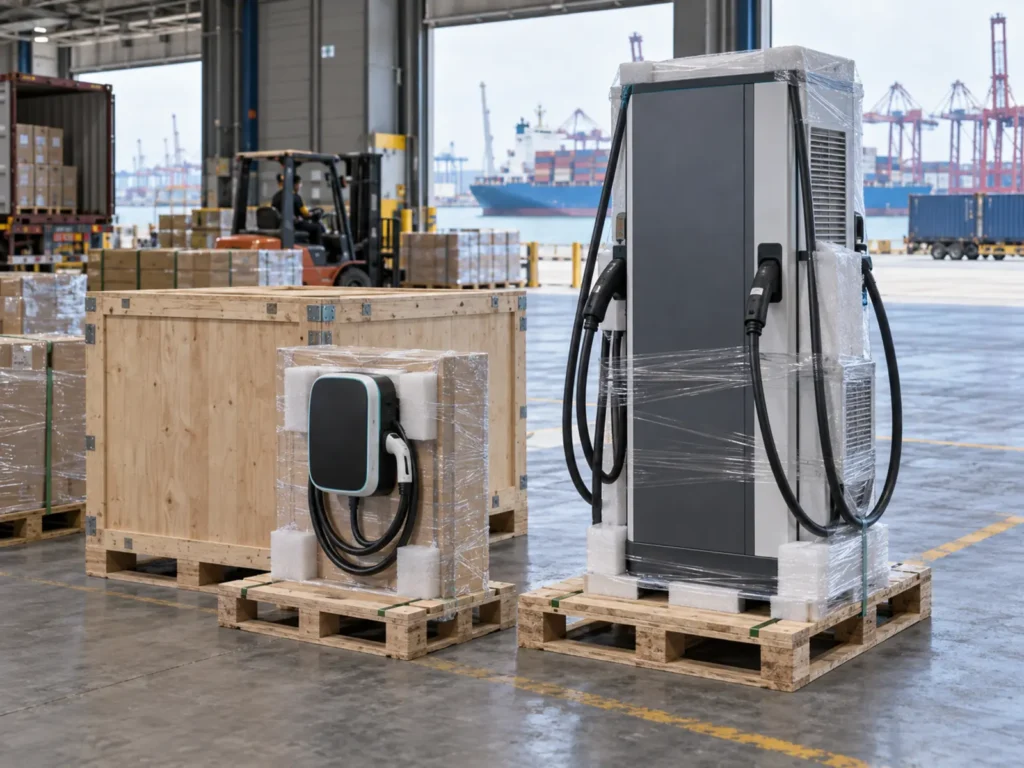
This guide focuses on the freight handoffs between a Chinese factory and an overseas receiver. It does not replace product-certification, electrical-installation, tax or legal advice. The manufacturer, importer, customs professional and local project team must each confirm the matters within their responsibility.
Preparing a shipment now? Send VoltFreight the product specification, packing details, factory city and delivery postcode through the contact page. We can review the transport route while your product and installation teams complete their technical checks.

What Information Does a Forwarder Need Before Booking?
A product link and a kilowatt rating are not enough for a reliable freight quotation. Before asking a forwarder to compare services, collect the following information from the supplier:
- Exact product name, model number and revision.
- AC wallbox, freestanding AC unit, DC cabinet or another configuration.
- Quantity and number of cartons, pallets or crates.
- Outside dimensions and gross weight of every final package.
- Single-piece weight for any cabinet, crate or unusually heavy pallet.
- Pickup address and factory-ready date in China.
- Destination country, full delivery address or postcode, and whether it is a warehouse or project site.
- Sales term, such as EXW, FOB, DAP or DDP, including the named place.
- Details of any battery, energy-storage module, refrigerant, liquid or other specially regulated component.
- Whether the receiver has a dock, forklift, crane or other unloading equipment.
Use measurements from the finished shipping package rather than the bare product dimensions in a catalogue. A wooden crate, pallet, protective frame or separate cable package can materially change chargeable weight, container loading and the final vehicle. If the factory has not completed the packaging, ask it to provide a preliminary packing plan and mark the figures as estimates.
Use the same data for every quotation. Otherwise, a port-to-port sea price can look cheaper than an air or door-delivery offer simply because the quotes do not include the same origin, customs and final-mile services.
AC Wallboxes vs DC Fast Chargers: What Changes in Freight?
AC wallboxes are usually a carton and pallet planning problem
AC wallboxes are often compact enough to ship as individual cartons, several cartons on a pallet or a larger consolidated order. The forwarder needs the carton count, pallet plan, stackability and final dimensions. If different models or connector versions share one pallet, the outer labels and packing list should make each variant easy to identify.
For samples and urgent replacements, express or air freight may be practical. For a commercial batch, sea LCL may reduce the international freight cost, while FCL can become worth comparing when the total volume, loading plan and handling risk justify a dedicated container. Quantity alone does not decide the mode: ten large pallets and ten small cartons are not the same shipment.
DC cabinets are a single-piece handling problem
A DC fast-charging cabinet can be tall, top-heavy and difficult to handle even when the total shipment occupies only a few cubic metres. Its single-piece weight, centre of gravity, approved lifting points and fork access can matter more than the total order weight. Projecting screens, connector holders, cable outlets and door panels also need protection from impact and vibration.
Ask whether the cabinet ships as one assembled unit or in separate modules. Confirm which accessories travel inside the crate and which arrive as separate packages. This affects the crate design, package count, customs description, installation sequence and the risk that the factory leaves a critical component behind.
What Should the Buyer Confirm Before Factory Release?
The forwarder can move a compliant, correctly described product, but it does not decide whether the charger will work at the destination. The buyer should close the following technical questions before collection, preferably before final payment.
Connector, vehicle and charging compatibility
Confirm whether the unit provides AC or DC charging and which connector configuration the exact model includes. Do not rely on a statement such as “works with all EVs.” Vehicle versions and connector adoption differ by market. The U.S. Department of Energy’s charging guide, for example, distinguishes charging equipment, ports and connector types rather than treating every charger as interchangeable.
Electrical supply and site readiness
Match the charger’s input requirements to the power available at the site. A high-output cabinet may also require utility work, switchgear, civil work, permits or other infrastructure that sits outside a freight contract. The local project team should establish those requirements and the commissioning sequence. The DOE’s infrastructure-development guidance shows why utility, site and installation planning belong to the wider project.
Software, network and supplied accessories
For public, workplace or fleet charging, verify the exact unit’s communications hardware, backend compatibility, payment configuration and agreed software features. Ask the supplier to identify the cables, connector assemblies, mounting hardware, spare parts and network components included in the order. Freight documents can confirm that the supplier shipped a package; they cannot prove that software will connect to the intended network.
Finally, match the model and revision across the product label, purchase order, invoice, manual, declaration and supporting test file. A folder of certificates for a related model does not show that a specialist reviewed the ordered configuration.
Which Product and Import Documents Should the Buyer Check?
Keep two document sets conceptually separate. Shipping and customs documents describe the commercial movement of the goods. Product-compliance documents help the responsible parties determine whether they may place, install or use the equipment in the market. One set does not replace the other.
Shipping and customs documents
The commercial invoice should identify the actual seller, buyer, charger models, quantities, values, currency and agreed Incoterm. The packing list should show every carton, pallet or crate, including its marks, contents, outside dimensions, net weight where required and gross weight. Depending on the route and service, the shipment may also require a transport document, origin evidence, insurance evidence or destination-specific customs information.
Product files for the destination market
Ask the responsible product specialist to confirm which rules apply to the exact model, intended use and destination:
- European Union: identify the applicable legislation, conformity-assessment route, technical file, labelling and EU declaration of conformity. The European Commission explains that CE marking requires more than placing a logo on the product.
- Great Britain: confirm the current marking route for the product and whether rules for private smart charge points or public charge points apply. Check the government’s current CE and UKCA guidance, private smart-charge-point guidance and, when relevant, public charge point rules.
- United States: the importer and local installer should confirm the applicable product listing, electrical code, permitting, utility and authority-having-jurisdiction requirements for the particular project. Public-funding conditions, when relevant, require a separate review.
- Australia: determine the equipment’s classification under the applicable electrical-safety regime and identify the locally established responsible supplier. The EESS guidance for manufacturers and importers treats that role separately from freight and customs work.
Do not copy a “global certificate list” from another supplier or country. France and Germany share EU-level rules but a project may still face local installation or operational obligations. Canada, Brazil, Mexico, Thailand, Malaysia, Saudi Arabia and other markets each need their own review. Ask the factory for evidence tied to the exact model and ask the responsible importer or adviser to check it before the goods leave China.
How Should the Factory Pack EV Chargers in China?
Packaging should protect the product and make it safe to handle through every transfer. For AC wallboxes, that usually means fitted internal protection, strong cartons, stable palletisation and clear model marks. For DC cabinets, it can mean a reinforced base, moisture protection, internal restraint and a crate designed around the manufacturer’s permitted handling points.
Record the cargo before closing the package
Request dated photos of the model and serial label, the unit from several sides, connectors and loose accessories, internal restraints where visible, and the finished package. Photograph the crate or pallet marks and any shock, tilt or handling indicators. These records help compare the condition at factory release and delivery. VoltFreight’s guide to preventing shipping damage explains the wider handoff controls.
Check wood packaging and any included battery
For solid-wood pallets or crates, confirm the destination’s ISPM 15 rules and inspect the treatment mark before collection. For US-bound cargo, follow the USDA wood-packaging requirements. The words “export packing” alone do not prove compliance.
Do not assume that every grid-connected charger contains an EV traction battery. If it includes energy storage, a backup battery or separate battery modules, disclose the chemistry, configuration, watt-hour information and transport documents before booking. Review IATA’s battery guidance and VoltFreight’s overview of shipping batteries from China.
After the factory confirms the final packages, dimensions and weights, compare routes using the packed cargo and complete delivery scope—not only the charger’s power rating or unit quantity.
| Packed cargo | Options to compare | Main checks before booking |
|---|---|---|
| Samples or small boxed AC chargers | Express or air freight | Chargeable weight, courier package limits, delivery urgency and any included battery. |
| Palletised AC wallboxes | Air freight or sea LCL; compare FCL when the total volume and loading plan justify it | Total CBM, pallet height, stacking restrictions, handling exposure and destination charges. |
| Heavy DC fast-charging cabinets | Sea LCL or FCL; air freight only after checking aircraft and handling limits | Crate dimensions, single-piece weight, lifting points, fork access, container loading and site unloading. |
| Chargers with integrated batteries or energy storage | Confirm a route only after the battery and carrier review | Battery chemistry, configuration, transport documents, packaging and carrier acceptance. |
These are planning options, not fixed thresholds. Compare pickup, export handling, international freight, customs and delivery together. For the general differences, see express freight, air freight and sea freight.
What Does Door-to-Door or DDP Actually Include?
First separate the sales contract from the freight quotation. ICC Incoterms 2020 allocates defined costs, risks and obligations between seller and buyer. It does not automatically describe every activity included in a forwarder’s price. VoltFreight’s Incoterms guide provides more context for EXW, FOB, DAP, DDP and the named place.
A door-to-door shipping quote should state the collection point, export handling, main transport, destination clearance arrangement and exact delivery address. It should also identify exclusions such as storage caused by a documentation delay, restricted-site access, waiting time, crane hire, unpacking, positioning, electrical installation and commissioning.
DDP requires particular care because the seller takes responsibility for import clearance and import duties under that sales term. Before accepting a DDP plan, confirm that the proposed importer and tax arrangement will work in the destination, the carrier accepts the cargo, and the quote explains its treatment of duties and taxes. Calling a service “DDP” does not make a non-compliant product lawful, appoint a local responsible party or include unquoted unloading equipment.
How Do Customs Classification, Duty and Tax Work?
“EV charger” is a commercial description, not a universal duty rate. Classification depends on the product’s characteristics and the tariff used by the destination country. The importer or customs professional should review the specification and proposed HS or commodity code instead of copying a code from a different charger, supplier or country.
Provide a truthful commercial description, transaction value, country of origin and supporting invoice. Make the quantities and package details consistent across the invoice, packing list and transport booking. If the shipment includes separate charging cables, payment terminals, communication modules, spare parts or battery equipment, identify them clearly so customs professionals review the cargo that the factory actually packed.
Duty, import VAT or other taxes depend on the destination, classification, value, origin and import arrangement. Therefore, calculate them for the actual shipment rather than presenting one worldwide percentage. VoltFreight can coordinate the selected service and customs documentation, while the importer remains responsible for accurate product information and any obligations assigned to it. See the customs clearance service for the broader process.
Can the Delivery Site Unload the Charger?
A staffed warehouse with a dock is different from an unfinished charging site or a parking area. Before confirming the final truck, ask:
- Can the delivery vehicle reach and safely leave the address?
- Is an appointment, access permit or specific delivery window required?
- Does the site have a dock, forklift or crane rated for the single-piece weight?
- Can the receiving team remove the crate from the vehicle, or must the carrier provide a tail lift or other equipment?
- Where can the crew place the package, and can the site protect it from weather and theft?
- Who can inspect the package, record visible damage and sign the delivery receipt?
Resolve these questions before dispatch, not when the driver arrives. A door-delivery price may cover arrival at the named address without covering unloading, uncrating or positioning on a prepared foundation. If delivery needs a crane, forklift or specialist rigging team, define who will arrange it and when.
At delivery, inspect the outer package before signing, photograph all sides and note visible damage on the receipt. Keep the factory-release photos, package marks and delivery records together. Discuss cargo insurance before shipment because liability under a transport contract is not the same as insurance for the equipment’s full commercial value.
What Determines Landed Cost and Total Lead Time?
Separate three figures when comparing suppliers and routes:
- Equipment price: the agreed charger price and the cables, mounting items, software features and spare parts included.
- Landed cost: the equipment plus origin charges, international freight, agreed insurance, destination handling, applicable duty and tax, and the contracted delivery.
- Installed project cost: the landed equipment plus utility work, electrical installation, civil works, permits, commissioning, network service and ongoing maintenance where applicable.
A freight forwarder can price the second figure only after the cargo data and service scope are clear. Compare like with like: the same pickup location, packed dimensions, destination, customs assumptions and unloading scope. For air freight, volumetric or chargeable weight may exceed gross weight. For a DC cabinet, one heavy crate may determine the vehicle and handling cost even when total CBM looks modest.
Build the schedule from milestones rather than relying on one transit-time number: product approval, factory completion, final packing, document review, pickup, export processing, departure, international transit, destination clearance, delivery appointment and site receipt. Installation and commissioning follow their own project timeline. Customs inspections, carrier schedules, document corrections and site readiness can all affect the final date, so do not present a planning estimate as a guaranteed delivery date.
Two Transparent Planning Examples
Example A: AC wallboxes for a UK distributor
The buyer confirms the exact model intended for Great Britain and asks the responsible product specialist to review the current marking and smart-charge-point requirements. The factory then supplies the final carton and pallet count, outside dimensions, gross weights, invoice, packing list and photos. Because the receiving warehouse has a dock, the forwarder can compare air and consolidated sea options on the same customs and delivery scope.
The useful decision is not simply “air or sea?” It is whether all units, connector variants and accessories match the order, whether the paperwork covers the exact revision, and whether the faster option produces enough project value to justify its cost.
Example B: one DC cabinet for a U.S. project site
The importer and installer first review the actual model and local acceptance requirements. The factory confirms the complete configuration, reinforced-crate dimensions, gross weight, centre-of-gravity information, fork access and lifting method. The site confirms truck access and a machine capable of unloading the packed unit. Only then can the forwarder compare sea arrangements and final-mile equipment for that single piece.
These are illustrative planning scenarios, not claims about completed VoltFreight shipments, freight rates or guaranteed outcomes. A real recommendation requires the buyer’s documents, measured packages and confirmed destination.
What VoltFreight Needs for a Quote
Send as much of the following as is available:
- Product specification or supplier link, exact model and revision.
- AC or DC configuration, rated power and connector type.
- Commercial invoice or clear order description.
- Final packing list with package count.
- Outside dimensions and gross weight of each package.
- Photos of the equipment and finished packaging.
- Battery or integrated energy-storage details, if any.
- Factory pickup address or city and factory-ready date.
- Destination country, postcode and complete delivery address.
- Agreed Incoterm and named place.
- Required delivery date and the reason for that deadline.
- Receiving-site access, appointment and unloading information.
If some measurements are still preliminary, identify them as estimates. VoltFreight can begin a route review, but the booking and final price must use the completed package data.
Why Choose VoltFreight for EV Charger Shipping?
EV charger logistics sits between ordinary freight and project delivery. VoltFreight reviews the actual packed cargo, not just the product name; checks the handoff between factory documents and shipping documents; compares appropriate air and sea options; and brings customs scope and final-site delivery into the discussion before booking.
That process is especially useful when an order combines wallboxes, cables, spare modules and heavy cabinets, or when the delivery address lacks a conventional warehouse dock. We define what the freight service includes and identify where the importer, product specialist, broker, installer or receiving team still needs to act.
Request a shipment review: contact VoltFreight with the charger model, packing details, pickup city and destination. We will use those facts to assess collection, express or air freight, LCL or FCL, customs coordination and final delivery for the actual consignment.