
Quick answer: For express shipping from China to USA, no courier is always the cheapest or fastest. Compare DHL, UPS and FedEx using the same final cartons, service level, destination ZIP code and duty terms. The best choice is the lowest complete quote after dimensional weight, fuel, delivery-area, handling and customs-related charges are considered.
Last reviewed: September 2026. Courier rates, capacity, product acceptance and U.S. entry rules can change, so confirm the final service against the actual cargo before dispatch.
This guide is for importers who have already decided to use an express courier and now need to choose between DHL, UPS and FedEx for one specific China-to-USA shipment. It does not attempt to compare every freight mode. Instead, it shows how to normalize three courier quotes, identify the charges that matter and decide when the shipment has become too bulky for express.
Express courier is most useful when the cost of delay is higher than the extra freight charge, such as production samples, urgent replacement parts, compact launch stock and time-sensitive commercial cartons. A bulky or non-urgent shipment may still need an air-freight comparison even when its actual weight appears suitable for courier service.
To request a live comparison: send VoltFreight the product name, product photos, supplier city, final carton count, dimensions and gross weight of each carton, cargo value, U.S. ZIP code and required delivery date. We can compare suitable courier channels after checking the actual shipment data.
Request a DHL, UPS and FedEx comparison

DHL, UPS or FedEx: Which Courier Should You Quote First?
Begin with the shipment rather than the carrier logo. The right first quotation depends on what is inside the cartons, where the supplier is located, how the goods are packed and what type of address will receive them in the United States. A compact sample going to a California office may produce a different result from a long carton going to a residential ZIP code in the Midwest, even when both shipments have the same actual weight.
The table below is a starting point, not a permanent ranking. It tells you which operational question to ask first. Final selection should still be based on a live, like-for-like quotation.
| Shipment situation | Courier comparison to request | What could change the decision |
|---|---|---|
| Urgent sample or compact commercial parcel | Compare DHL, UPS and FedEx priority services using the same pickup date. | Product acceptance, final billed weight, daily cut-off and destination ZIP code. |
| Delivery to a U.S. office, warehouse or 3PL | Compare the carrier’s commercial-address treatment and delivery service. | Whether the address is classified as commercial, appointment needs and delivery-area charges. |
| Residential delivery | Ask all three carriers for a quote showing residential and area-related charges. | Address classification, remote coverage, signature service and failed-delivery risk. |
| Large but light carton | Compare the billed weight before comparing any rate per kilogram. | Dimensional weight, rounding, additional handling and oversize rules. |
| Several cartons or heavier commercial cargo | Compare DHL, UPS and FedEx, then request a standard air-freight check. | Total chargeable weight, airport handling, customs scope and final delivery. |
For express shipping from China to USA, the first quotation does not determine the winner. DHL may produce the best confirmed scope for one shipment, while UPS or FedEx may be stronger for another destination, service level or carton profile. Contract rates, available capacity, product restrictions and local delivery conditions can change the result from one week or one shipment to the next.
A useful answer is therefore conditional: for these cartons, this product, this ZIP code and this delivery date, this courier has the best confirmed scope. That is much more reliable than choosing a carrier from a public price chart or from a supplier’s past shipment.
How to Compare China-to-USA Courier Quotes on the Same Basis
For express shipping from China to USA, the most common comparison error is placing unlike quotations next to each other. One supplier may quote from its factory, another forwarder may quote after delivery to a Shenzhen warehouse, and a retail courier calculator may assume a different service level. One quote may exclude fuel or import charges while another includes more of the delivery scope. The totals cannot be compared until those differences are identified.
Use the same information for DHL, UPS and FedEx. Dimensions must come from the finished outer cartons, not the product page or an early supplier estimate. The destination must include the exact U.S. ZIP code and whether the location is residential, commercial, a warehouse or a 3PL. The product description, declared value, country of origin and duty instruction should also remain consistent.
Before approving a label, ask the forwarder to identify the exact courier service or approved channel, origin pickup scope, expected acceptance date, final carton data, confirmed chargeable weight, base freight and fuel scope, residential or delivery-area charges, additional-handling exposure, customs or disbursement charges, duty and tax responsibility, estimated transit after acceptance and the estimated total under those assumptions. Record the answers for DHL, UPS and FedEx in the same order. If one quotation is based on estimated cartons, a different service level or receiver-paid duty while another uses final cartons or a duty-paid scope, the totals are not yet comparable.
Do not force every charge into one number if it cannot be known before U.S. entry. Instead, mark it clearly as included, excluded, estimated or payable by the consignee. This makes uncertainty visible and prevents a low headline rate from being mistaken for a fixed landed price.
Also check when the quotation expires. Express rates and fuel-related charges can change, and a quotation based on estimated cartons may need to be recalculated after the supplier finishes packing. If the shipment is not ready, treat the first number as planning guidance rather than a guaranteed booking price.
What Should You Verify in DHL, UPS and FedEx Quotes?
The three couriers all operate international express networks, tracking systems and U.S. delivery services. The relevant differences appear at shipment level: the exact service offered, whether the product is accepted, how the final cartons are measured, how the destination address is classified, which charges are included and how quickly the importer responds to a clearance request.
What to verify in a DHL quote
A DHL quote should identify the exact service or approved channel, China handover point, expected acceptance date, confirmed billed weight and estimated delivery range. Check whether the rate is based on the supplier’s estimate or final warehouse measurements. The quotation should also state whether fuel and known delivery-area charges are included and who will receive any customs or duty request.
Product acceptance must be confirmed separately. A shipment containing a battery, liquid, powder, magnet or another controlled item may need a different channel or supporting documents. Do not assume that a previous DHL shipment proves that a different product, carton or destination will use the same service.
What to verify in a UPS quote
A UPS quote should show the exact service, confirmed chargeable weight and the account or channel used for rating. Verify how the destination is classified, because a company name at a home address does not necessarily make it a commercial delivery. Ask whether residential, delivery-area, address-correction or signature-related charges are included or remain possible.
Long cartons, heavy individual pieces and unusual shapes should be disclosed with photos and accurate final measurements. Confirm whether any carton may trigger additional handling, a size-related charge or a different service. This check matters more than a broad claim that UPS is always cheaper for a particular type of U.S. address.
What to verify in a FedEx quote
A FedEx quote should name the service level rather than state only “FedEx shipping.” Confirm the pickup or handover date, chargeable weight, declared value, product status and destination coverage. If a faster service and a less urgent service are both available, compare each one only with courier options capable of meeting the same delivery deadline.
Also verify fuel, delivery-area, residential, handling and customs-related fee treatment. A lower FedEx base freight number does not prove that the final bill will be lower, just as a higher base number does not prove the complete service is more expensive. The comparison is valid only after the three quotations use the same shipment and fee scope.
The decision can change even when the product remains the same. A supplier may use a different carton, the consignee may change from an office to a residence, or the deadline may allow an economy service. For repeat shipments, keep the previous shipment data as a reference, but request a fresh comparison when carton size, product, ZIP code or delivery requirement changes.
How Chargeable Weight Changes Express Shipping from China to USA
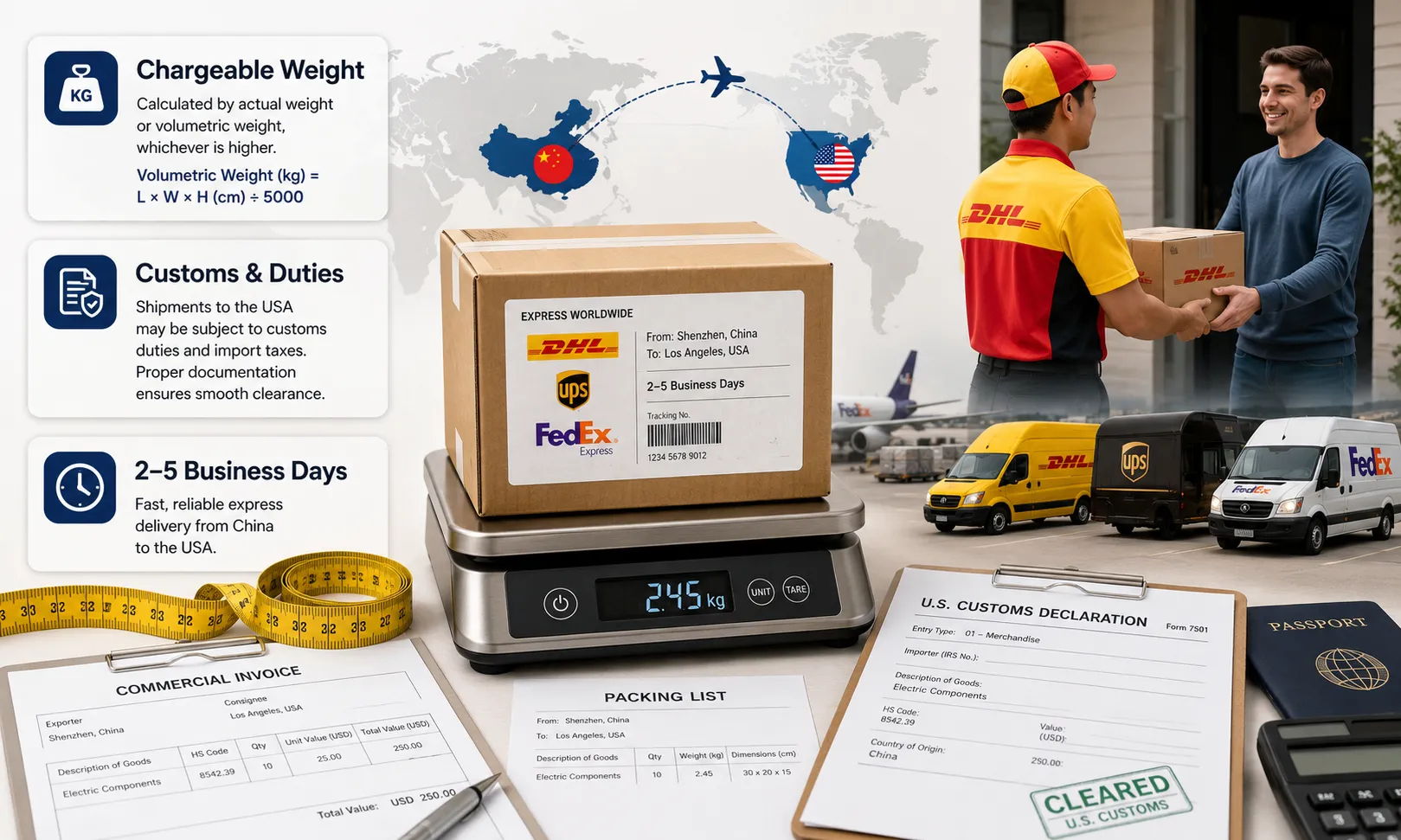
Chargeable weight is often the reason a courier quote is higher than the buyer expects. Express carriers compare actual gross weight with dimensional weight and generally bill the higher result. The method reflects both the physical weight of a package and the space it occupies in the aircraft and delivery network.
For preliminary international courier planning in centimetres and kilograms, VoltFreight uses:
Dimensional weight (kg) = Length × Width × Height (cm) ÷ 5,000
Planning chargeable weight = the higher of actual gross weight or dimensional weight.
This is a planning calculation, not a promise that every courier account applies identical rounding or billing rules. FedEx explains that the greater of actual and dimensional weight is used and publishes a dimensional calculation for its services. See FedEx’s dimensional-weight guidance. UPS also notes that dimensional weight and rate-specific divisors may apply, so the account and service rules must be checked before dispatch. See UPS package dimension and weight guidance.
| Final carton | Actual weight | Planning dimensional weight | Likely planning basis |
|---|---|---|---|
| 40 × 30 × 20 cm | 10 kg | 4.8 kg | 10 kg actual weight, subject to carrier rules |
| 60 × 50 × 40 cm | 10 kg | 24 kg | 24 kg dimensional weight, subject to rounding |
| 90 × 40 × 35 cm | 10 kg | 25.2 kg | At least 25.2 kg before carrier rounding; handling rules also require review |
The second and third examples show why a price per actual kilogram can be misleading. Both cartons weigh 10 kg on a scale, but their planning billed weights are much higher. A quote written as “USD X per kg” is incomplete unless it also states which chargeable weight is being used.
For multiple cartons, calculate every carton separately. Do not average all dimensions or compare only the total actual weight. One low-density carton can produce a large dimensional charge, while another compact carton may remain actual-weight based. The carrier may also remeasure cartons in its network. If the warehouse measurement differs from the supplier’s estimate, the invoice can be adjusted.
The practical solution is simple: ask the supplier for preliminary data, then verify each finished carton before creating the courier label. Reduce unnecessary empty space without weakening protection. Flag long, irregular, fragile or unusually heavy cartons early. If dimensional weight is much higher than gross weight, request a repacking review and an air-freight comparison before approving express.
Do not automatically apply the courier divisor to a standard air-freight quotation. International courier planning commonly uses a 5,000 divisor, while ordinary air-freight planning often uses 6,000. The confirmed carrier, airline and service rules determine the final chargeable weight.
Why the Lowest Freight Quote May Not Be the Lowest Final Bill
The cheapest base freight line is not necessarily the cheapest delivered result. A correct comparison must show what is included and what can still be billed after booking. Depending on the courier, account, shipment and destination, the final bill may be affected by fuel, delivery-area treatment, residential delivery, address correction, additional handling, customs advancement or disbursement, import duty and tax.
These charges do not mean that a carrier has quoted incorrectly. Problems usually arise when the buyer and seller use different definitions of “shipping cost.” A supplier may mean only the amount needed to create the label. The U.S. importer may believe the same number includes customs, duty and final delivery without further payment. The difference should be resolved in writing before dispatch.
A real buyer concern: freight price versus clearance scope
In a public Reddit discussion, a user comparing U.S.-bound courier shipments said a DHL customs-clearance charge was separate from import duty and then asked how FedEx handled a similar shipment. The post is anecdotal and does not establish a universal DHL or FedEx fee. Its value is the buyer question it reveals: two freight quotes cannot be compared until brokerage, clearance, advancement and duty responsibility are shown on the same basis. View the Reddit discussion.
Use that lesson when reviewing a quotation. Ask whether customs-related service charges are included, estimated or collected from the consignee. Ask whether the courier will contact the receiver and what importer information may be required. Never use an isolated Reddit amount as a market rate; actual fees depend on the shipment, entry and carrier terms.
Who pays U.S. duty?
Ordinary door-to-door courier delivery does not automatically mean duty-paid delivery. Under a receiver-paid arrangement, the carrier may request import duty, tax, importer information and applicable customs-related charges from the consignee. An eligible Express DDP quotation has a different scope and must be confirmed for the exact product, value and route.
Effective June 24, 2026, non-postal imports valued at USD 800 or less are no longer automatically eligible for the de minimis administrative exemption and must use the appropriate formal or informal entry procedure. This does not create one duty rate for every low-value shipment. The final duty, tax and entry cost still depend on the product classification, origin, customs value and rules in force. See the relevant Federal Register notice on de minimis treatment.
If duty arrangement is the main decision, use our DDP shipping from China to USA guide. For entry responsibilities, see USA customs clearance from China; for tariff and landed-cost planning, see import tax from China to USA. This courier article only needs to establish who is responsible and whether all three quotes use the same scope.
What Does a 3–7 Day China-to-USA Courier Estimate Really Mean?
Transit time for express shipping from China to USA is often planned at approximately 3–7 business days after courier acceptance. Selected priority services may be faster, but this range is not the same as three to seven days from the date the buyer places an order. The starting event should be defined before the delivery estimate is presented to the customer.
First, the supplier must complete production and final packing. If the forwarder collects the cargo, domestic pickup and warehouse receiving happen before courier acceptance. The cartons may then need measurement, product review, paperwork correction or transfer to an approved channel. Only after the shipment is accepted into the courier network does the international express transit estimate begin.
U.S. clearance and final delivery can also affect the result. An unclear invoice description, missing importer detail, customs examination, unpaid duty request, weekend, remote ZIP code, address correction or warehouse appointment can add time. For that reason, a responsible quotation should show:
- the supplier’s confirmed cargo-ready date;
- the expected pickup or warehouse-receiving date;
- the planned courier acceptance date;
- the estimated transit after acceptance; and
- any condition that could hold clearance or final delivery.
Regardless of the courier selected, the commercial invoice should clearly state what the product is, what it is made from and how it is used. It should also show the shipper, consignee, quantity, unit value, total value, currency, country of origin and available HS or HTS code. Descriptions such as “parts,” “accessories” or “sample” can lead to avoidable clearance questions.
If one carrier’s estimate is three to four days and another is five to seven days, confirm that both begin at the same event and use comparable service levels. A faster published transit means little if the first service misses the warehouse cut-off or needs an additional product review.
For a broader comparison of express, air and sea transit planning, see our China-to-USA shipping time guide.
When Should You Stop Comparing Couriers and Request Air Freight?
There is no universal weight at which DHL, UPS or FedEx automatically becomes more expensive than standard air freight. The crossover depends on carton density, number of pieces, origin, destination, service level, airport handling, clearance and final delivery. However, you should request an air comparison when any of the following occurs:
- dimensional weight is far higher than actual weight;
- the shipment contains several large cartons or a pallet;
- one carton may trigger oversize or additional-handling rules;
- the total chargeable weight reaches a commercial air-freight rate break;
- the buyer can accept a longer delivery plan than priority courier service; or
- the courier quotation contains delivery conditions that make the total cost difficult to control.
Compare the same delivery scope. An airport-to-airport rate is not equivalent to courier door delivery because terminal handling, customs support and delivery may remain outside the air quote. If the shipment has outgrown express, request a complete air freight from China to USA quotation rather than comparing an airport rate with a courier total.
10 Details Needed for a Firm China-to-USA Express Quote
A firm quote for express shipping from China to USA is only as accurate as the shipment information behind it. Send the following ten items together so the forwarder can check acceptance, billed weight, destination and fee scope without repeatedly returning for missing data:
- Specific product description: Explain what the item is, what it is made from and how it is used. Avoid vague terms such as “parts” or “accessories.”
- Clear product and packaging photos: Include labels and the finished outer cartons where possible.
- Supplier location: Provide the China pickup address or confirm delivery to the forwarder’s warehouse.
- Final carton count: State the number of separate pieces the courier will receive.
- Dimensions of every carton: Use centimetres and measure the finished outer packaging.
- Gross weight of every carton: Do not provide only the total product net weight.
- Commercial value and classification: Provide the genuine transaction value, currency and available HS or HTS code used for the shipping and customs documents.
- Cargo restrictions: Disclose batteries, liquids, powders, magnets, food, cosmetics, medical items and brand information before collection. Battery-powered cargo should be reviewed against the requirements in our lithium battery shipping guide.
- Complete U.S. destination: Supply the ZIP code and identify the address as residential, commercial, warehouse or 3PL.
- Delivery and duty requirement: State the required arrival date and whether the receiver can handle duty and customs communication or needs an eligible DDP review.
VoltFreight can receive goods at our Shenzhen warehouse, verify the final cartons, coordinate with the supplier and compare suitable DHL, UPS, FedEx and approved express channels. We will explain the planning chargeable weight, proposed service, delivery scope and duty responsibility before dispatch. If the cartons change after the quote, we will recalculate the shipment using the final measurements rather than hiding the difference behind an old per-kilogram rate.
The practical rule for express shipping from China to USA is simple: the best courier is not the carrier with the lowest advertised rate. It is the carrier with the lowest suitable all-in quote for the same product, cartons, service requirement, destination and customs scope.
Send your final carton data for a China-to-USA courier comparison
For a broader comparison of sea freight, air freight, express and DDP services, visit the Shipping from China to the USA route hub.