Last updated: September 2026
Quick Answer: What Do EXW and FOB China Mean, and Which Should You Choose?
FOB China means Free on Board at a named Chinese port of shipment, such as Yantian, Shanghai, Ningbo or Tianjin. Under an agreed FOB sale, the supplier normally handles the China-side export process and delivers the goods on board the nominated vessel at the named port. The buyer then arranges the main international freight and destination-side import process.
EXW China means Ex Works at a named factory, warehouse or supplier location in China. The seller makes the goods available at the agreed place, while the buyer or the buyer’s freight forwarder takes control much earlier and normally arranges factory pickup, China domestic transport and the export plan.
The practical EXW vs FOB shipping from China difference is therefore not only the supplier’s product price. It changes who controls and pays for factory pickup, domestic transport, export customs, origin handling and delivery to the named handover point.
FOB is usually the easier choice when you buy from one export-ready Chinese supplier and ship by sea. By contrast, EXW is often more practical when you buy from several suppliers, need China warehouse consolidation, or want one freight forwarder to control pickup and export planning.
As a practical rule, compare the total China-side cost rather than only the supplier’s EXW or FOB product price. A lower EXW product price can become more expensive after pickup, warehouse, export and origin charges are added. For one supplier and one sea shipment, FOB is often simpler. For multiple suppliers, consolidation or buyer-controlled logistics, EXW can be more flexible.
EXW vs FOB at a Glance
| Question | EXW China | FOB China |
|---|---|---|
| Who arranges factory pickup? | Buyer or buyer’s freight forwarder | Supplier normally arranges China-side transport |
| Who handles China export customs? | Buyer needs a workable exporter and declaration arrangement | Supplier or its exporter normally handles export clearance |
| Who pays international freight? | Buyer | Buyer |
| Best for one export-ready supplier? | Possible | Usually easier |
| Best for multiple suppliers? | Usually better | Often less convenient |
| Best for consolidation? | Yes | Usually less practical |
A useful rule is:
- One experienced supplier and one sea shipment: compare FOB first.
- Several suppliers or warehouse consolidation: compare EXW first.
- Supplier cannot arrange China export: confirm the exporter and document plan before choosing either term.
- Air freight or courier: EXW pickup is often more practical than using FOB wording.
- Door delivery: also compare DAP or reviewed DDP service scope.
Need to compare an EXW and FOB supplier quote? Send the supplier address, product, carton quantity, weight, dimensions, cargo value, destination and both quotations through the VoltFreight contact page. We can compare the China-side cost before you confirm the purchase order.
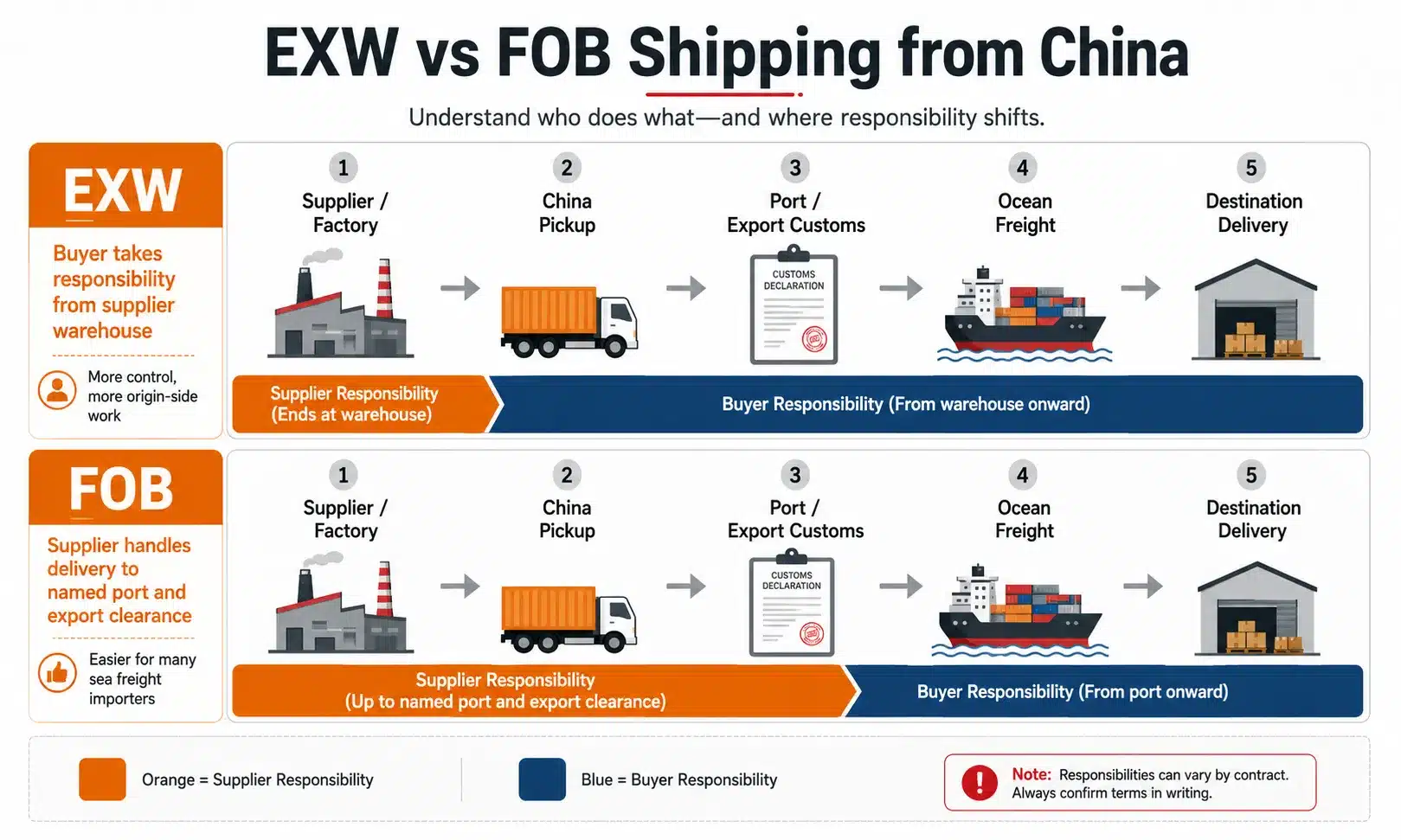
EXW vs FOB China: Key Differences in Cost, Export Clearance and Risk
The table below shows the main practical differences for importers buying from China. Nevertheless, the sales contract and named delivery place or port should always define the final responsibility.
| Shipping Stage | EXW China | FOB China |
|---|---|---|
| Goods prepared at factory | Supplier prepares the agreed goods and packing | Supplier prepares the agreed goods and packing |
| Loading at supplier premises | Buyer should confirm whether loading is included | Supplier normally manages the China-side movement |
| Factory pickup | Buyer or buyer’s forwarder arranges pickup | Supplier normally arranges transport toward the named port |
| China domestic trucking | Buyer pays or arranges it | Supplier normally includes it up to the agreed FOB delivery point |
| China export customs | Buyer needs a workable exporter and declaration arrangement | Supplier or its exporter normally handles export clearance |
| Origin warehouse or CFS handling | Buyer usually pays under the forwarder’s EXW scope | Responsibility depends on the named port and agreed FOB scope |
| Risk transfer | When goods are placed at the buyer’s disposal at the named place | When goods are loaded on board the nominated vessel at the named port |
| International freight | Buyer arranges and pays | Buyer arranges and pays |
| Import customs, duties and taxes | Buyer handles and pays | Buyer handles and pays |
| Best fit | Consolidation, multiple suppliers and buyer-controlled logistics | Regular sea freight from one export-capable supplier |
FOB does not include the international ocean freight unless the parties have separately agreed on another service. Similarly, EXW does not normally include China pickup or export handling.
For container and LCL route planning after the China-side term is confirmed, review our sea freight from China service.
EXW vs FOB Real Cost Examples
The examples below are illustrative only. They are designed to show how the comparison works and are not fixed freight quotations.
Example 1: One Shenzhen Supplier Shipping by Sea
An importer purchases 4 CBM of household products from one supplier in Shenzhen.
The supplier offers:
- EXW Shenzhen product price: USD 10,000
- FOB Yantian product price: USD 10,380
Under the EXW option, the forwarder estimates:
- Factory pickup: USD 160
- Warehouse receiving and measurement: USD 70
- Export and origin coordination: USD 190
The EXW China-side additions total USD 420. Therefore, the practical EXW result becomes USD 10,420 before international freight.
In this example, FOB Yantian is USD 40 lower and requires fewer China-side arrangements. Consequently, FOB may be the better choice.
Example 2: Suppliers in Shenzhen, Dongguan and Yiwu
Another importer buys electronics from Shenzhen, packaging from Dongguan and accessories from Yiwu.
Requiring each supplier to quote FOB separately may create three sets of local arrangements, minimum charges and document coordination. Instead, the importer asks all three suppliers for EXW prices.
One forwarder then arranges:
- Three supplier pickups
- Warehouse receiving
- Carton counting and measurement
- Consolidation into one shipment
- One coordinated export plan
Even when EXW is not dramatically cheaper, it may be more convenient because the importer gains one cargo total, one export schedule and one international shipment.
Therefore, the best term is not always the term with the lowest single line item. Operational control and repeated minimum charges also matter.
When EXW Is More Convenient
EXW can be a practical choice when the buyer has a reliable freight forwarder in China and wants the forwarder to manage the cargo from the supplier location.
Consider EXW when:
- You purchase from several Chinese suppliers.
- You need warehouse consolidation before export.
- You want cartons measured before the freight booking.
- You need inspection, labeling, repacking or palletization.
- You want one forwarder to compare sea, air and express shipping.
- The supplier’s FOB markup is too high or unclear.
- The goods must first move to an Amazon FBA or e-commerce preparation warehouse.
- You want to control the shipping schedule instead of relying on the supplier.
EXW is also common for urgent air freight and express shipments because the carrier or forwarder can collect the cargo directly from the factory. For urgent commercial cargo, review our air freight from China service.
However, EXW is only convenient when the export-document plan is clear. Without a suitable exporter and accurate cargo information, pickup control does not solve the customs problem.
When FOB Is the Better Choice
FOB is often the better option for one export-ready supplier shipping by sea. It creates a cleaner division between the supplier’s China-side responsibility and the buyer’s international freight responsibility.
Consider FOB when:
- You purchase from one supplier.
- The supplier regularly exports the product.
- The shipment moves by LCL or FCL sea freight.
- The supplier can provide accurate invoice and packing-list information.
- The supplier can work with your nominated freight forwarder.
- You want the supplier to manage China port delivery and export clearance.
- You do not need consolidation or inspection before export.
- The FOB price is competitive after comparison with EXW origin costs.
FOB may also reduce communication gaps because the supplier controls the stages closest to its factory and export documents.
Nevertheless, the buyer should still choose the main carrier or forwarder carefully. A low international rate may be offset by high destination charges, slow routing or unclear delivery terms.
What Does EXW China Mean?
EXW China meaning is generally “Ex Works at a named place in China.” The supplier makes the completed goods available at its factory, warehouse or another location stated in the sales agreement.
For example:
- EXW Shenzhen supplier warehouse
- EXW Dongguan factory
- EXW Yiwu warehouse
- EXW Guangzhou trading company warehouse
After the agreed handover, the buyer or its freight forwarder coordinates the remaining logistics. These steps may include loading, pickup, domestic trucking, warehouse receiving, consolidation, export formalities, main transport and destination delivery.
Therefore, an EXW quotation should always include a complete collection address. “EXW Shenzhen” alone is not enough because the factory may be in Bao’an, Longgang, Pingshan, Guangming or another district with a different pickup route.
What EXW Usually Does Not Include
- Pickup from the Chinese supplier
- Truck loading unless specifically agreed
- Domestic trucking to a port or airport
- China warehouse receiving
- Multi-supplier consolidation
- Export declaration and exporter arrangement
- Origin terminal or CFS charges
- International freight
- Import customs and final delivery
However, logistics companies may quote an “EXW pickup service” that combines several of these stages. The written freight quotation should explain exactly what has been added after the supplier’s EXW handover.
What Does EXW Shenzhen, Dongguan, Guangzhou or Yiwu Mean?
Location-based EXW searches usually come from buyers trying to estimate China pickup and export costs. The city name is helpful, but the full factory address remains essential.
EXW Shenzhen Meaning and Pickup Planning
EXW Shenzhen means the goods are collected from a named supplier location in Shenzhen. It does not mean that the supplier delivers the cargo to Shenzhen port, Yantian port or Shekou port.
The pickup cost depends on the exact district, carton quantity, truck type and destination warehouse. For instance, cargo in Bao’an may be convenient for a Shenzhen consolidation warehouse. By contrast, a factory in Pingshan may have a different trucking cost to Yantian or Shekou.
Before quoting EXW Shenzhen, the forwarder normally needs:
- Complete Chinese pickup address
- Contact name and telephone number
- Carton or pallet quantity
- Total gross weight
- Dimensions and CBM
- Whether a liftgate, forklift or manual loading is required
EXW Dongguan Meaning and Pickup Planning
EXW Dongguan means the forwarder collects cargo from the supplier’s factory or warehouse in Dongguan. Dongguan includes many manufacturing areas, so the exact town matters.
A supplier in Chang’an, Humen or Dalang may use a different pickup route from a supplier in Qingxi or Tangxia. In addition, the correct export gateway may be Yantian, Shekou, Nansha or a consolidation warehouse, depending on the destination route and cargo volume.
For a small LCL shipment, it may be practical to collect the goods into a Shenzhen or Dongguan warehouse. For a large FCL shipment, factory container loading may be compared with truck delivery to the port.
EXW Guangzhou Meaning and Pickup Planning
EXW Guangzhou means the cargo is available for collection from a named supplier, factory or warehouse in Guangzhou. It does not mean the supplier delivers the goods to Nansha port, a Shenzhen port or an airport unless that movement is separately included in the quotation.
Pickup planning depends on the exact district, cargo volume and export route. For example, a shipment from Baiyun, Panyu, Huangpu or another Guangzhou district may use a different warehouse or trucking plan. Sea cargo may be compared through Nansha, while some routes can also use Shenzhen gateways depending on the carrier, destination and total China-side cost.
For an accurate EXW Guangzhou quote, send the full pickup address, carton quantity, dimensions, gross weight and cargo-ready date rather than only the city name.
EXW Yiwu Meaning and Pickup Planning
EXW Yiwu means the goods are available for collection from a Yiwu supplier, market warehouse or trading company location.
Because Yiwu is inland, the forwarder must consider trucking to a consolidation warehouse or export gateway. Ningbo is often compared because of its location and ocean services. However, Shanghai may also be reviewed depending on the carrier, sailing schedule, cargo type and destination.
EXW Yiwu is especially useful when an importer buys products from several market suppliers. The cargo can first be consolidated, counted and measured before one international shipment is booked.
What Does FOB China Mean?
FOB China meaning is “Free on Board at a named Chinese port of loading.” The named port is essential. A proper quotation should say FOB Yantian, FOB Shanghai, FOB Ningbo or another specific port rather than only “FOB China.”
Under FOB, the supplier normally arranges the China-side export process and delivers the goods on board the nominated vessel at the named port. At that point, the risk transfers from the seller to the buyer.
The buyer then controls:
- International ocean freight
- Marine insurance if required
- Destination terminal charges
- Import customs clearance
- Duties and taxes
- Inland delivery after arrival
FOB is an Incoterms® rule for sea and inland waterway transport. Under the ICC rule, delivery and risk transfer occur when the goods are on board the nominated vessel at the named port.
For containerized cargo, however, the supplier may hand the goods to the carrier at a container terminal before they are physically loaded on the vessel. In that situation, the ICC notes that FCA may be more appropriate than FOB. Buyers and suppliers should therefore make sure the chosen term matches the actual handover process rather than using “FOB” only because it is familiar.
FOB nevertheless remains widely used in commercial quotations from Chinese suppliers, so the practical solution is to define the named port and responsibility scope clearly in writing.
FOB Shenzhen, Yantian, Shanghai, Ningbo and Tianjin Explained
FOB Shenzhen Meaning
FOB Shenzhen is a broad commercial expression, but it may be too vague for a final purchase contract. Shenzhen has several port areas and operating arrangements.
The buyer should ask:
- Is the named port Yantian, Shekou or another terminal?
- Does the supplier’s price include export declaration?
- Is delivery to the nominated forwarder’s warehouse included?
- Which cutoff date applies?
- Does the quotation apply to LCL or FCL cargo?
For this reason, “FOB Shenzhen” should be replaced by the exact named port whenever possible.
FOB Yantian Meaning
FOB Yantian means Yantian is the named port of loading. The supplier normally arranges China-side trucking, export clearance and delivery under the agreed FOB process until the cargo is loaded on the nominated vessel.
After that point, the buyer pays the international freight and destination-side costs. FOB Yantian is commonly used for cargo from Shenzhen, Dongguan, Huizhou and other South China manufacturing areas when the carrier service departs from Yantian.
However, the seller and buyer should still confirm the shipping line, cutoff, container arrangement and export documents before delivery to the terminal.
FOB Shanghai Meaning
FOB Shanghai meaning is that Shanghai is the named port of loading under the sales agreement.
The supplier or exporter normally manages China-side delivery and export customs under the agreed scope. Meanwhile, the buyer books the international ocean freight from Shanghai and handles destination costs.
FOB Shanghai may suit suppliers in Shanghai, Suzhou, Kunshan and nearby parts of East China. Nevertheless, the correct port should be selected according to inland trucking, sailing schedule, cargo type and total cost.
FOB Ningbo Meaning
FOB Ningbo means Ningbo is the named loading port. It is commonly considered for cargo from Ningbo, Yiwu, Hangzhou, Shaoxing and other Zhejiang manufacturing areas.
A Yiwu supplier may quote either EXW Yiwu or FOB Ningbo. To compare the two fairly, the importer should calculate the EXW pickup, consolidation, export declaration and origin charges against the supplier’s complete FOB Ningbo price.
FOB Tianjin Meaning
FOB Tianjin means Tianjin is the named port of shipment under the sales agreement. In practice, suppliers and forwarders may also refer to Tianjin Xingang, so the purchase order and shipping instructions should identify the agreed port clearly.
Under the agreed FOB arrangement, the supplier or exporter normally handles the China-side delivery and export clearance needed to place the cargo on board the nominated vessel. The buyer then controls and pays for the main ocean freight and destination-side costs.
FOB Tianjin is commonly used for cargo from Tianjin, Beijing, Hebei and other North China manufacturing areas. Importers should still compare inland transport, sailing schedule, container availability and total origin cost before deciding that Tianjin is the best loading port.
What If the Chinese Factory Has No Export License?
Some Chinese factories manufacture products but do not export directly under their own company name. Others may have export capability but prefer to sell through a trading company.
This does not automatically prevent the shipment. However, the export structure must be confirmed before pickup.
The buyer should clarify:
- Which company will act as the Chinese exporter
- Which company issues the commercial invoice for the export transaction
- Who prepares the packing list
- Who provides the product description and customs information
- Whether a trading company or export agent is involved
- Whether an export agency fee applies
- Whether the declared exporter can provide the required supporting documents
Under EXW, these questions are especially important because the supplier may only release the physical goods. The buyer’s forwarder cannot assume that the export documentation is already available.
Under FOB, the supplier’s quotation should include a workable export arrangement. If the actual factory cannot export, a trading company may quote FOB and coordinate the declaration instead.
If you are buying through a Chinese trading company, confirm whether that company is the contractual seller, the exporter, or only a sourcing intermediary. Also make sure the written quotation clearly says EXW, FOB, DAP or DDP and names the correct place or port. The Incoterm affects the China-side responsibility, but your landed cost also depends on international freight, destination charges, import customs, duties and final delivery.
Therefore, do not wait until the truck has collected the cargo to ask who will provide the export documents. Resolve the exporter arrangement before confirming the shipping date.
VoltFreight can help review the shipping documents and coordinate with the supplier or trading company. For broader documentation planning, visit our customs clearance support page.
Which Charges May Still Appear in a FOB China Quote?
FOB generally places more China-side responsibility on the supplier than EXW. Still, the word “FOB” alone does not guarantee that every operational cost has been clearly allocated.
Importers should check the following possible charges or disputes:
- International ocean freight: FOB does not include the main sea freight.
- Cargo insurance: Insurance is not automatically included.
- Destination charges: Terminal, documentation, customs and delivery costs remain after arrival.
- Special packaging: Pallets, crates, reinforcement or ISPM 15 treatment may cost extra.
- Customs inspection: Inspection, unloading, storage or container movement may create additional costs.
- Document amendments: Incorrect packing lists, shipping instructions or declarations may require correction.
- Missed cutoff: Late factory delivery may create rebooking, storage or trucking costs.
- Weight or volume changes: Final cartons may differ from the supplier’s first estimate.
- Multiple export declarations: Complex supplier or exporter structures may require additional coordination.
- LCL warehouse rules: The nominated CFS may charge for late delivery, abnormal cargo or incorrect packing.
Some of these charges may belong to the supplier under the agreed FOB contract, while others may remain with the buyer. Therefore, the solution is not to assume responsibility but to request a written list of inclusions and exclusions.
Documents and Information to Confirm Before Choosing EXW or FOB
The correct Incoterm cannot be selected without reliable cargo and supplier information.
Ask the supplier to confirm:
- Full legal company name
- Factory or warehouse pickup address
- Quoted Incoterm and named place or port
- Commercial invoice issuer
- Packing list issuer
- Exporter company under the customs declaration
- Product name, material and use
- HS code if available
- Carton quantity
- Carton dimensions
- Gross and net weight
- Total CBM
- Cargo-ready date
- Battery, liquid, powder, magnet or branded-product details
- Whether wood packaging is used
For an FOB quote, also confirm:
- The exact named loading port
- Whether the cargo is LCL or FCL
- Which forwarder or carrier receives the cargo
- Export cutoff and warehouse cutoff
- Whether the supplier includes export declaration
- Whether the supplier includes delivery up to the agreed FOB point
For an EXW quote, provide the forwarder with the complete pickup address and actual package details. Without this information, the China pickup quotation may be inaccurate.
How VoltFreight Helps with EXW Factory Pickup and FOB Shipping from China
VoltFreight reviews both the supplier quotation and the complete logistics chain before recommending EXW or FOB. The goal is to compare the real China-side responsibility and cost, not simply choose the Incoterm with the lower supplier price.
For EXW cargo, our China-side support may include:
- Factory pickup in Shenzhen, Dongguan, Yiwu and other manufacturing cities
- Warehouse receiving
- Carton count checking
- Basic package measurement
- Receiving photos
- Multi-supplier consolidation
- Shipping-mark coordination
- Export document review
- LCL, FCL, air freight and express comparison
For FOB cargo, we can:
- Coordinate with the supplier at the named China port
- Provide booking instructions and cutoff information
- Compare ocean carriers and routes
- Arrange LCL or FCL freight
- Review shipping documents
- Plan destination customs and final delivery
In addition, importers that need a more complete destination solution can compare door-to-door shipping from China. If your destination is the United States, our shipping from China to USA guide explains the main air, sea, DDP and customs options after the China-side term is confirmed.
Our goal is not to recommend EXW or FOB automatically. Instead, we compare the supplier city, export capability, number of suppliers, cargo volume, transport method and destination before choosing the practical option.
FAQ About EXW vs FOB Shipping from China
What does FOB China mean?
FOB China means Free on Board at a named Chinese port of shipment. The supplier normally handles the agreed China-side export process and places the goods on board the nominated vessel, while the buyer arranges the main ocean freight and destination-side import costs. A final quotation should name the actual port, such as FOB Yantian, FOB Shanghai, FOB Ningbo or FOB Tianjin.
What does EXW China mean?
EXW China means Ex Works at a named supplier location in China. The goods are made available at the agreed factory or warehouse, and the buyer or freight forwarder normally arranges pickup, China domestic transport and the export plan after that handover.
Is EXW or FOB better when importing from China?
FOB is usually easier for one sea freight shipment from an experienced supplier. EXW can be better when the buyer needs pickup, consolidation, inspection or stronger control before export.
Is EXW cheaper than FOB?
Not necessarily. EXW often has a lower supplier price, but the buyer must add China pickup, warehouse, export and origin costs. The complete EXW result may be higher than the supplier’s FOB price.
What does EXW Shenzhen mean?
EXW Shenzhen means the goods are collected from a named supplier location in Shenzhen. It does not mean the supplier delivers the cargo to Yantian, Shekou or another Shenzhen port.
What does FOB Yantian mean?
FOB Yantian means Yantian is the named port of loading. The seller manages the agreed China-side export process until the cargo is loaded on the nominated vessel, while the buyer arranges the main freight and destination costs.
Does FOB include ocean freight?
No. Under FOB, the buyer normally arranges and pays the international ocean freight. The supplier’s responsibility covers the agreed China-side stages up to the FOB delivery point.
Can I use EXW if the factory has no export license?
Possibly, but the exporter arrangement must be confirmed first. A trading company or export agent may need to support the export declaration and documents.
Why is FOB Shenzhen too vague?
Shenzhen has different port areas and terminal arrangements. The quotation should name the actual loading port, such as Yantian or Shekou, so the parties can confirm responsibility and routing.
Can EXW work for air freight?
Yes. EXW is common for air freight and courier shipments because the forwarder can collect goods from the supplier. Accurate dimensions, weight and export information are still required.
What does EXW mean on an Alibaba order?
If an Alibaba order states EXW, the agreed delivery point is normally the named supplier or warehouse location rather than your final destination. If the supplier separately promises DDP or door-to-door shipping, ask them to make the written order, invoice and shipping scope consistent with the service you are actually buying. Do not rely only on a chat message when the contractual Incoterm shows a different responsibility point.
Need FOB Shipping from China or EXW Factory Pickup?
Choosing between EXW and FOB requires more than comparing two product prices. A useful comparison starts with the supplier’s exact address or named port, the real cargo data and a written list of China-side inclusions.
Before confirming the order, compare:
- Factory pickup
- China domestic trucking
- Warehouse receiving
- Export declaration
- Origin handling
- International freight
- Destination charges
- Customs duties and taxes
- Final delivery
Send VoltFreight the supplier’s EXW and FOB quotations together with the cargo details. We will review the supplier location, named port, package information and export arrangement before comparing the practical cost.
Contact VoltFreight for an EXW or FOB shipping quote from China.
Important: Incoterms define delivery responsibilities, costs and risk between the seller and buyer, but they do not replace the sales contract, payment terms, product compliance requirements or customs rules. Confirm the exact named place or port and the applicable Incoterms version in writing.