China to USA shipping time can range from a few business days by express courier to several weeks by ocean freight. However, the most useful number for an importer is not simply how long the aircraft flies or how many days the vessel spends at sea. What matters is how long the shipment actually takes from China to the final U.S. delivery address.
As a practical planning guide, express shipping normally takes about 2–7 business days, door-to-door air freight about 5–12 business days, Air DDP around 7–15 calendar days, and sea freight roughly 25–55 calendar days depending on the route, service type and final U.S. destination.
Therefore, a freight forwarder quoting a 15-day ocean transit is not necessarily promising delivery in 15 days. China pickup, export handling, consolidation, U.S. customs clearance, port release and final delivery can all extend the complete shipping time.
If your main question is price rather than delivery speed, see our guide to China to USA shipping costs. For all shipping methods and services, visit our main guide to shipping from China to the USA.
Need your cargo before a specific date? Send VoltFreight your cargo-ready date, supplier city, product details, weight, dimensions and U.S. ZIP code. We can compare realistic express, air and sea delivery windows before you book.
How Long Does Shipping from China to USA Take?
Under normal conditions, most China to USA shipments fall within the following planning ranges:
| Shipping Method | Typical Main Transit | Practical Door-to-Door Time | Best For |
|---|---|---|---|
| Express Courier | Courier network | 2–7 business days | Samples, urgent parcels and small shipments |
| Air Freight | About 1–5 days airport to airport | 5–12 business days | Urgent commercial cargo |
| Air DDP | Air line-haul plus customs process | 7–15 calendar days | Door-to-door commercial shipments |
| Sea Freight – U.S. West Coast | Often about 14–20 days port to port | 25–40 calendar days | Larger cargo for western U.S. destinations |
| Sea Freight – U.S. East Coast | Often about 30–40 days port to port | 35–55 calendar days | Large shipments for eastern U.S. destinations |
| Sea DDP / Consolidated Ocean | Ocean freight plus consolidation | 30–55 calendar days | Cost-sensitive door-to-door cargo |
These are planning ranges rather than guaranteed delivery times. Carrier capacity, cargo-ready dates, customs inspections, port congestion, weather, final delivery appointments and the U.S. destination can all change the actual schedule.
Transit Time vs Door-to-Door Shipping Time
The difference between transit time and door-to-door shipping time causes much of the confusion around China to USA delivery estimates.
A carrier’s transit time usually covers only the main transportation stage. For example, a vessel may have a 15-day scheduled transit from Shanghai to Los Angeles. Likewise, an air shipment may reach a U.S. airport only a few days after departure.
Neither number necessarily tells you when the consignee will receive the goods.
A complete door-to-door shipment normally includes:
- Supplier pickup: The factory releases the finished cargo.
- China warehouse handling: The forwarder receives, checks and measures the shipment.
- Export preparation: The team completes booking and export procedures.
- Main transit: The cargo moves by courier, aircraft or ocean vessel.
- U.S. customs clearance: Customs processes the import entry and may review the shipment.
- Destination handling: The airport, port, CFS or warehouse releases the cargo.
- Final delivery: A courier or trucker delivers the goods to the final address.
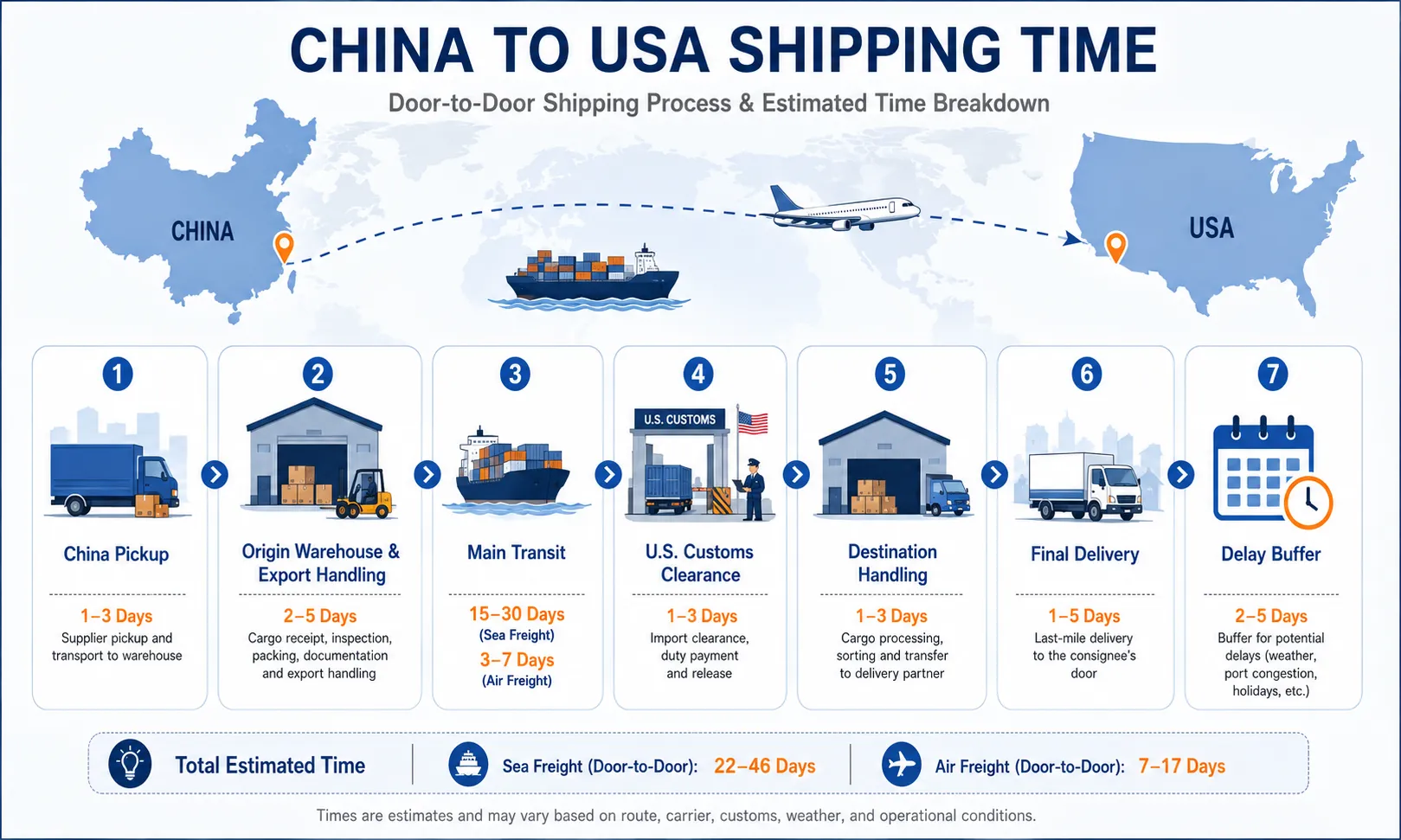
A useful way to calculate the complete timeline is:
Total delivery time = China origin handling + international transit + U.S. customs and release + final delivery.
Therefore, when two freight forwarders quote very different transit times, ask whether both estimates start and finish at the same points.
Why Can a 15-Day Shipping Quote Become 25 or 30 Days?
An importer may hear “15 days shipping” and naturally expect the goods to arrive 15 days later. However, the quoted number may describe only part of the journey.
Before departure, the cargo may spend several days waiting for warehouse receiving, consolidation, documentation, a vessel cut-off or available airline space.
After arrival, the shipment may still need customs clearance, terminal release and final delivery.
For ocean freight, the difference can become even larger because LCL consolidation and destination deconsolidation add extra handling.
For example, a vessel may sail from China to Los Angeles in roughly two weeks. Nevertheless, the complete shipment may still require several additional days before a California warehouse receives it.
If the final address is in Chicago, Dallas or another inland city, rail or trucking adds another stage.
For this reason, always ask your freight forwarder for the estimated door-to-door delivery time, not only the advertised vessel or flight transit.
How Long Does Express Shipping from China to USA Take?
Express courier is normally the fastest practical option for small and urgent shipments.
DHL, UPS and FedEx commonly deliver suitable shipments in about 2–7 business days. Major commercial destinations may receive cargo faster, while remote ZIP codes can require additional time.
Express works particularly well for:
- Samples
- Urgent replacement parts
- Small cartons
- Time-sensitive commercial goods
However, batteries, liquids, powders, cosmetics, food products and other regulated cargo may require additional review before the courier accepts them.
Customs questions can also interrupt the normal delivery schedule. Therefore, provide accurate product descriptions, values and consignee information before shipment.
For service options and courier comparisons, see express shipping from China to USA.
How Long Does Air Freight from China to USA Take?
Air freight is usually the best choice when commercial cargo needs faster delivery than sea freight but is too large or expensive for standard express courier service.
Airport-to-airport transportation may take roughly 1–5 business days. However, most commercial shipments require more than an airport arrival.
A realistic door-to-door air freight time is generally about 5–12 business days.
The additional time comes from:
- Supplier pickup
- China warehouse handling
- Export documentation
- Security screening
- Flight booking and uplift
- U.S. terminal handling
- Customs clearance
- Final truck delivery
In practice, the aircraft itself is rarely the slowest part of the journey. Delays more often happen before departure or after arrival.
Oversized cargo, lithium batteries and other sensitive products can also require airline approval. Consequently, send the freight forwarder complete product information before the cargo reaches the airport.
For chargeable weight, airport options and air freight services, visit air freight from China to USA.
How Long Does Sea Freight from China to USA Take?
Sea freight normally takes the longest, but it remains the preferred method for large, heavy and planned commercial shipments.
A general door-to-door planning range is approximately 25–55 calendar days. However, the U.S. destination makes a major difference.
China to U.S. West Coast
Major Chinese ports such as Shanghai, Ningbo, Qingdao and Shenzhen/Yantian have frequent services to Los Angeles and Long Beach.
Scheduled port-to-port transit on faster direct services can be roughly 14–20 days. After adding China handling, U.S. customs, port release and final delivery, importers should usually plan for approximately 25–40 calendar days door to door.
China to U.S. East Coast
Ocean routes to New York/Newark, Savannah, Charleston and other East Coast ports are longer.
Port-to-port schedules commonly fall around 30–40 days, depending on the Chinese origin, carrier and routing.
A more practical door-to-door planning range is therefore around 35–55 calendar days.
What About Inland U.S. Delivery?
Do not treat port arrival as final delivery when the consignee is inland.
Shipments to Chicago, Dallas, Kansas City and other interior markets may continue by rail or truck after customs clearance.
As a result, the destination ZIP code can change the complete delivery time even when two shipments use the same vessel.
For FCL, LCL, ports and complete ocean freight services, visit sea freight from China to USA.
China to USA Shipping Time by U.S. Destination
The United States is large enough that the final destination can change the best shipping route and the expected delivery date.
Los Angeles and Long Beach
Southern California is one of the fastest major U.S. destinations for ocean freight from China. Shanghai, Ningbo, Qingdao and Shenzhen/Yantian all have regular trans-Pacific services to Los Angeles and Long Beach.
Depending on the carrier, port pair and sailing, scheduled ocean transit can be around two to three weeks. Door-to-door delivery requires additional time for customs, terminal release and trucking.
New York and New Jersey
China to New York/New Jersey normally requires a longer ocean transit than China to California.
Direct or Panama-routed services can take roughly four to six weeks port to port. Therefore, importers should allow a larger total delivery window, especially for LCL cargo.
Savannah and the Southeast
Savannah is an important gateway for cargo moving to Georgia and the southeastern United States.
The ocean transit is longer than a typical West Coast service. However, Savannah can reduce inland transportation when the final warehouse is located in the Southeast.
Chicago and Other Inland Destinations
Chicago has no ocean port, so ocean cargo normally enters through a coastal gateway and then continues inland by rail or truck.
Therefore, a quote that ends at Los Angeles or New York does not represent the complete China-to-Chicago delivery time.
Dallas, Houston and Texas
Texas cargo may move through West Coast ports, Houston or another U.S. gateway depending on the carrier service and final delivery plan.
The fastest port on paper is not always the fastest door-to-door route. A freight forwarder should compare the complete journey from the China supplier to the actual Texas ZIP code.
Is FCL Faster Than LCL from China to USA?
FCL is usually more direct than LCL, although both shipments may travel on the same vessel.
FCL means Full Container Load. The container normally carries cargo for one shipment and moves through the port without destination deconsolidation.
LCL means Less than Container Load. Several importers share the same container.
As a result, LCL requires additional handling such as:
- China warehouse consolidation
- Waiting for the consolidation cut-off
- Container stuffing
- Destination CFS unloading
- Deconsolidation
- Individual shipment release
Therefore, LCL can take several days longer than FCL even when the ocean sailing time is identical.
If delivery time matters, ask for the complete warehouse-to-door schedule rather than comparing vessel schedules alone.
How Much Time Can U.S. Customs Add?
There is no fixed customs-clearance time that applies to every China to USA shipment.
Many correctly documented shipments clear without a major delay. However, U.S. Customs or another government agency may hold a shipment when it needs additional information or examination.
Common causes of delay include:
- Incomplete commercial invoices
- Vague product descriptions
- Incorrect or disputed HTS classification
- Missing importer information
- Duty or entry problems
- FDA, FCC, EPA or other agency requirements
- Customs examinations
Therefore, no freight forwarder can guarantee that every shipment will clear customs within a fixed number of hours or days.
The best way to reduce avoidable delays is to prepare accurate commercial documents and product information before the cargo leaves China.
For more information, see our guide to USA customs clearance from China.
How Long Does DDP Shipping from China to USA Take?
DDP shipping combines international transportation with customs handling and final delivery under the agreed service scope.
For suitable cargo, Air DDP normally takes around 7–15 calendar days.
Sea DDP generally takes around 30–55 calendar days, depending on the route, consolidation schedule, customs clearance and destination ZIP code.
DDP customers should pay particular attention to when the quoted delivery time begins.
For example, one forwarder may count from the day the supplier delivers cargo to the China warehouse. Another may count from the flight or vessel departure date.
Those two estimates can differ by several days even when both shipments use a similar international service.
In addition, some DDP services use UPS, FedEx or another carrier only for final delivery inside the United States. Therefore, the final-mile tracking number may not update while the cargo is still moving through the international freight and customs process.
For the complete service scope, read DDP shipping from China to USA.
What Can Delay Shipping from China to USA?
Most delays happen at one of four stages: before departure, during carrier operations, at customs or during final delivery.
Before Departure
Production delays, late packing, incorrect carton data, missing documents or missed vessel and airline cut-offs can delay the shipment before it even leaves China.
Carrier and Port Delays
Flight-space shortages, rolled bookings, blank sailings, weather and port congestion can change planned departure or arrival dates.
Customs Delays
Customs may request additional information or select cargo for examination. Regulated products may also need another U.S. agency to review the shipment.
Final Delivery Delays
After customs release, the shipment may still wait for port availability, CFS release, rail transfer, truck scheduling or a warehouse delivery appointment.
For this reason, add a reasonable buffer when the shipment supports a product launch, exhibition, seasonal promotion or other fixed deadline.
Which Shipping Method Fits Your Delivery Deadline?
The easiest way to choose a shipping method is to work backward from the date the goods must reach the U.S. destination.
If You Need the Cargo Within About 2–7 Business Days
Check express courier first. DHL, UPS and FedEx are normally the most practical solutions for smaller urgent shipments.
If You Have About 5–12 Business Days
Compare air freight with express shipping. Air freight often becomes more economical as the shipment becomes larger.
If You Have About 7–15 Calendar Days
Air DDP may be suitable when you need an integrated door-to-door service and the product qualifies for the route.
If You Have About 25–40 Days
Ocean freight to the U.S. West Coast may become realistic, particularly for California and nearby western destinations.
If You Have About 35–55 Days
FCL, LCL and Sea DDP become practical choices for larger and more cost-sensitive shipments.
If your deadline is critical, do not plan around the best-case transit time. Instead, include time for pickup, customs clearance and final delivery.
FAQ About China to USA Shipping Time
How long does shipping from China to USA usually take?
Express shipping usually takes about 2–7 business days, door-to-door air freight about 5–12 business days and sea freight approximately 25–55 calendar days. The exact time depends on the shipping method, route, customs process and final U.S. destination.
What is the fastest way to ship from China to USA?
Express courier is normally the fastest practical door-to-door option for small shipments. DHL, UPS and FedEx can often deliver suitable cargo within approximately 2–7 business days.
How long does air freight from China to USA take?
Airport-to-airport air freight may take roughly 1–5 business days. However, a complete door-to-door air shipment normally takes approximately 5–12 business days after including China handling, customs and final delivery.
How long does sea freight from China to USA take?
Sea freight to the U.S. West Coast may take approximately 25–40 calendar days door to door. East Coast and longer inland routes may require approximately 35–55 days.
How long does shipping from China to California take?
Express and air freight can reach California within several business days. Ocean freight is slower. A practical door-to-door sea freight range is often around 25–40 calendar days, although faster or slower services are possible.
How long does shipping from China to New York take?
Air freight may take approximately 5–12 business days door to door. Ocean freight generally requires a longer planning window, often around 35–55 calendar days when origin handling, ocean transit, customs and final delivery are included.
Why did my freight forwarder quote 15 days but the shipment is taking longer?
The quoted 15 days may refer only to the main flight or ocean transit. Warehouse handling, consolidation, customs clearance, port or airport release and final delivery can increase the complete door-to-door time.
Why does UPS or FedEx tracking only show “Label Created”?
With some DDP services, UPS or FedEx handles only the final delivery inside the United States. The forwarder may create the tracking number before the international cargo reaches the U.S. carrier, so the tracking page may remain at “Label Created” until final-mile handover.
Does “Label Created” mean my shipment has left China?
No. A tracking number by itself does not confirm physical departure. Ask the freight forwarder whether the cargo has been received, whether the flight or vessel has departed, the estimated U.S. arrival date and the current customs status.
Can U.S. customs make the shipment take much longer?
Yes. Customs examinations, document problems, importer information issues or regulatory reviews can extend delivery time. Because customs holds are not fully predictable, time-sensitive shipments should include a reasonable buffer.
Is FCL faster than LCL?
FCL is normally more direct. LCL requires consolidation before departure and deconsolidation after arrival, so it can take several additional days even when both shipments use the same vessel.
When should China to USA shipping time start?
For practical planning, start from the date the finished cargo is available for pickup or received at the freight forwarder’s China warehouse. Do not count freight transit from the purchase-order date while the supplier is still producing the goods.
Does Amazon FBA receiving time count as shipping time?
Not exactly. Freight delivery and Amazon inventory receiving are separate stages. Amazon sellers should allow additional time for appointments and fulfillment-center receiving after the freight reaches the assigned warehouse. For FBA-specific planning, see Amazon FBA shipping from China to USA.
Get a Realistic China to USA Shipping Time Estimate
There is no useful single answer such as “shipping from China to the USA always takes 20 days.” The actual delivery time depends on where the cargo starts, which transportation method you choose and where the shipment finally needs to arrive.
VoltFreight focuses on the complete door-to-door delivery timeline instead of quoting only the advertised flight or vessel transit.
We can compare express courier, air freight, Air DDP, FCL, LCL and Sea DDP according to your actual cargo-ready date and delivery deadline.
To receive a realistic estimate, send us:
- Product name and photos
- Number of cartons or pallets
- Total gross weight
- Carton or pallet dimensions
- Supplier city in China
- Cargo-ready date
- U.S. destination city, state and ZIP code
- Required delivery date
If your deadline is tight, tell us before booking. VoltFreight can compare the complete route and explain when you should realistically expect the cargo to reach your U.S. address.