Quick Answer: China-to-Mexico Shipping Cost, Time and Best Method
Quick answer: Shipping from China to Mexico normally takes about 3–6 business days by DHL, UPS or FedEx Express DAP, about 3–8 business days airport-to-airport by standard air freight, about 6–12 days by a confirmed Air DDP service, and about 45–55 days by the current Sea DDP route. Express works best for urgent small parcels, air freight for time-sensitive commercial cargo, and sea freight or Sea DDP for pallets, bulk cartons and regular inventory. Therefore, an experienced freight forwarder from China to Mexico should compare the customs and delivery scope, not only the first price per kilogram or CBM.
Current Cost and Operating Reference
Current cost reference: there is no responsible universal rate without the product, HS code, declared value, chargeable weight or CBM, China pickup point and Mexican postcode. For example, a recent Sea DDP quotation for 9.3 CBM / 1,634 kg of commercial LED lighting to Jalisco used USD 510/CBM for the main DDP service plus USD 150/CBM for local delivery. However, this is a real shipment-specific planning example, not a fixed tariff for every product or destination.
Current operational snapshot — reviewed August 10, 2026: an eligible direct-flight Air DDP line currently has three scheduled China cut-offs per week and an operating reference of about five business days from flight departure to the Mexico City warehouse. Meanwhile, current direct or US-transfer Sea DDP services generally reach the Mexico warehouse about 35–45 days after sailing. However, these milestones cover transport only, not a universal door-to-door promise. Therefore, the complete schedule must also account for China receiving, the next cut-off, customs processing, warehouse appointments and final delivery.
- Air chargeable weight: the current direct-flight line uses the higher of actual weight and volumetric weight calculated as length × width × height in centimeters ÷ 6,000.
- Mexico delivery: local Mexico City delivery is generally simpler; other states may require parcel, LTL or FTL pricing based on the postcode, piece weight and dimensions.
- Route confirmation: schedules, capacity, product acceptance and rates can change. Therefore, VoltFreight must review the goods and full delivery postcode before booking.
Get a China-to-Mexico Freight Quote | Contact VoltFreight on WhatsApp
Compare Shipping Methods at a Glance
| Shipping Method | How It Is Quoted | Planning Time | Customs and Tax Scope | Best For |
|---|---|---|---|---|
| DHL / UPS / FedEx Express DAP | By chargeable weight | About 3–6 business days | Receiver normally pays duty, IVA and destination charges when assessed | Documents, samples, replacement parts and small parcels |
| Standard Air Freight | By chargeable weight and airport route | About 3–8 business days airport-to-airport after airline acceptance | Mexican importer or broker handles clearance, taxes and cargo pickup | Urgent commercial cargo, higher-value goods and heavier cartons |
| Air DDP | By chargeable weight after product review | Commonly about 6–12 days | Confirmed DDP scope may include clearance, duty/IVA arrangement and delivery | Urgent e-commerce stock and suitable B2B cartons |
| LCL / FCL Sea Freight | By CBM or container, plus origin and destination scope | Usually about 18–40 days port-to-port depending on route | Mexican importer or broker normally handles destination clearance and charges | Pallets, machinery, furniture, wholesale cargo and full containers |
| Sea DDP | By CBM, weight, product and delivery postcode | Current end-to-end planning range about 45–55 days | Confirmed scope may include freight, customs coordination, duty/IVA arrangement and final delivery | Bulk cartons, regular stock, Amazon FBA and cost-sensitive B2B cargo |
For an accurate quotation, send the product and photos, HS code if available, cartons, weight, dimensions, CBM, China origin, value and complete Mexican postcode. In addition, tell VoltFreight about batteries, liquids, powders, magnets, wireless functions and brands.
01. Express DAP, Standard Freight or DDP: Confirm the Service Scope
First, a low freight number tells you little unless the quotation states who handles Mexican customs, who pays duty and IVA, and who delivers to the final address. Express DAP, standard freight and DDP follow different responsibility models. Therefore, importers should compare the full landed route rather than only a price per kilogram or CBM.
Express DAP
Under Express DAP, VoltFreight arranges DHL, UPS or FedEx transportation and courier delivery. However, the courier may assist with customs processing while the receiver or importer normally pays import duty, IVA, disbursement fees and other destination charges. Express DAP is fast and convenient. Nevertheless, do not describe it as a tax-included service.
Standard Air or Sea Freight
In contrast, standard freight works best when the Mexican buyer has a legal importing setup, an active RFC, the required Padrón registration and an appointed customs broker or representative. VoltFreight can arrange China pickup, export handling and international transportation to the agreed airport, port or handover point. Unless the quotation includes additional services, the importer then controls the Mexican Pedimento, taxes, destination charges and inland delivery.
Confirmed DDP Service
DDP shipping from China to Mexico may combine China pickup, warehouse handling, export processing, international freight, Mexican customs coordination, duty and IVA arrangement, and final delivery. However, DDP does not remove Mexico’s importer, customs or product-compliance requirements. VoltFreight confirms the legal import arrangement, product eligibility, declared value, HS classification and any NOM or permit requirements before accepting cargo.
| Service | China Pickup | International Freight | Mexico Clearance | Duty / IVA and Delivery |
|---|---|---|---|---|
| Express DAP | Included or quoted separately | Included | Courier process with receiver cooperation when required | Receiver normally pays taxes; courier delivery to a served address |
| Standard Air / Sea | Included or quoted separately | Included to agreed airport or port | Importer and customs broker | Importer pays taxes; inland delivery is optional |
| Air DDP / Sea DDP | According to confirmed quote | Included | Included under the confirmed legal route | Included according to the written DDP and delivery scope |
02. Express Shipping from China to Mexico by DHL, UPS and FedEx
Express shipping from China to Mexico is normally the best choice for documents, samples, product-testing orders, small replacement parts and urgent lightweight cargo. Moreover, DHL, UPS and FedEx provide tracking and door delivery, making the process simpler than arranging separate air cargo, customs brokerage and local transportation for a small parcel.
When Express Works Best
- The shipment is small, urgent and clearly described.
- The declared value and commercial documents are accurate.
- The receiver can cooperate with courier customs requests.
- The selected courier serves the address without special truck delivery.
- The product does not require complex permits or importer-specific compliance.
However, courier service may not be the best route for heavy cartons, oversized pieces, pallets or cargo requiring a delivery appointment. In addition, VoltFreight must review batteries, standalone power banks, liquids, powders, chemicals, magnets, medical-related products and branded goods before dispatch. Otherwise, a carrier rejection after pickup can create return, storage or disposal costs.
Chargeable Weight and Destination Charges
Express quotations use chargeable weight, which compares actual gross weight with volumetric weight. Large lightweight cartons can therefore cost more than expected. Before quoting, VoltFreight checks the parcel dimensions, weight, destination postcode, declared value and product type. For a quick volume check, use our CBM and chargeable-weight calculator.
Express DAP quotations normally exclude Mexican duty, IVA, customs advances, storage caused by importer delay and other destination assessments. Therefore, the receiver should not assume that a courier quotation showing door delivery is automatically DDP.
03. Air Freight and Air DDP from China to Mexico
Air freight from China to Mexico is suitable for urgent commercial cartons, higher-value cargo, seasonal inventory, spare parts and production components. Therefore, it can provide better cost control than express for medium or heavier consignments while remaining much faster than sea freight.
Standard Airport-to-Airport Air Freight
Standard air freight should identify the airports, chargeable weight and service boundary. For instance, cargo may move from Shenzhen, Guangzhou, Hong Kong, Shanghai or another gateway to NLU, MEX, GDL, MTY or another approved airport. The Mexican importer normally handles clearance, terminal charges and pickup unless separately included.
In addition, see our dedicated airport-to-airport air freight from China to Mexico guide for airport selection, route details, chargeable-weight examples, battery-cargo review and importer responsibilities. This product page remains the broader comparison page for express, sea freight and DDP services.
Airlines charge air cargo using the higher of actual weight and volumetric weight. For example, a carton measuring 100 × 80 × 75 cm has a volume of 600,000 cubic centimeters. Using the current line’s divisor of 6,000, the volumetric weight is 100 kg. If the carton actually weighs 72 kg, the quotation uses 100 kg. Therefore, final warehouse measurements matter.
Air DDP for Suitable Cargo
Air DDP can work for urgent e-commerce inventory and suitable B2B cartons when the buyer wants one coordinated landed-delivery plan. First, VoltFreight reviews the HS code, declared value, compliance requirements, dimensions, battery or wireless functions and final postcode. A confirmed Air DDP quotation should list the included services, chargeable weight, estimated delivery range and any exclusions for inspection, remote delivery or special handling.
Meanwhile, the eligible current direct-flight Air DDP line offers three scheduled China cut-offs each week and an operating reference of about five business days from flight departure to the Mexico City warehouse. Supplier delivery to the China warehouse, waiting for the next cut-off, Mexican customs processing and final delivery sit outside that milestone. Therefore, customers should use the confirmed 6–12 day range for end-to-end planning instead of treating five days as a universal door-to-door promise.
04. Sea Freight from China to Mexico by LCL and FCL
Sea freight from China to Mexico is normally the most economical option for large, heavy or non-urgent cargo. For example, importers commonly use it for furniture, machinery, hardware, auto parts, packaging products, home goods, e-commerce inventory, pallets and full-container orders.
LCL Sea Freight
LCL is suitable when a shipment does not fill a complete container. The cargo shares container space with other shipments, and carriers usually quote it by CBM or chargeable volume. Therefore, importers should ask whether the rate includes China pickup, export documentation, consolidation, destination handling, customs clearance and delivery. A very low LCL number may cover only the international ocean segment and may not represent the total landed cost.
FCL Container Shipping
FCL provides dedicated container space and normally offers stronger cargo control for regular importers. VoltFreight reviews a 20ft, 40ft or 40HQ container according to cargo volume, weight, loading method and destination. In addition, FCL quotations should identify the China loading port, Mexican discharge port, equipment type, ocean freight, origin charges, destination responsibility, free-time conditions and inland-delivery scope.
There is no universal CBM point at which FCL becomes cheaper than LCL. Instead, VoltFreight compares current rates, destination handling, density and loading efficiency before selecting a container.
Moreover, oversized pallets, non-stackable cargo and heavy machinery can consume extra container space or require special loading equipment. Provide the dimensions, weight and loading photos of each pallet or machine before booking.
China and Mexico Port Planning
| Mexico Gateway | Typical Planning Use | Possible Final Markets | Important Check |
|---|---|---|---|
| Manzanillo | Pacific gateway for FCL and LCL | Guadalajara, Mexico City and central/western distribution | Schedule, congestion, broker readiness and inland trucking |
| Lázaro Cárdenas | Pacific container gateway with inland connections | Central Mexico, industrial cargo and selected warehouse routes | Carrier schedule, customs plan and rail/truck availability |
| Veracruz | Gulf gateway | Mexico City, Puebla and eastern/central markets | Asia routing and destination handling scope |
| Altamira | Gulf and industrial gateway | Monterrey, San Luis Potosí and northern industrial areas | Port-to-door trucking, appointment and unloading requirements |
05. Sea DDP and Door-to-Door Shipping to Mexico
Sea DDP from China to Mexico is a coordinated door-to-door shipping option for suitable products, bulk cartons, e-commerce stock and regular B2B shipments. Moreover, its price depends on far more than CBM: density, HS code, declared value, NOM requirements, delivery postcode, address type and unloading conditions all affect route acceptance and cost.
Current operating references show about 35–45 days from sailing to arrival at the Mexico warehouse for available direct or US-transfer sea lines. However, that milestone does not include every day before sailing or after warehouse arrival. Consolidation, the weekly cut-off, customs inspection, warehouse appointments and out-of-state delivery are why the broader Sea DDP planning range remains about 45–55 days from China warehouse receiving to final delivery.
What a Sea DDP Quote Should Show
- China factory pickup or warehouse-delivery requirement.
- Warehouse receiving, measurement, consolidation and export handling.
- The international sea-freight or special-line movement.
- The confirmed legal Mexican import and customs arrangement.
- Duty and IVA treatment under the agreed DDP scope.
- Local transfer, parcel delivery, LTL, FTL or warehouse delivery.
- The quotation should state whether it includes appointment, tail-lift, unloading or remote-area service.
- Inspection, storage, redelivery and address-change exclusions.
Possible Additional Costs, Delays and Insurance
Customs inspection, storage, demurrage, detention, incorrect documents, remote delivery, appointments, special unloading or consignee delay can add cost or time. Therefore, VoltFreight lists confirmed inclusions and exclusions before booking.
However, a parcel address is different from an LTL or FTL delivery point. A warehouse may require an appointment number, delivery window, pallet exchange, proof of insurance or a particular vehicle type. Residential streets may restrict large trucks. Therefore, review these details before cargo reaches Mexico because changing the final delivery plan after customs release can increase cost and delay.
In addition, VoltFreight recommends cargo insurance for higher-value shipments and goods vulnerable to loss or damage. For example, in the recent Jalisco quotation, VoltFreight offered insurance separately at 0.6% of the declared cargo value. Finally, confirm the insured value, coverage basis, deductible and exclusions before departure. You can also review our freight insurance guide.
06. Mexico City and Out-of-State Delivery Rules
The cheapest port or airport is not always the lowest-cost final route. The Mexican destination, postcode, carton quantity, piece size, delivery appointment and unloading conditions can change the best gateway and last-mile method. Therefore, VoltFreight compares the international leg with the inland-delivery plan before confirming a route.
Mexico City Delivery
For the current special-line reference, the channel generally treats Mexico City postcodes 00000–15999 as the local delivery area, subject to the confirmed channel and shipment details. Small shipments, heavy commercial cargo, platform warehouses and appointment deliveries can follow different delivery rules. Therefore, the written quotation confirms the exact charge and service boundary; do not infer them from the city name alone.
For example, business addresses, 3PL warehouses, marketplace facilities and residential addresses have different receiving rules. Pallets may require an appointment, forklift, loading dock, tail-lift or manual-unloading plan.
Out-of-State Parcel, LTL and FTL Delivery
As a current small-parcel reference, an out-of-state carton may qualify for parcel delivery only when its actual weight is below 45 kg, its local volumetric weight is below 45 kg and every side is under 80 cm. Moreover, the current local parcel calculation uses length × width × height in centimeters ÷ 5,000. These thresholds are operational references, not a universal guarantee for every postcode or carrier.
If a carton exceeds any threshold, or the shipment contains many cartons, delivery normally requires separate local-logistics pricing. In addition, certain sea lines apply special handling above 70 kg per piece or 120 cm on one side. As a result, heavy or long cargo may require LTL, FTL, a dedicated truck, warehouse collection or terminal pickup.
| Destination Type | Typical Delivery Method | Information Needed | Important Risk |
|---|---|---|---|
| Mexico City business address | Parcel, LTL, FTL or local truck | Postcode, cartons, weight, dimensions and unloading conditions | Appointment or special equipment may be required |
| Guadalajara / Jalisco | Parcel or separately quoted local logistics | Full address, postcode and piece-level cargo data | Last-mile cost is not the same as Mexico City delivery |
| Monterrey / northern industrial area | LTL, FTL, local truck or route-specific parcel | Pallet data, delivery hours and unloading method | Long inland distance and industrial receiving requirements |
| Amazon, Mercado Libre or 3PL warehouse | Appointment truck, parcel or approved warehouse route | Warehouse code, labels, appointment and carton details | Wrong code, expired appointment or warehouse rejection |
07. Amazon FBA and Mercado Libre Shipping to Mexico
Amazon FBA, Mercado Libre and other e-commerce cargo require more than international freight. Therefore, sellers should confirm product labels, carton information, barcodes, packaging limits, pallet requirements, warehouse code and appointment rules before the goods leave China.
Warehouse Code and Delivery Eligibility
The warehouse code is essential because facilities in the State of Mexico, Guadalajara, Monterrey and other states may follow different delivery coverage. Some current routes serve selected State of Mexico fulfillment centers differently from out-of-state facilities. For example, a warehouse outside the standard route may need separately quoted local logistics, or the channel may reject it. Therefore, VoltFreight confirms the exact warehouse code and address before booking.
Marketplace cargo may require the seller to create or confirm an appointment after local arrival. Warehouse congestion, an expired receiving window, incorrect labels, damaged cartons or a closed product listing can cause rejection, redelivery and storage. Consequently, do not count these seller- or warehouse-caused delays as international transit time.
Choosing Air DDP or Sea DDP for Inventory
Air DDP can support urgent replenishment and smaller commercial cartons. Meanwhile, Sea DDP is normally more economical for larger inventory when the seller can plan about 45–55 days for the current end-to-end route. Therefore, the choice should consider sales speed, stock level, cargo density, product margin and the cost of running out of inventory.
VoltFreight can receive goods from multiple suppliers, check cartons, consolidate cargo, apply approved labels and prepare the shipment before export. For preparation options, see our FBA prep service in China.
08. China-to-Mexico Shipping Costs and a Real Sea DDP Example
How Each Shipping Method Is Priced
Shipping cost from China to Mexico depends on the method and the complete service boundary.
- Express and air freight: carriers quote by chargeable weight, route, service level, product and postcode.
- Air DDP: VoltFreight quotes by chargeable weight after product, value and compliance review.
- LCL: carriers use CBM or chargeable volume plus the confirmed origin and destination scope.
- FCL: carriers use the container type, loading port, discharge port, market capacity and inland responsibility.
- Sea DDP: VoltFreight uses CBM or weight according to cargo density, product category, customs scope and final postcode.
Moreover, cost changes with the product, HS code, value, chargeable weight, CBM, China pickup point, Mexican postcode and unloading conditions. For example, sensitive cargo may require another route, while capacity, schedules, fuel, peak season and customs policy also affect rates.
Recent Sea DDP Quotation to Jalisco
The following example shows why importers should not compare a real door-to-door quotation directly with a low port-to-port number. However, it is a recent commercial LED-lighting planning example, not a universal tariff.
| Item | Planning Detail |
|---|---|
| Cargo | Commercial LED lighting products |
| Shipment Size | 9.3 CBM / 1,634 kg |
| China Origin | Tongxiang, Jiaxing, Zhejiang |
| Mexico Destination | Jalisco |
| Main Sea DDP Service | USD 510/CBM |
| Mexico Final Delivery | USD 150/CBM |
| China Factory Pickup | USD 480 |
| Insurance | Quoted separately at 0.6% of declared cargo value |
| Estimated Transit Time | About 45–55 days after China warehouse receiving and route confirmation |
| Compliance Review | RFC/import arrangement and applicable NOM requirements must be confirmed |
Therefore, the final price for another shipment may be higher or lower. For every quotation, VoltFreight checks product classification, value, density, capacity, destination postcode, delivery equipment and customs requirements again.
Send Your Cargo Details for a Current Mexico Quote
09. Mexico Customs, IVA, Pedimento and Required Documents
Mexican import procedures are strict and product-specific. Therefore, a freight quotation cannot replace a compliance review. For standard commercial imports, the Mexican importer normally needs an active RFC, the required Padrón de Importadores registration, a customs broker or authorized representative and complete product documentation.
Key Mexico Customs Terms
- RFC: the Mexican tax identification used in formal import processes.
- Padrón de Importadores: the official importer register; certain products may require additional sector registration.
- Pedimento de Importación: the customs declaration recording the importer, goods, tariff classification, value, origin, customs regime and taxes.
- IVA: Mexican value-added tax applied according to the import calculation and applicable rules.
- NOM: Mexican standards that may apply to safety, energy efficiency, labeling or commercial information.
- Manifestación de Valor: customs-value information transmitted through the required Mexican process.
- VUCEM: Mexico’s electronic single-window system for foreign-trade procedures and documents.
Documents and Compliance Boundaries
- Commercial invoice with a precise product description and transaction value.
- Packing list with carton quantities, weights and dimensions.
- Bill of Lading, Air Waybill or courier waybill.
- HS code and detailed product information.
- Importer RFC, Padrón and customs-broker details for standard imports.
- Pedimento and Manifestación de Valor information as applicable.
- Certificate of Origin when required for the transaction or product.
- NOM, labeling, permits, safety documents or sector registrations when applicable.
- MSDS, UN38.3, battery test summary or other special-cargo documents when required.
The commercial invoice should state the product name, material, use, model or specification, quantity, unit value and total value. For example, descriptions such as “parts,” “accessories” or “samples” may be too vague. Likewise, the declared value should match the transaction and supporting payment information. Undervaluation or an incorrect HS code can cause inspection, reassessment, penalties or delay.
Therefore, review compliance before departure. If Mexico requires NOM labeling, product registration, sector-specific importer registration or another permit, confirm the responsible party and completion method in writing. DDP can coordinate an approved route, but it cannot make a regulated product exempt from Mexican law.
In addition, useful official references include the SAT Padrón de Importadores requirements, the VUCEM foreign-trade portal, the SNICE commercial-information NOM guidance and the Mexico import-documentation guide.
10. General Cargo, Sensitive Goods and Route Restrictions
Cargo Commonly Reviewed for Shipping
General commercial cargo may include electronics accessories without restricted batteries, hardware, machinery parts, packaging materials, household goods, furniture, textile products, approved toys, tools, lighting, auto parts, retail inventory and marketplace stock. Nevertheless, the suitable route still depends on the HS code, value, dimensions, weight, packaging and destination.
Therefore, high-value goods should use strong packaging and an appropriate insurance plan. In addition, fragile cargo may need a wooden crate or frame, while pallets and crates should provide safe forklift access. Finally, wood packaging used in international transport must meet the applicable treatment and marking requirements.
Goods Requiring Special Review or Rejection
However, food, supplements, cosmetics, medicines, medical equipment, liquids, pastes, powders, wireless products, products containing batteries, textiles, shoes, branded goods and regulated children’s products may require a special route, documents or importer review. Therefore, acceptance on one channel does not mean acceptance on every air, sea or DDP service.
Moreover, current quoted special lines may reject standalone batteries, hazardous chemicals, live animals or plants, controlled military-related products, firearms or firearm parts, e-cigarettes and other legally restricted goods. Alcohol-containing products, perfumes, refrigerants and high-powered batteries require route-specific confirmation. Finally, never conceal a battery, liquid, chemical, brand or controlled product in the cargo description.
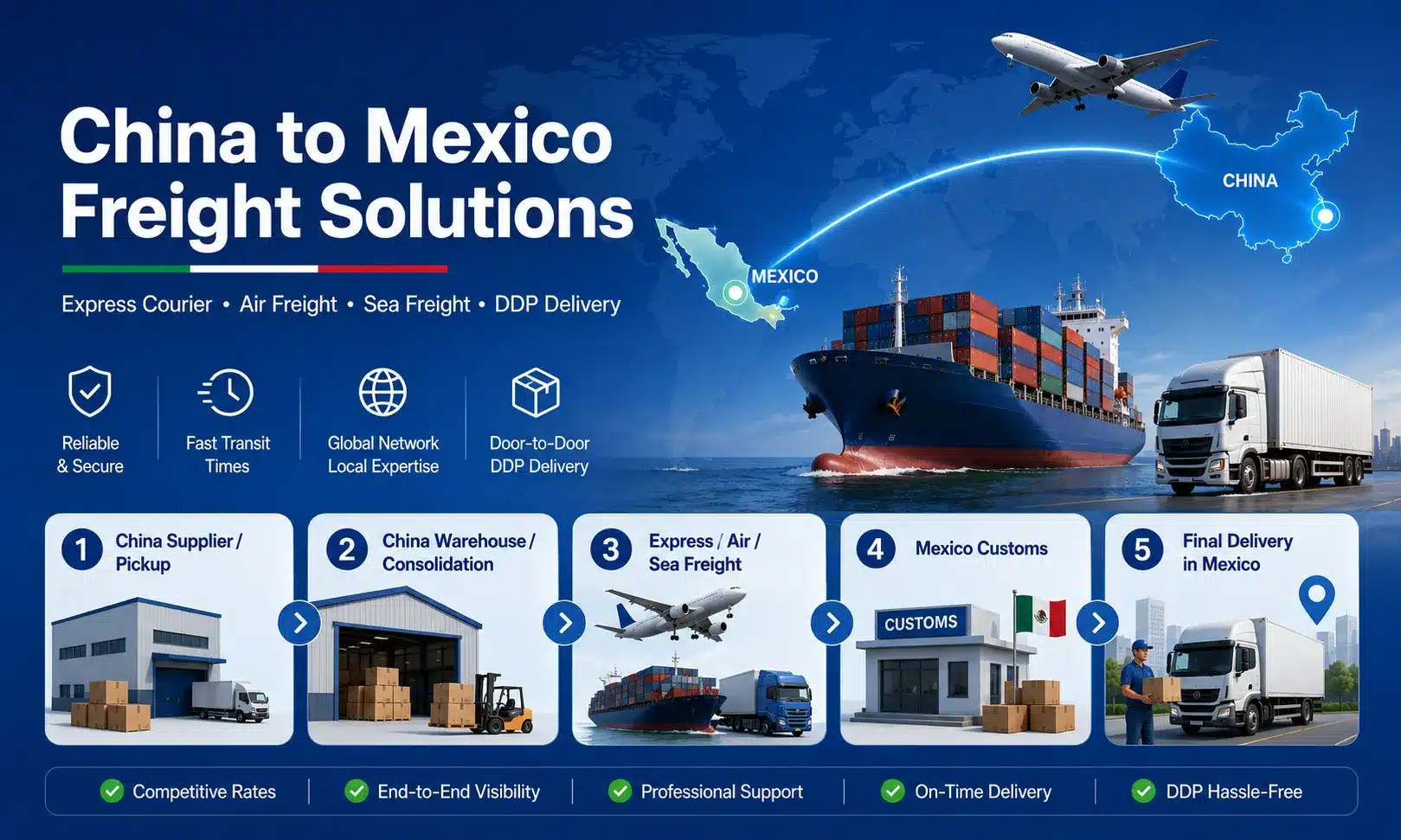
11. Step-by-Step Shipping Process
From Supplier Pickup to Final Delivery
- Send cargo details: provide the product, HS code, declared value, cartons, weight, dimensions, China origin and Mexican destination.
- Review compliance and route: confirm product eligibility, customs responsibility, NOM risks and the suitable express, air, sea or DDP service.
- Receive and measure cargo: suppliers deliver to the China warehouse or VoltFreight arranges pickup and consolidation.
- Confirm final data and charges: check actual cartons, chargeable weight, CBM, labels, packaging and any special handling.
- Arrange export and international transport: dispatch by courier, book air cargo, consolidate LCL, load FCL or enter the approved DDP line.
- Complete the Mexico stage: follow the confirmed customs model, arrange the appropriate parcel, LTL, FTL, warehouse or marketplace delivery and provide available tracking updates.
12. Why Choose VoltFreight and Get an Accurate Mexico Quote
A Freight Forwarder from China to Mexico with Route Options
VoltFreight does not force every shipment into one method. Instead, we compare Express DAP, standard air freight, standard sea freight, Air DDP and Sea DDP according to the real product, shipment size, deadline, customs responsibility and final postcode. The quotation clearly lists pickup, customs, duty and IVA arrangements, delivery and special handling.
- Supplier pickup and multi-supplier consolidation in China.
- Carton measurement, CBM calculation and chargeable-weight checks.
- Express, air, LCL, FCL, Air DDP and Sea DDP comparison.
- Commercial-invoice and packing-list review.
- Mexico customs-scope and product-compliance review.
- FBA, Mercado Libre, 3PL, business-address and pallet-delivery planning.
- Clear USD quotation based on actual cargo and confirmed service scope.
China warehouse and consolidation: In addition, VoltFreight can receive goods from suppliers in Shenzhen, Guangzhou, Foshan, Dongguan, Yiwu, Ningbo, Shanghai and other Chinese cities. We measure cartons, consolidate orders and identify differences between supplier data and actual warehouse measurements before shipping.
Quote Checklist
- Product name and clear product photos.
- HS code if available and declared cargo value.
- Total carton or pallet quantity.
- Gross weight and dimensions of each carton type.
- Total CBM if available.
- Supplier city and pickup address in China.
- Cargo-ready date.
- Mexico city, postcode and full delivery address.
- Address type: business, warehouse, residential, Amazon FBA, Mercado Libre or 3PL.
- Preferred method or required delivery deadline.
- Battery, liquid, powder, chemical, magnet, wireless or branded-goods information.
- Importer RFC, Padrón and customs-broker status for standard freight.
- Appointment, forklift, dock, tail-lift or unloading requirement.
As a result, after receiving these details, VoltFreight can compare practical routes and prepare a clear quotation instead of giving a misleading fixed rate.
Send Cargo Details and Get a Freight Quote | Ask About Your Shipment on WhatsApp
13. FAQ: Shipping from China to Mexico
How much does shipping from China to Mexico cost?
The price depends on the product, HS code, value, chargeable weight or CBM, China origin, scope and Mexican postcode. Express and air services use chargeable weight; LCL and Sea DDP may use CBM or weight; carriers quote FCL by container and route. For example, a recent 9.3 CBM Sea DDP shipment to Jalisco used USD 510/CBM plus USD 150/CBM for local delivery. However, every shipment requires a new quote.
How long does shipping from China to Mexico take?
Shipping time from China to Mexico is about 3–6 business days by express, 3–8 business days airport-to-airport by standard air freight, 6–12 days by Air DDP, and about 45–55 days by the current Sea DDP service after China warehouse receiving and route confirmation.
Is DDP shipping available from China to Mexico?
Yes. VoltFreight can review Air DDP and Sea DDP for suitable cargo. The written quotation may include the agreed duty and IVA arrangement, customs coordination and final delivery. However, DDP does not eliminate importer, customs, NOM, labeling or permit requirements.
What is the cheapest way to ship from China to Mexico?
Sea freight is normally cheapest for large or heavy cargo. LCL can work for smaller commercial shipments, while FCL becomes more efficient at higher volumes. However, Sea DDP provides a landed-delivery plan. Therefore, do not compare it directly with a port-to-port rate.
Can you deliver to Amazon FBA, Mercado Libre or a 3PL warehouse in Mexico?
Yes, subject to product, route and warehouse review. For example, VoltFreight can arrange Air DDP, Sea DDP, parcel, LTL or FCL delivery. Sellers must provide the exact warehouse code and address, approved labels, carton information, appointment requirements and pallet instructions.
Ultimately, the best route depends on more than the first freight number. Send VoltFreight your cargo details and Mexican postcode so we can compare suitable services and provide a quotation with clear inclusions and exclusions.