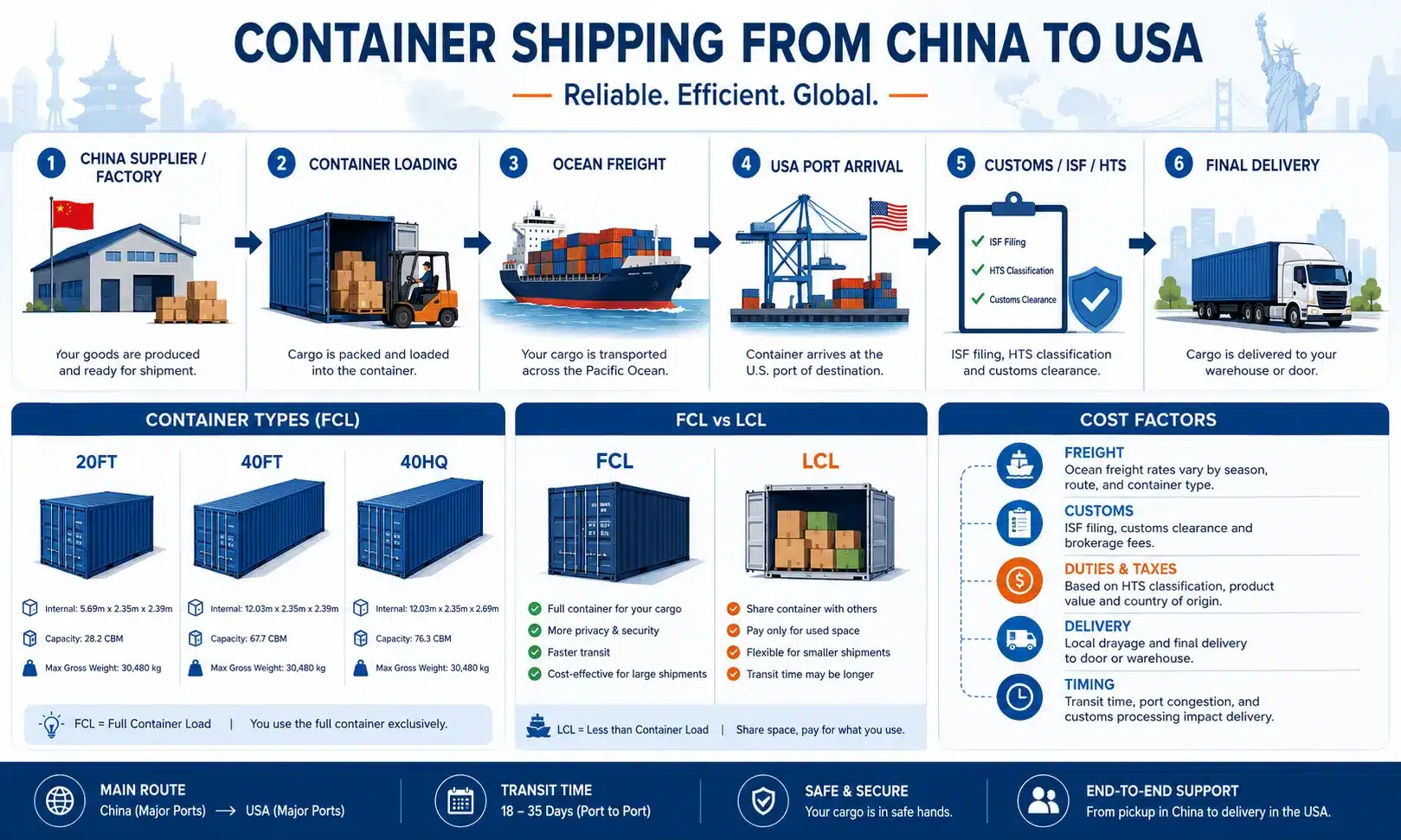
Container shipping cost from China to USA depends on the container size, Chinese origin port, U.S. destination port, departure week, carrier capacity, cargo weight and final delivery ZIP code.
Quick Answer: How Much Does a Container from China to USA Cost?
For current planning, the latest market review on August 1, 2026, indicates that a 20ft container to a major U.S. West Coast port may cost approximately USD 4,800–6,200 port to port, while a 40ft or 40HQ may cost about USD 6,100–7,600. By comparison, for East Coast and Gulf Coast routes, a 20ft container may fall around USD 6,200–7,900, while a 40ft or 40HQ may range from approximately USD 8,400–9,800.
However, these are broad planning ranges for general cargo rather than guaranteed VoltFreight booking prices. In practice, the actual rate depends on the exact port pair, shipping line, sailing date, container equipment, included carrier surcharges and current space availability.
More importantly, the ocean rate is not the final amount an importer pays. A complete container budget may also include China pickup, export handling, destination terminal charges, customs brokerage, duties, chassis, drayage, pre-pull, unloading, demurrage, detention and empty-container return.
For example, a lower ocean rate to Los Angeles may create a higher complete cost when the final warehouse is in New Jersey. Meanwhile, a higher all-water rate to New York or Newark may reduce rail, terminal and inland delivery expenses.
Need an accurate container quote? Next, send your product name, supplier address, preferred container size, cargo weight, cargo-ready date and final U.S. ZIP code through the VoltFreight contact page. Then, we can compare port-to-port, port-to-door and door-to-door costs using the same service scope.
Last market review: August 1, 2026
Rate disclaimer: In addition, public freight indexes, freight-forwarder quotations and carrier booking rates may show different figures because they do not always cover the same port pair, container equipment, surcharges or service scope. Use the ranges below for budgeting and request a live quotation near the cargo-ready date.
To begin with, the following prices provide a practical planning starting point for general cargo. Specifically, they represent broad port-to-port FCL market levels and do not automatically include supplier pickup, customs, duties or final delivery.
| Route and Container | Planning Range | Typical Port Transit | Main Cost Risk |
|---|---|---|---|
| 20ft to U.S. West Coast | About USD 4,800–6,200 | About 14–25 days | Heavy cargo, chassis requirements and inland delivery |
| 40ft / 40HQ to U.S. West Coast | About USD 6,100–7,600 | About 14–25 days | Peak surcharges, equipment availability and destination ZIP code |
| 20ft to U.S. East or Gulf Coast | About USD 6,200–7,900 | About 28–42 days | Longer ocean route and port-specific charges |
| 40ft / 40HQ to U.S. East or Gulf Coast | About USD 8,400–9,800 | About 28–42 days | Ocean capacity, port choice and final inland delivery |
Important: Importantly, a 20ft container does not automatically cost half as much as a 40ft container. Moreover, documentation, booking, terminal and operational charges apply to both equipment types. In addition, carriers may price 40GP and 40HQ at the same level or quote them separately according to route conditions and equipment availability.
Therefore, the most useful question is not simply:
“Which company has the lowest ocean freight rate?”
Instead, ask:
“What will it cost to move this exact container from my supplier to my final U.S. warehouse under the same service scope?”
For a wider comparison between containers, LCL, air freight, express and DDP, review our China-to-USA shipping cost guide.
Why Published Container Rates Can Be Very Different
For instance, an importer may see one website showing a 40ft rate near USD 3,000 while another shows USD 6,000, USD 8,000 or more. Still, that does not automatically mean one source is incorrect.
Specifically, different figures may represent:
- A broad trade-lane index rather than a specific carrier quotation
- A 40ft benchmark rather than a 20ft rate
- A regional coast-to-coast index rather than an exact port pair
- Base ocean freight without every carrier surcharge
- A freight-forwarder rate with selected charges included
- A premium service or guaranteed-space option
- A spot rate valid for only a limited period
- A port-to-port, port-to-door or door-to-door service
- A price published before a recent increase or decrease
Therefore, every rate comparison should identify:
- Chinese origin port
- U.S. destination port
- 20ft, 40ft or 40HQ equipment
- Carrier and service type
- Rate-validity period
- Included surcharges
- Carrier free time
- Final delivery scope
Overall, a freight index can help show the direction of the market. Nevertheless, only a live quotation can confirm whether a rate applies to the importer’s exact cargo and departure week.
What Is Included in a Container Shipping Quote?
In practice, two quotations for the same container may differ by several thousand dollars because they cover different stages.
Basic Port-to-Port Container Quote
For example, a basic port-to-port quote may include:
- Ocean freight between the stated Chinese and U.S. ports
- Selected carrier fuel or security surcharges
- Standard carrier documentation where stated
- Use of the container during the carrier’s allowed period
However, the quotation may exclude almost every stage before loading and after arrival.
Charges Commonly Excluded
In addition, depending on the Incoterm and service scope, additional charges may include:
- Factory pickup in China
- Empty-container trucking to the supplier
- Warehouse loading or container stuffing
- China export declaration
- Origin terminal handling
- Documentation and bill-of-lading fees
- Importer Security Filing
- U.S. customs brokerage
- Customs bond
- Import duty and additional tariffs
- Destination terminal charges
- Chassis rental
- Port drayage
- Pre-pull and yard storage
- Rail or inland transportation
- Live-unload waiting time
- Warehouse unloading
- Empty-container return
- Demurrage and detention
Consequently, importers should not compare a port-to-port rate with a port-to-door or door-to-door quotation.
Questions to Ask Before Accepting a Quote
Before booking, ask the forwarder:
- Is the rate port-to-port, port-to-door or door-to-door?
- Which origin and destination charges are included?
- Which normal carrier surcharges are included?
- How long is the quotation valid?
- How much carrier free time is available?
- Is chassis included in the drayage rate?
- Does the trucking rate include fuel and tolls?
- How much live-unload time is included?
- Who is responsible for returning the empty container?
- Which abnormal charges remain excluded?
20ft vs 40ft vs 40HQ: Which Container Is Better?
First, the correct container depends on cargo density, gross weight, carton dimensions, pallet configuration and U.S. road-delivery limits.
20ft Container
A 20ft container is often the better starting point for compact and heavy cargo, such as:
- Machinery
- Metal components
- Tools and hardware
- Tiles and stone products
- Dense industrial materials
- Heavy spare parts
As a result, these products may reach a practical weight limit before filling the available cubic capacity.
However, a heavy 20ft container can create additional U.S. trucking costs. Even so, the ocean container may technically accept the cargo, while inland transportation may still require special chassis equipment, permits or transloading.
40ft Container
By comparison, a standard 40ft container provides more internal length and volume than a 20ft container while retaining a standard height.
For example, it can suit:
- General commercial cargo
- Palletized inventory
- Products that do not need high-cube height
- Cargo with moderate density
Nevertheless, many importers compare it with a 40HQ because the rate difference may be small.
40HQ Container
Likewise, a 40HQ provides additional internal height and normally offers strong cost per cubic meter for bulky but relatively lightweight cargo.
Common examples include:
- Furniture
- Home and kitchen products
- Textiles and clothing
- Plastic goods
- Packaging materials
- Retail inventory
- E-commerce stock
However, the cargo must still fit through the container door. Therefore, loading plans should use the door dimensions rather than only the maximum internal height.
Do Not Choose by CBM Alone
Therefore, before choosing the container, check:
- Total gross weight
- Weight distribution
- Carton or pallet stackability
- Container door dimensions
- U.S. road and axle restrictions
- Unloading method at destination
For example, a poorly planned 40HQ can contain a large amount of unusable space. Meanwhile, a heavy 20ft container may require expensive destination handling.
How Is the Total FCL Shipping Cost from China to USA Calculated?
In practice, the complete FCL shipping cost from China to USA includes much more than the ocean-freight line shown in a carrier quotation.
Use the following formula to compare quotations on the same service scope:
Total FCL shipping cost = China pickup + export handling + ocean freight + destination terminal charges + customs costs + duties and tariffs + chassis + drayage + unloading + empty return + abnormal charges.
China-Side Costs
First, China-side charges may include:
- Empty-container pickup
- Factory trucking
- Warehouse loading
- Export declaration
- Origin terminal handling
- Documentation
- Container seal and security charges
- Special cargo handling
Moreover, the supplier Incoterm determines which party handles these stages.
For example, under EXW, the buyer normally needs to arrange pickup and export-related operations. By contrast, under FOB, the supplier generally delivers the cargo to the agreed port and completes the agreed China export responsibilities.
For more detail, review EXW vs FOB shipping from China.
Ocean-Freight Costs
Next, the ocean component may include:
- Base ocean freight
- Bunker or fuel adjustment
- Peak-season surcharge
- Equipment-related surcharge
- Security surcharge
- Carrier documentation
The exact naming varies by shipping line. Therefore, the quotation should state whether it includes all normal carrier surcharges for the selected sailing.
U.S. Arrival and Delivery Costs
Finally, after arrival, the importer may need to pay for:
- Destination terminal handling
- Container release
- Customs brokerage
- Customs bond
- Chassis
- Drayage
- Fuel surcharge
- Pre-pull
- Yard storage
- Warehouse appointment
- Live unloading or drop-and-pick
- Empty-container return
As a result, these costs can be more important than a small difference between two ocean rates.
U.S. Destination Charges: Drayage, Chassis, Storage and Demurrage
Importantly, U.S. port delivery is not simply a normal truck journey. Before delivery, the container must be released, mounted on suitable equipment, collected from the terminal, delivered and returned within the required time.
What Is Drayage?
In this context, drayage is the short-distance movement of a container between a port, rail terminal, yard, transload warehouse or final delivery location.
Therefore, the drayage rate may depend on:
- Port or rail terminal
- Final ZIP code
- Container size
- Cargo weight
- Chassis availability
- Fuel and tolls
- Appointment availability
- Driver waiting time
- Empty-return location
Consequently, a lower ocean quote cannot compensate for an impractical or expensive inland route.
What Is a Chassis Charge?
Similarly, a chassis supports the container during road transportation.
However, some trucking quotations include chassis, while others show it as a separate daily charge. In addition, heavy containers may require special equipment, which can increase the rate.
Therefore, always confirm:
- Whether chassis is included
- How many chassis days are included
- Whether special equipment is required
- What happens if the empty return is delayed
When Is a Pre-Pull Needed?
Meanwhile, a pre-pull means that the trucker collects the container from the terminal and stores it at a nearby yard before final delivery.
For example, it may be necessary when:
- The container’s last free day arrives before the warehouse appointment
- The warehouse cannot receive the container immediately
- The port appointment and warehouse appointment do not align
- The trucker needs to reduce terminal-delay risk
Although it adds cost, a pre-pull may prevent more expensive demurrage.
Live Unload vs Drop-and-Pick
In a live-unload arrangement, the driver waits while the warehouse unloads the container.
Therefore, the quote should state:
- How much free waiting time is included
- The hourly waiting charge
- Whether the warehouse has a dock or forklift
- Whether floor-loaded cargo can be unloaded quickly
By contrast, with a drop-and-pick arrangement, the container remains at the warehouse and is collected later. As a result, this can reduce driver waiting, although it may increase chassis days and detention risk.
Demurrage, Detention and Storage
Although these charges are often confused, they arise at different stages.
Demurrage
First, demurrage generally applies when an import container remains inside the marine terminal beyond the allowed free time.
For example, common causes include:
- Customs clearance is incomplete
- The bill of lading has not been released
- The importer has not paid required charges
- No truck or terminal appointment is available
- The container is under examination
Detention
Next, detention generally applies after the container leaves the terminal but is not returned empty within the carrier’s allowed time.
For example, common causes include:
- Slow unloading
- Warehouse closure
- Delayed collection of the empty container
- Restricted empty-return locations
- Weekend or holiday timing
Storage
Finally, storage may be charged by a terminal, rail yard, trucker’s yard or warehouse when cargo or equipment remains at the facility.
Moreover, storage can exist alongside demurrage or detention. Therefore, importers should not assume that paying one charge automatically covers the others.
How to Reduce These Risks
Therefore, before vessel arrival:
- Complete ISF and customs documentation
- Confirm the customs bond and broker arrangement
- Pay carrier and destination charges on time
- Confirm warehouse receiving availability
- Reserve the delivery appointment
- Check free time and empty-return rules
West Coast vs East and Gulf Coast Container Costs
In practice, the best U.S. port depends on the final destination, not only the ocean rate.
West Coast Routes
Common West Coast gateways include:
- Los Angeles
- Long Beach
- Oakland
- Seattle
- Tacoma
As a result, these routes normally provide shorter ocean transit from China. They often work well for delivery to California, Nevada, Arizona and other western distribution points.
However, cargo for New Jersey, Pennsylvania, Ohio or other eastern destinations may require rail or long-distance trucking.
East and Gulf Coast Routes
Common East and Gulf Coast gateways include:
- New York and Newark
- Savannah
- Charleston
- Norfolk
- Baltimore
- Houston
By comparison, the ocean rate and transit time may be higher. Nevertheless, these ports may reduce inland costs for warehouses in the Northeast, Southeast or Texas.
Compare the Complete Route
For example, for a New Jersey delivery, compare:
- Ocean freight to Los Angeles
- West Coast terminal charges
- Rail transportation
- Destination rail handling
- Local drayage
Next, compare those expenses with:
- All-water freight to New York or Newark
- Local terminal charges
- Short-distance drayage
Ultimately, the route with the higher ocean rate may still produce the lower complete cost.
For the wider ocean-shipping process, review our sea freight from China to USA guide.
When Should You Compare FCL with LCL?
For smaller volumes, LCL can work well when the cargo does not fill a complete container. In that case, the shipment shares space with other importers and is usually charged by CBM or weight/measure.
However, LCL involves:
- Origin consolidation
- Destination deconsolidation
- Additional warehouse handling
- Minimum origin and destination charges
- More handling of cartons
Therefore, importers should normally compare FCL when the cargo approaches approximately 12–15 CBM.
Nevertheless, FCL may become reasonable below that level when:
- The cargo is fragile
- The shipment is dense or high value
- Destination LCL charges are high
- Reduced cargo handling is important
- A more predictable delivery process is required
For smaller shipments and CFS cost structures, review our LCL sea freight from China guide.
Overweight and Heavy Container Costs
Importantly, a container’s technical payload is not the same as the weight that can move economically and legally on U.S. roads.
As a result, heavy cargo can create additional costs for:
- Tri-axle chassis
- Overweight permits
- Special drayage providers
- Reduced route options
- Transloading near the port
- Additional warehouse handling
- Split final delivery
Therefore, the forwarder should review:
- Total cargo weight
- Container tare weight
- Weight distribution
- Container size
- Destination state
- Drayage route
- Available chassis equipment
Accordingly, do not wait until the container arrives in the United States to check whether the loaded weight can move using standard equipment.
Anonymized Container Cost Cases
For example, the following anonymized cases reflect recurring situations handled in China-to-USA freight operations. To protect confidentiality, product and customer identities are omitted, while the numbers are rounded to illustrate the cost logic rather than provide current quotations.
Case 1: The Lower Ocean Rate Produced the Higher Total Cost
In the first case, an importer needed to deliver a 40HQ container to a New Jersey warehouse.
First, the importer considered a lower ocean rate to Los Angeles:
- Ocean freight to Los Angeles: USD 3,200
- West Coast terminal and handling: USD 650
- Rail movement to the East Coast: USD 2,100
- Rail-terminal handling and local drayage: USD 800
Illustrative route total before duty: USD 6,750.
Next, the importer considered a higher all-water ocean rate to New York or Newark:
- Ocean freight to New York/Newark: USD 4,600
- Terminal handling and local drayage: USD 850
Illustrative route total before duty: USD 5,450.
Although the second ocean rate was USD 1,400 higher, the complete route was approximately USD 1,300 lower.
Therefore, the lesson is straightforward:
Choose the U.S. gateway according to the final ZIP code, not only the lowest ocean-freight line.
Case 2: A Warehouse Appointment Created Pre-Pull and Waiting Costs
In this case, a container became available at the port, but the receiving warehouse could not accept it until the following day.
To avoid missing the final free day, the trucker arranged a pre-pull and stored the container at a local yard.
As a result, the rounded additional charges included:
- Pre-pull: USD 300
- One night of yard storage: USD 150
- Additional chassis day: USD 75
Later, during final delivery, the warehouse needed five hours to unload the floor-loaded cargo. However, the trucking quotation included two free hours, while the additional three hours were charged at USD 125 per hour.
- Additional waiting: 3 × USD 125 = USD 375
Total additional operating cost: approximately USD 900.
Importantly, the freight quotation itself was not incorrect. Instead, the extra expense came from the mismatch between port availability and warehouse receiving conditions.
Case 3: A 20ft Heavy Container Required Transloading
For another shipment, an importer shipped approximately 18 CBM of industrial machinery in a 20ft container.
Although the cargo did not fill the available volume, the gross weight was high. However, after arrival, the originally selected delivery provider could not move the loaded container with standard equipment.
Consequently, the shipment required:
- A heavy-container drayage provider
- Special chassis coordination
- Transloading near the port
- Local delivery in separate truckloads
As a result, the destination cost increased by several thousand dollars compared with the original standard-drayage estimate.
Therefore, this case shows why a 20ft container is not automatically simple or inexpensive for dense cargo. Accordingly, cargo weight and delivery feasibility must be reviewed before loading in China.
Case 4: Delayed Customs Preparation Used the Available Free Time
In another recurring situation, a container arrived before the importer had completed the customs-bond and broker arrangements.
Because the setup was incomplete, the container could not be released immediately. Meanwhile, the carrier’s free time continued to run.
By the time the customs entry was completed:
- The preferred truck appointment was no longer available
- A pre-pull was required
- Terminal storage or demurrage had started
- The warehouse appointment needed to be rescheduled
Notably, the ocean freight did not change. However, avoidable U.S. destination costs increased substantially.
Therefore, customs and delivery preparation should begin before vessel arrival, not after the container reaches the port.
Customs Costs That Affect the Container Budget
Importantly, this page focuses on container cost rather than the complete U.S. customs process.
Nevertheless, importers should budget for:
- Importer Security Filing
- Customs-broker entry fee
- Single-entry or continuous bond
- Normal import duty
- Section 301 tariffs where applicable
- Merchandise Processing Fee
- Harbor Maintenance Fee where applicable
- Customs examinations or agency processing
Ultimately, the final amount depends on the HTS classification, customs value, product origin and applicable trade measures.
For the operational clearance process, review our USA customs clearance from China guide.
For HTS, duty, Section 301, MPF and HMF calculations, use our import tax from China to USA guide.
Door-to-Door, DDP, Amazon and 3PL Container Delivery
Depending on the service, a container quotation can end at the port, a commercial warehouse, a 3PL, a transload facility or another approved destination.
Port-to-Door and Door-to-Door
For example, port-to-door service may include U.S. port pickup and final delivery after customs release.
In addition, door-to-door service may include China supplier pickup and origin operations. However, neither term automatically means import duty is included.
DDP Container Shipping
By contrast, a reviewed DDP arrangement may combine freight, customs coordination, agreed duties and final delivery under one confirmed scope.
However, availability depends on:
- Product type
- Cargo value
- HTS classification
- Importer structure
- Destination address
- Special regulatory requirements
Detailed responsibility and risk questions belong in our DDP shipping from China to USA guide.
Amazon FBA and 3PL Delivery
Likewise, a full container does not always move directly into an Amazon fulfillment center.
As a result, the cargo may first enter a U.S. warehouse for:
- Devanning
- Carton verification
- Palletization
- Carrier-label application
- Storage
- Amazon appointment delivery
Therefore, these services should be included in the landed-container budget when required.
For Amazon-specific devanning, palletization, storage and appointment costs, review our Amazon FBA shipping cost from China to USA guide.
How to Reduce Container Shipping Cost from China to USA
- Compare complete route costs. Do not choose a port using only the ocean rate.
- Improve container utilization. Reduce empty carton space and prepare a loading plan.
- Confirm the container size early. Compare cargo weight, volume and stackability before booking.
- Review heavy cargo before loading. Confirm U.S. chassis and road-delivery feasibility.
- Provide the final ZIP code. Drayage and inland delivery can change the best port.
- Prepare customs data before vessel arrival. Late entry preparation can consume free time.
- Confirm warehouse conditions. Check the loading dock, forklift, appointment and unloading time.
- Understand free time. Ask about demurrage, detention and empty-return deadlines.
- Use a realistic cargo-ready date. Do not request a final spot rate several months before production finishes.
- Compare FCL and LCL near the crossover. Shipments near 12–15 CBM should normally review both options.
Information Needed for an Accurate Container Quote
To begin with, an accurate container quotation requires complete cargo, origin and destination information.
For an accurate comparison, prepare:
- Product name: Include material, function and intended use.
- Product photos: Provide photos or a supplier link.
- Supplier address: Include the city and complete China pickup location.
- Incoterm: Confirm EXW, FOB, FCA, CIF or another term.
- Container requirement: State 20ft, 40ft, 40HQ or request a recommendation.
- Cargo information: Provide carton quantity, dimensions, gross weight and total CBM.
- Cargo value: State the commercial value and currency.
- HTS or HS code: Include it if available.
- Cargo-ready date: Give the realistic production-completion date.
- Final U.S. address: Provide the ZIP code and full address if available.
- Delivery type: Warehouse, 3PL, Amazon, job site, business or residence.
- Unloading conditions: Dock, forklift, crane, live unload or drop-and-pick.
- Special cargo: Declare batteries, liquids, chemicals, branded goods, regulated products, oversized or heavy cargo.
Finally, a final quotation should normally be reconfirmed after the cargo is ready and before the empty container is released for loading.
China-to-USA Container Shipping Support
VoltFreight is operated by Shenzhen Yutuo Supply Chain Co., Ltd. Our team has more than ten years of freight-forwarding experience coordinating shipments from Chinese suppliers to U.S. ports, warehouses, 3PLs and commercial destinations.
Depending on the shipment, our support can include:
- Supplier pickup and EXW or FOB route review in China
- 20ft, 40ft and 40HQ comparison, including port and carrier selection
- Multi-supplier consolidation and container loading coordination
- Ocean booking, export handling and shipping-document coordination
- Customs-broker communication under the agreed scope
- Port release, drayage planning and commercial warehouse or 3PL delivery
- Amazon-related transload and delivery review
- Shipment tracking and exception coordination
Importantly, we do not compare container quotations using only the first ocean-freight line. Instead, we review the supplier location, cargo weight, port pair, final ZIP code, customs setup, warehouse conditions and potential destination charges.
Get a Live Container Shipping Quote
Ultimately, a reliable container quotation should connect the Chinese supplier, port pair, container size, customs setup and final U.S. delivery address.
Before requesting the final rate, prepare the cargo, origin, destination, customs and unloading information listed in the quotation checklist above.
Send VoltFreight your supplier, cargo and destination information. We can compare port-to-port, port-to-door and door-to-door container options using the same service scope.
Contact VoltFreight for a live 20ft, 40ft or 40HQ quotation.
Related China-to-USA Shipping Guides
- Shipping from China to the USA — complete route and service overview
- China to USA Shipping Cost — compare express, air, LCL, FCL and DDP costs
- Sea Freight from China to USA — FCL, LCL, ports and ocean-shipping operations
- China to USA Shipping Time — port and door-to-door planning ranges
- LCL Sea Freight from China — CBM pricing, CFS handling and destination charges
- USA Customs Clearance from China — importer, broker, bond, ISF and entry process
- Import Tax from China to USA — HTS, duty, Section 301, MPF and HMF
- DDP Shipping from China to USA — responsibility, duty scope and delivery exclusions
- Amazon FBA Shipping Cost — devanning, palletization, storage and appointment costs
Official and Market Information Sources
- Freightos Baltic Index: China and East Asia to North America West Coast
- Freightos Baltic Index: China and East Asia to North America East Coast
- U.S. Customs and Border Protection: Importer Security Filing
- USITC Harmonized Tariff Schedule
- USTR Section 301 Tariff Actions
Important notice: Container rates, carrier surcharges, free time, customs requirements, tariffs, chassis availability and drayage charges can change. Finally, confirm the final bookable rate and included service scope before loading.
FAQ About Container Shipping Cost from China to USA
How much does it cost to ship a container from China to USA?
As a recent broad planning range, a 20ft container may cost approximately USD 4,800–6,200 to a major U.S. West Coast port and USD 6,200–7,900 to an East or Gulf Coast port. A 40ft or 40HQ may cost about USD 6,100–7,600 to the West Coast and USD 8,400–9,800 to the East or Gulf Coast. These are indicative port-to-port ranges rather than guaranteed booking prices.
How much does a 20ft container from China to USA cost?
As a broad port-to-port planning range, a 20ft container may cost approximately USD 4,800–6,200 to major U.S. West Coast ports and USD 6,200–7,900 to East or Gulf Coast ports. The final price depends on the port pair, carrier, departure week, cargo weight and included surcharges.
How much does a 40ft container from China to USA cost?
Under recent market conditions, a 40ft or 40HQ container may cost approximately USD 6,100–7,600 to major West Coast ports and USD 8,400–9,800 to East or Gulf Coast ports.
For a 40ft or 40HQ container from China to Los Angeles or Long Beach, use the West Coast planning range as the starting point. Then add China origin charges, U.S. destination fees, chassis and drayage to calculate the complete cost.
Is a 20ft container half the price of a 40ft container?
Usually not. In fact, both container sizes are subject to documentation, booking, terminal and other fixed charges. Therefore, a 40ft or 40HQ often provides a lower cost per cubic meter when the cargo can use the additional space.
Does the container rate include customs and delivery?
Not necessarily. For example, a basic port-to-port rate may exclude supplier pickup, export handling, ISF, customs brokerage, duties, terminal charges, chassis, drayage, unloading and final delivery. Therefore, always request a written list of inclusions and exclusions.
What is the cheapest U.S. port for a container from China?
In practice, there is no universally cheapest port. Although West Coast ocean rates are often lower and transit is normally shorter, inland rail or trucking can make the complete route more expensive for an eastern destination. Therefore, the final ZIP code must be included in the comparison.
When should I choose FCL instead of LCL?
Importers should normally compare FCL when cargo approaches approximately 12–15 CBM. However, FCL can also be reasonable for smaller fragile, high-value, dense or difficult-to-handle shipments.
What causes unexpected U.S. container charges?
For example, common causes include additional chassis days, pre-pull, yard storage, live-unload waiting, warehouse appointment delays, demurrage, detention, customs examinations and restricted empty-return locations.
How long does container shipping from China to USA take?
Generally, port transit to the U.S. West Coast may take about 14–25 days, while East and Gulf Coast routes may take approximately 28–42 days. However, the complete supplier-to-warehouse process takes longer because it includes pickup, export handling, customs clearance, port release and delivery.