Last verified: July 23, 2026. Rail freight from China to Europe is an overland and multimodal cargo service that connects Chinese railway hubs with European rail terminals, customs gateways and final truck-delivery networks.
Importers normally choose the China–Europe freight train when ocean shipping is too slow but air freight is too expensive. It can work particularly well for automotive parts, machinery components, electronics, industrial goods, household products, e-commerce inventory and seasonal replenishment.
However, China–Europe railway freight is not one single route or one train that serves every city. Cargo may move through the Northern Corridor, the Trans-Caspian Middle Corridor, a direct block train, a scheduled connecting service or a combination of rail, ferry and truck transport.
Moreover, the train journey is only one part of the total shipment. A complete service may also include China supplier pickup, warehouse consolidation, export customs, rail-terminal handling, border transloading, European import clearance, container or pallet release and final delivery by truck.
This guide focuses on China–Europe railway routes, departure hubs, European gateways, transit times, FCL and LCL rail freight, Northern and Middle Corridor differences, rail-and-truck delivery and quotation structure. For VoltFreight’s commercial booking, pickup and door-delivery services, visit our railway freight services from China page.
Need a live China–Europe rail freight quote? Send the product name, HS code if available, carton quantity, dimensions, gross weight, total CBM, supplier city, cargo-ready date, destination country and final postcode through the VoltFreight contact page.
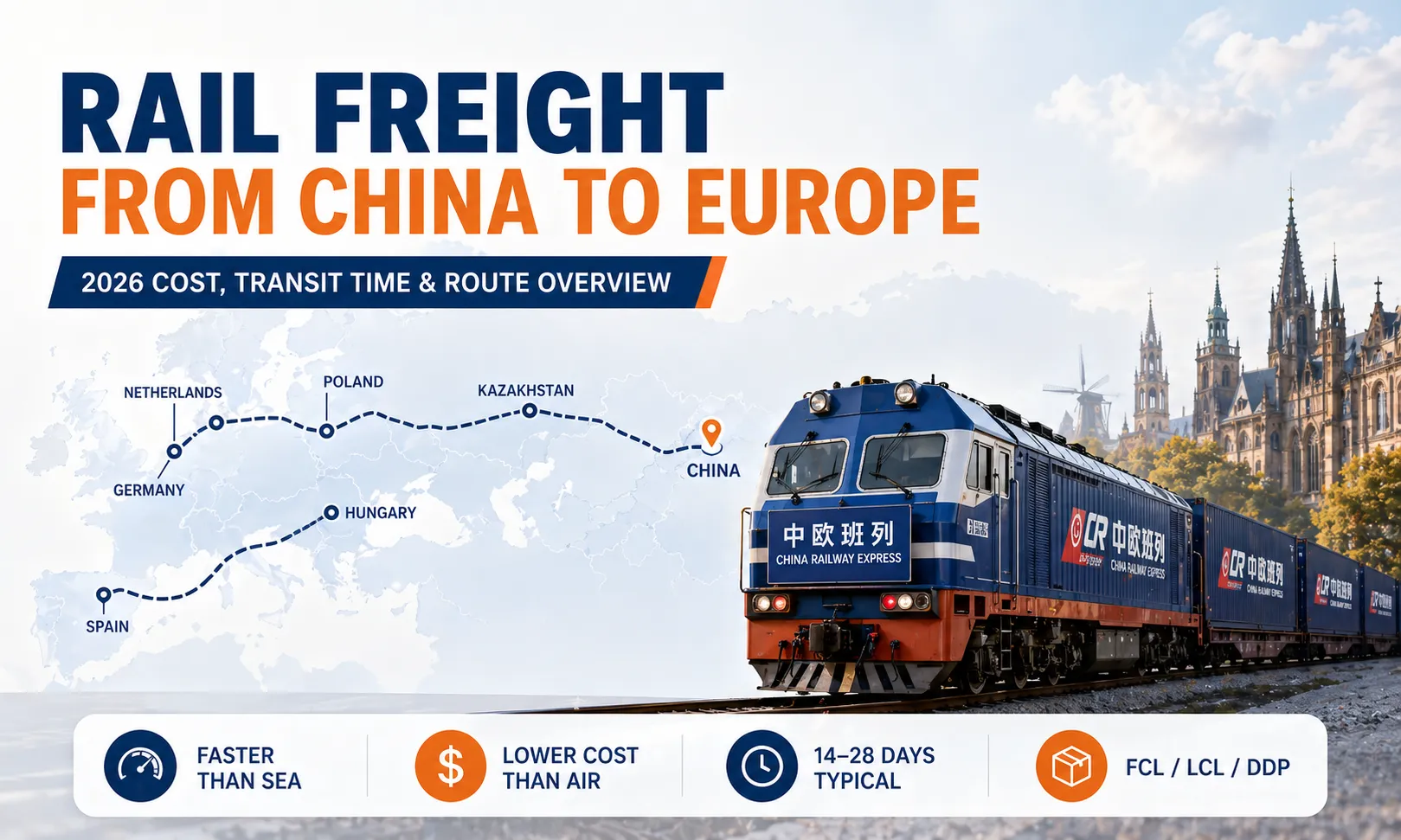
Quick Answer: How Does Rail Freight from China to Europe Work?
Rail freight from China to Europe normally begins with cargo pickup from a Chinese factory or delivery to a rail consolidation warehouse. The freight forwarder then selects an origin hub such as Xi’an, Chongqing, Chengdu, Zhengzhou, Wuhan or Yiwu according to the supplier’s location, current train schedule, cargo type and European destination.
After origin handling and export customs, the cargo moves west on a scheduled train service. Depending on the selected corridor, the shipment may cross Kazakhstan, Mongolia, Russia, Belarus, the Caspian Sea, Azerbaijan, Georgia, Türkiye or other transit countries.
Because China, Central Asia and Europe use different railway systems and track gauges, terminals may transfer containers between rail wagons at major border points. Customs and transit procedures also take place at several stages of the journey.
Once the cargo reaches a European rail gateway, the destination team completes the required import or transit formalities. Afterwards, the shipment may continue by:
- European rail to another inland terminal
- Full-container truck delivery
- LCL pallet or carton delivery
- Transloading into a European trailer
- Delivery to a 3PL or commercial warehouse
- Amazon or retail-distribution delivery after appointment booking
As a general planning range, Northern Corridor terminal-to-terminal services may take approximately 14–24 days on established routes. Middle Corridor services often require approximately 18–35 days or longer because they combine rail with Caspian Sea ferry and additional terminal transfers.
Door-to-door delivery takes longer than the main rail journey because it also includes China pickup, consolidation, waiting for departure, customs clearance and European trucking.
What Is the China–Europe Railway Express?
The China–Europe Railway Express is a network of scheduled freight-train services that links Chinese cities with European logistics hubs. It is also described as:
- Rail freight from China to Europe
- Train freight from China to Europe
- China–Europe freight train
- China–Europe rail freight
- Railway shipping from China to Europe
- Cargo train from China to Europe
- China to Europe by train
These expressions refer to the same general transport market, although individual services may follow different routes, operating models and timetables.
According to China State Railway Group information published in 2026, the wider China–Europe Railway Express network connects 129 Chinese cities with 235 cities in 26 European countries. However, this network figure does not mean every Chinese station has a direct train to every European city.
In practice, a shipment may use:
Direct Block Train
A block train carries a complete train formation between designated terminals with limited reassembly. This model can improve schedule control when sufficient cargo volume supports a dedicated or regular service.
Fixed-Timetable Train
A fixed-timetable service uses pre-arranged train numbers, routes, departure times and planned arrival schedules. As a result, it may offer more predictable planning than an ad hoc service.
Connecting Rail Service
A connecting service transfers cargo or rail wagons between terminals. Although this arrangement provides wider coverage, it can add waiting time and handling.
Rail–Ferry–Rail Service
The Middle Corridor combines railway transport with Caspian Sea ferry operations. Therefore, it is a multimodal trade corridor rather than one uninterrupted railway line.
Rail and Truck Service
Most customers do not receive their cargo directly at a railway terminal. Instead, the shipment reaches a European hub and then continues by truck to the final warehouse.
Main China Rail Freight Departure Hubs
China has many international railway stations, but several inland cities act as major consolidation and operating hubs. The most suitable departure point depends on the supplier location, current train capacity, European destination and route availability.
Xi’an
Xi’an is one of the largest China–Europe freight-train hubs. Its inland location allows cargo from western, northern, central and coastal China to consolidate before international departure.
Xi’an services may connect with Germany, Poland, Hungary and other European destinations. In addition, the city supports routes toward Central Asia and the Trans-Caspian network.
Xi’an can be suitable for:
- Automotive parts
- Machinery and industrial equipment
- Electronics
- Solar and energy products
- Household appliances
- FCL and LCL cargo collected from several Chinese regions
Chongqing
Chongqing played an important role in the early development of modern China–Europe freight trains. It remains a major inland gateway for southwest China.
Manufacturers in Chongqing, Sichuan, Guizhou and nearby regions often use this hub for automotive components, electronics, machinery and industrial cargo.
Duisburg is a well-known European destination associated with Chongqing services. Nevertheless, the actual terminal and timetable must be confirmed for each booking.
Chengdu
Chengdu supports cargo from Sichuan and other southwest manufacturing areas. It can handle electronics, e-commerce inventory, consumer products and commercial replenishment shipments.
Depending on the service schedule, cargo may move toward Poland, Germany, Central Europe or another regional terminal before final truck distribution.
Zhengzhou
Zhengzhou serves Henan and central China. Its geographic position allows factories from several provinces to consolidate cargo for westbound railway services.
Common cargo can include electronics, machinery parts, equipment, retail goods and industrial products. In May 2026, the network’s 130,000th China–Europe train departed from Zhengzhou for Hamburg, highlighting the city’s ongoing role in scheduled services.
Wuhan
Wuhan supports manufacturers across Hubei and the wider Yangtze River economic region. Automotive parts, machinery, electronics, textiles and commercial inventory commonly move through the city.
Furthermore, Wuhan is becoming relevant to Trans-Caspian planning. The Wuhan–Baku service provides a practical example of how cargo can move toward Azerbaijan before continuing to Türkiye or Europe.
For the detailed route, read our guide to the Wuhan–Baku Middle Corridor freight train.
Yiwu
Yiwu is strongly associated with small commodities, household products, consumer goods, accessories and retail inventory. Rail services from Yiwu have also supported long-distance connections toward Spain and other European markets.
However, suppliers outside Zhejiang may need additional domestic trucking or consolidation before departure. Therefore, the closest hub is not always the lowest-cost choice.
Other China Departure Cities
Additional services may operate from Suzhou, Hefei, Jinan, Qingdao, Changsha, Ganzhou, Xiamen and other cities. Nevertheless, train schedules, cargo acceptance and European destinations can change.
A freight forwarder should compare:
- Domestic pickup cost
- Warehouse cutoff
- Train frequency
- Current corridor
- FCL or LCL availability
- European terminal
- Final truck-delivery distance
Main European Rail Gateways and Logistics Hubs
A European railway gateway is not always the final customer destination. Instead, it often acts as a customs, transloading, deconsolidation or distribution point before the cargo continues by rail or truck.
Małaszewicze and Brest
Brest in Belarus and Małaszewicze in Poland form an important border interface on the traditional Northern Corridor.
For shipments that terminate in Belarus or move through Brest before onward distribution, review our guide to shipping from China to Belarus by rail.
Rail networks in Belarus and much of the former Soviet railway area use a 1,520 mm broad gauge. By contrast, Poland and most of Western Europe use the 1,435 mm standard gauge.
Consequently, operators often transfer containers between broad-gauge and standard-gauge wagons near the Brest–Małaszewicze border. Customs, security, railway and transit procedures may also occur in this area.
Małaszewicze should therefore be understood as:
- An entry point into the European Union rail network
- A gauge-change and container-transfer location
- A customs and transit gateway
- A rail-distribution hub
- A connection point for onward European rail or truck delivery
It is not the final destination for most shipments. After transfer and release, cargo may continue toward Germany, the Netherlands, Belgium, France, the Czech Republic, Austria, Italy or another European market.
Łódź and Warsaw
Poland provides important access to Central and Eastern Europe. Łódź can function as a rail and logistics hub for Polish distribution as well as onward delivery to neighbouring countries.
Warsaw may appear in commercial route descriptions, although the physical terminal can differ according to the operator and service. Therefore, the quotation should identify the exact station rather than only the city name.
For country-specific delivery planning, review shipping from China to Poland. Polish-speaking importers can also use our Polish guide to shipping from China to Poland.
Duisburg
Duisburg is one of Europe’s best-known inland logistics centres for China–Europe rail freight. Its location in western Germany provides access to:
- Germany
- The Netherlands
- Belgium
- France
- Luxembourg
- Other Western European markets
After train arrival, containers may move through the inland terminal, transfer to another rail service or continue by truck.
For a broader country route, visit shipping from China to Germany.
Hamburg
Hamburg is both a seaport and a major rail-connected logistics market. China–Europe rail services may use Hamburg as a destination or distribution point for northern Germany and nearby European countries.
Moreover, Hamburg can support multimodal planning because cargo can connect with road, rail, port and warehouse networks.
Budapest
Budapest can support Central and Eastern European distribution. Cargo arriving in Hungary may continue to Austria, Slovakia, Romania, Croatia, Serbia or nearby countries, depending on customs and transport arrangements.
For a Hungary-specific comparison of rail, truck, air and sea options, review shipping from China to Hungary.
Czech Rail Terminals
Czech terminals can support delivery to the Czech Republic, Slovakia, Austria, southern Germany and surrounding markets.
Importers using Czech or nearby Central European hubs for onward delivery can also review shipping from China to Slovakia.
They can also form part of a wider Central European distribution plan when cargo continues by truck after rail arrival. For a country-specific route, review shipping from China to the Czech Republic, including rail, sea, air and final-delivery options.
Madrid
Madrid represents one of the best-known long-distance China–Europe rail destinations. It can support consumer goods and retail replenishment to Spain.
Nevertheless, the longer distance across Europe normally requires a wider planning window than delivery to Poland or Germany.
Northern Corridor vs Middle Corridor
The China–Europe railway market now uses several corridors. The two most important concepts for importers are the Northern Corridor and the Middle Corridor.
What Is the Northern Corridor?
The Northern Corridor traditionally connects China with Europe through routes that may pass through:
- Kazakhstan or Mongolia
- Russia
- Belarus
- Poland
- Other European countries
A common westbound structure is:
China → shipping from China to Kazakhstan → Russia → Belarus → Poland → Western Europe
For the Russia section of the Northern Corridor, including border gateways, Rail FCL, Rail LCL and inland delivery, review our guide to China–Russia railway routes.
Some services may instead use Mongolia before entering Russia. The exact border crossing depends on the Chinese origin hub and train schedule.
The Northern Corridor usually offers:
- A mature railway operating network
- Established border-transfer procedures
- Broad train frequency on major lanes
- A high share of continuous land transport
- Access through Brest and Małaszewicze
- Connections to Duisburg, Hamburg, Łódź and other hubs
However, importers must check the current route, carrier policy, insurance conditions, banking requirements, sanctions compliance and cargo restrictions before booking. A route that operates physically may not suit every shipper, product or customer.
What Is the Middle Corridor?
The Middle Corridor is formally known as the Trans-Caspian International Transport Route, or TITR.
Its general structure is:
China → Kazakhstan → Aktau or Kuryk → Caspian Sea → Baku/Alat → Georgia → Türkiye or Black Sea connections → Europe
The route avoids Russia and Belarus. As a result, it gives importers another Eurasian transport option.
However, the Middle Corridor is not one direct freight train. Instead, it normally combines:
- Chinese and Kazakh railway transport
- Port handling in Kazakhstan
- Caspian Sea ferry transport
- Port handling in Azerbaijan
- Railway transport through Azerbaijan and Georgia
- Türkiye or Black Sea connections
- European railway or truck delivery
Therefore, the route contains more interfaces than the traditional Northern Corridor. Ferry schedules, port congestion, weather, wagon availability, customs and terminal coordination can all affect transit time.
Why Use the Middle Corridor?
The main advantage is route diversification. It can help importers:
- Avoid routes through Russia and Belarus
- Build an alternative Eurasian supply chain
- Reach Azerbaijan, Georgia and Türkiye
- Connect with Central and Southern Europe
- Reduce dependence on one transport corridor
Nevertheless, it should not automatically be marketed as faster than every Northern Corridor service. Its performance depends heavily on port and ferry coordination.
How Should Importers Choose?
Before choosing either corridor, compare:
- Current route availability
- Cargo type and restrictions
- Insurance acceptance
- Banking and sanctions compliance
- Terminal-to-terminal schedule
- Number of transfers
- Destination country
- Final truck-delivery distance
- FCL or LCL availability
- Total door-to-door cost
Main China–Europe Rail Routes and Transit Times
The table below gives conservative planning ranges. These figures refer mainly to the international terminal or corridor movement. They do not guarantee supplier-to-door delivery.
| China Origin Hub | Main Corridor | Common European Gateway | Terminal Transit Planning Range | Common Final Markets |
|---|---|---|---|---|
| Xi’an | Northern Corridor | Małaszewicze, Duisburg or Hamburg | About 14–24 days | Poland, Germany, Netherlands, Belgium, France and Central Europe |
| Chongqing | Northern Corridor | Duisburg or another German terminal | About 15–24 days | Germany, Benelux, France and Western Europe |
| Chengdu | Northern Corridor | Małaszewicze, Łódź or German hubs | About 14–24 days | Poland, Germany, Czech Republic and nearby EU markets |
| Zhengzhou | Northern Corridor | Hamburg, Duisburg or Polish gateways | About 15–25 days | Germany, northern Europe and Central Europe |
| Wuhan | Middle Corridor | Baku, Türkiye or connecting European hubs | About 18–35 days or longer | Azerbaijan, Türkiye, Central Europe and route-diversification users |
| Yiwu | Northern or connecting European rail service | Madrid or Western European hubs | About 21–32 days | Spain, France and Western Europe |
Transit-time note: Actual performance depends on the train schedule, route allocation, border transfer, rail gauge change, customs, ferry schedule, congestion and final terminal. Always request the latest departure plan before booking.
Terminal-to-Terminal vs Door-to-Door Transit Time
A railway quotation may show an attractive transit time, but the customer must understand where the clock starts and ends.
China Pickup and Origin Handling
Before the international train departs, the shipment may require:
- Factory pickup
- Domestic trucking to the rail hub
- Warehouse receiving
- LCL consolidation
- Container loading
- Export customs
- Document preparation
- Waiting for the booked train
Depending on the supplier city and departure schedule, this stage may add several days.
Terminal-to-Terminal Rail Transit
This period normally covers the international rail or multimodal journey from the Chinese origin terminal to the named European gateway.
Nevertheless, a quoted rail time may exclude the waiting period before departure and destination processing after arrival.
European Arrival and Final Delivery
After rail arrival, the shipment may still require:
- Import customs clearance
- Transit clearance to another EU country
- Terminal release
- Container pickup
- LCL deconsolidation
- Palletization
- Truck booking
- Warehouse appointment
- Final delivery
Therefore, a 16-day rail journey can result in a 22–30 day or longer door-to-door shipment.
Middle Corridor Time Boundaries
For Middle Corridor cargo, importers should also include:
- Kazakhstan port waiting
- Caspian ferry schedule
- Azerbaijan port handling
- Additional rail transfers
- Possible Black Sea or Türkiye connections
Consequently, the route may offer strategic value even when it does not provide the shortest transit time.
Why Rail Gauge Changes and Border Transfers Matter
China and most European countries use standard-gauge railway tracks, while Kazakhstan, Russia and Belarus mainly operate broad-gauge networks.
As the train crosses between these railway systems, operators cannot simply run the same wagon through every country. Instead, they may:
- Lift containers between rail wagons
- Transfer cargo between equipment
- Change wagon bogies on suitable services
- Reissue or update transport documents
- Complete border and transit procedures
Typical gauge-change or transfer locations can include:
- Alashankou / Dostyk
- Khorgos / Altynkol
- Erenhot / Zamyn-Uud
- Brest / Małaszewicze
These procedures explain why rail freight is not identical to domestic train transport. They also explain why terminal capacity and border congestion can affect the schedule.
FCL Rail Freight from China to Europe
FCL rail freight gives one importer the use of a dedicated container. It can provide stronger cargo control and fewer mixed-cargo handling steps than LCL.
Common FCL Equipment
Depending on the train and route, operators may offer:
- 40GP containers
- 40HQ containers
- Selected 20ft equipment
- Special equipment subject to route approval
However, importers should not assume every service accepts every container type. Rail operators may impose equipment, payload or dimensional restrictions.
FCL Loading Options
The container may load:
- At the supplier’s factory
- At a VoltFreight warehouse
- At a railway loading facility
- After consolidating several suppliers
Once loading is complete, the operator seals the container and transfers it to the departure terminal.
When FCL Rail Works Best
FCL can suit:
- Large commercial orders
- High-value cargo
- Fragile goods that need fewer handling steps
- Production parts
- Seasonal inventory
- Multiple supplier orders consolidated into one container
- Cargo requiring a controlled loading plan
FCL Destination Handling
After arrival, the importer may arrange:
- Container customs clearance
- Rail-terminal release
- Container truck delivery
- Live unloading
- Drop-and-pick delivery
- Container return or operator equipment procedures
The quotation should clearly explain whether European terminal handling, container trucking, unloading and waiting time are included.
LCL Rail Freight from China to Europe
LCL rail freight allows several importers to share one container. It can be useful for smaller shipments that need faster delivery than sea LCL.
However, LCL rail is not simply a smaller version of FCL. It follows a different warehouse and handling process.
China LCL Consolidation
The supplier or pickup truck delivers the cargo to a consolidation warehouse. The warehouse then:
- Receives the cartons or pallets
- Checks package quantity
- Measures dimensions
- Records gross weight
- Confirms cargo type
- Groups compatible shipments
- Loads the shared rail container
If the shipment includes goods from several factories, review how to consolidate shipments from multiple suppliers in China before the rail booking.
LCL Charging Method
Rail LCL quotations may consider:
- Total CBM
- Gross weight
- Chargeable ratio used by the operator
- Minimum billing unit
- China pickup
- Origin handling
- European deconsolidation
- Final pallet or carton delivery
Because operators can use different charging rules, the forwarder should confirm the actual calculation rather than applying one universal formula.
European LCL Deconsolidation
After the shared container reaches Europe, the destination warehouse unloads and separates each shipment. Next, the importer completes customs clearance or provides the documents required for a coordinated door service.
Finally, a truck delivers the cartons or pallets to the receiving address.
LCL Handling Risk
LCL cargo passes through more warehouse and terminal operations. Therefore, cartons should be strong enough for:
- Forklift handling
- Stacking
- Container movement
- Border transfers
- European warehouse processing
- Final delivery
Fragile or high-value cargo may need wooden cases, pallets, corner protection or another reinforced packing method.
How Rail and Truck Door-to-Door Delivery Works
Most China–Europe railway shipments require truck transportation at both ends. Therefore, the service is often better described as rail plus truck rather than rail alone.
Step 1: China Supplier Pickup
VoltFreight can arrange pickup from the supplier and deliver the cargo to the selected rail warehouse or container-loading point.
Step 2: China Origin Handling
The shipment enters the warehouse, passes measurement and documentation checks, and then loads into an FCL or LCL container.
Step 3: International Rail Movement
The cargo moves through the selected Northern or Middle Corridor and completes the required border transfers.
Step 4: European Terminal Arrival
The train reaches Małaszewicze, Łódź, Duisburg, Hamburg, Budapest, Madrid or another designated terminal.
Step 5: Customs or Transit Procedure
The destination team may complete import clearance at the first suitable EU entry point or arrange customs transit to another country. The correct method depends on the importer, Incoterm and final destination.
Step 6: Container or LCL Release
FCL cargo leaves the rail terminal as a container, while LCL cargo normally moves through a deconsolidation warehouse.
Step 7: European Truck Delivery
A truck delivers the shipment to the final warehouse, Amazon facility, factory, distributor or commercial address.
Importers delivering to European fulfillment centres should also review shipping from China to Amazon FBA Europe for labeling, appointment and final-delivery requirements.
European Truck-Cost Factors
The delivery price depends on:
- Destination country and postcode
- FCL container or LCL pallets
- Distance from the rail terminal
- Commercial or residential address
- Loading dock availability
- Tail-lift requirement
- Delivery appointment
- Waiting time
- Pallet exchange
- Limited-access location
- Amazon or retail receiving rules
For a full transport scope, review door-to-door shipping from China.
China–Europe Rail Freight Cost Structure
China–Europe rail freight cost depends on more than the international train rate. A complete quotation should identify the origin, terminal pair, corridor, container type, customs scope and final delivery.
FCL Rail Cost Factors
An FCL quote may include or depend on:
- China pickup
- Container positioning
- Container type
- Origin warehouse or factory loading
- Export customs
- Chinese rail-terminal handling
- International rail transport
- Border-transfer charges
- European terminal handling
- Customs clearance
- Final truck delivery
LCL Rail Cost Factors
An LCL quote may depend on:
- CBM
- Gross weight
- Minimum charge
- China warehouse receiving
- Consolidation
- International rail share
- Destination deconsolidation
- Customs brokerage
- Pallet or carton delivery
What Usually Changes the Rate?
- Peak-season capacity
- Train subsidies or commercial rate changes
- Northern or Middle Corridor selection
- Border and terminal congestion
- Container equipment availability
- Sensitive cargo acceptance
- European fuel and truck costs
- Remote delivery postcode
- DDP, DAP or terminal-only scope
What a Rail Quote Should State
A clear quotation should show:
- China origin city or terminal
- European rail terminal
- FCL or LCL service
- Container type or chargeable volume
- Corridor where relevant
- Estimated transit time
- Customs scope
- Duty and VAT responsibility
- Final delivery address
- Included and excluded charges
- Quotation validity
Do not compare a terminal-to-terminal rate directly with a door-to-door or DDP quotation.
Which Cargo Is Suitable for Rail Freight?
Rail freight works best for cargo with enough value or urgency to justify a faster service than sea freight.
Common Suitable Cargo
- Automotive parts
- Machinery components
- Industrial equipment
- Electronics
- Household appliances
- Consumer goods
- E-commerce inventory
- Retail replenishment
- Solar and energy products
- Medical equipment subject to compliance review
- Production-line materials
- Seasonal products
Best Commercial Situation
Rail can be valuable when:
- Sea freight would cause a stockout
- Air freight would damage the product margin
- The shipment has a fixed retail season
- A factory needs components before production stops
- The importer needs an alternative to ocean routes
- The cargo originates far from a Chinese seaport
Which Cargo Needs Extra Review or Another Shipping Method?
Rail operators do not accept every product. Moreover, cargo acceptance can differ by corridor, terminal and train operator.
Dangerous Goods
Dangerous goods may require classification, packaging approval, an MSDS, UN information and operator confirmation. Some classes may be prohibited on the selected service.
Lithium Batteries
Battery acceptance depends on:
- Battery chemistry
- Whether batteries are installed, packed with equipment or shipped alone
- Watt-hour rating
- MSDS
- UN38.3 test summary
- Packaging
- Corridor restrictions
- Operator approval
Therefore, never assume that a product can travel by rail merely because another forwarder accepted a different battery shipment.
For a broader comparison of transport methods, documents, packing and carrier acceptance, review our guide to shipping batteries from China.
Liquids and Chemicals
Liquids, powders, adhesives, paints and chemical products require a full product review. Leakage risk, dangerous-goods status and border rules may affect acceptance.
Temperature-Controlled Cargo
Products requiring continuous temperature control may need specialised rail equipment or another shipping method. The forwarder must confirm the available solution before booking.
Oversized Cargo
Large machinery and oversized pieces may exceed container, terminal or rail-wagon limitations. In that case, sea freight, special rail equipment or project cargo transport may work better.
Very Urgent Cargo
If the shipment must arrive within several days, air freight may provide a more suitable service. Review air freight from China for urgent commercial cargo.
Low-Value Bulky Cargo
When the cargo has low value, large volume and a flexible deadline, sea freight from China will often provide a lower unit cost.
Rail Freight Documents and Customs Process
China–Europe rail freight crosses several customs and railway systems. Therefore, accurate documents are essential before departure.
Commercial Invoice
The commercial invoice should show:
- Seller and buyer
- Specific product description
- Quantity
- Unit and total value
- Currency
- Country of origin
- Incoterm
- HS code where available
Packing List
The packing list should include:
- Carton or pallet quantity
- Net weight
- Gross weight
- Package dimensions
- Total CBM
- Package marks
For a complete document checklist and preparation guidance, review our packing list for international shipping guide.
HS Code
The supplier may provide a Chinese export HS code. However, the European importer or customs broker should confirm the destination classification and any product-specific duty or compliance requirements.
Rail Consignment Note
International rail shipments may use an SMGS, CIM or common CIM/SMGS consignment note, depending on the corridor and participating carriers.
The common CIM/SMGS document supports legal and documentary interoperability between railway systems. Nevertheless, the exact document arrangement depends on the booked route.
Transit and Customs Documents
Depending on the service, the destination team may prepare:
- EU customs transit documents
- Import declaration
- EORI-related importer data
- Customs valuation documents
- Proof of origin where applicable
- Destination VAT and duty information
Product Compliance Documents
Regulated goods may require:
- CE-related compliance documents
- Technical files
- Declarations of conformity
- Test reports
- Battery documents
- MSDS
- Brand authorization
- Food, medical or product-specific certificates
A DDP or door-to-door rail quotation does not remove these product-compliance responsibilities.
Rail Freight vs Sea Freight vs Air Freight
Rail, sea and air freight solve different logistics problems. Therefore, importers should select the method according to cargo value, urgency, volume and final destination.
Choose Rail Freight When
- Sea freight is too slow
- Air freight is too expensive
- The cargo has medium or high commercial value
- The importer needs inventory replenishment
- The supplier is located near an inland rail hub
- The destination is in Central or Western Europe
Choose Sea Freight When
- The cargo is bulky or heavy
- The deadline is flexible
- Cost per CBM is the main priority
- The shipment fills a large container
- The origin and destination are close to seaports
Choose Air Freight When
- The goods are urgent
- The shipment is relatively small
- The product has high value
- A production or sales deadline cannot wait for rail
In practice, many importers use all three methods. Sea freight supports planned inventory, rail freight handles faster replenishment, and air freight covers emergencies.
Practical China–Europe Rail Freight Examples
Example 1: LCL Electronics from Shenzhen to Germany
A Shenzhen supplier prepares 6 CBM of electronic accessories for a warehouse in western Germany.
The possible process is:
- Pickup from the Shenzhen supplier
- Domestic trucking to a China rail-consolidation warehouse
- LCL loading into a shared container
- Northern Corridor rail transport
- Arrival at Małaszewicze or a German hub
- European customs clearance
- Deconsolidation
- Pallet delivery to the German warehouse
Although a direct air shipment would arrive faster, rail may offer a better balance for cargo that cannot wait for ocean LCL.
Example 2: FCL Machinery Parts from Chongqing to Poland
A Chongqing manufacturer has a full container of machinery components for a Polish distributor.
The freight plan may include:
- Factory container loading
- Transfer to Chongqing railway terminal
- Northern Corridor departure
- Gauge transfers in Central Asia and at the EU border
- Arrival through Małaszewicze
- Polish customs clearance
- Container delivery to the distributor
Because the customer is in Poland, clearance and delivery near the rail gateway may reduce the final trucking distance.
Example 3: Middle Corridor Cargo from Wuhan to Türkiye
A Wuhan exporter has commercial inventory for a warehouse in Türkiye and wants to avoid a route through Russia.
The shipment may travel:
- Wuhan to Kazakhstan by rail
- Kazakhstan rail terminal to the Caspian port
- Caspian ferry to Baku or Alat
- Rail through Azerbaijan and Georgia
- Connection through Türkiye
- Truck delivery to the final warehouse
This route provides corridor diversification. However, the customer must allow time for ferry, port and additional rail transfers.
Why Choose VoltFreight for China–Europe Rail Freight?
VoltFreight helps importers compare railway routes according to supplier location, cargo volume, product type, European destination and delivery deadline.
China Supplier Pickup
We can arrange pickup from factories and warehouses in Shenzhen, Guangzhou, Dongguan, Foshan, Yiwu, Ningbo, Shanghai, Suzhou, Wuhan, Chongqing, Chengdu and other Chinese cities.
Warehouse Consolidation
When several suppliers are involved, their cargo can move to one China warehouse for receiving, measurement and consolidation.
FCL and LCL Rail Booking
VoltFreight can compare dedicated-container and shared-container railway services according to current route availability.
Northern and Middle Corridor Review
Our team can review the available corridor, terminal plan, operational restrictions and final-delivery route before booking.
Rail and Truck Door Delivery
Where available, the shipment can continue from the European rail gateway to a warehouse, 3PL, Amazon facility or commercial address.
Document Coordination
We can coordinate transportation documents and check whether the commercial invoice, packing list and shipment data match the booking information.
Alternative Route Comparison
When rail is not the best option, VoltFreight can compare sea or air freight based on the actual cargo and deadline.
What Information Is Required for a Rail Freight Quote?
- Product name and photos
- HS code if available
- Material and intended use
- Supplier city and full pickup address
- Carton or pallet quantity
- Dimensions of each package type
- Gross weight per package
- Total gross weight
- Total CBM
- Whether the cargo is stackable
- Cargo-ready date
- Destination country, city and postcode
- Final delivery address type
- FCL or LCL preference
- Terminal-to-terminal or door-to-door scope
- DAP or DDP requirement
- Battery, liquid, chemical or dangerous-goods information
- Warehouse or Amazon appointment requirements
After receiving these details, VoltFreight can compare the origin hub, European gateway, corridor, train service and final truck route.
Related China–Europe Shipping Guides
- Railway Freight Services from China — Review VoltFreight’s commercial rail booking, pickup and door-delivery services.
- Wuhan–Baku Middle Corridor Rail Freight — Learn how the Trans-Caspian rail and ferry route works.
- Shipping from China to Germany — Compare rail, sea, air and door-to-door routes.
- Shipping from China to Poland — Review rail freight through Poland and final delivery options.
- Shipping from China to France — Compare rail-and-truck delivery with sea and air freight.
- Shipping from China to the UK — Plan rail and truck delivery after arrival in continental Europe.
- Sea Freight from China — Use ocean freight for larger and less urgent shipments.
- Air Freight from China — Use air cargo for urgent commercial shipments.
- Door-to-Door Shipping from China — Understand pickup, customs coordination and final delivery.
- Request a Rail Freight Quote — Send cargo and destination details for a route comparison.
FAQ About Rail Freight from China to Europe
How long does rail freight from China to Europe take?
Established Northern Corridor services may often take approximately 14–24 days terminal to terminal. Middle Corridor services may require approximately 18–35 days or longer because they include Caspian Sea ferry and additional transfers. Door-to-door delivery takes longer because it also includes China pickup, customs clearance and European trucking.
What is the difference between the Northern Corridor and Middle Corridor?
The Northern Corridor generally crosses Kazakhstan or Mongolia, Russia, Belarus and Poland before entering the wider European rail network. The Middle Corridor travels through Kazakhstan, the Caspian Sea, Azerbaijan and Georgia before connecting with Türkiye or Europe. Unlike the mainly overland Northern Corridor, the Middle Corridor combines rail, ports and ferry transport.
Can I ship both FCL and LCL cargo by train?
Yes. FCL gives one importer a dedicated container, while LCL combines several compatible shipments in a shared container. Availability, equipment type, minimum charge and cargo acceptance depend on the selected rail operator and corridor.
How much does China–Europe rail freight cost?
The cost depends on the China origin hub, European rail gateway, Northern or Middle Corridor, FCL or LCL service, cargo size, container type, customs scope and final truck-delivery postcode. A live quotation should separate terminal freight from pickup, customs and door delivery.
Which European countries can receive rail and truck delivery?
Rail cargo can reach gateways in Poland, Germany, Hungary, the Czech Republic, Spain and other European markets. After terminal arrival, trucks can deliver eligible cargo to countries such as Germany, Poland, the Netherlands, Belgium, France, Austria, Italy, Spain and the United Kingdom, subject to current customs and carrier availability.
Conclusion
Rail freight from China to Europe is most useful when importers need a balance between speed and cost. It normally delivers faster than sea freight while avoiding the high per-kilogram cost of air cargo.
However, the China–Europe freight train is not one uniform route. The Northern Corridor and Middle Corridor use different countries, terminals and transfer processes. In addition, rail gauges, border handling, customs procedures and European truck delivery all influence the total lead time.
Importers should therefore compare the complete route rather than only the train schedule. The quotation should identify the China departure hub, European rail gateway, FCL or LCL service, corridor, terminal time, customs scope and final postcode.
For the most accurate planning, confirm cargo acceptance, current route availability and final delivery before the goods leave the factory.
To compare Northern Corridor, Middle Corridor, FCL, LCL and rail-plus-truck options, contact VoltFreight with your cargo details and European delivery postcode.
Official Information Sources
- China State Council: China–Europe Freight Train Network and Full-Timetable Services
- China State Council: China–Europe Railway Express Network Reaches 235 European Cities
- European Commission: Sustainable Transport Connections Between Europe and Central Asia
- Trans-Caspian International Transport Route: Official Middle Corridor Route
- World Bank: Middle Trade and Transport Corridor
- European Commission: Rail Container Transport and the Brest–Małaszewicze Gateway
- International Rail Transport Committee: CIM/SMGS Consignment Note Manual
Important disclaimer: This article provides general logistics-planning information. Rail routes, schedules, corridor availability, transit times, costs, sanctions compliance, insurance, cargo acceptance, customs procedures and final delivery conditions can change. Always confirm the live route and current requirements with your freight forwarder, customs broker, insurer and compliance adviser before shipment.