Rail freight from China to Russia offers a practical balance between cost, transit time and cargo capacity. It is especially suitable for machinery, auto parts, industrial goods, electronics accessories, textiles, furniture, wholesale inventory and other medium-to-large commercial shipments.
Compared with air freight, railway shipping is usually more cost-effective for heavy or bulky cargo. Compared with slower sea-rail routes, it can provide a more predictable solution for importers delivering goods to Moscow and other major Russian cities.
However, China to Russia railway freight should not be planned with old fixed-price assumptions. Importers need to check route options, border crossings, railway capacity, customs documents, TN VED codes, EAC requirements, DDP-style or DAP terms, terminal handling and final delivery before booking.
This guide explains how rail freight from China to Russia works, including China to Moscow rail routes, major border crossings, transit time, cost factors, FCL and LCL container options, Russia customs clearance, EAC compliance, DDP-style rail shipping and door-to-door delivery planning.
Need a China to Russia rail freight quote? Send your supplier city, Russian destination, product name, HS code or TN VED code if available, carton quantity, gross weight, CBM, container requirement and delivery term. Contact VoltFreight to compare rail freight, multimodal transport, customs support and door-to-door shipping options.
Quick Answer: Is Rail Freight from China to Russia the Right Option?
Rail freight from China to Russia is usually a good option when the shipment is too heavy or too large for cost-effective air freight, but the importer still wants a more structured route than slower sea-based or sea-rail delivery.
In many cases, rail works best for planned commercial cargo rather than emergency shipments. For example, a full container of machinery parts, auto parts, consumer goods or retail inventory may fit rail better than express or air freight. By contrast, urgent samples, high-value lightweight cargo or cargo with complex restrictions may need another route.
| Importer Situation | Recommended Option to Compare | Why |
|---|---|---|
| Medium or large commercial shipment | Rail freight | Can balance cost and transit time for containerized cargo |
| Very urgent and lightweight cargo | Air freight | Usually faster, although more expensive |
| Large shipment with flexible timing | Sea + rail or multimodal transport | May reduce cost when timing is less urgent |
| Flexible door delivery to a Russian warehouse | Rail + truck door delivery | Helps connect rail terminal arrival with final consignee delivery |
| Buyer wants one coordinated landed-delivery plan | DDP-style or door-to-door review | Can reduce coordination work when the cargo is suitable and documents are ready |
Current China-Russia Logistics Conditions Importers Should Know
China to Russia logistics changes with railway space, container supply, border handling, Russian domestic rail capacity, customs checks, seasonal demand and international compliance pressure. Therefore, importers should confirm live route conditions before booking instead of relying on old transit-time or rate tables.
In current market conditions, Russian rail freight capacity and domestic rail operations can face pressure from changing cargo flows, market conditions and rail infrastructure workload. As a result, a realistic quote should explain route, border crossing, customs scope, final city and delivery terms instead of only showing a headline price.
| Market Factor | How It Can Affect Your Shipment | What Importers Should Do |
|---|---|---|
| Rail capacity | Busy corridors can affect departure schedule and terminal handling | Confirm current space before cargo pickup |
| Border crossing conditions | Congestion or inspection can change transit time | Ask which border crossing the route will use |
| Container supply | 20GP, 40GP, 40HQ, SOC and COC availability can change | Confirm container type and loading plan early |
| Customs and compliance | Wrong TN VED code, value or EAC documents can delay clearance | Review documents before cargo leaves China |
| Final delivery city | Delivery to Moscow, Saint Petersburg or inland cities can change cost | Send full destination city or warehouse address |
| Restricted cargo review | Batteries, chemicals, dual-use goods or branded products may need extra checks | Send product photos and specifications before booking |
How Rail Freight from China to Russia Works
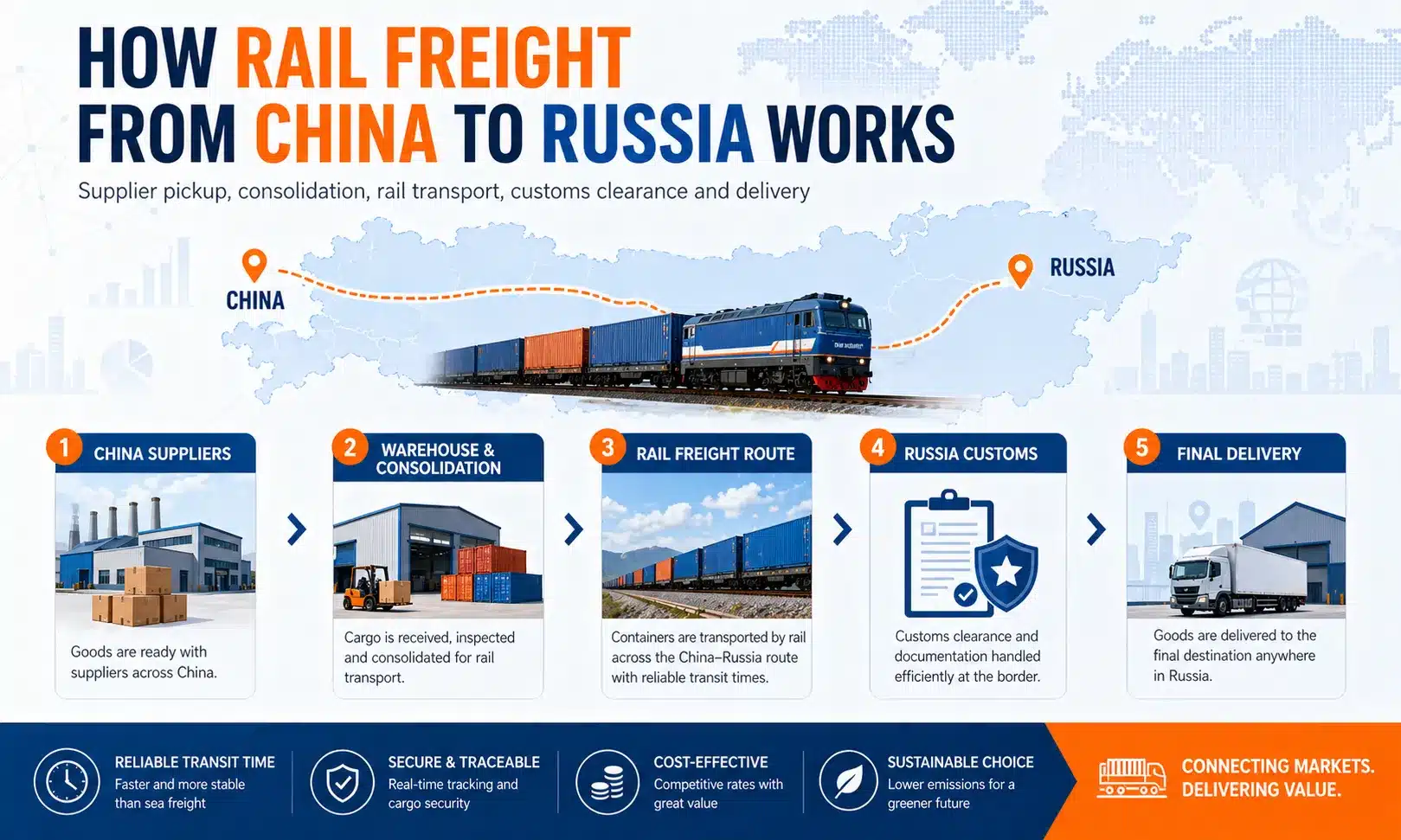
A typical rail freight shipment starts with supplier pickup in China. After pickup, the freight forwarder may receive cargo at a China warehouse, check cartons, consolidate goods from multiple suppliers, prepare export documents, load the container and arrange rail departure.
After departure, the shipment moves through a rail corridor and border crossing into Russia or a connected Eurasian route. Then, the cargo goes through customs clearance, terminal handling and final delivery by truck when the buyer needs door delivery.
Typical rail freight process
- Supplier pickup in China
- China warehouse receiving and cargo checking
- Consolidation from one or multiple suppliers when needed
- Carton measurement, weighing and packing review
- Container loading or LCL consolidation
- China export declaration
- Railway departure from China
- Border crossing and rail transit
- Russia customs clearance and terminal handling
- Truck delivery to warehouse, business address or consignee site
This process looks simple on paper. However, each step can create delay when the documents, cargo details, route plan or final delivery instructions are unclear.
Main China to Russia Rail Routes and Border Crossings
There is no single route for every shipment. A reliable China to Russia freight forwarder should choose the route based on supplier city, departure terminal, cargo type, container availability, border crossing, Russian destination, customs plan and current railway schedule.
Manzhouli / Zabaikalsk Route
The Manzhouli–Zabaikalsk railway border crossing is one of the most important corridors between China and Russia. It is especially relevant for shipments moving from China into Russia and onward to Moscow or other inland distribution markets.
Because this crossing handles a large share of China-Russia rail cargo, importers should check capacity, terminal handling and current congestion conditions before booking. A major corridor can be efficient, but it can also face pressure during busy periods.
Naushki, Dostyk, Altynkol and Other Corridor Options
Some China to Russia and China to CIS rail services may use Naushki, Dostyk, Altynkol, Zabaikalsk or other corridors. The best option depends on origin city, destination market, available train service and current route capacity.
For example, cargo from Chengdu, Chongqing, Wuhan, Suzhou, Hefei, Qingdao, Shanghai, Ningbo, Xiamen, Shenzhen or Guangzhou may connect to different railway hubs and border routes depending on service availability.
South China to Moscow or Vorsino
For cargo from Shenzhen, Guangzhou and other South China origins, a South China to Moscow or Vorsino route may be relevant. Published route examples from rail operators can help importers understand possible terminal-to-terminal timing. Nevertheless, each booking still needs live route confirmation.
Sea + Rail via Russian Far East
For some shipments, the cargo may move by sea to a Russian Far East port and then continue by railway across Russia. This multimodal option can work when direct rail space is limited, when the supplier location is closer to a Chinese seaport, or when a sea-rail plan offers a better balance between cost and timing.
China to Moscow Rail Freight and Major Russian Delivery Cities
China to Moscow rail freight is one of the most common route interests because Moscow and the Moscow region serve as major distribution centers for wholesale, retail, e-commerce and national logistics networks.
However, Moscow is not the only destination. After rail arrival and customs clearance, cargo may move onward by truck or domestic logistics to other Russian cities. The final delivery city can change the total cost more than many importers expect.
| Russian Destination | Typical Use Case | What to Confirm |
|---|---|---|
| Moscow and Moscow region | Wholesale, retail, e-commerce and national distribution | Terminal, warehouse address, delivery appointment and unloading rules |
| Saint Petersburg | Northwest Russia distribution and port-linked cargo planning | Rail or multimodal route, final trucking and customs plan |
| Yekaterinburg | Ural region and industrial supply chains | Inland delivery time and consignee receiving conditions |
| Novosibirsk | Siberian distribution and inland cargo movement | Rail terminal options and domestic delivery plan |
| Kazan | Volga region commercial cargo | Truck delivery distance and unloading requirements |
| Rostov-on-Don | Southern Russia distribution | Final delivery route and regional transit time |
| Krasnodar | Southern market delivery | Truck cost, warehouse address and delivery appointment |
For door-to-door shipping from China to Russia, the rail arrival terminal is only part of the plan. After customs clearance, the shipment may still need container trucking, unloading, storage, repacking or delivery to the consignee’s final address.
Rail Freight Transit Time from China to Russia
Rail transit time from China to Russia depends on the route, origin city, departure station, border crossing, Russian destination, customs process, terminal capacity and final truck delivery. Therefore, importers should use planning ranges instead of one fixed promise.
Some published rail services show route references such as about 14–18 days or about 20–25 days terminal-to-terminal, depending on the operator and corridor. However, door-to-door delivery usually takes longer because it includes pickup, export handling, border movement, customs clearance, terminal release and final trucking.
| Route Type | Planning Range | Important Note |
|---|---|---|
| Selected terminal-to-terminal rail services | Some published services show around 14–25 days depending on route | Use this only as a route-specific reference, not a universal guarantee |
| Rail door-to-door delivery | Often around 25–45 days depending on pickup, customs and final delivery | Includes more logistics steps than rail movement alone |
| Sea + rail via Far East | Often around 30–45+ days depending on vessel and rail connection | Useful for multimodal plans, but schedule depends on both sea and rail legs |
| Road or multimodal door delivery | Varies by route, border, cargo and city | Useful when delivery flexibility matters more than rail-only timing |
In practice, delays can happen because of border transshipment, railway congestion, customs inspection, missing documents, EAC issues, terminal handling, container availability and final truck delivery arrangements.
Rail Freight Cost from China to Russia: What Affects the Quote?
Rail freight cost from China to Russia changes by route, cargo size, market conditions and service scope. A reliable quote should not start from a country name only. Instead, it should start from the supplier city, Russian destination, product details, container type, weight, dimensions, customs requirements and delivery terms.
This guide does not use old fixed price ranges because railway freight rates can move with container supply, rail space, border capacity, market demand, route choice and final delivery requirements. Instead, importers should request an updated quote before booking.
| Cost Factor | Why It Matters | What to Send |
|---|---|---|
| Origin city in China | Pickup distance and nearest rail hub affect cost and timing | Factory address, warehouse location or pickup city |
| Russian destination | Moscow, Saint Petersburg, Yekaterinburg and other cities have different final delivery costs | City, ZIP/postal code and full delivery address if available |
| Container type | 20GP, 40GP, 40HQ, SOC and COC can have different availability and pricing | Container requirement or cargo CBM |
| Cargo volume and weight | Rail pricing depends on container use, cargo weight and loading plan | Carton quantity, dimensions, gross weight and CBM |
| Route and border crossing | Different corridors have different capacity, handling and transit time | Preferred destination and timing requirement |
| Customs and documents | Missing invoice, packing list, TN VED code or EAC documents can create delay and cost | Product description, HS code, photos and compliance documents |
| Service terms | Terminal-to-terminal, DAP, DDP-style and door-to-door have different scopes | Confirm whether customs and final delivery are included |
FCL, LCL, SOC and COC Rail Container Options
Container planning matters in China to Russia railway freight. The best option depends on cargo volume, shipment value, delivery deadline, loading method, container availability and whether the buyer wants more control over the container.
| Option | Best For | What to Check |
|---|---|---|
| FCL rail freight | Full container shipments, larger B2B cargo and planned inventory | 20GP, 40GP, 40HQ, loading plan, weight limit and destination terminal |
| LCL rail freight | Smaller shipments that do not fill a container | CBM, gross weight, consolidation fees, handling risk and destination charges |
| SOC container | Importers or shippers using their own container | Container acceptance, route approval, documentation and return requirements |
| COC container | Shipments using a carrier or operator container | Container availability, demurrage, detention and route restrictions |
| Multi-supplier consolidation | Buyers sourcing from several Chinese factories | Warehouse receiving, carton checking, storage time and loading sequence |
For smaller importers, LCL or warehouse consolidation can reduce the need to book a full container. However, LCL also adds handling steps, so fragile or high-value goods may need stronger packaging and clearer carton labels.
Rail Freight vs Road Freight vs Air Freight vs Sea-Rail
Rail is only one option for shipping from China to Russia. Importers should compare rail, road, air and sea-rail routes based on cost, timing, cargo type, customs plan and final delivery needs.
| Shipping Method | Best For | Main Advantage | Main Limitation |
|---|---|---|---|
| Rail freight | Containerized commercial cargo and medium-to-large shipments | Balanced cost and speed for many China to Russia shipments | Route capacity, border handling and customs timing can change |
| Road freight | Flexible door-to-door delivery and some smaller shipments | Flexible pickup and final delivery planning | Border conditions, road restrictions and cargo acceptance matter |
| Air freight | Urgent, high-value or lightweight cargo | Fastest option | Usually much more expensive for heavy cargo |
| Sea + rail | Bulk cargo with more flexible timing | Can work when multimodal routing offers better cost or capacity | Depends on vessel schedule and rail connection |
| Door-to-door shipping | Importers needing one coordinated logistics plan | Connects pickup, freight, customs support and final delivery | Scope must clearly define customs, duty, VAT and delivery responsibility |
For a more detailed comparison of road routes, border crossings and delivery options, read our guide to truck freight from China to Russia.
For a broader comparison, review Railway Freight from China, Air Freight from China, Sea Freight from China and Door-to-Door Shipping from China.
DDP-Style Rail Shipping from China to Russia: Useful, but Not for Every Cargo
DDP-style rail shipping from China to Russia can reduce coordination work when the cargo is suitable and the service provider clearly defines the scope. A DDP-style quote may include China pickup, export handling, rail freight, customs coordination, duty/tax handling under the agreed structure and final delivery.
However, DDP-style service is not a shortcut around customs, product compliance, EAC requirements, sanctions-related checks or restricted cargo rules. Importers should review the product, TN VED code, declared value, importer structure, EAC documents and delivery scope before choosing this option.
| DDP-Style Item | What to Confirm | Why It Matters |
|---|---|---|
| Product eligibility | Can this cargo move under the planned route? | Not every product fits DDP-style rail shipping |
| TN VED code | Is the classification accurate for Russia customs? | Classification affects duty, VAT, EAC and customs release |
| EAC requirement | Does the product need EAC certificate or declaration? | Missing EAC documents can delay or block clearance |
| Declared value | Does the invoice match the real transaction? | Undervaluation can create customs risk |
| Duty and VAT scope | Who pays duty, VAT, customs brokerage and terminal charges? | Prevents disputes after arrival |
| Final delivery | Does the quote include truck delivery, unloading and appointment? | Terminal arrival does not always mean door delivery |
| Excluded charges | Who pays storage, inspection, repacking or redelivery fees? | Hidden exclusions can change the final cost |
Russia Customs Clearance: TN VED Code, Invoice, Packing List and Importer Details
Russia customs clearance is one of the most important parts of shipping from China to Russia. Freight price matters, but wrong customs documents can create higher costs than the freight savings.
Before shipping, importers should confirm product classification, declared value, consignee details, broker requirements, TN VED code and whether EAC certification or declaration is required. In addition, the commercial invoice and packing list should describe the cargo clearly. Vague product names such as “parts,” “accessories” or “goods” can create customs questions.
Common Documents for China to Russia Shipping
- Commercial invoice: Shows seller, buyer, product description, quantity, unit price, total value, currency and Incoterms.
- Packing list: Shows carton quantity, gross weight, net weight, dimensions, package marks and packing details.
- Railway bill or transport document: Supports railway transportation and cargo handover.
- Contract or purchase agreement: May support commercial transaction details.
- HS code or TN VED code: Supports customs classification, duty calculation and compliance checks.
- Certificate of origin: May be requested depending on product, buyer or customs requirements.
- EAC certificate or EAC declaration: May be required for regulated products under EAEU technical regulations.
- Product compliance documents: May be needed for electronics, children’s goods, machinery, cosmetics, food-contact goods, batteries, chemicals or regulated cargo.
- Importer and customs broker details: Russian consignee information, tax details and broker instructions where applicable.
For customs document planning, review Customs Clearance.
EAC Certificate and Product Compliance for Russia Imports
Some products imported into Russia or other Eurasian Economic Union markets need EAC certification or EAC declaration before customs clearance or market sale. The requirement depends on product category, technical regulation, importer responsibility and conformity assessment rules.
Products such as electronics, machinery, children’s goods, textiles, cosmetics, food-contact products and some consumer goods may need extra review before shipping. Therefore, importers should check EAC requirements before cargo leaves China, not after the train reaches Russia.
| Product Type | Possible Compliance Issue | Importer Action |
|---|---|---|
| Electronics and electrical goods | EAC, technical standards, battery or wireless requirements | Check product certificates, specs and Russian importer requirements |
| Machinery and equipment | Technical regulations, safety documents and product manuals | Review EAC documents and TN VED code before shipment |
| Children’s products | Safety and labeling requirements | Confirm certification before production or shipment |
| Textiles and footwear | Material, labeling and conformity requirements | Prepare material details and label information |
| Cosmetics and personal care products | Product composition, labeling and safety documentation | Check registration or declaration requirements |
| Food-contact products | Material safety and technical regulation review | Prepare material composition and compliance documents |
Sanctions, Export Control and Restricted Cargo Review
China to Russia shipping may require extra review when the cargo involves dual-use items, controlled industrial equipment, electronics, wireless devices, drone parts, chemicals, batteries, branded goods, medical-related products or products with sensitive end use. Importers should not book these goods before checking product documents, destination user, compliance requirements and carrier acceptance.
This does not mean every sensitive product is prohibited. However, the freight forwarder, importer and customs broker should review the product before pickup. A shipment that looks like ordinary commercial cargo may still face delay when the product description, HS or TN VED code, brand authorization, EAC document or end-use information is unclear.
Extra-Review Cargo Examples
- Dual-use items or controlled industrial equipment
- Electronics with encryption, wireless or radio functions
- Drone parts, surveillance equipment or sensitive electronic components
- Batteries and battery-powered products
- Liquids, powders and chemicals
- Dangerous goods or suspected dangerous goods
- Branded goods without authorization
- Medical-related products or protective equipment
- Cosmetics and personal care products
- Food-contact products and regulated consumer goods
- Oversized or overweight cargo requiring special loading
- Fragile goods with weak packaging
Cargo That Works Well by Rail from China to Russia
Rail freight works best for commercial cargo that can move in containers and does not require emergency delivery. It can help importers plan inventory, reduce the cost pressure of air freight and create a more structured route for B2B shipments.
| Cargo Type | Why Rail Freight Can Work | What to Review Before Shipping |
|---|---|---|
| Machinery and spare parts | Often heavy, valuable and suitable for containerized rail movement | TN VED code, EAC requirement, packing strength and loading plan |
| Auto parts and industrial goods | Useful for planned replenishment and B2B distribution | Invoice description, material, product use and consignee documents |
| Electronics and accessories | Can balance cost and speed for larger commercial shipments | Battery rules, EAC documents, brand authorization and compliance |
| Textiles, shoes and retail goods | Useful for wholesale, seasonal inventory and retail distribution | Material descriptions, labeling, certificates and packing list accuracy |
| Furniture and home goods | Bulky goods may benefit from containerized rail when timing matters | CBM, packaging strength, loading method and unloading plan |
| Packaging materials and consumer goods | Good fit for stable B2B replenishment and consolidated shipments | Customs value, product use, HS/TN VED classification and final delivery |
Common Mistakes That Delay China to Russia Rail Shipments
Many delays happen because the shipment gets booked before the documents, cargo details and customs plan are ready. As a result, importers should review the full shipping process before loading the container.
- Using old freight rates: China to Russia rail rates change with market demand, container supply, rail space and route capacity.
- Assuming fixed transit time: Published route estimates help planning, but actual delivery depends on border handling, customs and final trucking.
- Using the wrong HS or TN VED code: Incorrect classification can affect duties, taxes, certification and customs release.
- Writing vague invoice descriptions: Product names such as “parts” or “accessories” may cause customs questions.
- Missing EAC documents: Regulated goods may require EAC certification or declaration before clearance.
- Ignoring cargo restrictions: Batteries, chemicals, liquids, powders and dual-use items may need special review.
- Using weak packaging: Long-distance rail movement requires strong cartons, pallets, labels and container loading plans.
- Forgetting final delivery: Terminal arrival does not always include door delivery, unloading or warehouse appointment.
- Misunderstanding DDP-style terms: Always confirm whether duties, VAT, customs brokerage, terminal handling and final delivery are included.
- Skipping consignee checks: Russian importer details and broker instructions should be ready before departure.
Quote Checklist for Rail Freight from China to Russia
The fastest way to get a useful quote is to send complete cargo, route, customs and delivery information. A freight forwarder cannot give a reliable China to Russia rail freight quote with only “how much per kg?”
- Supplier city and pickup address in China
- Russian destination city, terminal or full delivery address
- Product name and clear product description
- Product photos
- HS code or TN VED code if available
- Carton quantity
- Carton dimensions
- Gross weight per carton and total gross weight
- Total CBM
- Pallet information if applicable
- Container requirement: LCL, FCL, 20GP, 40GP, 40HQ, SOC or COC
- Whether goods are stackable
- Whether the cargo includes batteries, liquids, powders, chemicals or magnets
- Whether the goods are branded or need authorization documents
- Whether EAC certificate or EAC declaration is required
- Preferred term: terminal-to-terminal, DAP, DDP-style or door-to-door
- Russian importer and customs broker details if available
- Target delivery deadline
- Final delivery requirements: warehouse appointment, unloading, storage or repacking
How VoltFreight Helps with China to Russia Rail Freight
VoltFreight helps importers arrange shipping from China to Russia by rail, multimodal transport, road delivery and door-to-door solutions. Whether your cargo starts from Shenzhen, Guangzhou, Yiwu, Ningbo, Shanghai, Qingdao, Tianjin, Chengdu, Chongqing, Zhengzhou or another Chinese city, our team can help compare practical routes based on cargo details and delivery requirements.
Our role is not only to quote a rail rate. We help buyers check route options, cargo details, customs documents, container planning, delivery terms and final delivery requirements before cargo leaves China.
- China supplier pickup coordination
- Warehouse receiving and consolidation from multiple suppliers
- Carton checking, weighing and measurement support where arranged
- LCL and FCL rail freight planning
- 20GP, 40GP and 40HQ container loading support
- Rail route and border crossing comparison
- Customs document review for invoice, packing list and product description
- HS code or TN VED code review support based on importer information
- DDP-style, DAP and door-to-door delivery review
- Final delivery planning to Moscow and other Russian cities
- China warehouse storage support for eligible shipments
For country-specific service details, review Shipping from China to Russia.
Related China to Russia Shipping Guides
Use these VoltFreight guides to compare rail freight, customs clearance, door delivery and China-to-Russia logistics before booking your shipment.
- Shipping from China to Russia
- Railway Freight from China
- Door-to-Door Shipping from China
- Customs Clearance
- Air Freight from China
- Sea Freight from China
- Express Freight from China
- Contact VoltFreight
FAQ About Rail Freight from China to Russia
Is rail freight from China to Russia faster than sea freight?
In many cases, rail freight can be faster than sea-based or sea-rail delivery, especially for inland destinations such as Moscow. However, actual timing depends on the route, border handling, customs clearance, terminal capacity and final delivery distance.
How long does rail shipping from China to Russia take?
Some published route references show around 14–25 days for selected terminal-to-terminal services. Door-to-door delivery usually takes longer because it includes supplier pickup, export handling, customs clearance, terminal handling and final truck delivery.
How much does rail freight from China to Russia cost?
The cost depends on origin city, Russian destination, container type, cargo volume, cargo weight, railway route, border crossing, customs requirements, service terms and final delivery address. Because rates change often, importers should request an updated quote before booking.
Which border crossing is important for China to Russia rail freight?
Manzhouli–Zabaikalsk is one of the most important railway border crossings between China and Russia. However, other crossings such as Naushki, Dostyk and Altynkol may also be used depending on route, origin, destination and capacity.
Can I ship goods from multiple suppliers in China to Russia together?
Yes. A China freight forwarder can collect goods from multiple suppliers, store them in a China warehouse, check cartons, consolidate the shipment and arrange one rail freight plan to Russia.
Can I ship LCL cargo by rail from China to Russia?
Yes, LCL rail freight may be available for smaller shipments that do not fill a full container. However, importers should check consolidation fees, handling risk, minimum charge, destination charges and final delivery scope.
Can I ship a full container by rail from China to Russia?
Yes. FCL rail freight can be arranged for 20GP, 40GP or 40HQ containers depending on cargo volume, weight, route availability and destination requirements.
What is the difference between SOC and COC containers?
SOC means shipper-owned container, while COC means carrier-owned container. SOC may give more control in some situations, but it also requires container acceptance, documentation and route approval. COC depends more on operator container availability and return rules.
What documents are needed for Russia customs clearance?
Common documents may include commercial invoice, packing list, railway bill or transport document, contract, HS or TN VED code, certificate of origin if required, EAC certificate or declaration if applicable, product compliance documents and Russian importer or customs broker details.
Do I need EAC certification when shipping from China to Russia?
Some goods require EAC certification or EAC declaration before import or market sale in Russia and other EAEU countries. Requirements depend on product category, technical regulation and importer responsibility. Always check this before shipping regulated goods.
Can VoltFreight arrange DDP-style rail shipping from China to Russia?
VoltFreight can help review DDP-style, DAP and door-to-door options for suitable cargo. However, feasibility depends on product type, customs classification, declared value, EAC requirements, cargo restrictions and final delivery scope.
What cargo is suitable for rail freight from China to Russia?
Rail freight can work well for machinery parts, auto parts, industrial goods, electronics accessories, textiles, retail goods, furniture, packaging materials and other containerized commercial cargo.
What cargo needs extra review before rail shipping to Russia?
Batteries, liquids, powders, chemicals, dangerous goods, dual-use items, wireless electronics, branded goods, cosmetics, medical-related products and products requiring EAC certification need extra review before booking.
Can VoltFreight arrange door-to-door shipping from China to Russia?
Yes. VoltFreight can help coordinate supplier pickup in China, warehouse consolidation, rail freight, multimodal transport, customs document review and final delivery options in Russia depending on cargo details and service requirements.
Final Thoughts
Rail freight from China to Russia remains a practical option for importers who need a balance between speed, cost and cargo capacity. However, successful shipping requires more than booking a train. Importers should plan the route, container type, documents, customs clearance, EAC requirements, final delivery and total landed cost before cargo leaves China.
For many B2B shipments, rail can work well when the cargo is containerized, the consignee is ready, the customs documents are accurate and the final delivery plan is clear. By contrast, urgent cargo, restricted products or shipments with missing compliance documents may need another route or extra review.
If you are comparing rail, truck or multimodal shipping from China to Russia, send us your supplier city, Russian destination, product name, carton quantity, weight and CBM. Contact VoltFreight for a route-specific quotation based on your actual cargo and delivery requirements.
Information Sources
- FESCO: Railway transportation from China to Russia and CIS countries
- Rail Cargo Group: Guangzhou–Moscow/Vorsino rail connection
- Index1520: Trends in mutual trade and transport between Russia and China
- Reuters: Russian rail freight drop deepens as economy slows
- Eurasian Economic Commission: Customs documents
- Eurasian Economic Commission: Technical regulation documents
Important note: This guide is for logistics planning only. Rail freight routes, transit time, cost, DDP-style feasibility, customs clearance, TN VED code, EAC certification, product restrictions, dual-use review, sanctions-related compliance, duty and VAT handling, container availability and final delivery requirements depend on cargo type, route, declared value, consignee, Russian importer, customs broker, railway operator and current market conditions. Always confirm final requirements with your freight forwarder, customs broker, importer and compliance specialist before shipment.