To consolidate shipments from multiple suppliers in China, an importer collects goods from different factories, trading companies or online sellers at one China warehouse before international shipping. Each supplier shipment can be identified, checked and measured first, so the final freight plan is based on the actual combined cargo rather than separate supplier estimates.
This approach is especially useful when you buy from several suppliers in Shenzhen, Guangzhou, Dongguan, Foshan, Yiwu, Ningbo, Shanghai or other Chinese sourcing cities. Suitable orders can be received under one warehouse plan, checked for carton quantity and outer condition, repacked when necessary, and then compared for express, air freight, LCL, FCL, DDP or split-shipment delivery.
However, consolidation is not automatically cheaper. Supplier locations, cargo-ready dates, domestic pickup, storage, packaging, product restrictions, export documents and the final destination all affect whether combining the goods will actually reduce cost or improve control.
Need to combine goods from several Chinese suppliers? Send VoltFreight your supplier list, product names, estimated cartons, weight, dimensions, cargo-ready dates and destination through our contact page. We can review the warehouse receiving and shipping plan before your suppliers arrange separate international shipments.
Important: Freight consolidation is a logistics process. Combining physical cartons does not automatically combine separate commercial transactions, customs responsibilities or product-compliance requirements. Export documents and destination import requirements must still reflect the actual goods and shipment structure.
Quick Answer: How to Consolidate Shipments from Multiple Suppliers in China
To consolidate shipments from multiple suppliers in China, give each supplier the same warehouse address together with the correct customer or supplier receiving mark. The warehouse records each incoming batch, confirms basic carton information, measures the cargo and keeps the supplier shipments identifiable while waiting for the orders that belong to the same freight plan.
After the required goods arrive, suitable cargo can be kept in the original cartons, reinforced, repacked, palletized or consolidated where appropriate. Once the final weight, dimensions and CBM are confirmed, the importer can compare international shipping methods using real packed data.
A typical process is:
Supplier A + Supplier B + Supplier C → China Warehouse → Receiving & Identification → Carton Check → Weight & Measurement → Repacking if Needed → Consolidation → Export & Freight Booking → International Delivery
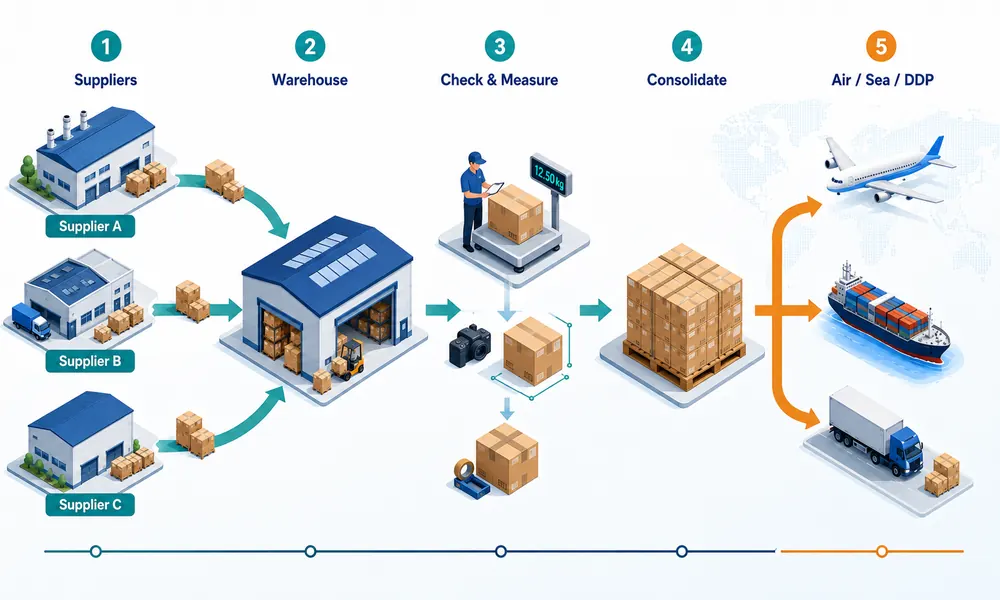
Should You Consolidate Your Suppliers?
| Situation | Usually Consider | Why |
|---|---|---|
| Several small suppliers are ready within a similar period | Consolidation | May reduce repeated minimum charges and create one coordinated freight plan. |
| Orders from Alibaba, 1688 or several factories | Consolidation | A China warehouse can identify, measure and organize different supplier shipments before export. |
| One supplier already has enough cargo for a full container | Direct shipment may be better | Direct FCL loading may avoid unnecessary warehouse handling and domestic movement. |
| One shipment is urgent while other suppliers are not ready | Split shipment | Waiting for every supplier may create more delay than the consolidation benefit justifies. |
| General cargo is mixed with batteries, liquids or restricted products | Separate route review | Not every product can use the same carrier, service or customs arrangement. |
| Total consolidated volume becomes large | Compare LCL and FCL | Combining several suppliers may make a full container more practical. |
What Does China Freight Consolidation Include?
China freight consolidation means receiving products from two or more suppliers and organizing the suitable cargo into one coordinated international shipment or shipping plan. The suppliers do not need to be located in the same city. For example, one may manufacture electronics in Shenzhen, another may produce packaging in Dongguan, while another supplies accessories from Yiwu.
Depending on the requested service, China-side handling may include:
- Supplier communication and cargo-ready confirmation
- Domestic pickup from factories or warehouses
- Warehouse receiving
- Customer-mark and supplier identification
- Carton-count checking
- Basic external package inspection
- Receiving photos
- Weight and dimension measurement
- CBM calculation
- Temporary storage while waiting for other suppliers
- Repacking or carton reinforcement when requested
- Palletizing where suitable
- Shipping-mark and label coordination
- Multi-supplier consolidation
- Export-document coordination
- Comparison of international shipping methods
The purpose is not simply to place several supplier orders in the same warehouse. When you consolidate shipments from multiple suppliers in China, the bigger advantage is that you can see the complete cargo picture before committing to international transportation.
This is particularly useful under EXW purchasing terms, where the overseas buyer normally controls more of the China-side logistics after the supplier makes the goods available. If you are still deciding which purchasing term works better, read our EXW vs FOB shipping from China guide.
When Should You Consolidate — and When Should You Ship Separately?
Before you consolidate shipments from multiple suppliers in China, compare supplier locations, cargo-ready dates, product restrictions and the cost of waiting. Consolidation is useful, but it should not be treated as the correct answer for every multi-supplier order.
Situations Where Consolidation Often Makes Sense
Combining shipments is usually worth reviewing when several suppliers have relatively small orders and their production schedules are close enough that the goods can wait for each other without causing a serious delay.
Common situations include:
- You buy several small orders from different factories.
- Each shipment would otherwise face a separate international minimum freight charge.
- Supplier carton dimensions are only estimates and need to be measured again.
- You want to inspect external packaging before export.
- You need several supplier orders combined into fewer export cartons.
- You want to compare air freight and sea freight after the final total cargo is known.
- You purchase from Alibaba, 1688, Yiwu suppliers or several independent factories.
- You need Amazon, 3PL or commercial warehouse preparation before shipping.
- You want one freight forwarder to coordinate supplier communication and transportation.
Situations Where Separate Shipping May Be Better
Sometimes waiting for consolidation creates more cost or risk than it saves.
For example, suppose Supplier A has urgent stock ready today, while Supplier B will not finish production for another three weeks. Holding Supplier A’s cargo simply to create one combined shipment may create an inventory problem at the destination.
Separate shipping should also be considered when:
- The suppliers are located very far apart and domestic transportation becomes expensive.
- One shipment is urgent while the others are not.
- One supplier has enough cargo for a direct FCL container.
- Different products require different carriers or customs arrangements.
- Dangerous goods cannot travel with the general cargo.
- One product is suitable for air freight while another clearly belongs by sea.
- Separate importers, purchase transactions or delivery destinations require different documentation.
- The cost of storage, pickup and warehouse handling exceeds the duplicate charges being avoided.
A good freight forwarder should therefore compare the complete logistics plan rather than automatically recommend consolidation.
Step-by-Step: How to Consolidate Shipments from Multiple Suppliers in China
The process to consolidate shipments from multiple suppliers in China works best when the warehouse instructions are prepared before suppliers begin sending goods.
Step 1: Create a Supplier List
Start with a simple list showing each supplier, product, city, estimated cartons, cargo-ready date and contact person.
For example:
- Supplier A — Shenzhen — electronic accessories
- Supplier B — Dongguan — packaging materials
- Supplier C — Yiwu — household accessories
The forwarder can then estimate when each batch should arrive and whether consolidation is practical.
Step 2: Give Every Supplier the Correct Warehouse Instructions
Each supplier should receive the warehouse address, contact information and required receiving mark.
A reference system might look like:
- CLIENT-4821-A — Supplier A
- CLIENT-4821-B — Supplier B
- CLIENT-4821-C — Supplier C
The exact format does not matter as much as consistency. The mark helps warehouse staff connect an incoming carton with the correct customer and supplier.
Ask suppliers to place the required mark clearly on the outer cartons and provide the domestic tracking or delivery information after dispatch.
Step 3: Suppliers Deliver the Goods or the Forwarder Arranges Pickup
Some suppliers can send the cargo to the warehouse using Chinese domestic logistics. For factories that cannot arrange delivery, the freight forwarder may arrange pickup.
Pickup planning normally requires:
- Full Chinese pickup address
- Supplier contact and telephone number
- Number of cartons or pallets
- Gross weight
- Dimensions or CBM
- Cargo-ready date
- Whether forklift or special loading support is needed
Step 4: Warehouse Receives and Identifies Every Batch
When cargo arrives, the warehouse checks the receiving mark and records which supplier delivered the goods.
The importer should not wait until every supplier has arrived before asking which cartons belong to which order. Identification should happen at the receiving stage.
Step 5: Confirm Basic Cargo Data
Supplier packing data is useful for planning, but final freight should normally be based on the actual packed shipment.
The warehouse can confirm details such as:
- Actual carton quantity
- Gross weight
- Outer carton dimensions
- Total CBM
- Visible carton condition
- Shipping marks
If the supplier originally estimated 1.5 CBM but the actual cargo is 2.1 CBM, the international freight quotation may change significantly. Measuring before booking helps reduce surprises.
Step 6: Wait for the Required Supplier Orders
Not every order needs to wait for every supplier. The importer should decide which batches belong to the same shipping plan.
If one supplier is seriously delayed, it may be better to send the ready cargo first and place the remaining order into a second shipment.
Step 7: Repack or Consolidate Suitable Cargo
After all required goods arrive, the warehouse can review whether repacking, reinforcement, palletization or carton consolidation makes sense.
Repacking should only be performed when it improves transportation without increasing product damage, labeling or traceability risk.
Step 8: Confirm the Final Shipping Method
Once the actual weight, dimensions, CBM, products and destination are known, the forwarder can compare express courier, air freight, LCL, FCL, DDP or other available services.
This is often the best time to finalize the freight rate because the quotation is based on the real consolidated cargo rather than estimates from several different suppliers.
China Warehouse Receiving: Marks, Carton Checks and Supplier Identification
If you consolidate shipments from multiple suppliers in China, the warehouse receiving process is one of the most important control points.
If ten cartons arrive without a clear customer reference, warehouse staff may know the sender but still have difficulty matching the shipment to the correct overseas buyer, especially when the supplier name differs from the trading company or store name used in the purchase order.
Why Warehouse Marks Matter
A receiving mark acts like an internal shipment reference. It helps separate your cargo from goods belonging to other customers and also helps distinguish Supplier A from Supplier B.
The safest process is:
- Get the warehouse mark before suppliers dispatch cargo.
- Send the exact marking instructions to every supplier.
- Ask suppliers to put the mark on the outer carton.
- Request domestic tracking information after shipment.
- Tell the warehouse how many cartons to expect.
What a Basic Warehouse Receiving Check Can Include
A standard receiving check may include carton counting, external condition review, mark confirmation, basic photos and measurement of the packed cargo.
For example, the warehouse may identify:
- One carton missing from the supplier’s stated quantity
- A crushed or wet outer carton
- Missing shipping marks
- Unexpected pallet packaging
- Actual dimensions larger than the supplier estimate
- A supplier sending additional cartons without notice
Basic Receiving Check Is Not the Same as Full Product Inspection
This distinction should be clear before booking.
A basic receiving check normally does not automatically include opening every retail box, testing product functions, checking every unit, confirming exact colors, inspecting internal components or verifying production quality.
Those tasks require a separate quality-control or product-inspection scope.
If you need detailed inspection, define the checklist before the goods arrive. Otherwise, the warehouse may only confirm what can reasonably be checked during normal cargo receiving.
Does Consolidation Actually Reduce Shipping Cost?
When you consolidate shipments from multiple suppliers in China, shipping cost can fall, but there is no honest fixed percentage that applies to every shipment.
The savings depend on which duplicate expenses disappear after the cargo is combined and which new costs are created by domestic pickup, storage, receiving and repacking.
Why Separate Shipments Can Become Expensive
Imagine three suppliers shipping internationally on their own.
Each shipment may separately generate:
- China pickup or local delivery
- Warehouse or terminal minimum charges
- Documentation fees
- Export-handling costs
- Minimum international freight charges
- Destination clearance or warehouse charges
- Final-mile delivery charges
When the individual shipments are small, these minimum charges can represent a large part of the total freight cost.
Where Consolidation Can Create Savings
Potential savings may come from:
- Fewer international minimum freight charges
- Fewer repeated origin handling charges
- One coordinated international booking
- Better carton utilization after suitable repacking
- Lower volumetric weight for air or express cargo
- Lower total CBM after unnecessary outer packaging is removed
- A larger LCL shipment with a better cost structure
- The possibility of changing from several LCL shipments to one FCL container
- Fewer repeated destination-delivery arrangements
When Consolidation Can Cost More
The importer should also account for:
- Domestic trucking between distant supplier cities
- Warehouse receiving fees
- Storage while waiting for late suppliers
- Repacking materials and labor
- Palletizing or wooden packaging
- Additional handling of oversized or heavy cargo
- Extra document coordination
A useful way to think about the decision is:
Consolidation benefit = duplicate costs avoided + packaging or freight efficiency gained − additional pickup, warehouse, storage and handling costs.
That is why the cheapest strategy cannot be determined from the number of suppliers alone.
Repacking and Volume Optimization Before International Shipping
Supplier packaging is often designed for domestic transport or product protection, not necessarily for efficient international freight.
Some cartons contain excessive empty space. Others use several small boxes where fewer stronger cartons could reduce total volume. For air freight and express shipping, inefficient carton dimensions can increase volumetric weight. For LCL sea freight, unnecessary packaging can increase CBM.
A Simple Volume Example
Suppose several supplier cartons create a combined volume of 4.0 CBM. After checking the products, the warehouse determines that some non-retail outer cartons can safely be removed and the suitable goods can be repacked into stronger export cartons.
If the final volume becomes 3.5 CBM, the shipment has reduced its space requirement by 0.5 CBM.
For LCL freight, this may directly affect the chargeable volume. For air or express freight, smaller cartons can also reduce volumetric weight where dimensional pricing applies.
Repacking Is Not Always the Right Choice
Do not repack only to make the shipment look smaller.
Original packaging may need to remain intact when products require:
- Factory seals
- Retail packaging
- Serial-number traceability
- Fragile protection
- Warranty packaging
- Specific Amazon preparation
- Battery or dangerous-goods labels
- Product-specific handling instructions
Heavy products may also require stronger cartons, pallets, crates, corner protection or reinforcement rather than smaller packaging.
The goal is therefore safe packaging efficiency, not simply the smallest possible box.
Commercial Invoice, Packing List and Export Documents for Multiple Suppliers
If you consolidate shipments from multiple suppliers in China, physical consolidation and document consolidation are related, but they are not the same thing.
If you purchase goods from three suppliers, you may initially receive three separate supplier invoices and three sets of packing information. Sending all three suppliers to one warehouse does not automatically turn those commercial transactions into one invoice.
Start with Accurate Supplier Information
Before export, collect accurate information for every product and supplier, including:
- Supplier or seller information
- Product name
- Material and intended use where relevant
- Quantity
- Unit and total value
- Currency
- Country of origin
- HS code if available
- Carton quantity
- Gross and net weight where applicable
- Dimensions
- Purchase terms
China Customs requires export declarations to accurately reflect the actual goods and supporting information. For this reason, the exporter and declaration structure should be reviewed rather than assuming that several unrelated commercial documents can simply be merged because the cartons are physically consolidated.
Commercial Invoice vs Packing List
The commercial invoice describes the commercial transaction and declared value, while the packing list describes the physical shipment and packaging.
After consolidation, the final packing information should reflect how the export cargo is actually packed. If cartons have been combined, removed, palletized or repacked, the final packing data may differ from the original supplier estimates.
For a detailed explanation, read our packing list for international shipping guide.
Who Handles the China Export Declaration?
The answer depends on the commercial arrangement, supplier capability, exporter structure and freight service being used.
For example, an experienced FOB supplier may normally coordinate its own China-side export process. Under EXW, the buyer and freight forwarder often need to discuss the export arrangement in more detail.
A freight forwarder can coordinate pickup, warehouse receiving, shipment data and communication, but physically controlling the cargo does not replace any legally required exporter, customs declaration or product-specific authorization.
For broader China-side customs planning, review our customs clearance in China guide.
Different Products May Have Different HS Codes
A consolidated shipment does not need to contain only one product type. A single shipment may contain multiple commodity lines, provided the shipment structure, carrier rules and customs requirements support them.
Each product still needs an accurate description and appropriate classification. The Harmonized System is the international framework used to classify traded goods, while destination countries may extend HS codes into longer national tariff codes.
Mixed Cargo: Batteries, Liquids, Branded Goods and Different HS Codes
When you consolidate shipments from multiple suppliers in China, warehouse consolidation does not mean every product should travel on the same international route.
This is especially important when suppliers sell very different products.
For example:
- Supplier A — clothing
- Supplier B — lithium battery products
- Supplier C — liquid cosmetics
All three suppliers may be able to deliver goods to the same China warehouse. However, that does not mean the three products can automatically be placed into one export carton or accepted by the same airline, courier, DDP line or ocean carrier.
Products That Need Extra Review
Examples include:
- Lithium batteries and power banks
- Products containing batteries
- Liquids
- Powders
- Chemicals
- Cosmetics
- Magnets
- Aerosols
- Branded goods
- Food and food-contact goods
- Medical-related products
- Wireless electronics
- Oversized or extremely heavy cargo
- Dangerous goods
Depending on the product, the freight forwarder may need additional information such as product photos, specifications, MSDS, battery documents, test reports, brand authorization or other carrier and customs information.
One Warehouse Can Still Support Several Shipping Routes
Consolidation can still be useful even when the final international transportation is split.
For example:
- Urgent general cargo may move by air.
- Large non-urgent cargo may move by sea.
- Battery products may use a compatible special cargo channel.
- Restricted goods may remain on hold until documentation is confirmed.
The China warehouse therefore acts as a logistics control point. It does not require every product to leave China together or use the same freight channel.
Air, Sea, LCL, FCL, Express or DDP After Consolidation?
One major advantage of multiple-supplier consolidation is that the shipping method can be selected after the actual total cargo is known.
Express Courier
Express shipping from China is usually suitable for smaller urgent shipments where DHL, UPS, FedEx or another courier accepts the product.
After consolidation, the warehouse can confirm the real chargeable data and identify whether several small supplier parcels can be repacked efficiently before courier booking.
Air Freight
Air freight from China can work for urgent commercial cargo that is larger than a normal courier parcel but still needs faster delivery than sea freight.
Weight and carton dimensions matter because air freight may be charged by the higher of actual and volumetric weight.
LCL Sea Freight
LCL is useful when the combined cargo is too large for economical courier or air freight but still does not justify a full container.
Several suppliers can first deliver to one warehouse or consolidation point before the goods enter the LCL export process.
FCL Container Shipping
One reason to consolidate suppliers is to discover whether the total cargo has become large enough for a full container.
For example, five suppliers may each have a relatively small order. Individually, each shipment appears to be LCL. Combined together, the total cargo may become large enough that FCL deserves comparison.
For broader container and LCL planning, review our sea freight from China service.
DDP and Door-to-Door Delivery
Importers that want freight, customs coordination and final delivery under a more complete service model can ask whether DDP is available for the product and destination.
DDP should be reviewed after the actual product, value, HS classification, packed data and destination requirements are known. It should not be assumed simply because the warehouse can consolidate the cartons.
For broader delivery planning, review our door-to-door shipping from China service.
Split Shipment Strategy
Consolidation does not mean the entire order has to use one shipping method.
A common inventory strategy is to send the urgent portion by air while the larger balance moves by sea.
For example:
- 30% of inventory → air freight for urgent replenishment
- 70% of inventory → sea freight for lower unit cost
Because all supplier cargo is visible at one warehouse, the importer can decide which products belong in each shipment before international dispatch.
Practical Example: Three Suppliers in Shenzhen, Dongguan and Yiwu
The following is an illustrative example, not a fixed freight quotation.
An importer purchases products from three Chinese suppliers:
- Supplier A — Shenzhen: 8 cartons of electronic accessories
- Supplier B — Dongguan: 5 cartons of packaging materials
- Supplier C — Yiwu: 12 cartons of household accessories
If every supplier arranges international shipping independently, the importer must manage three freight bookings, three cargo datasets and potentially several minimum charges.
Step 1: Assign Receiving References
The warehouse provides one customer reference with supplier identifiers:
- VF-4821-A
- VF-4821-B
- VF-4821-C
Each supplier marks its cartons before domestic delivery.
Step 2: Receive the Three Supplier Batches
Supplier A arrives first. The warehouse records eight cartons and confirms the outer packaging.
Supplier B arrives two days later with five cartons.
Supplier C arrives after another three days with twelve cartons.
At this point, the warehouse has 25 cartons belonging to one importer but still knows which supplier provided each batch.
Step 3: Measure the Real Cargo
The supplier packing lists are compared with the actual cartons.
The warehouse finds that some supplier dimensions were estimates and updates the final packed data.
This is important because the importer can now request international freight based on actual weight and volume instead of three separate estimates.
Step 4: Review Packaging
The electronic accessories already have suitable protective cartons, so they remain unchanged.
Some of the packaging-material cartons contain unnecessary outer boxes. After confirming that repacking will not damage the goods, selected cartons are optimized.
The household accessories remain in their original cartons because the internal retail packaging needs protection.
Step 5: Compare International Shipping
After all cargo is ready, the importer can compare:
- Separate express shipments
- One consolidated air freight shipment
- One consolidated LCL sea freight shipment
- Whether the total future purchase volume could support FCL
- A split shipment with urgent products by air and the balance by sea
- Available DDP or standard import options for the destination
The correct choice depends on the destination, cargo value, customs requirements, inventory deadline and final packed data.
This example shows the real purpose of consolidation: gain control of the complete shipment before committing to the international transportation method.
Consolidating Alibaba, 1688 and Factory Orders in One China Warehouse
Multiple-supplier consolidation is particularly useful when buyers source products through different channels and need one China-side control point before export.
One order may come from an Alibaba supplier, another from a 1688 seller and another directly from a factory introduced by a sourcing agent.
These sellers may have very different shipping capabilities.
An export-experienced Alibaba supplier may offer EXW or FOB terms. A 1688 seller may only want to deliver to a domestic Chinese address. A factory may have excellent production capability but limited experience preparing international shipping documents.
Using one China warehouse allows the importer to separate the sourcing process from the final international freight plan.
A Practical Workflow
- Place orders with the selected suppliers.
- Give each supplier the warehouse address and customer reference.
- Ask suppliers to provide domestic tracking details.
- Receive and identify each supplier shipment.
- Confirm actual carton data.
- Resolve missing or damaged cartons before export.
- Wait for the required orders.
- Consolidate suitable cargo.
- Review export documents.
- Select the international shipping method.
If your destination is the United States, you can also read our Alibaba shipping to USA and 1688 shipping to USA guides.
Buyers ordering from Taobao can also review our Taobao shipping to USA guide for parcel receiving, consolidation and repacking.
U.S. importers that need a broader receiving, storage and FBA workflow can also review our China warehouse service for US importers.
What Information Should You Send Before Consolidating Supplier Shipments?
The best time to contact the freight forwarder is before suppliers begin arranging separate international shipments.
You do not need perfect final data at the beginning. However, provide enough information to determine whether consolidation is practical.
Supplier Information
- Number of suppliers
- Supplier cities
- Pickup addresses if available
- Supplier contact details
- Expected cargo-ready dates
- Whether suppliers can deliver to a China warehouse
Cargo Information
- Product name
- Product photos
- Carton quantity
- Gross weight
- Carton dimensions
- Estimated total CBM
- Cargo value
- HS code if available
- Special product information
Destination Information
- Destination country
- City
- Postcode
- Complete address if available
- Business, residential, warehouse, 3PL or Amazon delivery
- Preferred delivery deadline
- Whether you need standard freight, DAP, DDP or another service scope
If final weight and dimensions are not available, the warehouse can confirm them after receiving the supplier shipments. The international freight quotation can then be updated using the actual packed cargo.
Why Choose VoltFreight for Multi-Supplier Consolidation in China?
Multiple-supplier shipping requires more than an international freight rate. The China-side work must be organized before the cargo reaches the port, airport or export consolidation facility.
VoltFreight can help coordinate the shipment from supplier receiving through international freight planning.
Supplier Coordination
We can communicate pickup or warehouse-delivery instructions with Chinese suppliers and help confirm cargo-ready information before shipment.
China Warehouse Receiving
Suitable shipments can be received at our China warehouse using customer and supplier references so different incoming batches can be identified.
Carton Checking and Receiving Photos
Basic receiving support can help confirm carton quantity, visible external condition and shipment identification before international dispatch.
Weight, Dimensions and CBM Measurement
We can measure the packed cargo after receiving it so the international freight quotation can use actual shipment data instead of early supplier estimates.
Repacking and Reinforcement Review
When suitable, cartons can be reviewed for consolidation, reinforcement, repacking or pallet preparation. The packaging plan should always consider product protection and transportation risk.
Multiple Supplier Consolidation
Goods from different suppliers can be organized into one freight plan when the products, timing, documentation and shipping method allow it.
Air, Sea, Express and Door-to-Door Comparison
After the final cargo is known, VoltFreight can compare suitable air freight, sea freight, express and door-to-door options instead of forcing every shipment into one transport mode.
Export and Shipping Document Coordination
We can review basic shipment information and coordinate with suppliers and the relevant export parties before international dispatch. Product-specific licenses, certificates and destination import requirements still need to be confirmed for the actual cargo.
Amazon, 3PL and Commercial Delivery Planning
Depending on destination and service availability, consolidated cargo can be planned for delivery to commercial addresses, warehouses, 3PL facilities or Amazon FBA destinations.
Have several suppliers in China? Send us the supplier cities, cargo details and destination before they arrange separate international shipments.
Get a Multi-Supplier Consolidation and Shipping Quote
FAQ About Consolidating Shipments from Multiple Suppliers in China
Can I consolidate goods from different suppliers in China?
Yes. Goods from different Chinese suppliers can usually be received at one warehouse and consolidated when the products, cargo-ready dates, export documents and international shipping requirements are compatible. Each supplier should use the correct warehouse reference so incoming cartons can be identified before consolidation.
Is it cheaper to consolidate multiple shipments from China?
It can be cheaper, especially when separate small shipments would each face minimum freight, handling and delivery charges. However, consolidation also creates China pickup, warehouse, storage or repacking costs. The correct comparison is the total cost of separate shipping versus the complete consolidated shipping plan.
Can I consolidate Alibaba and 1688 orders together?
Yes, suitable Alibaba, 1688 and direct factory orders can be sent to the same China warehouse. The warehouse can identify each supplier shipment, check cartons, measure the cargo and prepare a combined shipping plan. Export documents and product requirements still need to be reviewed before the goods leave China.
How do commercial invoices and packing lists work with multiple suppliers?
Each supplier may initially provide its own commercial and packing information. Physical consolidation does not automatically merge separate commercial transactions. Before export, the shipment’s invoice, packing information, exporter arrangement, product descriptions, values and customs declaration structure should be reviewed based on the actual goods and trade arrangement.
Can consolidated cargo ship by air, sea, DDP or to Amazon FBA?
Yes, depending on the product and destination. Consolidated cargo may move by express, air freight, LCL, FCL, DDP or another door-to-door route. Suitable inventory can also be prepared for Amazon FBA delivery when the seller provides the required labels and shipment information. Not every product qualifies for every route, so batteries, liquids, dangerous goods and other sensitive cargo should be reviewed before booking.
Conclusion: Consolidate Before Your Suppliers Ship Separately
The best time to consolidate shipments from multiple suppliers in China is before those suppliers arrange separate international shipments.
If several suppliers send goods internationally on their own, the importer may end up managing separate freight bookings, repeated minimum charges, different carton data and several delivery schedules.
By sending suitable goods to one China warehouse first, you can identify each supplier shipment, confirm the actual cartons, measure the cargo, review packaging, organize documents and compare the international shipping method after the complete order is visible.
However, consolidation should remain a logistics decision rather than an automatic rule. Urgent goods, distant factories, incompatible products, different customs requirements or long supplier delays may make separate or split shipping more practical.
If you are buying from several suppliers in China, send VoltFreight the supplier list, product details, expected cartons, cargo-ready dates and destination. We can review whether warehouse consolidation, direct shipping or a split freight plan makes more sense before the goods leave China.
Contact VoltFreight to Consolidate Shipments from Multiple Suppliers in China