
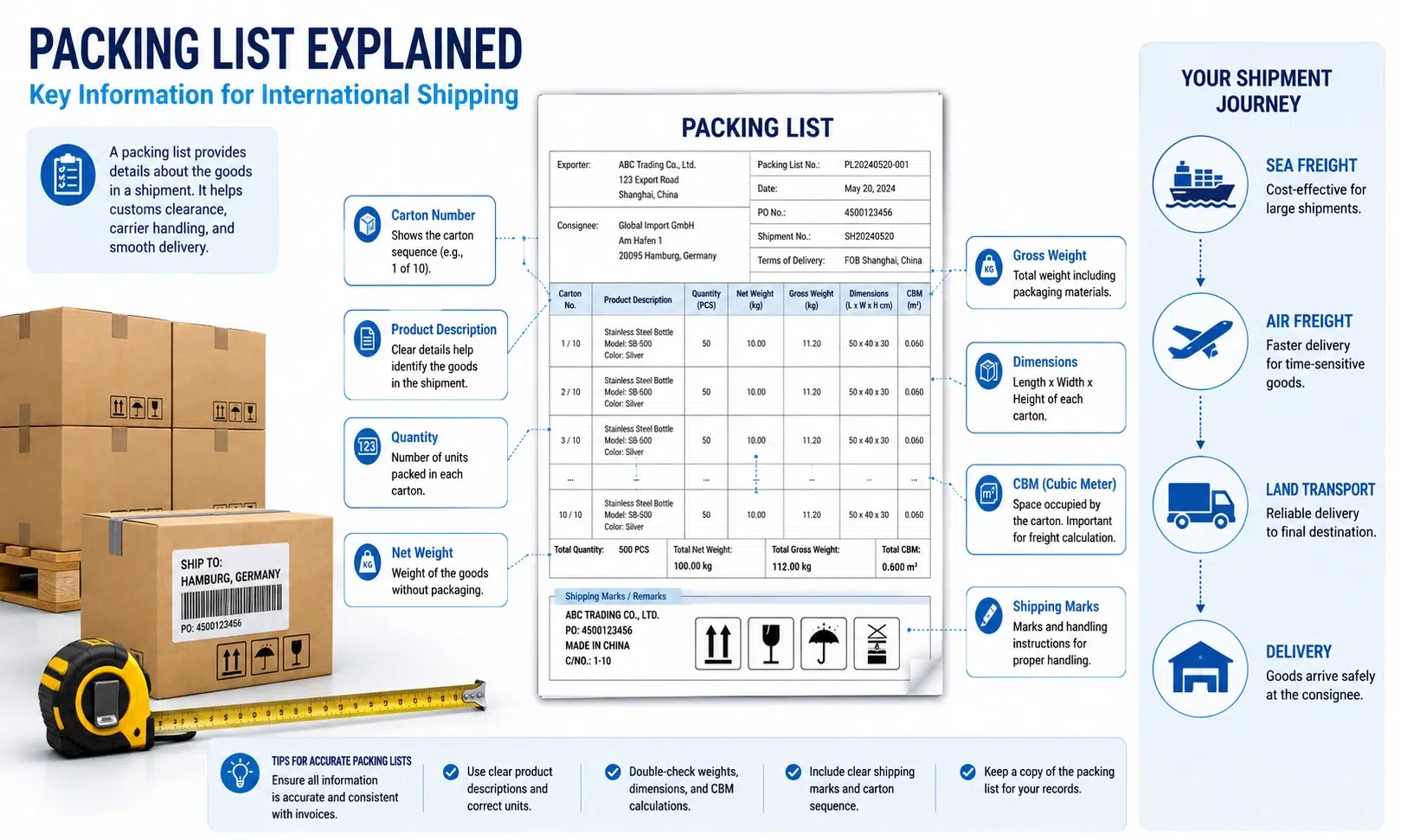
A packing list for international shipping should show exactly how a shipment is packed. It normally includes the exporter and consignee, package count, carton or pallet numbers, product descriptions, quantities, gross weight, net weight, dimensions, total CBM and shipping marks. Freight forwarders, customs brokers, carriers and warehouses use this document to verify the physical cargo, but it does not replace the commercial invoice or Bill of Lading.
A packing list is sometimes informally called a shipping list, shipment list or shipping packing list. However, the purpose remains the same: it connects each product to a specific carton, pallet, crate or package so the shipment can be checked, priced, loaded, cleared and received correctly.
The exact requirement depends on the destination country, shipping method and customs procedure. Some customs authorities may request or require a packing list, while others use it as supporting documentation when package-level details are not fully shown elsewhere. Therefore, exporters should prepare one for almost every commercial sea, air, rail, truck, express or DDP shipment.
Need help checking a supplier’s packing list before shipping from China? Send the product name, carton quantity, gross and net weight, carton dimensions, supplier city and destination postcode through our contact page. VoltFreight can review the cargo data, calculate CBM and compare sea, air, express and DDP options.
Last reviewed: August 6, 2026. Customs-document requirements vary by country, commodity and shipment type. Always confirm destination-specific requirements with the importer or licensed customs broker before cargo departure.
What Is a Packing List in International Shipping?
A packing list is a commercial shipping document prepared by the exporter, supplier, manufacturer or authorised shipping party. It describes the physical contents and packaging of a shipment rather than the commercial value of the transaction.
The U.S. International Trade Administration explains that a packing list itemises the contents of each package and includes weights, measurements and detailed goods information. Freight forwarders use it to confirm weight and freight cost, while customs officials may use it to check a particular carton or package. You can review the official description on the Trade.gov packing list page.
A useful packing list answers practical questions such as:
- How many cartons, pallets, crates or bags are in the shipment?
- Which products are inside each package?
- How many units are packed in each carton?
- What are the net weight, gross weight and outer dimensions?
- What is the total shipment volume in CBM?
- Which carton or pallet should customs inspect?
- Which package belongs to a purchase order, SKU or shipping mark?
Unlike a commercial invoice, the packing list normally does not focus on unit prices, total value or payment terms. Instead, it focuses on the physical cargo.
Is a Packing List Always Required?
No single rule applies to every country and every shipment. The destination customs authority, carrier, freight forwarder, bank, buyer or warehouse may request different documents.
For example, Japan Customs lists packing lists among the documents that may accompany an import declaration, while the European Commission’s Access2Markets portal explains that a packing list may be required for customs clearance as an inventory of incoming cargo. These examples show why exporters should prepare the document even when a carrier does not explicitly request it at the quotation stage.
Official references:
Because requirements vary, use the packing list as a standard commercial document rather than waiting until customs asks for it.
What Information Must a Shipping Packing List Include?
A professional international shipping packing list should allow another person to understand the shipment without opening every carton. The exact layout can vary because there is no universal mandatory template, but the following fields are commonly useful.
Exporter, Importer and Shipment References
Include:
- Exporter or shipper company name and address
- Consignee or importer company name and address
- Notify party when applicable
- Packing list number
- Commercial invoice number
- Purchase order number
- Date of issue
- Incoterm when useful
- Country of origin
- Port, airport or final destination
These references should match the commercial invoice, shipping instruction and transport document. Even a small spelling difference in company name, address, invoice number or package count can create questions during customs or warehouse receiving.
Product and Package Details
For each package or product line, include:
- Carton, pallet, crate or package number
- Shipping mark
- Product name and clear description
- SKU, model or item number
- HS code when available or requested
- Quantity per package
- Total quantity
- Packaging type
Avoid vague descriptions such as “parts,” “accessories,” “samples” or “goods.” A better description explains what the product is, what it is made from and how it is used.
Weight, Dimensions and CBM
The physical measurements should include:
- Net weight per package
- Gross weight per package
- Total net weight
- Total gross weight
- Outer carton dimensions
- CBM per carton or pallet
- Total shipment CBM
Use the final outer packaging dimensions, not the bare product dimensions. If a warehouse adds pallets, wooden crates, corner protection or additional cartons, the packing list should be updated before the final freight quotation.
Use our CBM calculator for shipping from China to check volume before requesting a rate.
International Shipping Packing List Example
The example below shows a simplified packing list for three product lines packed into five cartons. A real document may include more columns, company branding, signatures or destination-specific information.
| Package No. | Product Description | SKU / Model | Quantity | Net Weight | Gross Weight | Outer Dimensions | CBM | Shipping Mark |
|---|---|---|---|---|---|---|---|---|
| CTN 1–2 | Aluminium LED light housings | ALH-120 | 100 pcs | 36 kg | 40 kg | 60 × 45 × 40 cm each | 0.216 | VF/UK/001-002 |
| CTN 3 | Insulated electrical wires | EW-08 | 50 rolls | 22 kg | 24 kg | 55 × 40 × 38 cm | 0.084 | VF/UK/003 |
| CTN 4–5 | Motor coil components | MC-220 | 80 sets | 42 kg | 46 kg | 58 × 42 × 40 cm each | 0.195 | VF/UK/004-005 |
| Total | 3 product lines | — | 230 units | 100 kg | 110 kg | 5 cartons | 0.495 CBM | VF/UK/001-005 |
This example separates each package group and gives the warehouse, freight forwarder and customs broker enough information to identify the cargo. However, the exporter should adjust the fields to match the real shipment.
How to Read the Example
“CTN 1–2” means cartons one and two contain the same product and packaging details. If the cartons contain different quantities or dimensions, list each carton separately.
The gross weight includes the product and packaging, while net weight normally refers to the goods without outer packaging. CBM uses the outer dimensions of the shipping package.
The shipping mark links the physical carton to the documents. Therefore, the printed carton mark and the packing list should match.
How to Create a Packing List Step by Step
A good packing list should come from final warehouse data, not from an early production estimate. Follow this process.
Step 1: Collect Final Product Information
Ask the supplier for:
- Final product name and model
- Quantity ordered and quantity shipped
- Country of origin
- Material and intended use
- HS code if available
- Purchase order and invoice reference
If several suppliers contribute goods, collect separate data from each supplier before consolidation.
Step 2: Number Every Carton or Pallet
Use a clear sequence such as:
- CTN 1/20
- CTN 2/20
- CTN 3/20
For pallets, use PLT 1/4, PLT 2/4 and so on. If one pallet contains several cartons, record both pallet and carton references when the warehouse or consignee needs package-level visibility.
Step 3: Measure the Final Outer Packaging
Measure length, width and height after repacking, palletising or crating. Then record net weight and gross weight using warehouse scales.
Do not rely on supplier catalogue dimensions. International freight pricing uses the final shipping package.
Step 4: Calculate Total CBM and Weight
Calculate the volume of every package and then confirm the totals. The sum of the package-level CBM should match the total CBM shown at the bottom of the document.
Likewise, the package-level gross weights should add up to the total gross weight used for booking.
Step 5: Match the Commercial Invoice
The product descriptions, quantities, package count, invoice number, shipper, consignee and country of origin should remain consistent across the packing list and commercial invoice.
The commercial invoice can contain values and payment information, while the packing list contains packaging and physical details. However, the basic shipment facts must agree.
Step 6: Review Before Cargo Departure
Before booking, compare the packing list with:
- Commercial invoice
- Warehouse measurement sheet
- Supplier delivery note
- Shipping instruction
- Bill of Lading or Air Waybill draft
- Amazon or 3PL delivery plan
Correct mismatches before the cargo leaves China. Amendments become harder after export declaration, carrier handover or customs submission.
Packing List vs Commercial Invoice, Bill of Lading and Packing Slip
These documents often describe the same shipment, but they serve different purposes.
Packing List vs Commercial Invoice
The packing list explains how the goods are packed. It normally contains package numbers, quantities, weights, dimensions and CBM.
The commercial invoice explains the sale and customs value. It normally includes unit prices, total value, currency, seller, buyer, Incoterm and payment-related information.
The two documents should match on product description, quantity, shipper, consignee and shipment references. Nevertheless, the packing list usually does not need product prices.
Packing List vs Bill of Lading
A Bill of Lading is a carrier-issued sea transport document that records receipt of cargo and the contract of carriage. An Air Waybill performs a similar transport-document role for air cargo.
The packing list is prepared by the exporter or supplier and describes the package contents. It does not prove carrier receipt and does not replace the transport document.
Packing List vs Packing Slip
Companies sometimes use “packing list” and “packing slip” interchangeably. In practical international trade, however, a packing list often describes the full export shipment and supports freight and customs work.
A packing slip is more commonly a receiver-facing document placed inside a parcel or carton to help the buyer check the delivered order. It may not contain the full shipment’s dimensions, weights, CBM or customs references.
Because terminology varies between ERP systems and companies, focus on the document fields rather than the label alone.
Packing List vs Shipping Instruction
A shipping instruction tells the freight forwarder or carrier how to prepare the transport document. It usually includes shipper, consignee, notify party, cargo description, package count, weight, port information and Bill of Lading instructions.
The packing list provides the physical cargo detail that supports those instructions. Therefore, the package count and weight in both documents should agree.
Packing Lists for Sea, Air, Express, Rail and DDP Shipping
The core fields remain similar, but each shipping method creates different priorities.
Sea Freight Packing List
For LCL and FCL sea freight, include accurate:
- Package count
- Gross weight
- CBM
- Container or pallet references where applicable
- Shipping marks
- Product descriptions
LCL warehouses use the packing list to confirm consolidation data. FCL shipments also need accurate container loading and customs information.
For route planning, review our sea freight from China service.
Air Freight and Express Packing List
Air freight and express courier pricing depend heavily on chargeable weight. Therefore, final carton dimensions and gross weight must be accurate.
For multi-carton shipments, show each carton separately when dimensions or contents differ. This helps the carrier identify oversized pieces, special handling and customs-inspection packages.
Review our air freight and express freight services for route differences.
Rail and Truck Freight Packing List
Rail and truck cargo may pass through several terminals, borders or transfer warehouses. Clear carton and pallet numbers help operators check cargo during transfer.
For palletised cargo, show pallet dimensions, weight, carton count per pallet and whether the pallets are stackable.
DDP and Door-to-Door Packing List
DDP does not reduce the need for accurate documents. The freight forwarder still needs correct products, quantities, weights, dimensions, values and classifications to review customs and delivery risk.
A DDP packing list should match the commercial invoice and the accepted product scope. Undeclared goods, vague descriptions or package-count differences can cause customs questions, storage, return or additional charges.
Packing Lists for Amazon FBA, 3PL and Warehouse Delivery
Amazon FBA and 3PL shipments require both international shipping documents and warehouse receiving information.
Amazon FBA Shipments
The packing list should not replace Amazon carton labels, FNSKU labels or shipment IDs. Instead, it should support the freight forwarder and warehouse by showing:
- Amazon shipment reference
- Fulfilment-centre code or delivery address
- Carton count
- SKU and quantity
- Carton dimensions and gross weight
- Pallet details where applicable
Make sure the carton quantity on the packing list matches the shipment plan. If Amazon splits the shipment between fulfilment centres, prepare the documents and labels by destination.
For related support, review our FBA prep service in China and shipping from China to Amazon FBA guide.
3PL and Commercial Warehouse Delivery
A 3PL may request purchase order numbers, advance shipment notice references, pallet counts, carton labels and package-level SKU data.
Therefore, ask the receiving warehouse what information it needs before the shipment leaves China. Adding the warehouse reference to the packing list can reduce receiving delays.
Common Packing List Mistakes That Delay Customs or Delivery
Many problems come from inconsistent or estimated data rather than the packing-list format itself.
Package Count Does Not Match the Cargo
The packing list may show 20 cartons while the warehouse receives 21. This can delay export declaration, carrier handover, customs inspection or warehouse receiving.
Update the document after repacking or carton splitting.
Gross Weight and CBM Are Estimated
Suppliers sometimes prepare documents before final packing. As a result, the booking weight or CBM may not match the actual cargo.
Use final warehouse measurements before confirming the freight rate.
Product Descriptions Are Too Vague
Descriptions such as “parts,” “accessories,” “sample” or “gift” do not explain the cargo. Use a specific product name, material and function.
For example, write “aluminium LED light housing” instead of “metal parts.”
Commercial Invoice and Packing List Do Not Match
Common mismatches include:
- Different product quantities
- Different company names
- Different invoice numbers
- Different country of origin
- Different package count
- Different product descriptions
Customs may ask which document is correct. Therefore, review them together.
Carton Numbers and Shipping Marks Are Missing
Without carton numbers, customs or warehouse staff may need to open several packages to find one product. A clear carton sequence improves traceability.
Net Weight Is Higher Than Gross Weight
This obvious error appears surprisingly often in supplier documents. Gross weight should include the product and packaging, so it should not be lower than net weight.
The Packing List Was Not Updated After Consolidation
When a freight forwarder combines goods from several suppliers, the original supplier packing lists may no longer reflect the final export packaging.
Prepare one final consolidated packing list or a clearly linked master document before export.
How Freight Forwarders Review a Packing List
A freight forwarder does not only check whether the document looks professional. The forwarder compares the packing data with the route, carrier and customs requirements.
VoltFreight typically reviews:
- Whether product descriptions are clear
- Whether package quantities match supplier deliveries
- Whether weight and dimensions support the quotation
- Whether CBM calculations are correct
- Whether invoice and packing-list quantities match
- Whether special cargo has been declared
- Whether pallet and carton labels support final delivery
- Whether the consignee and postcode are complete
For sensitive cargo, the review may also cover batteries, liquids, powders, magnets, branded goods, chemicals, electronics or other regulated products.
A warehouse receiving check is not the same as a full product quality inspection. However, it can confirm carton count, visible packaging condition, labels and final measurements before shipping. Read our China inspection service before shipping guide for the difference.
Representative Packing List Case
The following anonymised example shows why a final warehouse packing list matters.
A buyer purchased electronics accessories and aluminium components from three suppliers in Shenzhen and Dongguan. Each supplier sent a separate packing list before delivery to the consolidation warehouse.
The original documents showed:
- 28 cartons
- 412 kg gross weight
- 3.10 CBM
After warehouse receiving, the team found that two suppliers had used estimated carton dimensions. The warehouse also combined several small boxes and added stronger export cartons.
The final shipment became:
- 24 cartons
- 426 kg gross weight
- 2.86 CBM
VoltFreight prepared a final consolidated packing list that linked each product to the new carton numbers and shipping marks. The commercial invoice quantities remained unchanged, but the package count, gross weight, dimensions and CBM were updated.
As a result, the air and sea freight comparison used real cargo data rather than supplier estimates. The buyer also received a clearer document for customs clearance and warehouse receiving.
Why Choose VoltFreight for Packing List and Shipping Support?
VoltFreight helps importers connect document preparation with the real cargo and shipping route.
Our support can include:
- Supplier pickup and China warehouse receiving
- Multi-supplier consolidation
- Carton count and visible packaging checks
- Final gross weight and dimension measurement
- CBM and volumetric-weight calculation
- Commercial invoice and packing-list consistency review
- Carton labels, pallet labels and shipping marks
- Sea, air, express, rail, truck and DDP route comparison
- Amazon FBA, 3PL and warehouse delivery planning
- More than 10 years of China freight-forwarding experience
We do not treat the packing list as an isolated form. Instead, we use it to confirm cargo measurements, customs readiness, shipping cost and final delivery requirements.
For a broader import workflow, read our how to import from China guide and customs clearance in China guide.
FAQ About International Shipping Packing Lists
What is a packing list used for?
A packing list shows how goods are packed, including package numbers, product quantities, weights, dimensions, CBM and shipping marks. Freight forwarders, carriers, customs brokers and warehouses use it to verify the physical shipment.
Is a packing list required for international shipping?
Requirements vary by destination, commodity and shipment type. Some customs authorities, carriers, banks or buyers may request it. Because it supports freight pricing, customs inspection and warehouse receiving, exporters should prepare one for almost every commercial shipment.
Does a packing list need prices?
Usually not. Product prices, total value and currency normally belong on the commercial invoice. The packing list focuses on package contents, quantities, weight, dimensions and CBM. However, follow any specific destination, bank or customer requirement.
What is the difference between a packing list and a commercial invoice?
The packing list describes the physical shipment and packaging. The commercial invoice describes the sale and customs value. Both documents should match on product descriptions, quantities, shipper, consignee and shipment references.
Who prepares the packing list?
The exporter, manufacturer, supplier, seller or authorised shipping party usually prepares it. When several suppliers are consolidated, the freight forwarder or warehouse may prepare a final master packing list using verified cargo data.
Prepare the Packing List Before Requesting the Final Freight Rate
A reliable packing list should show:
- Who ships and receives the cargo
- What each package contains
- How many units and packages are included
- The net and gross weight
- The final outer dimensions
- The total CBM
- The carton, pallet and shipping-mark references
Prepare the document after final packing and make sure it matches the commercial invoice, warehouse measurements and shipping instruction.
Need VoltFreight to review your cargo data before shipping from China? Send the product name, packing list, commercial invoice, carton quantity, weight, dimensions, supplier city and destination postcode. We can check the shipment details and compare suitable sea, air, express and DDP routes.
Request a packing-list review and freight quote from VoltFreight.
Important notice: This guide provides general shipping-document information. Customs requirements, document formats and product regulations vary by destination and shipment type. Confirm the final requirements with the importer, customs broker or relevant authority before cargo departure.