Updated: July 2026. Shipping from China to Amazon FBA Europe requires more than booking an international freight service. Amazon sellers must coordinate supplier pickup, FBA labels, export documentation, international transport, EU customs clearance, VAT and EORI arrangements, final delivery appointments and Amazon receiving requirements before the inventory leaves China.
Depending on the shipment size and replenishment deadline, sellers can use express courier, air freight, rail freight, truck freight, LCL sea freight, FCL sea freight or DDP door-to-FBA delivery. However, the cheapest shipping method is not always the best choice. A low freight rate can become expensive if the cartons need relabeling, customs documents are incomplete, Amazon rejects the delivery or the shipment arrives after the seller runs out of stock.
This guide explains the complete China-to-Europe Amazon FBA shipping process, including estimated transit times, cost factors, shipping-method selection, direct FBA delivery, European prep warehouses, VAT, EORI, Importer of Record responsibilities, FNSKU labels, carton requirements, pallet delivery and DDP service.
Need a China-to-Amazon FBA Europe shipping quote? Send your product name, supplier city, carton quantity, carton dimensions, total weight, total CBM, cargo-ready date and assigned Amazon fulfillment center to VoltFreight. We can compare air, sea, rail, truck, express and DDP delivery options based on your shipment.
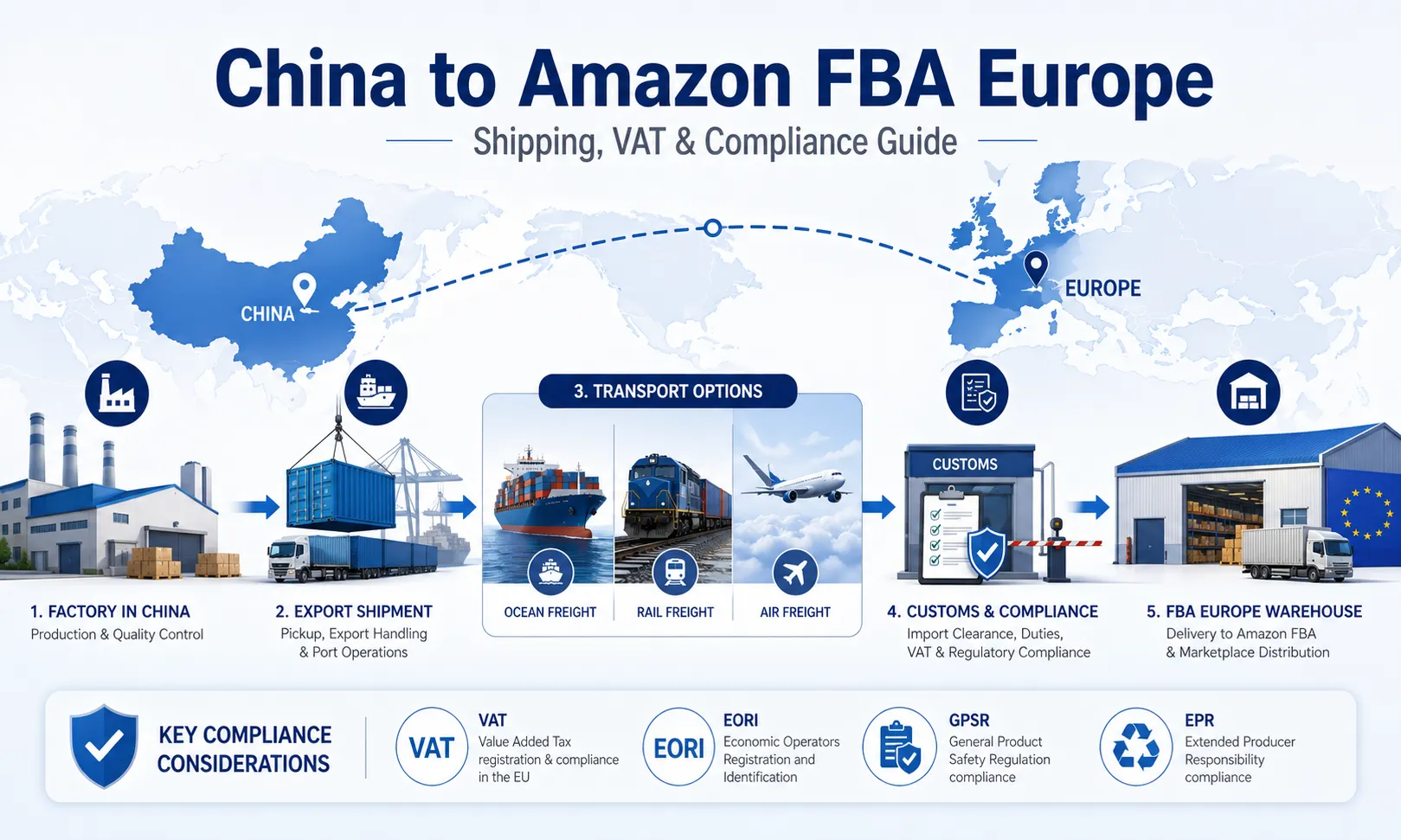
Quick Answer: How Can You Ship from China to Amazon FBA Europe?
You can ship directly from a Chinese supplier or China warehouse to an Amazon fulfillment center in Germany, France, Italy, Spain, Poland, the Netherlands or another European market. Before booking freight, however, you should create the Amazon shipment plan, confirm the final warehouse address and prepare the required product and carton labels.
For small and urgent shipments, express courier or air freight is usually the most practical option. For medium-sized replenishment orders, rail freight, truck freight or consolidated air freight may provide a better balance between cost and transit time. Meanwhile, LCL or FCL sea freight usually offers the lowest unit cost for large and non-urgent inventory shipments.
In addition, sellers must decide whether the cargo should move directly to Amazon or first enter a European prep warehouse. Direct delivery can reduce handling time when every label, carton and document is correct. By contrast, a prep warehouse provides more flexibility when the goods need inspection, relabeling, palletizing, storage or gradual replenishment.
- Urgent samples and small replenishment: Express courier or air freight.
- Medium commercial shipments: Air, rail, truck or DDP consolidated service.
- Bulky and non-urgent inventory: LCL sea freight.
- Large and stable replenishment: FCL sea freight.
- Goods requiring additional preparation: Deliver to a European prep warehouse before Amazon.
- Sellers requesting one landed-cost service: Review a DDP door-to-FBA option.
How Does Shipping from China to Amazon FBA Europe Work?
A reliable Amazon FBA shipment should be planned backward from Amazon’s receiving requirements. In other words, sellers should not book the international freight first and think about labels, VAT or delivery appointments later.
The following workflow helps reduce customs delays, Amazon rejection and unexpected storage or redelivery charges.
- Confirm the destination marketplace. Decide whether the inventory will enter Germany, France, Italy, Spain, Poland, the Netherlands or another European country.
- Create the Amazon shipment plan. Confirm the shipment ID, assigned fulfillment center, SKU quantities, carton count and box-content information in Seller Central.
- Download the required labels. Prepare FNSKU labels, FBA Box ID labels and pallet labels where applicable.
- Prepare the goods in China. Ask the factory or China warehouse to apply labels, check cartons, measure dimensions, confirm weight and take packing photos.
- Arrange supplier pickup or warehouse delivery. The goods can be collected from one supplier or consolidated from several factories.
- Complete China export handling. Prepare the commercial invoice, packing list, product description, HS code and export declaration information.
- Move the cargo to Europe. Use express, air, rail, truck, LCL sea freight, FCL sea freight or another approved route.
- Complete import customs clearance. Confirm the Importer of Record, EORI, customs value, duties, VAT arrangement and product documentation.
- Arrange final Amazon delivery. Deliver the cartons or pallets according to Amazon’s carrier, appointment, label and receiving requirements.
- Track receiving in Seller Central. Monitor checked-in, receiving and closed status, especially when inventory is divided between multiple fulfillment centers.
If several Chinese suppliers are involved, it is usually more efficient to send all goods to one China consolidation warehouse. The warehouse can receive the cartons, take photos, check shipping marks, apply FNSKU labels and combine the cargo before international shipment.
Shipping Cost and Transit Time from China to Amazon FBA Europe
There is no single fixed rate for Amazon FBA Europe shipping. The final cost depends on the shipment’s chargeable weight, CBM, product category, departure city, destination country, Amazon warehouse location, customs arrangement, season and final delivery method.
The following ranges are for initial planning only. Actual transit time begins after the cargo is ready, documents are complete and the shipment has been accepted by the carrier.
| Shipping Method | Suitable Shipment | Estimated Transit Time | Cost Level | Best Use |
|---|---|---|---|---|
| Express courier | Samples and small shipments, normally below 30 kg | About 3–7 days | Very high | Urgent samples, replacement stock and small parcels |
| Air freight | Approximately 30–500 kg or urgent commercial inventory | About 7–15 days door to door | High | Product launches, urgent replenishment and high-value goods |
| Rail freight | Medium-volume cargo suitable for China-Europe rail routes | About 20–35 days door to door | Medium | Inventory requiring lower cost than air and faster delivery than sea |
| Truck freight | Medium-volume e-commerce and commercial cargo | About 18–30 days door to door | Medium | Flexible door-to-door replenishment for suitable products |
| LCL sea freight | Approximately 1–15 CBM of non-urgent inventory | About 35–55 days door to door | Low | Bulky cargo, regular replenishment and multiple cartons |
| FCL sea freight | Large shipments using 20ft, 40ft or 40HQ containers | About 30–50 days plus receiving time | Lowest unit cost | Large and stable Amazon inventory replenishment |
| DDP door-to-FBA | Small, medium or large shipments depending on the route | Depends on air, rail, truck or sea service | All-inclusive quotation | Sellers wanting one coordinated landed-cost solution |
These transit times are estimates rather than guaranteed delivery commitments. Customs inspections, peak seasons, flight capacity, rail congestion, port delays, Amazon appointment availability and incorrect labels can extend the total lead time.
What Is Included in the Total Shipping Cost?
A complete China-to-Amazon FBA Europe quotation may include several separate cost components:
- Supplier pickup or domestic delivery to the China warehouse
- China warehouse receiving and consolidation
- FNSKU, carton-label or pallet-label handling
- Export documentation and customs declaration
- International air, sea, rail, truck or courier freight
- EU customs-clearance service
- Import duty and VAT arrangements where applicable
- Destination handling and temporary storage
- Carton or pallet delivery to Amazon
- Amazon delivery appointment or carrier booking
- Redelivery, waiting time or rejection charges if Amazon does not receive the cargo
A useful planning formula is:
Total landed logistics cost = China pickup + warehouse handling + export charges + international freight + import clearance + duties and taxes + final Amazon delivery.
Therefore, sellers should not compare freight quotations by the international rate alone. One quote may exclude customs, tax, palletizing or final Amazon delivery, while another may include most of these costs.
Which Shipping Method Should Amazon Sellers Choose?
The best shipping method depends on the shipment size, product value, stockout risk and expected sales speed. As a result, successful Amazon sellers often use more than one method instead of relying on a single route.
Samples and Shipments Below 30 kg
Express courier is usually the simplest option for samples, replacement parts and small emergency replenishment. DHL, UPS and FedEx provide fast tracking and direct parcel delivery. However, volumetric weight can make express shipping expensive for lightweight but bulky cartons.
Courier shipping also requires an accurate commercial invoice, HS code, declared value and consignee information. The receiver may need to cooperate with customs and provide tax or importer details.
Commercial Shipments of Approximately 30–300 kg
Air freight or an air DDP service is often more economical than official express courier for multiple cartons. This option works well for new product launches, seasonal stock and urgent Amazon replenishment.
Air freight normally uses chargeable weight, which is the higher of actual gross weight and volumetric weight. Therefore, carton dimensions should be confirmed before accepting the quotation.
Shipments of Approximately 1–10 CBM
Rail, truck or LCL sea freight may provide better value for medium-volume shipments. Rail and truck services are useful when sea freight is too slow but air freight is too expensive. Nevertheless, route availability depends on the cargo type, destination country and customs arrangement.
LCL sea freight generally provides the lowest cost for non-urgent inventory. However, sellers should allow additional time for consolidation, port handling, customs clearance, deconsolidation and final delivery.
Large Replenishment and Container Cargo
FCL sea freight is normally the best option for a large and stable inventory order. Sellers can use a 20ft, 40ft or 40HQ container depending on the total volume and product weight.
Although FCL provides a lower unit freight cost, the seller still needs a plan for European customs clearance, container unloading, pallet preparation, Amazon appointment delivery and possible warehouse storage. In many cases, the container first enters a European warehouse, and the stock is delivered to Amazon in several batches.
Use More Than One Shipping Method
For a new product launch, a seller may send the first small batch by air and the main inventory by sea. The air shipment creates stock quickly, while the sea shipment lowers the average transportation cost.
Similarly, an established seller may use regular sea or rail replenishment and keep air freight as an emergency backup. This combination reduces stockout risk without sending every shipment by an expensive method.
Direct Delivery to Amazon or a European Prep Warehouse?
Sellers can either ship directly to the assigned Amazon fulfillment center or deliver the goods to a European prep warehouse first. Both options can work, but they solve different problems.
When Direct Delivery to Amazon Makes Sense
Direct delivery is suitable when the inventory is fully prepared before departure from China. The shipment plan should be final, and the actual carton quantity should match Seller Central.
Direct FBA delivery works best when:
- Every product already has the correct FNSKU or approved barcode
- Each carton has the correct FBA Box ID label
- Box-content information matches the actual packing
- Cartons meet Amazon size and weight requirements
- No relabeling, repacking or inspection is needed in Europe
- The Importer of Record and customs-clearance arrangement are confirmed
- The forwarder can arrange the required Amazon delivery appointment
- The product is already compliant for import and sale in the destination market
Direct delivery can reduce warehouse handling and shorten the supply chain. However, if Amazon rejects the delivery, the forwarder may need to move the cargo to an external warehouse and arrange a second delivery. Therefore, the responsibility for rejection, waiting time and redelivery should be confirmed before booking.
When a European Prep Warehouse Is Better
A European prep warehouse provides additional flexibility after customs clearance. This can be useful when products need inspection, relabeling, palletizing or temporary storage before Amazon delivery.
A prep warehouse is often the better choice when:
- Goods from several Chinese suppliers need to be combined
- Amazon has assigned several fulfillment centers
- The seller wants to release inventory in smaller batches
- Products may need FNSKU replacement or new carton labels
- Cartons need damage inspection after international transport
- Amazon requires pallet delivery
- The seller wants backup storage outside the Amazon network
- The exact Amazon shipment plan is not ready when the cargo leaves China
The warehouse can receive the international shipment, check carton condition and arrange final delivery after the Amazon shipment plan is confirmed. However, this option adds handling, storage and European domestic transportation costs.
Amazon FBA Delivery Methods: SPD, LTL and FTL
The final delivery method depends on the shipment size and Amazon’s receiving arrangement. The three common terms are Small Parcel Delivery, Less Than Truckload and Full Truckload.
Small Parcel Delivery
Small Parcel Delivery, usually called SPD, is suitable for individual cartons delivered through a parcel or courier network. Each carton requires its own FBA Box ID label. The labels must remain clear, flat and scannable during transportation.
SPD is commonly used for air freight, express courier and small DDP shipments. However, a large number of separate cartons can become expensive, especially when the destination is far from the customs-clearance point.
Less Than Truckload Delivery
Less Than Truckload, or LTL, is suitable for palletized shipments that do not require a complete truck. The pallets share vehicle capacity with other shipments.
LTL delivery normally requires an Amazon appointment, correctly prepared pallets, pallet labels and accurate shipment information. In addition, every carton on the pallet should retain its required FBA carton label.
Full Truckload Delivery
Full Truckload, or FTL, is suitable for large replenishment shipments that use most or all of a vehicle. It can provide better control for high-volume deliveries, but the truck must still follow Amazon appointment and receiving requirements.
Before arranging LTL or FTL delivery, sellers should confirm:
- Number of pallets
- Pallet dimensions and gross weight
- Carton quantity on each pallet
- FBA Box ID labels on the cartons
- FBA Pallet ID labels
- Amazon reference or appointment information
- Whether stackable or non-stackable pallets are required
- Whether the destination warehouse has special carrier instructions
VAT, EORI and Importer of Record Requirements
VAT, EORI and Importer of Record arrangements should be confirmed before the goods leave China. Amazon receives and stores inventory, but Amazon does not become the importer for an overseas seller’s commercial shipment.
Importer of Record
The Importer of Record is the party responsible for the import declaration, customs compliance, declared value, duties, taxes and supporting documents. Amazon and an Amazon fulfillment center should not be listed as the Importer of Record on the commercial invoice, bill of lading or customs entry.
Depending on the shipping model, the importer may be the seller’s European company, an authorized business partner or another legally approved customs party. Sellers should confirm the structure with a customs broker or qualified adviser before shipment.
EORI Number
An EORI number identifies businesses and other economic operators during EU customs procedures. It is generally required for commercial customs activity, including import declarations.
The EORI number should match the correct importing party. Using an unrelated, invalid or incomplete customs identity can delay clearance or create compliance risks.
Official information is available from the European Commission EORI guidance.
VAT Registration
Storing inventory in an EU country can create VAT registration and reporting obligations. The exact requirements depend on the country where the goods enter, where Amazon stores the inventory and which Amazon fulfillment program the seller uses.
For example, a seller importing inventory into Germany and storing it in a German fulfillment center may require a different VAT arrangement from a seller importing through the Netherlands and distributing inventory under another Amazon program.
VoltFreight can coordinate logistics and customs-document preparation. However, freight forwarding does not replace professional VAT, legal or product-compliance advice. Sellers should confirm their tax responsibilities with a qualified European VAT adviser.
Product Compliance Before Shipping to Amazon Europe
Freight forwarding makes transportation possible, but it does not make a non-compliant product legal for import or sale. Sellers should review product compliance before mass production and before sending inventory to Europe.
GPSR and the EU Responsible Person
The EU General Product Safety Regulation has applied since 13 December 2024. It affects many non-food consumer products sold in the European Union and strengthens requirements involving product traceability, safety information, warnings and responsible economic operators.
Depending on the product and seller structure, Amazon may request manufacturer information, an EU Responsible Person, safety warnings, product images or supporting documents. Missing information can cause listing restrictions even when the physical shipment has cleared customs.
Sellers can review the official overview from the European Commission Access2Markets portal.
EPR for Packaging, Batteries and Electronics
Extended Producer Responsibility requirements depend on the destination country and product category. Amazon sellers commonly encounter EPR obligations involving packaging, electrical and electronic equipment and batteries.
Germany and France are two markets where Amazon sellers often receive EPR verification requests. However, other countries may also require registration, reporting or recycling contributions. A registration completed for one country does not automatically cover every European marketplace.
CE and Product-Specific Documents
Products such as toys, electronics, chargers, LED lights, machinery, personal protective equipment and medical devices may require CE marking, declarations of conformity, testing or technical documentation.
Other categories, including cosmetics, chemicals, food-contact products, textiles and products containing batteries, may have separate labeling or compliance obligations.
Before shipping, sellers should check:
- Exact product description and HS code
- Product materials and intended use
- Applicable CE or category-specific requirements
- Test reports and declarations of conformity
- Manufacturer and importer information
- Warnings and user instructions
- EU Responsible Person requirements
- Packaging, battery or electronics EPR obligations
- Amazon listing-compliance status
Amazon FBA Labels, Cartons and Pallets
FBA preparation should be completed before the final Amazon delivery. If possible, ask the factory or China warehouse to send clear photos of products, labels, cartons and pallets before pickup.
FNSKU and Product Labels
Each sellable unit should carry the correct barcode required by the seller’s Amazon setup. When an FNSKU label is used, it should cover other scannable barcodes that may cause confusion.
The label should remain flat, readable and securely attached. Labels should not be placed across carton edges, bag openings or curved surfaces that make scanning difficult.
FBA Box ID Labels
Each shipping carton requires the correct FBA Box ID label generated from the Amazon shipment workflow. A label from one shipment should not be reused for another shipment.
The factory should apply the final carton labels only after the shipment plan and actual carton count are confirmed. Otherwise, changes in carton quantity or SKU allocation may create incorrect labels.
Box-Content Information
The product quantity and SKU information recorded in Seller Central should match the actual contents of each carton. Differences can delay Amazon receiving and may require additional investigation.
Therefore, the packing list used by the freight forwarder and the box-content information used by Amazon should be based on the same final packing data.
Carton Strength and Weight
Cartons should withstand supplier handling, China domestic transportation, international freight, customs inspection and final delivery. Weak cartons may arrive crushed or open before reaching Amazon.
Heavy cartons may require special labels or team-lift warnings. Amazon limits and labeling rules can vary by marketplace and product type, so sellers should confirm the latest Seller Central requirements before packing.
Pallet Preparation
Pallets should be stable, wrapped securely and accepted for the destination market. Each pallet should have the required pallet labels, while the individual cartons should retain their FBA Box ID labels.
Sellers should also confirm whether the Amazon fulfillment center accepts double-stacked pallets, non-stackable pallets or oversized cargo. These factors can affect both the transportation rate and appointment process.
What Does DDP Shipping to Amazon FBA Europe Include?
DDP shipping can simplify logistics by combining several transportation and customs services into one quotation. However, the exact service scope differs between routes and forwarders. Therefore, sellers should request a written list of included and excluded charges.
For a broader explanation of importer responsibility, duties, customs clearance and final Amazon delivery, review our DDP shipping from China to Amazon FBA guide.
Services That a DDP Quotation May Include
- Pickup from the supplier or China warehouse
- China export handling
- International air, sea, rail or truck freight
- EU import customs-clearance coordination
- Import duties and tax arrangements under the agreed service
- Destination handling
- Carton or pallet delivery to the assigned Amazon warehouse
- Amazon delivery appointment where required
- Basic shipment tracking
Items That Require Separate Confirmation
- VAT registration and ongoing VAT filing
- EORI registration
- Product testing or certification
- GPSR, EPR and Responsible Person services
- FNSKU and carton-label preparation
- European warehouse storage
- Palletizing or repacking
- Customs inspection charges
- Amazon waiting-time charges
- Amazon rejection and redelivery
- Oversized, overweight or non-stackable cargo fees
- Remote-area or special warehouse delivery charges
DDP does not mean that Amazon becomes the importer. In addition, DDP transportation does not remove the seller’s responsibility for product safety, accurate declarations, Amazon listing compliance or local tax obligations.
Before accepting a DDP quotation, ask the forwarder to confirm the product name, HS code, declared value, destination warehouse, delivery method and customs arrangement.
Shipping to Amazon FBA Germany, France, Italy, Spain, Poland and the Netherlands
Amazon Europe is not one single warehouse or customs destination. The best shipping route depends on the country of import, the assigned fulfillment center and the seller’s inventory structure.
China to Amazon FBA Germany
Germany is one of Europe’s largest Amazon markets. Sellers should pay particular attention to German VAT, EORI, packaging EPR and product-compliance requirements. Final delivery may use cartons or pallets depending on the warehouse and shipment size.
China to Amazon FBA France
Shipments to France may require French VAT and relevant EPR arrangements. For large sea-freight shipments, goods may enter through a European port and move by truck to the assigned French fulfillment center or a prep warehouse.
China to Amazon FBA Italy
Delivery costs can vary considerably between Amazon warehouses in northern, central and southern Italy. Therefore, the exact postal code and warehouse address should be provided before the forwarder calculates the final delivery rate.
For country-specific freight methods, customs planning and delivery options, review shipping from China to Italy.
China to Amazon FBA Spain
For Spain, the route may involve direct import clearance or clearance through another approved EU gateway followed by truck delivery. The final structure should match the seller’s importer and VAT arrangement.
For country-specific sea, air, rail, DDP and final-delivery planning, review shipping from China to Spain.
China to Amazon FBA Poland
Poland is an important location for Amazon fulfillment and European e-commerce logistics. Rail, truck and sea-plus-truck services may be available depending on the cargo. However, sellers should still confirm local tax, customs and Amazon-delivery requirements.
China to Amazon FBA Netherlands
The Netherlands is commonly used as a European logistics gateway. Nevertheless, importing through the Netherlands does not automatically solve VAT, IOR or product-compliance obligations. The customs model and onward distribution plan must be confirmed before shipment.
Because Amazon may assign inventory to different fulfillment centers, sellers should send the final warehouse address rather than requesting only a general “Europe FBA” quotation.
Practical China-to-Amazon FBA Europe Shipping Examples
Example 1: Urgent Air-Freight Replenishment to Germany
An Amazon seller has 25 cartons of electronic accessories in Shenzhen. The shipment weighs 320 kg and is assigned to an Amazon fulfillment center in Germany. The seller expects a stockout within three weeks.
In this situation, air freight or an air DDP service may be more practical than rail or sea freight. Before pickup, the seller should provide the FBA shipment ID, warehouse address, FNSKU status, carton labels and product details.
The China warehouse can check the cartons, confirm the chargeable weight and send label photos. After China export handling, the cargo moves by air to Europe, clears customs and is delivered by cartons or pallets according to Amazon’s receiving requirements.
The seller should still confirm who acts as importer, whether VAT and EORI are ready and whether batteries, magnets or other restricted components are included.
Example 2: LCL Sea-Freight Replenishment from Multiple Suppliers
Another seller purchases household products from three suppliers in Foshan, Dongguan and Yiwu. The combined shipment is 8 CBM and does not need urgent delivery.
Instead of asking each supplier to ship separately, the seller can use a China consolidation warehouse. The warehouse receives the cartons, checks quantities, takes photos and combines the goods into one LCL shipment.
Because the Amazon shipment plan may change during the sea journey, the seller chooses to deliver the cargo to a European prep warehouse after customs clearance. The warehouse inspects the cartons, applies final FBA labels, prepares pallets and delivers the inventory to Amazon in controlled batches.
This option takes longer than air freight, but it can reduce the shipping cost per unit and give the seller more flexibility over replenishment.
Common Problems That Delay Amazon FBA Europe Shipments
Using Amazon as the Importer
Amazon should not be listed as the Importer of Record. The correct importing party and customs structure should be confirmed before booking.
Creating Labels Before the Shipment Plan Is Final
If carton quantities or SKU allocations change, the original labels may no longer match the actual shipment. Therefore, apply final carton labels only after the packing data is confirmed.
Mismatch Between Seller Central and Actual Cartons
The number of cartons, product quantities and box-content information should match the physical cargo. A mismatch can delay receiving.
Incomplete Customs Descriptions
Descriptions such as “accessories,” “samples” or “general goods” are often too vague. The commercial invoice should use a specific product name, material, use, quantity, value and HS code.
Ignoring Volumetric Weight
Air freight and courier services may charge based on carton volume rather than actual weight. Large, lightweight cartons can produce a much higher chargeable weight than expected.
Unclear DDP Scope
A low DDP rate may exclude customs inspections, Amazon appointments, pallet delivery, warehouse storage or redelivery. Sellers should confirm the service scope in writing.
No Plan for Amazon Rejection
If Amazon refuses the delivery, the carrier may need an alternative warehouse address. Without a backup plan, the cargo can generate waiting-time, storage and redelivery charges.
Shipping Before Product Compliance Is Ready
Customs clearance does not guarantee that Amazon will allow the product listing. Product-compliance documents should be checked before a large inventory order leaves China.
Why Choose VoltFreight for Amazon FBA Europe Shipping?
VoltFreight helps Amazon sellers coordinate shipments from Chinese suppliers to European fulfillment centers and prep warehouses. Our service focuses on practical freight planning, cargo preparation and final-delivery coordination.
Supplier Pickup and Consolidation in China
We can collect goods from factories, Alibaba suppliers, trading companies and China warehouses. When several suppliers are involved, we can consolidate the cargo before international shipment.
Warehouse Receiving and Basic Cargo Checks
Our China warehouse can receive cartons, take arrival photos, check external packaging and confirm carton quantity, dimensions and gross weight. Eligible shipments may receive up to 30 days of free China warehouse storage, subject to the agreed service conditions.
FBA Label and Packing Support
We can help check FNSKU labels, FBA carton labels, shipping marks and packing information before departure. When requested, we can also arrange relabeling, repacking, palletizing or supplier coordination.
Multiple Shipping Options
VoltFreight can compare express, air, rail, truck, LCL sea freight, FCL sea freight and DDP routes. This allows sellers to select a service based on inventory urgency, product margin and shipment size.
Customs and Final-Delivery Coordination
We can review the commercial invoice, packing list, product description and available HS-code information for transportation purposes. We can also coordinate customs-clearance arrangements and final delivery to Amazon or a European prep warehouse where available.
For a quotation, send your shipment information through the VoltFreight contact page.
Information Required for an Amazon FBA Europe Quote
Complete shipment information helps the forwarder calculate a more accurate rate and select an appropriate route.
- Product name and photos: Include material, use and product category.
- Carton quantity: Confirm the final number of cartons or pallets.
- Carton dimensions: Provide length, width and height for each carton size.
- Gross weight: Provide the weight of each carton and total shipment weight.
- Total CBM: Include the shipment’s total volume if available.
- Supplier location: Provide the pickup city and full address in China.
- Amazon warehouse: Send the assigned fulfillment-center address and postal code.
- Shipment information: Provide the shipment ID, reference information and cargo-ready date.
- Label status: Confirm whether FNSKU and FBA carton labels have been applied.
- Special cargo information: Declare batteries, liquids, powders, magnets, chemicals, brands, fragile items or oversized goods.
- Customs information: Provide the commercial value, HS code, VAT, EORI and importer information where applicable.
- Delivery deadline: State the expected stockout date or preferred receiving date.
Related Amazon FBA and Europe Shipping Guides
- Shipping from China to Amazon FBA — Review the complete supplier-to-Amazon shipping workflow, labeling requirements, customs clearance and delivery options.
- Freight Forwarder in China — Learn how to choose a China freight forwarder for supplier pickup, consolidation and international shipping.
- Sea Freight from China — Compare LCL, FCL, 20ft, 40ft and 40HQ shipping options.
- Air Freight from China — Plan urgent Amazon replenishment and commercial air-cargo shipments.
- Rail Freight from China — Review China-Europe railway routes for suitable cargo.
- Door-to-Door Shipping from China — Understand pickup, customs coordination and final delivery.
- Customs Clearance Support — Prepare commercial invoices, packing lists and customs information.
- Request a Freight Quote — Send your cargo details to compare shipping options.
FAQ About Shipping from China to Amazon FBA Europe
Can I ship directly from China to Amazon FBA Europe?
Yes. You can ship directly from a Chinese supplier or warehouse to an Amazon fulfillment center in Europe. However, the goods must clear customs under a valid importer arrangement and meet Amazon’s product-label, carton-label, packing and delivery requirements.
How much does shipping from China to Amazon FBA Europe cost?
The cost depends on chargeable weight, CBM, product type, departure city, destination warehouse, shipping method and customs arrangement. Express and air freight cost more but deliver faster, while rail, truck and sea freight usually provide a lower cost for larger shipments.
How long does China-to-Europe FBA shipping take?
Express courier may take approximately 3–7 days, while air freight often takes about 7–15 days door to door. Rail and truck services may require approximately 18–35 days, and sea freight may require approximately 35–55 days. These are planning ranges and can change because of customs, capacity and Amazon delivery appointments.
Do I need VAT and EORI for Amazon FBA Europe?
In many cases, sellers importing and storing commercial inventory in the European Union need an appropriate EORI and VAT arrangement. The exact requirement depends on the importing country, inventory location and seller structure. Amazon does not act as the Importer of Record.
Is DDP shipping suitable for Amazon FBA Europe?
DDP can be suitable when the service clearly includes international freight, customs coordination, duties or taxes under the agreed arrangement and final Amazon delivery. However, sellers must still handle product compliance, Amazon-account requirements, accurate declarations and applicable VAT or EPR responsibilities.
Conclusion
Shipping from China to Amazon FBA Europe involves more than choosing between air, sea, rail or truck freight. Sellers must coordinate supplier pickup, FBA labels, customs documents, VAT, EORI, importer responsibilities, product compliance and final Amazon delivery.
Express courier and air freight work well for urgent replenishment. Rail and truck freight can provide a balance between cost and speed for suitable cargo. Meanwhile, LCL and FCL sea freight usually offer the lowest unit cost for larger and more stable inventory shipments.
Before booking, confirm whether the cargo should move directly to Amazon or first enter a European prep warehouse. In addition, make sure the quotation clearly explains customs, duties, taxes, appointments, storage and redelivery responsibilities.
If you are preparing an Amazon FBA Europe shipment, contact VoltFreight with your product information, carton details, supplier address, cargo-ready date and assigned Amazon warehouse. We will help you compare practical shipping options from China to Europe.
Official Information Sources
- Amazon Seller Central Europe: Importing and Exporting Inventory
- Amazon Seller Central: Europe Tax and Regulatory Considerations
- Amazon Seller Central Europe: Extended Producer Responsibility
- Amazon Seller Central: General Product Safety Regulation
- European Commission: General Product Safety Regulation
- European Commission: EORI Number
- Amazon Seller Central Europe: Product Packaging Requirements
- Amazon Seller Central Europe: Shipping and Routing Requirements
Important note: This guide provides general logistics-planning information. Amazon requirements, freight rates, transit times, customs procedures, VAT rules, EORI arrangements, product-compliance obligations and DDP service conditions may change according to the seller, product, marketplace and destination country. Always confirm the latest requirements with Amazon Seller Central, your freight forwarder, customs broker, VAT adviser and product-compliance specialist before shipping.