Last verified: July 23, 2026. The Wuhan to Baku freight train is a Trans-Caspian multimodal freight service connecting central China with Kazakhstan, the Caspian Sea and Azerbaijan.
The first scheduled Wuhan–Baku service departed from Wuhan on March 31, 2026. According to the official launch information, the shipment included electronic equipment, household appliances and daily consumer goods. After leaving Wuhan, the cargo travelled through the Khorgos border crossing, entered Kazakhstan and joined the Trans-Caspian International Transport Route.
However, the word “direct” does not mean that one train travels continuously from Wuhan to Baku without transfers. Instead, it describes a coordinated logistics service with Wuhan as the origin and Baku as the named destination. During the journey, the container moves by railway, passes through a rail-gauge transfer, crosses the Caspian Sea and enters a new terminal system in Azerbaijan.
The official launch plan estimated approximately 18 days from Wuhan to Baku. Nevertheless, this figure refers to the main route rather than delivery to a warehouse in Türkiye, Italy, Germany or another European country.
Therefore, this guide focuses specifically on the Wuhan–Baku route, the role of Khorgos, Kazakhstan and the Caspian Sea, the 18-day transit-time boundary, FCL and LCL availability, cargo acceptance, Baku onward connections and Trans-Caspian freight costs.
For a complete explanation of Chinese departure hubs, European rail gateways and the Northern Corridor, read our main rail freight from China to Europe guide.
Need a Wuhan–Baku Middle Corridor quote? Send the product name, cargo dimensions, gross weight, total CBM, supplier address, cargo-ready date and final destination through the VoltFreight contact page.
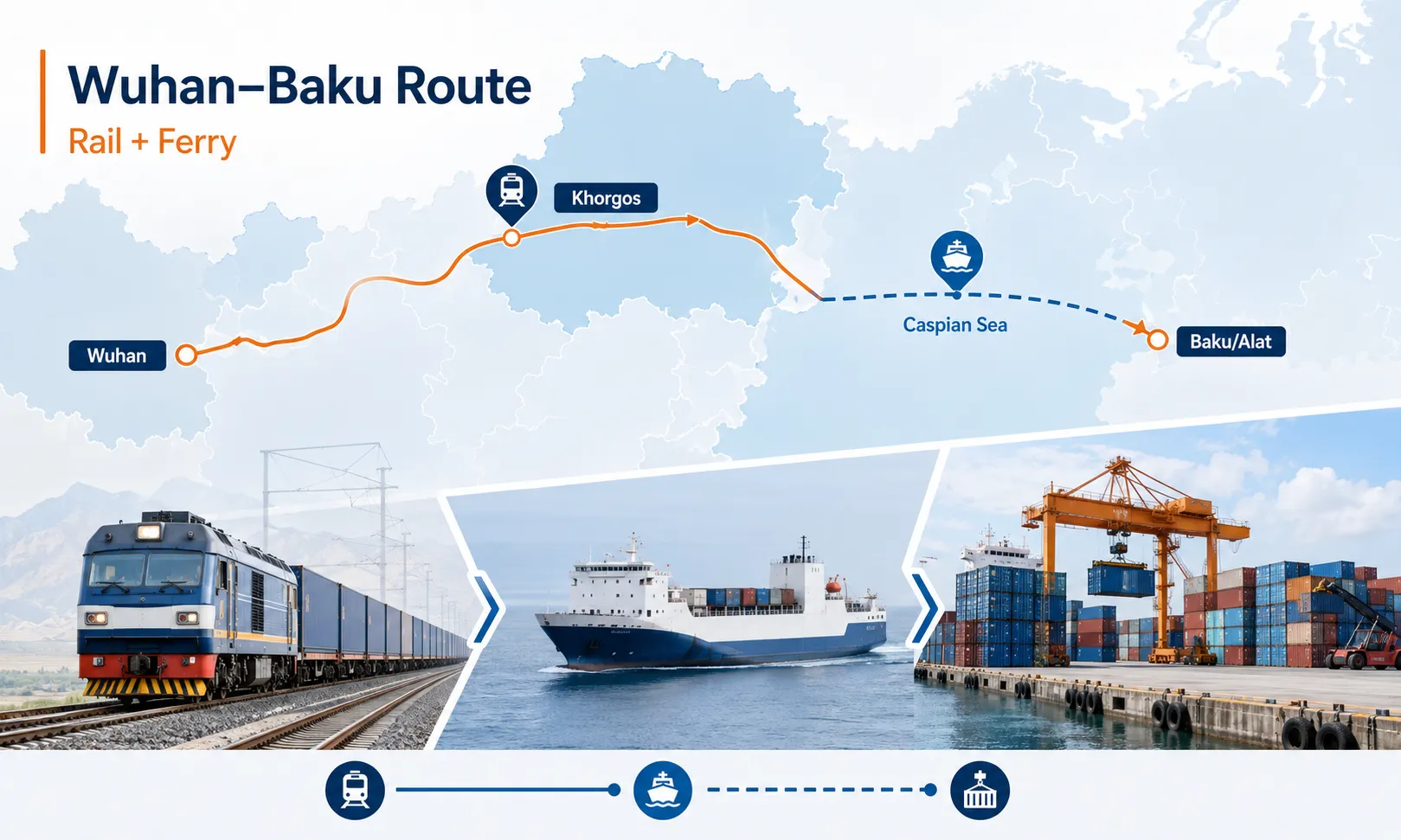
Quick Answer: What Is the Wuhan–Baku Freight Train?
The Wuhan–Baku freight train is a scheduled China–Azerbaijan cargo service that uses the Trans-Caspian Middle Corridor.
Its general route is:
Wuhan → Khorgos → Kazakhstan → Caspian Sea terminal → Caspian ferry → Baku/Alat
After arriving in Azerbaijan, cargo can enter the local market or continue toward Georgia, Türkiye and selected European destinations. Depending on the current service plan, onward transportation may use railway, ferry, truck or a combination of these methods.
In particular, the route can support importers that need:
- A China–Azerbaijan rail freight solution
- An alternative to routes through Russia and Belarus
- Faster movement than many conventional ocean routes
- Lower transport costs than air freight for suitable cargo
- Access to Azerbaijan, Georgia, Türkiye or nearby markets
- A diversified Eurasian supply-chain route
Even so, the service is not automatically suitable for every shipment. Ferry capacity, border handling, product restrictions, customs requirements and onward delivery must all be confirmed before booking.
When Was the Wuhan–Baku Route Launched?
The first Wuhan–Baku Trans-Caspian service departed on March 31, 2026, from the China Railway Intermodal Wuhan Central Station.
The inaugural shipment contained:
- Electronic equipment
- Household appliances
- Daily consumer goods
According to Wuhan authorities, the train travelled through Khorgos before entering Kazakhstan. Afterwards, the cargo connected with the Trans-Caspian route through a rail-and-sea multimodal operation.
The launch report estimated approximately 18 days to Baku. In addition, it compared the new service with a referenced maritime option of around 30 days and reported a potential cost reduction of approximately 15% for that initial route comparison.
However, importers should not treat those figures as fixed savings for every shipment. Actual performance depends on:
- Supplier location
- Wuhan departure schedule
- Cargo type
- FCL or LCL service
- Khorgos border conditions
- Kazakhstan railway capacity
- Caspian ferry availability
- Baku terminal handling
- Final delivery country
For this reason, VoltFreight uses the published time and cost figures as planning references rather than guaranteed commercial terms.
Exact Wuhan–Baku Middle Corridor Route
The Wuhan–Baku service contains several transport stages. Moreover, every stage has its own operator, terminal procedures and timing risks.
| Route Segment | Transport Mode | Main Operation | Main Planning Risk |
|---|---|---|---|
| Supplier to Wuhan | Truck or domestic rail | Pickup, consolidation and delivery to the Wuhan rail terminal | Cargo-ready date, warehouse cutoff and domestic pickup time |
| Wuhan to Khorgos | Rail | China domestic railway movement and export departure | Train allocation, export documents and departure schedule |
| Khorgos / Altynkol | Rail transfer | Border handling, customs transit and rail-gauge transloading | Border congestion, inspection and wagon availability |
| Kazakhstan inland route | Rail | Transport across Kazakhstan toward a Caspian terminal | Rail capacity, terminal allocation and operating schedule |
| Caspian Sea crossing | Ferry or feeder vessel | Container movement from Kazakhstan to Azerbaijan | Weather, port waiting time and vessel availability |
| Baku / Alat | Port and rail terminal | Discharge, terminal handling, customs or onward transfer | Port processing, customs documents and connection timing |
| Onward destination | Rail, ferry or truck | Delivery to Azerbaijan, Georgia, Türkiye or Europe | Final customs clearance, route availability and delivery appointment |
Route note: The specific Kazakhstan Caspian terminal depends on the operator and the live service plan. Although Aktau and Kuryk are important Middle Corridor terminals, not every Wuhan departure necessarily uses the same port.
Wuhan Origin and China Pickup Process
Wuhan is a major industrial and logistics centre in central China. Because of its inland location, it can collect cargo from Hubei and surrounding provinces before connecting with westbound international trains.
The origin process may include:
- Collecting cargo information from the supplier
- Checking product eligibility
- Arranging factory pickup
- Delivering cargo to a Wuhan consolidation warehouse
- Measuring cartons or pallets
- Preparing the commercial invoice and packing list
- Completing China export customs procedures
- Loading an FCL or LCL container
- Delivering the container to the rail terminal
- Waiting for the confirmed train departure
Factories outside Wuhan may first send their cargo by truck or domestic railway. Consequently, the complete supplier-to-Baku lead time can be longer than the published international route time.
For example, cargo collected from Shenzhen, Ningbo or Chongqing requires an additional domestic movement before reaching Wuhan. Therefore, importers should provide the full supplier address rather than only listing “Wuhan” or “China.”
Furthermore, the cargo-ready date should reflect the actual completion of production, packing and documentation. If the supplier misses the warehouse cutoff, the shipment may need to wait for the next train.
Khorgos Border Crossing and Rail-Gauge Transfer
The official route information states that the Wuhan service exits China through Khorgos in Xinjiang.
Khorgos on the Chinese side connects with Altynkol in Kazakhstan. At this point, the railway system changes because:
- China mainly uses the 1,435 mm standard gauge.
- Kazakhstan mainly uses the 1,520 mm broad gauge.
As a result, Chinese railway wagons cannot simply continue through Kazakhstan without an equipment operation. Operators usually lift the sealed container from a Chinese wagon and place it onto a broad-gauge wagon.
The Khorgos process may include:
- China export checks
- Kazakhstan transit procedures
- Container identification
- Rail-gauge transloading
- Document verification
- Security or customs inspection
- Assignment to the next train formation
Meanwhile, border workload and wagon availability can influence the schedule. A delay at this stage may also affect the connection to the Kazakhstan railway and Caspian terminal.
Therefore, the 18-day planning figure should not be interpreted as an unconditional delivery guarantee.
Rail Transport Across Kazakhstan
After crossing the China–Kazakhstan border, the container continues west through the Kazakh railway network.
Kazakhstan plays a central role in the Trans-Caspian International Transport Route because it connects China’s western border with ports on the eastern side of the Caspian Sea.
For country-specific route, customs and final-delivery planning, review our guide to China–Kazakhstan rail gateways.
During this stage, operators coordinate:
- Broad-gauge railway movement
- Transit customs documentation
- Train formation
- Wagon availability
- Caspian terminal allocation
- Connection with a ferry or feeder vessel
Although the service is often described as a freight train from Wuhan to Baku, the railway movement pauses when the container reaches the Caspian Sea.
Next, the cargo enters a port terminal and waits for the allocated maritime connection. Consequently, Kazakhstan rail performance and port coordination both affect the final Wuhan–Baku transit time.
How the Caspian Sea Crossing Works
The Caspian Sea crossing is the defining feature of the Middle Corridor. Unlike the traditional Northern Corridor, the Trans-Caspian route cannot remain entirely on railway tracks.
Once the container reaches a Kazakhstan port, the terminal generally:
- Receives the rail container
- Completes terminal documentation
- Waits for the allocated ferry or feeder vessel
- Transfers the container or rail equipment for loading
- Loads the cargo onto the vessel
- Moves it across the Caspian Sea
- Discharges it at Baku Port in Alat
Several factors can influence this section of the journey. For instance, the Caspian stage may be affected by:
- Ferry frequency
- Vessel capacity
- Weather and wind conditions
- Port congestion
- Container and wagon positioning
- Customs and transit documents
- Connection with onward rail services
Consequently, the Middle Corridor is more accurately described as Trans-Caspian multimodal freight rather than a purely railway service.
Moreover, the ferry does not always operate like a fixed daily passenger service. Cargo may need to wait until the vessel, port and onward railway plan are aligned.
Why the Wuhan–Baku Service Is Not One Continuous Train
The phrase “direct Wuhan–Baku freight train” can create the impression that one locomotive and one set of wagons travel from Wuhan to Azerbaijan without interruption.
Operationally, however, the route includes at least three different equipment environments:
- Chinese standard-gauge railway equipment
- Kazakhstan broad-gauge railway equipment
- Caspian ferry or feeder-vessel equipment
Containers may remain sealed while operators transfer them between wagons and vessels. Nevertheless, the shipment still passes through several terminals and modes of transport.
In logistics terminology, “direct service” usually refers to:
- One defined origin
- One named destination
- A coordinated booking product
- Pre-planned connections
- Through documentation or coordinated transit handling
In other words, the term describes the commercial service structure rather than an uninterrupted railway journey.
This distinction matters because every transfer can create additional waiting time, handling expenses and document risks.
Wuhan to Baku Transit Time: What Does 18 Days Include?
The official launch information estimated approximately 18 days for the Wuhan–Baku route.
Importers should interpret this figure as a planning estimate for the main multimodal movement from Wuhan to Baku. It is not a universal door-to-door commitment.
What the 18-Day Estimate May Include
- Departure from the Wuhan rail terminal
- Rail movement across China
- Khorgos border processing
- Rail transport through Kazakhstan
- Kazakhstan Caspian terminal handling
- Caspian Sea crossing
- Arrival in Baku/Alat
What It Does Not Automatically Include
- Pickup from a supplier outside Wuhan
- Waiting for the train before departure
- European import customs clearance
- Delivery to Türkiye, Greece or Italy
- Delivery to a warehouse in Germany or France
- Amazon or retail delivery appointments
- Customs inspections
- Storage caused by document problems
What Can Extend the Transit Time?
- Missing the Wuhan rail cutoff
- Border congestion at Khorgos
- Limited broad-gauge wagon capacity
- Kazakhstan terminal delays
- Caspian ferry waiting time
- Strong wind or poor weather
- Baku terminal congestion
- Customs or transit-document errors
- A missed onward rail connection
- Final truck-delivery appointment delays
Therefore, customers should request two separate planning figures: the Wuhan–Baku route estimate and the complete supplier-to-door estimate.
In addition, the quotation should state when the timing begins. A schedule measured from train departure is different from one measured from factory pickup.
What Happens After Cargo Reaches Baku?
Baku is not only the destination of the initial Wuhan service. It is also an important logistics and distribution hub on the western side of the Caspian Sea.
The Port of Baku is located in Alat, south of central Baku. From there, cargo can enter Azerbaijan or continue toward Georgia, Türkiye and selected European markets.
Delivery Within Azerbaijan
Cargo intended for Azerbaijan may complete import customs clearance before local delivery.
For country-specific truck, rail, Middle Corridor, customs and Baku delivery planning, see our shipping from China to Azerbaijan guide.
Afterwards, the destination process can include:
- Port release
- Import customs declaration
- Duty and VAT payment
- Container or cargo pickup
- Delivery to a Baku warehouse
- Truck transport to another Azerbaijan city
Connection to Georgia
From Azerbaijan, cargo can continue west through the Georgian railway or road network.
For destination-specific planning through Tbilisi, Poti, Batumi and the Middle Corridor, review our shipping from China to Georgia guide.
Possible destinations include:
- Tbilisi
- Georgian distribution warehouses
- Poti
- Batumi
- Black Sea feeder connections
However, the actual route depends on the customs plan, onward carrier and final delivery location.
Connection to Türkiye
The Baku–Tbilisi–Kars railway provides a land connection between Azerbaijan, Georgia and Türkiye.
Depending on current service availability, cargo may continue toward:
- Kars
- Ankara
- Istanbul
- Mersin
- Other Turkish logistics centres
Alternatively, truck delivery may be used when it provides a better schedule or more suitable final connection.
Connection to Europe
After Baku, cargo may reach European markets through:
- Rail transport through Georgia and Türkiye
- Truck transport through Türkiye
- Black Sea ferry or feeder connections
- Rail or truck distribution after entering Europe
Potential markets include Türkiye, Bulgaria, Romania, Greece, Italy and other European countries. Nevertheless, the onward route must be confirmed for each shipment.
Most importantly, Baku arrival does not mean that the cargo automatically has a booked connection to the final European warehouse.
Wuhan–Baku FCL Rail Freight
FCL gives one importer the use of a complete container.
For suitable cargo, FCL can provide:
- Better control over the loading plan
- Fewer mixed-cargo warehouse operations
- Improved protection for high-value cargo
- More consistent container documentation
- A clearer onward-delivery structure
Nevertheless, equipment availability depends on the live Wuhan–Baku service. Before booking, importers should confirm:
- Available container types
- Maximum cargo weight
- Container payload restrictions
- Factory or warehouse loading
- Wuhan terminal cutoff
- Baku terminal handling
- Empty-container or equipment-return rules
Although the importer uses a dedicated container, border and Caspian transfers still take place. Operators must move the sealed container between different wagons and maritime equipment.
Wuhan–Baku LCL Rail Freight
LCL allows several shippers to share container space. Therefore, it may suit smaller shipments that do not justify a complete container.
However, LCL availability on a developing Middle Corridor service can depend on:
- Current consolidation schedule
- Available cargo volume
- Minimum charge
- Wuhan warehouse operations
- Product compatibility
- Baku deconsolidation service
- Final delivery destination
A typical LCL process may include:
- Pickup from the Chinese supplier
- Delivery to the consolidation warehouse
- Carton measurement and weight checks
- Product-eligibility review
- Loading into a shared container
- Wuhan–Baku multimodal transport
- Destination deconsolidation
- Customs clearance
- Final pallet or carton delivery
Because LCL cargo receives more handling than FCL, the cartons should be suitable for stacking, forklift movement and terminal transfers.
Furthermore, a regular China–Europe LCL service does not automatically guarantee Wuhan–Baku LCL capacity. The live consolidation schedule must be confirmed before the supplier delivers cargo to the warehouse.
What Makes Up a Wuhan–Baku Freight Quote?
A Wuhan–Baku quotation is more complex than a simple railway rate because it covers several countries, rail systems, ports and transport modes.
China Origin Costs
- Supplier pickup
- China domestic trucking
- Warehouse receiving
- FCL loading or LCL consolidation
- Export customs
- Wuhan terminal handling
China and Kazakhstan Rail Costs
- Wuhan to Khorgos rail transport
- Khorgos border handling
- Rail-gauge transloading
- Kazakhstan railway transport
- Wagon and container operations
Caspian Sea Costs
- Kazakhstan port handling
- Ferry or feeder-vessel freight
- Container loading and discharge
- Port documentation
- Potential waiting or storage charges
Baku and Onward Costs
- Baku/Alat terminal handling
- Azerbaijan customs clearance or transit
- Container or LCL release
- Georgia or Türkiye connection
- European rail or truck transport
- Final warehouse delivery
What Changes the Price?
- FCL or LCL service
- Container type
- Cargo volume and gross weight
- Wuhan train capacity
- Caspian ferry allocation
- Final country and postcode
- Customs-clearance scope
- DAP or DDP terms
- Product restrictions
- Seasonal capacity
For that reason, publishing one permanent per-CBM or per-container price would be misleading. Instead, each quotation should use the actual cargo information and live departure schedule.
Which Cargo Is Suitable for the Wuhan–Baku Route?
The inaugural service carried electronics, household appliances and consumer goods. These categories demonstrate the route’s potential for medium-value and time-sensitive commercial cargo.
Common Suitable Cargo
- Electronic equipment and accessories
- Household appliances
- Automotive parts
- Machinery components
- Photovoltaic equipment
- Industrial products
- Consumer goods
- Retail replenishment
- E-commerce inventory
- Seasonal goods
- Production-critical components
In general, the route is most valuable when ocean freight is too slow and air freight is too expensive.
Commercial Situations That Fit the Route
- The buyer needs access to Azerbaijan or the Caucasus.
- The cargo must avoid a route through Russia and Belarus.
- The shipment cannot wait for a long ocean schedule.
- The goods are too heavy for economical air freight.
- The importer needs an alternative Eurasian corridor.
- The product has a fixed sales or production deadline.
Which Cargo Requires Pre-Approval?
Cargo accepted on another railway service is not automatically accepted on the Wuhan–Baku Middle Corridor. Therefore, sensitive products require a separate review.
Lithium Batteries
Battery-related cargo may require:
- MSDS
- UN38.3 test summary
- Battery type
- Watt-hour information
- Product and battery photos
- Packaging information
- Operator approval
Liquids, Powders and Chemicals
These products need a detailed assessment to determine whether they are dangerous, restricted or acceptable as general cargo.
Dangerous Goods
Dangerous goods require correct UN classification, packaging, labels and transport documents. Moreover, some classes may be prohibited on the route.
Branded Goods
Brand authorization, purchase records or distribution documents may be required to reduce customs and intellectual-property risks.
Temperature-Sensitive Cargo
Products requiring continuous temperature control need a confirmed specialist solution. Otherwise, a standard railway container may not provide the required environment.
Oversized Cargo
Large machinery can exceed container, wagon, port or ferry limits. Consequently, the importer should submit exact dimensions and a loading plan before requesting a quotation.
Export-Controlled or Sanctioned Goods
Products subject to export controls, sanctions or dual-use restrictions require specialist compliance review before booking.
Documents Required for Wuhan–Baku Rail Freight
The route passes through several customs and transport systems. As a result, every document should describe the shipment consistently.
Commercial Invoice
The invoice should include:
- Seller and buyer
- Specific product name
- Quantity
- Unit price
- Total value
- Currency
- Country of origin
- Incoterm
- HS code where available
Packing List
The packing list should show:
- Carton or pallet quantity
- Net weight
- Gross weight
- Package dimensions
- Total CBM
- Shipping marks
Rail and Multimodal Documents
Depending on the service, the shipment may require:
- Rail consignment note
- Transit customs documents
- Container information
- Ferry or port documents
- Destination release instructions
- Onward rail or truck documents
Product-Specific Documents
Regulated products may require:
- MSDS
- UN38.3
- Dangerous-goods declaration
- Certificate of origin
- Brand authorization
- CE-related documents
- Technical specifications
- Destination-country permits
For example, vague descriptions such as “parts,” “accessories” or “samples” can create delays. Therefore, use a precise commercial description before the cargo reaches the Wuhan terminal.
For broader entry-document support, review our customs clearance service.
Wuhan–Baku Route vs the Northern Corridor
The Wuhan–Baku service should not be treated as a replacement for every China–Europe railway route.
The traditional Northern Corridor generally moves through Kazakhstan or Mongolia, Russia, Belarus and Poland. By contrast, the Wuhan–Baku Middle Corridor travels through Kazakhstan and the Caspian Sea before reaching Azerbaijan.
Middle Corridor Advantages
- Avoids routes through Russia and Belarus
- Provides access to Azerbaijan and the Caucasus
- Supports connections toward Türkiye and Southern Europe
- Adds supply-chain route diversity
- Creates another option for central China exporters
Middle Corridor Challenges
- Includes Caspian Sea ferry operations
- Requires more transport interfaces
- May face port and weather delays
- Needs coordination between several operators
- Can have less predictable connections on some departures
Ultimately, the best corridor depends on compliance requirements, cargo type, final destination, delivery deadline and current route availability.
How VoltFreight Supports the Wuhan–Baku Route
VoltFreight helps importers determine whether the Wuhan–Baku Middle Corridor is suitable for their actual shipment.
China Supplier Pickup
We can arrange pickup from Chinese factories and transfer the cargo to a suitable consolidation or railway facility.
Wuhan Consolidation
When several suppliers are involved, their cargo can move to one warehouse for receiving, measurement and document checks.
FCL and LCL Feasibility Review
Before booking, VoltFreight can confirm whether the current service supports the required container or LCL consolidation plan.
Cargo-Acceptance Check
In addition, batteries, liquids, chemicals, branded goods and regulated products are reviewed before departure.
Middle Corridor Coordination
The route can involve Chinese railway operators, Kazakhstan railways, Caspian terminals, ferry operators, Baku Port and onward carriers. Therefore, our team helps coordinate the available service structure.
Baku and Onward Delivery
Depending on current availability, cargo may enter Azerbaijan or continue toward Georgia, Türkiye or another destination.
Alternative Mode Comparison
When the Wuhan–Baku route does not fit the shipment, VoltFreight can compare sea freight from China, air freight from China or another railway corridor.
For general commercial railway booking, visit our railway freight services from China page.
What to Send for a Wuhan–Baku Quote
- Product name
- Product photos
- HS code if available
- Material and intended use
- Supplier city and full pickup address
- Carton or pallet quantity
- Package dimensions
- Gross weight per package
- Total gross weight
- Total CBM
- Whether the cargo is stackable
- FCL or LCL requirement
- Cargo-ready date
- Final destination country and postcode
- Baku delivery or onward transport requirement
- DAP or DDP requirement
- Battery, liquid, chemical or dangerous-goods information
- Target delivery deadline
Once these details are available, the forwarder can check the Wuhan departure, product acceptance, Caspian connection and onward delivery before confirming the quotation.
Related Rail Freight Guides
- Rail Freight from China to Europe — Compare the Northern Corridor, Middle Corridor, hubs, FCL, LCL and rail-to-door delivery.
- Railway Freight Services from China — Review commercial pickup, consolidation, booking and door-delivery services.
- Door-to-Door Shipping from China — Understand supplier pickup, customs coordination and final delivery.
- Customs Clearance — Prepare commercial and customs documents.
- Sea Freight from China — Suitable for larger and less urgent shipments.
- Air Freight from China — Suitable for urgent commercial cargo.
- Request a Wuhan–Baku Middle Corridor Quote — Send cargo details for a live route review.
FAQ About the Wuhan–Baku Freight Train
How long does the Wuhan–Baku freight train take?
The official launch plan estimated approximately 18 days from Wuhan to Baku. However, this is a route-planning estimate rather than a guaranteed door-to-door time. Supplier pickup, train waiting, border congestion, Caspian ferry availability, customs and onward delivery can extend the total lead time.
Is Wuhan–Baku a direct railway service?
It is a direct logistics service between the named origin and destination, but it is not one continuous railway journey. First, the cargo travels by rail through China and Kazakhstan. Afterwards, it crosses the Caspian Sea by ferry or feeder vessel before arriving at Baku Port in Alat.
Which countries does the Wuhan–Baku route cross?
The published route travels from China through the Khorgos border into Kazakhstan, crosses the Caspian Sea and reaches Azerbaijan. From there, cargo can continue through Georgia, Türkiye or another onward transport route.
Can cargo continue from Baku to Türkiye and Europe?
Yes, subject to the current service plan. For example, cargo may continue through the Baku–Tbilisi–Kars railway, move by truck through Georgia and Türkiye or use Black Sea connections. Nevertheless, the exact route and final delivery time must be confirmed before booking.
Can FCL and LCL cargo use the Wuhan–Baku route?
FCL may be available for suitable containers and cargo. Meanwhile, LCL depends on the current consolidation schedule, minimum charge, destination deconsolidation and product acceptance. Therefore, neither service should be assumed available without checking the live departure plan.
Conclusion
The Wuhan to Baku freight train gives importers a new Trans-Caspian route between central China and Azerbaijan. More importantly, it creates an alternative Eurasian supply-chain corridor through Kazakhstan and the Caspian Sea.
Nevertheless, the service is more complex than its name may suggest. Containers must cross different railway gauges, travel through Kazakhstan, wait for Caspian transport and pass through Baku Port before local delivery or onward transportation.
The published 18-day figure applies to the planned Wuhan–Baku main movement. Therefore, it does not automatically include supplier pickup, European customs clearance or delivery to a final warehouse in Türkiye or Europe.
Before shipping, importers should confirm the live train schedule, ferry connection, FCL or LCL availability, product eligibility and final destination plan.
To determine whether this route fits your shipment, contact VoltFreight with the product details, carton data, supplier address and final delivery location.
Official and Authoritative Sources
- Wuhan Municipal Government: Wuhan–Baku Route Launch and 18-Day Transit Plan
- Wuhan Commerce Bureau: First Direct Trans-Caspian Wuhan–Baku Train
- Trans-Caspian International Transport Route: Official Middle Corridor Route
- World Bank: Middle Trade and Transport Corridor
- Port of Baku: Multimodal Rail and Road Connections
- Middle Corridor Association: Baku–Tbilisi–Kars Railway Information
Important disclaimer: This guide provides general logistics-planning information. Train schedules, Caspian ferry capacity, border conditions, route availability, cargo acceptance, customs requirements, transit times and onward delivery can change. Therefore, always confirm the live service with the freight forwarder, carrier, customs broker and compliance adviser before shipment.