Updated: August 2026.
Shipping batteries from China is possible by approved air freight, sea freight, express courier and selected door-to-door services. However, battery cargo should be reviewed before a final freight rate is confirmed.
The first question is not simply how much the shipment weighs. A forwarder needs to know what battery is being shipped, how it is configured, whether its documents match the physical model, how it is packed and whether the selected carrier accepts that exact shipment.
A power bank, a spare e-bike battery, a LiFePO4 storage battery and a lithium battery installed inside a laptop may all contain rechargeable cells. Nevertheless, they can follow different UN classifications, packing instructions, aircraft restrictions and carrier-acceptance procedures.
For an initial battery shipping review, prepare:
Battery manufacturer and model, chemistry, voltage, Ah or mAh capacity, Watt-hour rating, shipping configuration, battery condition, UN38.3 test summary, available SDS, battery-label photographs, packing photographs, quantity, carton dimensions, gross weight, supplier city in China and final delivery postcode.
VoltFreight can review eligible battery shipments from China to Europe, the United States, Canada, Mexico, the United Kingdom, Australia, the Middle East and other international destinations. Final acceptance always depends on the actual cargo and selected carrier rather than on a universal “battery shipping channel.”
Can Batteries Be Shipped from China?
Yes. Many new batteries and battery-powered products can be shipped internationally from China when the goods comply with the applicable transport requirements and an appropriate carrier accepts the shipment.
The practical route depends heavily on whether the battery is:
- shipped by itself;
- packed in the same package with equipment;
- installed inside equipment;
- installed in a battery-powered vehicle;
- part of a larger energy-storage system; or
- damaged, defective, recalled, used or intended for recycling.
Battery chemistry also matters. Lithium-ion, lithium-metal, sodium-ion, lead-acid and other battery types do not automatically follow the same transport rules.
| Shipment Type | Typical Classification | Practical Starting Point | Main Review Point |
|---|---|---|---|
| Standalone lithium-ion battery | UN3480 | Cargo-aircraft service or sea freight | UN38.3, Wh, SoC, packing and carrier approval |
| Lithium-ion battery packed with or installed in equipment | UN3481 | Air, sea or approved courier route | Packed with equipment vs contained in equipment |
| Lithium-ion power bank | Normally UN3480 | Approved battery route or sea freight | Battery-only treatment, capacity, SoC and carrier limits |
| Standalone lithium-metal battery | UN3090 | Cargo-aircraft or sea route after review | Lithium content, packing and carrier restrictions |
| Lithium-metal battery with equipment | UN3091 | Route-specific air, sea or courier review | Configuration and applicable packing instruction |
| Sodium-ion battery | UN3551 or UN3552 | Route-specific air or sea review | Classification, testing, configuration and packing |
| E-bike or e-scooter | Vehicle classification may apply | Sea freight is often practical | Complete vehicle plus any spare batteries |
| LiFePO4 or energy-storage battery | Usually lithium-ion family for transport | Sea freight often suits larger systems | Capacity, total weight, configuration and DG acceptance |
| Lead-acid or other battery chemistry | Depends on exact battery | Separate classification review | Wet, non-spillable or other applicable status |
Batteries correctly installed inside eligible equipment often have more transport options than standalone batteries. Meanwhile, standalone lithium batteries and power banks generally face tighter air and courier restrictions.
Large battery packs, heavy LiFePO4 batteries and commercial energy-storage systems frequently make sea freight the practical starting point.
The most useful time to review a battery shipment is before the factory completes export packing. Early review provides time to correct documents, labels or packaging before the cargo reaches a dangerous-goods warehouse.
VoltFreight can compare suitable air freight from China, sea freight from China and door-to-door shipping after the battery details are reviewed.
Before You Buy Batteries in China: Check the Supplier First
Many battery shipping problems begin before the importer contacts a freight forwarder.
A buyer selects a battery based on product specifications and price. Only after production starts does the buyer discover that the supplier cannot provide the correct test summary, the battery model on the paperwork differs from the physical product, or the export packing cannot meet the selected carrier’s requirements.
For commercial battery orders, ask the supplier several questions before paying the final balance.
Does the Exact Battery Model Have UN38.3 Information?
Ask for the UN38.3 test summary and compare its manufacturer and model information with the battery you intend to purchase.
Do not accept a document merely because the file name contains “UN38.3.”
The important question is whether the supporting information corresponds to the actual battery design being shipped.
Can the Supplier Provide Clear Battery Specifications?
Ask for:
- manufacturer name;
- exact model number;
- battery chemistry;
- nominal voltage;
- Ah or mAh capacity;
- Watt-hour rating;
- battery weight;
- dimensions; and
- photographs of the battery label.
These details should agree with each other.
For rechargeable lithium-ion batteries:
Watt-hours (Wh) = Nominal voltage (V) × Capacity (Ah)
If capacity appears in mAh, divide it by 1,000 before calculating Ah.
For example:
10,000 mAh = 10 Ah.
A 3.7 V, 10 Ah battery therefore has a nominal energy rating of:
3.7 × 10 = 37 Wh.
Has the Supplier Exported This Model Before?
Previous export history does not guarantee that every carrier will accept the next shipment. However, it can reveal useful information.
Ask which:
- airport or seaport was previously used;
- shipping configuration was declared;
- packing method was used; and
- documents were provided.
Do not rely only on a statement such as “we ship batteries every month.” Different routes can apply different operator requirements.
Can the Supplier Adjust Packing If the Carrier Requests Changes?
Confirm this before production finishes.
A freight forwarder may need different inner protection, stronger outer cartons, terminal insulation, labels, pallets or other packing changes depending on the accepted route.
If the factory refuses to adjust packing after production, the importer may face repacking fees or warehouse delays in China.
Identify the Battery and Its Shipping Configuration
Descriptions such as “rechargeable battery,” “electronic goods” or “battery product” are not detailed enough for international transport planning.
The forwarder needs to understand both the battery chemistry and how it is presented for transport.
Confirm the Battery Chemistry
Common battery chemistries include:
- Lithium-ion
- Lithium iron phosphate (LiFePO4)
- Lithium-metal
- Sodium-ion
- Wet lead-acid
- Non-spillable batteries
- Dry batteries
- Nickel-metal hydride batteries
LiFePO4 is a lithium-ion chemistry for transport classification purposes. A standalone LiFePO4 battery does not automatically become general cargo because the chemistry may have different thermal characteristics from other lithium-ion designs.
This guide focuses mainly on lithium and sodium-ion cargo because they create many international carrier-acceptance questions. Other battery chemistries should still receive their own classification review.
Shipped Alone, Packed With Equipment or Contained in Equipment?
These phrases have specific transport significance.
- Shipped alone: cells or batteries travel without the equipment they power.
- Packed with equipment: the battery and its equipment are in the same package, but the battery is not installed.
- Contained in equipment: the battery is installed inside the equipment during transportation.
- Battery-powered vehicle: the finished product may follow a vehicle classification instead of an equipment classification.
Retail packaging does not change the underlying transport configuration.
For example, a power bank packed with a USB cable remains a power bank. The charging cable is not the equipment that the battery is designed to power.
Check the Battery Condition
Tell the forwarder whether the battery is:
- new;
- used;
- returned;
- prototype or low-production;
- recalled;
- damaged;
- defective; or
- intended for recycling or disposal.
A used battery is not automatically damaged.
However, swelling, leakage, impact damage, overheating, short-circuit evidence or a safety recall can fundamentally change the transport options.
Make Sure the Physical Battery Matches the Documents
One of the most common warehouse problems is a mismatch between the battery submitted for approval and the battery physically received.
The manufacturer, model, voltage, capacity and other identifying information should correspond to the documents supplied for transport review.
If a shipment contains several battery models, confirm each model separately rather than assuming that one test summary covers every design.
Battery UN Numbers: UN3480, UN3481, UN3090, UN3091, UN3551 and UN3552
The UN number gives the carrier an essential starting point for deciding which packing instruction, quantity limits, labels, marks, documentation and transport restrictions may apply.
UN3480: Lithium-Ion Batteries Shipped Alone
UN3480 generally covers lithium-ion cells and batteries shipped without the equipment they are designed to power.
Examples can include:
- standalone rechargeable battery packs;
- many standalone LiFePO4 batteries;
- replacement lithium-ion batteries; and
- lithium-ion power banks.
Air transportation requires particularly careful review because standalone lithium-ion batteries face aircraft and state-of-charge restrictions.
UN3481: Lithium-Ion Batteries With Equipment
UN3481 can cover lithium-ion batteries:
- packed with equipment; or
- contained in equipment.
These are not identical configurations.
A spare removable battery packed beside a tool differs from a battery already installed inside that tool.
Typical products include laptops, power tools, speakers, medical devices and other battery-powered electronics.
UN3090 and UN3091: Lithium-Metal Batteries
UN3090 generally covers lithium-metal batteries shipped alone.
UN3091 can apply when relevant lithium-metal batteries are packed with or contained in equipment.
Lithium-metal batteries use lithium-content criteria rather than the Watt-hour calculation commonly used for rechargeable lithium-ion batteries.
UN3551 and UN3552: Sodium-Ion Batteries
Relevant sodium-ion batteries with organic electrolyte shipped alone use UN3551.
Relevant sodium-ion batteries packed with or contained in equipment use UN3552.
Sodium-ion technology now forms part of the modern dangerous-goods battery framework and should not simply be described as ordinary rechargeable cargo.
Battery-Powered Vehicles Need Separate Review
An e-bike, e-scooter, mobility device or other battery-powered vehicle should not automatically be declared as UN3481 merely because it contains a lithium battery.
The complete product may follow a vehicle classification.
Meanwhile, spare batteries shipped together with the vehicle may need their own classification and packing review.
Provide photographs of:
- the complete vehicle;
- battery compartment;
- battery label;
- charging system; and
- any spare battery packs.
2026 Air Freight Rules for Shipping Batteries from China
Shipping batteries from China by air can reduce transit time substantially compared with ocean freight. However, air transportation usually requires the strictest carrier-acceptance process.
Airlines evaluate the applicable dangerous-goods regulations, battery configuration, packing instruction, Watt-hour rating, package quantity, state of charge and their own operator variations.
Standalone Lithium-Ion Batteries: UN3480
Standalone lithium-ion batteries under Packing Instruction 965 are subject to strict air requirements.
They must normally be offered for transport at a state of charge not exceeding 30% of rated capacity unless the applicable authority approvals allow otherwise.
UN3480 lithium-ion batteries shipped alone are also not accepted as ordinary cargo on passenger aircraft. Commercial transport normally requires a suitable cargo-aircraft route unless specific regulatory approval applies.
A battery being below 100 Wh does not automatically make it eligible for a normal passenger-aircraft cargo route.
Capacity is only one part of the acceptance process.
2026 Rule: Lithium-Ion Batteries Packed With Equipment — PI966
The 2026 air rules are particularly important for lithium-ion batteries packed with equipment.
For Packing Instruction 966 Section I, lithium-ion cells and batteries must generally be offered at a state of charge not exceeding 30% of rated capacity.
For Section II, lithium-ion cells and batteries with a Watt-hour rating above 2.7 Wh are also subject to the applicable 30% state-of-charge requirement.
Shipments above the permitted state of charge require the relevant approvals and conditions where the regulations allow them.
Importers should therefore confirm the actual battery charge condition with the factory before the goods reach the airport or dangerous-goods warehouse.
Contained in Equipment — PI967 Is Different
Lithium-ion batteries contained in equipment follow Packing Instruction 967 rather than PI966.
For these shipments, the 2026 IATA guidance strongly recommends offering the batteries at no more than 30% rated capacity, or an indicated battery capacity not exceeding 25%.
However, this reduced state of charge is not the same general mandatory rule that applies to the affected PI966 packed-with-equipment shipments.
This distinction is one reason why the forwarder needs to know whether the battery is physically installed inside the product.
Airlines Can Apply Additional Operator Restrictions
Compliance with the general regulatory framework does not guarantee that every airline will accept the cargo.
Airlines can impose additional restrictions concerning:
- battery type;
- capacity;
- packages per shipment;
- gross package weight;
- origin airport;
- transit airport;
- destination airport; and
- dangerous-goods documentation.
For this reason, prior carrier acceptance remains important even when the same product has previously moved by air.
Damaged, Defective and Prototype Batteries
Damaged or safety-defective lithium batteries that may produce dangerous heat, fire or short circuit should never be placed into an ordinary air-freight battery channel.
The same concern applies if the problematic battery remains installed inside equipment.
Prototype or low-production-run batteries without the normal UN38.3 testing history may require special regulatory provisions, approvals and packing.
Commercially practical transportation may not be available for every such shipment.
Shipping Batteries from China by Sea Freight
Sea freight is frequently the practical choice for:
- heavy standalone batteries;
- large LiFePO4 batteries;
- energy-storage batteries;
- commercial quantities of power banks;
- e-bike batteries;
- battery-powered vehicles; and
- palletised battery shipments.
The main disadvantage is longer transit time.
However, ocean freight can provide capacity for battery shipments that are difficult, restricted or uneconomical to move by air.
Sea transportation does not turn dangerous-goods battery cargo into general cargo.
The 2024 Edition of the IMDG Code incorporating Amendment 42-24 became mandatory on 1 January 2026. Battery bookings therefore need to follow the current maritime dangerous-goods framework together with shipping-line, terminal, port and warehouse requirements.
What May Be Required for a Sea-Freight Battery Booking?
Depending on the battery and carrier, the booking may require:
- correct UN number;
- proper shipping name;
- battery chemistry;
- manufacturer and model;
- capacity or lithium-content information;
- battery condition;
- UN38.3 test summary where applicable;
- technical specification;
- SDS when requested by the operator;
- dangerous-goods declaration where applicable;
- net battery weight;
- gross shipment weight;
- carton or pallet quantity;
- battery photographs;
- packing photographs; and
- required dangerous-goods marks and labels.
Can Batteries Ship by LCL?
Some battery shipments can move by LCL when the origin warehouse, consolidator, shipping line and destination handling network accept the classification.
However, small volume does not automatically make a battery suitable for ordinary general-cargo LCL.
A specialised dangerous-goods consolidation service may be required.
Do not send battery cargo to an LCL warehouse until acceptance is confirmed.
When Does FCL Make More Sense?
FCL can provide more loading control for larger battery quantities, heavy industrial batteries and energy-storage systems.
It can also avoid certain co-loading limitations associated with LCL.
Nevertheless, the shipping line still needs accurate dangerous-goods information, and the loading arrangement must comply with the accepted booking conditions.
Why Can Sea Freight Still Be Rejected?
A shipping line may reject cargo because of:
- incorrect classification;
- unclear product description;
- untested battery models;
- damaged batteries;
- incorrect dangerous-goods declarations;
- unsuitable packing;
- port restrictions; or
- destination handling limitations.
For the broader ocean process, see our sea freight from China service guide.
Documents Required to Ship Batteries from China
Battery documents need to correspond to the actual battery delivered to the carrier.
A technically valid report for a different model does not solve the transport-compliance problem.
UN38.3 Test Summary
Applicable lithium battery designs must complete the required tests in subsection 38.3 of the UN Manual of Tests and Criteria.
Manufacturers and subsequent distributors should make the applicable test summary available.
A useful test summary normally identifies information such as:
- cell, battery or product manufacturer;
- model or item number;
- physical description;
- battery type;
- Watt-hour rating or lithium content;
- completed battery weight;
- test laboratory information;
- test report identification;
- tests completed;
- reference to the applicable UN Manual edition; and
- responsible person information.
Do not confuse the test summary with a simple one-line document stating only:
“UN38.3 Passed.”
The actual battery model needs to be traceable to the tested design.
For technical reference, see the UN Manual of Tests and Criteria.
Is an SDS or MSDS Required?
An SDS can provide useful information about battery chemistry, hazards and emergency handling.
However, it is important to distinguish transport-regulation requirements from a carrier’s commercial acceptance checklist.
IATA does not treat an SDS or MSDS as a universal mandatory transport document for battery articles.
Nevertheless, an airline, dangerous-goods warehouse, courier network, shipping line or destination agent may request an SDS as part of its own acceptance process.
Therefore:
Provide a suitable SDS when available, but do not use it as a substitute for UN38.3 information.
Battery Specification Sheet
A useful battery specification should identify:
- manufacturer;
- model;
- chemistry;
- nominal voltage;
- Ah or mAh capacity;
- Watt-hour rating;
- cell count where applicable;
- dimensions; and
- battery weight.
Any difference between the battery label, specification and submitted transport documents should be resolved before booking.
Commercial and Shipment Documents
Depending on the route, other documents may include:
- commercial invoice;
- packing list;
- carton dimensions and gross weight;
- net battery weight;
- product photographs;
- battery-label photographs;
- inner and outer packing photographs;
- dangerous-goods declaration where applicable;
- air waybill or bill of lading data;
- HS code;
- destination customs information; and
- other carrier-specific transport documents.
China-Side Acceptance Can Vary by Gateway
Airlines, shipping lines, dangerous-goods warehouses and export gateways in China may request different supporting documents.
A document set accepted through one airport or seaport should not automatically be assumed to work through another gateway.
VoltFreight can coordinate applicable origin procedures through our China customs clearance service.
Destination import permits, product certification and market-access requirements remain dependent on the product and importing country.
What If the Chinese Supplier Cannot Provide UN38.3?
This is one of the most important questions to solve before shipping lithium battery products.
If the supplier cannot immediately provide the correct UN38.3 information, do not automatically assume either of these extremes:
“the battery definitely cannot be shipped”
or
“an SDS is enough.”
Neither conclusion is reliable without further review.
First, Confirm Who Actually Manufactured the Battery
The finished-product supplier may not manufacture the battery.
For example, an e-bike factory may purchase battery packs from a specialist battery manufacturer.
Ask the supplier to contact the actual battery manufacturer or distributor and obtain the test summary for the exact model.
Check Whether the Model Number Is Different
Sometimes the supplier has valid test information, but the model on the test summary differs from the model printed on the battery.
Do not simply edit a document or declare the closest model.
The manufacturer should confirm whether the physical battery corresponds to the tested design and whether the documentation legitimately covers that model.
Do Not Substitute an SDS for UN38.3
An SDS describes safety and hazard information.
It does not prove that a lithium battery design completed the UN38.3 test sequence.
Therefore, an SDS alone should not be treated as evidence of UN38.3 compliance.
If No Applicable Test Information Exists, Pause the Normal Booking
The next step may involve:
- obtaining the correct information from the manufacturer;
- confirming whether the design is part of a tested battery family;
- arranging appropriate testing where necessary;
- reviewing whether a special regulatory provision applies; or
- deciding that the planned commercial route is not currently suitable.
It is usually cheaper to solve this problem before the factory dispatches the cargo than after the goods arrive at an export warehouse.
Battery Packing, Marks and Labels
Correct documents cannot compensate for unsafe physical packing.
The battery, inner protection, outer package and visible labels should match the shipment submitted for carrier approval.
Protect Battery Terminals Against Short Circuit
Terminals should not be able to contact other batteries, loose metal components or conductive surfaces.
Depending on the shipment, suitable protection may include:
- terminal caps;
- appropriate insulating tape;
- individual inner packaging;
- protective trays; or
- another accepted isolation method.
Prevent Movement and Physical Damage
Batteries should not move freely inside the package.
Cushioning, dividers, restraints or shaped inserts can help keep the batteries stable during warehouse handling and transportation.
Equipment containing batteries should also be protected against accidental activation.
Heavy battery packs may require reinforced cartons, wooden cases or palletised packing.
Do All Batteries Need UN-Specification Packaging?
No.
There is no universal rule that every battery shipment needs the same type of UN-specification box.
Some fully regulated dangerous-goods shipments require UN-specification packaging.
Other eligible configurations may use strong rigid outer packaging where the applicable packing instruction permits it.
For this reason, both of these statements are unreliable:
“All batteries need UN boxes.”
“The factory’s retail carton is always enough.”
Packing should follow the actual classification and accepted route.
Battery Marks and Hazard Labels
Depending on the shipment, required package information can include:
- battery mark;
- Class 9 lithium or battery hazard label;
- Cargo Aircraft Only label;
- UN number;
- proper shipping name;
- shipper and consignee information;
- net quantity information; and
- overpack marking where applicable.
Do not apply a generic collection of dangerous-goods labels simply because the shipment contains lithium batteries.
The required combination depends on the battery classification, packing instruction and mode of transport.
Once packing is complete, photographs of all sides of the package can help identify visible problems before warehouse delivery.
Air vs Sea vs Express vs DDP for Battery Shipping
The best shipping method is not automatically the fastest or cheapest quotation.
A useful route needs to combine:
carrier acceptance + transit time + service scope + total landed cost.
Air Freight
Air freight can suit:
- urgent eligible battery-powered electronics;
- production components;
- higher-value cargo;
- certain approved standalone battery shipments; and
- shipments where transit time justifies DG handling costs.
The main limitation is carrier availability.
Standalone batteries may require cargo-aircraft capacity, while dangerous-goods processing can add origin and destination charges.
Compare the entire service rather than an airport-to-airport USD/kg figure alone.
Sea Freight
Ocean freight is often more practical for:
- large standalone batteries;
- LiFePO4 batteries;
- energy-storage systems;
- commercial battery quantities;
- e-bike batteries; and
- palletised heavy cargo.
LCL may suit some smaller accepted shipments.
FCL can become more practical as volume and battery weight increase.
The trade-off is longer transit time.
Express Courier
Express courier can work for certain approved battery-powered products and samples.
However, standalone batteries and power banks frequently face tighter restrictions.
Acceptance can depend on:
- courier network;
- shipper account;
- origin location;
- battery configuration;
- capacity;
- quantity; and
- destination country.
Never hide batteries inside product cartons or describe a power bank as ordinary electronics merely to obtain a general-cargo courier rate.
DDP and Door-to-Door Battery Shipping
A reviewed DDP service can combine:
- China pickup;
- origin handling;
- international transportation;
- customs coordination;
- applicable duties and taxes under the confirmed quotation scope; and
- final delivery.
However, DDP is a delivery and Incoterm arrangement.
DDP does not remove dangerous-goods restrictions.
Before accepting a DDP battery quotation, confirm:
- which battery configuration the route accepts;
- importer-of-record arrangement;
- which duties and taxes are included;
- dangerous-goods destination charges;
- final-mile acceptance;
- delivery-address type; and
- known exclusions.
Shipping Batteries from China to Europe, the USA and Other Countries
International dangerous-goods rules create a common framework, but practical transport options still vary by destination.
Airline capacity, port acceptance, local dangerous-goods handling, customs requirements and final-mile transportation can all affect whether a route is commercially practical.
Shipping Batteries from China to Europe
Eligible batteries can move from China to European destinations by approved air freight, sea freight and selected door-to-door services.
The most suitable airport or seaport does not always need to be located in the buyer’s final country.
For some services, cargo may enter the EU through one member state and continue to another EU destination when the selected customs and transport arrangement permits it.
Importers should separate:
transport compliance
from:
EU product-market compliance.
IATA, IMDG and ADR concern transportation.
Meanwhile, Regulation (EU) 2023/1542 concerning batteries and waste batteries addresses requirements for batteries placed on the EU market, including areas such as safety, sustainability, information, labelling and producer responsibility.
Therefore:
A carrier accepting a battery shipment does not automatically mean that the product is legally ready for sale in the European Union.
Depending on the transaction, importers may also need to consider:
- customs classification;
- EORI;
- VAT;
- producer-responsibility requirements;
- product conformity; and
- other product-specific obligations.
For destination planning, see:
shipping from China to Germany,
shipping from China to Italy,
shipping from China to Greece
and
shipping from China to Romania.
Shipping Lithium Batteries from China to the United States
Battery shipments to the United States must comply with the applicable international transport rules as well as relevant U.S. hazardous-material and import requirements.
The exact process depends on whether the shipment contains standalone lithium batteries, batteries with equipment, power banks, battery-powered products, vehicles or large energy-storage systems.
Because the U.S. route involves additional questions concerning PHMSA/DOT requirements, customs classification, duties, importer arrangements and final delivery, we cover it separately.
For the complete U.S.-specific process, read:
Shipping Lithium Batteries from China to USA.
That guide is the primary page for China-to-USA lithium battery shipping. This global article focuses on the broader international battery-shipping framework.
Canada, Mexico, Australia and Other Destinations
The same battery can have different practical carrier options depending on the destination.
Factors can include:
- available airline routes;
- dangerous-goods seaport acceptance;
- destination terminal procedures;
- customs requirements;
- local carrier restrictions; and
- final-mile delivery capability.
Always provide the final destination postcode.
An airport-to-airport or port-to-port quotation does not answer whether the battery can complete the final delivery leg.
Power Banks, E-Bikes, Electronics and Energy-Storage Batteries
Commercial product names can hide the actual transport classification.
The forwarder should identify both the finished product and the battery configuration.
Power Banks
A power bank primarily stores electrical energy so that it can supply power to another device.
Lithium-ion power banks are therefore generally treated as battery cargo rather than as normal equipment containing a battery.
A retail box containing a power bank, USB cable and charging adaptor does not change that basic transport function.
E-Bikes and E-Scooters
A spare e-bike battery can travel as standalone battery cargo.
A battery installed inside a complete e-bike or scooter may follow the applicable battery-powered vehicle provisions.
Any spare batteries included with the vehicle should also be identified separately.
Because of battery size and total shipment weight, sea freight is often the practical starting point for commercial e-bike shipments.
For a product-specific example, see our shipping e-bikes and e-scooters from China to Greece guide.
Consumer Electronics
Laptops, tablets, speakers, tools, instruments and many other electronics contain lithium batteries.
Useful information includes:
- finished-product model;
- battery model;
- Watt-hour rating;
- number of batteries in each product;
- number of products per carton; and
- supporting battery documents.
Battery transport compliance does not automatically cover every product regulation that may apply in the destination market.
Vapes and E-Cigarettes
Vaping products combine battery transportation with separate customs and product restrictions.
Because the search intent differs from ordinary battery freight, see our:
shipping vapes and e-cigarettes from China
and
vape shipping document checklist.
LiFePO4 and Energy-Storage Systems
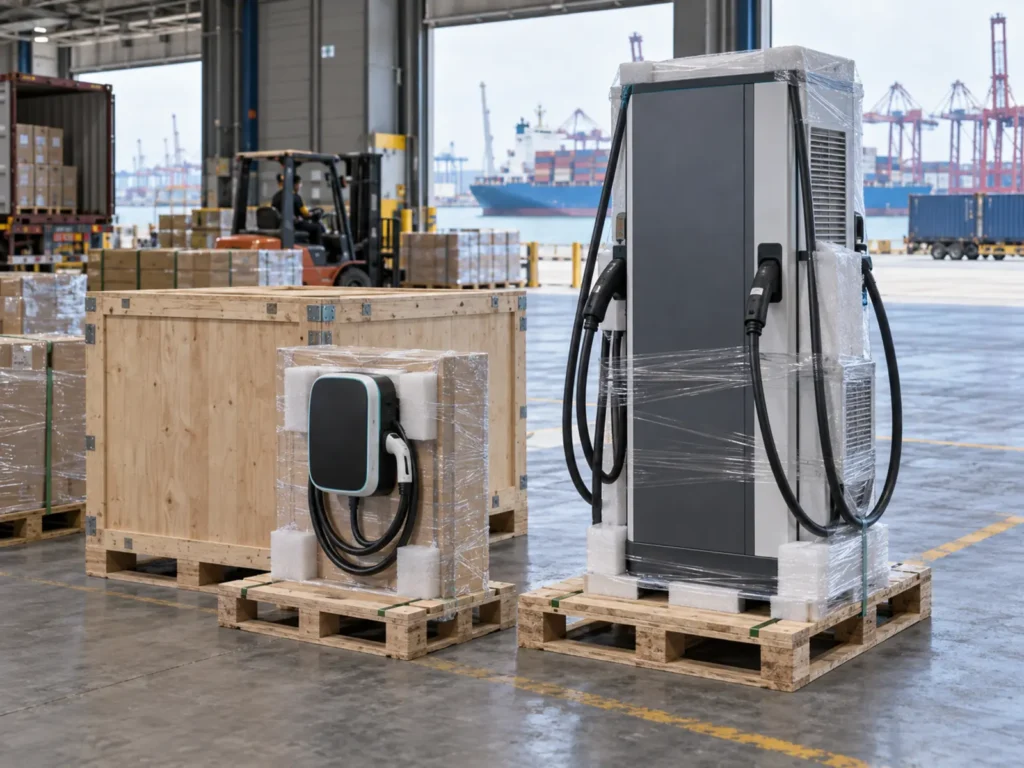
Residential solar batteries, commercial LiFePO4 packs and battery energy-storage systems can be both heavy and high-capacity.
Sea freight is frequently more realistic than air freight for palletised commercial shipments.
The supplier should provide:
- individual battery specifications;
- complete system description;
- battery model;
- total battery quantity;
- net battery weight;
- total gross weight;
- packing structure;
- pallet or crate dimensions; and
- lifting or unloading requirements.
Some containerised battery energy-storage configurations can require a classification different from standalone battery packs.
For example, certain lithium batteries installed in a cargo transport unit may fall under UN3536.
Do not automatically declare every BESS shipment as UN3480 merely because it contains lithium-ion or LiFePO4 batteries.
The complete system configuration should be reviewed before booking.
Used Batteries vs Damaged Batteries
A used battery that remains safe and compliant is not automatically a damaged battery.
However, swollen, leaking, overheated, impact-damaged, safety-defective or recalled batteries require different assessment and may not qualify for normal transport services.
Disclose the actual battery condition before requesting a quotation.
How Much Does It Cost to Ship Batteries from China?
There is no reliable universal battery freight rate per kilogram.
Two shipments with the same gross weight can have very different shipping costs because their classification, carrier options, packing requirements and destination handling may differ.
Main Battery Shipping Cost Factors
Battery freight pricing can depend on:
- Battery configuration: standalone, packed-with and contained-in-equipment shipments can have different route options.
- Battery capacity: specifications can affect classification, packing and carrier acceptance.
- Quantity: package count and total battery quantity can influence the available service.
- Air chargeable weight: airlines compare gross and volumetric weight.
- Ocean volume: LCL and FCL have different pricing structures.
- Dangerous-goods handling: specialist warehouses and operators can add charges.
- Documentation: declarations or route-specific processing may incur fees.
- Packing: additional cartons, reinforced packaging, crates or pallets may be necessary.
- Factory location: inland pickup and transfer to an approved gateway affect origin cost.
- Carrier availability: fewer accepted routes usually reduce pricing competition.
- Destination handling: dangerous-goods charges vary by airport, seaport and operator.
- Customs scope: brokerage, duties, VAT and importer arrangements vary by country.
- Final delivery: residential, commercial, remote and fulfillment-centre deliveries can have different costs.
Possible Charges in a Battery Freight Quote
Depending on the service, a quotation can include:
- factory pickup;
- transfer to an approved battery or dangerous-goods warehouse;
- warehouse handling;
- document review;
- dangerous-goods processing;
- repacking;
- international air or sea freight;
- origin airport or seaport charges;
- destination dangerous-goods handling;
- customs clearance;
- duties and taxes where included; and
- final delivery.
How Should You Compare Two Battery Freight Quotes?
Do not compare only the headline USD/kg figure.
Ask what the quotation actually includes.
A useful quotation should state:
- chargeable basis;
- shipping method;
- estimated transit time;
- service scope;
- origin charges;
- destination charges;
- customs scope;
- final delivery scope;
- known exclusions; and
- whether final carrier approval remains pending.
A very low preliminary rate has little value if the physical battery later fails carrier acceptance.
Why Battery Shipments Get Rejected — and What to Send for a Quote
Many failed battery shipments result from differences between the information submitted for approval and the physical cargo that reaches the warehouse.
Common Reasons Battery Cargo Is Rejected or Delayed
- The invoice describes the goods vaguely and does not disclose the battery.
- The battery model does not match the UN38.3 information.
- The supplier submits documents for another battery design.
- A power bank is incorrectly described as ordinary electronics.
- A spare battery is incorrectly declared as contained in equipment.
- Voltage, Ah and Watt-hour figures conflict.
- The state of charge does not meet the applicable air requirement.
- Battery terminals are not adequately protected.
- Batteries can move or contact conductive material inside the package.
- Outer cartons are damaged.
- Required marks or labels are missing.
- The supplier sends the cargo to the warehouse before carrier approval.
- The destination handling agent cannot accept the battery classification.
- The battery is swollen, leaking, defective or under safety recall.
Do Not Fix a Rejection by Changing the Cargo Description
If an operator rejects the shipment, correct the actual cause.
Changing:
“lithium battery”
to:
“electronic accessory”
does not change the physical risk or legal transport classification.
Inaccurate declarations can lead to:
- additional inspections;
- warehouse holds;
- returns;
- repacking;
- booking cancellation; and
- loss of future carrier options.
What Does VoltFreight Need for a Battery Quote?
For an efficient initial review, send:
- product name;
- battery manufacturer;
- exact battery model;
- battery chemistry;
- nominal voltage;
- Ah or mAh capacity;
- Watt-hour rating;
- shipping configuration;
- batteries per product;
- total battery quantity;
- battery condition;
- UN38.3 test summary;
- available SDS;
- battery specification;
- battery-label photograph;
- finished-product photographs;
- packing photographs;
- carton quantity;
- carton dimensions;
- gross weight;
- net battery weight where available;
- supplier city in China;
- cargo-ready date;
- destination country;
- final postcode;
- commercial or residential delivery;
- required transit time;
- commercial value;
- HS code if known; and
- requested Incoterm.
How VoltFreight Reviews Battery Cargo
First, we screen the cargo.
We review battery type, configuration, condition and supporting documents.
Next, we compare practical routes.
Depending on the shipment, this may include approved air freight, sea freight, express or selected door-to-door services.
Then, we define the quotation scope.
The quotation should identify the transport basis, included services, known exclusions and approvals that remain outstanding.
After acceptance, we coordinate the shipment.
The supplier, origin warehouse, carrier, destination agent and consignee can then follow the confirmed shipping plan.
Need a battery shipping review?
Send the battery documents, cargo details, supplier city and final delivery postcode through the VoltFreight contact form. We can review practical shipping options before the factory sends the goods to the export warehouse.
Frequently Asked Questions About Shipping Batteries from China
Can batteries be shipped internationally from China?
Yes. Many compliant new batteries and battery-powered products can be shipped internationally from China. Availability depends on battery chemistry, classification, capacity, configuration, condition, packing, documents, carrier acceptance and final destination.
What is the best way to ship lithium batteries from China?
Air freight can suit urgent eligible shipments. Sea freight is often more practical for standalone, heavy or high-capacity batteries. Express can work for certain approved battery-powered products. The best route depends on the actual cargo rather than one universal shipping method.
What is the cheapest way to ship batteries from China?
For large or heavy commercial battery shipments, sea freight is often the lowest-cost starting point. LCL may suit smaller accepted volumes, while FCL can reduce the unit cost for larger shipments. However, the cheapest compliant option depends on the battery type, documents, packing, weight, volume, destination, dangerous-goods charges, customs scope and final delivery requirements.
Can standalone lithium-ion batteries be shipped by air?
Eligible standalone lithium-ion batteries can move on approved cargo-aircraft routes when the applicable classification, packing, state-of-charge and operator requirements are satisfied. UN3480 batteries shipped alone should not be treated as ordinary passenger-aircraft cargo.
Can power banks be shipped from China?
Yes, when a suitable carrier accepts the shipment. Lithium-ion power banks are generally treated as battery cargo rather than ordinary electronics containing a battery.
Do I need UN38.3 to ship lithium batteries?
Applicable lithium battery designs need to comply with the relevant UN38.3 testing requirements. The available test summary should correspond to the physical battery design being shipped.
What if my supplier cannot provide UN38.3?
Ask the supplier to contact the actual battery manufacturer or distributor and identify the test summary for the exact model. Do not substitute an unrelated model or SDS. If no applicable test information exists, pause the normal commercial booking until the battery’s test status and transport options are properly reviewed.
Is an MSDS or SDS enough to ship lithium batteries?
No. An SDS can provide useful safety information, but it does not demonstrate that the battery design completed UN38.3 testing. Individual carriers may request an SDS in addition to other battery documents.
Is sea freight easier than air freight for batteries?
Sea freight avoids some aircraft-specific restrictions and can be more practical for large batteries. However, it still requires correct classification, documentation, packaging, shipping-line acceptance and dangerous-goods handling.
Can batteries be shipped DDP from China?
Some eligible battery shipments can use reviewed DDP or door-to-door services. DDP does not remove dangerous-goods requirements, so battery acceptance and service scope should be confirmed before booking.
Can batteries be shipped from China to Europe?
Yes. Eligible battery shipments can move to European countries by approved air, sea and selected door-to-door routes. Transport compliance and EU product-market obligations should be reviewed separately.
Can lithium batteries be shipped from China to the USA?
Yes, when the battery and selected route meet the applicable requirements. Because U.S. hazardous-material, customs, duty and final-delivery questions create a separate search intent, see our complete China-to-USA lithium battery shipping guide.
Can damaged lithium batteries be shipped normally?
Do not assume a normal air or general battery route is available for damaged or safety-defective lithium batteries. These shipments require early disclosure and specialist review.
What information should I send before requesting a battery freight rate?
At minimum, provide the battery manufacturer and model, chemistry, voltage, capacity, Watt-hour rating, shipping configuration, UN38.3 test summary, available SDS, photographs, carton dimensions, gross weight, supplier city and final destination postcode.
Final Takeaway
Shipping batteries from China works best when the battery is reviewed before the freight rate becomes the main decision.
Use this sequence:
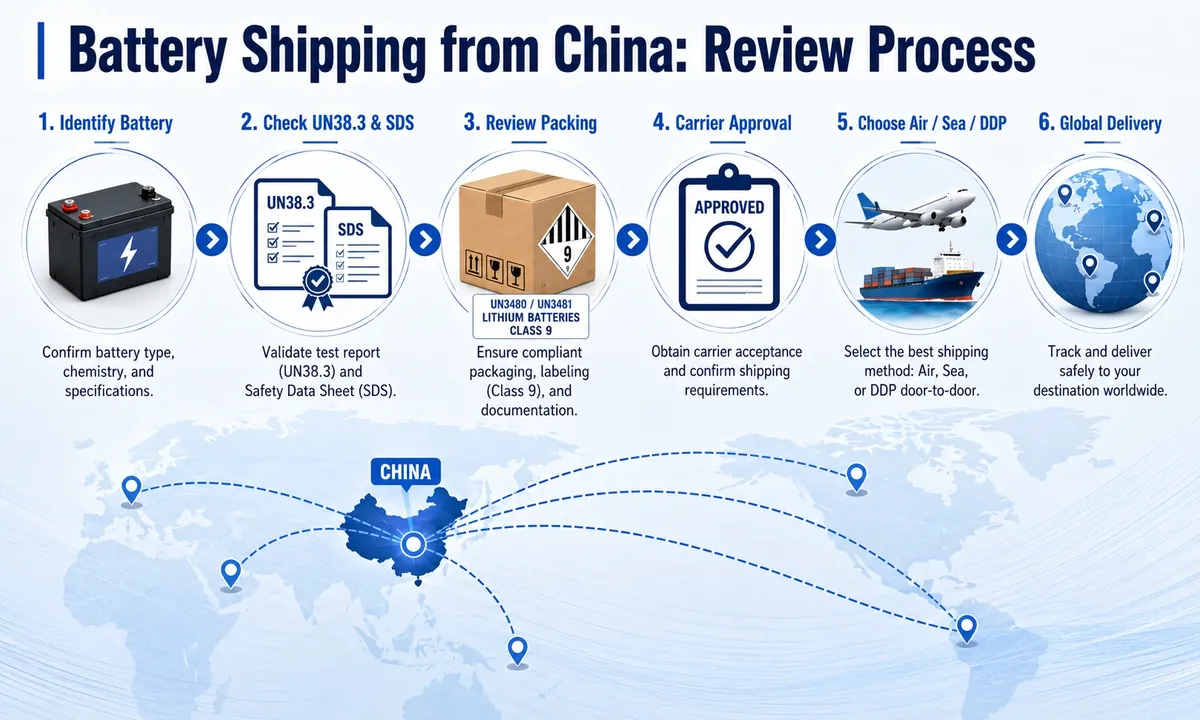
identify the battery → verify the documents → confirm the shipping configuration → review the packing → obtain carrier acceptance → confirm the final freight quotation.
Air freight, sea freight, express courier and DDP can all be practical for eligible battery cargo. However, the correct option depends on the battery chemistry, UN classification, Watt-hour rating, state of charge, configuration, packing, documents, carrier and final destination.
If you are unsure which route fits your shipment, send VoltFreight the battery model, chemistry, voltage, capacity, Watt-hour rating, UN38.3 test summary, available SDS, product photographs, packing photographs, carton details, supplier city and final delivery postcode.
We can review the practical transport options before the factory releases the cargo.
Official Battery Shipping Sources
Battery regulations and carrier policies can change. Check current official requirements before transportation.
IATA:
Battery Shipping Regulations
Dangerous Goods FAQ
United Nations:
UN Manual of Tests and Criteria
International Maritime Organization:
International Maritime Dangerous Goods Code
United States:
PHMSA Lithium Battery Guidance
PHMSA Lithium Battery Test Summary Guidance
European Union:
Regulation (EU) 2023/1542 on Batteries and Waste Batteries
Compliance notice:
This article provides general freight-planning information and does not replace the current IATA Dangerous Goods Regulations, ICAO Technical Instructions, IMDG Code, ADR, national dangerous-goods regulations, carrier variations, customs advice or product-specific legal requirements. Final classification, packing, documentation, state of charge and carrier acceptance should be confirmed for the actual shipment before transportation.