Quick Answer: How to Source Vapes from China to USA Safely in 2026
Yes, a U.S. business can investigate and contract with qualified Chinese suppliers. However, finding a factory that can manufacture a vape is not the same as finding a product that may lawfully enter and be sold in the United States.
For most U.S. importers, the practical sourcing options are an official manufacturer or brand supply network, a transparent China sourcing agent, verified independent company websites, and professional referrals. Alibaba and 1688 are better used for market research than as proof of a finished vape’s U.S. eligibility.
In practical terms, how to source vapes from China to USA safely is a sequence of product-eligibility, supplier, quality, commercial, and shipping checks. Each gate must pass before the buyer commits more money.
A workable sourcing process follows this order:
- Define the exact product, brand, model, flavor, nicotine strength, battery, packaging, and intended sales states.
- Verify that the exact finished product—not merely the factory or brand—has a valid route to the U.S. market.
- Find the legal Chinese manufacturer or an authorized supply channel.
- Confirm the manufacturer’s business identity, tobacco-production authority, production scope, address, and bank beneficiary.
- Request technical, quality, battery, e-liquid, packaging, and export documents before paying for samples.
- Approve a golden sample and a written product specification.
- Inspect bulk production and reconcile every model, batch, carton, and document.
- Confirm customs, dangerous-goods, tax, PACT Act, state, carrier, and final-delivery requirements before paying the balance.
If a supplier cannot support step two, a low unit price is irrelevant. As of August 24, 2026, FDA’s authorized e-cigarette page listed 45 authorized e-cigarettes and stated that these were the only e-cigarettes that could be lawfully sold in the United States. FDA also warns that authorization does not mean a product is safe or “FDA approved.” Always check the live FDA authorized e-cigarette list when making a sourcing decision.
Start With U.S. Market Eligibility, Not the Factory Price
Many sourcing guides start with Alibaba searches, factory quotations, and MOQ. For vapes, that order creates unnecessary risk. Begin with the exact product’s U.S. status and work backward to an authorized supply chain.
Four claims that do not prove a vape may be sold in the United States
- “Our factory is FDA registered.” Facility registration or product listing is not a marketing authorization for the finished SKU.
- “We filed a PMTA.” A submission, tracking number, acceptance, or pending review does not equal a marketing granted order.
- “We have CE, RoHS, FCC, ISO, or lab reports.” These may support technical or quality review, but they do not create U.S. tobacco-product marketing authorization.
- “Our China tobacco license covers exports.” This can support China-side manufacturing eligibility. It does not decide whether the product may be marketed in the United States.
FDA Import Alert 98-07 allows detention without physical examination of electronic nicotine delivery systems that lack required premarket authorization. The alert covers ENDS and may include components and parts. Therefore, an importer should not assume that removing nicotine, separating a battery, or describing goods as “accessories” eliminates FDA review.
Moreover, all tobacco products offered for import must meet applicable federal requirements. FDA’s importing and exporting guidance explains that noncompliant products may be refused admission and lists data elements submitted through the Automated Commercial Environment. Personal use is not a blanket exemption.
Practical rule: do not ask a supplier, “Is this FDA compliant?” Ask for the exact legal product identity and documentary evidence. Then have the U.S. importer’s compliance team verify it independently.
Decide Which Vape Product and Business Model You Need
A supplier cannot quote accurately until you define what you plan to buy and how you plan to sell it. “Disposable vape, 5%, cheapest price” is not a usable specification. It invites incomparable quotations and makes substitution easy.
Lock the product identity
At minimum, document the brand owner, exact commercial name, model or SKU, device type, e-liquid volume, flavor, nicotine concentration, coil, battery cell and capacity, charging interface, materials, firmware if relevant, retail warning statement, package count, carton quantity, and intended sales states. Photograph the retail unit, inner box, master carton, labels, and batch coding.
For an authorized finished product, spelling, flavor, strength, device-pod combination, and other characteristics must match the authorization and supply records. A supplier’s “equivalent” version, new flavor, larger puff count, different nicotine strength, or custom logo is not automatically the same product.
Choose the commercial route before contacting factories
- Authorized finished-brand sourcing: buy an exact eligible SKU through the brand owner, contract manufacturer, or an authorized distributor whose chain of authority can be documented.
- Contract manufacturing for an existing authorization holder: use a factory approved by the brand or authorization holder and control product identity, change management, and records.
- New OEM or private-label product: treat this as a regulatory-development project, not a quick logo-printing order. A new or modified tobacco product generally requires the applicable U.S. marketing pathway before commercial sale.
- Components or empty hardware: obtain product-specific advice. FDA’s ENDS framework can cover components and parts, while batteries and liquids add separate transport and product questions.
If you are still defining the broader import structure, read our guide to importing from China. For this category, however, product eligibility must remain the first gate.
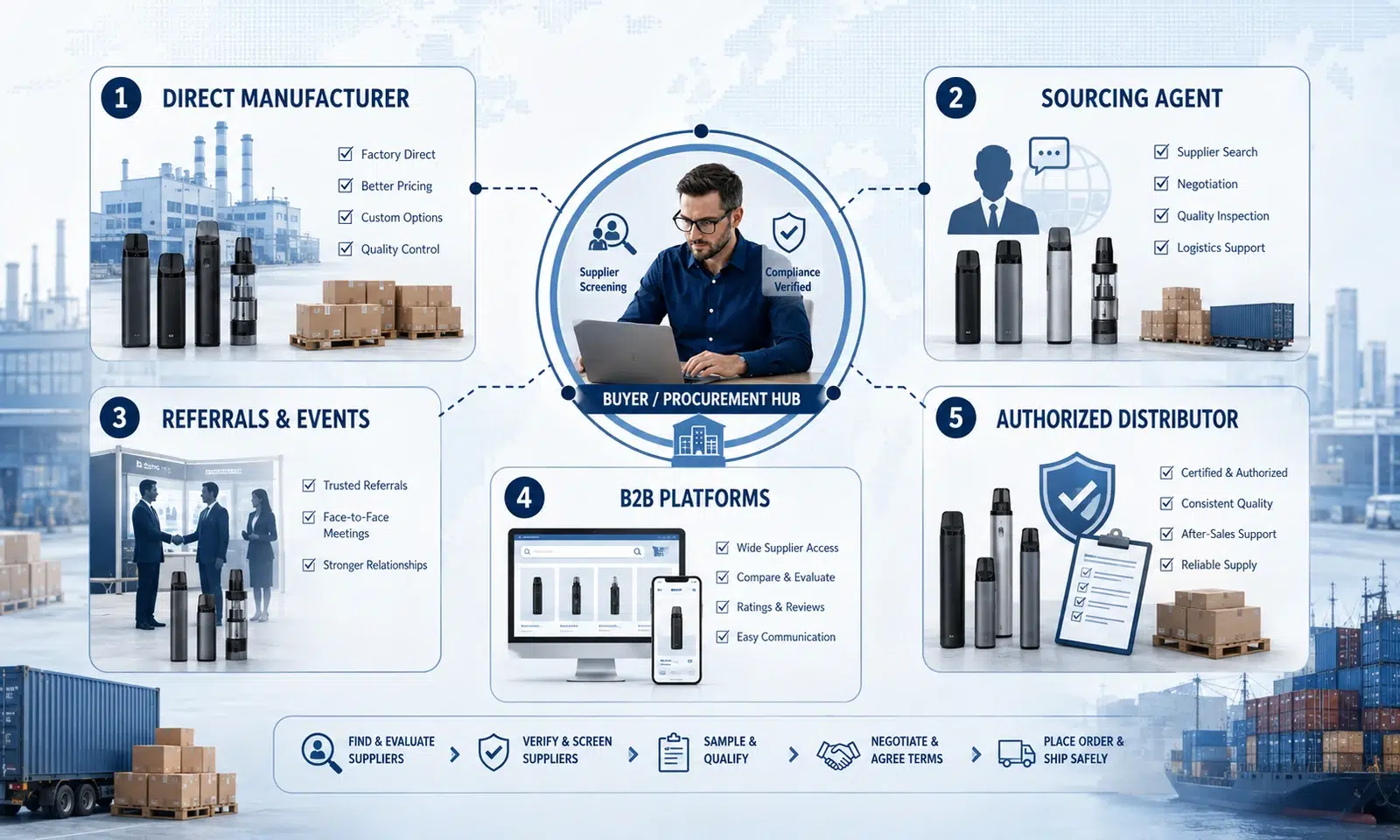
Five Ways to Find Vape Manufacturers and Suppliers in China
No single channel is best for every importer. Direct sourcing can reduce markups, while an agent can reduce search and coordination work. A U.S. brand network may cost more per unit but provide a clearer authorization and distribution chain. Compare the channels on evidence and total risk, not only the opening quotation.
Use the following comparison when deciding how to source vapes from China to USA for a specific product and order size.
| Sourcing channel | Best use | Cost potential | Main risk | Recommendation |
|---|---|---|---|---|
| Direct licensed manufacturer or official brand website | Qualified buyers with clear specifications, volume, and their own compliance resources | Often strong at repeat-production volume | Factory identity, brand authority, and U.S. product status may still be unclear | Shortlist only after independent legal, factory, and product verification |
| China sourcing agent or integrated sourcing/freight partner | Buyers needing Chinese-language search, supplier comparison, samples, inspection, consolidation, and freight planning | Agent fee adds cost, but failed-order and coordination risk may fall | Opaque commissions, conflicts of interest, or an agent that claims to replace legal review | Use a written scope, disclosed fee model, supplier transparency, and separate U.S. compliance review |
| Industry referrals and specialized overseas B2B events | Meeting brand owners, export teams, distributors, and factories in person | Good negotiation potential after qualification | Event participation is not proof of licensing, quality, or authorization | Use for discovery, then run the same document and factory checks |
| Alibaba, 1688, Made-in-China, and general B2B platforms | Market mapping, adjacent products, packaging, and initial company discovery where listings are permitted | Many quotes, but price comparisons can be misleading | Restricted listings, traders presented as factories, copied certificates, counterfeit goods, or off-platform payment pressure | Do not use coded searches to evade platform rules; verify outside the listing |
| U.S. authorization holder, brand network, or authorized distributor | Importers prioritizing a documented product and distribution chain | Higher purchase price may produce lower risk-adjusted cost | Territory restrictions, distributor margin, and limited assortment | Often the logical starting point for exact FDA-authorized products |
When does a China sourcing agent add value?
A capable agent can search Chinese corporate names, compare quotations on the same specification, arrange one warehouse for samples, visit a stated address, coordinate third-party inspection, check carton data, and involve a freight team before production. This is useful when a U.S. buyer lacks Mandarin support or cannot manage several vendors.
However, the agent should disclose the actual supplier, fees, and payment flow. The agent must not be treated as the issuer of FDA authorization or legal advice. Read more about the role, fees, and controls in our China sourcing agent guide.
Why Alibaba, 1688, and the Canton Fair Need Special Caution
Alibaba is not a complete directory of the Chinese vape industry
Importers often report that they cannot find finished vapes on mainstream platforms. That does not mean the factories disappeared. It often reflects platform rules, local regulation, category restrictions, and the difference between domestic and export sales channels.
Alibaba’s product listing policy restricts or prohibits categories that include e-cigarette-related items. Consequently, a missing listing is not evidence that a company is inactive, while a live listing is not proof that a transaction is allowed or that the product is lawful in the destination market.
Do not search secret code words, ask sellers to hide the product category, or move to a false description. Search and transact transparently. If a supplier proposes declaring finished vapes as toys, chargers, electronic parts, aromatherapy products, or another inaccurate description, reject the proposal.
For allowed categories, our Alibaba supplier verification guide still provides useful general due-diligence steps. The product itself remains subject to separate tobacco and transport checks.
1688 serves China’s domestic market
1688 can reveal company names, packaging vendors, electronics suppliers, and domestic price signals. Nevertheless, domestic specifications, invoices, packaging, payment, and delivery terms may not support export. Listings can also come from traders rather than the legal manufacturer.
A buyer using 1688 needs Chinese-language communication, a local receiving point, supplier verification, and an export plan. Never infer U.S. eligibility from a domestic listing. See our separate 1688 shipping to the USA guide for the platform workflow.
The Canton Fair is not a normal finished-vape marketplace
China’s e-cigarette controls include licensing and restrictions on online promotion and promotional exhibitions. Therefore, do not plan a Canton Fair trip on the assumption that finished vape brands and factories will exhibit like ordinary consumer-electronics suppliers.
The fair can still help with permitted adjacent needs, such as packaging, retail displays, general electronics, automation, and broader supplier networking. Specialized overseas industry events and verified introductions may be more productive for finished products. If you attend, use our Canton Fair sourcing and shipping checklist, then apply vape-specific compliance checks separately.
How to Search Google and Independent Supplier Websites
The most useful search keywords combine product + company role + location + proof. Generic searches such as “cheapest vape China” attract directories, resellers, expired stock, and promotional pages. A precise search reveals the legal company, product identity, or document you need to verify.
Supplier-discovery keyword formulas
electronic cigarette manufacturer Shenzhen OEMvape contract manufacturer China export[exact brand] authorized distributor wholesale USA[exact model or SKU] manufacturer[factory name] Shenzhen address[Chinese legal company name] 统一社会信用代码site:gsxt.gov.cn [Chinese legal company name][company name] warning letter OR recall OR lawsuit OR scam
U.S. product-status keyword formulas
site:fda.gov authorized e-cigarettes [brand]site:accessdata.fda.gov [exact product name][exact product name] marketing granted order[brand] [flavor] [nicotine strength] FDA marketing order
Search results are leads, not proof. Open the official record and compare the complete product identity. A blog, supplier screenshot, PDF uploaded to a sales page, or search snippet can be outdated.
How to assess an independent factory website
A credible site should connect the English trading name to a Chinese legal entity, provide a consistent address and corporate email domain, identify whether the company is the brand owner or contract manufacturer, and show products that match its claimed production scope. Look for original factory information rather than stock photographs and copied certifications.
Check when the domain appeared, whether staff email addresses use the same domain, and whether company names match across the website, quotation, invoice, license, test reports, bank account, and shipping documents. Treat a new domain, only WhatsApp contact, an unrelated bank beneficiary, impossible prices, and urgent wire instructions as red flags.
Four Established Chinese Vape Companies to Research—Not a U.S. Authorization List
The following companies are useful starting points for understanding China’s electronic-atomization manufacturing ecosystem. They are included as research examples, not as blanket supplier recommendations. A large company, famous brand, professional website, or OEM capability does not prove that every product is available for wholesale, authorized for U.S. sale, or suitable for your order.
SMOORE International
SMOORE International is a major Chinese atomization-technology company with large-scale research, product-development, and manufacturing operations. Its corporate website is useful for understanding the company’s technology platforms, business structure, brands, investor information, and official news. For an importer, SMOORE can serve as a benchmark for how a large manufacturer presents its corporate identity, R&D resources, intellectual property, and manufacturing capabilities. However, buyers must still identify the actual contracting entity, production site, brand owner, and exact product supplied under a proposed transaction.
Firstunion Group
Firstunion Group states that it was founded in Shenzhen in 2004 and provides electronic-atomization solutions, including nicotine atomization and intelligent manufacturing. Its website is particularly relevant to B2B buyers because it presents technology platforms, manufacturing information, quality systems, and an official ODM contact route. Use the site to prepare a structured inquiry, but verify the Chinese legal entity, license scope, factory address, contract manufacturer relationship, and the exact proposed SKU before discussing a deposit.
SMOK / Shenzhen IVPS Technology
SMOK / Shenzhen IVPS Technology is an established Shenzhen vape brand and manufacturer. The official site identifies the company behind the SMOK brand and provides product information, support resources, product-verification tools, and wholesale or OEM contact routes. This makes it useful for checking whether a salesperson, domain, product code, or claimed distributor connects to the official brand. Still, brand authenticity and U.S. marketing authorization are separate checks; a genuine SMOK product is not automatically an FDA-authorized U.S. product.
Aspire / Shenzhen Eigate Technology
Aspire / Shenzhen Eigate Technology presents itself as an integrated R&D, manufacturing, and OEM/ODM solutions provider. Its official site identifies the Chinese manufacturer, factory address, product range, manufacturing information, dealer application, compliance resources, and global partners. Buyers can use these pages to compare a supplier’s claimed identity and to locate an official business contact. They must then confirm whether Aspire accepts the project, who will sign and receive payment, and whether the exact product has a lawful route to the intended U.S. market.
How to Use These Official Sites
Study the company’s official legal name, contact domain, product-verification tools, manufacturing claims, and partnership pages. Then compare that information with the quotation, Chinese registry record, production license, bank beneficiary, sample, contract, and FDA product record. Do not copy a model from a global catalogue and assume that it may be imported into the United States.
How to Verify a Licensed Chinese Vape Manufacturer
Factory verification has two goals: prove who will receive your money and prove who will manufacture the goods. They may be different legal entities, but the relationship must be documented.
Step 1: establish the legal identity
Request a color copy of the Chinese business license. Record the Chinese legal name, Unified Social Credit Code, legal representative, registered address, formation date, and business scope. Search the name and code in China’s official National Enterprise Credit Information Publicity System. If access is difficult from overseas, have a Chinese-speaking professional retrieve and preserve the result.
Do not rely on an English company name alone. Several unrelated businesses can use similar English names, while a trading company may market the production of another factory.
Step 2: verify tobacco-production authority and scope
Ask for the Tobacco Monopoly Production Enterprise License and confirm the license number, holder, address, validity, and permitted scope with the relevant Chinese authority or qualified local adviser. China’s e-cigarette export management rules require licensed production within the approved scope and capacity, destination-law compliance, export filings, and the production-license number on export packaging.
A license image can be altered or borrowed. Match it to the legal entity, site, product, quotation, and packaging. If a trader holds no production license, obtain the actual manufacturer’s documents and a contract or authorization showing the relationship.
Step 3: verify the site and production capability
- Conduct a live video tour that begins outside the building and follows material flow through production, testing, quarantine, and finished-goods storage.
- Compare signs, room numbers, equipment plates, employee uniforms, and fire exits with the stated address and earlier media.
- Request a recent audit or arrange an independent on-site assessment focused on the exact production line.
- Review incoming inspection, e-liquid control, battery traceability, line clearance, nonconforming goods, complaint handling, and recall procedures.
- Confirm monthly capacity with equipment, shifts, and recent production records rather than a sales claim.
Step 4: reconcile contracts, invoices, and bank details
The quotation, sales contract, commercial invoice, beneficiary, and manufacturer should form an explainable chain. If payment goes to a Hong Kong company, exporter, agent, or affiliate, obtain a written explanation and supporting corporate relationship. Do not send a large deposit to a personal account or an unrelated beneficiary simply because a salesperson says it is faster.
For a broader pre-shipment verification workflow, see our China inspection service guide.
How to Check the Exact Product’s U.S. Marketing Status
This check should be completed by the U.S. importer’s qualified regulatory team. A freight forwarder, Chinese supplier, inspection company, or sourcing agent can collect records, but none should convert a marketing claim into a legal conclusion.
- Write the exact product identity. Include manufacturer, brand, device, pod or cartridge, flavor, nicotine concentration, package configuration, model, and any identifying numbers.
- Search FDA’s live authorized list and searchable tobacco-product database. Do not stop at a brand-level match.
- Obtain the relevant marketing order and supporting authorization-chain documents. Confirm that the party selling to you has authority to supply that exact product.
- Compare physical samples and packaging to the official identity. Record every difference and resolve it in writing.
- Check current enforcement information. Review import alerts, warning letters, recalls, and any product-specific updates.
- Check federal, state, and local sales requirements. Authorization at the federal level does not remove state product-directory, flavor, tax, licensing, age-verification, or delivery restrictions.
Remote and interstate sales can also trigger the PACT Act. ATF explains that ENDS sellers may face registration, reporting, labeling, recordkeeping, age-verification, delivery, state-law, and tax obligations. A warehouse or residential delivery address does not make those obligations disappear.
Never accept these shortcuts: “the PMTA is under review,” “similar to an authorized model,” “our lawyer says everyone imports it,” “DDP includes compliance,” or “small quantities are safe.” Ask for verifiable documents and obtain your own advice.
What to Ask Before Ordering Vape Samples
A sample order should test the supplier’s documentation and communication as well as the product. Send the same request to each shortlisted supplier so that you can compare like with like.
Subject: U.S. vape sourcing inquiry—exact product and factory verification
Please provide: (1) Chinese legal company name and Unified Social Credit Code; (2) business license; (3) Tobacco Monopoly Production Enterprise License, validity, address, and production scope; (4) factory address and relationship among manufacturer, exporter, brand owner, and payment beneficiary; (5) exact product name, model/SKU, flavor, nicotine strength, e-liquid volume, battery cell and capacity, coil, materials, packaging, warnings, and batch coding; (6) documentary basis for the exact product’s U.S. marketing status and the seller’s supply authority; (7) MOQ and price tiers on EXW and FOB terms with all exclusions; (8) sample price, lead time, and courier options; (9) UN38.3 test summary, battery specification, applicable SDS, e-liquid SDS/formulation records, and available test reports; (10) QC plan, defect standard, warranty, change-control process, and inspection access; (11) unit, inner-carton, and master-carton dimensions and weights; and (12) proposed contract entity, invoice issuer, and bank beneficiary.
Do not request a generic “FDA certificate.” There is no universal certificate that turns any factory’s vape into an authorized U.S. product. Request the exact product identity, official record, order, and chain of authority, then verify them independently.
Reduce sample costs without reducing evidence
Importers often find that sample freight costs more than the samples themselves. This can happen because a small shipment still needs pickup, acceptance, documentation, security screening, and battery or liquid handling.
Instead of asking five factories to send five separate parcels, route permitted samples to one verified China warehouse, label each supplier’s units, photograph receipt, and consolidate only after the carrier confirms acceptance. Keep each product’s paperwork and identity separate. The cheapest courier quote is not useful if the carrier later rejects the package or the declaration is inaccurate.
How to Test Samples and Inspect Bulk Production
A beautiful pre-production sample does not prove that 20,000 bulk units will match. Control the transition from quotation to sample, approved specification, materials, production, inspection, and shipment.
Create a golden sample and written specification
Sign and date at least two approved samples. Keep one with the importer and one sealed with the factory or inspection party. Attach photographs, dimensions, weight tolerances, color references, taste or formulation controls, electrical requirements, packaging artwork, warnings, barcode data, and batch-code format.
The purchase contract should require written approval before any change to the cell, coil, liquid, nicotine, materials, firmware, enclosure, supplier, production site, artwork, or package configuration. A cheaper substitute can change safety, performance, shipping documents, and the product’s legal identity.
Build a product-specific test plan
- Identity and traceability: model, flavor, strength, license number, warnings, barcode, lot code, manufacturing date, and carton reconciliation.
- Leak resistance: upright, inverted, temperature-conditioning, and reduced-pressure testing designed for the transport profile.
- Functional consistency: activation, airflow, draw or puff consistency, charging where applicable, indicator behavior, and failure rate.
- Electrical protection: short-circuit, overcharge, over-discharge, temperature, and other protection checks appropriate to the design.
- Battery traceability: cell maker, model, rating, production lot, installed cell, and consistency with the UN38.3 test summary and shipping documents.
- E-liquid controls: identity, nicotine concentration, ingredients or contaminants specified by the buyer’s qualified laboratory and compliance program.
- Packaging: tamper evidence, warnings, print accuracy, carton strength, unit protection, and scannable codes.
Inspect at the right production stages
Use pre-production verification for materials and artwork, an in-process check when early output can still be corrected, and a pre-shipment inspection after production is complete and packed. Select cartons randomly across the lot and record the sampling plan, acceptance criteria, defects, photographs, and serial or batch details.
An inspection report describes what the inspector sampled. It does not certify FDA authorization, guarantee every unit, or replace importer due diligence. If the result fails, require a documented corrective action and reinspection rather than accepting edited photographs.
MOQ, OEM, ODM, Branding, and Payment Terms
The direct factory is not always the cheapest option. A factory may quote its best unit price only at a high MOQ, while a brand distributor or agent can combine demand and offer a smaller, safer order. Compare the cash committed, unsold inventory risk, defects, and compliance costs.
Compare price tiers only after locking the specification
Request at least three quantity tiers on the same product specification and Incoterm. Ask what changes at each tier: packaging, flavors per run, deposit, lead time, tooling, inspection, spare units, warranty, and carton configuration. A quote of USD 2.20 EXW and USD 2.45 FOB cannot be compared until you know exactly what the FOB seller includes and which port applies.
Understand OEM and ODM risk
ODM normally starts from a supplier platform and changes branding or selected features. OEM may use the buyer’s design and specification. In ordinary consumer products, private labeling can be mainly a commercial decision. For a U.S. vape, a new brand, flavor, strength, configuration, or other modification may create a different new tobacco product that needs the applicable authorization before commercial marketing.
Therefore, “add my logo” is not a shortcut to the U.S. market. Do not place a private-label production order until qualified counsel has mapped the product and regulatory pathway.
Use milestone-based commercial controls
- Put the exact specification, quantity, price, Incoterm, delivery point, lead time, and approved artwork in the contract.
- Define when the deposit becomes nonrefundable and what happens if documents, samples, or inspections fail.
- Reserve the right to inspect, test, reject, rework, or receive a refund under measurable criteria.
- Link balance payment to completed production, passing inspection, final carton data, and an accepted shipping plan.
- Verify any change to bank instructions through a known contact and a second communication channel.
How to Calculate the Cheapest Compliant Landed Cost
People searching for the cheapest vapes from China to the USA usually compare unit quotations. That number can hide tooling, sample freight, rejects, dangerous-goods handling, duties, brokerage, delivery, excise tax, returns, and the possibility that the goods cannot be admitted or sold.
Use this formula instead:
Risk-adjusted landed cost per sellable unit = (product + tooling and samples + inspection and testing + China pickup and warehouse + battery/liquid documentation and handling + international freight + duties, taxes, and brokerage + final delivery + expected defect, return, and refusal costs) ÷ expected sellable units.
Do not copy a tariff percentage from an old article. Classification and trade measures depend on the exact product, construction, origin, entry date, and current rules. Give your broker a complete specification and confirm the HTS classification, ordinary duty, additional tariffs, fees, and entry requirements using current sources such as the U.S. International Trade Commission HTS Search. State and local ENDS taxes can sit outside the customs entry and still affect the final economics.
A simple risk-adjusted comparison
Suppose Supplier A quotes 12% less than Supplier B. Supplier A cannot document the actual manufacturer, will not permit inspection, uses an unrelated payment account, and excludes battery paperwork. Supplier B has a verified chain, approved sample, inspection access, consistent documents, and a carrier-accepted packing plan. Even before regulatory eligibility is considered, Supplier B may deliver more sellable units and a lower final cost.
Now add the decisive gate: if Supplier A’s exact SKU lacks the required U.S. marketing authorization, its apparent savings do not repair the product’s admissibility. The cheapest factory quotation can produce a total loss.
Eight legitimate ways to reduce landed cost
- Compare all suppliers on the same locked specification, quantity, Incoterm, port, and exclusions.
- Request MOQ tiers and calculate total cash at risk, not only the lowest unit price.
- Use an already eligible, documented product and supply chain instead of assuming a low-cost custom model can enter quickly.
- Consolidate permitted samples in China after checking carrier and document requirements.
- Improve carton dimensions and pack density without compromising battery safety, product protection, warnings, or traceability.
- Negotiate spare units, defect allowance, warranty credit, and clear rework terms.
- Obtain an independent freight quotation based on verified weights, dimensions, battery data, liquid data, pickup address, and destination.
- Use an appropriate air, sea, or split-shipment plan only after the exact cargo is eligible and accepted; do not choose a mode from price per kilogram alone.
A responsible “cheap electronic cigarettes from China” article should therefore define cheap as the lowest lawful, documented, delivered cost per sellable unit. Anything else is an incomplete price comparison.
Plan Shipping Before Paying the Supplier Balance
Finished vapes combine a lithium battery, electronics, and e-liquid. Their transport plan depends on the exact design, liquid composition, battery, quantity, packing method, route, airline or vessel operator, carrier policy, and destination rules. Do not promise a route until a freight specialist reviews the cargo details.
Start the freight review while samples and production specifications are being approved. Collect the UN38.3 test summary, battery specification, applicable SDS, e-liquid information, packing photographs, unit and carton data, commercial documents, manufacturer and exporter details, and exact product list. The documents must describe the goods accurately and consistently.
Our vape shipping documents checklist explains the file set in more detail. You can also review the lithium battery shipping guide and the complete China-to-USA vape shipping guide.
Confirm the importer and delivery model
Name the importer of record, customs broker, consignee, warehouse, responsible FDA data party, and party handling state licenses, product directories, taxes, PACT Act duties, and adult-signature delivery where applicable. A freight term allocates specified costs and risks between buyer and seller; it does not transfer every regulatory duty.
DDP deserves particular caution. A supplier’s “tax included, door to door” quote does not prove lawful product status, accurate entry, correct importer setup, or PACT and state compliance. Ask who will appear in the entry, what value and description will be declared, which broker and carrier will be used, what taxes are included, and what happens if authorities examine or refuse the goods.
Common mistakes to reject
- Declaring vapes as toys, chargers, accessories, or generic electronics.
- Reducing the commercial value without a lawful valuation basis.
- Using a residential address as if it removes importer, tax, licensing, or delivery-sale obligations.
- Booking ordinary courier service before disclosing the battery and liquid.
- Assuming a sample shipment, small parcel, or personal-use label creates an exemption.
- Paying the factory balance before the forwarder accepts the final cargo profile and documents.
- Letting the supplier change the model, cell, liquid, or cartons after the freight review.
For entry planning, see our U.S. customs clearance guide. For other destinations and transport fundamentals, use the global vape shipping guide.
FAQ About Sourcing Vapes from China to the USA
Can I buy vapes directly from a Chinese factory?
You can contact and contract with a qualified factory, but factory capability alone is not enough. Verify the Chinese legal manufacturer and production authority, exact U.S. product status, supply authority, importer obligations, quality system, payment chain, customs entry, and carrier acceptance before ordering.
Where can I find vape suppliers if Alibaba and AliExpress show few results?
Start with FDA’s exact authorized-product records, then identify the authorization holder, brand owner, authorized distributor, and documented manufacturer or supply network. You can also use precise Google searches, verified independent factory sites, professional referrals, a transparent China sourcing agent, and specialized overseas B2B events. Do not use coded listings to avoid platform policies.
Is 1688 cheaper for electronic cigarettes?
A domestic listing may show a lower price, but it may exclude export packaging, documentation, testing, tax, local pickup, agent work, international freight, or U.S. compliance. The listed seller may also be a trader. Compare verified, export-ready, risk-adjusted landed cost—not the 1688 screen price.
How do I know whether a supplier is a real vape manufacturer?
Match the Chinese business license, Unified Social Credit Code, tobacco-production license, address, production scope, site inspection, production records, quotation, contract, bank beneficiary, packaging, and shipping documents. If a trading company is involved, document its relationship with the licensed factory and brand owner.
Does a PMTA number mean the product can be imported and sold?
No. A submission or tracking number does not by itself prove a marketing granted order. Verify the exact product against current FDA records and obtain qualified product-specific advice. Also check state and local requirements.
Can a factory make my own vape brand for the U.S. market?
A factory may have the technical ability to make a private-label product. That does not make the new brand or SKU lawful for U.S. sale. Changes in brand, flavor, strength, device, liquid, or configuration may affect product identity and required authorization. Build the regulatory pathway before commercial production.
Can VoltFreight tell me whether a vape is FDA authorized?
VoltFreight can help collect supplier and cargo information, coordinate sourcing steps, samples, inspections, documents, and freight review. We do not issue FDA marketing orders, provide a legal opinion, or make an ineligible product lawful. The U.S. importer should use official records and qualified U.S. regulatory counsel for the final determination.
Can vapes be delivered to a home address in the United States?
A carrier may accept certain business shipments to a valid address under its rules, but the address does not resolve product authorization, importer of record, state licensing, excise tax, PACT Act, age-verification, or delivery restrictions. Confirm the full business and delivery model before booking.
Why Choose VoltFreight for Vape Sourcing and Shipping?
Vape procurement crosses supplier search, Chinese-language verification, product specifications, samples, inspection, battery and liquid documents, export handling, customs planning, and carrier acceptance. When these tasks sit with disconnected parties, buyers often discover a conflict only after production is complete.
For businesses asking how to source vapes from China to USA, the most useful partner is one that connects supplier evidence to the actual cargo and route without hiding the limits of its role.
VoltFreight can help coordinate the China-side work around one documented cargo profile:
- Translate the buyer’s product and supplier requirements into a structured request for quotation.
- Collect and organize Chinese company, manufacturer, quotation, product, battery, liquid, packaging, and shipping information.
- Compare suppliers on the same specification, Incoterm, MOQ tier, exclusions, and carton data.
- Coordinate permitted samples, China warehouse receipt, consolidation, and inspection logistics.
- Connect approved product details to freight routing, carrier review, customs documentation, and final delivery planning.
- Identify missing or conflicting information early so the importer can obtain legal, broker, laboratory, or regulatory advice before committing more money.
We keep the boundary clear: VoltFreight does not guarantee government admission, issue tobacco-product authorization, replace the importer’s legal responsibilities, or support false declarations. Our role is to make the sourcing and shipping file more complete, transparent, and operationally ready.
Send these details for an initial review
- Exact brand, model/SKU, flavor, nicotine strength, liquid volume, and battery details.
- Supplier’s Chinese and English legal names, factory address, quotation, and proposed payment entity.
- Evidence supporting the exact product’s U.S. marketing status and the supplier’s authority to sell it.
- Sample or order quantity, unit price, Incoterm, pickup location, and production schedule.
- Unit, retail-box, and master-carton dimensions and weights.
- Available UN38.3, battery specification, SDS, e-liquid, test, inspection, and packaging files.
- U.S. destination, importer of record, customs broker, warehouse type, and intended sales states.
With those details, the discussion can move from “What is the cheapest vape?” to the question that protects margin: Which documented supply chain can deliver the lowest compliant cost per sellable unit?
Need help comparing a supplier, cargo documents, and a feasible shipping plan? Send VoltFreight the details above before you pay the supplier balance or book the shipment.