Canton Fair shipping should be planned before you leave China, not after every supplier starts sending goods separately. If you find suppliers, collect samples or place trial and bulk orders at the Canton Fair, the next step is to decide how those products will move from different Chinese factories to one international shipping plan.
A single sample may be easy to send by DHL, UPS or FedEx. However, ten samples from ten suppliers are different. Likewise, a 300 kg trial order, a 5 CBM mixed shipment and a 40HQ furniture order should not use the same logistics method.
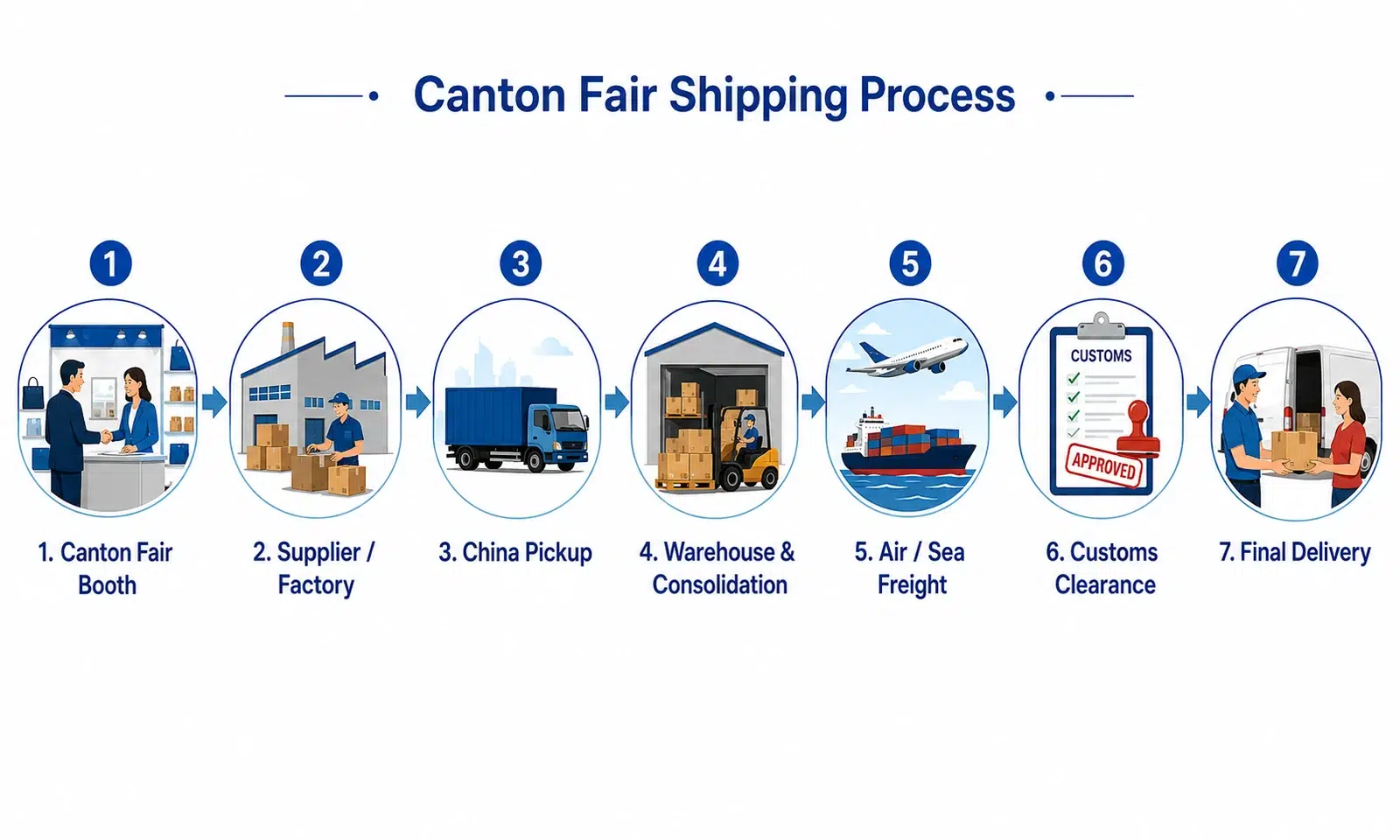
For many international buyers, the practical process is:
Canton Fair → Supplier Confirmation → Production → China Pickup → Warehouse Receiving → Consolidation or Direct Loading → Inspection and Packaging Check → Freight Booking → Export → Customs → Final Delivery
This guide explains how to organize that process after the 140th Canton Fair in 2026, including supplier information to collect, sample shipping, multi-supplier consolidation, Phase 1–3 cargo risks, Guangzhou-area pickup, express, air freight, LCL, FCL, rail and suitable door-to-door options.
Already have Canton Fair suppliers? Send VoltFreight the supplier cities, product names, estimated package details, cargo-ready dates and final destination through our freight quote form. We can review whether the orders should ship separately or move under one coordinated China shipping plan.
Quick Answer: How Should You Ship Goods Bought at the Canton Fair?
The right method depends first on the stage of your purchase.
- One or two small samples: Compare express courier services such as DHL, UPS or FedEx.
- Samples from several suppliers: Consider sending them to one China warehouse first, then consolidating them into fewer international parcels.
- Small trial order: Compare express, standard air freight, LCL sea freight and suitable door-to-door services according to weight, CBM and urgency.
- Several trial orders from different factories: Review China warehouse consolidation before each supplier arranges separate international freight.
- Larger commercial order: Compare air freight, LCL or FCL using the final packed dimensions and gross weight.
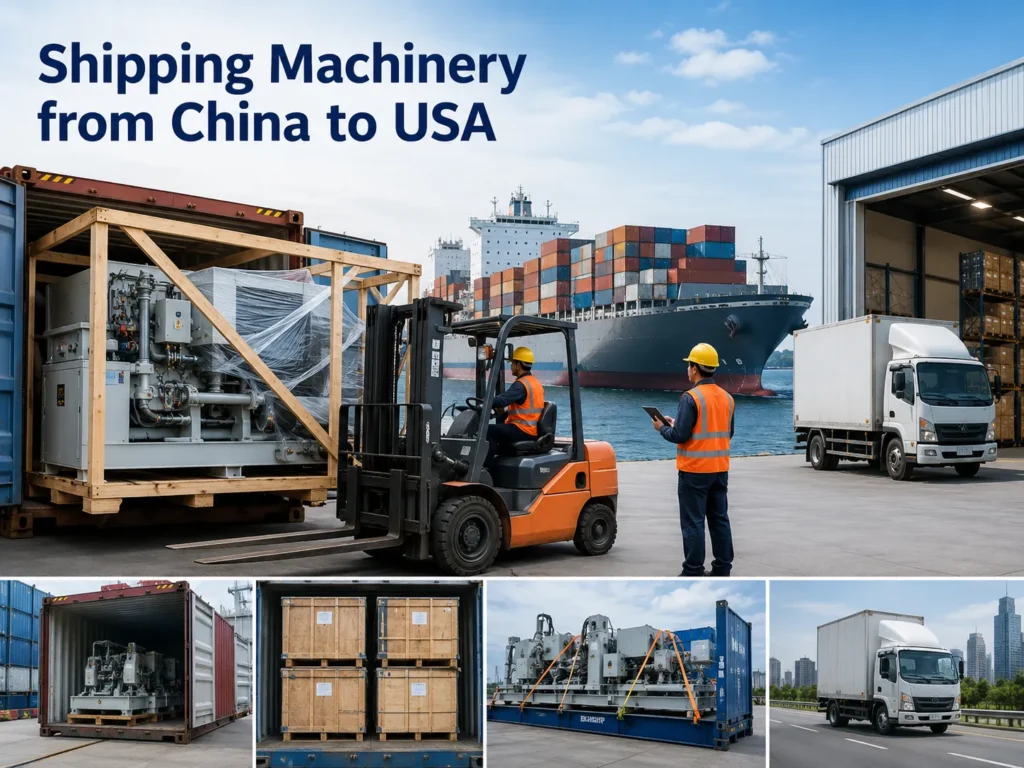
- Large furniture, machinery or project cargo: Check container loading, packing, equipment and final unloading before booking.
- Amazon, 3PL or business warehouse inventory: Confirm labels, package data, customs scope and receiving requirements before departure.
The cheapest method is not always the best choice. Buyers should compare the complete route, including supplier pickup, China warehouse costs, consolidation, international freight, customs responsibility and final delivery.
140th Canton Fair 2026 Dates and Why They Matter for Shipping
The 140th China Import and Export Fair, commonly known as the Canton Fair, is scheduled in Guangzhou in three phases during autumn 2026:
| Phase | 2026 Dates | Typical Product Direction | Main Shipping Questions |
|---|---|---|---|
| Phase 1 | October 15–19 | Electronics, electrical equipment, machinery, vehicles, industrial products and advanced manufacturing categories | Weight, batteries, dangerous goods, machinery dimensions, crates, lifting and equipment acceptance |
| Phase 2 | October 23–27 | Furniture, building materials, household goods, ceramics, gifts and home-related categories | CBM, fragile cargo, palletizing, moisture, carton strength and container utilization |
| Phase 3 | October 31–November 4 | Textiles, clothing, footwear, toys, personal products, health-related goods, food and lifestyle categories | Labels, product compliance, cartons, deadlines, restricted ingredients and destination requirements |
The phase matters because the shipping problem changes with the product. A machine supplier and a clothing supplier may both exhibit at the Canton Fair, but their freight requirements are completely different.
For buyers, another important point is timing. Products displayed at the fair are not necessarily ready for export immediately. A supplier may have samples available today but need 15, 30 or 60 days for the commercial order.
Therefore, do not ask only:
“How much is shipping?”
Ask instead:
“When will the final packed cargo be ready, where is the factory, and what will the shipment look like after production?”
Those answers determine whether several Canton Fair orders can realistically be consolidated into one shipment.
What to Collect From Suppliers Before Leaving the Canton Fair
Many buyers leave the fair with business cards, catalogues and product prices but not enough information to prepare a freight quotation.
A better approach is to collect basic logistics information while the supplier is still easy to contact.
Supplier Information
- Full company name
- Factory or pickup address in China
- Supplier contact person
- Telephone or WeChat contact
- Whether the company is the manufacturer or a trading company
- Whether it can handle China export formalities
Product Information
- Clear product name
- Material and intended use where relevant
- Product photos or catalogue link
- HS code if the supplier already uses one
- Battery, liquid, powder, magnet, chemical or other special-cargo status
- Brand information if the goods carry a trademark
Shipping Information
- Estimated number of cartons, pallets or crates
- Estimated gross weight
- Estimated package dimensions
- Estimated total CBM
- Packaging type
- Production lead time
- Expected cargo-ready date
- Quoted Incoterm such as EXW, FCA or FOB
- Named factory, warehouse or port connected with that Incoterm
Some data will still be estimates because production has not started. That is acceptable for preliminary planning. However, the final freight quotation should use the actual packed cargo after production.
If the supplier quotes EXW, FOB, CIF or another trade term, review what it actually includes before comparing prices. Our Incoterms for shipping from China guide explains the practical differences between common China purchasing terms.
Shipping Samples From the Canton Fair
Samples create one of the first logistics decisions after the fair.
One Supplier and One Small Sample
If one supplier gives or sends you one compact sample, international express courier is usually the first option to compare. The supplier or forwarder may arrange DHL, UPS, FedEx or another available courier service.
Before shipping, still confirm:
- Product description
- Sample quantity
- Declared value
- Package size
- Gross weight
- Battery, liquid, powder or other restriction
- Destination address and postcode
A sample is small, but customs rules do not disappear simply because the package is marked “sample.” Use a realistic product description and value instead of asking the supplier to write an inaccurate declaration.
Samples From Several Suppliers
Suppose you meet eight suppliers during the Canton Fair and each supplier sends one sample internationally.
You may end up paying:
- Eight separate China-origin courier charges
- Eight international minimum charges
- Eight tracking numbers
- Multiple customs entries or courier-clearance events
- Different dispatch dates
In suitable cases, the suppliers can instead send their samples to one China warehouse. The warehouse identifies each supplier batch, waits for the required samples and then prepares a consolidated international shipment.
This does not automatically guarantee a lower total cost. Supplier location, domestic delivery, warehouse handling, product restrictions and waiting time all matter. Nevertheless, it is worth comparing before every factory dispatches separately.
For small urgent goods, see our express shipping from China service guide.
From Samples to Trial Orders and Bulk Orders
The shipping strategy should change as the buying relationship develops.
Stage 1: Sample
The main objective is speed and product evaluation. Express courier usually deserves the first comparison unless the sample is heavy, oversized or restricted.
Stage 2: Trial Order
A trial order may contain several cartons or a few hundred kilograms. At this stage, compare the cost of express with standard air freight, economy door-to-door services or LCL sea freight.
The decision should use the final carton dimensions because low-density cargo can become expensive by air even when the actual weight is relatively low.
Stage 3: First Bulk Order
Once the order becomes several CBM, compare LCL with FCL rather than assuming that LCL remains cheaper indefinitely. Destination charges, handling, cargo value, loading risk and container utilization can affect the decision.
Stage 4: Regular Replenishment
Repeat buyers may split inventory across multiple methods. For example, urgent stock can move by air while the main inventory moves by sea. This approach can protect sales without paying air-freight rates for the complete order.
The same principle applies to several Canton Fair suppliers. The fastest order does not always need to wait for the slowest supplier if the inventory deadline is more important than consolidation savings.
How to Consolidate Orders From Multiple Canton Fair Suppliers
Multi-supplier consolidation is one of the most useful logistics options after a sourcing event such as the Canton Fair.
A simplified process looks like this:
Supplier A + Supplier B + Supplier C → China Warehouse → Identify Each Batch → Count Cartons → Measure Cargo → Review Packaging → Wait for Required Orders → Consolidate or Split → International Freight
The important phrase is “required orders.” Not every supplier has to wait for every other supplier.
For example:
- Supplier A finishes on November 15.
- Supplier B finishes on November 18.
- Supplier C finishes on December 20.
It may make sense to combine A and B and ship C separately. Holding urgent inventory for another month simply to create one shipment may cost more in lost sales than the freight savings.
Supplier geography matters too. Guangzhou, Foshan, Dongguan and Shenzhen can often be coordinated within a South China logistics plan. By contrast, a supplier in Shanghai or Ningbo may be far enough away that trucking everything to Shenzhen creates unnecessary domestic cost.
For the complete workflow, use our guide to consolidating shipments from multiple suppliers in China. It explains supplier identification, warehouse receiving, cargo measurement, waiting decisions, repacking and when separate shipping may be more practical.
Phase 1, Phase 2 and Phase 3: Different Products Create Different Freight Risks
The three Canton Fair phases should not be treated as three identical sourcing events from a logistics perspective.
Phase 1: Electronics, Machinery and Industrial Products
Before placing an order, ask for more than the machine catalogue dimensions.
Useful freight information may include:
- Final packed dimensions
- Gross weight per piece
- Wooden crate dimensions
- Lifting points
- Center of gravity for heavy equipment where available
- Battery specifications
- Whether oil, fuel or liquid remains inside the equipment
- Loading method
Battery-powered products should be disclosed before the freight quote is confirmed. A battery installed in equipment and a standalone battery may follow different transport requirements. Review our shipping batteries from China guide for battery classification and route planning.
Phase 2: Furniture, Home Products, Glass and Ceramics
Volume often matters more than weight for these categories.
Ask the supplier for:
- Outer carton dimensions
- Cartons per set
- Total CBM
- Stackability
- Fragile components
- Wooden pallet or crate use
- Moisture-protection method
- Expected 20ft, 40ft or 40HQ loading quantity for large orders
Large display packaging may look attractive in a showroom but create expensive freight volume. Packaging should therefore be reviewed before mass production when possible.
Phase 3: Apparel, Footwear, Toys, Food and Consumer Products
These categories may have easier physical handling but more product-specific labeling or compliance questions.
Depending on the product and destination, the buyer may need to review:
- Material composition
- Labels and country-of-origin information
- Product safety documents
- Age grading for children’s products
- Food ingredients or shelf life
- Cosmetic ingredients
- Trademark authorization
- Destination-specific certification
Freight forwarding does not make a non-compliant product legal to import or sell. Product compliance should be reviewed separately from the transportation quotation.
Guangzhou, Foshan, Dongguan or Shenzhen: Where Should the Cargo Go?
The Canton Fair takes place in Guangzhou, but the supplier’s actual factory may be somewhere else.
Buyers frequently meet suppliers whose factories or warehouses are located in:
- Guangzhou
- Foshan
- Dongguan
- Shenzhen
- Zhongshan
- Jiangmen
- Huizhou
- Yiwu
- Ningbo
- Shanghai
- Suzhou
- Other Chinese manufacturing regions
Therefore, do not automatically tell every supplier to send cargo to one warehouse before the route has been reviewed.
Guangzhou and Foshan Suppliers
Guangzhou, Foshan, Zhongshan, Jiangmen and nearby areas support major furniture, lighting, household, garment, appliance, cosmetics and auto-parts industries.
Depending on the international route, cargo from this region may use a Guangzhou-area warehouse, Nansha, Shenzhen or another suitable South China gateway.
Dongguan and Shenzhen Suppliers
For suppliers around Dongguan, Shenzhen and nearby Guangdong manufacturing zones, a Shenzhen-area consolidation plan can be practical when the selected air, sea, express or door-to-door route also departs through the region.
Suppliers Outside South China
If one supplier is in Ningbo or Shanghai, trucking the cargo all the way to Shenzhen may not make financial sense. The forwarder should compare:
- Domestic pickup cost
- Warehouse location
- Supplier cargo-ready dates
- International route availability
- Whether the order can ship directly
- Whether another regional consolidation point works better
The goal is not to force every supplier into one warehouse. The goal is to build the lowest-risk and most efficient complete freight plan.
Inspection, Packaging and Repacking Before International Shipping
A supplier saying “the goods are ready” does not necessarily mean that the shipment is ready for international transportation.
Before booking, buyers may need to confirm:
- Actual carton quantity
- Outer packaging condition
- Final gross weight
- Final carton, pallet or crate dimensions
- Shipping marks
- Customer or warehouse labels
- Visible damage
- Whether repacking or reinforcement is needed
A warehouse receiving check is different from a full factory quality inspection. Warehouse staff can normally confirm visible package condition, carton quantity, marks and basic cargo data. A formal product inspection may check workmanship, specifications, function, sample conformity and other quality requirements.
Our China inspection service before shipping guide explains this distinction in more detail.
Packaging also needs to match the freight route. Standard cartons may be enough for many products. Multiple cartons may benefit from pallets. Heavy machinery or fragile equipment may require a crate or skid.
If your export packaging page is already published, review our export packaging from China guide for cartons, pallets, wooden crates, skids, CBM and ISPM 15 planning.
Express vs Air vs LCL vs FCL vs Rail vs Door-to-Door
After the final cargo data is known, compare the shipping methods instead of choosing a route only because a supplier recommends it.
Express Courier
Best to compare for samples, small parcels, urgent spare parts and compact commercial shipments. Courier service provides tracking and door delivery but can become expensive as chargeable weight increases.
Air Freight
Air freight is useful for urgent commercial inventory, higher-value cargo and replenishment shipments. Pricing normally depends on the higher of actual gross weight and volumetric weight.
See our air freight from China guide for the wider airport and chargeable-weight process.
LCL Sea Freight
LCL allows smaller commercial orders to share a container. It can work well for trial orders and shipments that do not justify a full container, but CFS handling, minimum charges, destination fees and additional handling should be included in the comparison.
Use our LCL sea freight from China guide for a detailed explanation.
FCL Sea Freight
FCL gives the buyer dedicated container use. It is often worth comparing when the cargo volume becomes large, when many cartons are involved, or when furniture, machinery and higher-value goods benefit from fewer handling stages.
FCL does not mean the container must be physically full. The correct choice depends on the complete LCL and FCL cost and handling structure.
Rail Freight
Rail can be considered for suitable commercial cargo moving from China toward Europe when the importer wants a middle ground between air and ocean freight. Route availability, cargo acceptance, terminal handling and final delivery should be checked before booking.
See our railway freight from China service guide.
Door-to-Door, DAP and DDP
“Door-to-door” describes a delivery scope, not automatically a customs arrangement.
A DAP-style delivery may leave destination import customs, duties and taxes with the buyer. A reviewed DDP arrangement can provide a broader service scope where the product, destination and importer structure allow it.
Always ask who acts as importer, who pays duty and tax, whether customs brokerage is included and where the carrier’s responsibility ends.
Customs Documents and Restricted Products
Canton Fair orders eventually become normal international commercial shipments. Therefore, the documents must describe the actual cargo rather than the exhibition experience.
Common documents and information may include:
- Commercial invoice: Seller, buyer, product description, quantity, price, value, currency and trade term.
- Packing list: Packages, product quantities, gross and net weight, dimensions, CBM and shipping marks.
- Bill of Lading or Air Waybill information: Prepared for the selected transportation method.
- HS code: Used as part of customs classification review.
- Importer information: Depends on the destination country and import structure.
- Product-specific certificates or permits: Required when the goods fall under controlled categories.
For package-level document preparation, use our packing list for international shipping guide.
Tell the freight forwarder before pickup if the goods contain:
- Lithium batteries
- Liquids
- Powders
- Chemicals
- Magnets
- Aerosols
- Perfume or alcohol-based products
- Food
- Cosmetics
- Branded goods
- Wood packaging
- Medical-related products
- Oversized or heavy cargo
Do not hide a restricted product simply to obtain a lower general-cargo quotation. The correct route can only be confirmed after the actual commodity is reviewed.
What Should a Canton Fair Freight Quote Include?
A useful Canton Fair shipping quotation should be based on the real supply chain rather than a price such as “USD X per kg” without a defined scope.
Send the freight forwarder:
- Supplier company or reference
- Supplier city and complete pickup address
- Product name
- Product photos or link
- Number of cartons, pallets or crates
- Package dimensions
- Gross weight
- Total CBM if available
- Cargo value and currency
- Cargo-ready date for each supplier
- Current Incoterm
- Battery, liquid, powder, chemical, magnet or branded-goods information
- Destination country and city
- Final postcode
- Full delivery address for a door-delivery quote
- Delivery type: warehouse, 3PL, Amazon FBA, factory, business or residential
- Required delivery deadline
If there are several suppliers, send them as a list rather than combining their estimates into one unknown total.
For example:
Supplier A
City: Guangzhou
Product: LED lighting
Ready date: Nov 12
Cartons: 18
Gross weight: 260 kg
Dimensions: 55 × 42 × 38 cm / carton

Supplier B
City: Foshan
Product: Display fixtures
Ready date: Nov 16
Cartons: 12
Gross weight: 310 kg
Dimensions: 80 × 55 × 40 cm / carton

Supplier C
City: Dongguan
Product: Electronic accessories
Ready date: Nov 28
Cartons: 6
Gross weight: 95 kg
Battery: Yes, installed in equipment

Destination:
Commercial warehouse
Dallas, TX, USA
ZIP 752xx
With this structure, the forwarder can decide whether all three orders should wait, whether A and B should move first, whether Supplier C needs a different restricted-cargo route, and whether air, sea or a split-shipment plan is more practical.
Common Canton Fair Shipping Mistakes
Most problems after the fair come from making shipping decisions too late or letting each supplier choose its own international logistics without a complete plan.
Letting Every Supplier Ship Internationally Separately
Separate shipping may be correct for some orders, but do not accept it automatically. Several small shipments can create repeated minimum freight charges, separate tracking, separate documents and inconsistent delivery timing.
Comparing Only Product Prices
A lower unit price can be offset by high domestic pickup, oversized cartons, poor container utilization, destination charges or import costs.
Using Supplier Product Dimensions Instead of Packed Dimensions
Freight is calculated from the cargo after packaging. Pallets, cartons and crates can change both CBM and chargeable weight.
Use our CBM calculator for shipping from China after the final package size is known.
Ignoring Different Cargo-Ready Dates
Waiting three weeks for one supplier can cancel the savings created by consolidation if the ready cargo is urgently needed at destination.
Using FOB for Every Supplier Without Considering Consolidation
If several suppliers each arrange separate FOB delivery, repeated China-side handling and port charges may appear. EXW or FCA may sometimes give the buyer’s forwarder better control, but the correct structure depends on supplier export capability and the actual transport mode.
Hiding Batteries or Other Sensitive Cargo
A low general-cargo price is useless if the shipment later gets rejected. Disclose restricted goods before pickup.
Accepting “DDP All Included” Without Asking Questions
Confirm the importer arrangement, customs value, duties, taxes, final delivery and possible exclusions. A service name alone does not define the complete customs structure.
Waiting Until Production Is Finished to Plan Freight
Freight planning should begin while orders are being confirmed. Early planning allows the buyer to coordinate supplier ready dates, packaging, labels, consolidation and delivery deadlines before the cargo becomes urgent.
How VoltFreight Helps After the Canton Fair
VoltFreight helps overseas buyers organize freight after meeting suppliers, collecting samples or placing orders in China.
Our focus is the logistics stage after sourcing. Depending on the shipment and agreed service scope, we can help coordinate:
- Supplier communication before pickup
- Factory pickup in Guangzhou, Foshan, Dongguan, Shenzhen and other Chinese cities
- China warehouse receiving
- Supplier-batch identification
- Carton-count checks
- Weight and dimension confirmation
- Receiving photos
- Multi-supplier consolidation
- Repacking, reinforcement or palletizing when agreed
- Shipping-mark and label coordination
- Express courier comparison
- Air freight
- LCL and FCL sea freight
- Rail freight for suitable European cargo
- Reviewed door-to-door, DAP or DDP options
- Export and shipping-document coordination
- Freight insurance review
- Destination customs and final-delivery coordination where supported
We do not automatically recommend consolidation. If one supplier is delayed, located far from the others, requires a different cargo route or already has enough volume for direct FCL, a separate shipment may be more practical.
The objective is to turn several supplier orders into a workable freight plan before unnecessary pickup, warehouse, minimum freight or destination charges appear.
If you are sourcing at the 2026 Canton Fair, you do not need to wait until every order is finished to discuss shipping. Send your supplier list, estimated cargo details and destination through our contact page. We can review the preliminary logistics structure first and update the freight quotation after the final packed cargo is ready.
Frequently Asked Questions About Canton Fair Shipping
Can I ship products directly from the Canton Fair?
Small samples may sometimes be sent shortly after the fair, but commercial orders normally ship from the supplier’s factory or warehouse after production. The freight forwarder should use the actual pickup address and final packed cargo information rather than treating the exhibition hall as the export origin.
How do I ship samples from several Canton Fair suppliers?
You can compare separate courier shipments with China warehouse consolidation. In a consolidation plan, each supplier sends its sample to one receiving warehouse, where the batches are identified and combined before one international shipment. The better option depends on supplier locations, package sizes, restrictions, waiting time and total cost.
Can I consolidate orders from different Canton Fair suppliers?
Yes, suitable orders from several suppliers can often be received at one China warehouse before international freight. However, consolidation is not automatically the best choice. Supplier locations, cargo-ready dates, product restrictions, warehouse costs and delivery deadlines should be compared first.
Should I use air freight or sea freight after the Canton Fair?
Air freight is generally better for urgent, compact or higher-value inventory. Sea freight usually becomes more attractive for larger or heavier commercial shipments with flexible deadlines. Compare actual and volumetric weight for air cargo and CBM, LCL/FCL costs and destination charges for sea cargo.
What information does a freight forwarder need from my Canton Fair suppliers?
Provide the product name, supplier city and pickup address, carton quantity, dimensions, gross weight, cargo value, cargo-ready date, Incoterm, special-cargo information and final destination. If several suppliers are involved, list each supplier separately so the forwarder can review consolidation and split-shipment options.
Final Thoughts: Plan the Shipping Before the Orders Leave the Factories
The Canton Fair can help buyers find products and suppliers, but the sourcing process is only the beginning. Once samples or purchase orders are confirmed, every supplier creates a different combination of production date, pickup location, packaging, cargo volume and freight requirement.
The best Canton Fair shipping plan therefore starts before the factories dispatch the goods. Collect the supplier addresses, cargo-ready dates, estimated cartons, product details and special-cargo information early. Then decide which orders should ship directly, which should wait for consolidation and which transportation method matches the inventory deadline.
For multi-supplier orders, use one coordinated China logistics plan whenever it improves cost and control—but do not delay urgent cargo merely to force everything into one shipment.
Meet the suppliers first. Build the freight plan next. Ship only after the final cargo, documents and delivery scope are clear.
Official and Related Information Sources
- China Import and Export Fair — Official Canton Fair Website
- VoltFreight — Consolidating Shipments from Multiple Suppliers in China
- VoltFreight — China Inspection Service Before Shipping
- VoltFreight — Packing List for International Shipping
- VoltFreight — Incoterms for Shipping from China
Important:
Canton Fair dates, exhibition categories, carrier acceptance, freight rates, customs requirements and product regulations can change. Confirm current fair information with the official Canton Fair website and confirm the actual cargo, route and destination requirements before international booking.