Shipping vapes from China is possible for some commercial products and destinations, but approval depends on the exact device, lithium battery, e-liquid, nicotine content, importer setup, destination law and current carrier policy.
Quick Answer: Can Vapes Be Shipped from China Internationally?
Yes, selected vape products can move internationally from China after a product, document, route and destination review. However, a freight forwarder should not confirm a shipment from a general product name such as “vapes” or “electronic accessories.” Disposable vapes, reusable devices, prefilled pods, empty hardware, bottled e-liquid and loose batteries create different transport risks.
If you are researching how to ship vapes internationally, first separate commercial freight from ordinary personal mailing. International vape shipping requires review of the exact product, shipment quantity, battery and liquid configuration, destination importer and complete delivery route.
Commercial Vape Freight Is Different from Personal Vape Mailing
This guide focuses on commercial shipments moving from Chinese factories, trading companies or warehouses to overseas importers, distributors, retailers, e-commerce businesses and commercial receiving locations. It does not provide advice for mailing one or two devices to a friend or carrying a vape in passenger baggage.
A personal parcel experience does not prove that a larger commercial shipment is acceptable. Commercial cargo normally requires an accurate product description, genuine value, complete carton data, importer information, customs planning and approval from every carrier or warehouse involved in the route.
In practice, the review should answer four questions before booking:
- What is the exact product? Confirm every model, battery configuration, liquid capacity, nicotine strength and retail-kit component.
- Can the proposed carrier accept it? Courier, airline, shipping line, rail operator, truck route and consolidation warehouse policies can differ.
- Can the destination legally import and distribute it? Carrier acceptance does not replace product authorization, importer registration, customs or tax requirements.
- Do the documents match the physical cargo? Battery, liquid, invoice and packing records must describe the goods that actually arrive at the China warehouse.
Quick Product and Route Comparison
The table below shows why vape cargo must be separated by product type before a forwarder selects the route.
| Vape Product | Main Freight Issue | Methods to Review | What Must Be Confirmed First |
|---|---|---|---|
| Disposable vapes | Installed lithium battery and prefilled e-liquid | Reviewed air freight, sea freight or approved special line | Battery model, liquid information, destination eligibility and carrier acceptance |
| Reusable vape devices | Installed or removable battery configuration | Approved courier, air freight or sea freight | Whether batteries are installed, packed with equipment or shipped separately |
| Prefilled pods and cartridges | E-liquid, nicotine and destination-product rules | Reviewed air freight or sea freight | Liquid capacity, formulation, labeling and importer readiness |
| Empty pods, coils and hardware | Accurate product identity and proof that no battery or liquid is included | Courier, air freight or sea freight | Product photos, component list and commercial description |
| Bottled vape juice or e-liquid | Liquid composition, leakage protection and destination controls | Reviewed air freight or sea freight | SDS or formulation details, nicotine level, capacity and packaging |
| Loose lithium batteries | Stricter dangerous-goods treatment | Dedicated battery route | Cell model, UN38.3, specifications, packing instruction and operator approval |
Need a route review? Send VoltFreight the exact product list, photos, battery information, e-liquid details, carton data, supplier city, destination country and importer setup through our contact page. We can compare practical freight options before the supplier releases the cargo.
Which Vape Products Are You Shipping?
First, separate the shipment by product type. A route approved for empty hardware does not automatically accept disposable vapes, prefilled cartridges or loose replacement cells.
Disposable Vapes
A disposable vape usually combines an electronic device, an installed rechargeable or non-rechargeable lithium battery and prefilled e-liquid. As a result, the shipment may require both battery and liquid review.
Before requesting a rate, confirm:
- Brand, model and SKU
- Battery manufacturer and model
- Nominal voltage, capacity and Watt-hour rating
- Liquid capacity per device
- Nicotine or nicotine-free formulation
- Flavor and product variations
- Units per carton and total shipment quantity
- Destination-market eligibility
Moreover, a supplier should not assume that one document package covers every disposable model. Different product sizes may contain different batteries, liquid volumes or formulations.
Reusable Devices and Vape Kits
By comparison, reusable vape kits may include a device, installed battery, removable cell, empty pod, prefilled cartridge, coil, cable, charger or replacement component. Therefore, the final retail configuration matters as much as the main device.
For example, an operator may approve a device with one installed battery. If the factory later adds loose replacement cells, the approved transport configuration has changed and the shipment requires another review.
Prefilled Pods and Cartridges
Similarly, prefilled pods contain liquid but may not contain a battery. Even so, the freight forwarder and importer still need to confirm the formulation, nicotine concentration, unit capacity, total liquid quantity, leakage protection and destination requirements.
In addition, a registration or product record for one flavor or nicotine strength may not cover every SKU in the shipment.
Empty Hardware and Accessories
Empty cartridges, coils, mouthpieces, cases and other hardware may follow a simpler transport route when they contain no battery or liquid. Nevertheless, the invoice and product photographs must accurately show what the goods are.
Therefore, shippers should not declare finished electronic cigarettes as “plastic accessories,” “USB devices” or another vague description merely to obtain an easier booking.
Bottled Vape Juice and E-Liquid
By contrast, bottled e-liquid normally has no lithium battery. Instead, the review focuses on liquid composition, nicotine, flash point where relevant, bottle capacity, total liquid volume, inner packaging, leakage protection and destination-market controls.
Because e-liquid and disposable devices have different freight risks, forwarders should not quote them as one generic commodity without a product breakdown.
Vape Shipping Methods from China Compared
In practice, no single shipping method works for every vape shipment. The right route depends on product acceptance, shipment size, urgency, destination, importer readiness and final delivery requirements.
| Shipping Method | Best Use | Planning Time | Main Advantage | Main Limitation |
|---|---|---|---|---|
| Approved express courier | Samples, empty hardware and small eligible shipments | Often 3–7 business days after acceptance | Fast door-to-door movement and tracking | Account, product and destination restrictions can be strict |
| Air freight | Urgent commercial inventory | Often around 7–15 days door to door | Faster than sea freight for larger shipments | Requires detailed battery, liquid and operator review |
| Sea LCL | Planned carton shipments that do not fill a container | Often around 30–50 days door to door | Lower unit cost for larger volume | Consolidation warehouse and shipping-line acceptance are required |
| Sea FCL | Large commercial orders and container-level inventory | Often around 25–50+ days depending on route | Better loading control and fewer shared-cargo handling steps | Requires sufficient volume and destination unloading planning |
| Rail or truck freight | Selected European and Eurasian routes | Route-specific, often several weeks | Alternative to air or sea on approved lanes | Transit-country and operator rules may limit acceptance |
| Reviewed DDP or landed service | Importers needing wider customs and delivery coordination | Depends on the underlying air, sea, rail or truck route | Can simplify landed-cost planning under a confirmed scope | Not available for every product, importer or destination |
Timing note: These planning ranges normally begin after the China warehouse receives the cargo, the review team approves the final product and packing information, and the carrier confirms space. Document correction, destination review and carrier approval before departure may require additional time. Customs inspection, destination transfer, tax processing and final delivery can also extend the complete lead time.
Approved Express Courier
For small eligible shipments, an approved courier can be practical for samples, empty devices and accessories. However, a standard online DHL, UPS or FedEx rate does not prove that the account can carry finished vape products.
In addition, acceptance may depend on the shipper account, destination, product, battery configuration, commercial purpose and current carrier policy. Therefore, the route must be confirmed before pickup.
For general courier planning, review our express freight from China service.
Air Freight
By contrast, air freight can work for urgent commercial shipments that are too large for economical courier delivery. Importers often use it for product launches, seasonal stock and inventory replenishment.
Because the cargo travels by air, the operator will review the lithium battery configuration carefully. In addition, chargeable weight depends on both gross weight and carton dimensions.
For general air-routing and chargeable-weight information, review our air freight from China service.
Sea LCL and FCL
For planned commercial volume, sea freight may reduce the unit cost. For example, LCL works when the shipment shares container space, while FCL provides a dedicated container for larger orders.
Nevertheless, sea freight is not an automatic approval route for vape products. The shipping line, consolidator, China warehouse, destination warehouse and importer must all accept the final cargo configuration.
For LCL, FCL and port planning, review our sea freight from China service.
Rail and Truck Routes
Meanwhile, selected European shipments may use rail or truck freight after product and route review. Yet approval for air or sea freight does not automatically cover a railway or road route.
Moreover, transit-country controls, terminal policies and operator rules can change the available service. For broader planning, review our railway freight and truck freight service pages.
How to Choose Air, Sea, Courier or DDP
Ultimately, the shipping method should solve the importer’s inventory problem without ignoring product acceptance or destination compliance.
Samples and Product Testing
For a few eligible devices or empty hardware samples, an approved courier route may be the fastest choice. However, the supplier should still provide accurate product, battery, liquid and value information.
When finished nicotine products are involved, the destination importer must also confirm whether samples can legally enter and how customs will process them.
Urgent Commercial Inventory
Meanwhile, air freight may be practical for urgent inventory when the importer cannot wait for ocean transport. A typical example is a launch shipment or replenishment order required before stock runs out.
Before booking, compare the additional air cost with the commercial risk of unavailable inventory. Also confirm whether the destination delivery network accepts the cargo after customs clearance.
Regular Bulk Shipments
Sea LCL or FCL usually becomes more attractive as volume increases. In addition to the ocean rate, calculate origin handling, dangerous-goods or sensitive-cargo review, destination deconsolidation, customs, storage and final delivery.
Consequently, a lower port-to-port rate is not useful when the destination warehouse or final carrier refuses the products.
Split Air-and-Sea Planning
For example, some importers send a small urgent quantity by air and the main order by sea. This approach can protect sales while reducing the average freight cost.
However, both shipments require their own route approvals, documents and customs plans. Do not reuse an approval for one method without reviewing the other shipment.
DDP and Landed Delivery
Finally, a reviewed DDP or landed service can be helpful when the importer needs coordinated freight, customs and final delivery. Still, the forwarder must review the product, value, importer structure, destination rules and excluded charges before confirming the service.
Why Vape Products Need Special Freight Review
Unlike ordinary consumer electronics, vape products combine several freight and compliance issues.
Lithium Batteries
Disposable and reusable vape devices often contain lithium-ion batteries. Therefore, the forwarder should identify the actual battery manufacturer, model, voltage, capacity, Watt-hour rating and shipping configuration before route approval.
Battery information should match the cell installed in or supplied with the finished product. However, this global vape guide does not need to repeat the complete UN3480, UN3481, UN38.3, packing and air-versus-sea framework.
For detailed lithium battery classifications, UN38.3 requirements, air and sea freight rules, packing and global delivery options, read our complete guide to shipping batteries from China.
E-Liquid and Nicotine
Likewise, prefilled devices, pods and bottled e-liquid require composition, capacity, leakage and destination review. Nicotine-free products may still face liquid, carrier, labeling or market restrictions.
Therefore, the words “0% nicotine” do not automatically make a product ordinary cargo.
Destination Product Rules
For example, a carrier may accept a shipment while the product remains ineligible for import or sale at destination. Conversely, a legally registered product may still face a carrier restriction.
For that reason, review transport approval and destination-market authorization separately.
Carrier and Warehouse Policies
Airlines, shipping lines, couriers, rail operators, truck routes, consolidation warehouses and final-mile providers can apply different acceptance policies.
The route is not fully confirmed until the parties handling the actual shipment have approved the final product and packing configuration.
Documents Needed Before Vape Route Approval
The global shipping page only needs a high-level document checklist. Detailed UN38.3 fields, SDS review, commercial-document matching and warehouse verification belong in our dedicated vape shipping documents from China guide.
For an initial route review, prepare:
- Complete product and SKU list
- Product and retail-packaging photographs
- Battery manufacturer, model, voltage, capacity and Watt-hours
- UN38.3 test summary for the installed or packed battery
- Battery SDS when requested
- E-liquid SDS or formulation information
- Nicotine concentration and liquid capacity
- Commercial invoice
- Packing list with final carton data
- HS or tariff-code information when available
- Importer and customs-broker information
- Destination product notifications, registrations or authorizations where applicable
Most importantly, documents must match the final cargo. If the factory changes the battery, liquid, product model, carton configuration or retail kit after approval, the forwarder should review the shipment again.
Packaging Requirements for Vapes and E-Cigarettes
Strong packaging protects the products and also supports carrier acceptance.
Prevent Accidental Activation
Pack devices so that buttons, sensors or switches cannot activate unintentionally during normal handling. Retail packaging alone may not provide enough protection for international freight.
Protect Batteries and Terminals
In addition, keep installed batteries secure inside the product. Loose cells require separate review and protection against short circuit, movement and contact with conductive materials.
Do not add undeclared spare batteries after the carrier approves the route.
Prevent E-Liquid Leakage
Prefilled devices, pods and bottles should use secure caps, seals and suitable inner protection. When leakage risk exists, the shipper may need sealed inner bags, absorbent material, dividers or other secondary containment.
A leaking unit can damage retail boxes, contaminate other cargo and cause a consolidation warehouse or carrier to reject the shipment.
Separate Models and SKUs
Clearly identify different devices, flavors, nicotine strengths and liquid capacities. Mixed cartons need a detailed packing breakdown rather than one general line saying “mixed vapes.”
Use Strong Export Cartons
Cartons should withstand warehouse handling, stacking, airport or port transfers and final delivery. Heavy or high-volume shipments may also require pallets, corner protection, stretch wrapping and stable load distribution.
China Warehouse Inspection Before Export
Email documents alone cannot confirm what the factory actually packed. Therefore, a China warehouse check can identify visible problems before the cargo enters international transport.
VoltFreight can arrange agreed checks such as:
- Receiving and counting cartons
- Checking external carton condition
- Weighing and measuring each carton type
- Photographing shipping marks and retail packaging
- Checking product models and SKU labels
- Checking visible nicotine and liquid-capacity information
- Confirming whether batteries are installed, packed separately or unexpectedly loose
- Comparing carton contents with the packing list
- Separating visibly damaged or leaking products
- Coordinating repacking or additional protection when agreed
With the cargo owner’s approval, the warehouse may open a sample product or retail box to photograph visible battery or product information. However, warehouse inspection does not replace laboratory testing, dangerous-goods certification, customs classification or legal product authorization.
When a mismatch appears, correction in China is usually less expensive than correction at an airport, seaport, bonded warehouse or destination customs facility.
Destination Review: USA, EU and Other Markets
Although the physical freight process may look similar across markets, importer, product, tax and delivery requirements can differ substantially.
Shipping Vapes from China to the USA
The U.S. review may involve the exact product’s FDA marketing status, importer information, customs-broker setup, entry data and final delivery arrangement. The FDA states that imported tobacco products must comply with applicable U.S. requirements, and products can face detention or refusal when they do not meet import conditions.
Our dedicated shipping vapes from China to the USA guide explains the U.S. importer, FDA, customs, carrier and delivery framework in more detail.
Official references include the FDA pages on importing tobacco products and electronic nicotine delivery systems.
Shipping Vapes from China to the European Union
EU shipments may require an EU importer, EORI and VAT planning, product notifications, TPD packaging and labeling, excise arrangements and Member State review. National rules can also differ, especially for disposable products, flavors and local tax systems.
Read our shipping vapes from China to the EU guide for the detailed regulatory and logistics framework.
The European Commission explains that Article 20 of the Tobacco Products Directive covers electronic cigarettes sold as consumer products in the EU. Manufacturers and importers also use the EU Common Entry Gate to submit required product information.
United Kingdom, Canada, Australia and Other Markets
Other destinations apply their own product, nicotine, labeling, tax, importer and carrier rules. Therefore, do not copy a route used for the United States or European Union to another market without review.
As a result, provide the exact destination country, postal code, importer details and intended commercial use before requesting a quote.
Can Vapes Be Shipped DDP from China?
A DDP or landed service may be available for selected products and destinations after review. Nevertheless, “DDP” should describe a confirmed responsibility and cost scope rather than a shortcut around import rules.
A reliable DDP review should identify:
- The exact product and destination eligibility
- The party responsible for the import entry
- Whether customs brokerage is included
- Whether duties, taxes or excise are included
- Whether destination transfer, storage and final delivery are included
- How customs inspection, rejected entry, return, destruction or redelivery will be charged
- Whether the final-mile provider accepts the cargo
DDP should not rely on a false product name, hidden batteries, undeclared liquid, an unrealistic value or an importer arrangement that the customer cannot verify.
When a DDP route is not suitable, standard air or sea freight with the customer’s own importer and customs broker may provide a clearer solution.
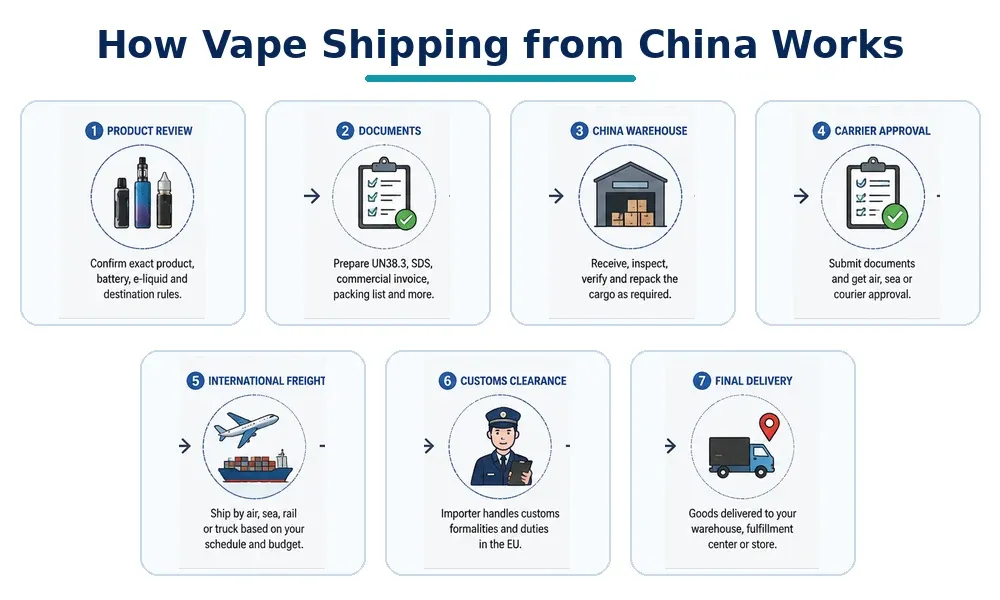
Step-by-Step Vape Shipping Process from China
A well-planned shipment connects the product, carrier, importer and destination before pickup.
- Identify every product and SKU. Separate disposable devices, reusable kits, pods, bottled e-liquid, hardware and loose batteries.
- Confirm the destination and importer. Check whether the products can enter the market and who will manage the import entry.
- Collect battery and liquid information. Obtain the battery model, UN38.3, SDS files, liquid details and product photographs.
- Compare freight methods. Review courier, air, sea, rail, truck and landed-delivery options according to cargo size and urgency.
- Confirm the quotation scope. Identify pickup, warehouse handling, carrier approval, customs, duty, delivery and excluded charges.
- Receive or pick up the cargo in China. The supplier can deliver to the agreed warehouse, or VoltFreight can arrange pickup.
- Check the physical shipment. Verify carton data, product models, visible labels, battery configuration and packing condition.
- Obtain final carrier approval. Submit the final product and packing information to the selected route.
- Complete export handling. Prepare the agreed shipping documents, booking and China export procedures.
- Move the shipment internationally. Track the approved air, sea, rail, truck or courier route.
- Complete import clearance. The importer and broker provide the required destination records and respond to customs questions.
- Arrange final delivery. Confirm destination warehouse acceptance, delivery appointment and final-carrier requirements.
If the product, battery, liquid or packing changes at any stage, review the route again.
Common Reasons Vape Shipments Are Rejected or Delayed
In practice, most failures begin before departure rather than during international transport.
- The battery document covers another model. The manufacturer, capacity or cell design differs from the battery installed in the device.
- The supplier provides one generic MSDS. The file does not clearly identify the battery, liquid or product formulation.
- Loose batteries appear after approval. The carrier approved batteries contained in equipment, but the factory added replacement cells.
- Products leak inside the cartons. Weak seals or poor inner packing contaminate retail boxes and other cargo.
- The invoice uses a vague description. Finished vapes appear as accessories, electronic parts, samples or gifts.
- The importer is not ready. Cargo departs before the responsible parties confirm the importer, broker, tax or product records.
- The destination does not accept the exact SKU. Documents refer to another flavor, nicotine strength, capacity or product model.
- Mixed cartons are not declared clearly. The packing list fails to separate models and formulations.
- The product changes after route approval. The factory substitutes the battery, liquid, carton or retail-kit contents.
- The final-mile provider refuses delivery. The international carrier accepts the shipment, but the destination carrier or warehouse refuses vape products.
- The DDP scope is incomplete. Inspection, storage, redelivery, return or destruction costs were not explained before booking.
- The declared value is unrealistic. Customs requests purchase, payment or valuation evidence and delays the entry.
Early product and warehouse review can prevent many of these problems.
Anonymized Vape Shipping Cases
The following composite, anonymized examples reflect recurring situations in commercial vape freight operations. We omit customer and product identities and simplify some details for privacy. Therefore, do not treat these examples as guaranteed outcomes for another shipment.
Case 1: One Purchase Order Required Several Freight Routes
An importer purchased disposable vapes, empty devices, bottled e-liquid and loose replacement batteries from the same Chinese supplier. Initially, the buyer requested one door-to-door price per kilogram for the complete order.
After the cargo details were separated, the shipment could not rely on one approval because the four product groups created different transport conditions:
- The empty devices contained no liquid and followed the route available for the confirmed hardware configuration.
- The disposable products required combined battery, e-liquid, packaging and destination review.
- The bottled e-liquid required its own formulation, SDS, leakage and import assessment.
- The loose replacement cells required a dedicated battery review rather than the approval used for finished devices.
The order was therefore divided according to product type and route acceptance. This avoided treating every vape-related item as one generic commodity and allowed each part of the order to use a service scope that matched its actual risk.
Case lesson: A single purchase order does not always equal a single freight route. Product classification should come before price comparison.
Case 2: Outer Cartons Looked Normal, but Disposable Vapes Were Leaking
Several cartons of prefilled disposable devices arrived at the China warehouse with no obvious external damage. During an agreed inspection, however, staff noticed liquid marks and odor inside one retail carton.
Warehouse staff isolated the affected units before export. The remaining products received additional visual checking, while the agreed repacking scope added stronger inner separation and leakage protection where appropriate.
The visibly compromised products were not placed into the international shipment. As a result, damaged units did not contaminate otherwise usable retail stock or create a larger rejection risk at the consolidation warehouse.
Case lesson: An undamaged export carton does not prove that every prefilled device inside is suitable for transport. Leakage checks and secondary containment can matter before carrier handover.
Case 3: International Freight Was Possible, but the Final Delivery Network Refused the Cargo
A commercial shipment had a workable international air or sea option, but the proposed destination parcel network and receiving warehouse did not accept vape products under the planned delivery arrangement.
If the shipment had departed before this final-mile check, the cargo could have reached the destination country and then accumulated storage, transfer and redelivery costs while the importer searched for another provider.
Instead, the team changed the delivery plan before export. The importer confirmed a commercial warehouse that accepted the cargo, and the team reviewed the final delivery method separately from the international freight segment.
Case lesson: Airline or shipping-line acceptance is only one part of the route. Confirm destination warehouse and final-carrier acceptance before departure.
Case 4: The Cheapest DDP Quote Did Not Explain the Exception Costs
An importer compared two landed quotations. The lower offer showed a simple price per kilogram but did not identify who would manage the import entry or how the provider would charge customs inspection, storage, rejected delivery, return, re-export or destruction.
The alternative quotation used a clearer written scope. It separated the normal freight and delivery stages from abnormal charges and required the importer to confirm the exact products, commercial value and destination eligibility before booking.
Therefore, the importer based the decision on comparable service coverage rather than the first price line alone. The importer could then see which normal stages the quotation included and which events could still create additional costs.
Case lesson: A lower DDP rate is not automatically a lower final cost. Compare identical responsibilities, inclusions and exception terms.
Case 5: One Approved Product Did Not Cover Every SKU
A buyer planned to ship several models, flavors, nicotine strengths and liquid capacities. Because one product had moved successfully before, the buyer expected all related SKUs to use the same route and destination records.
During the pre-shipment review, the product list showed that the configurations were not identical. Some SKUs used different liquid capacities or labeling, while others still required importer or destination confirmation.
First, the review team assessed the products with complete and matching information for shipment. Meanwhile, the team paused the remaining SKUs until the importer and supplier resolved the outstanding product records and labeling questions.
Case lesson: Vape approval is product-specific. Do not use a previous shipment or one accepted SKU as proof that every flavor, capacity, nicotine level or model is eligible.
What Should a Vape Freight Quote Include?
Two quotations can show similar freight prices while covering very different responsibilities.
Depending on the route, a complete quotation should identify:
- Supplier pickup or delivery to the China warehouse
- Warehouse receiving, counting, weighing and measuring
- Product, battery, liquid and document review
- Sample opening or inspection scope when authorized
- Repacking, leakage protection or palletization
- Carrier or operator approval
- China export handling
- International courier, air, sea, rail or truck freight
- Destination customs brokerage
- Duty, tax and excise scope
- Destination warehouse or transfer handling
- Final delivery and appointment requirements
- Storage, inspection, waiting and redelivery exclusions
- Return, re-export, destruction or refused-entry costs
- Insurance scope where available
Do not compare a port-to-port or airport-to-airport rate with a complete landed-delivery quotation.
Information Needed for a Vape Shipping Quote
An accurate quotation requires more than the destination country and total weight.
Send:
- Product type: Disposable device, reusable device, pod, cartridge, empty hardware, bottled e-liquid or battery.
- Brand, model and SKU: List every variation separately.
- Product photographs: Include retail packaging, labels and the product itself.
- Nicotine information: State nicotine or nicotine-free, concentration and formulation.
- Liquid information: Provide capacity per unit, total quantity, SDS or formulation details.
- Battery information: Provide manufacturer, model, voltage, capacity, Watt-hours and configuration.
- Battery documents: Include the UN38.3 test summary and SDS where available.
- Shipment quantity: Units, cartons, pallets and SKUs.
- Carton data: Gross weight, dimensions and total CBM.
- Commercial value: State the genuine transaction value and currency.
- Supplier information: Provide the factory or trading-company city and pickup address.
- Destination: Country, city, postcode and full address if available.
- Importer setup: Explain who will act as importer and whether a customs broker is ready.
- Target delivery date: State the inventory deadline.
- Preferred method: Air, sea, courier, DDP or open comparison.
When information is incomplete, VoltFreight can provide an initial route assessment. However, reconfirm the final price and acceptance after the warehouse verifies the physical cargo and the importer confirms the destination setup.
Related Vape Shipping Guides
Use the following pages for detailed destination, document and battery planning:
- Shipping Vapes from China to the USA — FDA, importer, customs, carrier and U.S. delivery review
- Shipping Vapes from China to the EU — TPD, EU-CEG, EORI, VAT and Member State planning
- Vape Shipping Documents from China — UN38.3, battery SDS, e-liquid SDS, invoice and cargo matching
- Shipping Batteries from China — UN38.3, lithium battery classifications, air, sea and battery packing requirements
- Door-to-Door Shipping from China — pickup, customs coordination and final delivery scope
FAQ About Shipping Vapes from China
Can you ship vapes internationally from China?
Freight forwarders can ship selected commercial vape products internationally after they review the product, battery, e-liquid, destination, importer and carrier. Approval is shipment-specific, so one successful route does not guarantee acceptance for another model or country.
What is the best way to ship vapes from China?
Courier may suit small eligible shipments, air freight can work for urgent commercial inventory, and sea freight may reduce unit cost for larger planned orders. The best route depends on the exact product, shipment size, urgency, destination and importer setup.
Can disposable vapes be shipped internationally?
Some disposable vapes can move on reviewed routes. However, they combine an installed lithium battery with prefilled liquid, so the forwarder must check battery documents, liquid information, packaging, destination eligibility and carrier acceptance.
Can vapes be shipped by air freight?
Air freight may be available after airline or operator approval. The review normally includes the battery configuration, UN38.3 information, SDS files, product details, packing and destination arrangement.
Can vapes be shipped by sea freight?
Sea LCL or FCL may be possible when the shipping line, consolidator, warehouses and destination importer accept the cargo. Sea freight still requires accurate product, battery, liquid and customs information.
Can vape juice be shipped internationally?
Some bottled e-liquid can move on reviewed air or sea routes. Acceptance depends on formulation, nicotine, SDS information, flash point where relevant, bottle capacity, leakage protection and destination rules.
Can vapes be shipped DDP from China?
A reviewed DDP or landed route may be available for selected products and destinations. The quote should identify importer responsibility, customs scope, duties, taxes, final delivery and excluded inspection or exception costs.
Can a factory describe vapes as electronic accessories?
The commercial description should identify the physical goods accurately. Misdescribing finished vapes as accessories, gifts or ordinary electronics can create carrier, customs and compliance problems.
What documents are needed to ship vapes from China?
The initial package normally includes the product list, photographs, battery specifications, UN38.3 test summary, battery SDS where requested, e-liquid SDS or formulation details, commercial invoice, packing list and destination-import information. Requirements vary by product and route.
Can VoltFreight inspect vape cargo before export?
VoltFreight can arrange agreed warehouse checks such as carton counting, measurement, photography, visible model verification, packing-list comparison and sample opening with authorization. These checks do not replace laboratory testing or legal product approval.
Get a Vape Shipping Quote from China
Shipping vapes from China works best when one logistics team reviews the product, documents, carrier, importer and final delivery plan together.
VoltFreight’s freight-forwarding team can help coordinate:
- Supplier pickup and China warehouse receiving
- Product, battery, liquid and document pre-checks
- Carton counting, weighing, measuring and receiving photos
- Approved courier, air, sea, rail and truck route comparison
- DDP or landed-service feasibility review where available
- China export handling
- Customs and importer coordination under the confirmed scope
- Destination transfer and final delivery planning
- Shipment tracking and exception communication
Send us the exact product list, battery information, liquid details, carton data, supplier address and destination.
Contact VoltFreight for a vape and e-cigarette shipping review from China.
Official Information Sources
- UNECE: UN Manual of Tests and Criteria, Revision 8
- IATA: Lithium Batteries Fact Sheet
- IATA: 2026 Guidance Document for Lithium Batteries and Sodium-Ion Batteries
- U.S. FDA: Importing Tobacco Products
- U.S. FDA: E-Cigarettes, Vapes and ENDS
- European Commission: Electronic Cigarettes
- European Commission: EU Common Entry Gate
Important notice: This page provides general freight-planning information. It does not provide legal advice, product authorization, dangerous-goods certification, customs classification or a guarantee of carrier acceptance. Vape laws, import requirements, carrier policies, tax rules and final-delivery availability can change. Confirm the final product, destination, importer, documents and service scope before supplier pickup.