Updated: August 2026.
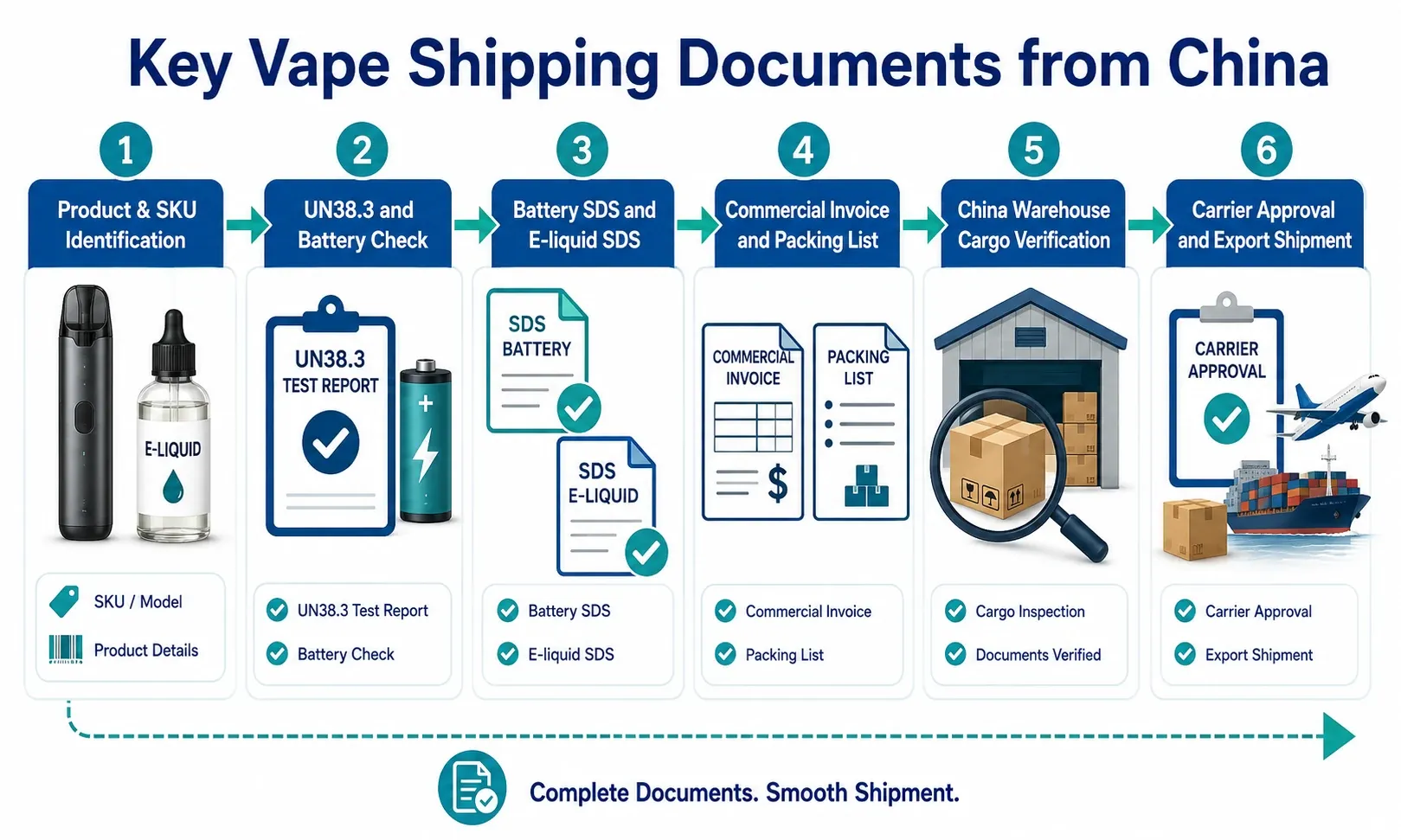
Vape shipping documents from China must match the actual device, battery, e-liquid, SKU list and final carton configuration. A folder named “UN38.3 and MSDS” is not enough when the battery model in the report differs from the cell installed inside the product, or when the liquid document describes another formulation.
The required file package also changes by product type. A disposable electronic cigarette normally combines an installed lithium-ion battery, atomizing components and e-liquid. A reusable device may use an installed battery or removable cells, while a pod or bottled e-liquid may contain no battery at all.
Therefore, the first step is not collecting as many certificates as possible. Instead, identify every SKU and determine exactly what is inside the finished product. The forwarder can then compare the documents with the physical cargo before requesting airline, courier, shipping-line or consolidation-warehouse approval.
This guide focuses specifically on document preparation and cargo matching. For product types, route selection, destination restrictions and international delivery planning, read our main guide to shipping vapes and e-cigarettes from China.
Need a vape document review before supplier pickup?
Prepare the SKU list, product photos, battery information, UN38.3 test summary, available battery SDS, e-liquid SDS or formulation information, commercial invoice, packing list, carton data, supplier information and destination country. VoltFreight can review the initial file package before the cargo enters the export process.
What Documents Are Needed to Ship Vapes from China?
There is no single document set that covers every electronic-cigarette shipment. The required files depend on the physical product, battery configuration, e-liquid formulation, transport method, carrier, importer and destination country.
For most commercial shipments, the initial review can be divided into five document groups.
| Document Category | Main Files or Information | What Must Match |
|---|---|---|
| Product identity | SKU list, model list, product photos, specification and retail packaging | Brand, model, device type, flavor, nicotine concentration and liquid capacity |
| Lithium battery | UN38.3 test summary, battery specification and battery SDS when requested | Manufacturer, model, chemistry, voltage, capacity, Watt-hours and configuration |
| E-liquid | E-liquid SDS or formulation information | Product name, formulation, nicotine, capacity, physical properties and transport information |
| Commercial and customs | Commercial invoice, packing list and customs-classification information | Description, quantity, value, origin, weights, dimensions and carton contents |
| Destination and export records | Importer records, China export checks and applicable destination authorizations | Exact SKUs, responsible manufacturer, importer, destination and current product status |
A carrier may request additional declarations, package photographs, marks, labels or other supporting records after reviewing the initial package. Conversely, a genuinely empty mouthpiece or accessory without a battery or e-liquid does not normally require the same battery and liquid files as a finished disposable vape.
Document preparation should therefore start with the actual goods rather than a checklist copied from another shipment.
Identify the Exact Vape Product and SKU First
The supplier should prepare a clear product matrix before sending certificates. Each line should identify the model, product type, battery, e-liquid, nicotine strength, liquid capacity, retail configuration and units per carton.
Disposable Vapes
A finished disposable vape normally needs the closest matching review between the physical device, installed battery, UN38.3 information, battery specification, liquid formulation, packaging and destination records.
A common mistake is to submit one generic battery report for several vape models even though the devices use different cells or capacities.
Reusable Vape Devices
For reusable products, confirm whether the battery is permanently installed, removable but supplied with the kit, or not included at all.
Do not add loose replacement cells after a carrier has approved a shipment consisting only of devices with installed batteries. Changing the battery configuration can change the transport review.
Pods, Cartridges and Bottled E-Liquid
Prefilled pods and cartridges shift more attention toward formulation, nicotine concentration, liquid capacity, leakage prevention and destination-market records.
Bottled e-liquid contains no lithium battery, so UN38.3 does not apply to the bottle itself. However, the liquid may still require an SDS or other formulation and transport information depending on its properties, carrier and destination.
Empty Hardware and Accessories
A genuinely empty accessory without a battery or liquid should be described accurately. Product photographs, material, function and final packaging can help distinguish it from a finished vape product.
Do not describe a finished electronic cigarette as an “electronic accessory” simply to obtain an easier freight route.
Check the Final Retail Kit
The final packed product matters more than an early sales sample. A charger, loose battery, power bank, prefilled pod or promotional bottle added later can change the shipment review.
Therefore, the supplier should disclose every item included in the retail package before the forwarder submits the cargo for acceptance.
Lithium Battery Documents for Vape Shipments
Many disposable vapes and compact pod devices use relatively small lithium-ion cells compared with power banks, e-bike batteries or energy-storage batteries. However, battery size alone does not remove the need to identify the battery correctly or verify the applicable UN38.3 information.
For this page, the most important battery question is not how lithium-battery regulations work in general. It is whether the documents actually describe the battery installed in or supplied with the vape being shipped.
UN38.3 Test Summary Must Match the Actual Battery
Lithium cells and batteries offered for transport must use an applicable tested design type. The UN38.3 test summary provides standardized information that helps identify and trace that tested design.
A useful test summary normally identifies information such as:
- Cell, battery or product manufacturer
- Manufacturer contact information
- Testing laboratory information
- Unique test-report number
- Test-report date
- Lithium-ion or lithium-metal battery type
- Battery mass
- Watt-hour rating or lithium content where applicable
- Physical description and model number
- Tests conducted
- Relevant UN Manual edition
- Responsible person’s name and title
For current battery transport information, refer to the IATA Battery Shipping Regulations and the PHMSA lithium battery test summary guidance.
Test Summary vs Full Laboratory Report
A factory may send a large laboratory report and call it a “UN38.3 certificate.” However, a full laboratory report and a standardized test summary are not the same document.
UN38.3 test summary: provides standardized identification and traceability information for the tested design.
Full laboratory report: can contain detailed test methods, measurements, equipment, photographs and supporting technical evidence.
General compliance letter: may state that a battery passed testing, but a short statement does not necessarily contain the information expected in a proper test summary.
The test summary does not normally need to be physically placed inside every shipping carton. Still, the responsible manufacturer or distributor should be able to make the applicable summary available when required.
The Battery Model Must Match
A report for a similar-looking cell should not automatically be used for another battery design.
For example, the following should be checked separately rather than assumed to be interchangeable:
- Model 13400-650mAh and model 13400-850mAh
- A cell from Manufacturer A and a cell from Manufacturer B
- A 3.7 V 500mAh cell and a 3.7 V 650mAh cell
- A pouch cell and another battery design with different specifications
Compare the manufacturer, model, nominal voltage, capacity and Watt-hour rating across the battery label, product specification and UN38.3 information before route approval.
Small Vape Batteries Still Need Correct Identification
A small installed battery may qualify for different packing provisions from a large standalone battery, but “small battery” is not a transport classification by itself.
The forwarder still needs to know what battery is installed, whether it is lithium-ion or another chemistry, its capacity, its configuration and whether the supporting test information matches the actual design.
This distinction is especially important when one vape brand uses several factories or changes its internal battery supplier without changing the external device name.
Installed Battery vs Loose Replacement Cells
Finished vape with an installed battery: the battery is part of the equipment, so the device, installed battery, protection against short circuit or accidental activation, liquid and final packaging should be reviewed together.
Battery supplied separately with a reusable device: the final configuration can follow different battery packing provisions from a battery already installed in the equipment.
Loose replacement cells: these should be disclosed separately. They should not be treated as ordinary vape accessories simply because they are sold for use with a vape device.
Air-freight requirements can also change according to battery configuration. The 2026 IATA Battery Shipping Regulations introduced stricter state-of-charge provisions for affected lithium-ion batteries packed with equipment.
For the broader rules covering UN3480, UN3481, state of charge, air freight, sea freight, packing and carrier acceptance, read our complete guide to shipping batteries from China.
Battery SDS vs E-Liquid SDS
SDS means Safety Data Sheet. Some suppliers still use the older term MSDS, or Material Safety Data Sheet.
A vape shipment can involve two very different materials: a lithium battery and e-liquid. Consequently, one generic file called “Vape MSDS” may not clearly describe both.
Battery SDS
A battery SDS can provide information about the manufacturer, chemistry, product identification, handling, fire response and transport considerations.
However, it does not replace the UN38.3 test summary and does not prove by itself that the actual battery design completed the applicable UN38.3 testing.
Battery SDS requests can also depend on the carrier, warehouse or commercial acceptance process rather than functioning as a universal transport permit for every battery-powered article.
E-Liquid SDS
An e-liquid SDS should relate to the actual liquid formulation. Relevant information may include the manufacturer, product identification, ingredients, nicotine content, physical properties, flash point where applicable, handling information and transport classification.
An e-liquid SDS says nothing about whether the lithium battery inside the device has completed the applicable UN38.3 testing.
Do Not Classify a Finished Vape from the Battery Alone
A finished electronic cigarette can combine a battery, atomizing equipment and a liquid formulation. Therefore, the complete device should be reviewed rather than assuming that every vape follows one lithium-battery classification simply because it contains a lithium-ion cell.
If the liquid itself introduces an additional dangerous-goods hazard, the appropriate transport classification can depend on the material properties, quantity, device design and applicable transport rules.
The shipper and qualified dangerous-goods operator should confirm the final classification for the actual product and route.
One Generic “Vape MSDS” Is Not Enough
A complete file package may contain several distinct records:
- UN38.3 test summary
- Battery specification
- Battery SDS when requested
- E-liquid SDS or formulation information
- Finished-product specification
- Commercial invoice
- Packing list
- Destination-market records
Each document should clearly identify the material or product it is intended to describe.
E-Liquid Information and Total Liquid Quantity
The liquid is one reason a vape shipment should not be treated as an ordinary battery-powered electronic device.
Depending on the product and route, collect information such as:
- Formulation or product name
- Manufacturer
- Ingredients
- Nicotine source and concentration
- PG/VG information where relevant
- Flavor identification
- Liquid capacity per device, pod or bottle
- Physical properties and flash point where applicable
- Transport information
- Leakage-protection method
Calculate the Total Liquid Quantity
The carrier may need to understand the total quantity of liquid in the shipment rather than only the volume inside one device.
For example:
- 2 ml per disposable vape
- 500 devices per carton
- 10 cartons
2 ml × 500 × 10 = 10,000 ml, or 10 liters.
This calculation helps define the shipment scale. It does not replace the SDS, formulation information or dangerous-goods assessment.
Nicotine-Free Products Still Need Accurate Records
A “0% nicotine” claim should correspond with the formulation and retail label.
Nicotine-free liquid can still create questions involving composition, leakage, carrier acceptance, product classification or destination-market rules. In addition, a finished device may still contain a lithium battery even when the e-liquid contains no nicotine.
Different flavors, capacities and nicotine concentrations should be separated in the SKU records when their formulations or destination-market records differ.
China Export Documents and Vape Manufacturer Checks
Battery and e-liquid documents are only one part of shipping vapes from China. Export electronic cigarettes are also subject to China’s electronic-cigarette production and export-management framework.
Before pickup, the buyer or forwarder should confirm that the supplier and actual manufacturer understand which entity is responsible for production licensing, export packaging, customs declaration and the required export filing.
Check the Actual Manufacturer
China’s current electronic-cigarette management framework requires relevant production enterprises to operate within the approved licensing scope. Export products should therefore be traced to the actual responsible manufacturer rather than only to a trading-company name shown on a sales invoice.
For OEM or contract-manufactured products, confirm which licensed manufacturing entity actually produces the goods.
Check Export Packaging Information
China’s electronic-cigarette export-management rules require export vape packaging to display the relevant tobacco monopoly production-enterprise licence number. For contract manufacturing, the applicable number relates to the responsible entrusted manufacturer under the rules.
This production-license marking is separate from lithium-battery marks, dangerous-goods labels and destination-market warning labels. One does not replace another.
Export Filing and Destination Compliance
Current Chinese rules state that relevant electronic-cigarette production enterprises should complete the required export filing through the national electronic-cigarette transaction-management platform after export customs declaration. The framework also requires products made only for export to comply with the laws, regulations and standards of the destination country or region.
These are China-side regulatory responsibilities. They should not be confused with an airline’s UN38.3 checklist, an e-liquid SDS request or the importer’s destination-market authorization.
For the official China framework, review the China electronic-cigarette import and export management rules.
What VoltFreight Should Check Before Pickup
For logistics planning, useful China-side checks include:
- Actual supplier and manufacturer names
- Whether the product is finished vape, pod, cartridge, liquid or empty hardware
- Final SKU and model list
- Export-package photographs
- Battery and liquid documentation
- Commercial invoice and packing list
- Who will complete the China export declaration
- Whether the responsible manufacturer has confirmed its export compliance process
VoltFreight’s role is to support freight and document coordination. Licensing, product legality and formal manufacturer obligations remain with the responsible parties under the applicable rules.
Commercial Invoice and Packing List
The commercial invoice and packing list should connect every SKU to the physical cartons. These documents should remain consistent with the model list, product specification, battery information, liquid records and warehouse measurements.
Commercial Invoice
A commercial invoice should normally include:
- Seller and buyer legal names and addresses
- Manufacturer information where relevant
- Invoice number and date
- Specific product description
- Brand and model where applicable
- Quantity
- Unit value and total value
- Currency
- Country of origin
- HS-code reference when reviewed
- Incoterm
- Freight or insurance information where relevant to customs value
Avoid vague descriptions such as “electronic accessories,” “USB devices,” “plastic products,” “gifts” or simply “samples.”
The word “sample” describes the commercial purpose of the shipment. It does not describe the physical goods.
Depending on the actual product, clearer descriptions may include:
- Disposable electronic cigarettes with installed lithium-ion batteries and prefilled e-liquid
- Reusable electronic cigarette devices with installed lithium-ion batteries, without e-liquid
- Prefilled electronic-cigarette cartridges containing e-liquid
- Empty electronic-cigarette cartridges without batteries or e-liquid
These are description examples rather than universal customs classifications. The importer and customs broker should confirm the final HS or tariff classification for the destination.
The declared value should reflect the genuine transaction. Supporting purchase, payment and sales records should remain consistent with the commercial invoice.
Packing List and Final Carton Data
The packing list should use final rather than estimated cargo information.
Useful fields include:
- Carton numbers
- Models and SKUs
- Flavors and nicotine concentrations where relevant
- Units per carton
- Total units
- Net and gross weight
- Carton dimensions
- Total CBM
- Pallet information where applicable
- Battery configuration
- Liquid capacity or total liquid quantity where relevant
When several carton sizes are used, list each package type separately rather than using one average carton size.
Update the packing list when the factory changes cartons, the warehouse repacks goods, SKUs are added or removed, loose batteries or accessories are added, cartons are combined, or final measurements differ from the supplier’s estimate.
Mixed cartons should include a carton-level SKU and quantity breakdown.
Destination-Market Records Are Separate from Freight Documents
Transport acceptance does not automatically mean that the electronic cigarette may legally be imported or sold in the destination market.
The carrier focuses on whether it can transport the actual cargo through the proposed route. Meanwhile, the importer may need separate product, tax, notification, registration, licensing or marketing records.
United States
For U.S.-bound vape cargo, the importer may need to review product and manufacturer information, current marketing status, importer details, customs-broker arrangements, customs bond, FDA entry requirements and other U.S.-specific product obligations.
This document page should not duplicate those rules. For the destination-specific framework, read our guide to shipping vapes from China to the USA.
European Union
EU importers may need to consider product notifications, TPD requirements, Member State rules, EORI, VAT, excise arrangements, packaging, labeling and other destination-specific requirements.
Transport rules for the installed lithium battery and EU market rules for the finished vape are separate compliance layers.
For a destination-specific review, use our guide to shipping vapes from China to the EU.
Other Markets
The United Kingdom, Canada, Australia, Middle Eastern countries and other destinations can apply different nicotine, product, tax, importer and carrier restrictions.
Do not reuse a U.S. or EU product file simply because the same SKU is being shipped to another country.
Document Requirements by Shipping Method
Changing the transport method can change which documents the carrier wants to review. Approval for one route does not automatically transfer to another airline, courier, shipping line or consolidation service.
Express Courier
For an eligible courier shipment, the initial review may include product photographs, battery information, UN38.3, liquid documents, commercial invoice, importer details and courier-account acceptance.
A normal DHL, UPS or FedEx online rate does not prove that the selected account or service will accept finished vape products.
Air Freight
Air-freight review may require battery configuration, applicable UN classification, UN38.3 information, package photographs, liquid information and any declarations required for the actual cargo.
Airline, state and operator variations can affect final acceptance. Therefore, the forwarder should confirm the proposed carrier before cargo handover.
Sea Freight
Sea LCL or FCL can require battery information, liquid information, packing details, dangerous-goods data where applicable, invoice, packing list and destination importer setup.
LCL acceptance may be especially route-specific because the origin warehouse and consolidator must consider the other cargo sharing the container.
Rail or Truck Routes
Selected land or multimodal routes may be available for some destinations, but the required product, battery, liquid, customs and transit information must be reviewed for the actual route.
Do not assume that approval for air or sea freight automatically covers rail or truck transportation.
For wider freight planning, compare our air freight from China and sea freight from China service pages.
China Warehouse Document Verification
A good document review should eventually be compared with the physical cargo. Email attachments alone cannot confirm what the factory actually packed.
What the Warehouse Can Check
Depending on the agreed service and customer authorization, warehouse checks may include:
- Counting cartons
- Checking visible outer damage
- Weighing and measuring carton types
- Photographing shipping marks
- Photographing retail packaging
- Checking visible models and SKUs
- Checking flavor, nicotine and liquid-capacity labels
- Confirming whether batteries appear installed or loose
- Checking for undeclared chargers, bottles, cells or power banks
- Comparing carton contents with the packing list
When separately authorized, a sample retail package may be opened to check the visible battery label or product configuration. The customer should approve this before opening because retail packaging may require resealing or replacement.
What a Warehouse Check Cannot Prove
A visual warehouse check does not replace laboratory testing, battery design verification, chemical analysis, customs classification, legal product authorization or a qualified dangerous-goods classification.
Its purpose is to identify visible inconsistencies before the cargo reaches a carrier, bonded warehouse, airport or seaport.
Example Review Scenario: Battery Report Does Not Match the Product
Suppose the supplier submits UN38.3 information for a 650mAh battery while the final product specification lists an 850mAh battery.
The shipment should be paused until the supplier confirms the actual battery and provides the appropriate supporting information. Sending the cargo forward with a document belonging to another battery can create a later carrier rejection.
Example Review Scenario: Loose Cells Are Added After Route Approval
Suppose the forwarder reviews finished devices with batteries installed in the equipment, but the final cartons also contain loose replacement cells.
The final configuration no longer matches the approved shipment. The loose cells should be identified separately and the transport route reviewed again before dispatch.
Example Review Scenario: E-Liquid SDS Covers an Older Formula
If the product name, nicotine concentration or formulation changes but the supplier continues using an older SDS, the file may no longer describe the actual liquid in the shipment.
The importer should obtain updated information before booking rather than waiting for a carrier or customs authority to discover the mismatch.
Common Vape Shipping Document Errors
The most common document problems are usually not caused by the absence of a huge certificate folder. They occur because different files describe different products.
UN38.3 Covers Another Battery
The manufacturer, model, voltage or capacity differs from the battery in the finished vape. Request information that corresponds to the actual battery design.
Only a General Battery Compliance Letter Is Provided
A one-page statement saying “UN38.3 passed” may not contain the standardized test-summary information needed to identify the tested design.
Battery SDS and E-Liquid SDS Are Confused
One file is used for both the battery and liquid even though they are different materials. Collect and identify the relevant files separately.
Battery Capacity Is Inconsistent
The product specification, battery label, UN38.3 information and SDS show different voltage or capacity data. Resolve the discrepancy before route approval.
Loose Batteries Are Added Later
Adding replacement cells after the carrier reviews only finished devices changes the final shipment configuration.
The Invoice Uses a Vague Description
Descriptions such as “accessories,” “USB devices” or “samples” can make it difficult for the carrier and customs authority to understand the physical product.
One Product Record Is Used for Every SKU
Different flavors, nicotine strengths, battery models or capacities may not be covered by the same supporting information.
Packing-List Data Is Still an Estimate
Update the packing list after production and warehouse measurement when actual carton quantities, dimensions or weights have changed.
Mixed Cartons Have No SKU Breakdown
Prepare a carton-level breakdown when several models or flavors are packed together.
Documents Are Outdated or Edited
Check whether the manufacturer, battery, formulation or product model changed after the original files were issued.
The Physical Cargo Contains Undeclared Items
Bottles, power banks, loose cells, replacement batteries or promotional accessories can change the transport review. Check the final packed cargo rather than relying only on the purchase order.
Final Pre-Shipment Vape Document Checklist
Before the supplier releases the cargo, use the following checklist to confirm that the documents describe the final shipment.
Product and SKU
- Exact product name
- Brand and model where applicable
- Actual manufacturer
- Product and retail-packaging photographs
- Complete SKU list
- Flavor list
- Nicotine concentration
- Liquid capacity
Battery
- Battery manufacturer
- Battery model
- Battery chemistry
- Nominal voltage
- Capacity
- Watt-hour rating
- Installed, packed separately with equipment or loose configuration
- UN38.3 test summary matching the actual design
- Full test report when available or requested
- Battery SDS when requested
E-Liquid
- Manufacturer or formulation owner
- Formulation or product name
- Ingredient information
- Nicotine source and concentration
- PG/VG information where relevant
- Flavor information
- Capacity per unit
- Total liquid quantity
- Physical and transport information where applicable
- Current e-liquid SDS or equivalent requested information
- Leakage-protection method
China Export and Commercial Records
- Responsible manufacturer identified
- China export packaging checked
- Relevant manufacturer licence information checked where applicable
- China export declaration responsibility confirmed
- Applicable export filing responsibility confirmed
- Commercial invoice uses a truthful product description
- Packing list uses final carton quantities, weights and dimensions
- Country of origin and customs-classification information reviewed
Destination Records
- Importer legal name
- Customs-broker arrangement where required
- Destination-market product records reviewed
- Product notifications, authorizations or marketing status checked where applicable
- Destination postcode
- Delivery address type
Carrier and Warehouse Approval
- Proposed shipping method matches the final battery and liquid configuration
- Required marks, labels and declarations have been confirmed
- Package photographs are available where requested
- Carrier or consolidator has reviewed the final file package
- Destination warehouse or final-mile provider accepts the product where relevant
- No product, battery, liquid or packing changes were made after approval
FAQ About Vape Shipping Documents from China
Is UN38.3 required for disposable vapes?
A disposable vape normally contains a lithium-ion battery. The applicable battery design must satisfy the relevant UN38.3 testing requirements, and the required test-summary information should correspond to the battery actually installed in the product.
Are vape batteries too small to need battery documents?
No general rule says that a small vape battery can ignore battery identification or UN38.3 requirements. Battery size and capacity can affect the applicable transport provisions, but the actual battery design and shipping configuration still need to be identified.
Is an MSDS enough to ship electronic cigarettes?
No. An SDS or MSDS can communicate hazard, composition, handling or transport information, but it does not replace applicable UN38.3 information, commercial documents, destination-market records or carrier approval.
What is the difference between UN38.3 and SDS?
UN38.3 concerns testing of applicable lithium-cell and battery designs. An SDS communicates safety and hazard information about the material or product it describes. A vape shipment can involve battery information and separate e-liquid information.
Does the UN38.3 test summary need to be inside every carton?
It does not normally need to be physically placed inside every shipping carton. However, the applicable test summary should be available to the supply chain when required, so obtaining it before booking is a sensible part of the freight review.
Can a supplier use UN38.3 documents for a similar battery?
Do not assume that a similar-looking battery is the same tested design. Check the manufacturer, model, voltage, capacity and other identifying information against the actual battery used in the finished product.
Can every disposable vape be classified only as a lithium-battery product?
No universal classification should be assumed from the battery alone. A finished vape can combine a lithium battery, atomizing equipment and e-liquid. The complete product, liquid properties, quantity, packing and applicable transport rules should be reviewed before the final classification is confirmed.
What documents are needed for bottled e-liquid?
The initial file package may include an e-liquid SDS or other formulation information, nicotine concentration, liquid capacity, total quantity, commercial invoice, packing list and destination-market records. The exact requirements depend on formulation, carrier and destination.
Do empty vape accessories need battery documents?
A genuinely empty accessory without a battery or e-liquid may not need lithium-battery or liquid documentation. Product photographs and an accurate description help the carrier verify what is actually being shipped.
What China-side checks should be made for export vapes?
Confirm the actual responsible manufacturer, export-product configuration, relevant production and export responsibilities, export-package information, commercial documents and whether the responsible party has completed the required China-side compliance process for the shipment.
Can VoltFreight check vape documents before pickup?
VoltFreight can perform an initial logistics document review and identify visible inconsistencies between the SKU list, battery information, liquid information, invoice, packing list and proposed route.
A stronger comparison becomes possible after the cargo reaches the China warehouse and physical labels, packaging, quantities, weights and cartons can be checked. This does not replace laboratory testing, legal advice, formal product authorization or final carrier classification.
Before shipping, the goal is simple: the product, battery, liquid, invoice, packing list, China export information and destination records should all describe the same final cargo.
If one part changes after approval—such as the battery model, liquid formulation, nicotine concentration, loose-cell quantity or final carton contents—the shipment should be reviewed again before dispatch.
Need help reviewing vape shipping documents from China?
Send VoltFreight the product list, battery specifications, UN38.3 test summary, available battery SDS, e-liquid SDS or formulation information, commercial invoice, packing list, carton details, supplier information and destination through our contact page.
Official Reference Links
IATA:
Battery Shipping Regulations.
PHMSA:
Lithium Battery Test Summaries
and
Electronic Cigarette Transport Classification Interpretation 22-0032.
China Electronic-Cigarette Export Rules:
Electronic Cigarette Import, Export and Foreign Economic Cooperation Management Rules.
ECHA:
Safety Data Sheet Guidance.
Important notice: This guide provides general freight and document-planning information. It is not dangerous-goods certification, legal advice, customs classification, tobacco licensing advice or product authorization. Transport regulations, carrier variations, China export requirements and destination-market rules can change. Final acceptance depends on the actual cargo, responsible parties and current route review.