Updated: August 2026.
Shipping vapes from China to the USA may be possible for selected commercial products, but a freight route should not be confirmed until the exact product, U.S. marketing status, importer arrangement, customs entry, battery configuration, e-liquid information and carrier acceptance have been reviewed.
A Chinese factory may legally manufacture and export electronic cigarettes. However, that does not prove that the same device, pod, e-liquid, flavor or nicotine strength can lawfully enter or be marketed in the United States. Likewise, an FDA registration number, a submitted PMTA or an application under review should not be treated as automatic U.S. marketing authorization.
Therefore, importers planning to import vapes from China to the USA should verify the exact manufacturer and SKU before comparing freight rates. They should also identify the U.S. importer, customs broker, battery configuration, international carrier and final delivery provider before supplier pickup.
This guide focuses specifically on the U.S. side of vape shipping: FDA marketing status, Import Alert risk, importer preparation, PACT Act responsibilities, USPS restrictions, customs entry, state requirements, shipping costs and reviewed air, sea and DDP options.
For the wider international logistics framework, see our guide to shipping vapes and e-cigarettes from China.
Need a shipment review before pickup? Send VoltFreight the exact product model, manufacturer, FDA information, battery documents, e-liquid details, carton data, cargo value, U.S. importer setup and final ZIP code through our contact page.
Can Vapes Be Shipped from China to the USA?
Selected commercial vape products may have workable freight routes from China to the United States. However, transport availability and U.S. import eligibility are separate questions.
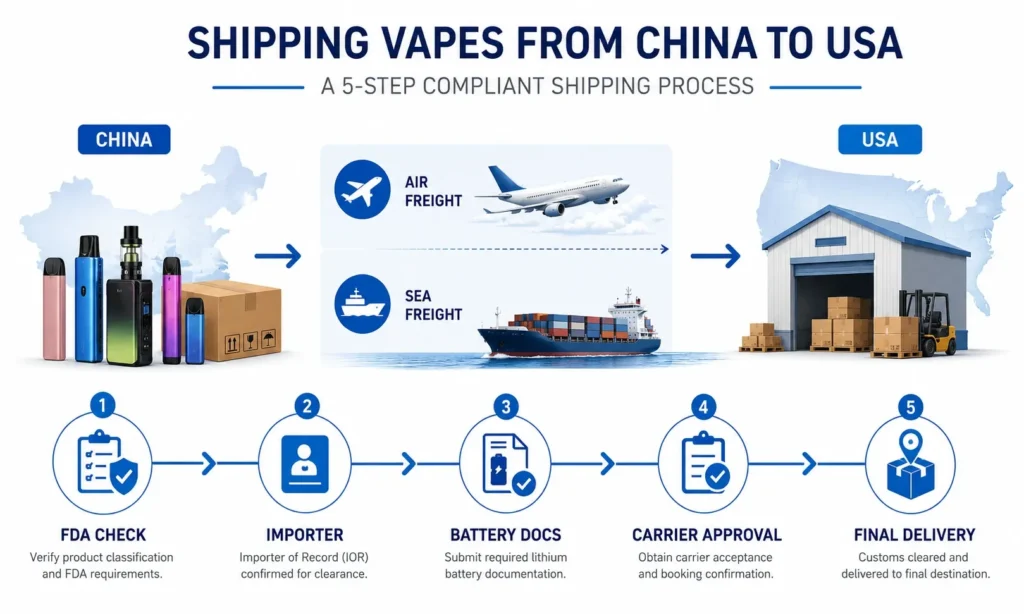
A workable shipment normally needs positive answers to four checks:
- Product check: Does the exact device, pod or e-liquid have the U.S. marketing status required for the intended commercial activity?
- Importer check: Can the U.S. importer and customs broker provide the information needed for CBP and FDA entry?
- Cargo check: Do the battery, e-liquid, invoice, packing list and SKU information match the physical goods?
- Route check: Will the China warehouse, international carrier, destination handler and U.S. final-delivery provider accept the shipment?
Passing one check does not satisfy the others. For example, an airline may accept a battery-powered device even when the importer cannot establish the U.S. marketing status needed for the intended transaction.
Conversely, a product may have relevant FDA marketing status while the proposed airline, destination warehouse or final-mile provider still refuses the cargo.
Therefore, the recommended sequence is:
Exact product verification → U.S. importer confirmation → FDA and customs review → cargo document review → carrier approval → freight quotation → supplier pickup.
Starting with the cheapest freight rate can leave the buyer with inventory that cannot complete U.S. entry or use the proposed delivery route.
FDA Marketing Status and U.S. Import Eligibility
FDA regulates electronic nicotine delivery systems, commonly called ENDS. Depending on the product, this can include electronic cigarettes, disposable vapes, vape pens, pods, cartridges, e-liquids and certain components or parts.
For a new tobacco product to be lawfully marketed in the United States, the responsible company generally needs a written FDA marketing order through an applicable pathway.
FDA Terms Importers Should Not Confuse
Before shipping, distinguish between the following concepts:
- FDA establishment registration: Registration identifies an establishment under an applicable FDA requirement. It does not authorize every product manufactured there.
- Product listing: Product information may have been submitted to FDA, but listing alone does not establish marketing authorization.
- PMTA submitted: The company submitted an application. Submission alone does not equal a marketing granted order.
- Application accepted or filed: The application has reached a review stage. This is different from a final marketing decision.
- Marketing granted order: FDA has issued a written marketing order covering the exact product identified in that decision.
Therefore, importers should not accept a supplier statement such as “FDA approved” based only on a registration certificate, application number or screenshot.
Instead, compare the exact manufacturer, brand, product name, device configuration, flavor and nicotine strength with FDA’s current information.
FDA maintains a current list of e-cigarettes and ENDS authorized by FDA. Because marketing decisions can change, check the current information before each shipment rather than relying on an old supplier screenshot.
Import Alert 98-07 and Unauthorized ENDS
FDA Import Alert 98-07 addresses electronic nicotine delivery systems that lack required premarket authorization. The alert provides a framework for detention without physical examination of affected ENDS.
Consequently, a shipment may face an enforcement-based hold rather than only a routine random inspection.
Possible consequences can include:
- FDA detention or refusal of admission
- Requests for product and marketing-status evidence
- CBP or FDA examination
- Bonded-warehouse and storage expenses
- Return or export requirements
- Destruction costs where applicable
- Loss of freight and handling payments
- Additional scrutiny of later shipments
Importers should review the current FDA Import Alert 98-07 and FDA guidance on importing tobacco products.
May 2026 FDA Enforcement-Priorities Guidance
FDA issued final guidance in May 2026 describing enforcement priorities for certain ENDS and nicotine pouch products marketed without premarket authorization.
However, an enforcement-priority policy is not the same thing as a marketing granted order. Therefore, importers should not assume that a product becomes automatically admissible or commercially lawful merely because FDA may exercise enforcement discretion under specified circumstances.
Review the current FDA enforcement-priorities guidance together with the exact product’s current application or marketing status.
Verify the Exact Vape Product and SKU Before Booking
A brand name alone is not enough. One product family can contain different devices, pods, flavors, nicotine strengths, liquid capacities and battery configurations.
Before requesting carrier approval:
- Confirm the manufacturer’s complete legal name. Do not rely only on a trading name or marketplace profile.
- Record every exact SKU. Separate devices, pods, cartridges, flavors, nicotine levels and liquid capacities.
- Check current FDA information. Compare the manufacturer and exact product with available FDA records.
- Obtain the relevant marketing-order or application information. The evidence should correspond to the actual goods.
- Check retail packaging. Confirm the brand, model, flavor, nicotine information and capacity.
- Confirm the intended U.S. commercial activity. Wholesale distribution, retail sale, samples, exhibitions and testing shipments may raise different questions.
- Ask the U.S. importer or regulatory adviser to confirm eligibility. A freight forwarder should not be the only party evaluating U.S. product legality.
If a supplier says “PMTA submitted,” ask for the current status rather than relying on the original application date.
Disposable Vapes, Pods and Other Products
This U.S. page does not need to repeat the full international product guide. For U.S. planning, the key point is that different SKUs may have different FDA and transport requirements.
- Disposable vapes: Check the exact model, flavor, nicotine strength, liquid quantity, marketing status and installed battery information.
- Reusable devices: Confirm whether the battery is installed, removable or accompanied by spare cells.
- Prefilled pods and cartridges: Review the exact flavor, nicotine level, capacity and product-specific marketing status.
- Bottled e-liquid: Confirm formulation, nicotine information, capacity, packaging and applicable U.S. product requirements.
- Empty hardware: Verify that the product genuinely contains no undeclared liquid or battery and describe it accurately on customs documents.
For the broader differences between disposable vapes, reusable devices, pods, e-liquid and empty hardware, use our global vape shipping guide.
U.S. Importer, Customs Broker and Bond
A U.S. delivery address does not automatically create a valid importer arrangement.
Confirm the Importer Before the Cargo Leaves China
The parties should identify:
- Who will act as importer of record
- Who will appoint and communicate with the customs broker
- Which importer number will support the entry
- Whether a customs bond is required and how it will be arranged
- Who will provide FDA product information
- Who will respond to FDA or CBP requests
- Who will pay duties, taxes, examinations, storage and other destination charges
The importer should also have accurate commercial documents, manufacturer information, customs classification, declared value and product-admissibility records.
Customs Broker and Bond Responsibilities
Because vape products can involve FDA as well as CBP requirements, the importer and customs broker should confirm the appropriate entry type and bond arrangement for the actual shipment rather than relying only on shipment value.
A customs broker can prepare and file the entry and communicate with government agencies. However, the importer remains responsible for providing accurate product, manufacturer, value and admissibility information.
Therefore, a freight forwarder should not promise to replace the importer, product owner, tax registrant and customs declarant through one unclear “DDP importer” statement.
FDA provides an ENDS entry-filing guide for importers and customs brokers that explains product, manufacturer, importer, consignee and marketing-status information relevant to FDA entry review.
For the broader customs process, see our guide to USA customs clearance from China.
PACT Act, USPS and U.S. Delivery Restrictions
FDA marketing status and PACT Act responsibilities address different parts of the transaction.
PACT Act Responsibilities
The PACT Act can create registration, reporting, tax, recordkeeping and delivery-related obligations for businesses involved in covered ENDS delivery sales.
ATF states that ENDS became subject to the PACT Act in 2021. Delivery sellers and businesses engaged in covered delivery-sale activity should therefore review federal, state and local registration and reporting obligations for their actual distribution model.
A commercial pallet from a Chinese factory to a U.S. importer is not the same transaction as individual consumer parcels sent from a U.S. vape store. Nevertheless, the importer may later create separate PACT Act, tax, age-verification and delivery obligations when the goods enter wholesale, online or consumer distribution.
For current information, review the ATF PACT Act requirements.
USPS International-Mail Restrictions
USPS prohibits ENDS in inbound and outbound international mail. The limited domestic mailing exceptions do not create an international-mail exception for a China-to-USA commercial vape shipment.
Therefore, a Chinese supplier should not send finished commercial vapes through ordinary international postal mail while describing them as gifts, accessories or samples.
USPS’s restriction does not mean that every private commercial air or ocean route is prohibited. Instead, the shipper must obtain approval from the actual private carriers and warehouses involved.
For the current international-mail rule, review USPS International Mail Manual section 136.4.
Final-Mile Acceptance Must Be Confirmed
A route can fail even after the international line-haul provider accepts the goods.
For example:
- The China origin carrier may reject ENDS.
- The airline may reject the battery or liquid documentation.
- The U.S. express account may not accept vape products.
- A destination warehouse may refuse regulated tobacco or nicotine products.
- A truck provider may accept B2B pallets but not individual consumer deliveries.
- The destination state may restrict the product, flavor or delivery model.
As a result, confirm the international carrier, U.S. receiving warehouse and final-delivery provider before supplier pickup.
Documents Needed for U.S. Import and Carrier Review
The final document package depends on the exact product, importer and transport route. For this U.S. page, the most important distinction is between U.S. import records and transport pre-approval records.
U.S. Product and Import Records
- Manufacturer’s full legal name and manufacturing address
- Brand owner and manufacturer relationship
- Exact device, pod, e-liquid, flavor and nicotine-strength list
- Relevant FDA marketing-order or application information
- Retail packaging and warning-label photographs
- Importer number and customs-broker information
- Customs-bond information where applicable
- Commercial invoice and packing list
- Accurate declared value, country of origin and product description
Transport Pre-Approval Records
- Battery manufacturer and model
- Battery voltage, capacity and Watt-hour rating
- Matching UN38.3 test summary
- Battery SDS when requested by the route
- Installed, packed-with-equipment or standalone battery configuration
- E-liquid SDS or formulation information when required
- Liquid capacity and nicotine concentration
- Carton quantity, gross weight, dimensions and packing photographs
Most importantly, the documents must match the physical cargo. A UN38.3 test summary for one battery model should not automatically support another cell installed in a different vape device.
For detailed document matching, SDS review, invoices and packing lists, read our vape shipping documents from China checklist.
Air, Sea and DDP Options for U.S. Vape Cargo
The freight method should be selected only after the product and importer pass the initial review. The practical route for vape shipping to the USA depends on product eligibility, battery configuration, cargo size, delivery deadline, customs model, destination ZIP code and current carrier acceptance.
Air Freight to the USA
Air freight may suit urgent commercial inventory. However, the forwarder must first review the actual battery and product configuration.
Finished disposable vapes commonly contain an installed lithium battery, while reusable kits can use different battery arrangements. Therefore, the forwarder should confirm:
- Battery manufacturer, model and Watt-hour rating
- Whether the battery is installed, packed with equipment or shipped separately
- Matching UN38.3 information
- Protection against short circuit and accidental activation
- E-liquid information and leak-resistant packing
- Airline and route acceptance
This U.S. vape page does not need to repeat the complete UN3480, UN3481, packing-instruction and air-versus-sea battery framework. For those topics, read our complete guide to shipping batteries from China.
For general chargeable-weight and air-routing information, visit our air freight from China service page.
Sea Freight to the USA
Sea freight may work better for larger distributor orders, pallets and planned inventory.
LCL requires acceptance from the origin warehouse, consolidator, shipping line and destination handling network. FCL provides more loading control, but a dedicated container does not remove battery, e-liquid, customs or FDA requirements.
Therefore, both LCL and FCL should use accurate product descriptions and an approved destination-entry plan.
For general container and consolidation planning, review our sea freight from China service.
Reviewed DDP or Door-to-Door Service
A reviewed DDP or door-to-door route may be available for certain eligible products. However, DDP does not replace FDA marketing requirements, truthful customs declarations, importer responsibilities, taxes or carrier approval.
Before accepting a DDP quotation, confirm:
- Exact accepted products and SKUs
- FDA marketing status reviewed
- Importer-of-record and customs-entry structure
- Duty and tax scope
- Whether tobacco or excise obligations remain excluded
- Approved destination and address type
- U.S. receiving warehouse and final carrier
- Responsibility for examination, storage and refusal costs
- Insurance restrictions where applicable
Avoid services claiming “no FDA documents,” “no importer,” “tax-free vape customs clearance,” “guaranteed clearance for every brand” or instructions to declare finished vapes as ordinary electronics.
For the broader DDP framework, read our guide to DDP shipping from China to the USA.
Vape Shipping Costs from China to the USA
The cost of shipping vapes from China to the USA depends on the exact product, battery configuration, e-liquid content, chargeable weight, carton dimensions, destination ZIP code, customs model and current carrier acceptance.
Electronic cigarettes should not automatically use ordinary-cargo freight rates. Therefore, the forwarder should review the product, importer, battery information, e-liquid information and delivery route before confirming a final quotation.
The following figures are VoltFreight planning references for eligible commercial shipments. They are not guaranteed live rates and require reconfirmation against the actual cargo before pickup.
| Shipping Method | Reference Cost | Estimated Transit Time | Typical Use |
|---|---|---|---|
| Approved Express Courier | About USD 12–20/kg | Approximately 3–7 business days | Approved samples, empty hardware and small eligible shipments |
| Standard Air Freight | About USD 6–12/kg | Approximately 5–10 days before final customs and delivery | Commercial cargo with an established importer and customs broker |
| Air Freight DDP Door to Door | Usually about USD 8–10/kg | Approximately 10–15 days door to door | Eligible cargo that passes product, importer, battery and route review |
| Large Air DDP Shipments | May be below USD 8/kg | Approximately 10–15 days door to door | Larger, denser and consistent shipments with complete information |
| Sea LCL or Reviewed Sea DDP | Quoted by CBM, chargeable weight or shipment | Approximately 25–45 days or longer | Larger, non-urgent wholesale and distributor orders |
What Changes the Freight Rate?
Pricing can increase because of:
- Low-density cartons and high volumetric weight
- Several product or battery models
- Incomplete UN38.3, SDS or product information
- Additional dangerous-goods or carrier handling
- Remote-area delivery
- Residential or limited-access delivery
- Appointment requirements
- Customs examination or storage
- Document correction
- Peak-season air capacity
- Changes in carrier acceptance
What May Be Included in an Air DDP Quote?
For an eligible shipment, a confirmed quotation may include:
- Receiving at the agreed VoltFreight warehouse in China
- Basic carton counting, weighing and measurement
- China export handling
- International air transportation
- Customs coordination under the confirmed service model
- Applicable import duty when specifically included in the quotation
- Destination warehouse transfer
- Final delivery to the approved U.S. address
The quotation should separately state whether supplier pickup, inspection, repacking, insurance, FDA consulting, excise obligations, customs examination, storage, redelivery and residential surcharges are included or excluded.
Air DDP Cost Example
If an eligible shipment has a chargeable weight of 200 kg and the confirmed air DDP rate is USD 8–10/kg, the indicative freight amount would be approximately USD 1,600–2,000.
However, this is only a planning example. Final pricing must use the actual product, chargeable weight, battery information, e-liquid details, U.S. importer arrangement and destination ZIP code.
Important: A freight quotation does not establish that a product is eligible to enter or be marketed in the United States.
State and Local Vape Requirements
Federal FDA review does not complete the entire U.S. market analysis.
Depending on the destination and business model, states and local authorities may impose:
- Licensing requirements
- Product-registration requirements
- Excise taxes
- Tax-stamp obligations
- Flavor restrictions
- Remote-sales rules
- Age-verification requirements
- Consumer-delivery restrictions
Therefore, the importer should identify where the goods will enter, remain in storage, move through wholesale channels and eventually reach customers.
A warehouse in one state does not automatically eliminate obligations in other states where the products are sold or delivered.
Because these requirements can change, use current state guidance or a qualified U.S. adviser rather than relying on a permanent state-by-state list in a freight article.
Step-by-Step Process for Shipping Vapes to the USA
A controlled commercial shipment should follow this sequence:
- Collect the complete SKU list. Record every device, pod, flavor, nicotine strength, liquid quantity and relevant battery model.
- Confirm the manufacturer. Obtain the factory’s complete legal name and relationship to the brand.
- Verify current FDA information. Match the exact products with current marketing-order or application records.
- Confirm the U.S. importer. Identify the importer number, customs broker, bond arrangement and responsible contact.
- Review the U.S. distribution model. Consider PACT Act, state licensing, tax and delivery obligations.
- Collect transport documents. Obtain the relevant UN38.3, battery, e-liquid and commercial information.
- Request route approval. Check the China warehouse, airline or shipping line, destination handler and final provider.
- Receive and inspect the cargo in China. Count, weigh, measure and photograph the cartons.
- Correct any mismatch. Resolve differences involving SKUs, batteries, liquids, labels or packing before export.
- Complete export and international transport. Follow the confirmed booking and carrier procedures.
- Complete FDA and CBP entry. The importer and customs broker respond to agency requests.
- Release and deliver the cargo. Use the approved commercial receiving and final-delivery arrangement.
Reaching a U.S. airport or seaport does not complete the shipment. Customs admissibility and final-carrier acceptance remain part of the complete China-to-USA route.
Common Reasons Vape Shipments Are Detained or Rejected
Many expensive problems can be identified before the supplier releases the cargo.
- Marketing status is not confirmed: The importer relies on a pending, denied, withdrawn or unrelated application.
- Wrong product match: The FDA information does not match the actual device, pod, flavor or nicotine strength.
- Registration is confused with authorization: The supplier provides an FDA-related number but cannot show the exact product status.
- False customs description: Finished vapes are declared as accessories, USB devices or generic electronics.
- No prepared U.S. importer: Nobody can answer FDA or CBP questions.
- Incomplete entry data: The broker lacks manufacturer, product or marketing-status information.
- Mismatched battery documents: The UN38.3 information belongs to another battery.
- Missing e-liquid details: Capacity, nicotine concentration or formulation information is incomplete.
- Undeclared loose batteries: The factory adds spare cells after route approval.
- Weak packaging: Devices may leak, short circuit or activate during transport.
- Final-carrier refusal: International freight moves, but the U.S. warehouse or final provider rejects ENDS.
- State conflict: The proposed product, flavor, tax setup or delivery method conflicts with destination requirements.
- Incomplete DDP scope: Examination, excise, storage, redelivery or refusal costs were never explained.
In most cases, rejecting or correcting an unsuitable shipment in China costs less than resolving the same problem after the cargo enters a U.S. bonded facility.
Information Needed for a U.S. Vape Shipping Quote
To prepare an accurate freight quotation and route review, send VoltFreight the following information.
Product and FDA Information
- Brand and exact model
- Manufacturer’s complete legal name
- Disposable, reusable, pod, e-liquid or accessory category
- Product and retail-package photographs
- Flavor and nicotine-strength list
- Relevant FDA marketing-order or application information
- Commercial purpose and distribution model
Battery, Liquid and Cargo Information
- Battery manufacturer and model
- Voltage, capacity and Watt-hours
- Matching UN38.3 test summary
- Installed, packed-with-equipment or loose battery status
- Nicotine concentration
- Liquid capacity per unit
- Carton quantity, gross weight and dimensions
- Total CBM and commercial value
- Supplier city and pickup address
- Cargo-ready date
U.S. Import and Delivery Information
- Importer’s legal name
- Importer-number status
- Customs-broker information
- Customs-bond arrangement
- Destination city, state and ZIP code
- Business, warehouse, 3PL, retailer or other receiving address
- B2B or consumer-distribution model
- Required delivery deadline
VoltFreight may prepare an indicative quotation before final carton data is available. However, acceptance and pricing must be reconfirmed after the physical goods, documents and importer arrangement are reviewed.
How VoltFreight Can Help
VoltFreight coordinates freight and pre-shipment checks for eligible commercial customers shipping vapes from China to the United States.
Our support may include:
- Supplier pickup in China
- China warehouse receiving and consolidation
- Carton counting, weighing and measurement
- Receiving photographs and external-condition checks
- Battery, e-liquid and product-information pre-checks
- UN38.3 and SDS consistency review
- Air freight, sea freight and reviewed Air DDP comparison
- Commercial invoice and packing-list coordination
- Communication with the importer and customs broker
- Destination warehouse and final-delivery planning
- Shipment tracking and exception reporting
VoltFreight does not describe unauthorized vapes as ordinary electronics, and DDP should not be presented as a way to bypass FDA, customs, tax, PACT Act or carrier requirements.
Related Guides
- Shipping Vapes and E-Cigarettes from China — global vape freight methods, products, packaging and route planning
- Vape Shipping Documents from China — UN38.3, SDS, invoice, packing list and document matching
- Shipping Batteries from China — lithium battery classifications, UN38.3, air, sea and packing rules
- USA Customs Clearance from China — importer, CBP, customs documentation and entry planning
- DDP Shipping from China to the USA — importer responsibility, duty and door-to-door service scope
FAQ About Shipping Vapes from China to the USA
Can I import disposable vapes from China to the USA?
Selected disposable vapes may have workable U.S. import and freight routes when the exact product has the required marketing status and the importer, customs entry, battery information and carrier route meet the applicable requirements. A Chinese factory’s ability to export does not by itself prove U.S. admissibility.
Does FDA registration allow a vape product to be imported?
Not by itself. Establishment registration, product listing, PMTA submission, application review and a marketing granted order are different concepts. Therefore, confirm the exact product’s current FDA status before booking.
Can vapes be shipped from China to the USA by air freight?
Air freight may work for eligible commercial cargo. However, the forwarder should review the U.S. product status, importer, battery configuration, UN38.3 information, e-liquid details, packaging and airline acceptance before confirming the route.
Can disposable vapes be shipped by sea freight to the USA?
Some eligible commercial shipments may use LCL or FCL after the shipping line, consolidation warehouse, destination handler and importer approve the actual product and cargo configuration. Ocean freight does not remove FDA or customs requirements.
Can vapes be sent from China through USPS?
USPS prohibits ENDS in inbound and outbound international mail. Therefore, ordinary international postal mail should not be used as a China-to-USA commercial vape route.
Can VoltFreight ship vapes DDP to the USA?
VoltFreight can review Air DDP or other door-to-door options for selected eligible products. Availability depends on the exact product, U.S. marketing status, importer structure, battery and e-liquid information, carrier acceptance, destination ZIP code and current route capacity.
DDP does not make an otherwise ineligible product lawful and does not eliminate federal, state or local responsibilities.
How much does vape shipping from China to the USA cost?
For planning purposes, the current page uses approximately USD 6–12/kg for standard air freight and approximately USD 8–10/kg for eligible Air DDP shipments. Larger and denser eligible shipments may sometimes receive lower rates. However, actual pricing depends on chargeable weight, product type, documents, destination and current carrier capacity.
What documents do I need before shipping vapes to the USA?
Prepare the exact SKU list, manufacturer information, FDA records, commercial invoice, packing list, importer details, battery specifications, matching UN38.3 information, e-liquid information and final carton data. The exact package depends on the product and route.
Conclusion: Verify the U.S. Product and Import Setup Before Booking Freight
Shipping vapes from China to USA is not simply a matter of choosing air freight, sea freight or the cheapest DDP rate.
First, verify the exact product and its current U.S. marketing status. Next, confirm the importer, customs broker and entry arrangement. The importer should also review PACT Act, state tax, licensing and delivery obligations for the intended business model.
After the U.S. compliance structure is clear, collect the battery, e-liquid, commercial and carton information. The forwarder can then compare approved air freight, sea freight and reviewed DDP routes without repeating the broader international vape or battery guidance on this page.
Contact VoltFreight for a China-to-USA vape shipping review.
Official Reference Sources
- FDA: E-Cigarettes and ENDS Authorized by FDA
- FDA: Tobacco Products Marketing Orders
- FDA Import Alert 98-07
- FDA: May 2026 Enforcement Priorities for Certain Unauthorized ENDS
- FDA: Importing Tobacco Products
- USPS International Mail Manual: ENDS Restrictions
- ATF: Prevent All Cigarette Trafficking Act
Important notice: This article provides freight and compliance-planning information only. It does not provide legal, regulatory, customs or tax advice. FDA policies, Import Alerts, PACT Act obligations, state requirements and carrier acceptance can change. Therefore, confirm the current requirements for the exact product, importer, transaction and destination before production, payment or shipment.