Quick answer: Learning how to find reliable suppliers on Alibaba requires more than checking the lowest price or choosing the first company with a supplier badge. A safer process is to define the product precisely, shortlist several relevant suppliers, verify each company, compare technical answers, order samples, confirm measurable quality requirements, inspect the finished goods, and plan shipping before production ends. The best supplier is usually the one that can repeatedly deliver the correct product, documents, packaging and lead time—not simply the one that sends the cheapest quotation.
Alibaba can help importers, Amazon sellers, e-commerce brands, wholesalers and retailers connect with manufacturers and trading companies. However, it remains a marketplace. Therefore, buyers still need to manage supplier verification, product compliance, payment risk, quality control and international logistics. This guide provides a practical process you can use before paying for a larger order.
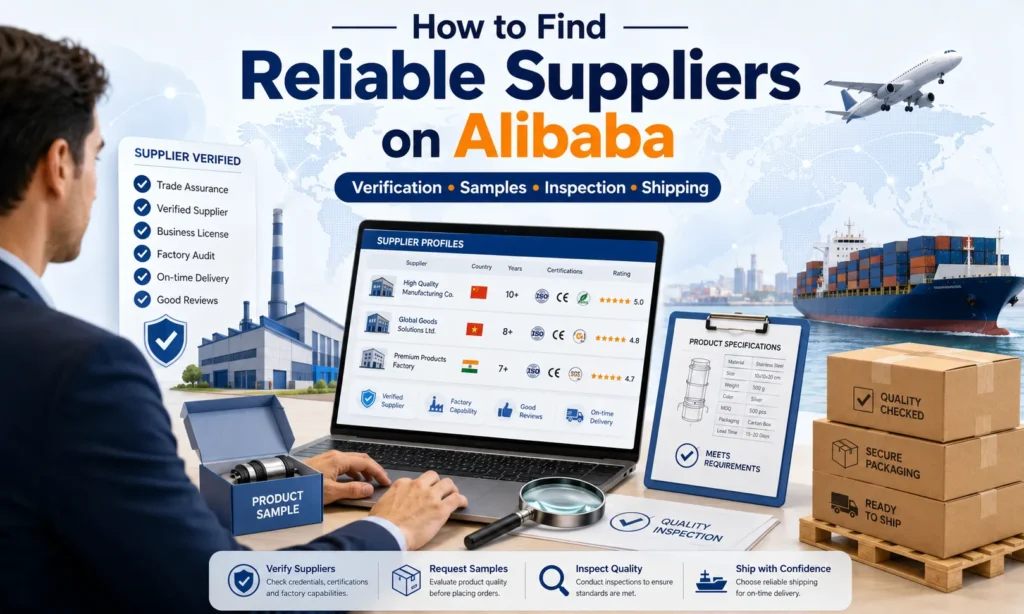
How to Find Reliable Suppliers on Alibaba: A 10-Step Process
Step 1: Define the Exact Product Before You Search
First, prepare a product specification sheet. Suppliers cannot quote accurately when the buyer only sends a product photo and a target price. Small differences in material, thickness, size, performance, accessories and packaging can create large differences in production cost and quality.
Your initial product brief should include:
- Product name and intended use
- Material, grade, composition or key components
- Dimensions, weight, capacity, power or technical performance
- Color reference, finish and acceptable tolerance
- Required quantity and expected repeat-order volume
- Logo, printing, private label or OEM requirements
- Individual packaging and master carton requirements
- Destination country and sales channel
- Applicable testing, labeling or compliance requirements
- Preferred Incoterm and delivery deadline
In addition, separate mandatory requirements from optional preferences. A supplier should understand which items can never change and which items may be adjusted to reach the target price or MOQ.
Step 2: Build a Shortlist Instead of Contacting One Supplier
Next, identify approximately eight to twelve suppliers that appear relevant. Do not send a generic message to hundreds of companies. A smaller, carefully selected group produces more useful replies and makes comparison manageable.
Step 3: Send Every Supplier the Same Request
Use the same product brief, quantity and commercial questions for each shortlisted supplier. Otherwise, you may compare different materials, packaging standards or shipping terms without realizing it. Ask suppliers to separate product price, tooling, packaging, sample cost and shipping cost rather than combining everything into one unclear total.
Step 4: Evaluate the Quality of the Reply
A reliable supplier does more than answer quickly. The supplier should identify missing information, ask technical questions and explain production limitations. By contrast, an instant “yes, no problem” response to every request can be a warning sign.
Step 5: Verify the Company Behind the Alibaba Store
Before paying, compare the company name shown on the Alibaba profile, business license, quotation, proforma invoice and beneficiary account. Ask for a copy of the business license and confirm the registered address, establishment date, business scope and legal company name.
Step 6: Verify Product and Production Capability
Ask for evidence that relates to your exact product, not only general factory photos. Useful evidence may include production-line videos, machine lists, quality-control procedures, workshop photos, recent inspection reports and examples of similar products.
Step 7: Order and Approve Samples
Never treat listing photos as proof of quality. Order samples from the strongest candidates and compare them under the same checklist. Check dimensions, materials, color, finish, function, odor, labeling, packaging and any market-specific requirements.
Step 8: Confirm the Purchase Order and Quality Standard
Before mass production, place all important requirements in the Alibaba order, purchase contract, specification sheet or approved attachment. Avoid vague expressions such as “high quality,” “export packing” or “same as usual.” Instead, use measurable requirements such as material grade, size tolerance, color code, carton strength, barcode position, drop-test standard or acceptable defect level.
Step 9: Inspect Before Paying the Final Balance
For a meaningful order value, arrange a pre-shipment inspection after production is complete but before the goods leave the factory. The inspection should compare randomly selected units with the approved specification and sample.
Step 10: Plan Shipping Before Production Finishes
Finally, ask the supplier for the expected carton quantity, carton dimensions, gross weight, pickup address and cargo-ready date before production ends. Then compare the supplier’s shipping quote with a freight forwarder’s quote on the same basis.
Manufacturer, Trading Company or Wholesaler: Which Should You Choose?
Alibaba includes manufacturers, trading companies, wholesalers and hybrid businesses. None of these supplier types is automatically good or bad. The right choice depends on customization, order size, product range, communication and how much factory control you need.
When a Manufacturer Is Usually Better
A manufacturer is often the stronger option for custom molds, special materials, engineering changes, private-label production and larger repeat orders. Direct factory communication can improve technical control. However, factories may have higher MOQs, narrower product ranges or weaker export communication, so factory ownership alone should not decide the order.
When a Trading Company Can Be Useful
A trading company can help when you need several related products, smaller mixed orders or stronger export communication. It may coordinate more than one factory and provide flexible service. In return, the buyer may pay a markup and have less direct production visibility, so ask how the company controls its factories and whether inspection can occur at the production site.
When a Wholesaler Is a Practical Choice
A wholesaler can be practical for ready-made goods, lower quantities and faster delivery from stock. This helps buyers test demand before investing in customization. Nevertheless, confirm whether the product is continuously available, because materials, colors and packaging may change between stock batches.
How to Tell Whether a Supplier Is Really a Factory
Check several signals together rather than relying on one claim:
- The store focuses on a logical product category instead of unrelated products.
- The company business scope includes manufacturing when applicable.
- The supplier can answer questions about machinery, tooling, materials and capacity.
- Factory videos show the product and process you are buying.
- The supplier permits a factory audit or inspection at the production address.
- The company name, factory address and documents remain consistent.
- The sample and bulk-production plan match the claimed capability.
Even after these checks, factory ownership alone should not determine your decision. A transparent trading company with strong quality control can outperform a poorly managed factory.
How to Search for Good Suppliers on Alibaba
Use Specific Product Keywords
Instead of searching only for “water bottle,” search for details such as “750 ml double-wall stainless steel vacuum bottle custom logo.” Specific phrases reduce irrelevant listings and make the first shortlist more accurate.
Use Supplier Filters as a First Screen
Alibaba may show filters related to supplier status, product features, location, MOQ, certifications, Trade Assurance and other criteria. Use these tools to reduce the candidate list, but do not treat any filter as final proof of reliability.
Use RFQ Only After Preparing a Clear Brief
Do not select a supplier only because it responds first. Compare whether the supplier understood the request and whether the quoted product matches your specification.
Alibaba Verified Supplier, Gold Supplier and Trade Assurance Explained
Alibaba provides supplier labels and transaction services that can support the screening process. Still, buyers should understand what each item does and what it does not prove.
What Does Verified Supplier Mean?
Alibaba states that the Verified Supplier process includes on-site verification by a third-party inspection company and produces an assessment report that buyers can review. This can provide useful information about the company and its capabilities. However, a verification report does not replace product samples, written specifications or order-specific inspection.
What Does Gold Supplier Mean?
Gold Supplier has historically referred to a paid supplier membership with promotional and business features. Therefore, do not interpret the Gold Supplier label alone as proof of product quality, factory ownership or successful order performance.
How Trade Assurance Helps Buyers
Trade Assurance can support order protection when buyers place and pay for eligible orders through the platform and follow the applicable process. Its value depends heavily on the written order terms. Therefore, describe the product, quality standard, quantity, shipping requirement and delivery deadline clearly in the order.
Official references: Alibaba.com Verified Supplier, Alibaba.com Trade Assurance, and Alibaba Buyer Central.
Alibaba Supplier Evaluation Scorecard
The following scorecard helps buyers compare shortlisted suppliers on the same basis. Adjust the weighting for your product, but avoid choosing a supplier from price alone.
| Evaluation Area | What to Check | Suggested Weight |
|---|---|---|
| Company identity | Business license, registered company name, address, beneficiary details and consistent documents | 15 points |
| Product specialization | Relevant product range, similar projects, material knowledge and technical capability | 15 points |
| Communication quality | Clear answers, useful questions, realistic promises and written confirmation | 15 points |
| Sample result | Material, dimensions, finish, function, packaging and consistency with requirements | 15 points |
| Quality control | Incoming material checks, in-process control, final inspection and defect handling | 10 points |
| Compliance evidence | Relevant reports, correct model numbers, document validity and destination-market fit | 10 points |
| Commercial terms | Transparent price, reasonable MOQ, lead time, payment structure and quotation scope | 10 points |
| Inspection and shipping cooperation | Allows inspection, provides packing data, supports pickup and prepares accurate documents | 10 points |
Questions to Ask an Alibaba Supplier Before Ordering
Good questions reveal whether the supplier understands the product and whether the quotation is complete. Ask the questions in groups so the supplier can answer clearly.
Company and Production Questions
- Are you the manufacturer, a trading company or both?
- What is the legal company name shown on your business license?
- Where will this product be manufactured?
- How many years have you produced this type of product?
- Which production steps do you complete in-house?
- Which processes do you outsource?
- Can you provide a recent factory video showing this product line?
- Can a third-party inspector visit the production location?
Product and Quality Questions
- What exact material and grade will you use?
- What are the product tolerances and inspection standards?
- Which parts of my specification require modification?
- Can you make a sample before mass production?
- How do you control incoming materials and finished products?
- What are the most common defects for this product?
- What will you do if inspection finds defects above the agreed limit?
Compliance and Document Questions
- Which reports or certificates apply to this exact product and model?
- Who is the certificate holder?
- Can you provide the full report rather than only the first page?
- Does the report cover the same material, component and model?
- Can you provide a commercial invoice and packing list with accurate product descriptions?
- Do you have export experience to my destination market?
Price, MOQ and Delivery Questions
- What is the MOQ for the standard product and customized version?
- What is included in the unit price?
- Are tooling, printing plates, labels or packaging charged separately?
- What is the sample cost and sample lead time?
- What is the mass-production lead time after sample approval?
- What payment terms do you propose?
- How long is the quotation valid?
- Which Incoterm and named place does the quotation use?
Packing and Shipping Questions
- How many units will be packed in each carton?
- What are the estimated carton dimensions and gross weight?
- Can you use the buyer’s shipping mark and barcode labels?
- Can you strengthen cartons for international transport?
- Can you deliver to my freight forwarder’s China warehouse?
- Can you provide final packing data before pickup?
- Does the product contain batteries, liquids, powders, magnets, wood or other restricted materials?
Alibaba Supplier Inquiry Message Template
Personalize the following template before sending it. Suppliers respond more seriously when the buyer provides clear information and asks relevant questions.
Subject: Request for Quotation – [Product Name] – [Quantity]
Hello,
We are looking for a reliable supplier for
for sale in [destination country or market]. Please review the requirements below and confirm whether your company can manufacture this product.
Product:
Material/specification: [details]
Size/color/model: [details]
Quantity: [trial quantity and expected repeat quantity]
Customization: [logo, packaging, color or OEM requirements]
Packaging: [individual pack, carton and label requirements]
Compliance requirements: [applicable requirements, if confirmed]
Preferred trade term: [EXW/FOB/other term and named place]
Required delivery date: [date or target lead time]
Please provide:
1. Unit price for [quantity A], [quantity B] and [quantity C]
2. MOQ for standard and customized orders
3. Sample cost and sample lead time
4. Mass-production lead time
5. Exact material and product specifications
6. Packaging details and estimated carton size/weight
7. Payment terms
8. Business license and relevant product documents
9. Confirmation that third-party inspection is allowed before shipment
10. Confirmation whether you are the manufacturer or a trading company
Please quote each cost separately and explain anything that does not match our request.
Best regards,
[Name / Company]
How to Order and Evaluate Product Samples
Order Samples from More Than One Finalist
Order samples from two or three strong candidates when the product value justifies it. Ask each supplier to use the proposed mass-production material and process. This gives you a fairer comparison and reduces the risk of choosing a supplier from photos or promises alone.
Evaluate Samples with a Written Checklist
Record the following items where relevant:
- Dimensions and weight
- Material and component specifications
- Color and surface finish
- Assembly and workmanship
- Function, performance and durability
- Smell, noise, leakage or other product-specific issues
- Logo, printing and label accuracy
- Individual packaging and carton protection
- User instructions and warnings
- Any testing or compliance-related characteristics
Create an Approved Reference Sample
After approving the final sample, identify it as the reference for mass production. Record the version, approval date, measurements and any corrections. If possible, keep one sample and ask the supplier to keep a matching unit for the production team and inspector.
Factory Audits, Production Monitoring and Pre-Shipment Inspection
Factory Audit
A factory audit checks whether the production site, staff, machinery, quality systems and capacity can support the order. It is most useful before a large or long-term manufacturing relationship. An audit can also help clarify whether the supplier manufactures the product or outsources most production.
During-Production Inspection
A during-production inspection takes place after production has started but before the order is complete. It can identify material, color, size or assembly problems early enough for correction. This service is useful when the product has several production stages or when the buyer cannot afford to discover a systematic defect at the end.
Pre-Shipment Inspection
A pre-shipment inspection normally checks finished goods, quantity, workmanship, function, labels, packaging and carton details before shipment. The inspector should use the approved specification, reference sample and inspection checklist.
If the inspection fails, do not release the final balance automatically. Ask for a corrective-action plan, rework evidence and reinspection when necessary. Also decide in advance who pays for reinspection if the first inspection fails because of supplier defects.
Container Loading Supervision
For full-container shipments, loading supervision can verify carton count, container condition, loading method and seal information. It can reduce the risk of missing cartons, loading damage or last-minute product substitution.
MOQ, Price Negotiation and Safe Payment Terms
MOQ, price and payment terms are connected. A supplier may accept a lower MOQ but increase the unit price because setup, raw-material purchasing and packaging costs are spread over fewer units.
How to Negotiate MOQ
Instead of asking only “What is your lowest MOQ?”, explain your trial-order plan and potential repeat volume. Then ask whether the supplier can reduce customization, use stock materials, combine colors, use standard packaging or schedule the order with another production batch.
How to Compare Prices Correctly
Compare quotations line by line. Check whether each price includes the same material, accessories, testing, logo, packaging, labels, tooling, export packing and Incoterm. A quotation can look cheaper simply because important items are missing.
Common Payment Structures
For samples or very small orders, full payment may be normal. For large orders, avoid paying the full amount before the supplier has produced verifiable goods unless a well-understood arrangement justifies it. Keep payment milestones connected to clear deliverables.
Check the Beneficiary Before Paying
Before every payment, confirm:
- The beneficiary name matches the approved company or documented collection arrangement.
- The bank details match the proforma invoice and platform order.
- Any account change has been verified through a known phone number or platform account.
- The currency, amount, order number and payment purpose are correct.
- The purchase terms and product specification are attached to the order.
Email accounts can be compromised. Therefore, treat urgent bank-detail changes as a serious verification event, not a routine update.
Common Alibaba Supplier Scams and Red Flags
Unrealistically Low Prices
A price far below every comparable quote may exclude packaging, use different materials or rely on an inaccurate product description. Ask for a detailed breakdown and confirm the sample before assuming you found a bargain.
Pressure to Pay Immediately
Be careful when a supplier creates false urgency, refuses reasonable verification or asks for payment before answering basic product questions. Genuine production deadlines can exist, but the supplier should still provide complete documents and terms.
Last-Minute Bank Account Changes
Never accept new bank details from one email message without independent verification. Contact the supplier through the Alibaba account or a previously verified number. Ask for a revised invoice and written explanation.
Refusal to Provide Samples or Accept Inspection
Some products cannot be sampled easily, and some factories have security rules. Even so, a complete refusal without a practical alternative creates risk. A supplier expecting a large order should usually support reasonable quality verification.
Certificates That Do Not Match the Product
Check the certificate holder, manufacturer, product model, material, tested standard, issue date and laboratory. A certificate for a similar product does not automatically cover your exact item. Ask for the complete document and verify important reports with the issuing organization when necessary.
Copied Product Photos and an Unfocused Catalog
Stock photos are common on marketplaces, so copied images alone do not prove fraud. However, a store that lists hundreds of unrelated products and cannot provide original factory evidence may be acting only as an intermediary. Decide whether that business model fits your needs.
Unauthorized Branded Goods
Counterfeit or unauthorized branded products can create customs seizures, marketplace suspensions and legal problems. Ask for authorization when a product uses another company’s trademark, design or copyrighted content. Avoid explanations such as “same factory” or “original quality” without verifiable rights.
Shipping Quotes That Sound Complete but Are Not
A supplier may quote “door-to-door” shipping without explaining duties, customs clearance, destination charges, remote-area fees, delivery appointments or unloading. Ask for the exact scope in writing. A cheap freight quote can become expensive after the cargo reaches the destination.
EXW, FOB, CIF, DAP and DDP for Alibaba Orders
Incoterms clarify important tasks, costs and risks between buyer and seller in an international sales transaction. Always include the named place or port and the applicable Incoterms version in the quotation or contract. For example, “FOB Shenzhen” is clearer than simply writing “FOB.”
EXW: Ex Works
Under EXW, the seller makes the goods available at the agreed location, while the buyer takes responsibility for most transport arrangements from that point. In practice, the buyer’s freight forwarder may arrange factory pickup, export handling and international shipping.
EXW can give the buyer stronger logistics control, especially when consolidating multiple suppliers. However, confirm who can legally and practically handle export formalities in the origin country.
FOB: Free on Board
FOB applies to sea or inland waterway transport. The seller handles the goods to the agreed port and loads them on board according to the rule, while the buyer manages the main international freight and later stages.
FOB can work well for established ocean shipments. Nevertheless, confirm origin charges, port, cutoff date, documentation and whether the supplier’s quoted FOB price includes all agreed local costs.
CIF: Cost, Insurance and Freight
Under CIF, the seller arranges ocean freight and insurance to the named destination port, but risk and cost responsibilities do not simply transfer together at the destination. Buyers also need to understand destination handling, customs clearance, duty, port charges and final delivery.
A low CIF quote may lead to high destination fees. Therefore, ask for the nominated agent and expected destination charges before accepting the term.
DAP: Delivered at Place
DAP places more delivery responsibility on the seller to the named destination, while the buyer generally manages import clearance and import taxes. The exact scope still needs written confirmation, especially for customs brokerage, unloading and delivery surcharges.
DDP: Delivered Duty Paid
DDP assigns extensive responsibility to the seller for delivery, export, import clearance and applicable duties under the rule. However, not every supplier can legally or operationally act as importer or complete a compliant DDP shipment in every country.
Before accepting DDP, confirm the importer arrangement, customs declaration method, duty and tax scope, product compliance, final delivery address and excluded charges. Do not use DDP as a substitute for asking how the shipment will be imported.
Incoterms do not replace a complete sales contract. They do not define product quality, payment timing, transfer of ownership or every dispute remedy. Official references: ICC Incoterms 2020 and Trade.gov: Know Your Incoterms.
Alibaba Shipping, China Warehouses and Freight Forwarders
Compare Supplier Shipping with an Independent Quote
Ask both parties to quote from the same origin point to the same final destination under the same customs and duty terms. Confirm whether the price includes:
- Factory pickup or delivery to the China warehouse
- Warehouse receiving and consolidation
- Export documentation and customs handling
- Main freight by courier, air, sea, rail or truck
- Fuel, security and carrier surcharges
- Destination customs clearance
- Import duty and tax, when applicable
- Port, terminal or destination handling charges
- Final delivery, appointment and residential or remote-area fees
- Palletization, labeling, repacking or Amazon FBA preparation
Why Final Carton Data Matters
Air freight and express services may charge by the greater of actual weight and volumetric weight. Sea LCL costs also depend on volume, origin charges, destination charges and minimum billing rules. Therefore, ask the supplier for final carton quantity, dimensions and gross weight instead of relying on an early estimate.
When a China Warehouse Is Useful
A China warehouse can act as a control point between suppliers and international transport. It is especially useful when you buy from multiple Alibaba suppliers or when the goods need checking before export.
Depending on the agreed service, the warehouse can:
- Receive cartons from one or more suppliers
- Record carton quantity and visible packing condition
- Measure final weight and dimensions
- Take receiving photos or videos
- Apply shipping marks or warehouse labels
- Consolidate compatible orders
- Replace weak outer cartons
- Prepare FBA carton labels or pallet plans
- Hold goods until all suppliers are ready
When to Use Express, Air Freight or Sea Freight
Express courier often suits urgent samples, documents and smaller commercial parcels. It offers convenient tracking, but volumetric weight and destination surcharges can make bulky cartons expensive.
Air freight usually suits time-sensitive commercial cargo that is too large for economical courier service. Buyers need accurate weight, dimensions, product details and airport or door-delivery requirements. Learn more about air freight from China.
Sea freight normally works better for heavier or bulkier, non-urgent cargo. Buyers can compare LCL for smaller volumes and FCL for full-container shipments. Learn more about sea freight from China.
Door-to-door shipping combines international transport with destination delivery under an agreed customs scope. Review exactly what the quote includes before booking. See door-to-door shipping from China.
Shipping Alibaba Goods to Amazon FBA
Amazon FBA shipments need correct product labels, carton labels, packing rules, shipment details and delivery planning. The supplier may apply labels, but the buyer or freight forwarder should verify that the labels match the current Amazon shipment.
When buying from several suppliers, consolidation can reduce scattered deliveries and give the buyer one point for label checks and final measurements. For more information, read FBA prep service in China. U.S. buyers can also review shipping from Alibaba to the USA.
Why Choose VoltFreight After Sourcing from Alibaba?
Once you choose a supplier, the next challenge is moving the goods from the factory to the destination with clear costs, documents and delivery responsibility. An independent freight forwarder can compare routes and check the logistics information before cargo departure.
After you select an Alibaba supplier, VoltFreight can support the logistics stage with services such as:
- Pickup coordination from factories and trading companies in China
- China warehouse receiving and multi-supplier consolidation
- Basic carton quantity, packaging, weight and dimension checks
- Shipping-mark, carton-label and FBA-label support
- Repacking or outer-carton improvement when required
- Comparison of express, air freight, sea freight, rail and truck routes
- Commercial invoice and packing list review for shipping purposes
- Customs-clearance and door-delivery planning according to the selected service
- Shipment tracking and coordination with suppliers before cargo departure
For buyers who need broader supplier support, read our China sourcing agent guide. If you have already selected suppliers, send VoltFreight the product name, supplier city, pickup address, carton quantity, dimensions, gross weight, cargo value, destination and required delivery time.
Contact VoltFreight to review your Alibaba shipping plan.
Frequently Asked Questions
How do I verify an Alibaba supplier?
Check the supplier’s legal company name, business license, registered address, product specialization, factory evidence, assessment report, sample quality and willingness to accept inspection. Compare the company name across the Alibaba profile, quotation, invoice and beneficiary account. Verification should combine documents, product evidence and order-specific checks.
Is Verified Supplier enough to prove a supplier is reliable?
No. Verified Supplier can provide useful third-party assessment information, but it does not guarantee that every product, quotation or order will meet your requirements. Review the assessment report, order samples, define written specifications and inspect important orders before final payment.
Should I pay an Alibaba supplier outside the platform?
Moving payment outside the platform may reduce the protection and evidence available through the platform. Before using any payment method, understand the current Trade Assurance rules, verify the beneficiary and keep complete written records. Never send money to a new account based only on an unverified email change.
Should I inspect goods before paying the balance?
For meaningful order values, inspection before the final balance is a practical risk-control step. Arrange the inspection when production is complete and enough goods are packed for checking. If the order fails, require corrective action and reinspection before approving shipment or payment.
Can a freight forwarder collect goods from multiple Alibaba suppliers?
Yes. A freight forwarder with a China warehouse can coordinate supplier delivery or pickup, receive the cartons, record weight and dimensions, consolidate compatible goods, apply shipping marks and arrange one international shipment. Confirm the warehouse service scope because basic receiving does not automatically include detailed product inspection.
Conclusion: Build a Repeatable Alibaba Supplier Selection Process
Understanding how to find reliable suppliers on Alibaba starts with a simple principle: choose evidence over promises. Define the product, compare several suppliers, verify the company, evaluate technical communication, approve samples, document quality requirements, inspect the finished order and confirm shipping costs before the cargo leaves China.
Once your supplier is selected, plan the logistics early. Accurate carton data, independent freight comparison and China warehouse support can prevent last-minute surprises. To arrange supplier pickup, consolidation, carton checks, air freight, sea freight, FBA preparation or door-to-door delivery, contact VoltFreight with your supplier and cargo details.