Export packaging should match the product, shipping method, handling environment and final destination. For many commercial shipments from China, the practical choice is between strong export cartons, palletized cartons, wooden crates or heavy-duty skids. The right option can reduce handling problems, while the wrong option can increase freight cost, create oversized cargo, cause warehouse difficulties or leave the goods under-protected.
There is no single packaging method that is best for every shipment. Loose cartons may work well for compact consumer goods. Pallets can make warehouse and forklift handling easier. Wooden crates can protect machinery, fragile equipment and irregular cargo. Meanwhile, a skid may provide a stable base for heavy cargo without enclosing the entire product.
The key is to confirm the final packed dimensions and gross weight before booking freight. International freight is priced and handled according to the cargo as the carrier actually receives it, not according to the product dimensions shown in a supplier catalogue.
If your main concern is cushioning, void fill, double boxing, liquid leakage or fragile-product protection, see our separate guide on how to prevent shipping damage. This page focuses specifically on choosing export packaging and preparing cargo for international freight from China.
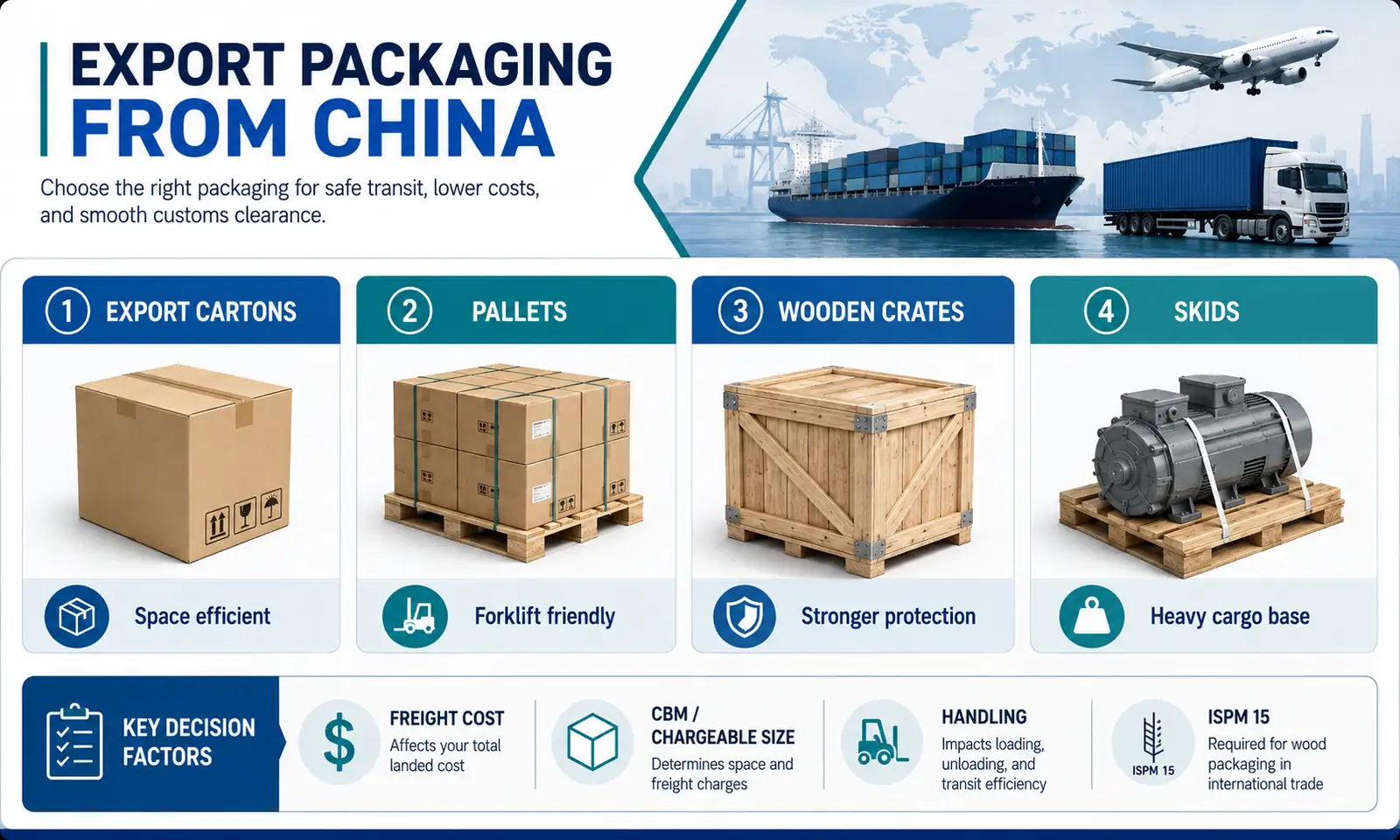
Quick Answer: Which Export Packaging Should You Use?
Use the simplest packaging that can safely support the product and the planned transport route without creating unnecessary volume or handling risk.
- Export cartons: Usually suitable for standard consumer goods, apparel, accessories, household products and other compact cargo.
- Pallets: Useful when many cartons need to move as one handling unit or when warehouses, LCL terminals or business receivers prefer forklift handling.
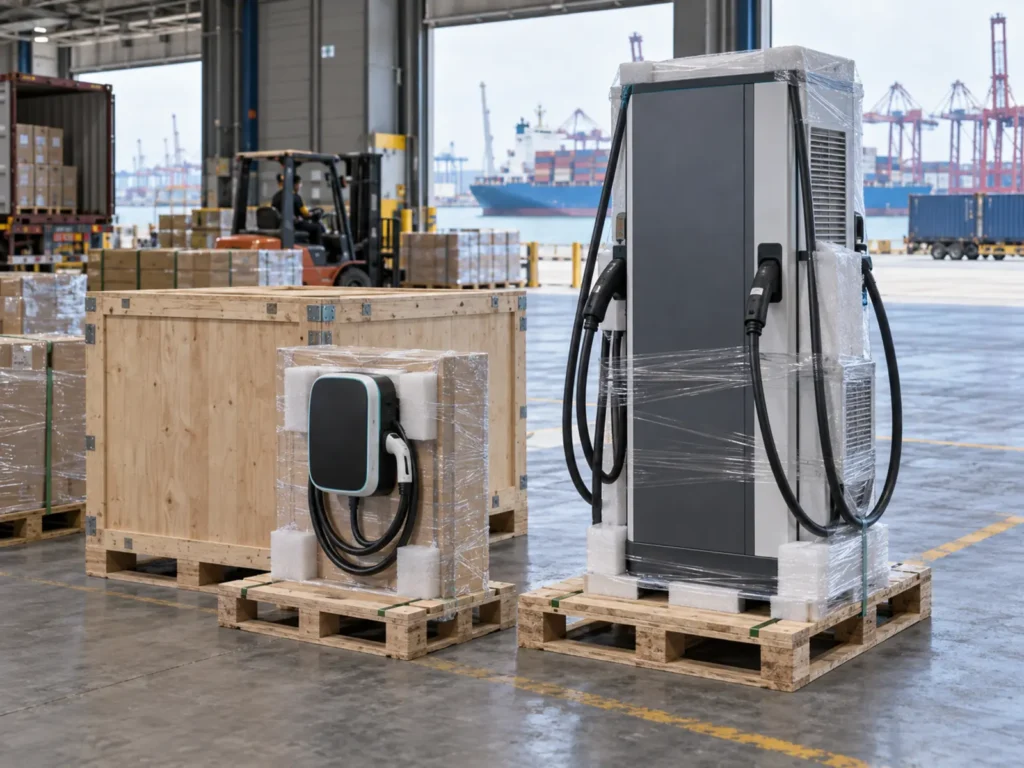
- Wooden crates: Often used for machinery, fragile equipment, glass, valuable components and products that need stronger structural protection.
- Skids: Useful for heavy machinery or equipment that needs a strong forklift or lifting base but does not always require a fully enclosed crate.
However, the packaging decision should not be made separately from the freight decision. Palletizing cartons can increase CBM. A wooden crate can add both weight and volume. Oversized packaging can affect airline acceptance, container fit, truck requirements and final unloading.
What Is Export Packaging for International Shipping?
Export packaging is the transport packaging used to protect, support and handle goods during an international shipment. It is different from the retail box or consumer packaging designed mainly for presentation and sale.
A product may leave the factory in attractive retail packaging but still need stronger outer cartons, pallets, crates, waterproof protection or other transport packaging before international freight.
Export cargo can pass through several handling stages:
- Factory loading
- Domestic trucking in China
- Warehouse receiving
- Consolidation or palletizing
- Airport, CFS or port handling
- International transportation
- Customs inspection
- Destination terminal handling
- Final truck or parcel delivery
- Warehouse or 3PL receiving
Therefore, packaging that works for a short domestic delivery inside China may not automatically be suitable for international air, sea, rail or multimodal freight.
Cartons vs Pallets vs Wooden Crates vs Skids
The best cargo packaging depends on product weight, dimensions, fragility, stackability, handling method and freight route.
| Packaging Type | Usually Best For | Main Advantage | Main Freight Consideration |
|---|---|---|---|
| Export Cartons | Standard consumer goods, apparel, accessories, small parts and compact products | Low packaging weight and good space efficiency | Weak cartons can crush during stacking or repeated handling |
| Pallets | Multiple cartons, warehouse deliveries, heavier commercial cargo and forklift handling | Combines many cartons into one handling unit | Can increase total CBM and volumetric weight |
| Wooden Crates | Machinery, valuable equipment, fragile goods and irregular products | Provides stronger structural protection | Adds weight and volume and may involve ISPM 15 requirements |
| Skids | Heavy equipment, industrial parts and machinery requiring a lifting base | Provides support while using less material than a full crate | Product may remain partly exposed and still need wrapping or securing |
A low-cost packaging choice is not always the lowest-cost freight choice. For example, an oversized pallet can increase LCL CBM or air-freight volumetric weight even when the cargo itself is lightweight. By contrast, using loose cartons may save volume but create more individual handling units.
How the Shipping Method Changes Your Packaging Choice
Packaging should be selected with the transport method in mind because courier, air freight, LCL, FCL and rail cargo do not experience identical handling conditions.
Express and Courier Shipments
Small courier shipments are handled as individual parcels and may move through automated sorting facilities, vans, aircraft and local delivery depots. Strong outer cartons are therefore important, but unnecessary palletization usually does not help a normal parcel shipment.
If the goods are fragile, liquid, unusually heavy or contain batteries, additional packaging and carrier review may be required before pickup.
Air Freight
Air freight is sensitive to both weight and package dimensions. Large lightweight cartons, oversized pallets or bulky wooden crates can increase chargeable weight even when they improve protection.
Before building a large pallet or crate, confirm the finished dimensions with the freight forwarder. Aircraft-door dimensions, cargo-compartment limits, pallet height and single-piece weight can affect route availability.
For general air-shipping planning, see our air freight from China service guide.
LCL Sea Freight
LCL cargo normally passes through consolidation and deconsolidation facilities. As a result, one shipment may be handled several times before reaching the final receiver.
Cartons should therefore be strong enough for commercial freight handling. Palletizing may help when there are many cartons, heavy packages or a warehouse receiving requirement. However, the finished pallet dimensions should be checked because LCL pricing commonly depends heavily on cargo volume.
Learn more about consolidation and CFS handling in our LCL sea freight from China guide.
FCL Sea Freight
FCL gives one shipper dedicated use of the container. This can reduce the number of consolidation-handling stages, but packaging still needs to support factory loading, container movement, vessel transit and destination unloading.
Some products can be floor loaded in cartons to maximize container utilization. Other cargo benefits from pallets or crates because the receiving warehouse needs forklift handling or because the product cannot safely support direct stacking.
For FCL planning, the important question is not only whether the product fits the container. The finished cargo must also be loaded, secured and unloaded safely.
Rail and Truck Freight
Rail and road freight can involve warehouse handling, terminal transfers, border processes and final truck delivery. Stable cartons, pallets and crates can make these transfers easier, particularly for commercial shipments moving to European warehouses.
Nevertheless, route-specific size, weight and cargo-acceptance limits still apply. The forwarder should review the final packed dimensions before confirming the shipment.
How Packaging Changes Freight Cost and Chargeable Size
Packaging is part of the freight calculation because carriers transport the finished shipping package, not only the product inside it.
Final freight data should include:
- Total number of cartons, pallets or crates
- Length, width and height of every package type
- Final gross weight including packaging
- Total CBM
- Whether the cargo is stackable
- Any oversized or heavy individual piece
For example, a supplier may initially quote the dimensions of 30 loose cartons. If the cargo is later rebuilt onto two pallets, the carrier should use the outside dimensions of the finished pallets, including the pallet base, wrapping, corner boards and any overhang.
Likewise, a wooden crate can add substantial weight compared with the product itself. This may matter for air freight, heavy-piece handling and final truck delivery.
Use our CBM calculator for shipping from China after the final package dimensions are confirmed.
When Should Cargo Be Palletized?
Palletizing can make cargo easier to move by forklift and can combine many cartons into one commercial handling unit. However, it should solve a real handling problem rather than simply being added by default.
Palletization may make sense when:
- There are many cartons in one shipment
- Individual cartons are heavy
- The receiving warehouse requests pallet delivery
- The cargo needs forklift handling
- LCL handling risk is a concern
- Cartons need a stable base for strapping and wrapping
- The shipment will move to a commercial warehouse or 3PL
Loose cartons may still be better when the goods are compact, strong, lightweight and space efficiency is more important than pallet handling.
One common mistake is palletizing before checking the freight route. A supplier may build an unusually tall pallet that becomes non-stackable, exceeds a warehouse limit or increases air-freight volume sharply. Send the proposed pallet size to the freight forwarder before final packing when possible.
Wooden Crates, Pallets and ISPM 15
Solid wood packaging used in international trade can be subject to ISPM 15, the international phytosanitary standard for wood packaging material.
ISPM 15 is designed to reduce the risk of transporting plant pests in raw wood packaging. Regulated wood packaging can include items such as solid-wood pallets, crates, skids and dunnage.
Before using solid wood export packaging, ask the supplier or packing provider to confirm:
- What type of wood is being used
- Whether the destination applies ISPM 15 requirements
- Whether regulated wood has received an approved treatment
- Whether the required IPPC / ISPM 15 mark is clear and legible
- Whether repaired or reused packaging still carries valid compliant markings
The International Plant Protection Convention explains that ISPM 15 covers wood packaging made from raw wood, including dunnage, while packaging made entirely from processed wood such as plywood is generally outside the same scope because the processing removes the relevant pest risk.
However, do not assume that an entire crate is exempt merely because some panels are plywood. If the crate also uses solid-wood battens, blocks, runners or skids, those components still need to be reviewed.
See the official IPPC ISPM 15 standard for the international framework. Destination-country implementation and inspection practices should still be confirmed before shipment.
Packaging Fragile, Heavy and Special Cargo
Some products need more than a standard carton, but this page should not be used as a universal packing specification for every commodity.
Fragile Products
Glass, ceramics, lighting, instruments and other fragile goods may need reinforced cartons, internal separation, foam, edge protection or wooden crates depending on their value and handling risk.
For detailed cushioning, void fill, double-boxing and damage-prevention methods, use our shipping damage prevention guide.
Heavy Machinery and Equipment
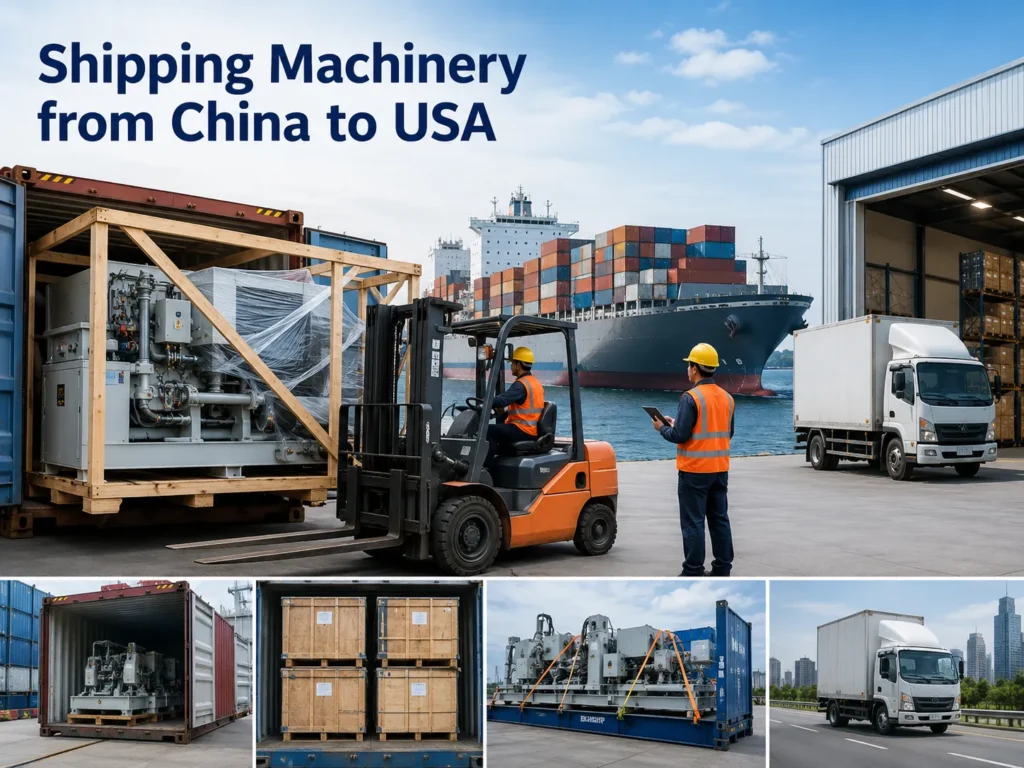
Machinery may require a wooden crate or skid with suitable lifting points, structural support and securing. The packed crate dimensions can decide whether the shipment moves by LCL, FCL, open top, flat rack or another heavy-cargo solution.
Always provide the forwarder with the final packed dimensions, not only the machine dimensions.
Furniture and Bulky Cargo
Furniture may need corner protection, moisture protection, reinforced cartons, crates or other packaging depending on material and fragility. Bulky packaging should also be reviewed against usable container space because low-density furniture can fill a container by volume before reaching its weight limit.
Batteries, Liquids and Regulated Cargo
Transport packaging for batteries, liquids, chemicals and dangerous goods cannot be decided only from product size. Classification, carrier acceptance and product-specific transport requirements may affect the permitted packaging method.
For lithium-battery cargo, review our shipping batteries from China guide before the supplier completes the export packing.
Moisture, Compression and Long-Transit Risk
International sea and multimodal transportation can expose cargo to long transit times, humidity changes, stacking pressure and repeated warehouse handling.
Moisture-sensitive goods may need suitable wrapping, liners or moisture-control planning. Cartons should also be strong enough for the intended stacking arrangement, especially when they remain inside a container for several weeks.
At the same time, more packaging is not automatically better. Excess packaging can increase CBM, add chargeable weight and reduce container utilization. The objective is to provide enough transport protection without creating unnecessary shipping volume.
Shipping Marks, Labels and Package Identification
Good export packaging also needs clear package identification. Labels do not strengthen a carton, but they help warehouses, forwarders and receivers identify the correct cargo.
Depending on the shipment, the outside packaging may need:
- Consignee or customer reference
- Purchase order or shipment number
- Carton numbering such as CTN 1/20, CTN 2/20 and so on
- Pallet numbering such as PLT 1/4
- Destination or warehouse reference
- Handling marks where appropriate
- Amazon, 3PL or customer labels when required
- Required dangerous-goods marks or labels for regulated cargo
The package count and numbering should match the final packing list for international shipping.
A “Fragile” or “This Side Up” label should never be treated as a substitute for suitable physical packaging.
How to Review Supplier Packaging Before Pickup in China
The easiest time to fix a packaging problem is while the goods are still at the supplier or a China warehouse.
Before pickup or international booking, ask for:
- Photos of the finished outer cartons
- Photos of pallet or crate construction where applicable
- Final package quantity
- Dimensions of every package type
- Final gross weight
- Pallet dimensions after wrapping
- Confirmation of stackable or non-stackable status
- ISPM 15 mark photos when regulated solid wood packaging is used
- Product details for batteries, liquids, chemicals or regulated goods
- Loading method for heavy crates or machinery
If several Chinese suppliers are involved, packaging can also be reviewed after the goods arrive at one consolidation warehouse. Cartons can then be counted, measured and combined before the final international shipment.
Read our guide to consolidating shipments from multiple suppliers in China if your order comes from several factories.
Export Packaging Checklist Before International Booking
Before the cargo leaves China, confirm the following:
- Product: What exactly is being shipped?
- Packaging type: Carton, pallet, crate, skid or mixed packing?
- Package count: How many final shipping units?
- Dimensions: What are the outside dimensions after packing?
- Gross weight: Does it include cartons, pallet, crate and protective materials?
- Stackability: Can the cargo safely support weight above it?
- Handling: Is a forklift, crane or other equipment required?
- Wood packaging: Does solid wood need ISPM 15 review?
- Special cargo: Batteries, liquids, chemicals, magnets or other restricted products?
- Shipping method: Courier, air, LCL, FCL, rail or truck?
- Destination: Port, airport, warehouse, 3PL, Amazon facility, factory or business address?
- Receiving requirements: Does the final warehouse require pallets, labels or delivery appointments?
After these details are confirmed, prepare the final packing list and request the freight quotation using the actual finished cargo data rather than the supplier’s early estimate.
How VoltFreight Helps with Export Packaging and Freight Preparation
VoltFreight helps importers prepare cargo for international shipping from China before the booking is finalized. Our role is not to manufacture every type of packaging or replace a professional packaging engineer. Instead, we help connect the packaging decision with the actual freight route.
Depending on the shipment, our China-side support can include:
- Supplier pickup coordination
- Warehouse receiving
- Carton-count checking
- Receiving photos and visible packaging checks
- Final weight and dimension measurement
- CBM and chargeable-weight review
- Multi-supplier consolidation
- Repacking or reinforcement under agreed instructions
- Palletizing where suitable
- Shipping-mark and label coordination
- Wood-packaging and ISPM 15 mark review
- Air, sea, rail, truck, express and door-to-door route comparison
We can also record cargo condition before departure. This is useful when importers need a clearer shipping record or plan to arrange freight insurance from China. Weak packaging can affect transport risk, while good packing photos and cargo records can provide better evidence if a covered loss or damage claim is later reviewed.
If your supplier’s packaging looks weak or the finished package is much larger than expected, it is better to review the issue before international booking rather than after the cargo reaches the airport, CFS or port.
Need help reviewing export packaging before shipping from China? Send the product photos, supplier city, package quantity, dimensions, gross weight, packing photos, cargo value and destination through our contact page. VoltFreight can review the freight route and tell you what additional cargo information is needed before booking.
Frequently Asked Questions About Export Packaging
What is the best packaging for international shipping?
There is no single best packaging method. Standard commercial goods may move safely in strong export cartons, while multiple cartons may benefit from pallets. Machinery, fragile equipment and irregular products may need wooden crates or skids. The right choice depends on product weight, size, fragility, shipping method and handling requirements.
Should I palletize goods before shipping from China?
Palletizing can help when there are many cartons, heavy packages or a warehouse requires forklift handling. However, pallets can increase CBM and air-freight volumetric weight. Confirm the proposed finished pallet size before deciding.
Do wooden pallets and crates need ISPM 15?
Many international destinations regulate solid wood packaging under ISPM 15. The requirement generally applies to raw wood packaging such as pallets, crates, skids and dunnage, while processed wood such as plywood is treated differently. Always confirm the destination requirements and check any solid-wood components before shipment.
Does palletizing increase shipping cost?
It can. A pallet adds its own height, width, weight and protective materials. As a result, the finished shipment may occupy more CBM or create more volumetric weight. Nevertheless, palletizing can still be worthwhile when it reduces handling difficulty or meets the receiver’s warehouse requirements.
Should freight quotes use product dimensions or packed dimensions?
Use final packed dimensions. Freight providers move the cargo after cartons, pallets, crates, wrapping and protective materials have been added. Quotes based only on the product dimensions can underestimate CBM, chargeable weight, container fit or truck requirements.
Final Recommendation
Good export packaging is not simply the strongest or most expensive package. It is the packaging that gives the cargo enough protection and handling support for the selected freight route without creating unnecessary weight or volume.
For standard goods, strong cartons may be enough. For many cartons or warehouse deliveries, pallets may provide better handling. Machinery and fragile equipment may need crates or skids. When solid wood packaging is used, confirm the destination’s ISPM 15 requirements before departure.
Most importantly, do not request the final freight quote until the packaging plan is known. Confirm the package type, final dimensions, gross weight, CBM, stackability and loading requirements first. These details can change the recommended shipping method and the final transportation cost.
Official and Related Information Sources
- International Plant Protection Convention — ISPM 15: Regulation of Wood Packaging Material in International Trade
- USDA APHIS — Import ISPM 15-Compliant Wood Packaging Material into the United States
- VoltFreight — How to Prevent Shipping Damage
- VoltFreight — Packing List for International Shipping
Important:
Export packaging requirements depend on product type, transport mode, carrier, destination country and receiving requirements. Wood-packaging rules and dangerous-goods packaging requirements should be confirmed for the actual shipment before cargo leaves China.