CBM Calculator helps importers calculate carton volume before asking for a freight quote from China. If you know your carton size, carton quantity and gross weight, you can estimate total CBM, convert CBM to CFT, understand chargeable weight and compare sea freight, air freight, DDP shipping, Amazon FBA delivery or door-to-door freight options.
CBM means cubic meter. In international freight, it shows how much space your cargo takes inside a container, aircraft, warehouse, truck or delivery network. This matters because shipping cost from China is not based only on actual weight. A light but bulky shipment may cost more than expected because it uses more space.
However, a CBM calculator only gives the volume. A real freight quote from China may also depend on gross weight, product type, cargo value, pickup city, destination country, delivery address, customs risk, packaging, pallets, shipping method and whether the shipment goes to Amazon FBA, a 3PL warehouse, a business address or a residential address.
This guide explains how to calculate CBM, how to convert CBM to CFT, how CBM affects LCL sea freight, air freight, express, DDP and FBA shipping, why supplier dimensions may differ from warehouse measurements, and what details you should send to VoltFreight for an accurate freight quote from China.
Quick Answer: How to Use a CBM Calculator for Shipping
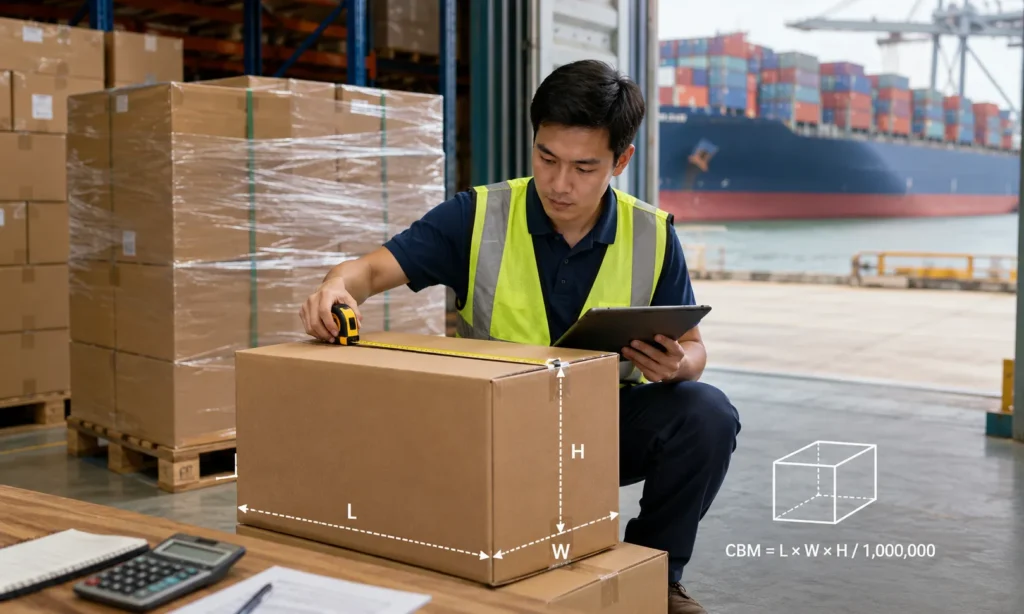
To use a CBM calculator for shipping, measure the outer carton length, width and height. Then multiply the carton volume by the number of cartons.
Basic CBM formula:
CBM = Length × Width × Height × Quantity
If the carton size is in centimeters, use this formula:
CBM = Length cm × Width cm × Height cm × Quantity ÷ 1,000,000
For example, if one carton is 60 cm × 50 cm × 40 cm:
60 × 50 × 40 ÷ 1,000,000 = 0.12 CBM
If you have 30 cartons of the same size:
0.12 CBM × 30 cartons = 3.6 CBM
For most importers, this is the fastest way to estimate shipment volume before requesting a freight quote. Still, always use the final outer carton size, not the product size. If the cargo is packed on pallets, in wooden crates or in irregular packaging, the final shipping volume may be higher.
Manual CBM Calculator Formula for Meters, Centimeters, Inches and Feet
Importers receive carton dimensions in different units. Some suppliers use centimeters, some overseas buyers use inches, and some warehouse teams may provide cubic feet. The table below gives a quick manual CBM calculator reference.
| Calculation Need | Formula or Conversion |
|---|---|
| CBM from meters | Length m × Width m × Height m × Quantity |
| CBM from centimeters | Length cm × Width cm × Height cm × Quantity ÷ 1,000,000 |
| CBM from inches | Length in × Width in × Height in × Quantity ÷ 61,024 |
| CBM from feet | Length ft × Width ft × Height ft × Quantity ÷ 35.3147 |
| CBM to CFT | 1 CBM = 35.3147 CFT |
| CFT to CBM | 1 CFT = 0.0283168 CBM |
| Air freight volumetric weight | Length cm × Width cm × Height cm × Quantity ÷ 6000, depending on service |
For example, if a carton is 24 inches × 20 inches × 16 inches:
24 × 20 × 16 ÷ 61,024 = 0.126 CBM
If you are not sure about the measurement unit, send the original carton size to your freight forwarder. Do not convert numbers if you are not confident. A small unit mistake can change the shipping quote significantly.
What Does CBM Mean in Shipping?
CBM means cubic meter. It measures cargo volume, not cargo weight. In freight shipping, CBM tells a forwarder how much space the shipment may occupy in a container, aircraft, warehouse, truck or final delivery network.
This matters because international freight is not only about weight. A shipment can be light but bulky. Foam products, display stands, plastic goods, furniture, empty packaging, toys, textiles and many e-commerce products may not weigh much, but they take a lot of space.
On the other hand, metal parts, machinery accessories, tools, hardware and spare parts can be heavy but compact. These products may have low CBM but high gross weight.
That is why a freight forwarder usually asks for both shipment volume and shipment weight. CBM helps estimate space. Gross weight helps estimate handling, trucking, air freight chargeable weight and customs-related risk.
How to Calculate CBM for One Carton
To calculate CBM for one carton, measure the outer carton length, width and height. Always use the final packed carton size, not the product size inside the carton.
For example:
- Carton length: 60 cm
- Carton width: 50 cm
- Carton height: 40 cm
Formula:
60 × 50 × 40 ÷ 1,000,000 = 0.12 CBM
So one carton is 0.12 CBM.
If your supplier gives the size in meters, the formula is simpler:
0.6 × 0.5 × 0.4 = 0.12 CBM
Both formulas give the same result.
Importers often make mistakes when they use product size instead of carton size. A product may be 50 cm long, but the outer carton may be 60 cm after adding foam, corner protection, inner packaging and outer packaging. Freight forwarders quote based on the final shipping size.
How to Calculate Total CBM for Multiple Cartons
To calculate total CBM for multiple cartons, first calculate the CBM of one carton. Then multiply it by the number of cartons.
Total CBM formula:
Total CBM = Single Carton CBM × Number of Cartons
Example:
- One carton size: 60 cm × 50 cm × 40 cm
- Single carton volume: 0.12 CBM
- Total carton quantity: 50 cartons
Calculation:
0.12 CBM × 50 cartons = 6 CBM
So the total shipment volume is 6 CBM.
If the shipment has different carton sizes, calculate each size group separately. Then add them together.
Example:
- 20 cartons at 0.08 CBM each = 1.6 CBM
- 15 cartons at 0.12 CBM each = 1.8 CBM
- 10 cartons at 0.2 CBM each = 2 CBM
Total CBM:
1.6 + 1.8 + 2 = 5.4 CBM
This method is useful when you buy from multiple suppliers in China. However, if the goods will be palletized, crated, consolidated or repacked at a China warehouse, the final CBM may change.
CBM to CFT and CFT to CBM Conversion
CBM to CFT conversion is useful when suppliers, buyers or overseas warehouses use cubic feet instead of cubic meters. However, most international freight quotes from China use CBM because cubic meter is the common volume unit for sea freight, LCL consolidation, warehouse space and many door-to-door freight quotations.
The main conversion is simple:
1 CBM = 35.3147 CFT
And the reverse conversion is:
1 CFT = 0.0283168 CBM
For example, if a shipment is 3.6 CBM:
3.6 × 35.3147 = 127.13 CFT
If your customer gives you 100 CFT:
100 × 0.0283168 = 2.83 CBM
CBM to CFT is helpful for volume understanding, but your freight forwarder still needs carton quantity, outer carton size, gross weight, product name, pickup city and delivery address to prepare a real freight quote.
CBM vs KG: Chargeable Weight and Volumetric Weight
CBM measures volume. KG measures weight. Freight cost may depend on volume, actual weight or chargeable weight, depending on the shipping method.
Some importers hear that “1 CBM equals 167 kg.” This statement is only useful in certain air freight or volumetric weight contexts. It does not mean every 1 CBM shipment weighs 167 kg. It also does not mean sea freight always charges this way.
For air freight, a common volumetric weight method is:
Length cm × Width cm × Height cm × Quantity ÷ 6000 = Volumetric Weight in KG
Under this method, 1 CBM equals about 167 kg because:
1,000,000 ÷ 6000 = 166.67 kg
However, different airlines, express services, forwarders and DDP channels may use different volume factors, such as 5000, 6000 or other agreed rules. Therefore, the final chargeable weight should always be confirmed in the actual quote.
The key point is simple: for air freight and express, a shipment can be charged by size even when it is not heavy.
How CBM Affects Sea Freight LCL Shipping
CBM is very important for LCL sea freight from China. LCL means less than container load, so your cargo shares container space with other shipments. The carrier, co-loader or forwarder charges based on the space your cargo uses, often with weight/measure rules.
In many LCL shipments, freight is calculated by volume or weight, whichever is greater under the applicable charging rule. A common reference is 1 CBM or 1000 kg, but exact rules may vary by route, carrier, co-loader and service agreement.
For most light or medium goods, CBM is the main factor in LCL sea freight. If your shipment is 3 CBM, 6 CBM or 12 CBM, the volume strongly affects the quote.
However, CBM is not the only factor. LCL cost may also depend on port of loading in China, destination port, final delivery address, product type, gross weight, warehouse handling, customs clearance, destination charges and delivery method.
If you ask for door-to-door or DDP shipping, the forwarder needs more than CBM. You should also send the product name, HS code if available, cargo value, delivery address and whether you need customs clearance and tax handling.
How CBM Affects Air Freight and Express Shipping
Air freight and express shipping use space very differently from sea freight. Aircraft space is limited, and bulky cargo can reduce loading efficiency. Therefore, airlines and express carriers often compare actual weight with volumetric weight.
The chargeable weight is usually the higher number between:
- Actual gross weight
- Volumetric weight
Example:
- Total actual weight: 120 kg
- Total volume: 1.2 CBM
- Volumetric weight under 6000 factor: about 200 kg
In this case, the cargo may be charged as about 200 kg, not 120 kg, because the shipment is bulky.
This is why importers should not only send weight when asking for an air freight quote. If you only say “120 kg,” the quote may look cheap at first. Once the warehouse checks the carton dimensions, the final chargeable weight may increase.
Air freight from China is usually better for urgent, high-value, smaller or time-sensitive goods. If the cargo is bulky but not urgent, sea freight, railway freight, truck freight or sea DDP may be more cost-effective depending on the destination country.
How CBM Affects DDP and Door-to-Door Shipping from China
DDP shipping from China is different from basic port-to-port freight. A DDP quote may include pickup, export handling, international freight, customs clearance, duties, taxes and final delivery to the buyer’s address.
CBM affects DDP because it shows cargo volume. However, a DDP quote is not based on CBM alone.
A real DDP shipping quote may depend on product name, HS code, cargo value, carton quantity, total CBM, total gross weight, pickup city, destination country, full delivery address and whether the goods are branded, battery-powered, magnetic, liquid or regulated.
Delivery address type also matters. Amazon FBA warehouses, 3PL warehouses, business addresses and residential addresses may involve different delivery rules, appointment requirements or final-mile costs.
This is where many online CBM calculators are limited. They can calculate volume, but they cannot judge customs risk, duties, taxes, final delivery cost or route suitability.
For example, 5 CBM of plastic household goods and 5 CBM of electronic devices may need different quote logic. The CBM may be the same, but customs requirements, duty risk, handling and route options may differ.
For a destination-specific example, see our shipping from China to Mexico guide, which explains how CBM, cargo density, customs scope and the final postcode affect express, air freight, sea freight and DDP pricing.
CBM and Amazon FBA Shipping
CBM is also important for Amazon FBA shipping from China. Amazon sellers need accurate carton size, carton quantity and gross weight before planning delivery to FBA warehouses.
For FBA shipments, CBM affects sea freight or air freight quotes, DDP delivery planning, carton planning, pallet planning, truck delivery arrangement, FBA label checks and warehouse receiving preparation.
Amazon FBA shipments also need strict labeling and carton information. If the supplier changes carton size after the quote, the delivery plan may also change. If goods are palletized, the final pallet size and pallet height may affect truck delivery and warehouse receiving.
For Amazon sellers buying from Alibaba, 1688 or multiple factories, a China warehouse can help check cargo photos, labels, carton quantity and packaging before international shipping. This is especially useful when the seller cannot visit the supplier in person.
CBM does not replace Amazon’s own shipment requirements. The seller should still create the shipment plan correctly and provide FBA labels. However, CBM helps the forwarder plan the freight side more accurately.
How Many CBM Fit in a 20ft, 40ft and 40HQ Container?
Container capacity is useful when deciding whether to ship by LCL or FCL. FCL means full container load. Instead of sharing container space, your cargo uses a full 20ft, 40ft or 40HQ container.
As a general reference:
- 20ft container: about 28 CBM usable cargo space
- 40ft container: about 56–58 CBM usable cargo space
- 40HQ container: about 65–68 CBM usable cargo space
These are not guaranteed loading numbers. Actual loading volume depends on carton size, packaging shape, cargo weight, stacking ability, pallets, loading method and product safety requirements.
For example, soft cartons may not stack well. Fragile goods may need extra space. Palletized cargo usually uses more space than loose cartons. Heavy goods may reach container weight limits before the container reaches full volume.
This is why a shipment may not fully use the theoretical container volume. For accurate loading planning, send carton dimensions, weight, product details and packing photos to the forwarder.
Pallets, Oversized Cargo and Irregular Shapes
A CBM calculator works best for regular cartons. Calculation becomes more complicated when cargo is packed on pallets, in wooden crates, machinery frames, rolls, furniture packages or irregular shapes.
If cargo is palletized, the CBM should usually be calculated based on the palletized dimensions, not only the carton dimensions. The pallet length, width and height may increase the final volume.
Example:
- Carton-only volume: 4.2 CBM
- After palletizing: 5.1 CBM
The final quote may use 5.1 CBM because that is the actual space occupied after palletizing.
Oversized cargo can also create special handling needs. If the cargo is too long, too high, too heavy or difficult to stack, the forwarder may need special warehouse handling, loading equipment, truck arrangement or container planning.
Irregular cargo should be photographed before quoting. Photos help the forwarder understand whether the goods can be stacked, palletized, loaded safely or moved by forklift.
Why Supplier CBM May Be Different from Warehouse CBM
Supplier CBM is not always the final shipping CBM. This is a common issue in China freight quotes.
A supplier may calculate CBM based on product size, not outer carton size. Another supplier may provide estimated dimensions before packing. Some suppliers do not include pallet height, corner protection, wooden crates or reinforced packaging. Others may change carton quantity after production.
Common reasons supplier CBM changes include:
- The supplier used product dimensions instead of carton dimensions
- The final carton size changed after packing
- The goods were repacked at the warehouse
- The cargo was palletized after delivery
- The supplier forgot to include all cartons
- Different suppliers used different measurement methods
- Cartons arrived crushed, loose or unsuitable for export
- Warehouse measurement included the real packed dimensions
This is why VoltFreight often recommends confirming dimensions after warehouse receiving. When goods arrive at a China warehouse, the team can check carton quantity, measure cargo, take photos and confirm whether the supplier’s CBM looks accurate.
For small shipments, the difference may be minor. For larger shipments, even a 10% CBM difference can change the freight cost, especially for LCL, air freight, express or DDP shipping.
Common CBM Calculation Mistakes Importers Make
Many freight quote problems start with simple measurement mistakes. Importers can avoid most of them by checking cargo details before booking.
Common mistakes include:
- Using product size instead of outer carton size
- Forgetting to multiply by carton quantity
- Mixing centimeters, meters, inches and feet
- Using net weight instead of gross weight
- Ignoring pallet size or crate size
- Forgetting that repacking may change CBM
- Assuming air freight only charges actual weight
- Thinking a DDP quote is based only on CBM
- Sending estimated dimensions without confirming final packing
- Not telling the forwarder that goods are fragile, oversized or non-stackable
The best solution is to send clear data from the beginning. Provide carton size, carton quantity, total gross weight, product name, pickup city in China and destination address. If the supplier has not packed the goods yet, tell the forwarder that the dimensions are estimated.
For more accurate quotes, ask the supplier or warehouse to provide photos of packed cartons with labels and shipping marks. Photos reduce misunderstanding and help the forwarder review whether the packing is suitable for the selected shipping method.
Practical Cases: How CBM Changes Freight Quotes
Case 1: Low Weight but High Air Freight Chargeable Weight
In daily freight quote work, importers often estimate shipping cost based only on gross weight. However, bulky cargo can change the final quote because air freight and express services may charge by volumetric weight.
For example, a buyer prepared to ship lightweight promotional display products from China to an overseas business address. The total gross weight was around 300 kg, so the buyer first expected air freight to be affordable.
After checking the packed carton dimensions, the shipment reached about 4.8 CBM. The cargo was not heavy, but it took up a large amount of space. Under the air freight volumetric weight calculation, the chargeable weight became much higher than the actual gross weight.
If the quote had been based only on 300 kg, the buyer would have received a misleading estimate. After reviewing both CBM and gross weight, the shipping plan was compared again. Because the cargo was not extremely urgent, sea freight LCL or sea DDP door delivery became a more practical option.
Case 2: Supplier Dimensions Changed After Final Packing
Another common situation happens when suppliers provide product dimensions or estimated carton dimensions before the goods are finally packed. The buyer may think the shipment is smaller than it really is, but the final packed cargo becomes larger after foam, inner boxes, corner protection, wooden crates or pallets are added.
In one typical warehouse review, the supplier first provided estimated carton data before packing. After the goods arrived at the China warehouse, the actual carton size was larger than the first estimate. The total CBM increased, and the freight quote needed to be adjusted before booking.
This kind of case is common when importers buy from multiple suppliers, Alibaba sellers or 1688 suppliers. Checking the final packed dimensions before shipment helps avoid quote changes, wrong route selection and unexpected shipping cost.
The lesson is simple: supplier dimensions are useful for an initial estimate, but final warehouse measurements are more reliable for booking. When the cargo reaches a China warehouse, carton photos, measurement checks and weight confirmation can make the freight quote more accurate.
What to Send VoltFreight for an Accurate Freight Quote
A CBM calculator can estimate volume, but a freight forwarder still needs full shipment details to recommend the right shipping method. Before asking for a quote from China, prepare the following information:
- Product name and material
- Supplier city or pickup address in China
- Carton quantity
- Outer carton size
- Gross weight per carton or total gross weight
- Total CBM if already calculated
- Product value and HS code if available
- Photos of packed cartons if available
- Destination country and full delivery address
- Delivery address type: business, residential, Amazon FBA or 3PL warehouse
- Preferred shipping method: sea freight, air freight, express, DDP or door-to-door delivery
- Whether the goods are branded, battery-powered, fragile, magnetic, liquid or regulated
These details help VoltFreight review whether sea freight, air freight, express, DDP or FBA delivery is more suitable. They also reduce quote changes after warehouse receiving.
Why Choose VoltFreight for CBM Review and Freight Quotes?
VoltFreight helps importers calculate CBM, review cargo dimensions and compare shipping options from China. We do not only ask for volume. We check how the cargo details affect the full shipping plan.
Our team can review carton quantity, outer carton dimensions, total CBM, gross weight, volumetric weight for air freight or express, cargo photos, packaging condition, pallet planning and delivery address type.
VoltFreight can also help with China warehouse receiving, cargo photos, carton checks, consolidation, inspection support, freight insurance review, customs preparation and final delivery planning.
If your supplier only gives estimated dimensions, you can still send them for an initial quote. After the goods arrive at the warehouse, VoltFreight can help confirm the final packed size and adjust the quote if needed.
This process helps importers avoid surprise cost changes and choose a more suitable shipping method before the cargo leaves China.
Send Your Carton Size and Weight to Get a Freight Quote
Related China Shipping Guides
Use these related guides to plan the full process from supplier order to shipping from China:
- China Warehouse Service for US Importers
- China Inspection Service Before Shipping
- Shipping from Alibaba to USA
- 1688 Shipping to USA
- China to USA Shipping Cost
- Sea Freight from China to USA
- Air Freight from China to USA
- DDP Shipping from China to USA
- Freight Forwarder China to USA Amazon FBA
- Shipping from China to the USA
FAQ About CBM Calculator for Shipping from China
What is a CBM Calculator?
A CBM Calculator helps calculate cargo volume in cubic meters. Importers use it to estimate how much space cartons, pallets or crates may take before asking for a sea freight, air freight, DDP, FBA or door-to-door shipping quote from China.
How do I calculate CBM?
To calculate CBM, multiply length, width and height in meters. If the dimensions are in centimeters, use length cm × width cm × height cm × quantity ÷ 1,000,000. Always use the outer carton size, not the product size.
How do I convert CBM to CFT?
To convert CBM to CFT, multiply CBM by 35.3147. For example, 3 CBM equals about 105.94 CFT. For most freight quotes from China, CBM is more commonly used than CFT.
Is CBM used for air freight?
Yes. CBM can affect air freight because airlines and forwarders calculate volumetric weight. Air freight usually compares actual weight with volumetric weight and charges based on the higher number.
Why does my freight forwarder need carton dimensions?
Your freight forwarder needs carton dimensions to calculate CBM, estimate chargeable weight, plan warehouse handling, compare shipping methods and provide a more accurate freight quote from China.
Can VoltFreight calculate CBM and quote shipping from China?
Yes. VoltFreight can review carton quantity, carton size, gross weight, product details, pickup city and destination address to calculate CBM and recommend sea freight, air freight, DDP, express or door-to-door shipping options.
Conclusion
A CBM Calculator helps importers understand cargo volume before asking for a freight quote from China. The basic formula is simple: length × width × height × quantity. However, real freight pricing is not always simple because shipping cost may also depend on gross weight, volumetric weight, product type, pallets, packaging, customs requirements and final delivery address.
CBM is especially important for LCL sea freight, container planning, DDP shipping, Amazon FBA delivery and bulky cargo. For air freight and express, CBM can affect volumetric weight and chargeable weight. Therefore, importers should send both dimensions and weight before comparing freight options.
To get a more accurate quote, send your carton quantity, outer carton size, total gross weight, product name, supplier city, destination country, delivery address and preferred shipping method. If the goods are not packed yet, send estimated dimensions first and confirm final packing later.
VoltFreight can help calculate CBM, review shipping volume, check cargo photos, compare freight methods and arrange shipping from China by sea, air, express, DDP or door-to-door delivery.
Contact VoltFreight for a CBM Review and Freight Quote from China
Useful Official Sources
- Trade.gov: Know Your Incoterms
- Amazon Seller Central: Packaging and Prep Requirements
- Amazon Seller Central: Shipping Label Requirements
Important note: CBM formulas are useful for estimating shipment volume, but final freight quotes depend on actual packed dimensions, gross weight, product details, destination country, shipping route, carrier rules, warehouse handling, customs requirements and final delivery service. Air freight, express, LCL, FCL and DDP channels may use different calculation rules, so the final quote should always be confirmed before shipment.