For most China imports, FOB suits one export-ready supplier shipping by sea, while EXW or FCA often works better for factory pickup and multi-supplier consolidation. DAP may suit importers that can handle destination customs and taxes, whereas a carefully reviewed DDP arrangement can provide a broader door-delivery scope when the import structure is legally workable.
However, no Incoterm is automatically the cheapest or safest choice. The right term depends on the supplier’s export capability, the transport mode, the named place or port, the buyer’s customs position and the exact services included in the quotation. Therefore, importers should compare the complete landed-cost scope instead of accepting the lowest product price.
This guide explains the current Incoterms for shipping from China, including EXW, FCA, FOB, CFR, CIF, DAP, DPU and DDP. It also shows where cost, responsibility and cargo risk change during an international shipment.
Quick Answer: Which Incoterm Should You Choose When Importing from China?
Start with the way you purchase and ship the goods. Then check whether the supplier can complete China export formalities and whether your business can handle import customs at the destination.
- One export-ready supplier and one sea shipment: compare FOB with the supplier’s complete EXW price. FOB is often easier because the supplier manages the agreed China-side delivery and export clearance.
- Several suppliers or warehouse consolidation: EXW or FCA may give the buyer and freight forwarder better control over pickup, receiving, inspection and consolidation.
- Supplier arranges freight to the destination port: CFR or CIF may apply. Nevertheless, the buyer normally still handles destination charges, import customs, duties and inland delivery.
- Buyer can complete destination import clearance: DAP may provide door delivery while leaving import formalities and taxes with the buyer.
- Buyer requests a broader door-delivery scope: reviewed DDP may be suitable when the seller or its appointed party can legally complete import formalities and account for duties and taxes.
- Seller must deliver and unload at destination: DPU may fit, provided the seller can safely arrange unloading at the named place.
In practice, the lowest supplier quotation may not create the lowest final cost. For example, an EXW price can look cheaper than FOB, but the buyer must still add factory pickup, China domestic transport, warehouse handling, export arrangements and origin charges.
If you already have a supplier quotation, send VoltFreight the quoted Incoterm, complete pickup address, cargo details and destination through our freight quote form. We can review which logistics stages are included before you confirm the purchase order.
What Incoterms Control—and What They Do Not Control
Incoterms are standardized trade rules used in contracts for the sale of goods. They help the seller and buyer describe where delivery occurs and how they divide transport-related obligations.
What Incoterms normally define
- Where the seller delivers the goods
- Where cargo risk transfers from seller to buyer
- Which party arranges the main transport
- Which party pays the transport costs assigned by the selected rule
- Who handles export customs formalities
- Who handles import customs formalities
- Whether the seller or buyer pays import duties and taxes
- Whether the seller has an insurance obligation under the selected rule
What Incoterms do not automatically decide
Incoterms do not replace the complete sales contract. They do not automatically determine product ownership, payment timing, product quality, warranty rights, customs classification or regulatory compliance. Likewise, they do not guarantee a shipping time or confirm that the destination country will accept the goods.
In addition, an Incoterm does not correct an unclear freight quotation. A document that only says “FOB China” or “DDP door to door” still lacks essential detail. The contract and quotation should name the exact factory, warehouse, port, airport or delivery address and state the applicable Incoterms version.
A freight forwarder also plays a different role from the seller or buyer. Incoterms govern responsibilities within the sales contract. Meanwhile, a freight forwarder performs the logistics services requested by one party. Therefore, a forwarder’s door-to-door quotation does not automatically change the Incoterm agreed between the buyer and supplier.
Incoterms 2020 at a Glance
The current ICC Incoterms rules contain 11 three-letter terms. Seven rules can apply to any mode or a combination of transport modes. By contrast, four rules apply specifically to sea and inland waterway transport.
| Incoterm | Transport Mode | Main Delivery Point | Import Clearance | Typical China Import Use |
|---|---|---|---|---|
| EXW | Any mode | Named seller premises or another named place | Buyer | Factory pickup and buyer-controlled consolidation |
| FCA | Any mode | Named carrier handover place | Buyer | Export-cleared handover for air, sea, rail or truck freight |
| CPT | Any mode | Delivery to first carrier; seller pays carriage to named destination | Buyer | Seller-arranged main carriage without a seller insurance obligation |
| CIP | Any mode | Delivery to first carrier; seller pays carriage and insurance | Buyer | Multimodal transport with seller-arranged insurance |
| DAP | Any mode | Named destination, ready for unloading | Buyer | Destination delivery where buyer handles import formalities |
| DPU | Any mode | Named destination after unloading | Buyer | Project, terminal or site delivery that includes unloading |
| DDP | Any mode | Named destination, import-cleared and ready for unloading | Seller | Reviewed import-and-delivery scope where legally workable |
| FAS | Sea or inland waterway | Alongside the nominated vessel | Buyer | Specialized bulk, breakbulk or project cargo |
| FOB | Sea or inland waterway | On board the nominated vessel at origin | Buyer | Regular ocean freight from an export-ready supplier |
| CFR | Sea or inland waterway | On board at origin; seller pays freight to destination port | Buyer | Supplier-arranged ocean freight without seller-provided insurance |
| CIF | Sea or inland waterway | On board at origin; seller pays freight and insurance | Buyer | Supplier-arranged ocean freight and required insurance |
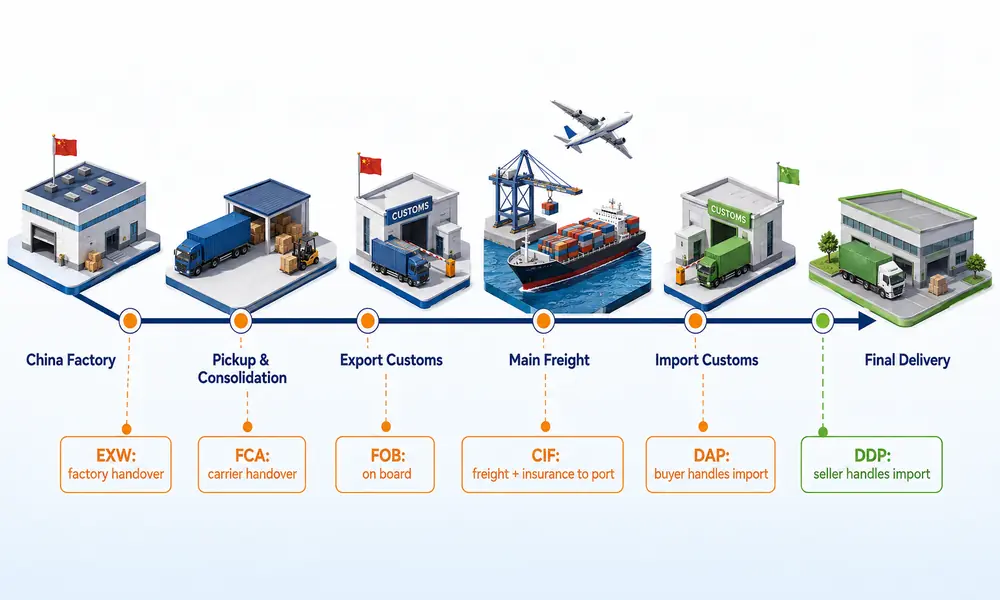
Rules for any transport mode
EXW, FCA, CPT, CIP, DAP, DPU and DDP can support air, sea, rail, road or multimodal movements. However, the parties must still identify a precise named place. For example, “FCA Shenzhen” may remain too broad if the contract does not identify the factory, warehouse, terminal or carrier facility where delivery occurs.
Rules for sea and inland waterway transport
FAS, FOB, CFR and CIF relate to vessel-based delivery. They should not automatically appear on every air or express quotation. Moreover, container cargo often reaches a terminal or consolidator before vessel loading. In that situation, the buyer and seller should review whether FCA describes the operational handover more accurately than FOB.
Which Incoterms Best Fit Different China Importers?
The best Incoterm depends on the importer’s operational ability. Therefore, the buyer should assess control, customs readiness and total cost before selecting a term.
First-time importers
New importers often prefer a solution that reduces the number of parties they must coordinate. DAP can work when the importer has a customs broker, tax number and ability to pay destination duties and taxes. Alternatively, reviewed DDP may reduce operational work when the import structure is compliant and the written quotation clearly identifies the included charges.
Nevertheless, first-time buyers should not accept “tax-free DDP” or an unusually low all-in price without asking who declares the goods, which value will appear on the customs entry and whether duty or tax evidence will be available.
Experienced importers
An experienced importer with a reliable forwarder may prefer EXW, FCA or FOB because these terms provide more control over routing, carrier selection and freight costs. For one export-ready supplier and a regular sea shipment, FOB is often convenient. For air freight, multimodal transport or container handover before vessel loading, FCA may better match the actual process.
Multi-supplier buyers
Importers that buy from several Chinese factories often need pickup, receiving, carton checks, storage and consolidation. In this case, separate FOB arrangements may create repeated local charges and multiple document handovers. By contrast, EXW or FCA can allow one China freight forwarder to coordinate the suppliers before one consolidated export shipment.
Amazon and e-commerce sellers
Amazon FBA sellers must separate the sales term from Amazon’s delivery requirements. An Incoterm does not cover FNSKU labels, carton labels, pallet standards, delivery appointments or Amazon warehouse compliance. Consequently, the seller needs both a clear purchasing term and a separate FBA preparation and delivery scope.
EXW, FCA and FOB: How China-Side Responsibilities Change
EXW, FCA and FOB mainly change the China-side handover. However, they do not include the same loading, pickup, export or port responsibilities.
EXW: maximum buyer coordination at origin
Under EXW, the supplier makes the goods available at the named premises or another agreed place. The buyer then arranges the remaining movement. Depending on the contract, these tasks may include vehicle loading, pickup, China domestic transport, warehouse receiving, export documentation, main freight, destination customs and final delivery.
An EXW quotation must include the complete collection address. “EXW Shenzhen” is not precise enough because pickup from Bao’an, Longgang or Pingshan can create different routes and costs. In addition, the buyer should confirm which Chinese company can act as exporter and provide correct commercial documents.
FCA: seller-supported export and carrier handover
FCA often solves a practical weakness of EXW because the seller handles export clearance. The named place determines the delivery process. For example, the parties may agree on the supplier’s premises, a forwarder’s warehouse, an airport cargo terminal or another carrier handover point.
FCA can work with air, sea, rail and road freight. Therefore, it deserves consideration when suppliers use FOB language for cargo that is actually handed to a carrier before loading on a vessel.
FOB: an established sea freight term
Under FOB, the supplier delivers the goods on board the nominated vessel at the named Chinese port. The buyer normally controls and pays for the international ocean freight, destination charges, import clearance and inland delivery.
The named port matters. For instance, FOB Yantian, FOB Shekou, FOB Shanghai and FOB Ningbo describe different operating points. A broad phrase such as “FOB Shenzhen” should be clarified before the supplier delivers the cargo.
For a detailed cost and responsibility comparison, read our guide to EXW vs FOB shipping from China.
CFR and CIF: When the Supplier Arranges Ocean Freight
CFR and CIF can look convenient because the supplier arranges and pays the ocean freight to the named destination port. Nevertheless, the buyer must understand the difference between the freight payment point and the risk-transfer point.
CFR does not keep cargo risk with the seller until arrival
Under CFR, the seller delivers the goods on board the vessel at the origin port and pays the freight to the named destination port. However, cargo risk transfers when the seller delivers the goods on board at origin. Therefore, the seller may pay the ocean freight even though the buyer already carries the transit risk.
CIF adds an insurance obligation
CIF follows a similar delivery and risk structure, but the seller must also arrange the required cargo insurance. Still, the buyer should review the insured amount, coverage conditions, exclusions, claim process and policy beneficiary. The required coverage may not protect every product or every commercial risk.
Destination costs remain important
CFR and CIF generally do not make the shipment duty paid or fully delivered to the buyer’s warehouse. The importer may still face terminal handling, delivery-order fees, CFS charges, storage, inspection, customs brokerage, duties, taxes and inland transport.
As a result, a low CIF quotation can produce a high landed cost when the supplier’s destination agent applies expensive local charges. Before accepting the quote, ask for the destination agent details and a written estimate of the charges payable after arrival. If the buyer wants to control the carrier and destination cost structure, FOB may provide a clearer alternative. Our sea freight from China guide explains the additional FCL and LCL cost components.
DAP, DPU and DDP: Destination Delivery and Customs Responsibilities
DAP, DPU and DDP are destination-delivery rules. Yet they create different obligations for unloading, import customs and tax payment.
DAP: seller transports, buyer imports
Under DAP, the seller arranges transport to the named destination and presents the goods ready for unloading. Meanwhile, the buyer handles import clearance and normally pays the related duties and taxes.
DAP can suit an established importer with an EORI, VAT number, tax registration, customs broker or other destination-country requirements. It may also provide the buyer with clearer import records because the buyer completes the entry in its own name.
DPU: destination delivery after unloading
DPU is the only current Incoterm that requires the seller to deliver the goods after unloading at the named destination. Therefore, the seller should confirm that the delivery location has suitable equipment, access and safety arrangements. The buyer still handles import formalities and taxes.
DPU may be relevant for project cargo, machinery or delivery to a terminal or worksite. However, the parties must define who provides the crane, forklift, labor, appointment and site access.
DDP: the seller carries the broadest import obligation
Under formal DDP, the seller handles export, transit and import formalities, pays applicable import duties and taxes and delivers the goods to the named destination ready for unloading. This creates the seller’s broadest Incoterms obligation.
However, the parties must first confirm whether the seller can legally act as importer or appoint a compliant party in the destination country. Some countries require local registration, an importer of record, a tax number, product authorization or specific customs representation. Consequently, a foreign seller may not always be able to complete DDP exactly as expected. The ICC also discusses this issue in its guidance on choosing between DAP and DDP.
Before accepting DDP, the buyer should ask who files the import entry, which HS code and customs value will be used, whether duties and taxes are included and whether proof of import can be provided. A low all-in price should never depend on undervaluation, inaccurate descriptions or an unauthorized importer.
For a focused comparison, review DAP vs DDP shipping from China. Importers that need a service quotation can also compare our door-to-door shipping from China options.
What Happened to DDU Shipping Terms?
DDU means Delivered Duty Unpaid. Businesses still use the expression in emails and freight quotations, especially when they want delivery to a destination address while the receiver pays import duties and taxes.
However, DDU is not one of the 11 current Incoterms 2020 rules. Incoterms 2010 removed DDU and introduced DAP as one of the replacement rules. Therefore, parties preparing a current sales contract should normally use DAP rather than relying on an informal DDU description.
The wording still needs care because a commercial “DDU shipping service” may not match every formal DAP obligation. The quotation should specify the delivery address, customs broker, duty payment, tax payment, unloading and possible local charges.
Read our complete explanation of DDU shipping terms and their replacement by DAP before using DDU in a new purchase contract.
How Incoterms Change Your Freight Quote and Landed Cost
Importers should compare the same cost scope. Otherwise, a quotation with a low first price may become more expensive after origin, destination and customs charges appear.
A practical landed-cost review may include:
Product price + supplier loading + China pickup + domestic transport + export handling + origin charges + main freight + cargo insurance + destination charges + import duty + import tax + customs brokerage + final delivery + unloading or appointment charges.
EXW and FOB prices need China-side adjustments
An EXW product price often excludes pickup, loading and export coordination. By contrast, an FOB product price usually includes more China-side responsibility. Therefore, buyers should add every missing origin cost before deciding which supplier quotation is lower.
FOB and CIF provide different control
FOB normally allows the buyer to choose the main freight provider. CIF places the freight booking and required insurance with the seller. Nevertheless, neither term automatically includes import customs and delivery to the buyer’s address.
DAP and DDP separate import costs
DAP normally leaves import clearance, duties and taxes with the buyer. Formal DDP assigns these obligations to the seller. As a result, the DDP price should normally include a reviewed customs and tax structure rather than only international freight and last-mile delivery.
Even two quotations both labeled DDP may include different services. One may include customs brokerage, duty, tax, remote-area delivery and residential appointment, while another may exclude one or more of these items. Always request written inclusions and exclusions.
Three Practical China Import Scenarios
The following examples are illustrative commercial scenarios. They explain the selection process and are not fixed freight quotations.
Scenario 1: one export-ready supplier shipping by sea
A buyer orders 6 CBM of household goods from one Shenzhen supplier. The supplier regularly exports and can provide accurate invoice, packing-list and customs information. In addition, the cargo will move by LCL sea freight.
In this situation, FOB at a specific loading port may create a practical division of work. The supplier handles the agreed China-side delivery and export process, while the buyer’s forwarder controls the international freight and destination arrangements.
However, the buyer should still compare the FOB price with the supplier’s EXW price plus pickup, warehouse and export costs. FOB is not automatically cheaper, but it may reduce coordination.
Scenario 2: three suppliers require consolidation
Another importer purchases electronics in Shenzhen, packaging in Dongguan and accessories in Yiwu. The buyer needs carton checks, receiving photos, temporary storage and consolidation before export.
Requiring all three suppliers to arrange separate FOB delivery may create repeated trucking, minimum handling charges and document coordination. Therefore, EXW pickup or an agreed FCA handover can allow one forwarder to receive and combine the cargo.
Before using EXW, the buyer must confirm the exporter and declaration structure. If each supplier can complete export formalities and deliver to an agreed carrier point, FCA may provide a cleaner alternative.
Scenario 3: door delivery to an EU business
An EU company buys commercial goods from China and requests delivery to its warehouse. If the buyer has an EORI, VAT registration and customs broker, DAP may allow the seller to arrange transport while the buyer imports in its own name and keeps the related customs records.
Alternatively, the buyer may request DDP because it wants one quoted delivery scope. Before choosing it, the parties must confirm the importer of record, customs value, HS code, duty, VAT treatment and availability of import evidence.
Therefore, “door to door” alone does not answer the customs question. DAP and DDP can both reach the destination address, but they assign import obligations differently.
Common Incoterm Mistakes When Buying from Chinese Suppliers
Most Incoterm disputes start with incomplete wording or assumptions. Importers can reduce risk by avoiding the following mistakes:
- Writing only “EXW China”: the contract should include the complete named pickup location.
- Writing only “FOB Shenzhen”: identify the actual loading port, such as Yantian or Shekou.
- Using FOB for every transport mode: review FCA for air freight, courier, rail or container handover before vessel loading.
- Assuming CIF keeps risk with the seller until arrival: under CIF, risk transfers at origin even though the seller pays freight and insurance to the destination port.
- Assuming CIF includes import duty and delivery: the buyer normally still manages destination customs, taxes and inland transport.
- Assuming DAP includes import taxes: the buyer generally handles import clearance and pays the related duties and taxes.
- Accepting an unclear DDP importer: confirm who files the customs entry and whether the import arrangement complies with local rules.
- Using DDU in a current contract without clarification: use DAP where appropriate and state the current Incoterms version.
- Comparing only product prices: calculate missing origin, freight, destination, customs and delivery costs.
- Treating Incoterms as transit-time guarantees: routing, carrier schedule, customs and final delivery still affect timing.
- Ignoring unloading and delivery conditions: confirm forklift access, tail-lift needs, residential delivery, remote areas and appointments.
- Leaving the version unstated: write the named place or port followed by “Incoterms 2020” in the contract.
For wider purchasing and shipping preparation, see our guide on how to import from China.
What to Confirm Before Accepting a Supplier Quote
Ask the supplier and freight forwarder to confirm the following information in writing:
- The complete three-letter Incoterm
- The applicable Incoterms version
- The exact named factory, warehouse, port, terminal or delivery address
- Whether the supplier loads the collecting vehicle
- Which Chinese company acts as exporter
- Who prepares the commercial invoice and packing list
- Whether China export declaration and related fees are included
- Who chooses the carrier and pays the main freight
- Whether cargo insurance is included and what it covers
- Which destination terminal and local charges remain payable
- Who acts as importer of record
- Who completes import customs clearance
- Who pays customs duty, VAT, GST or other import taxes
- Whether customs, duty and tax documents will be available
- Whether final delivery includes appointment, tail lift or residential service
- Who unloads the goods at the destination
- The cargo-ready date, number of packages, weight and dimensions
- The product name, material, use, HS code and commercial value
- Whether the goods contain batteries, liquids, powders, magnets, wood or branded products
Accurate cargo information matters because the forwarder cannot compare routes or costs from an Incoterm alone. For example, air freight may use chargeable weight, while LCL sea freight may use CBM and destination minimum charges. Likewise, sensitive or regulated products may need additional documents before any DAP or DDP option can be confirmed.
Why Choose VoltFreight to Review Your Shipping Terms?
VoltFreight reviews the supplier quotation and the practical logistics chain before recommending a shipping scope. Our objective is not to recommend EXW, FOB or DDP automatically. Instead, we compare the supplier location, export capability, number of suppliers, cargo details, transport mode and destination requirements.
Depending on the shipment, our China-side support may include:
- Factory pickup in Shenzhen, Dongguan, Guangzhou, Yiwu and other Chinese cities
- Warehouse receiving and basic cargo-data checks
- Receiving photos, carton counting and measurement
- Temporary storage and multi-supplier consolidation
- Export document and shipping-mark coordination
- Air, sea, rail, truck and express route comparison
- FCL, LCL and chargeable-weight review
- DAP, DDP and door-delivery scope review
- Destination address, customs and delivery-condition checks
- Written quotation inclusions and exclusions
We can also coordinate with the supplier before pickup so that the invoice, packing list, product description and package data match the shipping plan. If export documents require further review, visit our guide to customs clearance in China. You can also learn how to evaluate a freight forwarder in China before booking.
FAQ About Incoterms for Shipping from China
Which Incoterm is best when importing from China?
There is no single best term. FOB often suits one export-ready supplier shipping by sea. EXW or FCA may work better for pickup and consolidation. DAP can suit buyers that handle import customs, while reviewed DDP may suit buyers that need a broader delivery scope and have a workable import structure.
Is EXW or FOB cheaper when buying from China?
EXW often has a lower supplier price, but it usually leaves more China-side costs with the buyer. Add pickup, loading, domestic transport, warehouse, export and origin charges before comparing it with FOB. Consequently, the lower product price may not produce the lower total cost.
Does CIF include customs duty and door delivery?
Normally, no. CIF requires the seller to arrange ocean freight and the required insurance to the named destination port. However, the buyer normally handles import customs, duties, taxes, destination charges and final inland delivery.
Is DDP always safer for the buyer?
No. DDP can reduce coordination, but only when the import structure is legal and transparent. The buyer should verify the importer of record, customs value, HS code, duty and tax treatment, product compliance and availability of import documents.
Can I still use DDU in a shipping contract?
Businesses still use DDU informally, but it is not a current Incoterms 2020 rule. DAP normally provides the modern contractual alternative for destination delivery where the buyer handles import formalities and taxes. Always state the exact named place and applicable version.
Conclusion: Compare the Complete Scope, Not Just the Lowest Quote
Incoterms for shipping from China help sellers and buyers define delivery, cost, customs and risk responsibilities. However, the three-letter term only works when the contract also identifies the named place or port and the applicable rules version.
For many China purchases, the practical shortlist includes EXW, FCA, FOB, CIF, DAP and DDP. FOB may simplify a regular sea shipment from one export-ready supplier. EXW or FCA can support pickup and consolidation. CIF lets the supplier arrange ocean freight and insurance, while DAP and DDP create different destination-import responsibilities.
Therefore, compare the complete landed-cost scope before you select a term. Check China pickup, export clearance, main freight, insurance, destination charges, import duty, tax, final delivery and unloading. In addition, confirm who will act as exporter and importer.
Send VoltFreight your supplier quotation, cargo details, China pickup address and final delivery address. We will review the practical EXW, FCA, FOB, DAP or DDP scope before you book the shipment.
Contact VoltFreight for a China freight and Incoterm review.
Important: This guide provides general logistics information and does not replace legal, customs or tax advice. Confirm the sales contract, destination import requirements and current ICC rules with qualified advisers when necessary.