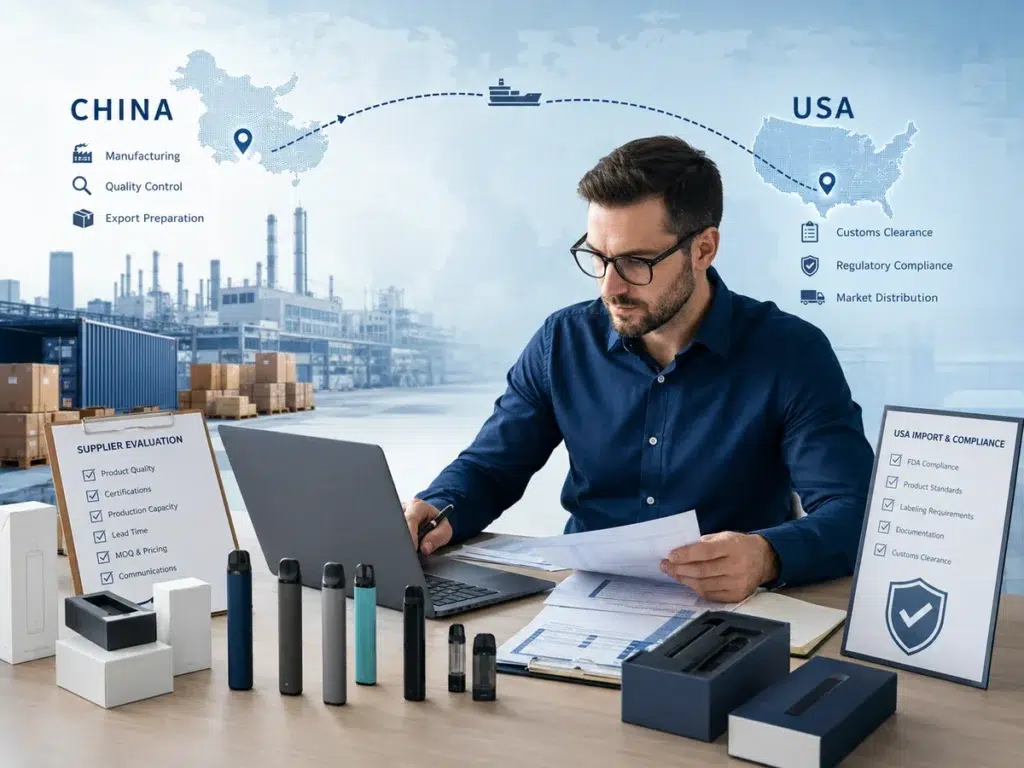
Choosing an Amazon FBA freight forwarder from China to the USA is not only a freight-rate decision. A strong provider must understand what happens before the cargo leaves China, during international transportation, at U.S. customs, inside the destination transfer network and during final delivery to the assigned Amazon fulfillment center.
A general freight forwarder may be able to move commercial cargo from China to the United States. An Amazon FBA shipment adds another layer of coordination because the supplier, seller, freight forwarder, customs parties, destination warehouse, final carrier and Amazon shipment data must remain consistent.
The forwarder may need to understand:
- Supplier pickup and China warehouse receiving
- Final carton quantity, weight and dimensions
- FBA box ID labels and shipment data
- Air-freight chargeable weight and sea-freight CBM
- Express, air, LCL, FCL and split-shipment options
- Commercial invoice and packing list requirements
- Importer of Record responsibility
- DDP inclusions, exclusions and conditional costs
- Product restrictions and customs risk
- Destination transfer and palletization
- SPD, LTL and FTL final delivery
- Amazon appointments and possible redelivery
- Cargo insurance and claims procedures
- Communication when something does not go according to plan
This guide focuses specifically on how to choose and verify the freight forwarder.
If you need the complete supplier-to-Amazon transportation process, read our main shipping from China to Amazon FBA guide.
For route-specific freight cost and final warehouse delivery factors, review our Amazon FBA shipping cost from China to USA guide.
If you are evaluating a duty-paid route, use our detailed DDP shipping from China to Amazon FBA guide.
Need an Amazon FBA freight quote from China to USA? Send VoltFreight your product name, supplier city, carton quantity, dimensions, gross weight, cargo value, Amazon shipment ID, fulfillment center code, label status and required delivery date through our contact page.
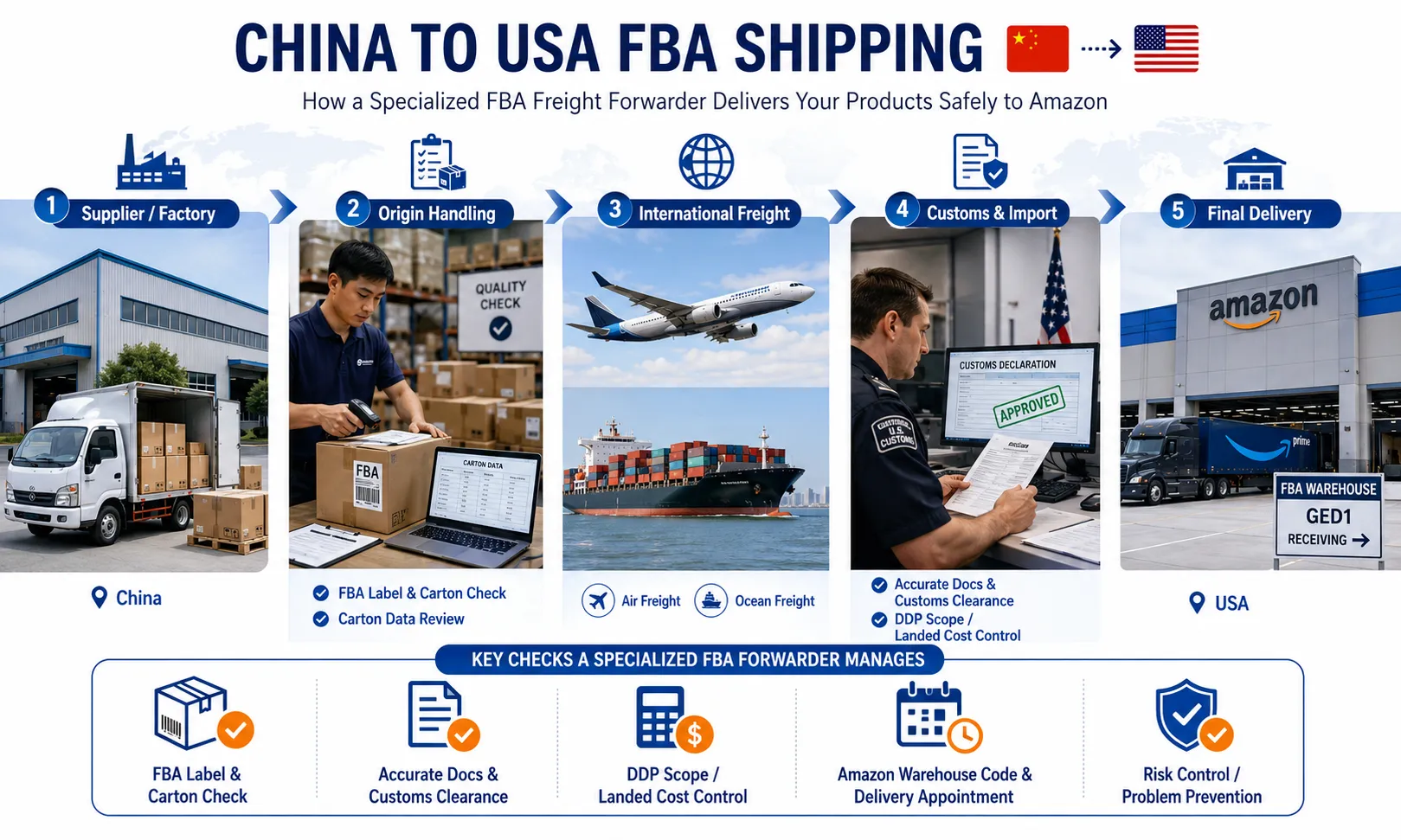
Quick Answer: What Should an Amazon FBA Freight Forwarder Actually Do?
An Amazon FBA freight forwarder coordinates the movement of inventory from a Chinese supplier, factory, warehouse or prep center to the assigned Amazon fulfillment center in the United States.
However, the forwarder’s most valuable job is not simply moving the cargo.
It is identifying problems before those problems become expensive.
For example:
- The supplier may still be using estimated carton dimensions instead of final packed dimensions.
- The seller may have sent FBA box labels from an old shipment plan.
- The commercial invoice may use a vague product description.
- A product may contain batteries that were not disclosed during quoting.
- The quote may include sea freight to a U.S. warehouse but not delivery to Amazon.
- The seller may assume Amazon will act as the Importer of Record.
- The final fulfillment center may be much farther from the destination gateway than expected.
- A DDP quotation may not clearly identify what happens during a customs examination.
A specialized FBA forwarder should identify these gaps early, explain who is responsible for correcting them and confirm the service scope in writing before pickup.
The goal is not to find a forwarder that promises there will never be a problem.
The goal is to choose one that can:
identify foreseeable problems, explain exceptions clearly and coordinate a workable solution when conditions change.
When Do You Need a Specialized Amazon FBA Freight Forwarder?
Not every Amazon shipment needs the same setup.
A seller may use a supplier, prep center, general freight forwarder, specialized FBA forwarder or a combination of these providers.
The right choice depends on how much coordination the shipment requires.
Supplier-Arranged Shipping
Direct supplier shipping can work when one experienced factory:
- Understands the current Amazon shipment plan
- Uses the correct FBA box labels
- Provides accurate carton data
- Prepares clear commercial documents
- Understands the agreed customs arrangement
- Knows how the cargo will reach the final Amazon warehouse
The risk is assuming that manufacturing experience automatically equals Amazon inbound logistics experience.
A factory may be excellent at production but still have limited knowledge of FBA warehouse codes, U.S. customs responsibility, palletization, appointment delivery or the difference between delivery to a transfer warehouse and delivery to Amazon.
Use our separate guide to decide whether shipping directly from a China supplier to Amazon FBA is suitable.
China FBA Prep Center
A prep center solves a different problem.
Prep services can include:
- Inspection
- Quantity checking
- FNSKU labeling
- Polybagging
- Bundling
- Repacking
- Carton replacement
- Receiving photos
A prep center does not automatically manage international freight, customs clearance and final Amazon delivery.
Likewise, a freight forwarder may move correctly prepared inventory without performing detailed product-level prep.
If the inventory requires China-side rework, see our Amazon FBA prep service in China.
When a Specialized FBA Forwarder Adds More Value
A specialized forwarder becomes particularly useful when:
- Several Chinese suppliers are involved
- The supplier has limited Amazon experience
- The shipment needs an air-versus-sea decision
- The seller is close to stockout
- DDP or another landed-delivery structure is being considered
- The cargo will be palletized in the United States
- The final delivery requires LTL or FTL trucking
- The product has transport or customs restrictions
- The seller wants one logistics coordinator across the route
The provider should fit the shipment.
Do not choose a specialized FBA forwarder only because the company uses “Amazon” in its marketing.
The following nine checks help determine whether the operation behind the marketing is actually suitable.
Check 1: Can They Verify FBA Labels, Cartons and Shipment Data?
Amazon-specific shipment data is one of the clearest differences between ordinary commercial freight and FBA delivery.
Before pickup, the forwarder should confirm that the physical cargo matches the information being used for freight and final delivery.
Important information includes:
- Final carton quantity
- Final gross weight
- Final carton dimensions
- SKU and carton-content information
- Amazon shipment ID
- Assigned fulfillment center code
- Complete warehouse address
- FBA box ID label files
- Pallet information when applicable
Amazon states that each box in an FBA shipment requires its own FBA box ID label generated from the shipment workflow.
The box ID is not a generic label that should be copied from one carton to another or reused from an old shipment.
Amazon also explains that the box-content information connected to the label should match the actual SKU and unit quantity inside that specific carton.
Official reference: Amazon Seller Central — Shipment Label Requirements.
Why This Matters Before the Cargo Leaves China
Imagine a supplier prepares 30 cartons and prints labels while the seller is still editing the shipment plan.
Later, Amazon changes the shipment configuration.
The physical cartons may still be perfectly packed, but the labels no longer match the active shipment.
If the problem is discovered at the supplier or China warehouse, the labels can usually be corrected before international freight begins.
If the problem is discovered after the cargo reaches the United States, the shipment may require transfer-warehouse handling, relabeling, storage or redelivery.
Labels Must Also Survive Transportation
The forwarder should check that labels are:
- Flat
- Readable
- Scannable
- Not placed across carton edges
- Not placed across openings or seams
- Not covered by stretch film in a way that prevents scanning
Old carrier labels, obsolete warehouse labels and unrelated barcodes should not interfere with the required Amazon labels.
Ask Before Booking
Ask:
Will you confirm the final carton count, FBA box labels, shipment ID and fulfillment center code before pickup or international departure?
A provider that assumes the supplier has handled every Amazon detail correctly may discover a mismatch too late.
Check 2: Do They Calculate Chargeable Weight, CBM and Freight Basis Correctly?
A reliable freight quote begins with real packed-cargo data.
The phrase:
> “My shipment is about 250 kg.”
is usually not enough for a final freight quotation.
Air Freight and Express
Air and express pricing normally compare actual gross weight with volumetric or dimensional weight.
A light product packed in large cartons can produce a chargeable weight much higher than the scale weight.
Therefore, the forwarder should request:
- Length of each carton type
- Width
- Height
- Gross weight
- Carton quantity
The provider should also tell the seller which dimensional divisor or carrier rule is being used for the quoted service.
A seller comparing two air quotations should make sure both quotes are based on the same packed dimensions and calculation method.
Sea LCL
LCL pricing depends heavily on CBM and weight/measure rules.
The lowest ocean rate per CBM does not automatically create the lowest final cost.
An LCL route may also include:
- Origin handling
- Export handling
- Destination CFS or deconsolidation
- Customs clearance
- Transfer warehouse
- Palletization
- Final Amazon delivery
Therefore, compare the complete route rather than only the ocean-freight line.
Sea FCL
FCL planning should consider:
- Container type
- Cargo CBM
- Total weight
- Carton dimensions
- Loading efficiency
- Floor-loaded or palletized cargo
- Destination devanning requirements
A 40HQ that is poorly utilized may not be the most economical choice simply because the seller has a large order.
Final Data vs Supplier Estimates
Supplier estimates are useful during early planning.
They should not automatically become final booking data.
If the factory changes:
- Carton quantity
- Units per carton
- Outer-carton size
- Pallet configuration
the forwarder should recalculate the freight.
Ask Before Booking
Ask:
Is my quote based on gross weight, volumetric weight, CBM, pallets or container space, and will you recalculate it after final packing?
A good answer should make the pricing basis easy to understand before the cargo enters the warehouse.
Check 3: Can They Compare Express, Air, Sea and Split Shipping Based on Inventory Risk?
A strong Amazon FBA forwarder should not recommend the same freight method for every seller.
The cheapest transportation method is not always the cheapest business decision.
Express Courier
Express may work for:
- Samples
- Replacement units
- A small launch quantity
- A few urgent cartons
However, a bulky shipment can become expensive because of dimensional weight.
Air Freight
Air freight may fit:
- Urgent commercial inventory
- Seasonal stock
- Higher-value inventory
- Launch quantities
- Stockout prevention
The correct question is not only:
> “How much per kilogram?”
It is also:
> “What happens to sales if this inventory arrives three weeks later?”
Sea LCL
LCL is often practical for medium-size planned shipments that are too large for economical air freight but do not fill a container.
The seller should still have enough inventory coverage to absorb:
- Origin handling time
- Sailing time
- Destination deconsolidation
- Customs processing
- Transfer warehouse handling
- Final Amazon delivery
Sea FCL
FCL becomes more attractive for larger and predictable production orders.
It also gives the seller more control over loading and cargo separation.
However, the provider should explain how the container moves after arrival.
A container reaching a U.S. port is not the same as inventory reaching Amazon.
Split Air and Sea Shipping
One of the most useful FBA strategies is to split one production order.
For example:
- A smaller urgent portion moves by air.
- The main quantity moves by sea.
This can protect the listing from stockout without paying air-freight rates for the entire production batch.
A good forwarder should recognize when the additional air cost is commercially justified.
For deeper inventory planning, read our Amazon FBA inventory replenishment guide.
Ask Before Booking
Ask:
Why are you recommending this route, and did you compare at least one faster and one lower-cost option?
A strong provider should explain the business logic behind the route instead of simply quoting whichever service is easiest for the forwarder to sell.
Check 4: Do They Understand Fulfillment Center Codes and Final Amazon Delivery?
Shipping cargo to the United States is not the same as successfully delivering it to Amazon.
The final fulfillment center affects the real logistics cost.
A warehouse code can influence:
- Destination gateway
- Transfer warehouse location
- Inland mileage
- Parcel feasibility
- Palletization
- LTL or FTL requirements
- Appointment planning
- Possible redelivery
A quotation prepared for a California fulfillment center should not automatically be reused for a Pennsylvania, Texas or New Jersey destination.
The international freight may be similar while the final inland delivery is very different.
Small Parcel Delivery
Smaller carton shipments may use an approved parcel network.
The forwarder should confirm:
- Parcel size and weight limits
- Amazon carton labels
- Carrier labels
- Tracking
- Destination coverage
LTL and FTL Delivery
Palletized cargo may use:
- LTL for partial truckloads
- FTL for larger loads
The quote should clarify:
- Who builds the pallets
- Whether pallet costs are included
- Whether carrier labels are included
- Who books the appointment
- Whether waiting time is included
- How redelivery is charged
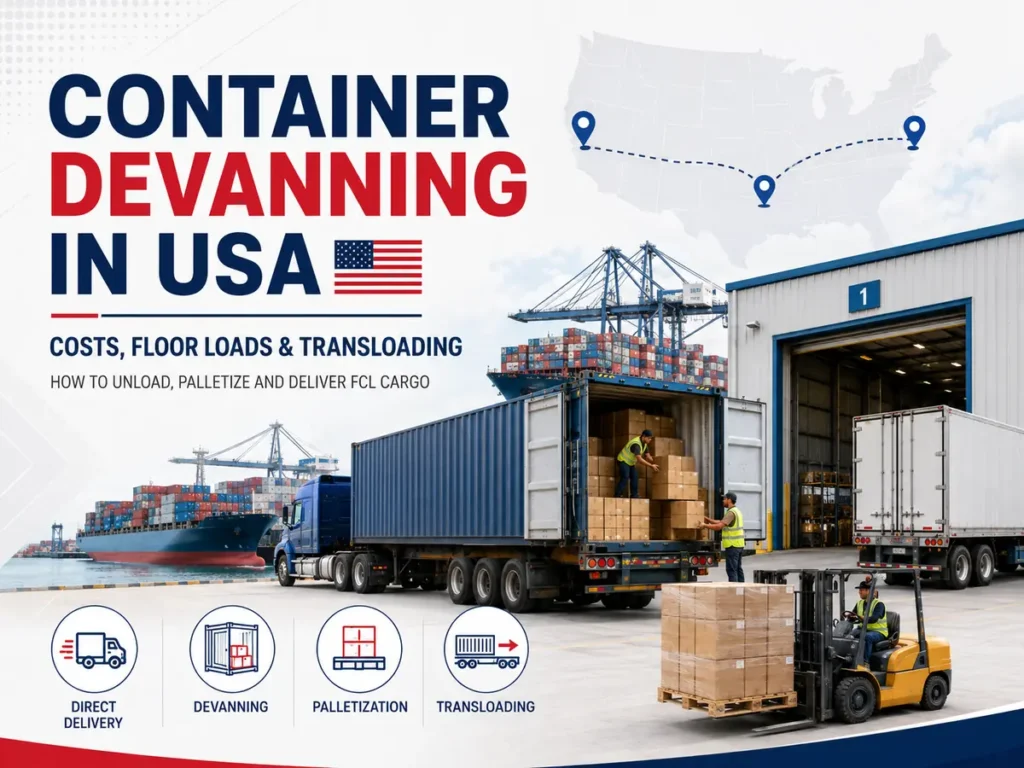
Devanning and Transfer Warehouses
Sea FCL cargo does not always move directly from the container to Amazon.
The container may first go to a U.S. warehouse for:
- Devanning
- Carton verification
- Palletization
- Carrier-label application
- LTL or FTL preparation
The same principle applies to some air and LCL routes that use a transfer facility before final delivery.
Ask Before Booking
Ask:
Is my final price based on the exact Amazon fulfillment center, and what delivery method will be used after customs clearance?
Be careful with quotations that only say:
> “Delivery to Amazon included.”
That sentence does not explain whether the route uses parcel delivery, transfer warehouse, palletization, LTL, FTL or another method.
Check 5: Can They Explain Customs Documents and Importer of Record Responsibility?
A forwarder does not need to be the customs broker in every shipment.
However, the provider should understand how the customs process fits into the agreed route.
Before departure, the seller should know:
- Who prepares the customs entry
- Who acts as the Importer of Record
- Which customs broker is involved
- Whether a customs bond is required
- Who provides the HTS classification
- Who pays duties and tariffs
- Who responds if customs requests additional information
Amazon Is Not Your Importer of Record
Amazon states that the seller or an entity appointed by the seller must act as the Importer of Record for inventory entering the United States.
Amazon does not act as the IOR for the seller’s imported inventory.
Official reference: Amazon Seller Central — Importer of Record.
This distinction matters because the Importer of Record may be responsible for:
- Entry information
- Compliance with applicable import requirements
- Duty and tax payment
- Customs records
Do not enter an international shipment assuming:
> “Amazon will handle customs when it arrives.”
Commercial Invoice and Packing List
The forwarder should request an invoice and packing list that reflect the actual shipment.
Avoid vague descriptions such as:
- Accessories
- Parts
- Goods
- Samples
when a more accurate commercial description is available.
Useful information may include:
- Product name
- Material
- Intended use
- Quantity
- Unit value
- Total value
- Country of origin
- HTS code if available
For deeper customs planning, use our USA customs clearance from China guide and import tax from China to USA guide.
Ask Before Booking
Ask:
Who will act as the Importer of Record, which customs documents do you need and who pays the duties and tariffs?
A provider should be able to explain the structure instead of answering only:
> “Customs is included.”
Check 6: Does the DDP Quote Clearly Explain What Is Included, Excluded and Conditional?
DDP is attractive because Amazon sellers often want one coordinated price from China pickup through U.S. delivery.
However, the label “DDP” is not enough to evaluate a quotation.
A serious quote should explain the service scope.
Depending on the shipment, that may include:
- China supplier pickup
- China warehouse receiving
- Origin handling
- Export declaration
- International air or sea freight
- Customs brokerage
- Normal duty and tariff scope
- Destination handling
- Deconsolidation or devanning
- Palletization
- Parcel, LTL or FTL delivery
- Amazon appointment coordination
Conditional Costs Still Exist
A responsible provider should not promise that no exception cost can ever occur.
Possible conditional costs can include:
- Customs examination
- Storage
- Waiting time
- Redelivery
- Incorrect cargo information
- Unexpected product restrictions
- Duty adjustments
- Anti-dumping or countervailing duties where applicable
- Changes in carton dimensions or weight
- Changed Amazon fulfillment center
The important distinction is whether those conditions are disclosed before booking.
DDP Does Not Make Product Information Optional
DDP does not justify:
- False product descriptions
- Incorrect cargo values
- Unsupported HTS classifications
- Hiding batteries or restricted materials
The seller should provide truthful product and commercial information regardless of the route.
Ask Before Booking
Ask:
Can you provide a written list of what the DDP quotation includes, excludes and treats as conditional?
If the answer is simply:
> “Everything is included.”
ask for the scope in writing.
Check 7: Can They Coordinate Suppliers, FBA Prep and Multi-Supplier Consolidation?
Amazon FBA shipping frequently involves more than one company in China.
The seller may work with:
- Several factories
- A trading company
- A packaging supplier
- A prep center
- A freight forwarder
A strong China-side forwarder should be able to coordinate practical details before international freight begins.
Supplier Communication
Before pickup, confirm:
- Is production complete?
- Are cartons sealed?
- Are final carton dimensions available?
- Are FBA box labels ready?
- Does the shipment ID match the active shipment?
- Are invoice and packing-list drafts available?
- Does the product require special transport review?
Multi-Supplier Consolidation
When several suppliers finish at different times, a China warehouse can:
- Receive each supplier shipment
- Count cartons
- Check outside carton condition
- Take receiving photos
- Measure cartons
- Verify gross weight
- Identify missing cartons
- Coordinate repacking where agreed
- Combine compatible cargo into one international shipment
Consolidation can reduce duplicate international shipping and give the seller a final cargo picture before booking.
For deeper information, see our China warehouse service for U.S. importers.
Prep Is Not the Same as Freight
The forwarder should be clear about what basic label verification means.
Checking that cartons carry the provided labels is not the same as performing:
- Full product inspection
- Detailed FNSKU relabeling
- Polybagging
- Bundling
- Product rework
If those services are required, the quote should identify them separately.
Ask Before Booking
Ask:
Who will communicate with my suppliers, and can you receive and consolidate cargo if several orders are ready at different times?
China-side coordination is one of the biggest practical advantages of working with a forwarder close to the supplier.
Check 8: Do They Identify Product, Transport and Compliance Risks Before Pickup?
Not every product can use every freight route.
A forwarder that gives a final quote without asking what the product is may create problems later.
Additional review can be necessary for:
- Lithium batteries
- Power banks
- Battery-powered electronics
- Wireless products
- Liquids
- Powders
- Chemicals
- Aerosols
- Cosmetics
- Food
- Food-contact products
- Toys
- Children’s products
- Medical-related products
- Textiles and footwear
- Wood products
- Branded goods
- Products subject to trade-remedy duties
These products are not automatically impossible to ship.
The point is that the forwarder should know enough to ask the next question.
Product Information to Provide
Depending on the cargo, the seller may need to provide:
- Product photos
- Supplier link
- Material
- Intended use
- Battery specifications
- MSDS or transport documents
- Brand information
- Available certificates
- Ingredient information
- Technical specifications
A good forwarder does not say:
> “Everything can ship.”
Instead, the provider says:
> “Let us review the exact product and confirm which routes are available.”
Ask Before Booking
Ask:
Does my product require transport approval, customs documentation, certificates or additional review before pickup?
The answer should be based on the actual product rather than a generic cargo category.
Check 9: Can You Verify the Company, Quote, Insurance and Exception Process?
Operational knowledge is only half of the decision.
Before sending valuable inventory or making payment, the seller should also understand exactly who the logistics provider is and how the company handles problems.
Verify the Legal Company Identity
Ask for the legal entity that is actually providing or contracting the service.
Check whether the following information is reasonably consistent:
- Company name
- Business address
- Company website and email domain
- Quotation company
- Invoice company
- Payment beneficiary
- Warehouse information
- Main contact person
This does not mean every logistics party must have the same company name.
International freight regularly involves:
- Origin forwarders
- Airlines or ocean carriers
- NVOCCs
- Customs brokers
- Destination warehouses
- Truckers
The important question is:
Can the forwarder clearly explain who is responsible for each stage?
Verify the Ocean-Freight Structure for U.S. Shipments
For China-to-USA ocean freight, ask who is acting as the NVOCC or Ocean Transportation Intermediary for the relevant ocean movement.
The U.S. Federal Maritime Commission explains that U.S.-based Ocean Freight Forwarders and NVOCCs must obtain the relevant FMC license, while non-U.S.-based NVOCCs may operate through an applicable foreign registration or licensing route when the regulatory requirements are met.
Official references:
- Federal Maritime Commission — OTI License and Foreign NVOCC Registration
- Federal Maritime Commission — NVOCC Search
Do not assume a China freight forwarder itself must always hold a U.S. FMC license.
A China-based provider may use another registered or licensed NVOCC in the transportation chain.
The professional question is:
Who is actually responsible for the ocean transportation contract and documentation?
Check Cargo Insurance Before You Need It
Do not assume cargo insurance is automatically included in the freight rate.
Ask:
- Is insurance available?
- Is it included or optional?
- What declared cargo value is used?
- Which risks are covered?
- What exclusions apply?
- What deductible applies?
- Which evidence is required for a claim?
- Who submits the claim?
- What is the claim-notification deadline?
For higher-value Amazon inventory, the seller should understand the insurance and carrier-liability position before departure.
Ask How Loss, Shortage and Damage Are Handled
A forwarder should be able to explain what happens if:
- A carton is missing
- A pallet arrives damaged
- The carrier shows delivery but Amazon has not received the inventory
- Visible damage is found at the transfer warehouse
The seller may need:
- Warehouse photos
- Carrier POD
- Damage photos
- Commercial invoice
- Packing list
- Insurance certificate
- Transport documents
The claims process should not be invented after the problem occurs.
Evaluate Communication During Exceptions
Fast WhatsApp replies before payment are useful.
They are not enough.
Ask how the provider handles:
Customs examination
Who contacts the broker? Who collects extra product information? Who reports storage or examination costs?
Amazon appointment delay
Where does the cargo wait? Who rebooks the appointment? How is storage charged?
Damaged cartons
Can they be repacked before international departure? What happens if damage is discovered in the United States?
Warehouse reassignment
Does a new Amazon FC change the final delivery price?
Supplier production delay
Does the missed cutoff create cancellation or rebooking costs?
A professional forwarder should be able to explain the process even when it cannot predict the exact cost in advance.
What Should an Accurate Quote Request Contain?
Before asking several forwarders for prices, give each provider the same shipment data.
Provide:
Product and customs information
- Product name
- Material and intended use
- Photos or supplier link
- Cargo value
- Country of origin
- HTS code if available
- Battery, liquid or sensitive-product details
Supplier and cargo information
- Supplier city
- Pickup address
- Supplier Incoterm if relevant
- Number of suppliers
- Carton quantity
- Carton dimensions
- Gross weight
- Total CBM
- Cargo-ready date
Amazon delivery information
- Shipment ID
- Fulfillment center code
- Complete warehouse address
- FBA box label files
- Carton-content information
- Required delivery deadline
Red Flags Before You Book
Be cautious when:
- The provider gives a final price without asking what the product is.
- No one asks for carton dimensions.
- No one asks which Amazon FC will receive the cargo.
- The provider says Amazon will be the importer.
- The DDP quote has no written service scope.
- The provider cannot explain who handles customs.
- The route ends at a U.S. warehouse but is described as complete Amazon delivery.
- Sensitive cargo is quoted without product information.
- The company cannot explain its ocean-freight contracting structure.
- The payment beneficiary cannot be reasonably connected to the business arrangement.
- The provider refuses to explain conditional charges.
- No one can explain what happens after cargo loss, damage or customs inspection.
A Real Seller Warning: When a DDP Quote Does Not Add Up
Real seller discussions are useful because they reveal the questions importers ask after a quotation looks too good to understand.
In an August 2026 discussion in the r/AmazonFBA community, a first-time importer described a shipment from China for which the seller estimated that U.S. import duties and tariffs alone might be around USD 3,500.
The factory, however, offered a total DDP shipping quotation of only about USD 800.
The seller asked:
- Who would pay the duties?
- When would the duties be paid?
- Could the provider explain the quote?
According to the discussion, the forwarding partner did not provide a detailed cost breakdown.
Source: Reddit — DDP Quote Missing Import Duties?
This Reddit post is an anecdotal seller discussion, not proof that the quotation was illegal or incorrectly declared.
The post does not establish:
- The correct HTS code
- The actual duty calculation
- The customs entry structure
- The legality of the provider’s route
That is exactly why the example is useful.
The seller did not have enough information to understand the difference between the expected duty and the all-in DDP quotation.
The Lesson for Amazon Sellers
When the numbers do not make sense, do not immediately assume fraud.
Also do not ignore the gap simply because the quote says “DDP.”
Ask:
- Which HTS classification is being used?
- What commercial value will be declared?
- Who is the Importer of Record?
- Who files the customs entry?
- Which duties and tariffs are included?
- Where exactly does the quoted service end?
- Is final Amazon delivery included?
- Which charges remain conditional?
If the provider cannot answer the structure clearly enough for you to understand what you are buying, obtain another independent quotation before committing the inventory.
The cheapest quote is not automatically wrong.
But an unexplained quote creates a risk that the seller cannot evaluate.
How to Score and Test an Amazon FBA Freight Forwarder Before Scaling
A useful way to compare forwarders is to score the complete service instead of ranking providers only by freight price.
The following 100-point framework is not an Amazon rule.
It is a practical evaluation model sellers can use when comparing providers.
| Evaluation Area | Weight | What to Verify |
|---|---|---|
| Amazon FBA experience | 15% | Labels, shipment IDs, FC codes, pallet and appointment understanding |
| Customs and IOR clarity | 15% | Importer structure, broker, HTS, duties, documents and customs responsibility |
| Quote transparency | 15% | Included, excluded and conditional costs are written clearly |
| Final Amazon delivery | 15% | Parcel, pallet, LTL, FTL, devanning, appointment and redelivery capability |
| China supplier coordination | 10% | Pickup, receiving, measurement, labels and multi-supplier consolidation |
| Air and sea route planning | 10% | Express, air, LCL, FCL and split-shipment comparison |
| Communication and exception handling | 10% | Customs issues, appointment delays, damaged cartons and route changes |
| Company verification | 5% | Legal entity, invoice, payment beneficiary and relevant logistics parties |
| Insurance and claims process | 5% | Coverage options, evidence, reporting process and claim responsibility |
A provider that scores highly on price but poorly on customs and final delivery may not be the best choice for Amazon FBA.
Likewise, the most expensive forwarder is not automatically the best.
The purpose of the scorecard is to make the seller compare the same capabilities across several providers.
Test the Forwarder Before Scaling
When practical, a new seller does not need to move the largest annual shipment through an untested provider on day one.
A controlled first shipment can help evaluate:
- Quote accuracy
- Final invoice vs original quotation
- Warehouse measurement accuracy
- Supplier communication
- Label verification
- Customs-document coordination
- Tracking updates
- Delivery performance
- POD availability
- Exception handling
The first shipment is not only transportation.
It is a test of the operating relationship.
Do Not Judge the Test Only by Transit Time
A shipment that arrives quickly may still reveal poor processes if:
- The final invoice is much higher than the written quote.
- The seller receives no explanation of customs responsibility.
- The provider gives no tracking updates.
- The transfer warehouse cannot explain carton shortages.
- The appointment process is unclear.
Likewise, one unavoidable customs examination does not automatically mean the forwarder performed badly.
The better question is:
> How clearly and professionally did the provider manage the exception?
Scale After the Process Becomes Predictable
Once the first shipments demonstrate:
- Reliable pricing
- Accurate cargo measurements
- Clear communication
- Consistent customs coordination
- Successful Amazon delivery
the seller can gradually move larger volumes or more suppliers through the same logistics structure.
Why Choose VoltFreight as Your Amazon FBA Freight Forwarder?
Amazon sellers do not only need another company that can book air or sea freight.
They need a logistics partner that connects the Chinese supplier with the final Amazon delivery requirement.
VoltFreight focuses on that connection.
One Point of Coordination in China
Instead of separately chasing several factories and logistics providers, sellers can use VoltFreight to coordinate:
- Supplier communication
- Pickup
- Warehouse receiving
- Carton measurement
- Basic label verification
- Consolidation
- International freight
This is particularly useful when several Chinese suppliers are involved.
Find Problems Before International Departure
A carton or label problem is usually easier to fix in China than after the shipment reaches a U.S. destination warehouse.
Our China-side workflow can help identify issues such as:
- Incorrect carton quantity
- Changed dimensions
- Damaged outer cartons
- Missing shipping marks
- Incomplete shipment information
When additional prep is needed, the scope can be reviewed before international transport.
Compare More Than One Freight Method
VoltFreight can compare suitable:
- Express courier
- Air freight
- Sea LCL
- Sea FCL
- Air-and-sea split shipments
The route recommendation should consider:
- Cargo size
- Chargeable weight
- Inventory urgency
- Product restrictions
- Final fulfillment center
- Required delivery date
Amazon-Specific Final Delivery Planning
Our job does not end simply because the cargo reaches the United States.
Depending on the shipment, final coordination may involve:
- Destination transfer
- Devanning
- Palletization
- Parcel delivery
- LTL
- FTL
- Appointment delivery
The final delivery method should be identified before the seller compares complete quotations.
Clearer Freight Scope
A useful freight quotation should explain what it covers.
VoltFreight can review:
- China pickup
- Freight basis
- Customs scope
- Destination handling
- Final delivery
- Conditional charges
This allows the seller to compare like-for-like services instead of comparing one complete quote with another quote that ends halfway through the route.
Support for Sensitive Products
If a shipment contains:
- Batteries
- Liquids
- Powders
- Branded inventory
- Other controlled or sensitive products
we review the cargo before recommending the transportation route.
The purpose is not to promise that every product can use every service.
It is to identify the realistic options before pickup.
Multi-Supplier Consolidation
If inventory comes from several factories, VoltFreight can receive compatible shipments in China before international departure.
This can help sellers:
- Reduce duplicate international freight
- Verify total carton count
- Confirm final CBM
- Coordinate one export shipment
When Should You Contact VoltFreight?
The best time is usually before the supplier finishes final packing.
Early contact gives the logistics team time to:
- Review the cargo
- Confirm what carton data is needed
- Compare freight methods
- Identify product restrictions
- Coordinate multiple suppliers
- Review the Amazon destination
Waiting until inventory is already overdue can reduce the available route choices and increase the chance that the seller must use emergency freight.
Final Checklist and FAQ Before Booking
Before choosing an Amazon FBA freight forwarder from China to the USA, use this final checklist.
Final Forwarder Checklist
Confirm:
- Do I know the legal company I am working with?
- Does the provider understand Amazon FBA rather than only general freight?
- Will the final carton quantity, weight and dimensions be verified?
- Will the FBA box labels and shipment information be checked?
- Has the provider explained the freight calculation?
- Have express, air and sea options been compared where relevant?
- Does the quote use my actual Amazon fulfillment center?
- Do I know how final delivery will occur?
- Do I know who acts as Importer of Record?
- Do I know who handles customs clearance?
- Are DDP inclusions and exclusions written clearly?
- Has the product been reviewed for restrictions?
- Can several suppliers be consolidated if needed?
- Do I understand insurance and claims options?
- Do I know what happens during customs inspection or Amazon appointment delay?
- Are conditional charges disclosed?
If a forwarder cannot answer these questions before pickup, the shipment may not be ready to book.
What does an Amazon FBA freight forwarder do?
An Amazon FBA freight forwarder coordinates transportation from Chinese suppliers to Amazon fulfillment centers.
Depending on the service, this may include supplier pickup, China warehouse receiving, air or sea freight, customs coordination, DDP review, destination transfer, palletization and final Amazon delivery.
How do I choose the best Amazon FBA freight forwarder in China?
Look for a provider that requests complete product and carton information, understands Amazon shipment data, explains customs responsibility, compares realistic transport methods and provides written inclusions, exclusions and conditional charges.
The best provider for one seller may not be the best provider for another shipment.
Should I choose the cheapest Amazon FBA freight forwarder?
Not automatically.
Compare the complete route.
A cheaper quote may still be competitive if it includes the same service scope.
However, a low headline rate is not meaningful if customs, destination handling, palletization or final Amazon delivery are excluded.
Can my China supplier ship directly to Amazon FBA?
Yes, when the supplier understands the shipment plan, labels, carton information, customs documents and final Amazon delivery process.
When these items are uncertain, a specialized freight forwarder or China consolidation warehouse can provide more control.
Is DDP always better for Amazon FBA?
No.
DDP can simplify coordination for suitable shipments, but the seller should understand the importer structure, customs scope, tariff treatment, final delivery and conditional costs.
Importer-controlled customs clearance may be preferable for some businesses.
Does Amazon act as the Importer of Record?
No.
Amazon states that the seller or an appointed entity must act as the Importer of Record for imported inventory.
Amazon fulfillment centers should not be treated as the seller’s customs importer.
Can one freight forwarder collect from several Chinese suppliers?
Yes.
A China warehouse can receive compatible shipments from multiple factories, count cartons, verify external condition, measure cargo and consolidate the goods before international transportation.
Should I buy cargo insurance for Amazon inventory?
Insurance is optional in many freight arrangements, but it is worth reviewing for higher-value inventory or shipments where the seller wants additional protection against covered cargo loss or damage.
Ask about the insurer, coverage, exclusions, declared value, deductible and claim procedure before shipment.
What information should I send for an FBA freight quote?
Send:
- Product name and photos
- Supplier address
- Carton quantity
- Carton dimensions
- Gross weight
- Total CBM
- Cargo value
- Special-product information
- Shipment ID
- Fulfillment center code
- FBA box label status
- Required delivery date
Should I test a new FBA freight forwarder with a smaller shipment first?
When commercially practical, a controlled first shipment can help the seller evaluate quote accuracy, warehouse handling, communication, customs coordination and final Amazon delivery before committing larger volumes.
What is the biggest mistake when choosing a freight forwarder?
One of the biggest mistakes is comparing only the headline freight rate.
The better comparison is:
What exactly will this provider do from supplier pickup until the inventory reaches the assigned Amazon fulfillment center?
Conclusion: Choose the Provider, Not Only the Price
A reliable Amazon FBA freight forwarder should make the shipment easier to understand before it makes the shipment cheaper.
The provider should be able to explain:
- What information is required
- How the freight is calculated
- Which route fits the inventory
- Who handles customs
- How Amazon final delivery works
- What the quotation includes
- What can still create additional cost
- What happens if something goes wrong
That level of clarity gives the seller a better basis for comparing providers and protecting inventory.
Send VoltFreight your product information, supplier location, final carton data and Amazon destination.
We can review the shipment and compare suitable express, air freight, sea LCL, sea FCL, DDP, consolidation and final-delivery options.
Request an Amazon FBA freight quote from China to USA.
Important: Freight rates, customs rules, Amazon warehouse assignments, carrier requirements and delivery conditions can change. Final cargo details, service scope and customs arrangements should be confirmed before supplier pickup.