Shipping directly to Amazon FBA from China can reduce handling time when the supplier has already prepared the products, labels, cartons and documents correctly. It can also create expensive problems when goods leave the factory before anyone confirms whether the shipment is truly ready for Amazon receiving.
The key question is not simply whether the supplier can arrange shipping. Instead, the seller should ask whether the supplier can release the cargo without creating label errors, carton-data mismatches, customs-document problems, product-compliance risks or final-delivery delays.
This guide helps Amazon sellers decide whether a China supplier can ship directly to an Amazon fulfillment center, whether a China FBA prep step is safer, whether several suppliers should first send their goods to a consolidation warehouse, or whether a U.S. 3PL should receive the inventory before Amazon.
For broader transportation planning, including express, air freight, sea freight, customs clearance and final delivery, read our shipping from China to Amazon FBA guide. For inspection, labeling and repacking, review our Amazon FBA prep service in China.
Need help checking supplier readiness? Send your supplier city, product details, carton data, label photos, shipment ID and fulfillment center code through our contact page. VoltFreight can review whether direct supplier-to-FBA shipping is suitable before pickup.
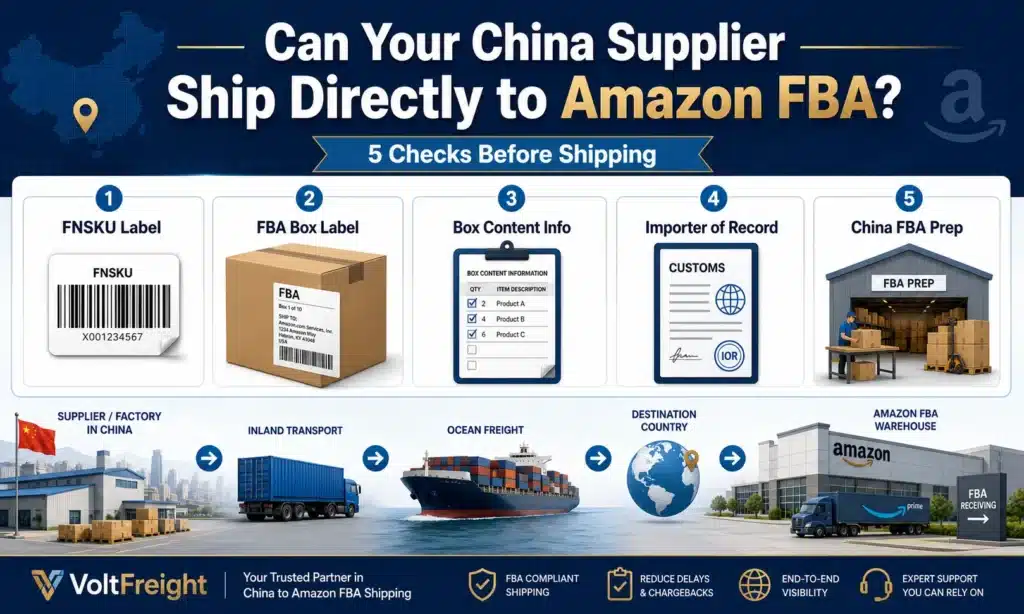
Quick Answer: Can Your China Supplier Ship Directly to Amazon FBA?
Yes. A China supplier can ship directly to Amazon FBA when the supplier fully prepares the products, cartons, labels and commercial documents before pickup and when the customs and final-delivery plan has already been confirmed.
Direct supplier-to-FBA shipping is usually more suitable when:
- The supplier has completed successful FBA shipments before
- The order is a repeat order with stable packaging
- The shipment uses simple SKU and carton configurations
- The seller has verified the product and FBA box labels
- The supplier has confirmed final carton quantity, weight and dimensions
- The commercial invoice and packing list match the actual cargo
- The product has no unresolved compliance or carrier restrictions
- The importer, customs and duty responsibilities are clear
- The final Amazon warehouse code and delivery method are confirmed
Direct shipping is riskier when the order is new, several suppliers are involved, labels have not been checked, carton data may still change or the products need inspection, relabeling, repacking or compliance review.
A supplier saying “we have shipped to Amazon before” is useful information, but it is not enough by itself. The seller should request evidence from the current order before authorizing pickup.
Direct Shipping Readiness Scorecard
Use the following scorecard before releasing cargo from the factory.
| Readiness Check | Yes or No? | What to Confirm |
|---|---|---|
| Supplier FBA experience | Yes / No | The supplier has previously prepared and released inventory for Amazon FBA |
| Repeat-order stability | Yes / No | The product, packaging and carton configuration have already been proven |
| Final product labels | Yes / No | The required labels match the correct SKU and are scannable |
| Final FBA box labels | Yes / No | Each carton has the correct label from the active Amazon shipment plan |
| Final carton data | Yes / No | Carton count, dimensions and gross weight are final after packing |
| Box-content accuracy | Yes / No | SKU quantities inside each carton match the Amazon shipment data |
| Commercial documents | Yes / No | The invoice and packing list match the physical shipment |
| Product compliance | Yes / No | Battery, electronics, textile, food-contact or other product risks have been reviewed |
| Customs responsibility | Yes / No | Importer, duty and customs-clearance responsibilities are clear |
| Amazon delivery plan | Yes / No | The shipment ID, fulfillment center code and final delivery method are confirmed |
Use the result as a planning guide:
- 8–10 Yes answers: Direct supplier-to-FBA shipping may be suitable.
- 5–7 Yes answers: Arrange a document, label and carton review before pickup.
- 0–4 Yes answers: Use a China FBA prep or consolidation warehouse before export.
The scorecard is not a customs or compliance guarantee. Product type, carrier restrictions, declared value and Amazon receiving requirements can still affect the final decision.
When Supplier-Direct Shipping Makes Sense
Direct shipping works best when the supplier has already proven that the same type of inventory can be prepared correctly.
Repeat Orders with Stable Packing
A repeat order is usually easier to ship directly because the seller already knows:
- How the supplier packs the goods
- Whether carton dimensions remain stable
- Whether labels scan correctly
- Whether the cartons survive international transport
- Whether Amazon received previous shipments without major issues
When the product, packaging and carton configuration remain unchanged, direct pickup can reduce extra warehouse handling.
Even so, repeat orders still need a final check. Factories may change cartons, product quantities, packing materials or label placement without realizing that the change affects freight or Amazon receiving.
Simple SKU and Case-Pack Orders
Single-SKU cartons and simple case-pack orders are easier to control. They reduce the risk of applying the wrong label to the wrong product or submitting incorrect carton-content information.
For example, 20 cartons containing the same SKU and the same quantity per carton are usually easier to verify than mixed cartons containing several colors, sizes or product variations.
Experienced Suppliers with Verifiable Evidence
An experienced supplier should understand that Amazon FBA preparation requires more than placing a shipping label on the outside of a box.
The supplier should be able to provide:
- Final product and carton photos
- Final carton dimensions and weight
- Correct commercial documents
- Current FBA box-label photos
- Confirmation of carton contents
Evidence from the current order matters more than a general claim that the factory has FBA experience.
When You Should Not Ship Directly
A China warehouse or FBA prep step is safer when important details remain uncertain.
First Order with a New Supplier
A first order has no proven history. Product quality, packaging strength, label placement and carton accuracy may still differ from the seller’s expectations.
Before direct release, request finished-goods photos, sealed-carton photos, label photos, final carton data and the commercial document drafts.
For products where quality or packing cannot be judged from photos, an inspection or warehouse receiving step is usually safer.
Mixed SKUs, Bundles or Variations
Mixed-SKU cartons create more risk because box-content data must match the physical contents. Bundles may require product labels, set labels, package warnings or special carton organization.
A single labeling mistake can affect several cartons. When the supplier has limited Amazon experience, a China prep center can provide stronger control.
Unverified Labels or Changing Carton Data
Do not approve pickup when:
- The supplier has not provided label photos
- The carton count is still changing
- The dimensions are estimates rather than final measurements
- The supplier plans to change packaging after the Amazon shipment is created
- The packing list does not match the shipment data
- The supplier cannot explain which label belongs to each carton
Once cargo leaves China, fixing these problems usually becomes slower and more expensive.
Sensitive or Regulated Products
Batteries, wireless devices, electronics, cosmetics, liquids, powders, food-contact products, toys, children’s goods, textiles, medical-related products and branded products may require additional freight or compliance review.
Do not release the cargo only because the supplier says it can be shipped. The freight forwarder and customs side may need product photos, material information, battery specifications, MSDS, certificates or a clearer commercial description first.
Supplier Direct, China FBA Prep, Consolidation or U.S. 3PL?
The right option depends on how much control the shipment needs.
Supplier Ships Directly to Amazon FBA
This option works best for stable repeat orders from a proven supplier.
The main advantage is fewer handling steps. Cargo can move from the factory into the international freight route without passing through another China warehouse.
The main risk is that mistakes become harder to correct after export. Direct shipping should only be approved when the labels, carton data, documents and delivery plan are already complete.
Supplier Sends Cargo to China FBA Prep
This option works better for:
- New suppliers
- Products needing FNSKU labeling
- Mixed SKUs or bundles
- Orders needing repacking or inspection
- Cartons that need label or quantity correction
Prep adds warehouse handling cost, but it can prevent more expensive corrections after the goods arrive in the United States.
Suppliers Send Cargo to a China Consolidation Warehouse
Consolidation works well when several factories contribute to one Amazon shipment or one replenishment plan.
The warehouse can receive cargo from all suppliers, count cartons, compare packing lists, check basic labels and combine the inventory into a cleaner international shipment.
Consolidation can also reduce repeated freight minimums, repeated pickup fees and inconsistent commercial documents.
For multi-supplier projects, review our China warehouse service for U.S. importers.
Supplier Sends Cargo to a U.S. 3PL First
A U.S. 3PL can make sense when the seller wants to:
- Store bulk inventory outside Amazon
- Send smaller replenishment quantities into FBA
- Reduce the risk of sending too much inventory to one fulfillment center
- Handle returns, relabeling or domestic transfers
This option adds U.S. storage and transfer costs. However, it can provide better domestic inventory control for mature sellers.
Inventory-planning options are explained further in our Amazon FBA inventory replenishment guide.
Evidence to Request Before Supplier Pickup
The direct-shipping decision should be based on evidence rather than promises.
Ask the supplier to provide the following after final packing:
- Product-label photos: Confirm the correct label is applied to the correct product or variation.
- FBA box-label photos: Check that every carton has the correct scannable label from the active shipment plan.
- Sealed-carton photos: Confirm the cartons are clean, closed correctly and ready for transport.
- Total-carton photo: Request one photo showing the complete finished shipment whenever practical.
- Final carton list: Confirm carton quantity, dimensions and gross weight after packing.
- Packing list: Check that SKU and carton quantities match the physical shipment.
- Commercial invoice draft: Review product description, quantity, value and country of origin.
- Box-content confirmation: Ensure the Amazon shipment data matches each physical carton.
- Finished-product photos: Confirm the goods and retail packaging match the order.
Photos taken during production are not enough for final release. The supplier should provide evidence after the goods are packed and labels are applied.
If the supplier refuses to provide basic evidence, direct shipping should be reconsidered.
Basic Label and Carton Checks Before Pickup
This page is not a complete FBA prep manual. However, every direct shipment needs a basic label and carton review.
Confirm that:
- The labels belong to the current Amazon shipment plan
- The correct label is applied to each carton
- Barcodes are flat and easy to scan
- Labels are not placed across carton edges or seams
- Tape, straps and plastic wrapping do not cover the barcode
- Old carrier or Amazon labels have been removed or covered correctly
- The physical carton count matches the packing list
- The dimensions and gross weight are final
- The carton contents match the shipment data
- The cartons are strong enough for international transport
A basic shipping check is not the same as detailed prep.
When the inventory needs label creation, replacement, polybagging, bundling, inspection or carton rebuilding, use a dedicated China FBA prep service.
Questions Before Paying an Alibaba Supplier
Many sellers consider the supplier’s shipping option when production is nearly complete. Before paying the balance and authorizing release, review the supplier’s readiness and shipping scope.
Ask:
- Have you prepared this product type for Amazon FBA before?
- Will you provide photos after all product and carton labels are applied?
- Are the carton quantity, dimensions and weights final?
- Does the packing list match the Amazon shipment data?
- What international shipping method will be used?
- Does the quotation include customs clearance?
- Does the price include duties and additional tariffs?
- Will the service deliver to the exact Amazon fulfillment center?
- Does the delivery method require palletization or an appointment?
- What happens if Amazon rejects or reschedules the shipment?
- Which charges remain conditional or excluded?
“Shipping to Amazon included” is not a complete service description.
The quotation should identify:
- The pickup point
- The customs and duty scope
- The exact delivery endpoint
- The final delivery method
- Possible additional charges
For broader marketplace sourcing and transportation issues, read our shipping from Alibaba to USA guide.
Sellers comparing a supplier’s rate with a forwarder-managed route can also review our Amazon FBA shipping cost from China to USA guide.
Customs, DDP and Final Amazon Delivery Scope
Direct supplier shipping still requires a clear customs and delivery plan.
Before release, confirm:
- The commercial invoice uses an accurate product description
- The declared value matches the transaction
- The product classification has been reviewed when necessary
- The importer and customs-clearance responsibilities are clear
- The supplier’s DDP quote explains which duties and services are included
- The final price is based on the assigned fulfillment center code
- The delivery method is parcel, LTL, FTL or container delivery
- Appointment responsibility is confirmed when required
Amazon fulfillment centers should not be treated as the seller’s Importer of Record.
If the supplier offers DDP, ask for a written list of included, excluded and conditional charges. A low price that stops at a U.S. warehouse is not the same as a complete door-to-Amazon quotation.
For a deeper explanation of importer responsibility, duties and appointment delivery, review our DDP shipping from China to Amazon FBA page.
If the supplier’s shipping scope is unclear, review our shipping from China to Amazon FBA guide to compare the full transport, customs and final-delivery scope.
Three Supplier-to-FBA Planning Scenarios
The following situations show how the correct decision changes from shipment to shipment.
Repeat Supplier with Stable Cartons
An Amazon seller has ordered the same product from the same Ningbo supplier several times. The product, carton size and labeling method remain unchanged. Previous shipments reached Amazon without major packaging or label issues.
Direct supplier-to-FBA shipping may be efficient.
Before pickup, the seller or forwarder should still confirm:
- Final carton count
- Final dimensions and gross weight
- Current FBA box-label photos
- Commercial invoice and packing list
- Assigned warehouse and final delivery scope
This limited review avoids unnecessary warehouse handling while confirming that the repeat order remains consistent.
First Alibaba Order with Mixed Variations
A seller places a first order with an Alibaba supplier. The supplier says it can ship directly, but the factory has limited experience with FBA box labels. The order includes several colors and mixed carton quantities.
Direct release creates unnecessary risk.
A China FBA prep step can:
- Check product variations
- Verify product and box labels
- Confirm carton-content information
- Measure the final cartons
- Correct packing or labeling before export
The additional handling cost may be lower than correcting inventory after arrival.
Several Suppliers in One Shipment
A seller buys the main product from one factory, accessories from a second supplier and printed inserts from a third supplier.
Allowing every supplier to ship separately may create:
- Three freight minimums
- Three pickup arrangements
- Several commercial document sets
- Different packing standards
- Inconsistent carton and label information
A China consolidation warehouse can receive the goods, count cartons, compare documents, check basic labels and combine the cargo into one cleaner export plan.
Common Direct-Shipping Mistakes
Most supplier-direct shipping problems begin before pickup.
Avoid:
- Approving pickup before receiving final label photos
- Using estimated carton dimensions as final booking data
- Changing carton quantities after creating the Amazon shipment
- Using labels from an old shipment plan
- Mixing SKUs without accurate carton-content information
- Accepting a supplier’s DDP quote without written scope
- Assuming Amazon will solve customs or receiving problems
- Allowing several suppliers to ship separately without comparing consolidation
- Failing to disclose batteries, liquids, powders or regulated goods
- Shipping a first order without product or packaging evidence
- Paying the supplier balance before checking final packing data
- Comparing a port or warehouse rate with a complete Amazon delivery rate
Direct shipping should remove unnecessary handling. It should not remove necessary verification.
How VoltFreight Reviews Supplier Readiness
VoltFreight helps sellers decide whether a shipment should move directly from the supplier or first pass through prep or consolidation.
Our review may include:
- Communicating with the supplier in China
- Requesting final carton and label photos
- Checking carton quantity, weight and dimensions
- Reviewing the commercial invoice and packing list
- Checking whether the product needs special freight review
- Confirming the shipment ID and fulfillment center code
- Comparing the supplier’s shipping quote with a forwarder-managed option
- Recommending direct pickup, FBA prep or warehouse consolidation
- Comparing air, sea or split-shipment options when needed
Our role is not to force every shipment through a warehouse.
When the supplier is genuinely ready, direct pickup may be the fastest and most practical option. When labels, cartons, customs or product details remain unresolved, an additional China-side check can prevent larger problems later.
Information Needed for a Supplier-Readiness Review
Send:
- Supplier name, city and pickup address
- Product name, photos, material and intended use
- Carton quantity, dimensions and gross weight
- Total CBM
- SKU and carton-content information
- Product and FBA box-label photos
- Packing list
- Commercial invoice draft
- Amazon shipment ID
- Fulfillment center code and complete address
- Cargo-ready date
- Supplier shipping quotation if available
- Any battery, liquid, cosmetic, textile or compliance details
The more complete the information, the easier it is to distinguish a real direct-shipping opportunity from a shipment that still needs preparation.
FAQ: Shipping Directly to Amazon FBA from China
Can my China or Alibaba supplier ship directly to Amazon FBA?
Yes. A supplier can ship directly when products, labels, carton data, commercial documents, customs responsibility and final Amazon delivery are all confirmed before pickup.
When should I use a China FBA prep center?
Use FBA prep when the supplier is new, products need inspection or labels, carton data is unstable, the shipment contains mixed SKUs or the packaging needs correction.
What evidence should I request before pickup?
Request product-label photos, FBA box-label photos, sealed-carton photos, final carton measurements, a packing list, commercial invoice draft and box-content confirmation.
Is direct supplier shipping always cheaper?
No. Direct shipping can reduce handling cost for a stable shipment, but mistakes may create relabeling, storage, redelivery, customs or inventory-delay costs.
Should multiple suppliers ship separately or consolidate?
Consolidation is often better when the products belong to one inventory plan. It can reduce repeated freight minimums and create more consistent labels, documents and carton data.
Request a Supplier-to-FBA Readiness Review
Direct shipping can be the right choice when the supplier and shipment are already proven.
Before authorizing pickup, confirm:
- The final product and carton labels
- The carton count, dimensions and weight
- The commercial invoice and packing list
- The customs and duty responsibility
- The fulfillment center code and final delivery method
- The included, excluded and conditional shipping charges
Send your supplier information, label photos, carton data and Amazon shipment details.
Then contact VoltFreight to check whether the cargo can ship directly to Amazon FBA or should first move through prep or consolidation in China.
Important note: Carrier requirements, customs rules, Amazon warehouse assignments and delivery conditions can change. Confirm the final route and service scope before supplier pickup.