Amazon FBA inventory replenishment from China is the process of deciding how many units should leave China, where the inventory should go first and when the next batch must become sellable inside Amazon’s fulfillment network.
A low freight rate does not automatically create a good inventory result. A seller can save money on one sea shipment and still lose more through a stockout. On the other hand, sending an entire production batch directly into FBA can create storage pressure, reduce cash-flow flexibility and leave too much stock inside Amazon before demand is proven.
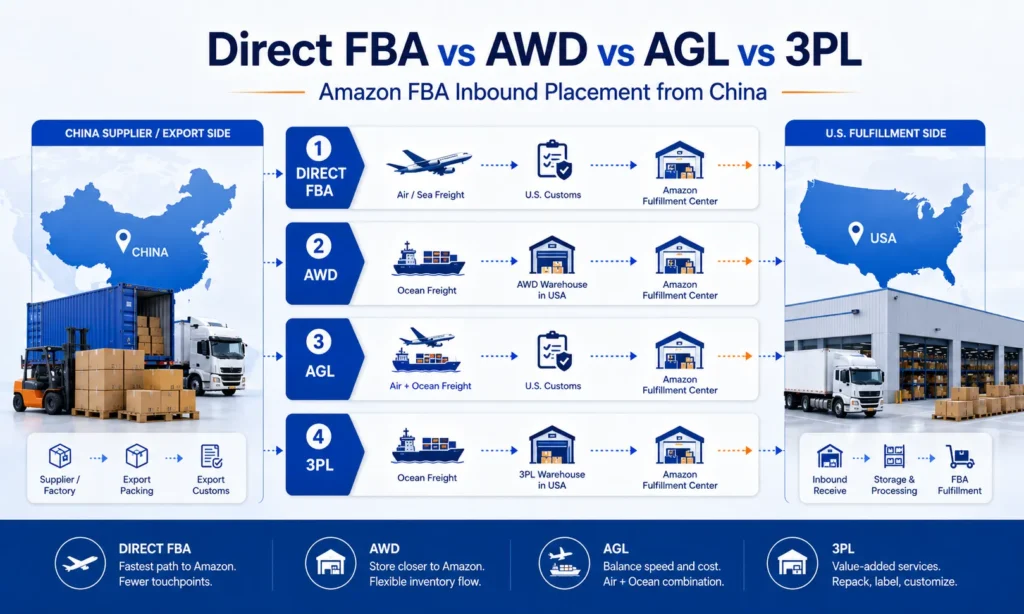
A practical replenishment plan compares three main inventory destinations:
- Direct delivery to Amazon FBA
- Bulk storage through Amazon Warehousing and Distribution
- Staged inventory through a U.S. third-party logistics warehouse
Amazon Global Logistics can transport eligible inventory from China to FBA or AWD, but it is a transportation program rather than a separate inventory destination.
This page focuses on inventory timing, reorder points, safety stock, days of cover and staged replenishment. For the complete international transport process, customs clearance and final Amazon delivery, read our shipping from China to Amazon FBA guide.
Need help planning your next replenishment? Send VoltFreight your current sellable inventory, average sales, production completion date, carton data, supplier city and target restock date through our contact page. We can compare Direct FBA, AWD, a U.S. 3PL and staged air-and-sea replenishment.
Quick Answer: How Should You Replenish Amazon FBA from China?
Use Direct FBA when inventory is needed soon and the seller wants the units available for customer orders with as few storage stages as possible.
Use Amazon AWD when a mature SKU has predictable demand and the seller wants to hold a larger quantity upstream of FBA inside Amazon’s supply-chain network.
Use a U.S. 3PL when the seller needs independent inventory control, multi-channel fulfillment, domestic relabeling or smaller staged releases into FBA.
In many cases, the best plan is not one destination. A seller may send urgent inventory directly to FBA by air, move the main production quantity by sea to FBA or AWD and hold reserve stock at AWD or a U.S. 3PL.
Before choosing the destination, calculate:
- Average daily sales
- Current sellable inventory
- Days of cover
- Production lead time
- End-to-end logistics lead time
- Amazon receiving buffer
- Safety stock
Direct FBA vs Amazon AWD vs U.S. 3PL
Each destination solves a different inventory problem.
| Decision Factor | Direct Amazon FBA | Amazon AWD | U.S. 3PL Before FBA |
|---|---|---|---|
| Best use | Near-term sellable inventory and urgent replenishment | Bulk Amazon-focused inventory and repeat replenishment | Independent reserve inventory and staged domestic release |
| Best SKU stage | Launch quantity, urgent stock or proven fast seller | Mature SKU with predictable demand | New, seasonal, uncertain or multi-channel SKU |
| Inventory control | Lower after Amazon receives the units | Managed within Amazon’s upstream network | Higher seller control through an independent warehouse |
| Replenishment method | Requires another inbound shipment when inventory falls | Can replenish eligible FBA inventory from upstream AWD stock | Seller instructs the 3PL to release domestic batches |
| Multi-channel flexibility | Mainly intended for Amazon fulfillment | Can support Amazon and eligible non-Amazon distribution workflows | Can support Amazon, Shopify, Walmart, wholesale and other channels |
| Main cost risk | FBA storage pressure and excess inventory | Storage, processing and transportation charges under current program terms | Receiving, storage, labeling and domestic transfer charges |
| Main operational risk | Too much inventory enters FBA before demand is confirmed | Product eligibility or program workflow may not fit the SKU | Poor 3PL service can delay domestic replenishment |
The correct destination should be chosen SKU by SKU. A mature seller may still use a U.S. 3PL for a new product, while a small seller may send a proven fast-moving SKU directly to FBA.
Inventory Replenishment vs FBA Inbound Placement
Inventory replenishment and FBA inbound placement are related, but they answer different questions.
Inventory replenishment answers:
- How many units should be produced or released?
- When should the next batch leave China?
- How much inventory should enter FBA now?
- Where should reserve inventory stay?
FBA inbound placement concerns how an inbound FBA shipment is distributed across Amazon’s fulfillment network and which placement option or fee may apply.
Amazon states that the FBA inbound placement service fee depends on factors such as product size, shipping weight and inbound locations. Sellers should check the available options and estimated fees in Seller Central when creating the shipment plan.
Review the current Amazon FBA inbound placement service fee guidance before booking.
A replenishment plan should account for placement costs, but placement fees should not determine the entire inventory strategy. Stockout risk, FBA storage, cash flow and demand uncertainty may be more important.
Six Numbers You Need Before Planning Replenishment
A freight quotation alone cannot determine how much inventory should ship.
1. Average Daily Sales
Use a realistic sales average for the SKU.
Do not base the plan only on one unusually strong week. When demand changes by season, calculate:
- Normal daily sales
- Peak daily sales
- Promotional daily sales
For a product selling 600 units per month, a simple starting estimate is approximately 20 units per day. However, advertising campaigns, holidays and listing changes can move the real average quickly.
2. Sellable FBA Inventory
Use inventory that customers can actually buy.
Do not automatically count all units shown in the account as available. Inventory may be:
- Sellable
- Reserved
- Transferring
- Inbound
- Receiving
- Damaged or unavailable
Inbound inventory can reduce future stockout risk, but it may not protect the listing today.
3. Days of Cover
Days of cover shows how long current sellable inventory may last at the current sales rate.
Days of Cover = Sellable Inventory ÷ Average Daily Sales
Example:
1,200 sellable units ÷ 20 units per day = 60 days of cover
Days of cover should be compared with the full replenishment lead time, not only the international transit time.
4. Production Lead Time
Production lead time starts before freight booking.
Include:
- Purchase-order confirmation
- Raw-material preparation
- Manufacturing
- Quality inspection
- Rework if needed
- Final packing
A supplier quoting “25 production days” may still need several additional days for final inspection and packing.
5. End-to-End Logistics Lead Time
Include the complete path:
- Supplier pickup or China warehouse delivery
- FBA prep or consolidation when required
- Export handling
- Air or sea transportation
- Customs clearance
- Destination transfer
- Final Amazon delivery
- Amazon receiving buffer
Delivery to the fulfillment center does not always mean the units become sellable immediately.
6. Safety Stock
Safety stock protects the seller when sales rise or the replenishment takes longer than expected.
A SKU may need more safety stock when:
- Demand changes quickly
- Production is unreliable
- The product is seasonal
- The cargo has carrier restrictions
- Sea schedules are inconsistent
- Amazon receiving has been slow
Amazon also publishes general inventory management guidance for sellers. Account-level recommendations should be compared with the seller’s own production and international freight data.
How to Calculate the Reorder Point
A practical reorder point must cover production, logistics and safety stock.
Reorder Point = Average Daily Sales × Total Replenishment Lead Time + Safety Stock
Suppose:
- Average daily sales: 20 units
- Production lead time: 25 days
- Shipping, customs and delivery: 30 days
- Total replenishment lead time: 55 days
- Safety stock: 15 days of sales
The calculation is:
20 × 55 + 20 × 15 = 1,400 units
The seller should place or release the next replenishment before available inventory falls below approximately 1,400 units.
The real number may need adjustment for:
- Reserved and inbound inventory
- Seasonal demand
- Advertising plans
- Amazon receiving delays
- Purchase-order minimums
- Supplier production capacity
China Reorder Point
The China reorder point determines when the seller should place the next production order.
It includes:
- Manufacturing lead time
- China-side preparation
- International shipping
- Customs and final delivery
- Amazon receiving buffer
Domestic Release Point
The domestic release point applies when inventory is already stored in AWD or a U.S. 3PL.
The seller does not need to wait for a new production order and international shipment. Instead, the calculation focuses on:
- Current FBA inventory
- Domestic transfer time
- Amazon appointment and receiving time
- Safety stock
Separating these two reorder points helps sellers avoid releasing reserve inventory too late.
When Direct Delivery to FBA Makes Sense
Direct FBA is most suitable when the seller needs inventory available for customer orders soon.
Choose direct FBA when:
- The SKU is approaching stockout
- The shipment contains a controlled near-term quantity
- The supplier and packaging process are proven
- Labels and carton information are final
- The seller does not need domestic storage first
- The product has stable customs and compliance documents
Direct FBA does not mean that the supplier should release cargo without review.
Before pickup, confirm:
- Amazon shipment ID
- Fulfillment center code
- Final carton quantity
- Final dimensions and gross weight
- Commercial invoice and packing list
- Customs and final delivery scope
For a supplier-readiness checklist, read shipping directly to Amazon FBA from China.
Do Not Send the Entire Production Batch Automatically
A proven product does not always need every finished unit inside FBA immediately.
Compare the production quantity with:
- Expected sales during the next replenishment cycle
- FBA storage pressure
- Cash-flow needs
- Demand uncertainty
- Reserve stock requirements
The seller can send the immediate requirement to FBA and hold the balance upstream.
When Amazon AWD Makes Sense
Amazon Warehousing and Distribution is designed as a bulk storage and distribution solution.
Amazon currently states that AWD can:
- Store larger quantities of inventory upstream
- Automatically replenish eligible inventory into FBA
- Distribute inventory to Amazon and eligible non-Amazon channels
- Cover FBA inbound placement within AWD pricing rather than charging it separately
AWD may fit when:
- The seller produces inventory in larger batches
- The SKU has predictable demand
- The seller wants Amazon-managed replenishment into FBA
- The product qualifies for the program
- The production quantity exceeds the immediate FBA requirement
- The seller prefers an Amazon-connected upstream inventory pool
When AWD May Not Be the Best Choice
AWD may be less suitable when:
- The SKU is new and demand remains uncertain
- The seller wants an independent multi-channel warehouse
- The product is not eligible
- The inventory needs frequent inspection or relabeling
- The seller needs greater control over individual release quantities
Evaluate AWD as a complete inventory system. Do not compare only one storage or placement charge. Review current storage, processing, transportation, eligibility and account-specific terms.
When a U.S. 3PL Before FBA Makes Sense
A U.S. 3PL can hold reserve inventory outside Amazon and release smaller domestic batches when needed.
A 3PL may fit:
- New products with uncertain sales
- Seasonal inventory
- Multi-channel sellers
- Products that may need relabeling or inspection
- Sellers who need returns or domestic rework support
- Inventory that should enter FBA in controlled quantities
The 3PL adds storage and handling charges. However, it can reduce the risk of sending too much stock into FBA.
Questions to Ask a U.S. 3PL
Before sending a production batch, confirm:
- Receiving charges
- Monthly or daily storage rates
- Carton and pallet handling charges
- Minimum monthly fees
- Labeling and inspection capabilities
- Domestic parcel, LTL and FTL delivery options
- Amazon appointment support
- Inventory reporting
- Long-term storage and disposal terms
The seller should also check whether the 3PL can process Amazon shipment plans and label batches accurately.
Where Amazon Global Logistics Fits
Amazon Global Logistics is an international transportation program.
Amazon states that AGL can ship eligible inventory from China to FBA fulfillment centers and AWD warehouses in the United States and Europe.
AGL should not be shown as a fourth inventory destination beside Direct FBA, AWD and a U.S. 3PL.
Ask two separate questions:
- Where should the inventory go? Direct FBA, AWD or a U.S. 3PL.
- Who should transport it? AGL or an independent freight forwarder.
AGL may suit standardized eligible shipments that fit Amazon’s workflow.
An independent freight forwarder may offer more flexibility for:
- Multi-supplier pickup and consolidation
- China-side inspection and prep
- Special-product route review
- Air, sea and split-shipment comparison
- DDP and non-DDP route planning
- Delivery to an independent U.S. 3PL
Sellers comparing providers can review our guide to choosing an Amazon FBA freight forwarder in China.
Three-Layer Replenishment Strategy
A staged replenishment plan separates one production batch into quantities serving different time horizons.
Layer 1: Emergency Inventory
Send the quantity needed to prevent an immediate stockout by air directly to FBA.
The emergency quantity should cover:
- Expected sales before the sea shipment becomes sellable
- Possible air and customs delays
- Amazon receiving time
- A reasonable safety buffer
Layer 2: Main Replenishment
Move the main quantity by sea to FBA or AWD.
This layer should cover the regular sales period while protecting unit margin.
The seller should compare:
- Sea LCL or FCL cost
- Destination and final delivery
- AWD or FBA inbound costs
- Expected sales during the replenishment cycle
Detailed route cost factors are explained in our Amazon FBA shipping cost from China to USA guide.
Layer 3: Reserve Inventory
Hold reserve inventory in AWD or a U.S. 3PL.
Release the reserve when:
- FBA inventory reaches the domestic release point
- Sales increase faster than expected
- The next China production batch is delayed
- Amazon receiving conditions change
Example Air-and-Sea Split Calculation
Suppose:
- Average daily sales: 20 units
- Sea inventory becomes sellable in 30 days
- Current FBA inventory covers only 7 days
- Amazon receiving safety buffer: 7 days
The uncovered period is approximately:
30 days – 7 days + 7 safety days = 30 days
The planning air quantity is:
20 units × 30 days = 600 units
The seller may send approximately 600 units by air and move the remaining production quantity by sea.
This is a planning example, not a fixed rule. Sales volatility, carton configuration, air chargeable weight and the actual receiving buffer must be reviewed.
Build a Replenishment Calendar
A strong replenishment plan uses a recurring calendar rather than one isolated shipment.
Track:
- Purchase-order date
- Expected raw-material completion
- Expected production completion
- Inspection date
- Final packing date
- Pickup date
- Expected export date
- Estimated customs release
- Final delivery window
- Amazon receiving buffer
- Projected stockout date
Add decision deadlines:
- Latest safe order date: Last date to place production without consuming safety stock.
- Latest safe sea-shipping date: Last date the shipment can move by sea and still arrive safely.
- Air decision date: Date when the seller must decide whether emergency air freight is necessary.
- Domestic release date: Date when AWD or 3PL reserve inventory should begin moving into FBA.
- Amazon receiving deadline: Date the shipment must become available, not only arrive at the warehouse.
Update the calendar when sales, production or freight conditions change.
A strong promotion may move the projected stockout date forward by several weeks. In that case, the seller should adjust the quantity or route before the supplier completes production.
Replenishment Strategy by SKU Stage
Replenishment should be planned by SKU rather than using one rule for the entire business.
New or Unproven SKU
Protect cash and avoid excessive FBA inventory.
A reasonable plan may use:
- A controlled launch quantity in FBA
- Reserve units in China or a U.S. 3PL
- Air freight only when launch timing requires it
AWD may be premature until demand becomes more predictable.
Growing SKU
A growing product often needs a mixed system:
- Air freight for urgent gaps
- Sea freight for regular replenishment
- AWD or a 3PL for reserve stock
The seller should update the reorder point frequently because sales can change quickly.
Mature Predictable SKU
A mature SKU can use repeat production schedules, sea freight and upstream bulk storage.
AWD may suit Amazon-focused inventory. A U.S. 3PL may fit sellers who need multi-channel distribution or domestic rework.
Seasonal SKU
Seasonal products require both an arrival deadline and an exit plan.
Avoid sending the entire production quantity into FBA too early. Hold part of the inventory at a 3PL when demand remains uncertain.
Three Amazon FBA Replenishment Scenarios
Fast-Selling SKU Near Stockout
A seller has three weeks of sellable FBA inventory remaining. The supplier will complete production soon, but the sea shipment cannot become sellable before stockout.
The seller should calculate the air quantity needed to cover the gap, including Amazon receiving time.
The remaining quantity can move by sea to FBA or AWD.
The seller should compare:
- Expected sales until sea inventory becomes available
- Air-freight chargeable weight
- Safety stock
- Whether reserve inventory should go to AWD or a 3PL
Mature SKU with a Large Production Batch
A mature product has stable demand. The supplier offers a lower production cost for a larger order.
Sending the entire batch directly to FBA may create excess inventory.
A practical plan may:
- Send near-term inventory into FBA
- Move bulk reserve stock into AWD
- Use a U.S. 3PL if the product also serves non-Amazon channels
Seasonal Product with Uncertain Demand
A seasonal product may sell rapidly during a short period and slowly afterward.
The seller can send a controlled quantity to FBA and hold reserve inventory at a 3PL.
If demand exceeds the forecast, the 3PL releases domestic replenishment. If demand slows, the seller retains more options than if all inventory already sits inside FBA.
Common Replenishment Mistakes
- Waiting until inventory is almost gone: This can force expensive emergency air freight.
- Sending the entire production batch to FBA: Excess inventory ties up cash and reduces flexibility.
- Using one plan for every SKU: Products have different margins, demand patterns and lead times.
- Ignoring Amazon receiving time: Delivery does not mean immediate sellable inventory.
- Confusing AGL with an inventory destination: AGL transports inventory; FBA, AWD and 3PLs store or distribute it.
- Using estimated carton data: Incorrect CBM or chargeable weight can change the route.
- Ignoring prep and compliance delays: Label or product problems can delay release.
- Failing to update the forecast: Promotions and seasonal demand can change the reorder point quickly.
- Counting inbound units as sellable: Inbound inventory may not protect the listing yet.
- Comparing only freight rates: Storage, placement, receiving and stockout costs also matter.
How VoltFreight Supports FBA Replenishment from China
VoltFreight helps Amazon sellers connect Chinese production schedules with U.S. inventory requirements.
Our support may include:
- Supplier pickup and communication in China
- Final carton measurement and shipment-data review
- Multi-supplier consolidation
- China warehouse receiving and temporary storage
- Air and sea freight comparison
- Air-and-sea split-shipment planning
- Direct FBA, AWD and U.S. 3PL route comparison
- FBA prep coordination when cargo is not ready
- Customs and DDP scope review
- Final Amazon warehouse delivery planning
When production is complete but the inventory is not ready to leave China, our China warehouse consolidation and temporary storage service can provide a buffer before export.
For duty-paid transport, read our DDP shipping from China to Amazon FBA guide. For labeling and inspection, review our Amazon FBA prep service in China.
Information Needed for a Replenishment Review
Send:
- Product name and SKU
- Average daily or monthly sales
- Current sellable FBA inventory
- Reserved and inbound inventory
- Current days of cover
- Production lead time and completion date
- Supplier city and pickup address
- Carton quantity, dimensions and gross weight
- Total units, CBM and cargo value
- FBA, AWD or U.S. 3PL destination
- Prep and label status
- Target sellable-inventory date
- Supplier minimum order quantity
- Preferred air, sea or split-shipment plan
FAQ: Amazon FBA Inventory Replenishment from China
Should I send inventory directly to FBA or use AWD?
Direct FBA is generally better for inventory needed soon. AWD may fit larger quantities of mature, predictable products that need upstream bulk storage and Amazon-managed replenishment.
When should I use a U.S. 3PL before FBA?
Use a 3PL when you need staged replenishment, independent inventory control, multi-channel distribution, domestic relabeling or greater flexibility over when inventory enters Amazon.
How do I calculate the reorder point from China?
Multiply average daily sales by the total production and logistics lead time, then add safety stock. Include Amazon receiving time and subtract reliable inbound or reserve inventory when appropriate.
Should I split inventory between air and sea freight?
A split shipment can work when inventory may run out before a sea shipment becomes sellable. Send the calculated urgent quantity by air and move the main replenishment by sea.
Is Amazon Global Logistics the same as AWD?
No. AGL is an international transportation program. AWD is an upstream inventory storage and distribution program. AGL may transport eligible inventory from China to FBA or AWD.
Plan Your Next Amazon FBA Replenishment
A reliable replenishment plan should answer:
- How many units does FBA need now?
- Where should reserve inventory stay?
- When must the next production order begin?
- When must AWD or 3PL inventory be released?
- How much should move by air and how much by sea?
Send your sales, inventory, production and carton details.
Then contact VoltFreight to compare Direct FBA, Amazon AWD, U.S. 3PL storage, China warehouse buffering and staged air-and-sea replenishment from China.
Important note: Amazon program availability, eligibility, fees, warehouse assignments and shipment workflows can change. Confirm current account-specific requirements in Seller Central before booking inventory to FBA or AWD.