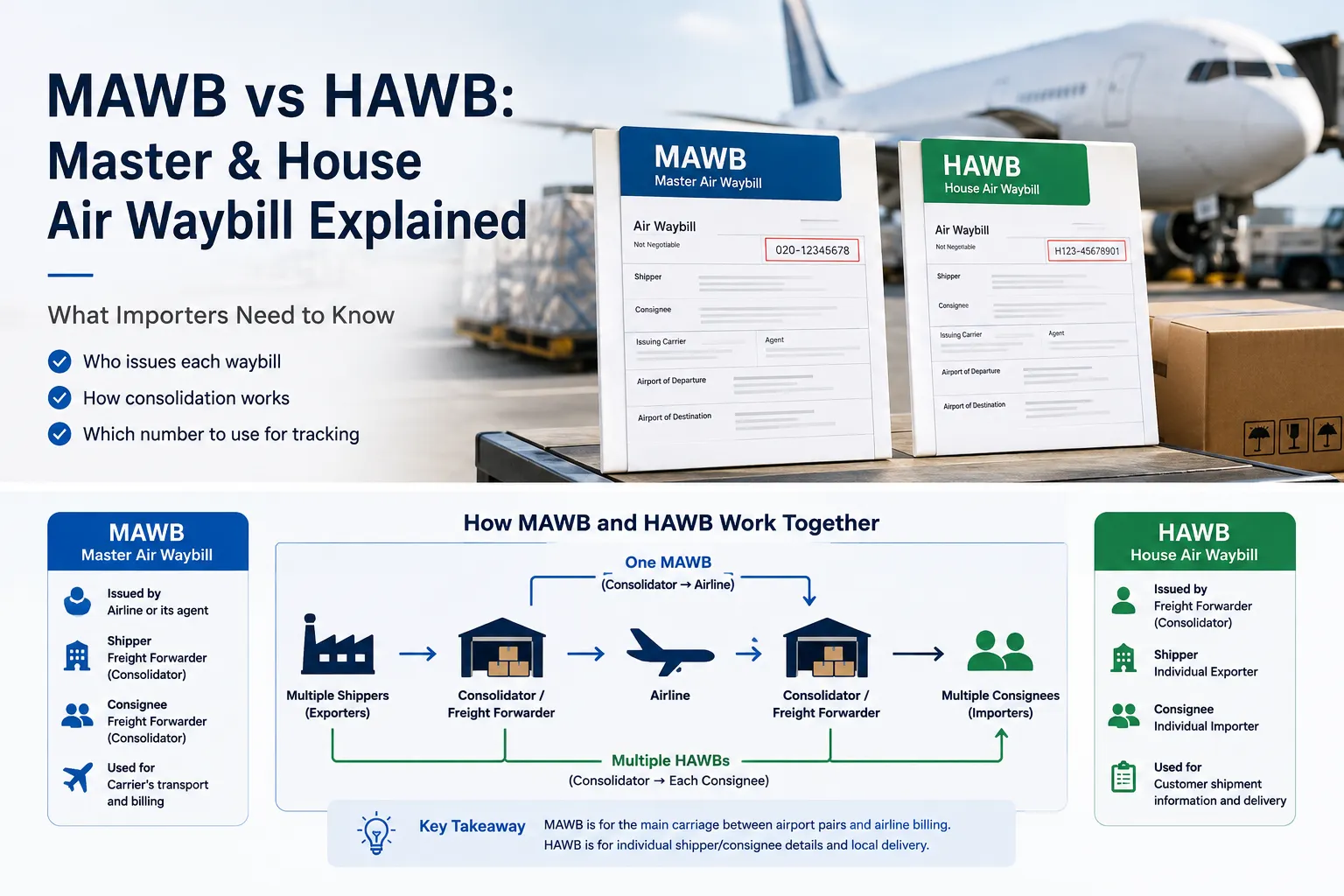
MAWB vs HAWB becomes much easier to understand once you separate the airline shipment from the individual customer shipment. In a typical consolidated air freight movement, the Master Air Waybill (MAWB) represents the shipment between the freight forwarder or consolidator and the airline. The House Air Waybill (HAWB) represents an individual shipment handled by the forwarder for its customer.
This is why an importer may receive one HAWB number from a freight forwarder while also seeing a different MAWB number connected to the airline booking. The two documents are not duplicates. They describe different levels of the same air cargo movement.
The practical questions are therefore not only “What does MAWB mean?” and “What does HAWB mean?” Importers also need to understand who issued each document, which shipper and consignee appear on it, which number works for airline tracking, how multiple HAWBs can move under one MAWB and which shipment data must remain consistent.
If you need a broader explanation of airline service, cargo acceptance, airports and transportation options, start with our air freight from China guide. This article focuses specifically on air waybill structure.
MAWB vs HAWB: Quick Answer
A Master Air Waybill is normally the carrier-level air waybill used between the airline and the party booking cargo with the airline, often a freight forwarder or consolidator.
A House Air Waybill is normally issued by a freight forwarder or consolidator for an individual customer shipment that forms part of the forwarder’s transportation arrangement.
In a typical consolidated shipment:
- The airline handles one MAWB.
- The forwarder may have several individual HAWBs underneath that MAWB.
- Each HAWB identifies a particular customer shipment.
- The MAWB represents the consolidated airline movement.
| Question | MAWB | HAWB |
|---|---|---|
| Full name | Master Air Waybill | House Air Waybill |
| Typical issuer | Airline or airline-authorized carrier system | Freight forwarder or consolidator |
| Typical relationship | Airline ↔ forwarder/consolidator | Forwarder/consolidator ↔ individual shipper/customer |
| Shipment level | Master airline movement | Individual house shipment |
| Consolidation | May cover several HAWBs | Usually identifies one individual shipment |
| Airline tracking | Usually the main airline tracking reference | May require the forwarder’s tracking system |
| Customer visibility | May or may not be provided directly to the customer | Commonly provided to the customer |
Important: This table describes a common consolidated air freight structure. Direct shipments, co-loading arrangements, neutral air waybills, destination-agent structures and local regulatory requirements can change how the parties appear on the documents.
What Is an Air Waybill?
An Air Waybill (AWB) is a core air cargo transport document. It records important information about the shipment and provides evidence of the contract of carriage between the relevant shipper and carrier.
An AWB commonly contains information such as:
- Shipper name and address
- Consignee name and address
- Issuing carrier or agent information
- Departure airport
- Destination airport
- Requested routing
- Number of packages
- Gross weight
- Chargeable weight where applicable
- Nature and quantity of goods
- Handling information
- Freight and other charge information
The International Air Transport Association describes the AWB as the document that establishes the air cargo contract of carriage between the shipper and carrier. IATA also identifies the AWB as a non-negotiable document. You can review the IATA Air Waybill guidance for the broader carrier context.
An Air Waybill Is Not the Same as an Ocean Bill of Lading
Importers familiar with sea freight sometimes assume that an AWB works like a negotiable original ocean bill of lading. It does not.
An air waybill does not normally function as a negotiable document of title. Therefore, an importer generally does not need to surrender an original AWB in the same way that some ocean shipments require control or surrender of an original bill of lading.
This difference also fits the speed of air freight. Cargo can arrive at the destination airport within days, so an air cargo system that depended on physically transferring negotiable original documents would create unnecessary delays.
What Is an e-AWB?
Air cargo has increasingly moved away from paper documentation. IATA’s electronic Air Waybill framework allows the contract-of-carriage data to move electronically rather than requiring the parties to print and archive a paper AWB for the same purpose.
This article does not attempt to become a complete e-AWB or ONE Record guide. Whether the information appears on paper or moves electronically, importers still need to understand the difference between the master and house shipment levels.
What Is a Master Air Waybill (MAWB)?
A Master Air Waybill represents the airline-level transportation arrangement. In a normal freight-forwarder consolidation, the airline issues the MAWB for the consolidated cargo booked by the forwarder or consolidator.
The MAWB connects the cargo to the actual airline movement, including the airline, origin airport, destination airport and master shipment information.
Who Normally Issues the MAWB?
The airline is the carrier behind the MAWB movement. In practice, an airline or its authorized cargo system or agent prepares the MAWB data based on the booking and shipping instructions.
In a standard consolidation, the freight forwarder or consolidator acts as the shipper at the airline level because it has combined one or more customer shipments into the cargo tendered to the airline.
Who Normally Appears on the MAWB?
In a typical consolidation:
- The MAWB shipper may be the origin freight forwarder or consolidator.
- The MAWB consignee may be the forwarder’s destination office, partner or handling agent.
This can surprise an importer who expects to see the Chinese factory as the shipper and its own company as the consignee.
That information may instead appear on the HAWB, because the HAWB represents the individual commercial shipment while the MAWB represents the consolidated airline movement.
However, do not treat this as a universal naming rule. A direct air shipment can use a different structure.
What Is a House Air Waybill (HAWB)?
A House Air Waybill is normally issued by a freight forwarder or air cargo consolidator to its customer for an individual shipment.
When the forwarder combines several customers’ cargo into one airline consolidation, each customer shipment can receive its own HAWB.
The HAWB therefore helps separate one commercial shipment from other cargo moving under the same master airline booking.
What Information Does the HAWB Identify?
Depending on the shipment structure, a HAWB commonly identifies:
- The individual exporter or shipper
- The individual importer or consignee
- Origin and destination
- Customer shipment reference
- Number of cartons or packages
- Gross weight
- Cargo description
- Handling information
- Freight terms or charges when applicable
The HAWB data should correspond with the commercial shipment behind it. Product descriptions, quantities and package details should also remain consistent with the commercial invoice and packing list.
For carton and shipment-data preparation, see our packing list for international shipping guide.
MAWB vs HAWB: What Is the Real Difference?
The most important difference is the transportation relationship represented by each document.
The MAWB looks at the shipment from the airline level.
The HAWB looks at an individual shipment from the freight forwarder’s customer level.
In other words:
MAWB = master airline movement
HAWB = individual house shipment
They Are Connected, Not Competing Documents
Importers sometimes ask which document is “the correct AWB.” In a consolidated shipment, both may be correct because they serve different levels of the same movement.
The HAWB tells the forwarder and customer which individual shipment belongs to which shipper and consignee.
The MAWB tells the airline which consolidated cargo movement it accepted for carriage.
For this reason, comparing MAWB and HAWB is not the same as choosing between two alternative shipping documents. A consolidated shipment can need both.
How Can One MAWB Cover Multiple HAWBs?
Air freight consolidation explains why two levels of waybills exist.
A freight forwarder may collect relatively small shipments from several exporters. Instead of booking every customer shipment separately with the airline, the forwarder can combine compatible cargo into a larger consolidated shipment.
Consider this simple example:
- Customer A: 8 cartons / 120 kg → HAWB A
- Customer B: 12 cartons / 180 kg → HAWB B
- Customer C: 15 cartons / 250 kg → HAWB C
The forwarder consolidates all three shipments:
Three customer shipments → three HAWBs → one consolidated airline shipment → one MAWB
At the customer level, Customer A does not need Customer B’s HAWB. Each shipment retains its own house reference.
At the airline level, the carrier handles the consolidated movement under the master air waybill.
Why Do Freight Forwarders Consolidate Cargo?
Consolidation can help forwarders combine compatible cargo, use airline capacity efficiently and manage several smaller commercial shipments under one planned air movement.
However, the cargo still needs proper separation and data control. A forwarder must know which cartons belong to each HAWB so the destination agent can break down the consolidation correctly after arrival.
This is why shipping marks, carton counts and house shipment references matter. A missing or incorrect house reference can create problems even when the master shipment reaches the correct airport.
For the wider service structure around airport cargo movement, see our airport-to-airport air freight guide.
Direct Air Waybill vs MAWB and HAWB Consolidation
Not every air freight shipment requires a house waybill.
If an exporter books or moves cargo directly under the airline-level shipment structure rather than through a forwarder consolidation, the shipment may use a direct airline AWB without a separate customer-level HAWB.
Typical Consolidated Structure
A common forwarder consolidation looks like this:
Exporter → HAWB → Freight Forwarder → MAWB → Airline
At destination:
Airline → Destination Forwarder/Agent → HAWB Shipment → Importer
Typical Direct Structure
A direct airline shipment can have a simpler relationship:
Shipper → Airline AWB → Airline → Consignee
In that case, the actual exporter and importer may appear directly in the airline-level document structure, depending on the booking arrangement.
This is why importers should not assume that every air shipment must have both a MAWB and HAWB.
Direct Does Not Always Mean Nonstop
Also avoid confusing a direct air waybill with a nonstop flight.
The AWB structure describes the transportation documentation and contractual arrangement. The aircraft routing describes how the cargo physically moves. A shipment can move under one direct AWB while the flight itinerary still includes a transfer or connection.
Our air freight booking from China guide covers airline space, cargo-ready dates, cut-offs and direct versus connecting routings in more detail.
Who Is the Shipper and Consignee on MAWB and HAWB?
This is one of the most useful parts of the MAWB vs HAWB distinction for importers.
In a typical consolidated air shipment, the commercial parties often appear on the HAWB while the freight-forwarder network appears on the MAWB.
Typical HAWB Structure
The HAWB may show:
- Shipper: Chinese exporter, supplier or other customer shipping party
- Consignee: Overseas importer, buyer or another nominated receiving party
Typical MAWB Structure
The MAWB may show:
- Shipper: Origin freight forwarder or consolidator
- Consignee: Destination freight forwarder, partner or cargo agent
Why Are the Names Different?
Because the two documents represent different contractual and operational relationships.
The importer buys or receives the goods from the commercial shipment shown at house level. Meanwhile, the airline is moving cargo tendered to it by the forwarder at master level.
That does not mean either document is wrong.
Do Not Use This as an Absolute Rule
Consignee arrangements can change when:
- The shipment moves directly rather than as a consolidation.
- A bank or financing arrangement affects the consignee information.
- A destination agent acts in a particular regulatory capacity.
- The importer uses a specialized customs arrangement.
- A co-loader or another forwarder sits between the customer and airline.
Therefore, check the actual shipment structure before asking someone to change the MAWB simply because the importer name does not appear in the master consignee field.
Which AWB Number Should You Use for Tracking?
If you receive two air waybill numbers, keep both.
They may serve different tracking purposes.
Airline Tracking Usually Uses the MAWB
The MAWB connects directly to the airline shipment. Therefore, airline cargo tracking systems normally use the master airline AWB reference.
A standard airline AWB number commonly includes an airline prefix followed by the shipment serial number.
When an importer wants to check whether the airline has accepted, departed, transferred or arrived the cargo, the MAWB is normally the more useful reference for airline-level status.
Forwarder Tracking May Use the HAWB
A freight forwarder’s own tracking system may use:
- HAWB number
- Forwarder shipment number
- Customer reference
- MAWB number
The exact system depends on the forwarder.
If an airline website rejects your HAWB number, that does not necessarily mean the shipment does not exist. The airline may only recognize the master reference.
Why Importers Should Keep Both Numbers
The MAWB helps identify the airline movement.
The HAWB identifies your individual cargo within the forwarder’s shipment structure.
If a shipment is delayed, giving the forwarder both references can make it easier to trace:
- The airline movement
- The house shipment
- The destination agent
- The consolidation breakdown
- The customs or release record
Which Air Waybill Does Customs Use?
There is no safe global answer that says customs authorities use only the HAWB or only the MAWB.
Different countries have different advance-cargo, manifest and customs-entry systems. A carrier, freight forwarder, customs broker and importer may each submit or use different parts of the master and house shipment data.
House-Level Data Identifies the Individual Shipment
For consolidated cargo, house data can identify the actual commercial shipment and the individual shipper and consignee associated with it.
The customs broker may therefore use the HAWB information together with:
- Commercial invoice
- Packing list
- HS or tariff classification
- Importer information
- Country of origin
- Declared value
- Product-specific documents
Master-Level Data Connects the Shipment to the Airline Movement
The MAWB connects those house shipments to the master airline transport record.
Regulatory and cargo-reporting systems may therefore require the house-level data to reconcile with the master shipment under which the airline transports the cargo.
IATA has continued to emphasize this issue as air cargo becomes more digital. In its 2026 air cargo digitalization guidance, IATA specifically highlighted the need for house waybill data to remain aligned with airline master air waybill records across systems and jurisdictions.
You can review the current IATA air cargo digitalization update for that wider industry context.
Customs Release and Cargo Release Are Still Different
Even when customs approves an import declaration, the consignee may still need the airline terminal, forwarder or destination agent to complete the commercial cargo-release process.
Likewise, a correct AWB does not replace the commercial invoice, packing list or destination import requirements.
For the wider import process, see our customs clearance support page.
What Information Should Match Between MAWB, HAWB and Other Documents?
Not every field on the MAWB and HAWB must show the same party because the documents represent different shipment levels.
However, the physical and shipment data must make sense together.
Package Count
The house shipment should use the correct number of cartons, pallets or other packages assigned to that customer.
The master shipment must account for the complete consolidated cargo according to the airline booking and manifest structure.
Gross Weight
The house gross weight should reflect the individual customer’s cargo.
The master-level shipment must accurately reflect the cargo tendered to the airline under that MAWB.
Do not change weights simply to make an old quotation match the final shipment. Warehouse and airline measurements should determine the final transport data.
Cargo Description
Descriptions such as:
- Parts
- Samples
- Accessories
- Equipment
- General goods
can be too vague for a commercial shipment.
The invoice and house shipment data should use a clear description that explains what the goods actually are. If regulatory reporting requires additional detail, the forwarder and customs broker should receive it before departure.
Origin and Destination
The airport routing and shipment relationship should remain logically consistent between the house shipment, master shipment and booking.
For connecting flights, the operational routing may include intermediate airports even though the commercial origin and final destination remain unchanged.
Shipping Marks and House References
For a consolidation with several HAWBs, warehouse staff must be able to identify which cartons belong to each house shipment.
Useful references can include:
- HAWB number
- Forwarder shipment number
- Customer shipping mark
- Carton number
- Purchase-order reference
This becomes especially important when several Chinese suppliers send cargo into one consolidation warehouse.
Common MAWB and HAWB Problems Importers Should Avoid
Assuming the MAWB and HAWB Should Show the Same Shipper
In a consolidation, the two documents can legitimately show different shipper and consignee relationships.
Before requesting an amendment, first confirm whether you are looking at the master or house level.
Using the HAWB on the Airline Tracking Website
An airline may not recognize the house number because the airline carries the consolidation under the MAWB.
Ask your forwarder for the master airline reference if you need airline-level tracking.
Incorrect Consignee Details
The HAWB consignee information should be reviewed before departure.
An incorrect company name, contact, address or importer detail can create problems with pre-alerts, customs brokerage or cargo release after arrival.
HAWB Package Count Does Not Match the Physical Cargo
This often happens when the supplier changes packaging after the forwarder has already prepared draft documents.
For example, the supplier may originally declare 20 cartons but later combine the cargo into 16 export cartons. The final house document and packing list should use the actual packed shipment.
Weight Changes After Warehouse Measurement
Supplier estimates may differ from the final warehouse weight.
The forwarder should update the shipment data before final document issuance and airline acceptance when required.
This article does not cover the full pricing calculation. A separate chargeable-weight guide should explain actual weight, volumetric weight and airline rating in detail.
Vague Cargo Description
A vague HAWB description can trigger questions from airlines, security teams, customs authorities or destination agents.
Use a specific commercial description and disclose batteries, liquids, powders, magnets, chemicals and other special cargo before booking.
House Data and Master Data Do Not Reconcile
Modern air cargo relies increasingly on electronic data sent between forwarders, airlines, handlers and government systems.
If the house-level information conflicts with the master shipment or advance filing, the parties may need to correct the data before cargo release.
The Importer Receives Only One Number and Does Not Know What It Is
When your freight forwarder sends an AWB number, ask:
- Is this the MAWB or HAWB?
- Which airline is carrying the master shipment?
- Can you provide the other reference if available?
- Which number should my customs broker use?
- Which number works for airline tracking?
Five simple questions can prevent a lot of confusion after the flight departs.
Practical MAWB and HAWB Example
Consider three Chinese exporters whose cargo will travel on the same scheduled air freight consolidation to Frankfurt.
House Shipment A
- Shipper: Shenzhen electronics supplier
- Consignee: German electronics importer
- Packages: 8 cartons
- Gross weight: 120 kg
- Document: HAWB A
House Shipment B
- Shipper: Dongguan machinery-parts supplier
- Consignee: German industrial distributor
- Packages: 12 cartons
- Gross weight: 180 kg
- Document: HAWB B
House Shipment C
- Shipper: Guangzhou accessories supplier
- Consignee: German wholesaler
- Packages: 15 cartons
- Gross weight: 250 kg
- Document: HAWB C
The forwarder combines the cargo at its China warehouse.
The consolidated shipment now contains:
- 35 cartons
- 550 kg total gross weight
- 3 individual HAWBs
- 1 master airline shipment
The forwarder then books the consolidated cargo with the airline under one MAWB.
The airline transports the master shipment to Frankfurt. At destination, the forwarder’s agent receives the master cargo, separates the individual house shipments and coordinates the appropriate release process for each consignee.
Customer A still deals with HAWB A. Customer B still deals with HAWB B. Customer C still deals with HAWB C.
The airline, meanwhile, sees the consolidated movement under the MAWB.
This example shows why the MAWB and HAWB do not compete with each other. They connect different layers of the same transportation chain.
MAWB and HAWB Checklist Before Air Freight Departure
Before the flight departs, importers and exporters should confirm the following information.
House Shipment Details
- Correct shipper legal name
- Correct consignee legal name
- Consignee address
- Contact person
- Phone number and email
- Package count
- Gross weight
- Clear cargo description
- Correct origin and destination
- Required shipping marks
Commercial Document Consistency
- Invoice product description matches the shipment
- Packing list uses the final package count
- Quantities are consistent
- Gross weight reflects final cargo
- Country of origin is correct
- Importer information is available
- Product compliance documents are ready when required
Master Shipment Questions
- Which airline is carrying the cargo?
- What is the MAWB number?
- Is the shipment direct or consolidated?
- Which flight or routing is planned?
- Who is the destination forwarder or handling agent?
- Has the forwarder sent the pre-alert?
Destination Preparation
- Customs broker appointed where required
- Importer registration ready
- HAWB and commercial documents sent to the broker
- Destination agent contact available
- Airport cargo pickup plan confirmed
- Final truck delivery arranged when needed
How VoltFreight Handles MAWB and HAWB Coordination
For suitable commercial air freight shipments from China, VoltFreight can coordinate the operational steps that create accurate master and house shipment data.
Depending on the service scope, our work can include:
- Supplier pickup in China
- Warehouse receiving
- Multi-supplier consolidation
- Carton counting
- Gross-weight and dimension measurement
- Shipping-mark checks
- Commercial invoice and packing-list review
- Airline booking
- China export handling
- Security-screening coordination
- HAWB preparation where applicable
- MAWB coordination with the airline or booking agent
- Flight and transfer updates
- Pre-alert documentation
- Destination-agent coordination
Before final document issuance, customers should confirm the shipper, consignee, product description, package count, gross weight and destination information.
The final AWB structure depends on whether the cargo moves as a direct airline shipment, forwarder consolidation, co-load or another approved arrangement.
For a broader commercial air freight service overview, visit our air freight services from China page.
FAQ About MAWB vs HAWB
What is the main difference between MAWB and HAWB?
A MAWB normally represents the airline-level shipment between the airline and the freight forwarder or consolidator. A HAWB normally represents an individual customer shipment handled by the freight forwarder.
Who issues a Master Air Waybill?
The MAWB belongs to the airline-level transportation arrangement. The airline or its authorized system or agent prepares the master shipment document based on the confirmed booking and cargo information.
Who issues a House Air Waybill?
A freight forwarder or consolidator normally issues the HAWB to its customer for the individual shipment handled under the forwarder’s transportation arrangement.
Can one MAWB have several HAWBs?
Yes. This is a normal air freight consolidation structure. Several individual customer shipments can each have their own HAWB while moving together under one airline MAWB.
Can one HAWB have several MAWBs?
A normal single movement usually links the house shipment to the relevant master transport record for that movement. More complex routing, rebooking, split shipments or operational changes can create additional references, so the forwarder should explain the actual shipment history when this occurs.
Do all air freight shipments have a HAWB?
No. A direct air shipment may use the airline-level AWB without a separate HAWB. HAWBs are particularly common when a freight forwarder or consolidator creates a house-level shipment for its customer.
Which number should I use to track my air freight?
Airline cargo tracking normally uses the MAWB or airline AWB reference. A freight forwarder’s own system may use the HAWB or another customer shipment number. Keep both references when the shipment has both.
Which AWB should I give my customs broker?
Provide the broker with the shipment documents requested for the destination, including the HAWB and MAWB information when available. Customs and advance-cargo systems vary by country, so do not assume every destination uses only one AWB level.
Does the MAWB consignee have to be the final importer?
No. In a typical consolidation, the MAWB consignee may be the destination freight forwarder or agent, while the commercial importer appears as the HAWB consignee. Direct shipments can follow a different structure.
Why is my company not shown on the MAWB?
If the cargo moves under a forwarder consolidation, the MAWB may show the forwarder’s origin and destination offices or agents. Your company may instead appear on the HAWB that identifies your individual shipment.
Is an Air Waybill negotiable like an original Bill of Lading?
No. An AWB is generally a non-negotiable air transport document and does not function like a negotiable original ocean B/L used as a document of title.
Can MAWB and HAWB weights be different?
The HAWB relates to an individual shipment, while the MAWB may cover the total consolidated cargo. Therefore, their total weights can naturally differ. However, the house shipments and master-level cargo data must reconcile logically with the actual cargo and applicable filing requirements.
What should I do if the HAWB has the wrong consignee?
Contact the freight forwarder immediately. Correcting the information before departure is usually easier than resolving an incorrect consignee after arrival. Amendment procedures and charges depend on the shipment status, airline, forwarder and destination requirements.
Conclusion
The easiest way to understand MAWB vs HAWB is to think in two shipment levels.
The Master Air Waybill represents the airline-level cargo movement. In a typical consolidation, the airline carries cargo tendered by the freight forwarder under the MAWB.
The House Air Waybill represents the individual customer shipment handled by the freight forwarder. Several HAWBs can therefore move together under one MAWB.
Importers should keep both references when available, understand which number works for airline tracking and confirm that the house shipment information matches the physical cargo, commercial documents and relevant master-level records.
Before departure, check the shipper, consignee, package count, gross weight, cargo description and destination details. Correcting a document while the cargo is still in China is usually much easier than resolving an AWB problem after the shipment reaches the destination airport.
Need help arranging air freight from China? Send VoltFreight your product name, supplier city, carton quantity, dimensions, gross weight, cargo value, destination airport or final delivery address and cargo-ready date through our contact page.
This article provides general air-freight documentation guidance rather than legal, customs or banking advice. Air waybill structures, regulatory filings, consignee arrangements and cargo-release procedures can vary by airline, freight forwarder, destination country and shipment.