Container devanning becomes important when a full ocean container arrives in the United States but the cargo cannot move directly from the port to its final destination for immediate unloading.
A 20ft, 40ft or 40HQ container may first move by drayage to a U.S. warehouse. There, the warehouse team can unload the cargo, count cartons, separate products, build pallets, inspect visible packaging condition, temporarily store inventory or transfer the freight to another truck.
This process is especially common for floor-loaded containers, Amazon inventory, 3PL shipments, multi-destination cargo and imports where the ocean container needs to return to the carrier quickly.
However, container unloading is not one fixed service. An importer receiving 20 pre-built pallets faces a very different operation from an importer receiving 2,000 loose cartons loaded from floor to ceiling. Likewise, direct delivery to one warehouse follows a different plan from cargo that must be separated among several U.S. destinations.
This guide focuses specifically on what happens after an FCL container reaches the United States: direct container delivery, devanning, floor-loaded unloading, transloading, palletization, warehouse handling and onward LTL or FTL delivery.
For the complete ocean route before this stage, review our sea freight from China to USA guide. For 20ft, 40ft and 40HQ freight budgeting, use our container shipping cost from China to USA guide.
Quick Answer: Does Your Container Need Devanning in the USA?
Not every FCL container needs a separate devanning warehouse.
After the container reaches a U.S. port, the best destination plan depends on the loading method, cargo weight, receiver capabilities, customs status and final delivery requirements.
In general, importers have three main options.
Option 1: Direct container delivery. A drayage carrier picks up the full container and delivers it to the final warehouse. The receiver unloads the cargo, and the trucker returns the empty equipment afterward.
Option 2: Container devanning. The container moves to a warehouse where workers unload the cargo. Depending on the agreed scope, the warehouse may also count cartons, separate SKUs, build pallets, apply labels, document visible damage or prepare another delivery.
Option 3: Transloading. Workers unload the cargo from the ocean container and transfer it into another transportation unit, such as a domestic trailer, for the next transportation leg.
Direct container delivery usually makes sense when the receiver has suitable dock access, equipment, labor and enough time to unload. By contrast, a devanning warehouse often works better when the container is floor-loaded, the receiver cannot unload quickly, the cargo needs palletization, several destinations are involved or the ocean container needs a fast return.
Therefore, the key question is not simply:
“Where is the cheapest unloading warehouse?”
Instead, ask:
“Should this container go directly to the receiver, or should we unload and prepare the cargo before final delivery?”
What Is Container Devanning?
Container devanning means removing cargo from a shipping container after arrival. Importers may also hear terms such as container unloading, destuffing or container stripping.
The physical action sounds simple: workers open the container and remove the goods.
In practice, however, the destination operation may involve several additional steps.
Depending on the shipment, the warehouse may:
- Verify container and seal information
- Check visible cargo condition before unloading
- Unload pallets with suitable equipment
- Hand-unload floor-loaded cartons
- Count cartons or handling units
- Separate products by SKU, purchase order or destination
- Photograph visible packaging damage
- Build new pallets
- Stretch-wrap and label pallets
- Stage cargo for immediate outbound transportation
- Place inventory into temporary storage
- Load LTL, FTL or local delivery vehicles
Importantly, devanning is not the same as customs clearance.
It also differs from drayage. Drayage moves the container from the port, rail ramp or terminal to the receiving facility, while devanning removes the cargo from the container.
Transloading goes one step further. In a typical import transload, workers unload the ocean container and reload the cargo into another transportation unit for onward movement.
What About Cross-Docking?
Cross-docking is another related warehouse operation.
In a cross-dock movement, freight normally passes from inbound handling to outbound transportation with little or no long-term storage.
Therefore, the terms overlap operationally but answer different questions:
Devanning describes unloading the ocean container.
Transloading focuses on transferring the cargo into different transportation equipment.
Cross-docking focuses on moving freight quickly from inbound to outbound transportation with minimal storage.
One shipment can involve more than one of these operations.
This article focuses on FCL container devanning. LCL cargo normally follows a different consolidation and deconsolidation process through a CFS or destination warehouse. For that workflow, see our LCL sea freight from China guide.
Direct Container Delivery vs Devanning vs Transloading
Choosing the correct destination operation can reduce unnecessary handling, truck waiting, storage and container-return risk.
| Option | Best When | What Happens | Main Risk to Check |
|---|---|---|---|
| Direct Container Delivery | One receiver can unload the container quickly | The full ocean container moves to the final warehouse for unloading | Truck waiting, slow unloading and empty return |
| Container Devanning | Cargo needs unloading, counting, palletization, sorting or storage | A warehouse unloads the container before further handling | Labor, pallet materials and warehouse charges |
| Transloading | Cargo needs different equipment for inland transportation | Workers unload and reload freight into another truck or trailer | Additional handling and outbound scheduling |
| Devanning + Storage | The final receiver is not ready or inventory will move later | The warehouse unloads, prepares and temporarily stores the cargo | Receiving, storage and later outbound charges |
The cheapest individual line item does not always produce the lowest total destination cost.
For example, a warehouse farther from the port may advertise a lower unloading rate. However, longer drayage, additional chassis time or another outbound transportation leg can erase the saving.
For this reason, compare the complete route from terminal pickup to final warehouse delivery rather than only the container devanning cost.
Floor-Loaded vs Palletized Containers
One of the first questions a U.S. devanning warehouse will ask is:
Is the container floor-loaded or palletized?
This detail can affect the unloading cost more than container size alone.
Floor-Loaded Container
A floor-loaded container contains cartons or other cargo placed directly on the container floor without pallets underneath.
Factories often use floor loading because it improves container-space utilization. As a result, more cartons may fit inside the same 40ft or 40HQ container, reducing the international freight cost per unit.
The trade-off appears after arrival.
Workers may need to remove floor-loaded cartons individually or in small groups. If the final distribution plan requires pallets, the warehouse must then build those pallets after unloading.
Important handling factors include:
- Total carton quantity
- Weight per carton
- Carton dimensions
- Number of SKUs
- Whether different SKUs are mixed throughout the container
- How tightly the supplier loaded the cargo
- Whether cartons shifted during ocean transit
- Whether the goods need sorting or counting
- Whether workers must build pallets after unloading
For example, a 40HQ containing several hundred large cartons may require less labor than another 40HQ containing several thousand small cartons.
Therefore, container size alone does not provide enough information for a reliable devanning quotation.
Palletized Container
A palletized container arrives with cartons or products already secured on pallets.
When the pallets remain stable and accessible, warehouse workers can usually unload them more efficiently with suitable material-handling equipment. Consequently, they do not need to touch every carton individually.
However, pallets use container space at origin.
In some shipments, reducing destination labor is more important. In others, maximizing the number of units inside a 40HQ creates greater savings.
Therefore, importers should compare:
origin packing efficiency + container utilization + U.S. unloading cost + final delivery requirements.
If you are still deciding how to pack the cargo in China, review our export packaging from China guide.
How Much Does Container Devanning Cost in the USA?
There is no nationwide fixed price for container devanning in the USA.
Nevertheless, public 2026 U.S. warehouse pricing provides a useful planning reference.
For relatively standard floor-loaded cargo, publicly available rates currently show approximately:
- 20ft floor-loaded container: roughly USD 250–500 for basic devanning
- 40ft / 40HQ floor-loaded container: roughly USD 350–800 for basic devanning
- Palletized container: generally lower when the operation involves straightforward forklift unloading; some warehouses quote per pallet instead of per container
These are broad market references, not VoltFreight quotations.
They also do not mean that a complete port-to-warehouse operation will cost only a few hundred dollars.
Actual pricing can rise substantially when the shipment requires high carton counts, mixed-SKU sorting, heavy lifting, special equipment, pallet building, storage, customs-examination handling, difficult warehouse appointments or premium coastal facilities.
In addition, warehouses use different pricing methods.
A facility may quote:
- A flat amount per 20ft or 40ft container
- An hourly labor rate
- A rate per carton
- A rate per pallet handled
- A combined devanning-and-palletization charge
- A project rate for heavy, oversized or mixed cargo
Therefore, always compare the scope, not just the headline devanning number.
The Real Destination Cost Is More Than the Devanning Fee
A practical container destination budget may include:
Port or rail drayage
+
chassis or pre-pull where required
+
container devanning labor
+
pallets and wrapping materials
+
sorting, counting or labeling
+
warehouse receiving or storage
+
LTL, FTL or local delivery
+
appointment, waiting or redelivery charges when applicable
For this reason, a USD 500 unloading quote does not mean the complete destination operation costs USD 500.
Main Factors That Change the Devanning Quote
Before quoting, a warehouse normally needs to understand:
- Container size: 20ft, 40ft or 40HQ
- Loading method: floor-loaded or palletized
- Carton quantity: high carton counts create more individual handling
- Carton weight: heavy cartons may require additional labor or equipment
- SKU count: mixed SKUs may require separation and staging
- Palletization: whether workers must build new pallets
- Labeling: whether outbound pallets or freight need new labels
- Inspection: whether the customer requests visible-condition checking or additional inspection work
- Storage: whether the cargo leaves immediately or remains at the warehouse
- Final destination: one warehouse or several delivery points
- Special cargo: machinery, long cargo, fragile goods and unusually heavy products may need different equipment
Therefore, do not request a devanning quote with only:
“40HQ container — please give me an unloading price.”
That information is not enough.
A warehouse unloading 22 pallets and another hand-unloading 2,000 mixed cartons perform very different operations.
Truck Waiting Can Change the Result
Importers sometimes focus on a low unloading fee while ignoring container and trucking time.
As a result, they may select the wrong delivery plan.
For example, a floor-loaded container may take longer to unload than expected. If the trucking quotation includes limited free waiting time, additional waiting charges can begin while the warehouse continues unloading.
Likewise, if the receiving warehouse cannot accept the container before the terminal pickup deadline, the importer may need a pre-pull or yard-storage arrangement.
For a complete breakdown of these U.S. destination expenses, see our container shipping cost from China to USA guide.
When Should You Use a Devanning or Transload Warehouse?
Not every FCL shipment should move through a separate devanning facility.
Direct delivery can be simpler when one experienced receiver can accept the ocean container, unload it quickly and return the equipment without difficulty.
However, a container devanning warehouse becomes useful in several common situations.
The Final Warehouse Cannot Receive an Ocean Container
Some business addresses and smaller warehouses can receive palletized trucks but lack the dock, yard space, labor or unloading equipment needed for an ocean container.
In that situation, the container can move to a suitable devanning facility first.
After unloading, the cargo can continue in a format that the final receiver can accept.
The Container Is Floor-Loaded
A floor-loaded container usually creates more destination handling than a palletized container.
Therefore, if the final consignee normally receives pallets, unloading and palletizing the goods before delivery may simplify the final appointment.
The Cargo Needs Several U.S. Destinations
One container may contain inventory for:
- Several 3PL warehouses
- Retail distribution centers
- Different Amazon fulfillment centers
- Multiple wholesale customers
- Regional warehouses
Instead of sending the full ocean container to one location and redistributing everything afterward, the importer may use a transload warehouse to unload, sort and prepare separate outbound shipments.
The Ocean Container Needs a Fast Return
The steamship-line container is transportation equipment, not permanent warehouse space.
Once the container leaves the terminal, the destination plan must account for unloading and empty return.
Therefore, a port-area devanning or transload facility can help release the ocean equipment while the cargo continues inland through another transportation mode.
The Container Is Heavy
Cargo may stay within the container’s technical payload but still create challenges for standard U.S. road transportation.
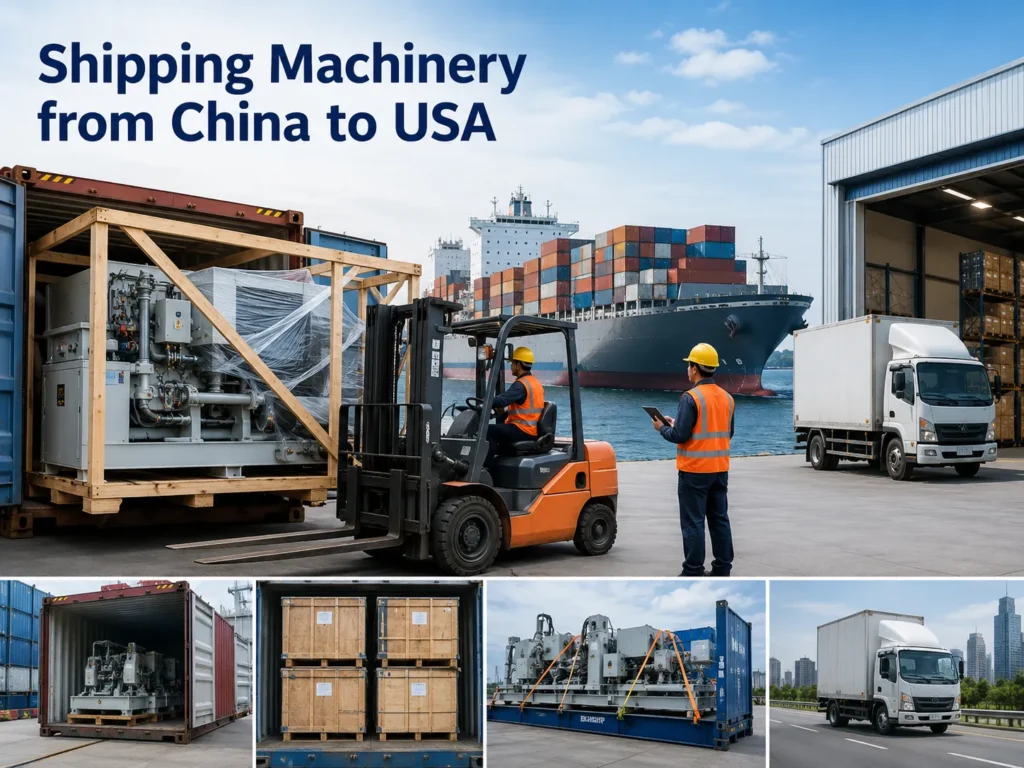
For example, dense machinery, metal products and other heavy cargo may require special chassis arrangements, permits, shorter drayage movements or transloading close to the port.
Accordingly, review loaded weight and U.S. delivery feasibility before the container leaves China.
The Cargo Needs Receiving Work Before Final Delivery
Depending on the agreed warehouse scope, workers may need to:
- Count cartons
- Separate SKUs
- Photograph visible packaging condition
- Replace damaged outer cartons when agreed
- Palletize loose cartons
- Apply agreed outbound labels
- Store inventory temporarily
In these cases, devanning becomes more than an unloading operation. Instead, it serves as the transition between international freight and U.S. domestic distribution.
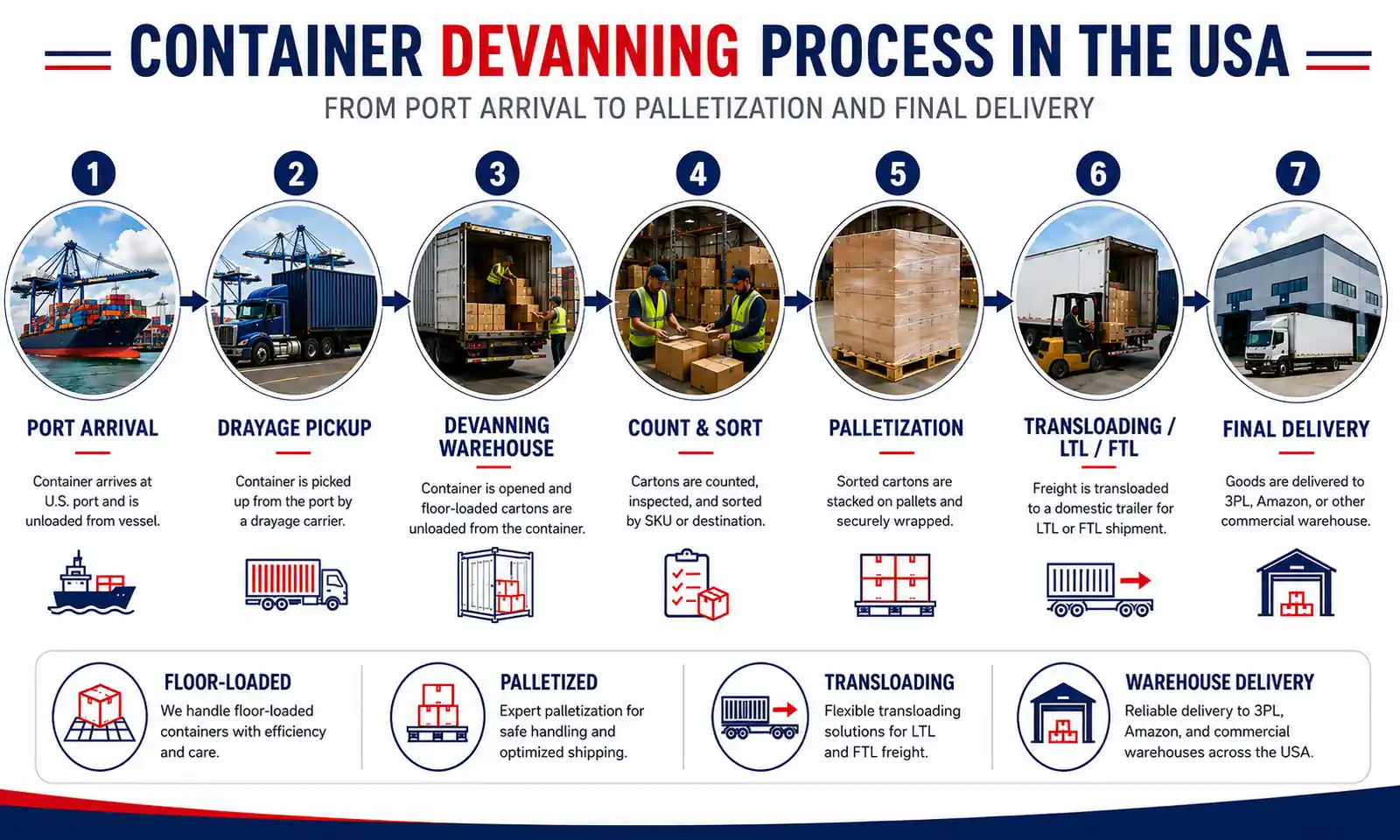
The Container Devanning Process: Port to Warehouse to Final Delivery
A well-planned container devanning operation begins before the truck reaches the warehouse.
Step 1: Confirm Cargo and Container Status
First, the importer, freight forwarder, customs parties and drayage provider confirm the applicable cargo-release and container-availability information.
At the same time, the destination team should identify the receiving facility, delivery appointment and known free-time deadlines.
Step 2: Arrange Port or Rail Drayage
Next, after the shipment becomes available under the applicable release conditions, a drayage carrier collects the container from the port terminal or rail ramp.
The trucker needs the correct container information, pickup location and receiving instructions.
Step 3: Receive the Container at the Warehouse
On arrival, the warehouse can verify basic receiving information such as:
- Container number
- Seal information where applicable
- Delivery documentation
- Visible exterior condition
- Planned unloading instructions
If workers notice visible container or cargo damage, they should document the condition before normal handling continues.
Step 4: Unload the Cargo
The warehouse may remove palletized cargo with suitable material-handling equipment. By contrast, floor-loaded cartons normally require more manual handling.
Before unloading begins, the team should know whether the operation involves:
- Carton-by-carton unloading
- Heavy-item handling
- Forklift support
- Special lifting equipment
- SKU separation
- Immediate pallet building
Step 5: Count, Sort and Check Visible Condition
After unloading, the warehouse may compare the physical cargo with the agreed receiving information.
Depending on the service scope, workers can count cartons, separate SKUs and photograph visible packaging damage.
However, basic devanning should not automatically be treated as a full quality inspection. If the importer needs detailed product inspection, that service should be arranged separately.
Step 6: Palletize, Cross-Dock or Stage the Cargo
Next, workers can build loose cartons onto pallets according to the next receiver’s requirements.
Alternatively, the cargo may move quickly across the facility into an outbound shipment or remain staged temporarily for transloading.
The correct choice depends on whether the freight needs reconfiguration, storage or immediate onward transportation.
Step 7: Return the Empty Container
Once unloading finishes, the trucker returns the empty ocean container according to the carrier or equipment provider’s instructions.
Before departure, the trucking team should confirm the nominated return location and any appointment requirements.
Step 8: Arrange the Next Transportation Leg
Finally, the goods may move by:
- Local truck
- LTL
- FTL
- Domestic trailer
- Parcel carrier for suitable smaller shipments
- 3PL transfer
- Amazon delivery under the applicable shipment plan
For this reason, importers should plan container devanning together with the next transportation step rather than treating it as an isolated warehouse service.
What Happens to Floor-Loaded Cartons After Devanning?
Floor loading can improve container utilization in China because pallets do not occupy part of the container cube.
However, many U.S. warehouses and domestic freight networks prefer palletized cargo.
As a result, a common workflow looks like this:
China factory
↓
Floor-loaded 40ft / 40HQ
↓
Ocean freight to USA
↓
Port drayage
↓
Container devanning
↓
Carton count and SKU separation
↓
Pallet building
↓
Stretch wrapping and labels
↓
LTL / FTL / 3PL / warehouse delivery
This workflow shows why the cheapest packing configuration at origin does not always create the lowest destination-handling cost.
Therefore, importers should compare the complete chain.
Mixed-SKU Floor Loads Need More Planning
Consider a 40HQ containing several product types from one or more suppliers.
If the supplier loads different SKUs randomly throughout the container, the U.S. warehouse may spend considerably more time separating the cargo.
For example, workers may need to identify cartons, separate product groups, count individual SKUs, build separate pallets and prepare several outbound shipments.
When the importer already knows that the U.S. warehouse must split the cargo, the loading plan in China should reflect the destination operation.
Clear shipping marks and a logical loading sequence can make devanning easier.
Plan the Destination Before the Container Is Stuffed
The best time to solve a difficult U.S. unloading problem is often before the container leaves China.
Before loading, ask:
- Will the U.S. warehouse accept floor-loaded cartons?
- Does the receiver require pallets?
- How many SKUs need separation?
- Will all cargo go to one destination?
- Is any carton too heavy for normal manual handling?
- Does the cargo require a forklift, clamp or other special equipment?
- Will the importer need temporary storage after unloading?
These answers can influence how the supplier packs and loads the container in China.
Palletization After Container Devanning
Palletization is one of the most common services requested after floor-loaded container devanning.
After workers unload loose cartons, they can rebuild the cargo into palletized handling units for storage or onward transportation.
A palletization scope may include:
- Pallet material
- Labor
- Carton arrangement
- Stack-height planning
- Weight distribution
- Stretch wrapping
- Corner protection where required
- Pallet labels
- Final pallet count
- Weight and dimensions for outbound freight
The downstream receiver should determine the pallet specification.
Therefore, do not assume that every 3PL, retailer, Amazon shipment or commercial warehouse follows the same pallet requirements.
Avoid Carton Overhang
Cartons extending beyond the pallet edge can become unstable and more vulnerable to handling damage.
For this reason, workers should build stable pallets that match the next transportation and receiving requirements.
Confirm Stackability
Some products support taller pallet configurations. By contrast, fragile cartons, irregular products or weak export packaging may require lower pallet heights.
The pallet plan should reflect the actual cargo rather than a generic warehouse standard.
Recalculate Outbound Freight After Palletization
Once loose cartons become pallets, the shipment dimensions change.
Consequently, pallet quantity, pallet dimensions and final weight affect LTL and FTL pricing.
Therefore, importers should not finalize inland transportation pricing using only the original China carton data when U.S. palletization will change the shipment configuration.
LTL, FTL, 3PL, Amazon or Commercial Warehouse After Devanning?
After container devanning, the next transportation method should match both the cargo and the receiver.
LTL Delivery
LTL can work when the warehouse has palletized the cargo and the shipment does not require a dedicated truck.
The quotation may depend on:
- Pallet quantity
- Pallet dimensions
- Pallet weight
- Freight class where applicable
- Origin warehouse
- Destination ZIP code
- Appointment requirements
- Liftgate or limited-access needs where applicable
FTL Delivery
FTL can be more practical when the shipment occupies a substantial part of a trailer, requires dedicated capacity or needs to move together.
In addition, transloaded cargo may move into a domestic trailer for a longer inland transportation leg.
3PL Warehouse
A 3PL may receive palletized cargo for storage, fulfillment, distribution or replenishment.
Before devanning, the importer should confirm the 3PL’s inbound appointment, pallet and labeling requirements.
Commercial Warehouse or Distribution Center
A commercial warehouse may accept direct container delivery or palletized truck delivery.
The correct option depends on dock setup, yard access, forklift equipment, receiving hours, labor availability and appointment rules.
Therefore, ask the receiver what it can actually handle before selecting the destination route.
Amazon FBA
Amazon inventory may require another destination step.
A full ocean container does not automatically move directly to a fulfillment center. Depending on the shipment plan, cargo may first enter a U.S. warehouse for devanning, palletization, labeling, storage or transfer to the final carrier.
For Amazon-specific carton labels, shipment IDs, pallet planning, SPD, LTL, FTL and appointment delivery, use our shipping from China to Amazon FBA guide.
For landed-cost planning, see Amazon FBA shipping cost from China to USA.
How Container Devanning Helps Reduce Detention and Delivery Risk
Efficient devanning can reduce the time that an ocean container remains outside the terminal before empty return.
That matters because container-related time risk does not disappear when the full container leaves the port.
For example, problems can develop when:
- The warehouse is not ready for the truck
- Floor-loaded cargo takes longer than expected to unload
- The facility has insufficient labor
- The receiving appointment changes
- The empty-return location is far from the receiver
- A dropped container remains at the warehouse too long
Therefore, the destination team should track both the terminal pickup deadline and the equipment-return requirement.
A practical plan should confirm:
- Container availability
- Last free day where applicable
- Receiving appointment
- Expected unloading method
- Truck waiting terms
- Live-unload or drop arrangement
- Empty-container return location
For a full explanation, read our demurrage vs detention guide.
What Information Is Needed for a Container Devanning Quote?
A reliable container devanning quote needs more than container size.
Whenever possible, provide:
- U.S. port or rail ramp
- Preferred devanning warehouse city or area
- Container type: 20ft, 40ft or 40HQ
- Product name
- Product or carton photos
- Floor-loaded or palletized status
- Total carton quantity
- Number of SKUs or purchase orders
- Total gross weight
- Approximate weight per carton
- Carton dimensions
- Any unusually heavy cartons
- Sorting requirements
- Carton-counting requirements
- Whether new pallets are required
- Required pallet specification if known
- Stretch-wrap or labeling requirements
- Temporary-storage requirements
- Final U.S. ZIP code
- Number of final destinations
- Final delivery method: LTL, FTL, 3PL, Amazon or commercial warehouse
- Cargo availability date when known
- Known final free day or empty-return deadline when available
Loading photos are especially useful for floor-loaded containers.
For instance, photos from the supplier can help the destination warehouse understand loading density, carton accessibility and possible equipment requirements before the container arrives.
Information to Confirm Before the Container Leaves China
Whenever possible, solve the destination operation before vessel arrival.
Before loading in China, confirm:
- Who will unload the container in the United States?
- Can the final warehouse receive the ocean container directly?
- Will the cargo need pallets after arrival?
- Does the final receiver accept floor-loaded freight?
- Will the shipment be split among several destinations?
- Is the loaded weight suitable for the intended U.S. road route?
- Who will arrange drayage?
- Who will manage empty-container return?
These decisions may influence the packing and loading plan before export.
FAQ About Container Devanning
What is container devanning?
Container devanning means unloading cargo from a shipping container after arrival.
Depending on the service scope, the warehouse may also provide carton counting, SKU sorting, palletization, visible-condition checking, temporary storage or preparation for onward transportation.
How much does it cost to devan a container in the USA?
Public 2026 warehouse pricing shows that basic floor-loaded devanning can commonly fall within several hundred dollars per container.
As a broad planning reference, standard 20ft floor-loaded services may appear around USD 250–500, while 40ft and 40HQ floor-loaded services may appear around USD 350–800.
However, carton count, cargo weight, SKU sorting, palletization, special equipment, warehouse location and storage can increase the final cost. Drayage and final delivery are also normally separate unless the quotation states otherwise.
How long does it take to unload a 40ft container?
There is no single unloading time for every 40ft or 40HQ container.
Generally, workers can handle palletized cargo more quickly because they move complete pallets instead of individual cartons.
By contrast, floor-loaded unloading time depends on carton quantity, carton weight, loading density, SKU count, labor, equipment and whether the cargo needs sorting or palletization.
Therefore, ask the warehouse for an estimated handling window based on the actual loading method rather than assuming a fixed number of hours.
Is devanning the same as transloading?
No.
Devanning means unloading cargo from the container.
Transloading normally means unloading that cargo and moving it into another transportation unit for the next leg.
For example:
Ocean container → unload → 53ft domestic trailer
includes devanning as part of a transloading operation.
Can I deliver the full container directly without using another devanning warehouse?
Yes.
Direct delivery can work when the final receiver can accept the ocean container and unload it under suitable delivery conditions.
However, before booking, confirm dock access, yard space, equipment, labor, receiving hours, truck waiting terms and empty-container return timing.
If the receiver cannot handle the container efficiently, a separate devanning warehouse may provide a more practical option.
Do Amazon FBA shipments always need container devanning?
No.
The correct route depends on the shipment plan, loading method, carrier arrangement and current Amazon receiving requirements.
Some cargo may follow an approved direct-container delivery plan. Other inventory may first move to a 3PL or transfer warehouse for devanning, palletization, labeling or onward LTL/FTL delivery.
Is floor loading cheaper than palletizing in China?
Floor loading can improve container-space utilization because pallets do not occupy part of the container cube.
However, the U.S. destination may then require additional unloading labor and palletization.
Therefore, compare the complete origin-to-destination cost rather than only the number of units that fit inside the container.
Can VoltFreight arrange container devanning and final delivery in the USA?
For suitable shipments and destinations, VoltFreight can coordinate China-to-USA freight together with destination logistics partners.
Depending on the shipment, the service scope may include China supplier pickup, FCL sea freight, customs-support coordination, port or rail drayage, container devanning, transloading, palletization, temporary warehouse handling, LTL or FTL delivery, 3PL delivery and Amazon destination planning where applicable.
Service availability and final pricing depend on the port, cargo, customs status, warehouse location and delivery requirements.
Plan Container Devanning Before the Vessel Arrives
Container devanning should not be treated as an afterthought.
For many importers, the best destination plan starts before the cargo leaves China.
If the U.S. receiver can unload a full container quickly, direct delivery may reduce handling.
However, when the container is floor-loaded, the receiver cannot accept ocean equipment, the cargo needs palletization, several destinations are involved or the container needs a fast return, a devanning or transload warehouse may provide a more practical solution.
Ultimately, the best plan connects:
China loading → ocean freight → U.S. port → drayage → container devanning → palletization or transloading → final delivery.
Therefore, compare the complete destination operation rather than only the ocean freight or warehouse unloading fee.
Need help planning an FCL container from China to the USA?
Send VoltFreight your product name, supplier location, container size, gross weight, loading method, carton quantity, loading photos and final U.S. destination. We can review whether direct container delivery, devanning, transloading, palletization or another destination plan is more practical.
Request a Container Shipping and Devanning Quote
Related VoltFreight Guides
- Sea Freight from China to USA — FCL, LCL, ports, transit and U.S. destination operations.
- Container Shipping Cost from China to USA — 20ft, 40ft, 40HQ, drayage and destination-cost planning.
- Demurrage vs Detention — free time and container-delay risk.
- Amazon FBA Shipping Cost from China to USA — palletization, LTL, FTL and FBA destination costs.
- Shipping from China to Amazon FBA — labels, cartons, customs and fulfillment-center delivery.
- Export Packaging from China — cartons, pallets, crates and export packing decisions.
Information and Market References
- Federal Maritime Commission — Detention and Demurrage
- Occupational Safety and Health Administration — Loading and Unloading
- WarehousingCosts — 2026 Container Devanning Cost Benchmarks
- LAX Freight Delivery — Public Warehouse Tariff
Important: Devanning rates shown above are broad 2026 public market references, not guaranteed VoltFreight rates. Warehouse capabilities, labor rates, drayage conditions, container free time, customs status, Amazon requirements and final delivery conditions vary by shipment and location. Therefore, confirm the actual service scope and warehouse-specific quotation before routing the container.