Shipping from China to Amazon FBA requires more than moving cartons from a supplier to an Amazon fulfillment center. A reliable plan must connect supplier pickup, China export handling, international freight, customs clearance, Amazon shipment data and final warehouse delivery.
Amazon sellers can use express courier, air freight, sea LCL, sea FCL or a split air-and-sea strategy. However, the lowest advertised freight rate is not always the best option. Inventory urgency, cargo size, product restrictions, customs responsibility and the assigned fulfillment center can all change the final route.
This guide explains how Amazon FBA shipping from China works, how to compare express, air and sea freight, which labels and carton details must be checked, and how cargo reaches the assigned Amazon warehouse after customs clearance.
The United States is a major Amazon FBA destination, while the same planning principles also apply to the United Kingdom, Europe, Canada and other supported marketplaces. Nevertheless, tax responsibility, import requirements and final delivery arrangements vary by destination.
Need a practical Amazon FBA shipping quote? Send your product details, carton information, supplier location and assigned warehouse through our contact page. VoltFreight can compare suitable routes before the goods leave China.
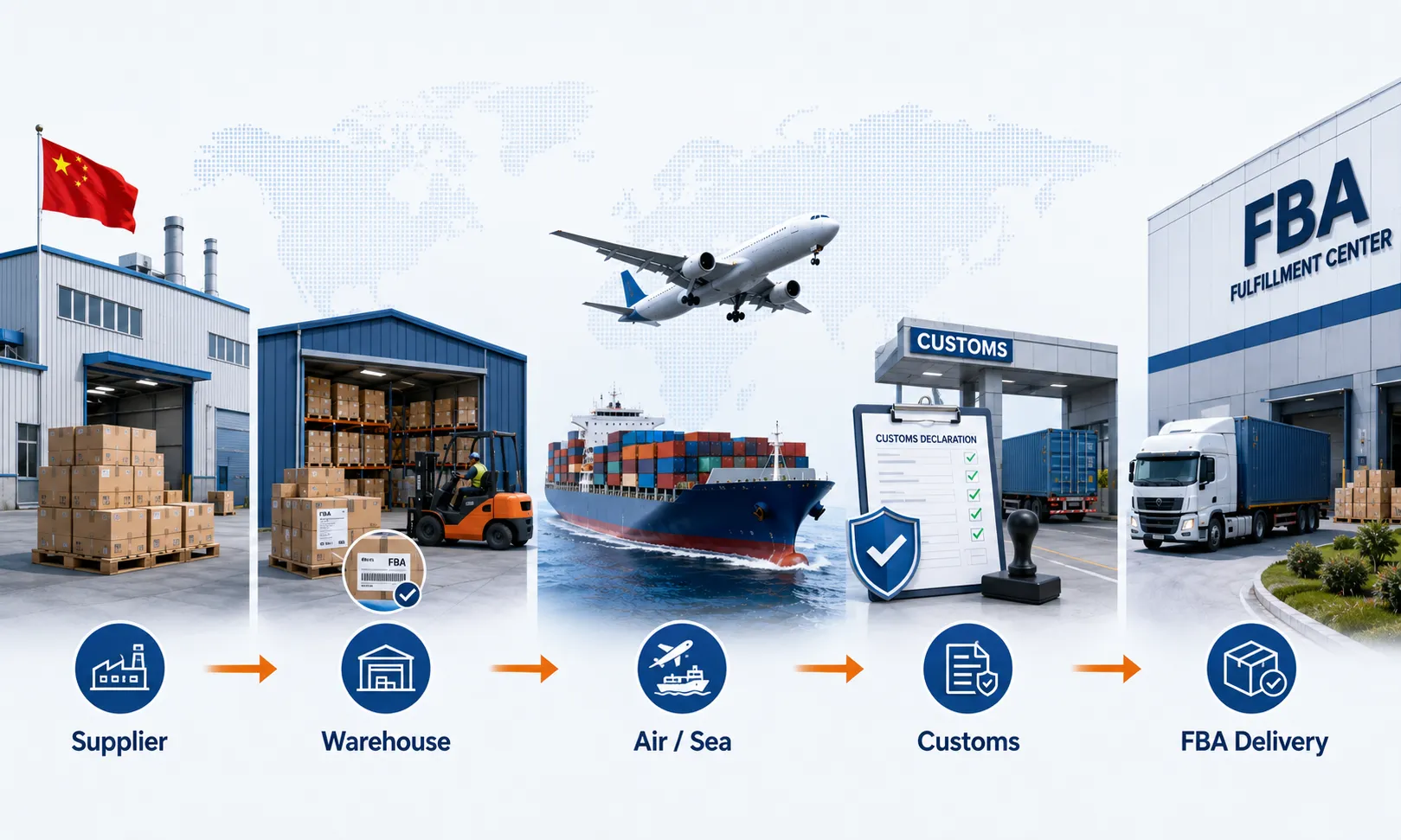
Shipping from China to Amazon FBA at a Glance
The best shipping method depends on the seller’s inventory position, shipment size and required delivery date. Therefore, compare the complete supplier-to-Amazon route rather than choosing only by the price per kilogram or cubic meter.
| Seller Situation | Recommended Method | Best Use | Planning Time | Pricing Basis |
|---|---|---|---|---|
| Samples or a few urgent cartons | Express courier | Fast delivery for small eligible shipments | Several business days on many routes | Chargeable weight |
| Product launch or urgent replenishment | Air freight | Commercial inventory that cannot wait for sea freight | Often around one to two weeks door to door | Chargeable weight |
| Smaller planned bulk shipment | Sea LCL | Cargo that shares container space | Several weeks, depending on route and delivery | CBM or revenue ton |
| Large planned order | Sea FCL | Container-level inventory and better loading control | Several weeks, depending on port and warehouse | 20GP, 40GP or 40HQ |
| Stockout risk with a large main order | Split air and sea shipment | Urgent stock by air and the main quantity by sea | Two coordinated timelines | Separate air and sea calculations |
| Seller needs a wider landed-delivery scope | Reviewed landed or DDP option | Agreed customs and final-delivery coordination | Depends on the confirmed route and customs plan | Confirmed service scope |
These are planning ranges rather than guaranteed delivery times. Supplier readiness, peak season, customs inspection, destination transfer, palletization and Amazon appointment availability can all affect the complete timeline.
How Shipping from China to Amazon FBA Works
A complete FBA shipment normally follows several connected stages. Planning them before pickup reduces the risk of customs delays, label mistakes and final-delivery problems.
- Create the Amazon shipment plan. Confirm the inbound shipment, shipment ID, fulfillment center code, delivery address and FBA box label files.
- Collect the final cargo information. Confirm the product, carton quantity, gross weight, dimensions, value, supplier address and cargo-ready date.
- Review labels and customs feasibility. Check whether the carton labels, product descriptions, customs documents and special-product information are ready.
- Choose the freight method. Compare express, air freight, sea LCL, sea FCL and split-shipment options according to inventory urgency and cargo size.
- Arrange supplier pickup or warehouse delivery. Cargo can move directly from one supplier or first enter a China consolidation warehouse.
- Complete export handling and international transport. The forwarder coordinates booking, China export procedures and the confirmed air or ocean route.
- Complete customs clearance and destination handling. After import release, cargo may enter a transfer warehouse for devanning, palletization or carrier handoff.
- Deliver to the assigned fulfillment center. The final carrier follows the shipment references, delivery method and appointment requirements.
Amazon FBA shipping does not always follow one direct physical route. For example, sea LCL cargo normally enters a destination warehouse for deconsolidation. Air cargo may also move through a local transfer facility before the final-mile provider receives it.
As a result, sellers should distinguish the airport-to-airport or port-to-port transit time from the complete supplier-to-Amazon delivery time.
Express, Air and Sea Shipping to Amazon FBA
Each freight method solves a different inventory problem. The right choice should balance speed, shipment size, cost per unit, product acceptance and the financial risk of running out of stock.
Express Courier
Express courier is usually suitable for samples, replacement products, launch inventory and a small number of urgent cartons. DHL, UPS and FedEx can provide fast pickup-to-delivery service for eligible cargo.
Express works best when:
- The shipment is relatively small.
- The cargo is urgent.
- The product is accepted by the courier.
- The customs documents are clear.
- The cartons already match the Amazon shipment plan.
However, courier charges can increase quickly for bulky cartons because the carrier compares actual weight with volumetric weight. Remote fulfillment centers, customs processing and special-product handling may also affect the total cost.
Air Freight
Air freight is often more practical when the shipment is too large for economical courier delivery but cannot wait for sea freight. Sellers commonly use it for seasonal inventory, product launches, higher-value goods and urgent replenishment.
Air freight is normally charged according to chargeable weight. Therefore, both gross weight and carton dimensions are required for an accurate quotation.
A coordinated air shipment may include:
- Supplier pickup or China warehouse receiving
- Carton measurement and consolidation
- China export handling
- International air transportation
- Destination customs coordination
- Transfer to a local delivery warehouse
- Final delivery to the assigned FBA location
Some air routes can use a wider landed-delivery arrangement. However, sellers should confirm which customs services, duties, destination handling and final-delivery charges are included.
For a broader explanation of chargeable weight, cargo acceptance and airport routing, review our air freight from China service.
Sea LCL
Sea LCL is usually suitable when the shipment is too large for air freight but does not fill a complete container. It can work well for planned wholesale orders, regular replenishment and sellers that can hold enough inventory while the cargo is in transit.
When shipping from China to Amazon FBA by ocean, the seller should compare more than the ocean rate. The complete route may also include origin handling, destination deconsolidation, customs clearance, warehouse transfer, palletization and final Amazon delivery.
Sea FCL
Sea FCL is generally more suitable for large orders that require a dedicated 20GP, 40GP or 40HQ container. It can provide better loading control for fragile products, high-volume inventory or regular container shipments.
Depending on the route and Amazon receiving arrangement, the container may move to an approved delivery point or first enter a local warehouse for devanning and final-mile preparation.
For a detailed comparison of LCL, FCL, transit stages and ocean freight planning, read our guide to sea freight from China.
Split Air and Sea Shipping
Split shipping can protect sales without sending the complete order by air. A smaller urgent quantity moves by air, while the main replenishment travels by sea at a lower unit cost.
This strategy can work when:
- Existing inventory is close to stockout.
- The supplier has completed a large production order.
- The seller needs enough stock to protect sales until the sea shipment arrives.
- The additional air cost is lower than the expected loss from unavailable inventory.
Sellers with regular inventory cycles may also compare direct FBA delivery, Amazon AWD and a U.S. 3PL. Our Amazon FBA inventory replenishment guide explains those options in more detail.
Amazon Shipment Plans, Box Labels and Carton Data
Amazon-specific shipment data is one of the main differences between ordinary commercial freight and FBA delivery. Even after customs clearance, incorrect labels or carton information can delay receiving.
FBA Box ID Labels
Each shipping carton should carry the correct FBA box ID label generated from the shipment plan. The label should remain clear, flat and scannable.
Old barcodes, unrelated shipping marks or supplier labels should not cover the required Amazon label. In addition, each carton must match the inventory assigned to that label.
Carton Quantity, Weight and Dimensions
The final carton quantity should match the Amazon shipment data and freight documents. Accurate weight and dimensions are also necessary because they affect courier pricing, air chargeable weight, sea volume and final-delivery planning.
Supplier estimates often change after production and packing. Therefore, sellers should obtain the final carton data before the forwarder confirms the route.
Shipment ID and Fulfillment Center Code
The freight forwarder needs the Amazon shipment ID, assigned fulfillment center code and complete delivery address.
The warehouse location affects:
- International gateway selection
- Inland delivery distance
- Final-mile carrier choice
- Appointment requirements
- Estimated delivery time
- Possible remote-area or redelivery charges
When Amazon has not assigned the destination, the forwarder may provide an initial estimate. However, the final route and delivery price should be reconfirmed after the warehouse is known.
Carton Content and SKU Information
Single-SKU cartons are usually easier to manage than mixed cartons. Nevertheless, the shipment plan and carton-content information must match the actual packing method.
When a supplier changes the carton configuration after the shipment plan is created, the seller should update the relevant information before pickup.
Final Delivery to Amazon Fulfillment Centers
International freight and Amazon final delivery are connected, but they are not the same service. After customs clearance, the cargo must still move through a delivery method accepted for the assigned inbound shipment.
Small Parcel Delivery
Small parcel delivery normally suits smaller carton shipments delivered through an approved parcel network. Each carton requires the correct Amazon box label and the relevant carrier label.
Although this method can be practical for small shipments, sellers should still confirm parcel limits, product acceptance and destination coverage.
LTL and FTL Delivery
Less-than-truckload delivery is commonly used for palletized cargo that does not require a dedicated vehicle. Full-truckload delivery can be suitable for larger palletized shipments.
These deliveries may require:
- Stable and correctly built pallets
- Pallet and carton labels
- Accurate carton and pallet counts
- Amazon shipment references
- An approved delivery appointment
Therefore, palletization and appointment responsibility should be confirmed in the freight quotation.
Container Devanning and Warehouse Transfer
Some FCL shipments can use container-based delivery when the route, warehouse and receiving conditions allow it. However, many containers first move to a local warehouse for devanning.
The transfer warehouse may unload the container, verify the cargo, build pallets, apply carrier labels and prepare LTL or FTL delivery.
Appointment and Redelivery Risk
Amazon appointment availability may extend the final delivery timeline. A shipment may also require rescheduling when the carton count, delivery reference or pallet information does not match the appointment.
A complete quotation should explain whether appointment delivery, waiting time, storage and possible redelivery are included.
Customs Responsibility and Landed Delivery Options
Amazon fulfillment centers generally receive inventory; they do not replace the seller’s import and customs planning. Before the goods leave China, the parties should confirm who manages the import entry, which documents are required and how duties and taxes will be handled.
A landed or DDP shipping option may combine freight, customs coordination, agreed duty handling and final Amazon delivery. However, the term “DDP” does not guarantee that every quotation includes the same services.
The quotation should clearly state:
- Which party manages the import entry
- Whether customs brokerage is included
- Which duties and taxes are included
- Whether destination handling and warehouse transfer are included
- Whether palletization and appointment delivery are included
- How inspections, storage, rejected appointments or redelivery are charged
Product descriptions, declared values and customs classifications must match the actual goods. Batteries, wireless products, cosmetics, food-contact goods, children’s products, textiles, branded inventory and medical-related goods may also require additional review.
For detailed importer responsibility, duty scope and landed-delivery exclusions, read our DDP shipping from China to Amazon FBA guide. For general documentation and import planning, visit our customs clearance service.
Should Inventory Ship Directly or Through a China Warehouse?
Not every shipment needs a warehouse step. The right setup depends on the supplier’s experience, the number of factories, the condition of the packaging and whether the inventory is already ready for Amazon.
Direct Supplier-to-FBA Shipping
A Chinese supplier can ship directly to Amazon FBA when the order comes from one reliable factory, the carton configuration is stable, the labels are correct and the customs and final-delivery plans are already confirmed.
A factory that can manufacture the product is not automatically experienced in Amazon inbound delivery. Therefore, direct shipping should be treated as a readiness decision rather than only a freight decision.
Use our dedicated checklist to decide whether shipping directly to Amazon FBA from China is suitable for your order.
China FBA Prep Center
FBA shipping focuses on transportation, customs clearance and final fulfillment center delivery. By contrast, FBA prep focuses on preparing products and cartons before shipment.
Prep work may include product inspection, quantity checking, FNSKU labeling, polybagging, bundling, repacking, carton replacement and receiving photos.
Shipments that are already prepared may only need carton and label verification. Sellers that require complete inspection or product-level preparation should review our Amazon FBA prep service in China.
Multi-Supplier Consolidation
A China warehouse is usually safer when inventory comes from several suppliers or when sellers need receiving control before international shipping.
A consolidation warehouse can:
- Receive cartons from several factories
- Count and measure the cargo
- Photograph external packaging
- Identify missing or damaged cartons
- Combine cargo into one international shipment
- Coordinate prep or repacking when separately agreed
Learn more about supplier receiving and consolidation through our China warehouse service for U.S. importers.
What Should a Complete Amazon FBA Freight Quote Include?
An Amazon FBA freight quote should cover the complete route being offered, not only the international air or ocean rate.
Depending on the shipment, the quotation may need to identify:
- Supplier pickup and China warehouse receiving
- Origin handling and export procedures
- Express, air or sea freight charges
- Chargeable weight, CBM or container basis
- Customs brokerage, duties and tax scope
- Destination deconsolidation or devanning
- Warehouse transfer and palletization
- SPD, LTL, FTL or container delivery
- Amazon appointment booking
- Storage, waiting time and redelivery exclusions
Two quotes can appear similar while covering very different service stages. Therefore, sellers should compare the same pickup point, customs scope, warehouse destination and final-delivery method.
For route-specific calculations and landed-cost examples, review our guide to Amazon FBA shipping costs from China to the USA.
Common Problems That Delay Amazon FBA Shipments
Most FBA shipping problems begin before the goods leave China. The seller, supplier and forwarder should confirm critical details before pickup.
- Incorrect FBA box labels: Cartons may not match the shipment plan or assigned warehouse.
- Wrong carton quantity or dimensions: Freight pricing and Amazon shipment data may become inaccurate.
- Unclear customs responsibility: Cargo may arrive without a workable import arrangement.
- Vague product descriptions: Customs may question the commercial invoice or classification.
- Missing appointment planning: Cargo may reach the destination country but wait for final delivery.
- Weak or damaged cartons: The shipment may require repacking before Amazon delivery.
- Incomplete freight quotation: Destination handling, duties or appointment delivery may be excluded.
- Undeclared special products: Batteries, liquids and regulated goods may need additional approval.
- Warehouse reassignment: A changed fulfillment center can alter the final route and price.
- Mismatch between documents and cargo: The invoice, packing list and physical cartons should show consistent information.
Early verification is usually less expensive than correcting a shipment after it reaches the destination country.
What We Need for an Amazon FBA Shipping Quote
An accurate quotation requires cargo, customs and Amazon delivery information.
Cargo Information
- Product name, material and intended use
- Product photos or supplier link
- Supplier city and pickup address
- Carton, pallet or crate quantity
- Dimensions of each package type
- Total gross weight and CBM
- Cargo value
- Cargo-ready date
- Battery, liquid, powder, magnet or branded-product details
Customs Information
- Commercial invoice
- Packing list
- Tariff or HS code if available
- Country of origin
- Importer and customs arrangement
- Product certificates when required
Amazon Delivery Information
- Amazon shipment ID
- FBA fulfillment center code
- Complete warehouse address and postcode
- FBA box label files
- Carton-content information
- Label and prep status
- Preferred shipping method
- Required delivery deadline
VoltFreight can prepare an initial estimate when some information is not yet available. However, the final quotation should be reconfirmed after the carton data and Amazon destination are complete.
Amazon FBA Shipping Guides by Destination
The physical transport process is similar across Amazon marketplaces, but customs responsibility, tax registration, product compliance and final delivery requirements vary by destination.
- United States: The main guide on this page covers express, air, sea, customs planning and fulfillment center delivery. Sellers needing route-specific pricing can use our Amazon FBA shipping cost guide for the USA.
- European Union: VAT, EORI, product compliance and cross-border inventory planning require separate attention. Read our shipping from China to Amazon FBA Europe guide.
- United Kingdom: UK VAT, EORI, customs clearance and Amazon UK warehouse delivery should be planned separately from EU imports. Review our shipping from China to Amazon FBA UK guide.
- Japan: Overseas sellers should confirm the importer, ACP/IOR, customs valuation, product compliance and warehouse delivery before dispatch. Review our guide to shipping from China to Amazon FBA Japan.
- Mexico: Warehouse codes, importer arrangements and final-mile delivery rules should be confirmed before dispatch. Review our guide to shipping to Amazon FBA Mexico, including air, sea and DDP options from China.
- Canada and other markets: Ask for a route review based on the assigned fulfillment center, product type, importer arrangement and available final-delivery service.
Do not assume that a DDP, importer or tax arrangement used in one marketplace can be copied to another destination without review.
Why Choose VoltFreight for Amazon FBA Shipping?
VoltFreight helps Amazon sellers coordinate the complete route from Chinese suppliers to the assigned fulfillment center.
Our service can include:
- Supplier pickup across major Chinese manufacturing cities
- Warehouse receiving and multi-supplier consolidation
- Carton counting, measurement and receiving photos
- Express, air, LCL and FCL route comparison
- Landed and DDP feasibility review where available
- Commercial invoice and packing list coordination
- Customs-clearance support under the agreed scope
- Warehouse transfer and palletization when required
- SPD, LTL, FTL and appointment delivery planning
- Shipment tracking from supplier pickup to final handoff
We do not recommend a route only because it has the lowest freight rate. Instead, our team compares cargo size, inventory urgency, customs feasibility, warehouse destination and final-delivery risk.
FAQ About Shipping from China to Amazon FBA
What is the best way to ship from China to Amazon FBA?
Express is suitable for a few urgent cartons, air freight works well for urgent commercial inventory, and sea freight is generally better for larger planned shipments. The best method depends on cargo size, remaining inventory, product acceptance, customs requirements and the assigned fulfillment center.
Can I ship from China to Amazon FBA by ocean?
Yes. Sea LCL is suitable for smaller bulk shipments, while FCL works for larger container-level inventory. The complete route may also include customs clearance, deconsolidation, palletization and Amazon appointment delivery.
Can a freight forwarder pick up from my supplier in China?
Yes. VoltFreight can coordinate pickup from factories, trading companies and warehouses in China. Goods from several suppliers can also move to one consolidation warehouse before international shipping.
How long does Amazon FBA shipping from China take?
Express may require several business days on many routes, air freight often takes around one to two weeks door to door, and sea freight normally takes several weeks. Final timing also depends on supplier readiness, customs clearance, destination transfer and Amazon appointment availability.
What information is needed for an Amazon FBA freight quote?
The forwarder normally needs the product name, carton quantity, dimensions, gross weight, cargo value, supplier address, special-product details, shipment ID, fulfillment center code and delivery deadline. Final carton data produces a more reliable quotation than factory estimates.
Get an Amazon FBA Shipping Quote from China
Shipping to Amazon FBA works best when supplier pickup, international freight, customs clearance and final warehouse delivery are planned together.
Before the cargo leaves China, confirm the shipment ID, fulfillment center code, carton quantity, dimensions, customs responsibility, label status and final delivery method.
Send VoltFreight your product details, carton information, supplier address and Amazon destination.
We will review the cargo and compare suitable express, air freight, sea LCL, sea FCL, split-shipment and landed-delivery options.
Contact VoltFreight for an Amazon FBA shipping quote from China.
Important note: Freight rates, customs requirements, Amazon warehouse assignments, transit times and final-delivery availability vary by shipment. Confirm the final service scope before supplier pickup.