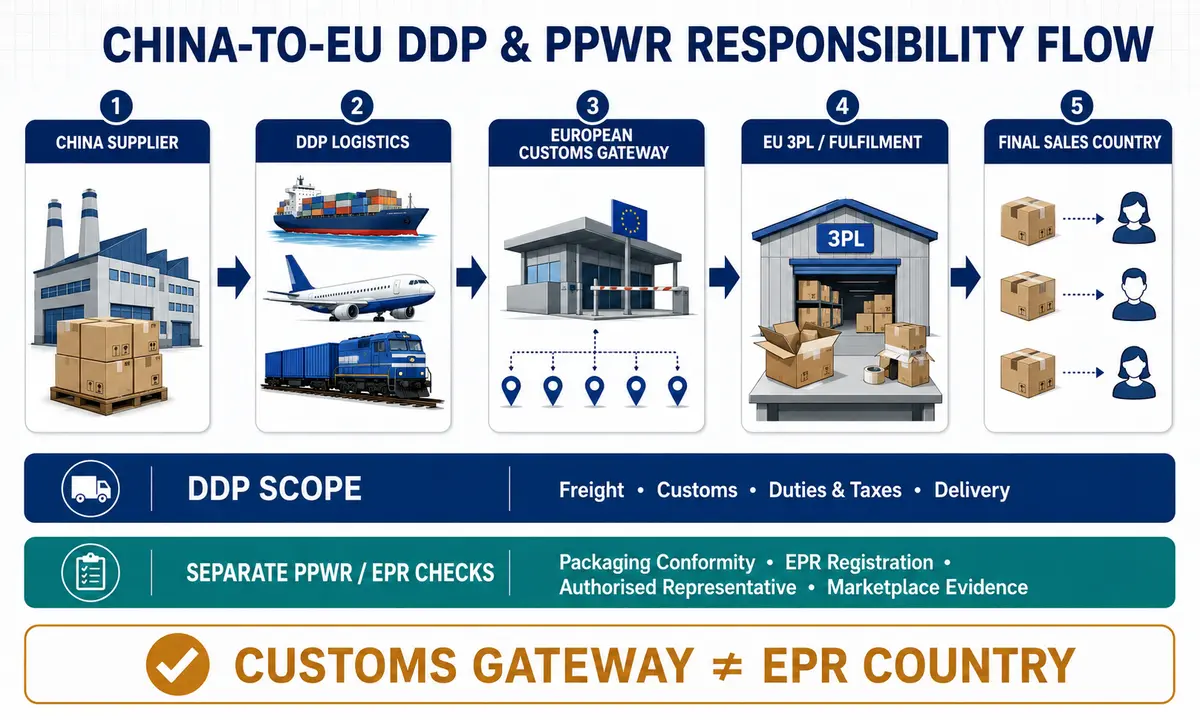
The EU PPWR packaging rules generally apply from 12 August 2026, but DDP shipping does not automatically make a shipment PPWR- or EPR-compliant. A confirmed DDP service may include pickup in China, international freight, import customs clearance at the European gateway selected for the route, duties and taxes under the agreed model, and delivery to the named destination. A standard DDP service excludes packaging conformity, national packaging EPR registration, an authorised representative, laboratory testing and marketplace submissions unless the quotation expressly includes them.
The practical question is therefore not simply, “Is this shipment DDP?” It is: who is the manufacturer, importer and EPR producer for each packaging layer, who will first make that packaging available in an EU Member State, where will it become waste, and who will add, remove or replace packaging before delivery?
This guide explains the PPWR from the viewpoint of a China-to-Europe freight forwarder. It covers cartons, retail boxes, mailers, tape, cushioning, stretch film and pallets; separates customs responsibilities from packaging responsibilities; and shows what e-commerce sellers, Amazon sellers, importers and DDP shippers should confirm before cargo leaves China.
Need a China-to-Europe freight and packaging review? Send VoltFreight your product name, sales model, destination countries, carton dimensions, packaging materials, product and packaging photos, EPR information, preferred transport mode and final delivery postcode through our freight quote form. We can review the logistics and warehouse scope, then identify which compliance points you must confirm with your importer or specialist adviser.
Compliance notice: This article provides general logistics information, not legal, tax or conformity-assessment advice. PPWR roles depend on the facts of the supply chain and national implementation. Confirm your position with the relevant EU authority, EPR scheme and qualified compliance adviser before placing packaging or packaged products on the market.
Does PPWR Apply to DDP Shipping? Quick Answer
Yes. The PPWR can apply when a company places packaging or a packaged product on the EU market, regardless of whether the sales contract uses DDP, DAP, FOB, EXW or another Incoterm. The transport term affects contractual delivery, cost, risk and customs responsibilities. It does not replace product law or packaging law.
The most useful way to remember the distinction is:
- DDP determines contractual transport and import responsibilities between seller and buyer.
- PPWR determines statutory packaging responsibilities for manufacturers, importers, distributors, producers and other economic operators.
- National EPR systems determine registration, reporting and fee obligations where the packaging will likely become waste.
These three layers interact, but they are not interchangeable. A shipment can clear customs successfully and still have an unresolved packaging EPR or marketplace issue. Conversely, an EPR registration number does not prove that the packaging satisfies chemical, recyclability, documentation or future labelling requirements.
Real seller discussions show why this distinction matters. In one Reddit discussion about packaging EPR, a small private-label seller shipping only a few thousand units asked whether low volume created an exemption. In another discussion among small cross-border sellers, one participant explained that packaging licensing costs had already led them to stop selling into several countries. These are anonymous experiences, not legal sources, but they reveal the commercial problem: sellers need a country-by-country compliance budget before promising EU-wide delivery.
What Are the EU PPWR Packaging Rules and When Do They Apply?
Most businesses call Regulation (EU) 2025/40 on packaging and packaging waste the PPWR. It entered into force on 11 February 2025 and generally applies from 12 August 2026. Unlike the previous packaging directive, the PPWR applies directly across EU Member States, although national authorities, registers, EPR schemes and penalties still have important country-level roles.
The European Commission’s PPWR overview states that the rules cover packaging and packaging waste regardless of material or origin. The full Regulation (EU) 2025/40 addresses packaging composition, substances of concern, recyclability, recycled content, minimisation, labelling, reuse, producer registration and extended producer responsibility.
Immediate Checks for China-EU Shippers
For a shipper in China, several points deserve immediate attention:
- The combined concentration of lead, cadmium, mercury and hexavalent chromium in packaging or packaging components must not exceed 100 mg/kg, subject to the regulation’s stated framework and derogations.
- From 12 August 2026, food-contact packaging must remain below the PPWR PFAS thresholds: 25 ppb for any targeted PFAS, 250 ppb for the sum of targeted PFAS, and 50 ppm for PFAS including polymeric PFAS, subject to the regulation and any stricter applicable EU act.
- Manufacturers and importers have conformity, technical-documentation, identification and traceability duties. Businesses must assess today’s requirements together with the transitional provisions and later technical acts.
- Packaging must be recyclable. Later phases introduce the detailed design-for-recycling and recycled-at-scale criteria.
- Packaging EPR remains connected to each Member State where the person meets the PPWR definition of producer. There is no automatic single EU-wide packaging EPR number.
Do not turn every 2030 target into a 2026 shipping requirement. The harmonised material label, the 50% maximum empty-space rule for grouped, transport and e-commerce packaging, recycled-content targets and several reuse obligations have later application dates. A credible PPWR page must separate what applies now from what businesses should prepare for next.
EU PPWR Timeline for Shippers: 2026, 2028, 2030 and Beyond
The PPWR is not a one-day switch. The following timeline highlights the dates most relevant to cross-border sellers and logistics planning. “Whichever is later” matters because several duties depend on implementing or delegated acts that may shift the practical date.
Key Dates and Practical Actions
| Date | Selected PPWR Development | Practical Action for China-EU Shippers |
|---|---|---|
| 11 February 2025 | PPWR entered into force. | Start mapping packaging materials, actors, destinations and supplier evidence. |
| 12 August 2026 | PPWR generally applies. The food-contact PFAS limits apply from this date; core economic-operator duties also become relevant. | Do not ship on assumptions. Confirm packaging composition, manufacturer/importer information, documentation and national EPR position. |
| 12 February 2028 | The Commission must complete several supporting acts, including the empty-space calculation methodology; businesses must reduce sales-packaging empty space to the minimum necessary from this date. | Collect reliable package dimensions now and redesign oversized consumer packaging before the deadline. |
| 12 August 2028 or later | Harmonised material-composition labelling applies from this date or 24 months after the relevant implementing acts enter into force, whichever is later. | Do not invent a PPWR symbol. Wait for the official format, then update artwork and packaging specifications. |
| 1 January 2030 or later | Major requirements phase in, including packaging minimisation, design-for-recycling criteria, recycled-content targets, selected format restrictions and a maximum 50% empty-space ratio for grouped, transport and e-commerce packaging. Some dates depend on later acts. | Use 2026-2029 orders to test right-sized cartons, lower-risk materials and supplier documentation rather than waiting for the last production cycle. |
| 1 January 2035 or later | The recycled-at-scale element of recyclability applies from 2035 or five years after the relevant implementing acts, whichever is later. | Monitor material-specific recycling assessments and avoid locking long-life products into difficult-to-recycle packaging formats. |
How to Read the Timeline
Timeline note: This is a logistics-focused summary, not an exhaustive legal calendar. Use the regulation and the European Commission’s June 2026 PPWR guidance to verify the rule for a specific packaging format.
Which Packaging Is Covered in China-EU Shipping?
Packaging function, not material alone, determines PPWR coverage. Paper, cardboard, plastic, glass, metal, wood, textiles and composite structures can all fall within scope. For a typical shipment from a Chinese supplier, review every layer separately:
- Sales packaging: the retail box, bottle, pouch, blister, jar, bag or other packaging presented as the sales unit.
- Grouped packaging: packaging that groups several sales units for sale, shelf replenishment or distribution.
- Transport packaging: export cartons, master cartons, crates, corner protectors, pallet wrap, straps and similar packaging used to prevent transport damage.
- E-commerce packaging: transport packaging used to deliver an online or distance-sale order to the end user, such as a mailer or parcel carton.
- Components: tape, labels, caps, closures, inserts, bubble wrap, air cushions, foam and other elements that perform a packaging function.
The PPWR definition of transport packaging excludes road, rail, ship and air containers. Therefore, the PPWR does not treat an ocean container, aircraft unit load device, rail container or truck body as the shipment’s transport packaging. The cartons, pallets, crates, films and protection inside or around the goods can still fall within scope.
Packaging qualification is fact-specific. An item sold empty for private use may not be packaging, while the same type of item filled or used by an economic operator to contain, protect, handle, deliver or present a product may be packaging. Ask the supplier for a packaging bill of materials rather than writing only “carton” on a checklist. At minimum, record material, weight, coating, adhesive, ink, food-contact status, recycled-content claim, supplier and intended function for each layer.
Manufacturer, Importer, Producer and Fulfilment Provider
The word “producer” causes confusion because the PPWR uses manufacturer and producer for different responsibilities. One company may hold more than one role, and the role can change with the sales flow.
Manufacturer
The PPWR generally treats the person that manufactures packaging or a packaged product as the manufacturer. If a brand orders packaging or a packaged product under its own name or trademark, that brand may become the manufacturer, subject to the PPWR’s specific micro-enterprise rule. Manufacturers must assess conformity, prepare technical documentation and draw up the EU declaration of conformity for the applicable packaging requirements.
Importer
An importer is an EU-established natural or legal person that places packaging from a third country on the market. The importer must check the manufacturer’s assessment and documentation, required labelling and identification before placing packaging on the market. A customs declarant, fiscal representative, carrier or freight forwarder does not automatically become the PPWR importer merely because it appears somewhere in a transport file.
Producer for EPR
Article 3(1)(15) identifies the EPR producer. It may be a manufacturer, importer or distributor that first makes packaging or packaged products available in a Member State, or an entity that unpacks packaged products without acting as the end user. For direct cross-border sales to end users, a seller established in China can be the producer in the customer’s Member State.
Article 44 requires producers to register in each Member State where they meet the definition. Article 45 connects that role to EPR costs and, for relevant cross-border producers, authorised representatives. National packaging schemes existed before PPWR and may use different portals, fees and transition processes, so verify the current system in every sales country.
Fulfilment Service Provider
A fulfilment provider may warehouse, handle, pack, address or dispatch goods without becoming the manufacturer or producer for every packaging layer. However, Article 20 says its handling conditions must not jeopardise compliance. In the consumer-facing fulfilment context, Article 45 requires producers to provide certain registration information and fulfilment providers to check it. If a logistics company unpacks imported goods and repacks them into smaller quantities, the Commission’s guidance explains that it can become the producer for the relevant transport packaging.
This is why the contract and warehouse instruction must identify who owns each decision. “The warehouse will repack if necessary” is too vague for PPWR planning.
What DDP Shipping Covers—and What It Does Not
Under Incoterms 2020, DDP places the greatest delivery obligation on the seller. The seller arranges transport to the named destination and handles export and import formalities, including applicable duties and taxes. The buyer normally takes the risk and cost of unloading unless the transport contract includes that cost. The ICC’s DDP explanation also warns that foreign sellers may face legal restrictions or practical difficulty when completing import formalities in some countries.
Typical DDP Logistics Scope
A China-Europe DDP quotation may include, subject to the approved cargo and route:
- Supplier pickup or delivery to a China warehouse
- Export handling and international sea, air, rail, truck or special-line transport
- Import customs coordination at the European gateway selected for that shipment
- Duty and VAT arrangement under the confirmed DDP model
- Onward delivery by truck, parcel network or another final-mile carrier
Compliance Work Outside a Standard DDP Quote
A standard DDP quotation does not automatically include:
- Deciding who is the PPWR manufacturer, importer or EPR producer
- National packaging EPR registration, reporting or eco-contributions
- Appointment of an EPR authorised representative in each required Member State
- PFAS, heavy-metal, recycled-content or material laboratory testing
- Preparation or signing of PPWR technical documentation and an EU declaration of conformity
- Marketplace compliance submissions or continued listing approval
- Legal approval of packaging artwork, environmental claims or future harmonised labels
Why Written Role Confirmation Matters
A discussion in r/CustomsBroker illustrates the recurring misconception: a non-EU seller asked whether bulk DDP could remove the need for EORI, VAT and importer arrangements. The practical lesson is not to treat DDP as a paperwork-free route. Confirm the importer of record, declarant, EORI, valuation, VAT treatment and documents in writing. The European Commission’s EORI guidance explains that EU customs operations require an EORI, but an EORI is not an EPR registration number.
For a broader Incoterm comparison, read VoltFreight’s guide to DAP vs DDP shipping from China.
Four China-to-EU DDP Scenarios
The letters “DDP” alone do not identify the responsible party. Map the actual sales and packaging flow.
Scenario 1: China Seller Ships DDP Directly to an EU Consumer
A Chinese brand sells through its own website and ships a parcel to an end user in France, Italy, Spain or another Member State. The seller may be the PPWR manufacturer when the packaged product carries its name or trademark. Because it makes the packaged product available directly to an end user in the destination Member State, it may also be the EPR producer there and may need a local EPR authorised representative.
The DDP transport provider can move and clear the parcel under the approved service model. It does not become the seller’s packaging-compliance department merely by paying or arranging import charges.
Scenario 2: China Seller Ships DDP in Bulk to an EU Importer
A Chinese supplier sells a bulk shipment to an EU wholesaler that imports the goods and then distributes them locally. The EU buyer may be the PPWR importer and may become the EPR producer when it first makes the packaged products available in its Member State. The Chinese brand may still be the manufacturer if it ordered the packaged product under its name or trademark.
The sales contract should state who supplies the packaging technical file, who verifies the manufacturer and importer markings, who handles EPR and whether the buyer will accept the chosen DDP customs model. Do not assume that “buyer receives the cargo” means the buyer has accepted every legal role.
Scenario 3: European Gateway Clearance and Onward EU Delivery
Sea freight may clear at one European seaport, air freight at a different airport, and rail freight at a route-specific terminal or inland customs location. After release or completion of the relevant transit procedure, cargo may move by truck, UPS, DPD or another network to the final Member State.
The customs gateway does not automatically determine the only EPR country. If the seller supplies the goods directly to an end user in another Member State, or another operator first makes them available there, the EPR analysis follows that commercial flow. When customs clears a shipment in one European country and the carrier delivers it in another, the parties still need separate answers for customs, VAT, PPWR importer status and packaging EPR.
Scenario 4: DDP Delivery to Amazon FBA or an EU 3PL
An Amazon fulfilment centre or 3PL receiving address is not automatically the importer of record, manufacturer or EPR producer. Before booking, confirm which entity owns the inventory, who imports it, where the business will store it, which countries the business will sell into and who will provide EPR numbers to the marketplace or fulfilment provider.
If the warehouse only stores and dispatches compliant packages, its role differs from a warehouse that opens master cartons, creates bundles, replaces retail boxes or adds new e-commerce packaging. Each repacking action can create a new packaging layer and a new producer question.
Where Does Customs Clearance Take Place in Europe?
VoltFreight does not use one fixed European customs-clearance country for every shipment. The clearance point depends on the transport mode, carrier network, service line, cargo type, customs arrangement, capacity and final destination.
- Sea freight: clearance may take place at the selected EU seaport or another approved customs location connected to the route.
- Air freight: clearance may take place at the arrival airport or a nominated European gateway used by the air-cargo line.
- Rail freight: the service may handle the customs or transit process at a rail gateway, inland terminal or another approved location.
- Truck, courier or parcel routes: the network and customs model determine the gateway and final-mile handover.
Your confirmed quotation and booking instructions should identify the customs service scope. Depending on the route, cargo may enter the EU under transit and complete import formalities at a different location. The importer, declarant, EORI, VAT treatment and supporting documents must match the actual arrangement.
This routing flexibility does not create an EU-wide EPR shortcut. Customs decides whether the declared procedure allows the goods to enter the customs territory and receive release. PPWR and EPR determine whether the packaging complies and who makes it available or causes it to become waste in a Member State. Therefore, the destination-country map matters as much as the gateway map.
Amazon FBA, EU 3PL Warehouses and Repacking
Amazon and other online platforms can request packaging EPR registration information before allowing sellers to use their services. Under PPWR Article 45, relevant online platforms must obtain producer registration information and a self-certification for the consumer’s Member State. Fulfilment service providers also have information-checking duties. They may suspend services when a producer fails to correct inaccurate or incomplete information.
Operationally, this produces three separate gates:
- Transport gate: Does the selected air, sea, rail or DDP route accept the cargo?
- Customs gate: Are the importer, EORI, value, HS code, documents, VAT and product requirements acceptable?
- Marketplace and PPWR gate: Do the relevant sales markets accept the packaging roles, EPR registrations and evidence?
Passing one gate does not prove that the other two are complete. A carton can arrive at an Amazon fulfilment centre while a listing remains restricted for missing EPR information. A marketplace-accepted registration also does not correct an inaccurate customs declaration.
Before an FBA or 3PL shipment, obtain written answers to the following:
- Which legal entity is the seller of record and inventory owner?
- Who is the importer of record and whose EORI appears in the customs process?
- In which Member States will the business store and sell the inventory?
- Who is the packaging EPR producer in each sales country?
- Will Amazon or the 3PL remove master cartons, relabel units, create bundles or add parcel packaging?
- Who records the material and weight of any packaging added in China or Europe?
VoltFreight’s separate guide to DDP shipping from China to Amazon FBA explains the freight, customs and final-delivery workflow. The China to Amazon FBA Europe guide covers the wider route and fulfilment context.
How Packaging Size Affects PPWR and Freight Costs
Why Oversized Packaging Raises Freight Cost
Right-sizing packaging is not only a future compliance project. It can reduce freight cost now.
For air freight and express parcels, carriers compare actual weight with volumetric or dimensional weight. A large carton around a light product can therefore produce a chargeable weight far above its actual weight. Sea LCL, rail, truck and many DDP lines price partly by CBM or chargeable volume, so unnecessary space increases the landed cost even before the seller considers packaging EPR fees.
How the Future Empty-Space Rule Works
The future PPWR empty-space rule reinforces this commercial logic. For grouped, transport and e-commerce packaging, Article 24 sets a maximum empty-space ratio of 50% from 1 January 2030 or three years after the relevant implementing acts enter into force, whichever is later. The regulation defines the ratio broadly as:
Empty-space ratio = (outer packaging volume – volume of the sales packaging inside) / outer packaging volume x 100%
Paper cuttings, air cushions, bubble wrap, foam, wood wool and polystyrene chips count as empty space for this calculation. However, the Commission must establish the formal methodology, and the rule recognises that some products need space for legal, safety or protection reasons.
Balance Right-Sizing with Product Protection
Do not reduce packaging until damage risk increases. A crushed retail box, leaking container or broken product creates waste, returns and replacement freight. The practical target is the smallest packaging system that still passes product-specific compression, drop, vibration, moisture and handling requirements.
Warehouse Records to Keep
At the China warehouse, record:
- Carton quantity, outside dimensions, gross weight and total CBM before and after repacking
- Materials added or removed, including tape, bubble wrap, foam, corners, stretch film and straps
- Pallet material, quantity, size, treatment mark and finished pallet dimensions
- Photos of original packaging, damage, reinforcement and final labels
- The customer’s written approval for repacking or dimensional changes
These records support freight quotation, damage prevention and the client’s compliance evidence trail. They do not serve as a PPWR conformity certificate. Use the VoltFreight CBM calculator to calculate shipment volume, and review our guide on preventing shipping damage before removing protective material.
DDP Packaging and EPR Checklist Before Shipping
Complete this checklist before the factory releases the cargo. If you do not know an answer, assign an owner and deadline rather than writing “forwarder handles it.”
1. Map the Commercial Flow
- Is the shipment B2B wholesale, direct-to-consumer, Amazon FBA, marketplace fulfilment or 3PL stock?
- Who owns the goods at import and after customs release?
- Who is the seller of record and who invoices the EU customer?
- Which Member States will receive, store, sell or unpack the goods?
2. Map the Legal and Customs Roles
- Identify the PPWR manufacturer and EU importer.
- Identify the EPR producer in every relevant Member State.
- Confirm the importer of record, declarant, EORI and VAT arrangement for the booked route.
- Confirm whether you need an authorised representative for manufacturer duties or EPR duties; these are distinct roles.
3. Build a Packaging File
- List every sales, grouped, transport and e-commerce packaging component.
- Record material, weight, supplier, coating, ink, adhesive and recycled-content claim.
- Flag food-contact packaging and obtain relevant PFAS and food-contact evidence.
- Obtain heavy-metal and other applicable material evidence from the packaging supplier.
- Confirm who prepares and signs technical documentation and the EU declaration of conformity.
4. Check Packaging Operations
- Will the supplier, VoltFreight warehouse, EU gateway warehouse, 3PL or Amazon add or remove packaging?
- Has each party approved the repacking instructions and material specifications in writing?
- Do the finished carton dimensions work for both freight pricing and product protection?
- Do solid-wood pallets or crates meet ISPM 15 requirements?
5. Verify Registrations and Claims
- Check national packaging EPR registration numbers and reporting arrangements in the sales countries.
- Keep EPR registrations separate from EORI, VAT and IOSS numbers.
- Do not print an unofficial “EU PPWR compliant” logo or future material label.
- Substantiate recyclable, recycled, compostable and environmental claims with the required evidence.
A Nordic e-commerce seller’s Reddit question captures a useful customs check: the seller wanted to know whether a DDP shipment would use the forwarder’s EORI or its own and whether import VAT would remain deductible. The discussion is anecdotal, but the takeaway is sound—ask whose identity appears as importer and obtain the customs and tax treatment in writing before shipment. Apply the same discipline to PPWR roles and EPR numbers.
What VoltFreight Can and Cannot Handle
VoltFreight can support the physical freight and packaging-information workflow for shipments from China. Depending on cargo, route and quotation, our service can include:
- Supplier pickup and receiving at our China warehouse
- Consolidation from multiple suppliers
- Carton count, weight and dimensional checks
- Packaging photos and visible-condition records
- Repacking, reinforcement, labelling or palletisation according to written instructions
- Final CBM and chargeable-weight confirmation
- Air, sea, rail, truck, express and suitable DDP route comparison
- Customs and final-delivery coordination under the confirmed European route
- Commercial invoice and packing-list coordination for the freight booking
VoltFreight is not automatically the packaging manufacturer, PPWR importer, EPR producer, authorised representative, laboratory or legal adviser. Unless expressly stated in the quotation, our DDP service does not include:
- PPWR conformity assessment or legal role determination
- Packaging EPR registration, reporting or fee payment
- Appointment as a PPWR or EPR authorised representative
- Packaging laboratory testing
- Preparation or signature of technical documentation or an EU declaration of conformity
- Amazon or marketplace compliance submissions
- A guarantee that non-compliant packaging will clear customs, remain on the market or keep a listing active
When a customer requests repacking, the customer should provide the approved packaging specification and confirm who owns the resulting compliance responsibility. VoltFreight can document the physical operation, but a warehouse photo does not prove chemical composition, recyclability or legal conformity.
PPWR vs ISPM 15 Wood Packaging Rules
Do not merge PPWR and ISPM 15 into one “new EU packaging rule.” They address different risks.
PPWR covers packaging sustainability, composition, recyclability, minimisation, labelling and waste responsibility. ISPM 15 aims to reduce plant-pest risks from solid wood packaging used in international trade.
The European Commission’s wood-packaging guidance states that operators must heat treat or fumigate non-EU wood packaging material and dunnage in line with ISPM 15, apply the official IPPC logo and required codes, and remove the bark. These requirements generally exclude processed wood made entirely using glue, heat and pressure, such as plywood, oriented strand board and veneer.
An important accuracy point: do not present ISPM 15 as a new PPWR rule that universally started on 1 August 2026. The official EU source describes a separate, established plant-health requirement. Carriers and national plant-health authorities can intensify checks, so the shipper should still inspect every solid-wood pallet or crate for a clear, complete and valid mark before loading.
Frequently Asked Questions
Does DDP shipping include PPWR compliance?
No, not automatically. DDP allocates contractual delivery, transport and import responsibilities. The parties must allocate PPWR conformity, national packaging EPR, authorised representation, testing and marketplace submissions separately and add them in writing if a service provider agrees to perform them.
Is there one EU packaging EPR number?
No. Article 44 requires a producer to register in each Member State where it meets the producer definition. Businesses must check the existing national systems, registration processes, fees and reporting arrangements country by country.
Is every Chinese exporter the PPWR producer?
No. A Chinese seller making direct sales to EU end users may be the producer in the destination country, but a shipment sold to an EU importer or distributor can produce a different result. Product branding, packaging design, who imports, who first supplies the packaged product and who unpacks or repacks all matter.
Does customs clearance in one EU country cover EPR across Europe?
No. The booked transport and clearance route determine the customs gateway. Packaging EPR follows the Member State-specific producer rules and the country where a business makes the packaging available or where it will likely become waste. Always map the final sales countries separately from the customs gateway.
Must all packaging carry the new EU material label now?
No. The harmonised material-composition label applies from 12 August 2028 or 24 months after the relevant implementing acts enter into force, whichever is later. Do not create or print an unofficial label before the specifications are final.
Does the 50% e-commerce empty-space rule apply in 2026?
No. For grouped, transport and e-commerce packaging, the maximum 50% ratio applies from 1 January 2030 or three years after the relevant implementing acts enter into force, whichever is later. Right-sizing earlier can still reduce freight costs and prepare the supply chain.
Are small e-commerce sellers exempt from packaging EPR?
Do not assume so. The PPWR producer definition and registration obligation do not create a general low-sales exemption that applies everywhere. National rules may contain specific thresholds or simplified arrangements for particular duties, so check each destination country’s current system.
Can VoltFreight register packaging EPR for my company?
Not as part of a standard freight or DDP quotation. VoltFreight can support packaging records, warehouse operations, freight, route review, customs coordination and delivery. EPR registration and authorised representation require a separately appointed qualified provider or the competent national system.
What should I send for a PPWR-aware DDP quote?
Send the product name and HS code if known, B2B or B2C sales model, destination countries, importer and EORI information, carton quantity, dimensions and weight, total CBM, packaging materials and layers, food-contact status, EPR numbers, pallet type, repacking instructions, product and packaging photos, cargo-ready date and final postcode.
Confirm Packaging Responsibility Before Booking
The EU PPWR changes packaging compliance across the whole product and logistics chain, but it does not turn a freight forwarder into the default legal manufacturer, importer or EPR producer. The safest operating rule is simple: separate the DDP transport scope, European customs arrangement, PPWR conformity roles and national EPR obligations—then put each one in writing.
Before the goods leave China, identify the manufacturer, importer, EPR producer, authorised representative where required, customs declarant, EORI holder and every party that will repack the goods. Confirm the actual European customs gateway only after you select the air, sea, rail, truck or parcel route. Then verify the destination-country EPR position independently of that gateway.
VoltFreight can help you measure, consolidate, photograph, reinforce and ship the cargo under a confirmed route while keeping the logistics record clear. To review a shipment, request a China-to-Europe freight quote and include the packaging and responsibility details listed in this guide.
Source and update note: VoltFreight fact-checked this page on 13 August 2026 against Regulation (EU) 2025/40, the European Commission’s PPWR guidance, EU customs guidance, ICC Incoterms material and EU wood-packaging guidance. We include Reddit links only as examples of seller questions and experiences; they do not serve as legal authority.