China warehouse service for US importers gives buyers a controlled place to receive supplier cargo before international freight begins. Instead of sending an unverified factory shipment directly to a port, airport, U.S. warehouse or final customer, the importer can first confirm what arrived in China, how it was packed and whether the shipment data is complete.
The core service is warehouse receiving and short-term storage. It can include delivery identification, outer-carton counting, arrival photos, visible packaging notes, weight and dimension measurement, temporary holding and agreed cargo preparation before release.
This page focuses only on the China warehouse stage. Product inspection, multi-supplier consolidation, Amazon FBA preparation and international transportation are separate scopes. They may connect to the warehouse workflow, but they should be quoted and approved independently.
Quick Answer: What Does a China Warehouse Service for US Importers Include?
A China warehouse receiving service accepts approved supplier cargo under a customer or shipment reference. When the goods arrive, warehouse staff identify the delivery, record the outer-carton quantity, note visible packaging problems and confirm the handling instructions.
Depending on the agreed service, the warehouse can also provide arrival photos, measure gross weight and carton dimensions, store the goods temporarily, replace unsuitable outer cartons, apply shipping marks or prepare the cargo for release to the selected freight route.
The exact scope must be confirmed before the supplier dispatches the goods. A warehouse address alone does not authorize unlimited storage, product inspection, unit counting, repacking or acceptance of restricted cargo.
Who Needs a China Warehouse Receiving Service?
This service is designed for commercial importers that need control between supplier dispatch and international shipping. It is particularly useful when the supplier cannot provide reliable final packing data or when the buyer wants warehouse evidence before authorizing export.
- US importers buying from Chinese factories or trading companies
- Buyers whose suppliers only deliver to a domestic China address
- Importers waiting for final freight instructions or a delivery window
- Businesses that need actual carton measurements before booking freight
- Buyers concerned about weak outer cartons or missing shipping marks
- Importers that need short-term storage before cargo release
- Companies sending cargo to a U.S. warehouse, distributor, 3PL or other commercial destination
This is not the same as long-term inventory fulfillment. A fulfillment center normally manages stock, individual customer orders, pick-and-pack work and parcel dispatch. By contrast, this China warehouse service holds commercial cargo temporarily and prepares it for the next freight movement.
Confirm the Warehouse Instructions Before Supplier Delivery
The importer should not give a supplier the warehouse address until the warehouse has reviewed the cargo. First, provide the product name, photos, carton estimate, supplier city and requested services. Also disclose batteries, liquids, powders, magnets, chemicals, wood, food, cosmetics, branded goods and other special characteristics.
After acceptance, the forwarder issues delivery instructions. These should identify the buyer and shipment clearly. A practical set of instructions normally includes:
- Warehouse address and receiving contact
- Customer code or shipment reference
- Supplier or purchase-order reference
- Required carton or pallet marks
- Receiving hours and advance-notice rules
- Domestic tracking number or vehicle details
- Expected delivery date and carton quantity
Every supplier should place the assigned mark on the outer packaging and include it in the delivery notice. An unmarked carton can delay identification, especially when several buyers or suppliers use the same warehouse.
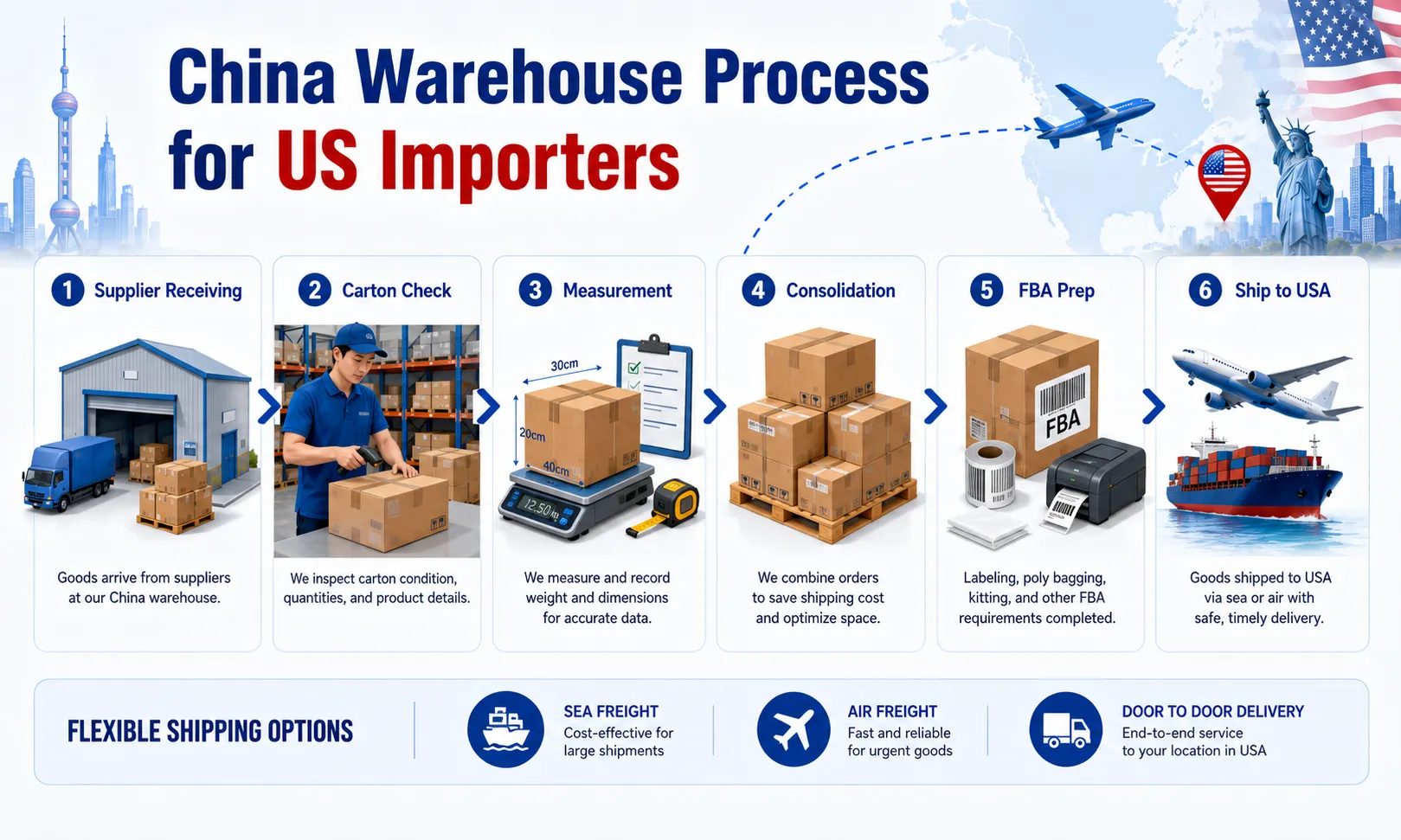
What Happens When Cargo Arrives at the China Warehouse?
1. Identify the delivery
Warehouse staff match the delivery to the customer code, supplier reference or expected-arrival notice. If the reference is missing or unclear, they may place the goods on hold until the importer or supplier confirms ownership.
2. Record the outer cartons
The receiving record should show how many outer cartons or pallets arrived. Staff can compare that quantity with the supplier’s delivery notice. However, an outer-carton count does not confirm the number of units inside each carton.
3. Note visible packaging condition
The warehouse can report clearly crushed, wet, torn, open or otherwise damaged outer packaging when visible during normal receiving. If the buyer requires detailed photos of every side, carton opening or a formal damage report, that additional work should appear in the service scope.
4. Measure the packed cargo
When requested, staff measure gross weight and carton dimensions after arrival. These figures help confirm total CBM or volumetric weight. Because factory estimates can change after final packing, warehouse measurements often provide a more reliable basis for the freight quotation.
5. Report exceptions before further handling
If carton quantity, marks, dimensions or visible condition differ from the expected information, the warehouse reports the exception. The importer can then ask the supplier for clarification, approve repacking or hold the goods before release.
What a Useful Warehouse Receiving Record Should Show
A warehouse receiving record should allow the importer to understand the cargo without relying only on a supplier message. The exact format varies, but a useful record normally contains the following information:
| Receiving Record | Information to Confirm | Purpose |
|---|---|---|
| Shipment identity | Customer code, supplier and purchase-order reference | Connects the delivery to the correct buyer |
| Arrival information | Receiving date and delivery reference | Establishes when the warehouse received the cargo |
| Package quantity | Outer cartons, crates or pallets received | Allows comparison with the supplier’s notice |
| Visible condition | Obvious outer-packaging exceptions | Identifies issues that may require buyer instructions |
| Cargo measurements | Gross weight and packed dimensions when included | Supports storage and freight planning |
| Current status | Received, held, awaiting instructions or ready for release | Shows the next required action |
The importer should report any discrepancy promptly. For example, if the supplier expected ten cartons but the warehouse received nine, the parties should resolve the missing carton before the cargo is repacked, combined or released.
How Short-Term Storage in China Works
Short-term storage creates a buffer between factory completion and international freight. It can help when the buyer is waiting for final shipping instructions, updated documents, a booking date or another operational decision.
VoltFreight can provide up to 30 days of free storage for eligible shipments when that allowance appears in the confirmed quotation. The free period is not automatic for every product, warehouse or shipment size. Before delivery, confirm:
- When the storage period starts
- How the warehouse calculates chargeable days
- Whether the allowance applies per delivery or per complete shipment
- What storage rate applies after the free period
- Whether storage is calculated by carton, pallet, CBM or occupied space
- Whether oversized, heavy or special cargo follows different rules
- What notice the warehouse needs before cargo release
Free storage covers space for accepted cargo under the agreed conditions. It does not automatically include unloading labor, repeated sorting, carton opening, inventory fulfillment, repacking or long-term stock management.
Basic Warehouse Receiving Is Not Full Product Inspection
A warehouse can confirm that outer cartons arrived and record visible shipping information. It cannot confirm product quality simply by receiving closed boxes. Therefore, the quotation should separate basic receiving from optional checking or professional inspection.
| Task | Basic Receiving | Additional Scope Needed? |
|---|---|---|
| Register supplier delivery | Normally included when pre-arranged | No |
| Count outer cartons | Can be included | Confirm before delivery |
| Note obvious outer-carton damage | Can be included | Confirm required photo detail |
| Open cartons or count inner units | Not automatic | Yes |
| Check model, color or product specification | Not included in basic receiving | Yes |
| Test product function or workmanship | Not included | Yes, arrange an inspection plan |
| Verify regulatory compliance | Not proven by warehouse receipt | Yes, obtain the required compliance review |
If you need product-level checks, review the separate China inspection service before shipping. Defining the scope in advance avoids treating a simple receiving photo as evidence of quantity, quality or compliance.
Carton Handling and Cargo Preparation Before Release
After receiving the goods, the warehouse may perform approved handling work. The buyer should specify the task and expected result before staff change the original packaging.
Carton reinforcement or replacement
Weak, torn or unsuitable outer cartons may need reinforcement or replacement. Before proceeding, the warehouse should confirm the number of affected cartons and any material or labor charges. After repacking, staff should update the package count, weight and dimensions.
Shipping marks and labels
The warehouse can apply supplied carton marks or freight labels when included in the quotation. The importer remains responsible for providing correct files and clear placement instructions. Product barcodes, marketplace labels and compliance markings require separate confirmation.
Palletization
Pallets can simplify forklift handling for suitable commercial cargo. However, palletization normally increases gross weight and occupied volume. The pallet type, size, material requirements and destination handling rules should be confirmed before work begins.
Amazon-specific labeling, polybagging, kitting and preparation belong to a separate service. Sellers that need those operations should use the Amazon FBA prep service in China page.
Which Products Need Warehouse Pre-Approval?
A China warehouse should review the product before issuing a receiving address. General commercial goods are usually easier to handle, but product characteristics can affect storage safety, carrier acceptance and insurance.
Disclose the following before supplier delivery:
- Lithium batteries or battery-powered products
- Liquids, powders, pastes or gels
- Chemicals, aerosols, perfume or flammable materials
- Food, supplements, cosmetics or medical products
- Magnets, motors or other products with magnetic properties
- Wooden crates, raw wood or wooden pallets
- Branded or intellectual-property-sensitive products
- Fragile, high-value, oversized or unusually heavy cargo
- Temperature-sensitive or humidity-sensitive goods
Do not describe special cargo only as “samples,” “accessories” or “general goods.” Accurate product information helps the warehouse decide whether it can receive the shipment and what documents or handling conditions may apply.
If Goods Come from Several Chinese Suppliers
The warehouse can receive separately approved deliveries from more than one supplier. Each batch should keep its own supplier or purchase-order reference until the importer confirms the next step. This prevents cartons from being mixed before missing goods or discrepancies are resolved.
However, the complete decision about whether to combine the batches belongs to a different search intent. It depends on supplier locations, ready dates, cargo compatibility, documents and the selected freight route. Read the dedicated guide on how to consolidate shipments from multiple suppliers in China for that workflow.
What Affects China Warehouse Service Costs?
Warehouse cost depends on the work performed and the space occupied. A low storage rate does not show the complete cost when the cargo needs repeated receiving, heavy unloading, carton opening or repacking.
- Number of inbound supplier deliveries
- Number and type of cartons, crates or pallets
- Total CBM, floor space and storage duration
- Manual unloading, forklift or heavy-cargo requirements
- Arrival photos and reporting detail
- Weight and dimension measurement
- Carton opening, unit counting or SKU separation
- Repacking, materials, labels and palletization
- Special storage or safety requirements
- Outbound loading and release instructions
Ask whether the quotation includes receiving, storage, measurements and outbound handling. Also confirm how the warehouse charges unplanned work. Written approval should come before optional repacking, labeling or other paid services begin.
How Cargo Leaves the China Warehouse
Before release, the warehouse should confirm the final package quantity and any measurements changed by repacking or palletization. The importer or forwarder then provides the outbound reference, collection instructions and approved shipping documents.
The warehouse service ends when the cargo is released under the confirmed plan. International freight, export procedures, U.S. customs clearance and final delivery follow the scope of the separate freight quotation. For the complete transportation stage, see shipping from China to the USA.
This separation matters because warehouse readiness does not guarantee carrier acceptance or customs clearance. The forwarder must still review the product, packed measurements, declared value, documents, route and U.S. destination before booking.
Information Needed for a China Warehouse Quote
Send enough information for the warehouse to approve the cargo and estimate the required work. If the supplier has not finished packing, identify which figures are estimates.
- Importer or customer name
- Supplier name, city and contact details
- Product name, material, intended use and photos
- Expected carton quantity
- Estimated gross weight and carton dimensions
- Expected delivery date
- Requested storage period
- Required receiving photos or measurements
- Any carton opening or unit-counting requirement
- Repacking, label, mark or pallet instructions
- Details of batteries, liquids, powders, magnets, wood or branded goods
- Cargo value and available HS or HTS code
- Planned U.S. destination and required cargo-release date
After review, VoltFreight can confirm whether the cargo is accepted, which warehouse location is suitable, what the supplier must place on the cartons and which services appear in the quotation.
How VoltFreight Supports Warehouse Receiving in China
VoltFreight coordinates the warehouse stage between your Chinese supplier and the later international shipment. We can issue approved delivery instructions, receive eligible commercial cargo, record outer cartons, report visible exceptions, measure packed goods and hold them under the confirmed storage terms.
Where requested and accepted, we can also arrange carton reinforcement, replacement cartons, shipping marks, labeling or palletization. We confirm optional work and charges before processing whenever the issue allows buyer approval.
Need a China warehouse before your supplier ships internationally? Send the supplier city, product details, expected cartons, weight, dimensions, requested warehouse work and U.S. ZIP code through the VoltFreight contact page.
FAQ About China Warehouse Service for US Importers
Can my Chinese supplier deliver directly to the VoltFreight warehouse?
Yes, after VoltFreight reviews and accepts the cargo. The supplier must follow the issued delivery instructions and place the correct customer or shipment reference on the outer packaging.
Will the warehouse count every product unit?
Not under basic receiving. Staff can record outer cartons when included in the scope. Opening cartons, separating SKUs or counting individual units requires advance instructions and an additional quotation.
Can I receive photos when my cargo arrives?
Arrival or exception photos can be arranged according to the confirmed service. Specify whether you need one overview image, carton-mark photos, damage photos or more detailed evidence before delivery.
Can the warehouse confirm the final weight and dimensions?
Yes, measurement can be included. If the warehouse later repacks or palletizes the cargo, it should measure the final configuration again before the freight booking.
Does warehouse receiving include product quality inspection?
No. Basic receiving identifies the delivery and can record outer-carton information. Product specifications, workmanship, function, unit quantity and compliance require a separately defined inspection or testing scope.
How long can VoltFreight store cargo in China?
Eligible shipments may receive up to 30 days of free storage when stated in the quotation. Confirm the start date, applicable cargo limits and storage charges after the free period before supplier delivery.
Can the warehouse accept batteries, liquids or branded goods?
Acceptance depends on the exact product, packaging, documents and planned route. Send complete product details and photos before the supplier dispatches any special or restricted cargo.
Can the warehouse send my goods to the United States?
The warehouse can release prepared cargo to an approved freight plan. International shipping, customs and U.S. delivery require a separate freight quotation based on the final cargo data and destination.
Receive and Store Supplier Cargo Before Export
A reliable China warehouse service for US importers creates a documented pause between supplier dispatch and international freight. It shows what reached the warehouse, how the outer packaging arrived, what the cargo measures and what action is still required.
Confirm cargo acceptance, receiving instructions, storage terms and paid handling work before the supplier sends the goods. That preparation gives the warehouse a clear scope and gives the importer better control before cargo leaves China.