Updated: September 2026.
Quick answer: You can ship new, undamaged lithium batteries and battery-powered products from China to the USA, but the shipment must be classified before a carrier can confirm the route. Identify the chemistry, Watt-hour rating, battery condition and whether the battery is shipped alone, packed with equipment or installed in equipment. Then match the cargo with an accepting air, sea, express or DDP service and prepare the U.S. import before departure.
A supplier may say the batteries are ready while one forwarder refuses them, another sends a surprisingly low general-cargo rate and a third asks for documents the buyer has never seen. These different answers usually do not mean that every battery is prohibited. They mean the exact battery, packing configuration, documents, carrier and U.S. import arrangement have not yet been reviewed as one shipment.
Shipping batteries from China to USA involves two connected checks. The first covers international dangerous-goods transport from China. The second covers U.S. customs entry, product-specific requirements and domestic delivery after arrival. Passing one check does not automatically satisfy the other.
This guide focuses on commercial shipments of new lithium-ion and lithium-metal batteries, including power banks, replacement packs and products with batteries. Lead-acid and dry-cell products require their own classification. Passenger baggage, waste batteries, recalled batteries and swollen, leaking, defective or damaged batteries fall outside the ordinary services described here.
The most useful first step is not sending the cargo to a warehouse. Send the battery label, product photographs, voltage, Ah or mAh, Watt-hour rating, quantity, UN38.3 test summary, SDS, packing details, supplier city and U.S. ZIP code to the forwarder. That information allows the route and quote scope to be checked before pickup.
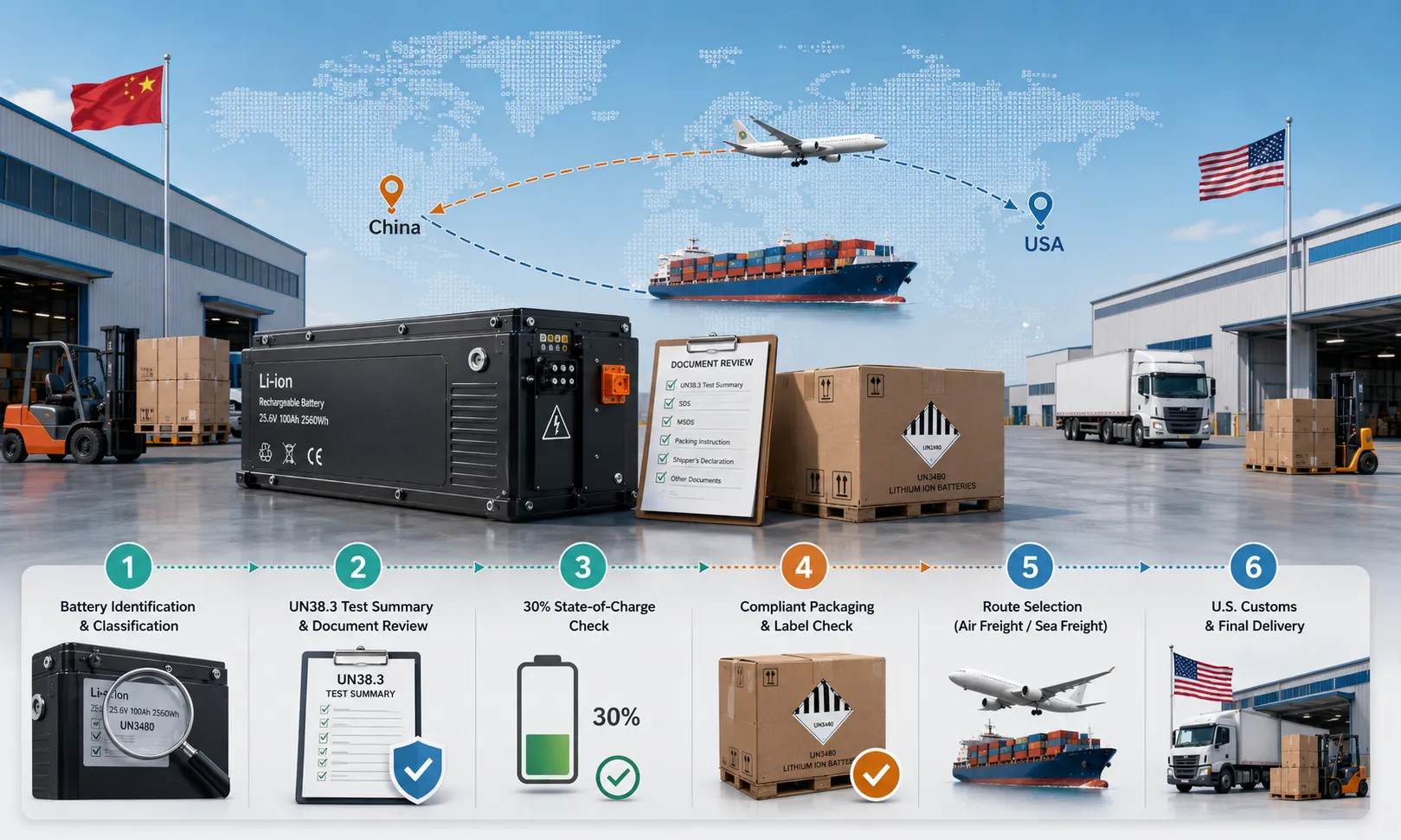
Can You Ship Batteries from China to the USA?
Yes, provided the actual goods are legal to import, the battery and package meet the rules that apply to their configuration, and the selected carrier accepts the shipment. There is no single approval that makes every battery acceptable to every airline, shipping line or courier.
The transport review normally considers:
- lithium-ion, lithium-metal, lead-acid or another chemistry;
- the battery model, voltage, capacity and Watt-hour rating;
- whether the battery is standalone, packed with equipment or contained in equipment;
- the number and net weight of batteries in each package;
- the state of charge for relevant air shipments;
- the condition of the batteries;
- the inner and outer packing; and
- the restrictions of the proposed carrier, transit point and handling station.
The U.S. import review asks different questions: Who will act as the Importer of Record? Which HTS classification applies to the imported article? Are additional duties or product rules involved? Is an ISF required for the ocean shipment? Who will arrange customs release and compliant domestic delivery?
A shipment is ready only when the transport plan and the U.S. import plan work together.
Step 1: Identify the Battery Before Comparing Freight Rates
“Lithium battery” is not a complete cargo description. A loose replacement pack, a power bank, a battery packed beside a tool and a battery installed inside a laptop can follow different packing instructions and carrier restrictions. Classify the physical shipment before comparing prices.
| Classification | Typical Configuration | Common Examples | Practical Shipping Effect |
|---|---|---|---|
| UN3480 | Lithium-ion batteries shipped alone | Power banks, replacement packs, portable power stations | Usually the most restricted lithium-ion category for air and courier service |
| UN3481 — packed with equipment | Battery and equipment in the same package, but the battery is not installed | Power tool with a separate battery, camera with a spare battery | Requires correct quantity, protection, packing and carrier review |
| UN3481 — contained in equipment | Battery installed inside the product it powers | Laptop, speaker, scanner, electric toothbrush | Often has more route options than standalone batteries, but disclosure remains mandatory |
| UN3090 / UN3091 | Lithium-metal batteries shipped alone or with equipment | Primary lithium cells and devices using them | Needs a separate lithium-metal review and cannot be treated as lithium-ion cargo |
A power bank is normally treated as a standalone battery because its main function is to supply power to another device. Adding a cable or retail box does not convert it into equipment containing a battery. Pure power-bank shipments therefore face stricter air and courier acceptance than many ordinary electronics.
A complete e-bike, a replacement e-bike battery and an e-bike packed with a spare battery are also different shipments. The same principle applies to solar-storage batteries, UPS units, cordless tools, drones and other battery-powered products. Send photographs of both the complete product and the battery label instead of describing every carton only as “electronics” or “parts.”
Products With Additional U.S. Requirements
Transport classification does not replace product compliance. A children’s battery-operated toy may need a Children’s Product Certificate and applicable third-party testing. An adult consumer product may require a General Certificate of Conformity only when a relevant CPSC rule applies. A complete drone may involve equipment-authorization questions for its radio components, while an e-bike or mobility product may face additional safety expectations from buyers, platforms, insurers or local authorities.
UL certification is not a universal condition for CBP to release every battery shipment. However, a retailer, marketplace, project specification, insurer, electrical code or customer may require an applicable UL or equivalent standard. Confirm the sales-market requirement before production rather than after the goods reach a U.S. port.
If the Battery Is Not Lithium
Lead-acid batteries contain corrosive electrolyte and require a different dangerous-goods review, including leakage control and suitable orientation. Some dry cells may qualify for different treatment, but bulk quantities still need accurate identification and short-circuit protection. Do not apply UN3480 or UN3481 instructions to a different chemistry.
Our broader guide to shipping batteries from China explains general classification and packing principles. This page remains focused on the China-to-USA route and the decisions a U.S. importer must make.
Step 2: Choose Air, Sea, Express or DDP for the Battery Shipment
When shipping batteries from China to USA, the best method depends on carrier acceptance first, then urgency, shipment size, budget and the buyer’s ability to handle the U.S. side. A fast service is not useful if the battery cannot be accepted, while a cheap port rate is incomplete if it excludes dangerous-goods handling, customs and delivery.
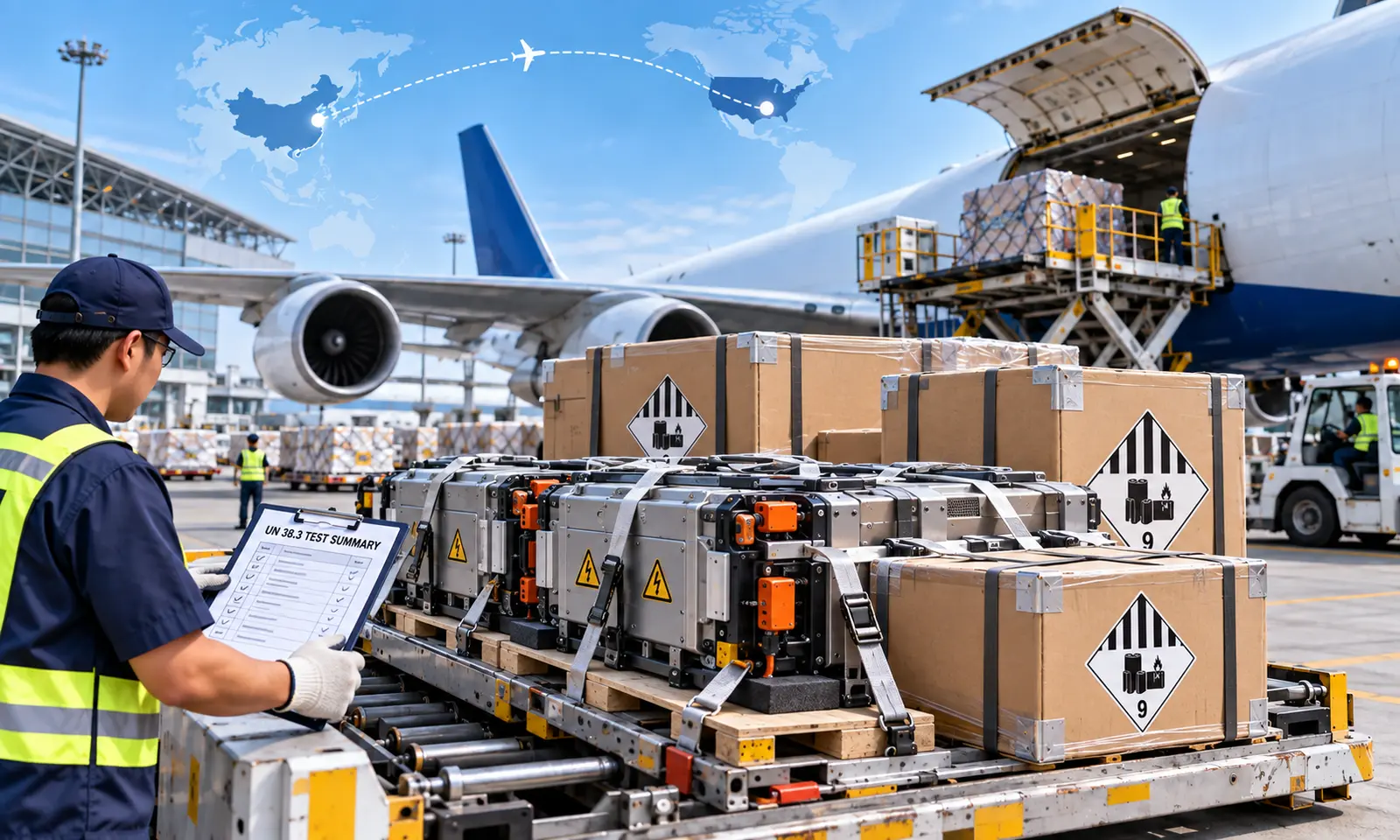
The planning ranges below begin after the cargo passes review and the selected service accepts it. They do not include time needed to replace incorrect documents or rebuild noncompliant packing.
| Service | Planning Transit | Best Fit | Pricing Basis | U.S. Responsibility |
|---|---|---|---|---|
| Air freight to airport | About 4–8 days | Urgent commercial cargo and importers with a broker | Chargeable weight plus DG and origin handling | Importer normally arranges entry, terminal release and inland delivery |
| Air DDP | About 10–18 days | Eligible shipments needing coordinated customs and door delivery | Chargeable weight, product value, customs treatment and ZIP code | Follows the written DDP scope |
| Sea freight to port | About 18–35 days port to port | Heavy batteries, commercial quantities and storage systems | LCL, FCL or shipment pricing plus DG charges | Importer normally handles entry, destination charges and trucking |
| Sea DDP | About 30–50 days | Eligible heavy cargo where cost matters more than speed | Weight or volume, product value, clearance scope and ZIP code | Follows the written DDP scope |
| Express or courier | About 5–10 days | Selected smaller batteries or products with batteries installed | Chargeable weight and the approved battery service | Depends on courier account, entry method and destination |
Air Freight to a U.S. Airport
Airport-to-airport service suits urgent commercial shipments when the importer already has a customs broker and a delivery plan. VoltFreight can coordinate supplier pickup, document review, China export handling, dangerous-goods booking and air freight to the accepted airport.
Eligible standalone UN3480 lithium-ion batteries normally require cargo-aircraft capacity, a compliant state of charge, suitable packing and an airline that accepts the route. A normal air-freight rate sheet is not a confirmed dangerous-goods booking.
Air DDP Door-to-Door
Air DDP can combine air transport with the agreed U.S. customs and final-delivery services. Battery type, shipment size, product value and destination still require review. Minimum chargeable weights vary by approved network; there is no universal DDP minimum for every battery shipment.
Sea Freight and Sea DDP
Sea freight is often the commercial starting point for large standalone batteries, LiFePO4 storage batteries, e-bike batteries, portable power stations and industrial packs. Buyers can compare sea freight from China to the USA by LCL, FCL, port service or eligible DDP shipping from China to the USA.
Removing the aircraft does not turn a battery into general cargo. The shipping line, terminal and warehouse still need accurate battery information, approved packing and the relevant dangerous-goods documents. A port-to-port ocean rate should also be separated from destination charges, entry, duties and inland trucking.
Express and Courier Services
DHL, UPS or FedEx may accept certain electronics with batteries installed and some approved smaller shipments. Standalone batteries, power banks and high-capacity packs face tighter account and network restrictions. If a supplier’s courier account refuses the parcel, a specialist air route may still be possible, but the shipment must be reviewed again rather than booked as general cargo.
What DDP Should and Should Not Mean
DDP is useful when it connects China pickup, international freight, the agreed import arrangement and final delivery. It becomes risky when “all-inclusive” does not identify the customs scope, duties, importer arrangement or delivery conditions.
For an eligible shipment, a VoltFreight Air DDP or Sea DDP quotation can include supplier pickup or Shenzhen warehouse receipt, battery and packing review, China export handling, international transportation, the agreed U.S. customs arrangement, included duties or taxes and delivery to the stated address. Repacking, special inspections, storage, remote-area service, liftgate service or missed appointments must be governed by the written quotation and actual shipment conditions.
Before paying, ask three questions: Who is responsible for the import entry? Are the applicable duties included? Does the price end at an airport, port, warehouse or the consignee’s door?
Step 3: Prepare the Battery Documents, Packing and 2026 Air Requirements
A battery shipment should be reviewed while the goods are still with the supplier. A factory may have a test report for one model and produce a visually similar model under another code. The physical battery, label, documents and invoice must describe the same product.
Documents and Product Information to Collect
- exact battery manufacturer and model;
- chemistry, voltage and Ah or mAh;
- Watt-hour rating;
- individual battery weight and quantity per package;
- UN38.3 test summary for the exact design type;
- current SDS or MSDS;
- battery specification sheet;
- commercial invoice and packing list;
- clear photographs of the battery and product labels;
- inner- and outer-packing photographs; and
- a dangerous-goods declaration or other transport documents when the booked service requires them.
UN38.3 and SDS Answer Different Questions
A UN38.3 test summary helps show that the battery design type passed the applicable tests under the UN Manual of Tests and Criteria. The manufacturer, model and technical details must match the physical battery. A report for a similar-looking pack does not automatically cover the cargo.
An SDS describes hazards, composition and handling information. It supports the review, but it does not reserve capacity or prove that a specific airline, vessel, transit airport or courier account will accept the shipment. The forwarder still compares the documents with the label, Watt-hours, quantity, packing and proposed route.
State of Charge Matters in 2026
Standalone UN3480 lithium-ion batteries offered under the normal air provisions are generally limited to a state of charge not exceeding 30% and normally move on cargo aircraft. From January 1, 2026, reduced state-of-charge requirements also apply to lithium-ion batteries packed with equipment under the relevant PI966 provisions. For batteries contained in equipment under PI967, IATA strongly recommends the reduced state of charge, but it is not presented as the same universal mandatory rule.
Do not let the supplier fully charge the batteries and release them before the air route is reviewed. Check the shipment against the current IATA lithium battery guidance and the selected airline’s operator variations.
Packing, Marks and Labels
Final requirements depend on classification, quantity and packing instruction. They can include strong outer packaging, protected terminals, separation against short circuit, cushioning against movement, applicable UN markings, lithium battery marks, Class 9 hazard labels and cargo-aircraft-only labels.
Do not download a label image, place it anywhere on the carton and assume the package is compliant. Size, color, placement, package specification and the information printed on the mark can matter. If the factory cannot complete the packing, VoltFreight can assess whether suitable repacking, labeling and palletizing can be arranged before the booking cutoff.
Repacking can correct a carton, cushioning, label or pallet problem. It cannot make a damaged battery eligible for ordinary transport or repair a test report that does not cover the actual model.
Step 4: Prepare the U.S. Import Before the Cargo Leaves China
Carrier acceptance solves the international transport question. It does not complete the U.S. import. The importer, broker, tariff treatment and delivery plan should be established before the battery leaves China. Our customs clearance services page explains how shipment data, broker handover, duty responsibility and release-to-delivery planning connect.
Importer of Record, Customs Broker and Bond
The Importer of Record is responsible for reasonable care, accurate entry information and applicable duties. For airport- or port-based freight, identify the importer and customs broker before departure. Commercial entries may require a customs bond, and first-time importers may need CBP registration information.
CBP announced enhanced verification of Form 5106 information beginning September 18, 2026. Inaccurate or unverifiable data can interrupt an importer’s registration. Buyers making their first commercial entry can review our guide to CBP Form 5106 and Importer of Record.
HTS Classification, Base Duty and Section 301
The imported article determines the HTS classification. A standalone battery, a battery part and a complete machine containing a battery may use different codes. For example, certain standalone rechargeable lithium-ion batteries classified under HTSUS 8507.60.0020 may have a 3.4% general duty rate and an additional 25% Section 301 duty in 2026. That example is not a universal rate for every battery-powered product.
A laptop, tool, speaker or complete machine is normally classified as the finished article rather than automatically under the battery heading. Check the actual goods against the current Harmonized Tariff Schedule and applicable Chapter 99 measures. For repeated high-value imports with genuine classification uncertainty, discuss a CBP binding ruling with a qualified customs professional.
Do not assume that a low-value shipment will automatically enter duty-free. Entry treatment and current de minimis rules should be checked against CBP’s current e-commerce guidance.
ISF for Ocean Freight
For applicable ocean shipments, the Importer Security Filing is separate from the later customs entry. The importer or filing agent needs the required shipment-party and classification information before loading. Filing is generally due no later than 24 hours before the cargo is loaded aboard the vessel at the foreign port. Late, inaccurate or mismatched filing can lead to holds and possible penalties that may reach USD 5,000 per violation.
Air cargo does not use the ocean ISF process. Our ISF 10+2 guide explains the roles and timing in more detail.
CPSC, UL, FCC and Product-Level Compliance
CBP entry, dangerous-goods transport and product compliance are connected but separate. A GCC is relevant only when an adult consumer product is subject to an applicable CPSC-enforced rule. The CPSC guidance for a General Certificate of Conformity explains who issues it and when it applies. Children’s products subject to children’s safety rules normally require a CPC based on required third-party testing. The certificate must cover the finished product and applicable rule; a generic battery report is not a substitute.
UL certification is not a universal customs-release document, but buyers, platforms, retailers, insurers or local codes may require the applicable standard. FCC authorization may apply to the radio function of a complete wireless device, not simply because the shipment contains a battery. Establish these requirements during sourcing and production.
Lead-acid batteries can also create post-import recycling or environmental obligations. Those responsibilities depend on the product and destination and should not be confused with the customs-entry documents for lithium cargo.
49 CFR and Delivery After Customs Release
International air or ocean compliance does not automatically complete the U.S. domestic movement. PHMSA administers the U.S. hazardous-materials rules under 49 CFR. The U.S. trucker, 3PL and other partners must understand the battery being moved and the applicable shipping-paper, marking and operational requirements. See the official PHMSA lithium battery guidance for U.S. transportation information.
A successful flight or customs release also does not guarantee simple delivery. A 20 kg carton going to a staffed warehouse differs from a 350 kg pallet going to a residential garage. Confirm whether the destination is a business, residence, Amazon facility or 3PL, and disclose dock access, forklift availability, liftgate needs, appointments and receiving hours.
Amazon will not act as the Importer of Record or pay customs duties for the seller. Marketplace listing approval, FBA receiving rules, international carrier acceptance and customs entry are separate approvals.
How Much Does It Cost to Ship Batteries from China to the USA?
The cost of shipping batteries from China to USA depends on classification, service scope and chargeable size. For commercial battery cargo of 100 kg or more, airport-to-airport air freight often begins in a broad planning range of approximately USD 5–12+ per chargeable kilogram. Small shipments, difficult battery configurations, limited capacity or remote pickup can cost more. For general rate components beyond battery-specific handling, review our China-to-USA shipping cost guide.
This range is not an Air DDP price. DDP also depends on the commercial value, HTS classification, applicable duties, entry arrangement, ZIP code and delivery conditions. Sea freight may be quoted by weight/measure, cubic meter, shipment or container, with dangerous-goods charges shown separately or included in the agreed rate.
A complete quote should identify whether it includes:
- pickup from the Chinese supplier;
- DG warehouse and China export handling;
- document review and declaration preparation;
- repacking, marks, labels or pallets;
- airline or shipping-line dangerous-goods charges;
- international freight;
- U.S. customs brokerage and bond;
- duties, Section 301 tariffs and other applicable charges;
- airport, terminal or port charges;
- customs examination or storage if incurred; and
- final delivery, appointment, residential or liftgate service.
Based on market references reviewed in September 2026, historical planning ranges can help explain why battery quotes differ. Depending on the provider and shipment, ocean DG surcharges may add roughly USD 150–400 per container, third-party dangerous-goods document preparation may add USD 200–500 per shipment, and ordinary customs brokerage may fall around USD 150–350. A CBP examination can add approximately USD 300–800 before storage or handling, while applicable product testing may cost USD 500–2,000 or more per model. These are not fixed VoltFreight charges or guaranteed current rates; obtain shipment-specific quotations before calculating landed cost.
Two quotations can show the same route and still cover different services. A lower figure is not necessarily cheaper if it stops at the U.S. airport while another quotation includes entry and delivery.
Real VoltFreight Shipment: 6,000 kg to Chicago
Completed shipment — April 2026: VoltFreight handled an airport-to-airport shipment of 6,000 kg in 300 cartons to Chicago. The booked air-freight rate was USD 5.50 per kilogram. Before airline acceptance, the outer cartons were prepared with the applicable UN markings and Class 9 lithium battery dangerous-goods labels.
This is a completed shipment example, not a current rate guarantee. The USD 5.50/kg figure covered the airport-to-airport basis rather than the complete U.S. landed cost. Battery specification, airline capacity, booking week, packing and service scope can change a new quotation. The case also shows why shipment size matters: fixed review and handling costs are spread across more kilograms on a large booking than on one replacement battery.
Chargeable Weight Can Exceed Scale Weight
Air freight is billed on chargeable weight: the greater of actual weight and volumetric weight. VoltFreight commonly uses the following formula for preliminary air-freight planning:
Length × Width × Height in centimeters ÷ 6,000
A battery-powered machine in a large wooden case may produce a higher volumetric weight even though the battery itself is dense. Send the final packed dimensions, not only the product dimensions.
How Long Does Battery Shipping from China to the USA Take?
The total time for shipping batteries from China to USA depends on both approval and transit. Once an eligible shipment is accepted, airport-to-airport air freight commonly takes about 4–8 days. Selected express services may take 5–10 days, while Air DDP often takes 10–18 days. Sea freight commonly needs about 18–35 days port to port, and Sea DDP may take around 30–50 days.
These are planning ranges, not delivery guarantees. China origin, U.S. coast, airline or vessel schedule, transshipment, dangerous-goods capacity, customs, terminal conditions and inland ZIP code can change the result. Peak periods before Chinese New Year and the year-end retail season may also add booking and transport time.
The flight or sailing is only one part of the schedule. Build the timeline from:
- battery and document review;
- packing correction when required;
- carrier acceptance and booking;
- China pickup and export handling;
- international transit;
- U.S. entry and terminal release; and
- final delivery.
A five-day flight does not help when the cargo spends ten days waiting for corrected documents or a compliant package. If the order has a hard deadline, disclose it before the supplier releases the goods so that the available air freight from China to the USA routes can be compared against cost and acceptance risk.
Why Do Carriers Reject Batteries or U.S. Customs Hold the Shipment?
Carrier rejection and customs holds do not have one universal cause. Transport problems normally arise before departure, while customs and product-compliance problems appear during U.S. entry. The most common preventable issues include:
- Wrong battery configuration: cargo declared as contained in equipment is actually a standalone pack or power bank.
- UN38.3 mismatch: the report manufacturer or model does not match the physical battery.
- Incomplete battery data: the Watt-hour rating, quantity, net battery weight or state of charge is missing.
- Unsuitable packing: terminals are exposed, batteries can move, the outer carton is weak or required marks are missing.
- Undeclared batteries: cartons described only as electronics or accessories contain lithium batteries.
- Carrier or route restriction: the proposed account, airline, transit airport or handling station does not accept the configuration.
- Wrong HTS classification: the declared code does not match the standalone battery or finished product.
- Late or inconsistent ISF: ocean-filing data is late or does not match the transport documents.
- Missing product certificate: a certificate required for the particular regulated product is unavailable or does not cover the model.
- Unclear importer or value: the entry lacks a valid Importer of Record, credible commercial description or supportable value.
- Domestic delivery problem: the U.S. carrier was not told about the battery or the receiver cannot unload the freight.
Do not hide the battery to obtain a cheaper general-cargo rate. Undeclared lithium batteries can be stopped during screening, rejected by the carrier and exposed to enforcement or additional handling costs.
What to Do After a Carrier Rejects the Cargo
A rejection does not always end the shipment. First identify whether the problem comes from the document, battery, package or route. VoltFreight can assess repacking for a carton, label or pallet problem. The supplier must correct reports that do not cover the actual model. If the route refuses the configuration, another approved air service or sea freight may be considered.
- hold the cargo before another booking;
- photograph and identify the problem;
- compare the physical battery with the documents;
- confirm whether repacking can solve the issue;
- approve the revised cost and schedule;
- rebook the same mode or change route; and
- release the cargo only after the new plan is confirmed.
There are also cases where the correct decision is to stop. VoltFreight does not place swollen, leaking, recalled, defective or visibly damaged batteries into an ordinary air, sea or DDP service. Those batteries require a separate specialist assessment and cannot be made eligible simply by adding a label.

How VoltFreight Handles Battery Shipping from China to the USA
VoltFreight treats shipping batteries from China to USA as one connected chain rather than selling an isolated air or ocean rate. The process normally includes:
- Pre-review: check the battery label, configuration, Watt-hours, reports, product photos, quantity and U.S. destination.
- Route selection: compare accepting air, sea, express or DDP options and explain where each quotation ends.
- China coordination: communicate with the supplier, arrange EXW pickup or receive cargo at our Shenzhen warehouse.
- Physical preparation: inspect visible packing, and arrange feasible repacking, marks, labels or palletizing after approval.
- Booking and export: coordinate the dangerous-goods booking, export handling and departure information.
- U.S. coordination: follow the agreed customs, terminal-release and delivery scope until handover or final delivery.
For port or airport service, the quotation identifies the responsibilities transferred to the U.S. importer. For DDP service, the written quotation identifies the agreed customs and delivery scope. Final acceptance always depends on the actual battery model, condition, documents, packing, quantity, carrier and route.
What Information Is Needed for an Accurate Battery Shipping Quote?
You do not need to determine every packing instruction yourself. You do need to disclose the battery and provide enough information for a real review.
- product name, intended use and clear photographs;
- battery manufacturer, label and exact model;
- chemistry, voltage, Ah or mAh and Watt-hours;
- whether the battery is standalone, packed with equipment or installed in equipment;
- UN number if already known;
- individual battery weight and quantity per carton;
- UN38.3 test summary and SDS/MSDS;
- battery specification sheet;
- inner-packing, carton and pallet photographs;
- carton or pallet quantity, dimensions and gross weight;
- commercial value, Incoterm and cargo-ready date;
- supplier pickup city in China;
- U.S. ZIP code and full delivery address;
- airport, port, door-to-door or DDP requirement; and
- business, residential, Amazon or 3PL delivery type, including dock or forklift availability.
VoltFreight will identify obvious information, document or packing gaps, compare practical routes and explain what the selected quotation includes. Review before factory release reduces the risk of warehouse storage, return freight and an expensive mode change.
Send VoltFreight your battery details for a China-to-USA route review and quotation.
Frequently Asked Questions
Are UN38.3 and SDS enough to book a battery shipment?
No. They are important review documents, but the forwarder and carrier must also check the exact model, Watt-hours, configuration, quantity, packing, state of charge where applicable and route restrictions. A report for another model does not cover the physical battery.
Can standalone UN3480 lithium batteries fly from China to the USA?
Eligible new and undamaged UN3480 batteries can move through approved cargo-aircraft services. The shipment normally needs a state of charge not exceeding 30%, compliant packing, matching documents and carrier acceptance. Capacity and route approval must be confirmed before pickup.
Can power banks ship from China to the USA by DHL, UPS or FedEx?
Sometimes, but power banks are normally treated as standalone lithium-ion batteries and face stricter courier controls. Acceptance depends on the battery, quantity, packing, shipper account and network. If courier is unavailable, compare a specialist air service or sea freight rather than declaring the goods as ordinary electronics.
What does DDP battery shipping include?
It includes only the services stated in the confirmed quotation. Check China pickup, DG handling, international freight, U.S. customs arrangement, duties, delivery address and special delivery services. Do not assume that the word “DDP” automatically covers repacking, customs examinations, storage, remote delivery or undisclosed address conditions.
Can damaged, swollen, used or recalled batteries use the same route?
No. VoltFreight’s ordinary battery services accept new, undamaged batteries. Swollen, leaking, defective, recalled, damaged, waste or disposal batteries need a separate specialist review and must not be sent to a normal warehouse or booked under an ordinary battery channel.
Plan the Battery, Route and U.S. Import as One Shipment
The safest way to ship batteries from China to the USA is to make the decisions in the correct order. Identify the chemistry and configuration, confirm the exact battery documents, select a carrier that accepts the shipment, prepare the U.S. import and only then release the cargo and book transportation.
The lowest headline rate can become expensive when it excludes dangerous-goods handling, uses the wrong battery classification or stops before customs and delivery. A complete plan explains what the carrier accepts, what the supplier must prepare, who is responsible in the United States and what the quotation covers from pickup to final handover.
Important: This guide supports freight planning. Current IATA, ICAO, IMDG, PHMSA, CBP, CPSC, carrier and route requirements take priority over general website information. Final acceptance depends on the actual battery model, condition, configuration, documents, packing, quantity, carrier and destination.