Updated: August 2026.
Shipping e-bikes from China to Greece requires more planning than shipping ordinary bicycles or general cargo. Importers need to review not only freight cost and transit time, but also the exact vehicle category, lithium battery configuration, CE documents, EU product rules, HS/TARIC classification, possible trade-defence duties, Greek VAT and final delivery conditions.
For most commercial e-bike orders, FCL sea freight is usually the practical starting point because complete electric bicycles are bulky and battery-powered. Meanwhile, LCL can work for smaller shipments when the consolidation warehouse and carrier accept the cargo. Air freight is much more route-sensitive, so the forwarder should review the battery-powered vehicle classification and airline acceptance before booking.
In addition, the product itself matters. Freight forwarders and importers should not treat a standard pedal-assist e-bike, a speed pedelec, a standing e-scooter, a high-powered electric vehicle and a standalone spare battery as the same cargo.
For importers, wholesalers, mobility retailers and distributors, the safest sequence is therefore: identify the exact product → review battery transport → confirm EU product compliance → check TARIC and trade-defence exposure → choose the freight route → confirm Greek customs and delivery.
Need an e-bike or e-scooter shipping quote from China to Greece? Send VoltFreight the product photos, model list, motor power, assisted speed, battery specifications, carton quantity, dimensions, gross weight, total CBM, supplier city, invoice value and final Greek delivery address through our contact page.
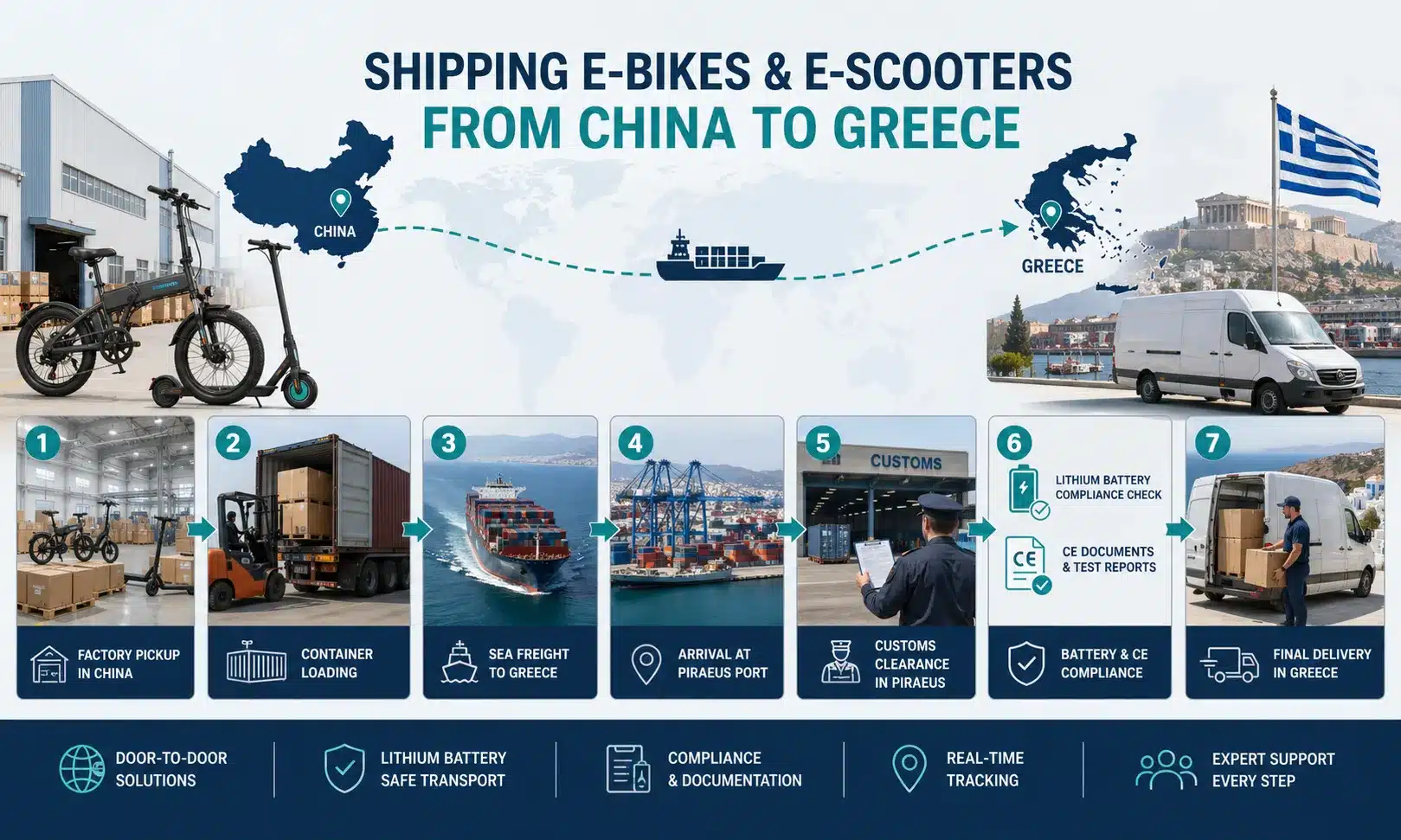
Quick Answer: What Is the Best Way to Ship E-Bikes from China to Greece?
For larger commercial orders, FCL sea freight is normally the first method to compare. It reduces consolidation handling and gives the importer more control over loading, cartons, accessories and battery-powered vehicles inside the container.
Meanwhile, LCL sea freight can work for smaller trial orders after the origin warehouse and carrier confirm battery and dangerous-goods acceptance. Because e-bikes and e-scooters are bulky, importers should also compare the LCL cost against total CBM and destination handling charges.
Air freight can work for some parts, samples or eligible battery-powered cargo. However, importers should not book complete e-bikes as ordinary air cargo before the forwarder confirms classification and airline acceptance.
DDP also requires careful review. A DDP quote does not remove product-compliance requirements, trade-defence duties, customs valuation or battery restrictions.
| Planning Question | Practical Answer |
|---|---|
| Best method for larger e-bike orders | Usually FCL sea freight after battery and customs review |
| Smaller commercial shipments | LCL may work when the DG warehouse and carrier accept the cargo |
| Complete lithium-ion battery-powered vehicle | Review the applicable vehicle classification, including UN3556 where relevant |
| Standalone spare battery | Review separately from the complete e-bike or e-scooter |
| EU product compliance | Confirm vehicle category, CE documentation and applicable technical requirements |
| Electric bicycle import duties | Check TARIC plus current anti-dumping and countervailing measures before shipment |
| Greek VAT | The standard VAT rate is currently 24% |
| Main Greek sea gateway | Piraeus is an important gateway for containerized China-to-Greece cargo |
| DDP | Use only after product, customs, duty, battery and delivery scope are confirmed |
E-Bike, E-Scooter or Speed Pedelec? Identify the Product First
The term “electric bike” is too broad for freight, customs and EU product-compliance planning.
Before requesting a quotation, identify whether the shipment contains a standard pedal-assist bicycle, speed pedelec, standing e-scooter, another battery-powered vehicle, standalone battery, charger, motor, controller, frame or mixed spare parts.
Standard Pedal-Assist E-Bikes
One important EU distinction concerns pedal-assist cycles equipped with an auxiliary electric motor having a maximum continuous rated power of no more than 250 W. In addition, assistance must stop when the cyclist stops pedalling and progressively reduce before cutting off at 25 km/h.
As a result, this type of product follows a different regulatory framework from more powerful or faster motor vehicles.
Therefore, ask the supplier for:
- Maximum continuous rated motor power
- Maximum assisted speed
- Whether assistance requires pedalling
- Whether the product has an independent throttle
- Battery voltage and capacity
- Exact model and manufacturer
Speed Pedelecs and Higher-Powered E-Bikes
A product that exceeds the common 250 W / 25 km/h pedal-assist profile should not automatically follow ordinary EPAC treatment.
As a result, higher motor power, higher assisted speed or different propulsion functions can change the vehicle category, technical approval requirements and customs treatment.
Therefore, confirm the category before the goods leave China rather than relying on the supplier’s marketing description of “electric bicycle.”
E-Scooters
By contrast, importers should review standing e-scooters separately from pedal-assist bicycles because their product rules, vehicle classification and tariff treatment can differ.
Therefore, do not automatically apply an electric-bicycle TARIC code, anti-dumping treatment or EN 15194 document package to every e-scooter simply because both products use lithium batteries.
Spare Batteries, Chargers and Parts
A standalone e-bike battery creates a different transport issue from a battery installed in a complete vehicle.
Likewise, chargers, motors, displays, controllers, frames and mechanical parts may use different tariff classifications and freight conditions.
Therefore, prepare a model and SKU list that clearly separates complete vehicles, batteries and spare parts in mixed shipments.
FCL, LCL, Air Freight or DDP: Which Shipping Method Works?
FCL Sea Freight
FCL is normally the first option to compare for distributor orders, wholesale inventory and larger batches of complete e-bikes or e-scooters.
As a result, the container holds only one shipper’s cargo, which reduces consolidation handling and makes it easier to control loading, carton orientation, accessories and model quantities.
However, FCL does not turn battery-powered vehicles into ordinary cargo. The forwarder still needs the correct product and battery information before booking.
For the main Greece ocean route, see our guide to sea freight from China to Piraeus, Greece.
LCL Sea Freight
For smaller orders, LCL can make sense when the cargo does not justify a full container.
However, the shipment passes through consolidation and deconsolidation warehouses. Therefore, the origin warehouse must accept the battery-powered product before workers load it with other shipments.
For this reason, do not assume that an LCL quote for ordinary bicycles automatically applies to e-bikes.
Air Freight
Air freight is not the default route for complete e-bikes or e-scooters.
Battery-powered vehicles require classification and airline acceptance. In addition, chargeable weight can become expensive because complete bikes are relatively bulky.
Instead, air freight may make more sense for urgent controllers, chargers, displays, motors, mechanical spare parts or other products after the carrier completes the necessary cargo review.
For general air-cargo planning, see air freight from China.
DDP Shipping
DDP can combine several logistics steps into one service scope. However, importers should never use it as a shortcut around EU customs, product compliance or trade-defence measures.
A workable e-bike DDP review needs the actual product model, motor power, speed, battery configuration, declared value, HS/TARIC information, CE documents, supplier information and final delivery address.
How Much Does It Cost to Ship E-Bikes from China to Greece?
There is no reliable universal per-bike or per-CBM rate without the actual shipment details.
The freight cost depends on factors such as:
- Supplier city in China
- Number of e-bikes or e-scooters
- Carton dimensions
- Total gross weight
- Total CBM
- FCL or LCL service
- Battery-powered vehicle acceptance
- Dangerous-goods handling where applicable
- Origin warehouse and port
- Destination terminal charges
- Greek delivery postcode
- Unloading requirements
More importantly, importers should separate the freight cost from the total landed import cost for larger orders.
Therefore, the budget may need to include:
- Factory value
- China origin transportation
- International freight
- Insurance where applicable
- Ordinary customs duty where applicable
- Anti-dumping duty where applicable
- Countervailing duty where applicable
- Import VAT
- Customs-broker and destination handling charges
- Final truck delivery
As a result, the cheapest ocean rate does not necessarily produce the lowest landed cost.
For route-level freight planning, review our China to Greece shipping cost guide.
Lithium Batteries, UN3556 and Battery Documents
Battery transport remains a critical part of e-mobility shipping. However, importers should not automatically treat a complete battery-powered vehicle as an ordinary electronic device containing a lithium battery.
Complete Battery-Powered E-Bikes and E-Scooters
International dangerous-goods rules now include specific entries for lithium-battery-powered vehicles. For eligible lithium-ion battery-powered vehicles, UN3556 — Vehicle, lithium ion battery powered may be relevant.
However, the correct classification depends on the physical product and battery configuration. Therefore, do not automatically describe every complete e-bike as UN3481 simply because the vehicle contains an installed lithium-ion battery.
Before booking, provide:
- Complete vehicle model
- Battery manufacturer and model
- Battery chemistry
- Nominal voltage
- Rated capacity
- Watt-hour rating
- Battery location in the vehicle
- UN38.3 test summary
- Battery specification
- SDS when requested for route review
- Product and packing photographs
Standalone Spare E-Bike Batteries
When a spare battery travels without the vehicle, the shipper should identify it separately. It can follow a different lithium-battery transport classification and different packaging requirements from the complete e-bike.
Consequently, adding loose spare batteries after the carrier approves the original freight configuration can change the booking requirements.
UN38.3 Still Matters
UN38.3 information should correspond to the actual battery design used in the product. Therefore, a test summary for another battery manufacturer, model or capacity should not automatically cover the shipment.
The same principle applies when the factory changes battery suppliers without changing the external e-bike model.
This page focuses on the e-bike-specific transport issue. For the broader rules covering standalone batteries, UN3480, UN3481, UN38.3, packing, air freight, sea freight and global delivery, read our complete guide to shipping batteries from China.
CE, EN 15194 and EU Vehicle Classification
Transport acceptance and EU product compliance are different checks.
For example, a carrier may accept an e-bike even when the importer still lacks the documentation needed to place the product on the EU market. Likewise, a supplier’s CE documentation does not prove that every airline, shipping line or dangerous-goods warehouse will accept the cargo.
CE Declaration of Conformity
The Declaration of Conformity should identify the actual product model and the applicable EU legislation used by the manufacturer.
Therefore, check that the model numbers on the Declaration, test documentation, labels, manual and commercial records remain consistent.
A generic declaration belonging to another e-bike series is a warning sign.
EN 15194
EN 15194 is an important standard for electrically power-assisted cycles. The current harmonised-standard framework includes EN 15194:2017+A1:2023.
However, importers should not treat an “EN 15194 certificate” as a universal document that automatically proves full EU conformity. In particular, the harmonised standard currently carries a restriction relating to vibration requirements, while the manufacturer remains responsible for the complete conformity assessment of the finished product.
Therefore, ask the supplier for the underlying model-specific documentation rather than only a certificate cover page.
Check Motor Power and Assisted Speed
For the common EPAC exclusion under Regulation (EU) No 168/2013, the auxiliary electric motor must have a maximum continuous rated power of no more than 250 W. In addition, assistance must stop when the cyclist stops pedalling and progressively reduce before cutting off at 25 km/h.
Products outside this profile require a separate classification review.
This distinction is especially important when a supplier describes a higher-powered model as a normal “EU e-bike” without explaining the motor, speed or throttle configuration.
Anti-Dumping Duties, Countervailing Duties and Greek VAT
Customs cost can be more important than the ocean freight rate for electric bicycles imported from China.
EU Anti-Dumping Measures on Chinese Electric Bicycles
The European Union currently maintains definitive anti-dumping measures on certain cycles with pedal assistance and an auxiliary electric motor originating in China.
In practice, the current measure covers specified CN/TARIC classifications, while the applicable anti-dumping rate varies according to the manufacturer and its additional TARIC code.
Therefore, importers should confirm:
- Exact product scope
- CN/TARIC classification
- Actual Chinese manufacturer
- Applicable TARIC additional code
- Current manufacturer-specific duty rate
For this reason, do not assume one percentage applies to every Chinese e-bike manufacturer.
Countervailing Duties
Separate countervailing measures also apply to electric bicycles within the defined product scope originating in China.
Again, the applicable rate depends on the responsible manufacturer and current EU measure.
Do These Duties Automatically Apply to E-Scooters?
No. The electric-bicycle trade-defence measures have a defined product scope.
Therefore, a standing e-scooter, electric motorcycle, spare battery or other mobility product needs its own tariff and trade-measure review rather than automatically inheriting the electric-bicycle duty treatment.
Greek VAT
The standard Greek VAT rate is currently 24%.
Importers should therefore plan VAT cash flow before the shipment arrives. The customs value, freight, applicable duties and other amounts included in the taxable basis can significantly affect the final amount due.
For a broader import framework, review our China to Greece customs clearance, VAT and EORI guide.
Piraeus Customs: Why Correct Value and TARIC Matter
Piraeus is an important gateway for cargo entering Greece. However, e-bike importers should not interpret a major port as an easy route for vague declarations or artificially low customs values.
Recent EU enforcement activity at Piraeus has specifically involved Chinese imports including e-bikes. In 2025, the European Public Prosecutor’s Office reported the seizure of 2,435 containers connected to an alleged customs and VAT fraud scheme. A substantial number contained e-bikes, while investigators reported patterns involving under-declaration and undervaluation.
Therefore, legitimate importers should follow several basic rules:
- Use the correct product description.
- Declare the genuine commercial value.
- Identify the actual manufacturer.
- Confirm the correct TARIC classification.
- Review anti-dumping and countervailing measures before arrival.
- Keep commercial and payment records consistent with the customs declaration.
For example, descriptions such as “bicycle parts,” “samples” or “toys” should not be used when the physical cargo is actually a complete electric bicycle or e-scooter.
Can You Ship E-Bikes from China to Greece by DDP?
DDP may work for selected cargo under a reviewed service model. However, VoltFreight should not accept e-bikes or e-scooters into a DDP route based only on carton size and weight.
Before confirming DDP, VoltFreight should review:
- Product photographs
- Exact model
- E-bike or e-scooter classification
- Motor power
- Assisted speed
- Throttle function where applicable
- Battery configuration
- UN38.3 information
- CE and product documents
- HS/TARIC classification
- Manufacturer
- Declared value
- Final Greek delivery address
A quotation described only as “tax free DDP” without explaining how product eligibility, customs classification, VAT and applicable trade-defence duties are handled should be treated cautiously.
Alternatively, when VoltFreight cannot confirm a compliant DDP route, standard sea freight followed by formal import customs clearance may provide the safer option.
Packaging, Container Loading and Damage Prevention
E-bikes and e-scooters are bulky, relatively high-value and vulnerable to handling damage.
Therefore, good packaging should protect both the vehicle and its battery while keeping the final carton data suitable for freight booking.
Before loading, check:
- Export-carton strength
- Battery protection and secure installation
- Protection against accidental activation where applicable
- Display and control-panel protection
- Brake lever and handlebar protection
- Fork and wheel protection
- Charger and accessory packing
- SKU and model markings
- Carton number and shipping marks
- Battery or dangerous-goods marks where applicable
- Loading photographs
For FCL shipments, prepare a loading plan before the truck or container arrives at the factory.
For LCL shipments, meanwhile, confirm whether pallets are required and whether palletisation materially increases CBM.
Final Delivery in Greece: Athens, Piraeus, Thessaloniki and Crete
Final delivery cost depends on more than the distance from the port.
Because e-bike cartons can be large and heavy, the forwarder should also review unloading requirements and site access.
Athens and Piraeus
Delivery to the Athens and Piraeus area commonly serves distributors, retailers, warehouses and 3PL facilities.
Therefore, provide warehouse opening hours, unloading method and appointment requirements before arranging the truck.
Thessaloniki and Mainland Greece
For delivery outside the Athens area, the final postcode affects inland trucking cost and transit time.
In addition, confirm whether the consignee has a forklift, loading dock or staff available for unloading.
Crete and Other Islands
For Crete, VoltFreight reviews the route separately because delivery may require an additional island transport leg.
For VoltFreight’s current DDP service scope, delivery to Crete can be reviewed separately, while other Greek islands are not supported under this DDP delivery service.
For the broader country route, see shipping from China to Greece.
What Information Do You Need for an E-Bike Freight Quote?
Sending complete information at the beginning makes it easier to compare FCL, LCL, standard import and eligible DDP routes.
Please provide:
- Supplier city and pickup address in China
- Product type: e-bike, e-scooter, speed pedelec, battery or spare parts
- Product photographs
- Brand and model list
- Actual manufacturer
- Motor power
- Maximum assisted speed
- Pedal-assist or throttle information
- Battery chemistry
- Battery manufacturer and model
- Battery voltage, capacity and Watt-hours
- Whether the battery is installed in the vehicle
- Number of standalone spare batteries, if any
- UN38.3 test summary
- Available battery specifications and SDS
- CE Declaration of Conformity
- EN 15194 or other applicable test documentation
- Charger information
- Commercial invoice value
- HS/TARIC code if already reviewed
- Carton quantity
- Carton dimensions
- Gross weight
- Total CBM
- Preferred route: FCL, LCL, air or DDP
- Final Greek delivery postcode and address
- Unloading and delivery appointment requirements
VoltFreight can then compare the practical freight options before the supplier releases the cargo.
Common Mistakes When Importing E-Bikes from China to Greece
Most expensive problems begin before the vessel sails rather than during the ocean transit itself.
- Treating an e-bike as an ordinary bicycle: the motor, battery and product category can change transport and customs treatment.
- Assuming every installed battery is simply UN3481: complete lithium-battery-powered vehicles may require vehicle-specific classification review.
- Adding spare batteries after booking: loose batteries can change dangerous-goods requirements.
- Using CE files for another model: model numbers and technical specifications should match the actual goods.
- Assuming EN 15194 alone proves full conformity: the finished product still needs the appropriate complete conformity assessment.
- Ignoring motor power and speed: higher-powered vehicles may fall outside the normal EPAC profile.
- Applying electric-bicycle trade duties to every e-scooter: confirm the actual TARIC scope first.
- Ignoring anti-dumping and countervailing duties: these can materially change landed cost.
- Under-declaring the customs value: this creates serious customs and tax exposure.
- Booking LCL before warehouse approval: not every consolidation warehouse accepts battery-powered vehicles.
- Choosing air freight before classification: check airline acceptance before quoting a final route.
- Using vague DDP terms: clarify importer, duties, VAT, customs and delivery responsibility in writing.
- Ignoring final unloading: bulky e-bike cartons may require forklift, tail-lift or appointment delivery.
Related China to Greece Shipping Guides
This e-bike page should remain focused on e-mobility. For broader freight, battery and customs questions, use the following supporting guides:
- Shipping Batteries from China — UN38.3, air, sea, battery classifications and global battery routes
- Shipping from China to Greece — overall China-to-Greece freight options
- Sea Freight from China to Piraeus Greece — LCL, FCL and Piraeus route planning
- Shipping Cost from China to Greece — wider freight-cost planning
- China to Greece Shipping Time — route and transit-time comparison
- China to Greece Customs Clearance, VAT and EORI — importer and customs planning
FAQ About Shipping E-Bikes and E-Scooters from China to Greece
What is the best way to ship e-bikes from China to Greece?
For larger commercial orders, FCL sea freight is usually the first method to compare because it reduces consolidation handling and gives the importer better control over the container. Meanwhile, smaller shipments may use LCL when the origin warehouse and carrier accept the battery-powered cargo.
Can an e-bike with a lithium battery ship by air to Greece?
Potentially. However, do not treat a complete e-bike as ordinary air cargo. Before booking, the forwarder should review the battery-powered vehicle classification, battery information, packing, airline rules, State requirements and operator acceptance.
What is UN3556 for e-bike shipping?
UN3556 is the proper shipping entry for certain vehicles powered by lithium-ion batteries. It can be relevant to complete lithium-ion battery-powered e-bikes or similar vehicles. However, the shipper and carrier should confirm the actual classification from the physical vehicle and battery configuration before shipment.
Is an e-bike battery UN3481?
Do not assume every e-bike shipment is UN3481. A complete battery-powered vehicle and a standalone or separately packed battery can follow different transport classifications. Therefore, provide the complete product and battery configuration to the forwarder before booking.
Do Chinese e-bikes face anti-dumping duties in the EU?
Yes, certain electric bicycles originating in China currently fall within EU anti-dumping measures. However, the applicable rate depends on the product scope and manufacturer. Separate countervailing measures also exist, so the importer should check the current TARIC treatment before shipment.
Do the same anti-dumping duties apply to e-scooters?
Not automatically. The electric-bicycle measures have a defined product scope. Therefore, e-scooters and other mobility products require their own tariff and trade-measure review.
What VAT applies when importing e-bikes into Greece?
Greece’s standard VAT rate is currently 24%. Therefore, the importer should calculate VAT together with customs value and any applicable duties rather than using only the Chinese factory price.
Is EN 15194 enough for importing an e-bike into Greece?
No single EN 15194 document should automatically serve as proof of complete EU conformity. Instead, the importer should review the actual product model, Declaration of Conformity, technical documentation, motor and speed configuration, labels and applicable EU requirements.
Can e-scooters ship from China to Greece by LCL?
Some shipments may use LCL. However, the forwarder should first confirm vehicle and battery details, dangerous-goods requirements, consolidation-warehouse acceptance, packing and destination handling.
Can VoltFreight arrange DDP for e-bikes to Greece?
DDP can be reviewed for suitable shipments, but VoltFreight does not confirm it from weight and CBM alone. Instead, we need to review the product, battery, manufacturer, tariff classification, compliance documents, declared value, customs scope and final delivery address first.
Can VoltFreight deliver e-bikes to Athens or Thessaloniki?
Yes. VoltFreight can coordinate China pickup, freight planning and final delivery to Athens, Piraeus, Thessaloniki and other supported mainland Greek destinations according to the confirmed service scope. In addition, Crete can be reviewed separately.
Conclusion: Check the Product Before You Book the Freight
Shipping e-bikes and e-scooters from China to Greece is not simply a question of choosing FCL, LCL or the lowest freight rate.
First, identify the actual product category, motor power, assisted speed and battery configuration. Next, review the battery transport classification, CE and product documentation, TARIC code, anti-dumping and countervailing exposure, Greek VAT and customs arrangement. Finally, confirm the freight route and total landed cost.
For larger commercial e-bike orders, FCL sea freight is usually the practical starting point. Meanwhile, smaller shipments may use LCL after warehouse acceptance. Air freight and DDP, however, require more detailed route review.
For a shipment-specific review, contact VoltFreight with your product photos, battery details, motor specifications, compliance documents, carton data, supplier city and final Greek delivery postcode.
Official Reference Sources
- IATA Battery Shipping Regulations
- EUR-Lex: Regulation (EU) No 168/2013
- EUR-Lex: Harmonised Standards Including EN 15194
- EUR-Lex: Electric Bicycle Anti-Dumping Regulation (EU) 2025/120
- EUR-Lex: Electric Bicycle Countervailing Regulation (EU) 2025/114
- Hellenic Ministry of Economy and Finance: VAT Rates
- European Public Prosecutor’s Office: Investigation Calypso at Piraeus
Important notice: This guide provides logistics and import-planning information only. Dangerous-goods classification, product conformity, customs classification, anti-dumping and countervailing duties, VAT and import eligibility depend on the actual product, battery configuration, manufacturer, TARIC code, declared value and current regulations. Therefore, confirm the final requirements with the relevant carrier, dangerous-goods specialist, customs broker and product-compliance professional before shipment.