Before your supplier releases the cargo, ask one simple question: who will appear as the exporter on the China customs declaration?
If the supplier cannot give you a clear answer, the shipment is not ready to move—even if the freight space has already been booked. This issue appears most often with EXW orders, factories that usually sell only inside China, mixed cargo from several suppliers, and products that need extra documents.
China export customs clearance covers the declaration and release of goods before they leave China. It is separate from import clearance in the destination country. A clean China export declaration does not remove the buyer’s duties, taxes, importer-of-record obligations or product compliance requirements after arrival.
This guide explains who files the export declaration, why a supplier or forwarder may charge an additional clearance fee, what documents you need, and what to do when a factory cannot export in its own name. For shipment-specific support, see VoltFreight’s customs clearance services for shipments from China.
Quick Answer: What Is China Export Customs Clearance?
China export customs clearance is the origin-side process used to declare commercial goods to China Customs and obtain release before departure. The declaration normally identifies the exporter, consignee, product, HS code, quantity, value, currency, trade terms, origin, destination and transport details.
A registered exporter may handle the declaration through its own team or appoint an authorized customs broker. In practice, the supplier, trading company, forwarder and customs broker may all take part, but their roles are not interchangeable. The forwarder that books the vessel or flight is not automatically the legal exporter shown on the declaration.
As an overseas buyer, you usually do not submit the China export declaration yourself. However, you should confirm four points before pickup:
- Which Chinese company will appear as the exporter?
- Is the supplier exporting directly or using a properly documented agency arrangement?
- Does the purchase or freight quotation include the export declaration charge?
- Do the invoice, packing list and product details match the cargo that will actually ship?
The General Administration of Customs of China publishes the official customs clearance and declaration framework. The exact procedure still depends on the product, export mode, port and declaring entity.
When Is a China Export Declaration Required?
Most commercial cargo leaving China must pass through an export customs process. However, the declaration method and responsible party can change. A full container, an LCL shipment, air cargo and an express parcel do not always use the same operational channel, so the buyer may not see the same documents or fee lines.
Conventional Air, Sea, Rail and Road Freight
For conventional commercial freight, the exporter or its appointed broker normally prepares a formal declaration before departure. First, the declaration must agree with the final cargo and the carrier’s transport information. If carton quantity, weight or product details change after booking, the documents may need an update before filing.
Express and Small-Parcel Shipments
DHL, UPS, FedEx and other courier channels may include export processing inside the courier service. Meanwhile, some eligible low-value or e-commerce shipments may use simplified or consolidated procedures. Therefore, the absence of a separate “customs declaration fee” does not mean the goods left China without a customs process.
Samples and Low-Value Cargo
Calling goods “samples” does not automatically remove customs requirements. Instead, customs treatment depends on the actual value, quantity, use, product and shipping channel. A carton of genuine product samples is different from a commercial order declared as samples only to avoid formal documentation.
Instead of asking only, “Do I need export clearance?”, ask: “Which export procedure will this shipment use, and which company is responsible for it?” That question usually produces a more useful answer.
Why Did My Supplier or Forwarder Add an Export Clearance Fee?
This is one of the most common points of confusion for importers. A supplier quotes an EXW price, the forwarder collects the cargo, and an additional China export declaration charge appears only after the booking has started.
In a public freight forwarding discussion, an importer buying electronics from Jiangsu was charged extra for China export clearance. The same importer had previously shipped from Guangdong and used DHL from Shanghai without seeing a separate charge, so they wondered whether the fee depended on the province.
A separate fee does not normally exist simply because the goods leave from Jiangsu rather than Guangdong. More often, the difference comes from the commercial and operational arrangement:
- The previous supplier included export clearance in an FOB or delivered price.
- The new purchase is EXW, so the buyer’s forwarder must arrange the origin-side work.
- The factory does not normally export and needs a compliant agency-export arrangement.
- The courier bundled the declaration cost into its shipping rate instead of showing it separately.
- The new shipment needs additional product documents, certificates or declaration lines.
- The cargo data changed and the broker must correct or resubmit information.
- An inspection creates handling, warehouse or terminal costs beyond the basic filing fee.
Before accepting the charge, ask for the scope in writing. For example, does it cover only customs filing, or does it also include the exporter arrangement, document review, multiple HS-code lines, inspection coordination and document correction? A low filing fee and a complete export solution are not always the same service.
Who Should File the China Export Declaration?
China customs rules allow a properly registered consignor or exporter to declare its goods directly or appoint an authorized customs broker. When a broker files the declaration, it does so under an authorization and on behalf of the relevant export party. The broker does not become the real seller merely because it transmits the customs data.
When the Supplier Exports in Its Own Name
This is usually the clearest arrangement. The supplier provides its legal company information, commercial records and product details, while its internal team or appointed broker files the declaration. Under an FOB sale, the supplier normally handles export clearance, although the parties should still confirm which local charges the quotation includes.
Therefore, ask the supplier to confirm the proposed HS code, exporter name and whether it can provide a copy or reference of the export declaration after release. This is especially useful for a first order or a product with unclear classification.
When a Trading Company Is the Seller
A trading company may purchase from the factory and sell the goods to the overseas buyer. In that case, the trading company may appear as the exporter and maintain the commercial and tax records supporting the shipment. As a result, the invoice, contract, payment flow and declaration should describe one traceable transaction.
When the Factory Cannot Export in Its Own Name
Do not wait until pickup to solve this. A compliant agency-export structure may be available, but the actual Chinese seller or manufacturer, transaction value and cargo details must remain traceable. The parties should document who sells the goods, who acts as the export agent, who appears on the declaration and who carries the related tax responsibilities.
A freight forwarder can coordinate the warehouse, documents and customs broker, but it should not hide the actual product or transaction. If the proposed solution is simply “use another company’s documents” and nobody can explain the named exporter or actual seller, pause the shipment and request a written explanation.
Formal Declaration, Agency Export and “Buying Export Documents”
Importers sometimes hear the Chinese term 买单报关, often translated as “buying export documents” or “using another company’s export name.” It is a trade expression, not the name of a formal customs procedure. Different suppliers may use the term for very different arrangements, so the label alone does not tell you whether the structure is compliant.
| Export Arrangement | How It Normally Works | What the Buyer Should Check |
|---|---|---|
| Formal export under the seller or trading company | The Chinese seller exports in its own name and supports the declaration with its commercial records. | Exporter name, invoice, contract, HS code, value and declaration copy or reference. |
| Compliant agency export | An export agent handles the transaction under a documented arrangement while reporting the actual entrusted Chinese seller as required. | Agency agreement, actual seller, payment and invoice flow, tax responsibility and document consistency. |
| So-called “buying export documents” | Another company’s identity or documents may be used, sometimes without a clear connection to the actual seller or goods. | Do not proceed until the parties explain the legal exporter, actual seller, declared value, supporting transaction and responsibility for any discrepancy. |
Why the Difference Matters More After October 2025
China’s tax reporting rules for agency exports became more specific from October 1, 2025. According to the State Taxation Administration’s policy explanation, an agency-export enterprise must report the customs declaration number, actual entrusted exporter and corresponding export amount. The actual entrusted exporter generally means the domestic entity that really produced or sold the goods.
This is a tax-reporting requirement connected with agency export; it is not a new name for the customs declaration itself. Still, it reduces the room for an opaque arrangement that lists a freight forwarder, customs broker or overseas buyer as the “real” entrusted seller when that party did not produce or sell the goods.
A Compliant Agent Does Not Fix Every Product Problem
An agency arrangement cannot make a restricted product unrestricted. In addition, it cannot replace an export license, dangerous-goods approval, inspection certificate or other product-specific requirement. Likewise, changing the exporter does not make an inaccurate HS code or unsupported value acceptable.
Before approving any alternative export arrangement, ask five questions: Who is the legal exporter? Who is the actual Chinese seller? Which company supports the invoice and transaction value? Can the declaration record be provided after release? Does the product itself require a license or certificate?
China Export Customs Clearance Process and Timeline
The exact system steps vary by port and transport mode, but the practical workflow for an importer is straightforward:
- Review the product. Confirm the name, material, function, model, brand and any sensitive characteristics.
- Confirm the export arrangement. Identify the exporter and customs broker before the truck collects the cargo.
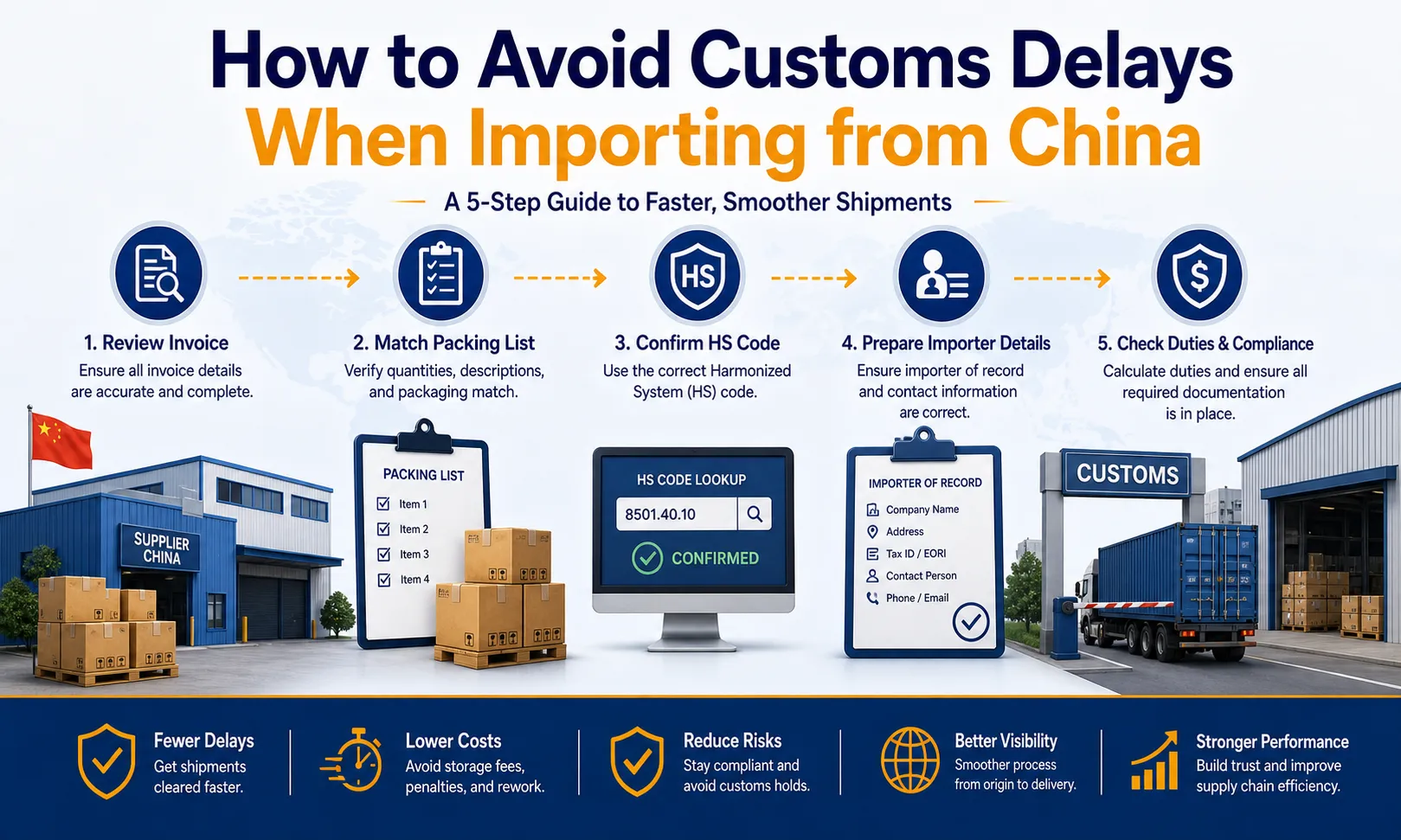
- Prepare the commercial records. Align the invoice, packing list, contract information and proposed HS code.
- Check the final cargo. Use the actual carton count, gross weight, net weight and dimensions received by the warehouse.
- Match the transport booking. Make sure the shipper, consignee, route and cargo details agree with the booking and manifest data.
- File the export declaration. The registered party or authorized broker submits the declaration and supporting information.
- Answer any customs query. Customs may request a correction, supporting document, scanning or physical inspection.
- Obtain release. After release, the cargo can proceed to carrier handover and departure.
A clean declaration may move quickly, but do not plan around a guaranteed same-day release. For instance, port cutoffs, document corrections, inspections and product licenses can add time. For ordinary cargo, the useful planning rule is to finish the document and exporter review before pickup and leave a working-day buffer before the vessel or flight cutoff.
Once Customs accepts a declaration, the parties cannot treat its contents like an editable draft. A modification or withdrawal needs a proper reason and customs approval. Therefore, correct obvious errors before filing rather than relying on a later amendment.
If timing matters, ask your forwarder for the current status in plain language: Has the declaration been filed? Is it under review? Has Customs requested inspection or correction? Has release been granted? “The cargo is at the port” does not answer any of those questions.
Documents and HS Code Details to Prepare
There is no universal document package for every shipment. However, most commercial exports begin with the same core information. Special products and destination markets may require additional records.
Commercial Invoice
The invoice should show the seller, buyer, consignee when different, invoice number and date, product description, quantity, unit price, total value, currency, country of origin and Incoterm when applicable.
Use a description that identifies the product, material and function. “Stainless steel kitchen sink” is useful; “hardware” is not. “12V LED desk lamp” explains more than “electronic item.” Do not describe a commercial order as a gift or sample simply because that wording seems easier.
Packing List
The packing list connects the documents to the physical cargo. It should show the number and type of packages, products per package, gross and net weights, outer dimensions, total weight, total CBM and package marks when used.
Final packed data matters. For example, product-box dimensions are not the same as export-carton dimensions, and protective packing may change both the weight and carton count. When several suppliers deliver to one warehouse, keep each delivery identifiable by supplier, invoice and carton reference.
HS Code, Declaration Elements and Product Files
An HS code cannot be chosen from a short sales name alone. Instead, material, function, operating principle, level of processing and intended use may change the classification. China may also require declaration elements such as brand, model, composition, specification and usage.
The first six HS digits follow the international Harmonized System, but China and the destination country add their own national details. Therefore, the complete China export code and destination import code do not always look identical. They should still describe the same real product. The destination importer should ask its local broker to confirm the import classification.
Send photos, specifications and safety information early for batteries, liquids, powders, chemicals, cosmetics, food, medical products, wireless equipment, branded goods, wooden products and controlled or dual-use items. Some records, such as an MSDS or UN38.3 report, may relate mainly to carrier acceptance rather than the basic customs filing, but a missing transport document can still stop the shipment before departure.
Who Handles Export Clearance Under EXW, FOB, CIF, DAP and DDP?
Incoterms allocate tasks, costs and risks between the seller and buyer. They do not override customs, tax or licensing rules. The purchase term should agree with the operational plan:
- EXW: The buyer takes on broad origin responsibility from the supplier’s premises. However, an overseas buyer cannot assume that it can personally act as a registered Chinese exporter. Confirm the exporter and broker arrangement before pickup.
- FOB: The seller normally handles export clearance and delivers the goods on board at the named port. Confirm whether the quotation includes local transport, terminal charges and any separate documentation fee.
- CIF: The seller arranges export clearance, ocean freight and the required insurance to the named destination port. The buyer still handles destination import clearance and local charges unless the contract says otherwise.
- DAP: The seller arranges transport to the named destination, while the buyer generally handles destination import clearance, duties and taxes.
- DDP: The seller takes broad responsibility for export, transport, import clearance and duties. Even so, the parties must confirm whether the proposed importer-of-record and tax arrangement is legally workable in the destination country.
If the supplier’s quotation is unclear, compare the responsibilities in our EXW vs. FOB shipping from China guide. Do not rely on an Incoterm label alone; ask which charges and documents the quoted price actually includes.
What Commonly Delays China Export Clearance?
Most preventable delays begin before the declaration is filed. The following problems appear repeatedly in real freight operations:
- Vague product descriptions: Replace “parts,” “accessories” or “samples” with the product’s material and function.
- Estimated packing data: Update the documents after final packing or warehouse receiving.
- No confirmed exporter: Resolve the supplier, trading company or agency arrangement before pickup.
- Mixed products under one code: Separate unrelated goods into traceable invoice lines and review each classification.
- Unsupported declared value: Keep the invoice, order and payment records consistent with the real transaction.
- Late disclosure of sensitive cargo: Tell the forwarder about batteries, liquids, powders, magnets, chemicals, brands and medical use before booking.
- Booking and declaration mismatch: Align the exporter, consignee, package count, weight and transport reference.
- Missing licenses or certificates: Check product controls early because these documents may take longer than the freight booking.
A customs inspection is not proof that the exporter did something wrong. Customs may select a compliant shipment for review. No forwarder can guarantee that Customs will never inspect a shipment, but complete information makes it easier to answer questions and prevents avoidable corrections.
China Export Customs Checklist Before Pickup
Use this checklist before the supplier hands over the cargo:
- Confirm the supplier’s legal company name and pickup address.
- Ask which company will appear as the exporter.
- Confirm whether the arrangement is self-operated export or documented agency export.
- Agree who pays the export declaration and related origin charges.
- Prepare a commercial invoice with clear product descriptions and real values.
- Match the packing list to the final cartons, weights and dimensions.
- Review the proposed HS code and required declaration elements.
- Disclose batteries, liquids, powders, chemicals, magnets, branded goods and controlled items.
- Check whether the product needs licenses, certificates or transport safety records.
- Confirm that the booking and customs information use consistent shipper and cargo details.
If you are not sure what to ask the supplier, send this short message:
Please confirm the legal company that will appear as exporter on the China customs declaration, whether your quotation includes export clearance, and whether you can provide the commercial invoice, packing list, proposed HS code and any required product certificates before pickup.
This one request often exposes a responsibility gap before it becomes a missed vessel, warehouse charge or last-minute documentation fee.
China Export Customs Clearance FAQ
Does every shipment from China need export customs clearance?
Most commercial exports pass through a customs process, but the filing method varies. Conventional freight normally uses a formal export declaration, while eligible courier, e-commerce or low-value shipments may use a different or consolidated procedure. Ask the carrier or forwarder which method applies to the actual shipment.
Is the export clearance fee different in each Chinese province?
The appearance of a separate fee usually depends more on the Incoterm, supplier’s export capability, shipment method, broker arrangement and included services than on the province alone. Port and local handling costs can vary, but a buyer should first compare what each quotation includes.
Who pays the China export declaration fee?
The contract and Incoterm usually determine the commercial responsibility. For example, under FOB, the seller normally handles export clearance. Under EXW, the buyer’s appointed forwarder may need to coordinate it. Regardless of the term, write the included and excluded charges into the quotation.
Can a forwarder help if the factory cannot export?
A forwarder may coordinate a customs broker or compliant agency-export arrangement. However, the real Chinese seller, transaction and cargo must remain traceable. Therefore, ask who will appear as exporter and how the actual entrusted seller will be documented.
Is “buying export documents” a legal customs method?
It is not the formal name of a customs method, and people use the expression for different arrangements. A properly documented agency export is different from borrowing an unrelated company’s identity while hiding the real seller or transaction. Do not approve the arrangement based on the label alone; request the named parties and supporting documents in writing.
How long does China export customs clearance take?
There is no reliable universal promise. A complete ordinary declaration may move quickly, while corrections, inspection, special-product documents or licensing can add working days. Review the file before pickup and leave enough time before the carrier cutoff.
Does the China export HS code have to match the destination code?
Both codes use the international Harmonized System, so the first six digits often align. National digits and interpretations may differ. The China-side exporter should confirm the export classification, while the destination importer or broker confirms the local import code.
Does China export release mean the cargo will clear at destination?
No. China export clearance and destination import clearance are separate. For U.S.-bound cargo, review our USA customs clearance from China guide for importer, HTS and entry responsibilities.
Can a freight forwarder guarantee customs release?
No. A forwarder can review documents, coordinate the broker, identify inconsistencies and respond quickly, but Customs makes the final decision. Be cautious of anyone promising that a shipment can never be inspected or delayed.
How VoltFreight Can Help
VoltFreight can coordinate supplier pickup, China warehouse receiving, final cargo measurement, document review, export declaration handover, international freight and destination clearance planning. We first review the actual product and shipping arrangement because the correct solution for ordinary machinery parts may not work for batteries, liquids, food, cosmetics or medical products.
To review a shipment, send us:
- Product name, material, use, photos and brand status
- Supplier name, city and agreed Incoterm
- Carton quantity, gross weight, dimensions and total value
- Proposed HS code and any available certificates
- Destination country, delivery address and required shipping date
We will then confirm the suitable freight method, the documents needed before pickup and whether the supplier’s export arrangement requires additional coordination. Visit our customs clearance service page or contact VoltFreight for a shipment review.
This article provides general shipping information, not legal, tax or customs advice. Requirements vary by product, exporting entity, transaction, port, destination and current regulation. Confirm the final arrangement with the relevant customs authority and qualified customs and tax professionals.