DAP vs DDP shipping from China affects much more than the freight price. The term you choose determines who handles import customs clearance, who pays duties and taxes, who controls the import documents and how the cargo reaches the named destination.
Under DAP, the seller arranges transportation to the agreed place, while the buyer normally completes import clearance and pays import duties and taxes. Under DDP, the seller assumes more responsibility, including import formalities, duties and taxes, provided the seller can legally complete those obligations in the destination country.
However, importers should not compare DAP and DDP only by the first quotation. A lower DAP freight rate may exclude customs brokerage, duty, VAT or GST, destination handling and other local costs. Meanwhile, a DDP quote may include more of the landed delivery process but still contain exclusions that need to be confirmed.
This guide explains DAP vs DDP shipping from China from a practical importer’s perspective, including customs responsibility, risk transfer, unloading, landed cost, Amazon FBA delivery, 3PL warehouses and residential addresses.
For China-side purchasing terms, review EXW vs FOB shipping from China. For complete delivery options, visit our door-to-door shipping from China service page.
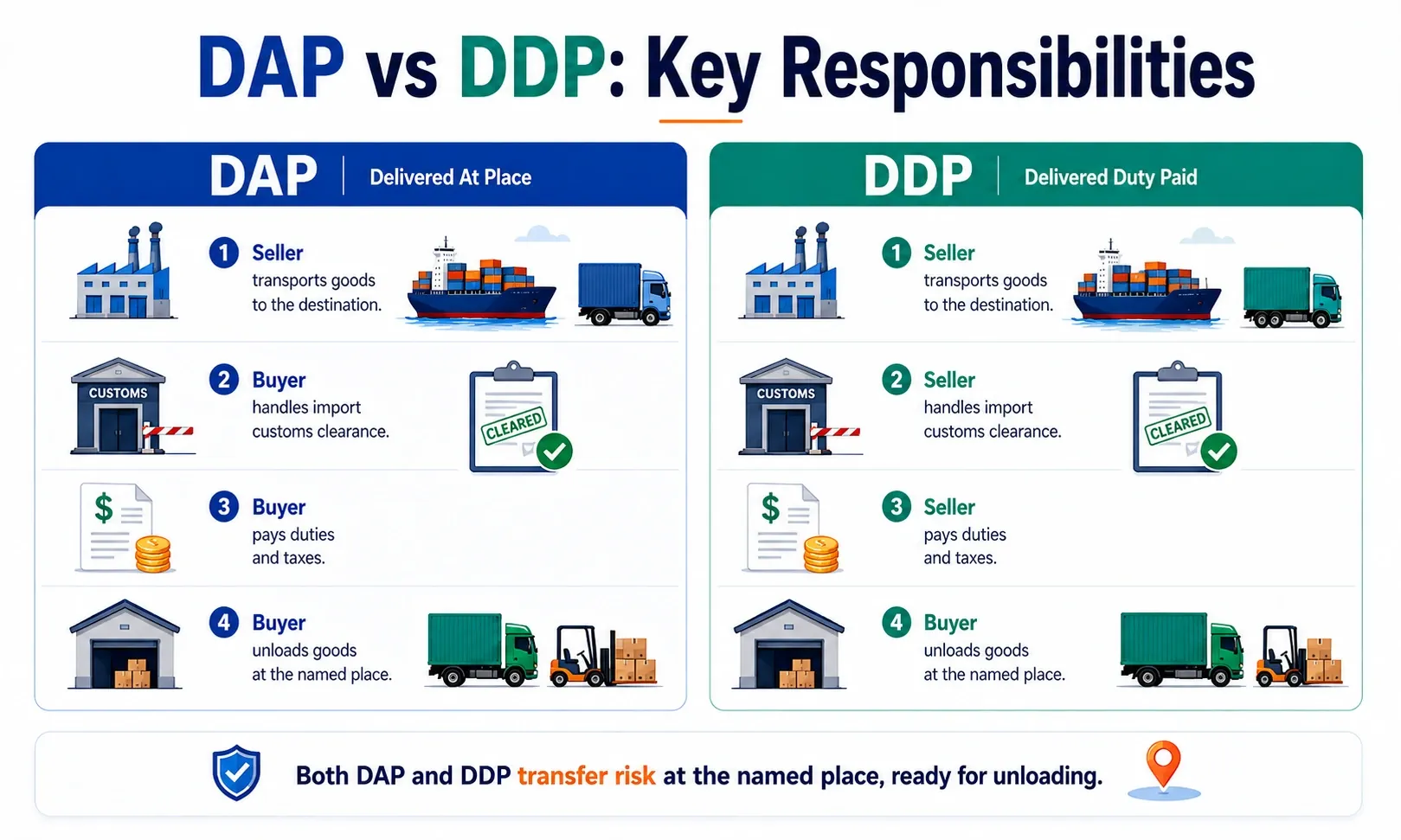
DAP vs DDP at a Glance
The central difference between DAP and DDP is responsibility for import clearance and import taxes.
With DAP, the buyer normally acts as the importer, works with a customs broker and pays the applicable duties and taxes. With DDP, the seller is responsible for completing import formalities and paying the relevant duties and taxes before delivery.
Both terms may bring the cargo to an agreed destination. However, neither term automatically means that every possible destination charge is included. The sales contract and freight quotation should clearly identify the named place, delivery conditions, unloading responsibility and excluded costs.
| Responsibility | DAP Shipping from China | DDP Shipping from China |
|---|---|---|
| China export formalities | Seller | Seller |
| International transportation | Seller to the named place | Seller to the named place |
| Import customs clearance | Buyer | Seller |
| Import duties and taxes | Buyer | Seller |
| Importer registration or permit | Buyer normally provides it | Seller must be able to satisfy destination-country requirements |
| Risk transfer | When goods are placed at the buyer’s disposal at the named place, ready for unloading | When goods are placed at the buyer’s disposal at the named place, ready for unloading |
| Unloading at destination | Normally the buyer, unless otherwise agreed | Normally the buyer, unless otherwise agreed |
| Control over import entry | Higher buyer control | Usually controlled by the seller or its appointed service provider |
| Best suited to | Importers with their own broker and import setup | Buyers seeking a more complete landed delivery arrangement |
A written freight quotation should still explain the operational scope. For example, it should state whether the service includes customs brokerage, duty, VAT or GST, destination handling, delivery appointments, residential delivery, liftgate service and remote-area surcharges.
What Does DAP Mean in Shipping from China?
DAP means Delivered at Place. Under this term, the seller arranges and pays for transportation from China to an agreed destination. The named destination might be a commercial warehouse, 3PL facility, Amazon FBA warehouse, residential address, airport facility, port terminal or another agreed place.
The seller normally handles China export formalities and the transportation required to reach the named place. However, the buyer is generally responsible for:
- Import customs clearance
- Appointing a customs broker when required
- Providing an importer number or tax registration
- Paying import duties, VAT, GST or other applicable taxes
- Providing product permits, registrations or compliance documents
- Paying customs examination, storage or related destination charges when applicable
- Unloading the cargo at the named destination unless otherwise agreed
DAP can be a practical option for experienced importers. It allows the buyer to control the customs entry, use its preferred broker and keep import records under its own company name.
It can also provide better visibility over duty and tax payments. This matters when the importer needs formal customs records, recoverable import VAT or documentation for accounting and compliance purposes.
Nevertheless, DAP is not an all-inclusive delivery term. A quotation described as “DAP door delivery” may still exclude duty, taxes, brokerage, customs bonds, customs examinations and other import-related costs.
Importers should therefore confirm who will contact the customs broker, which documents are required and what happens if clearance is delayed.
For more information about destination customs planning, review our customs clearance support page.
What Does DDP Mean in Shipping from China?
DDP means Delivered Duty Paid. Under the official Incoterms framework, DDP places the greatest level of responsibility on the seller.
The seller arranges transportation to the named destination and is also responsible for import customs clearance, applicable duties and taxes. The buyer generally receives the goods after import formalities have been completed, although unloading normally remains the buyer’s responsibility unless the contract states otherwise.
DDP can reduce the number of separate steps managed by the buyer. Instead of appointing a broker, paying customs charges and coordinating final delivery individually, the buyer may receive one more complete landed delivery arrangement.
This can be useful for:
- First-time importers
- Small businesses without an established customs broker
- E-commerce and Amazon sellers
- Buyers that want predictable landed shipping costs
- Importers receiving regular cartons rather than full containers
- Businesses that prefer one party to coordinate freight, clearance and delivery
However, DDP is not automatically suitable for every destination or product. The seller must be able to meet the destination country’s import requirements.
Some countries require a locally registered importer, tax number, fiscal representative, product registration or special permit. Certain products may also require approval from customs, food, medical, communications, environmental or product-safety authorities.
Before accepting a DDP quote, confirm:
- Who will be recorded as the importer
- Whose import registration or tax number will be used
- Whether duties and taxes are genuinely included
- Whether the buyer will receive formal customs and tax records
- Whether import VAT can be recovered where relevant
- Which customs examinations or storage costs are excluded
- Which final delivery services are included
DDP can simplify shipping, but the route should be reviewed before cargo leaves China.
Incoterms and Freight Forwarder DDP Services Are Not Identical
A crucial distinction is that Incoterms define responsibilities between the seller and buyer under the sales contract. They do not automatically define the legal relationship between an importer and a freight forwarder.
A freight forwarder may arrange transportation that supports a DAP or DDP sale. However, the forwarder is normally carrying out logistics services on behalf of the seller, buyer or another contracting party.
This means the following terms should not be treated as interchangeable without further explanation:
- Formal DDP sales term: The seller accepts the contractual obligations associated with DDP, including import formalities and taxes.
- Freight forwarder DDP line: A logistics provider offers a bundled door-to-door service that may include freight, customs coordination, duty or tax handling and final delivery.
A forwarder’s DDP line can be a practical shipping solution, but importers should understand how the route is structured. Ask whether the service uses individual customs entries, consolidated clearance, postal clearance, courier clearance or another import model.
You should also confirm whether your company appears on the import documents and whether formal tax or customs records will be available.
This is especially important for commercial importers that need:
- Customs entry records under their own company name
- Recoverable import VAT
- Proof of legal importation
- Product compliance records
- Accurate inventory and accounting documentation
A low DDP rate is not useful if the customs model does not meet your business, tax or compliance requirements.
When Does Risk Transfer Under DAP and DDP?
DAP and DDP have similar delivery and risk-transfer points.
Under both terms, risk normally transfers from the seller to the buyer when the goods arrive at the named destination and are placed at the buyer’s disposal on the arriving means of transport, ready for unloading.
This means the named place should be precise.
For example, the contract should not simply state “DAP USA” or “DDP Germany.” A more useful description would identify a specific warehouse, street address, Amazon facility, port terminal or other agreed delivery point.
The exact named place affects:
- Where the seller’s transportation obligation ends
- Where risk transfers to the buyer
- Which local delivery costs are included
- Whether an appointment is required
- Whether residential or limited-access fees apply
- Who handles unloading
Unloading is another frequently overlooked issue. Under standard DAP and DDP arrangements, the seller delivers the goods ready for unloading, but the buyer normally handles the actual unloading.
Therefore, services such as liftgate delivery, forklift unloading, inside delivery, upstairs delivery, room-of-choice delivery and packaging removal should be confirmed separately.
DAP vs DDP Cost: Which Option Is Really Cheaper?
DAP often appears cheaper because the initial quotation may exclude import-related costs. The buyer may later receive separate charges from customs, a broker, a carrier, a port, an airport terminal or a local delivery company.
A DAP landed-cost calculation may include:
- International freight
- Import duty
- VAT, GST or other import taxes
- Customs brokerage
- Customs bond or importer filing charges
- Terminal or destination handling
- Customs examination fees
- Storage caused by delayed clearance
- Final delivery surcharges
DDP quotations often appear higher because more of these items are included in one price. This can make budgeting easier, particularly for e-commerce sellers and small importers.
However, DDP does not necessarily mean every possible cost is included. Customs examinations, storage, address corrections, delivery appointments, remote areas, liftgate service, waiting time and failed delivery may still be excluded.
A fair comparison should therefore use the total expected landed cost:
Product cost + China-side charges + international freight + customs clearance + duties and taxes + destination handling + final delivery.
Do not compare a basic DAP freight rate with a more complete DDP landed quote. First make sure both quotations cover the same transportation and delivery scope.
When Is DAP Better Than DDP?
DAP can be the better choice when the buyer already has an established import process.
For example, an importer may prefer DAP when it has:
- A licensed customs broker in the destination country
- An importer number, EORI, EIN, VAT number, ABN or other registration
- A customs bond where required
- An internal compliance team
- A preferred local trucking or delivery provider
- A requirement to keep customs records under its own company name
DAP may also be more appropriate for regulated products. When the goods require importer-specific permits, product registration, agency filings or detailed compliance documentation, the buyer may need to control the entry directly.
Established importers may also negotiate better customs brokerage and local delivery rates. As a result, managing clearance independently can provide greater transparency and lower long-term costs.
However, DAP requires preparation. Before the shipment departs China, the buyer should know:
- Who will act as importer
- Which broker will handle clearance
- Which documents must be supplied
- How duties and taxes will be paid
- Who will coordinate delivery after customs release
Without these arrangements, the shipment may face clearance delays and storage charges.
When Is DDP Better Than DAP?
DDP can be more practical when the buyer wants a simpler landed delivery process and the seller or logistics provider can offer a legally workable import solution.
It is commonly considered for:
- Small and medium commercial shipments
- Amazon FBA and e-commerce inventory
- Buyers without a customs broker
- First-time importers
- Regular replenishment cartons
- Businesses that want one coordinated delivery price
A clear DDP arrangement can reduce the need to coordinate multiple companies. The same logistics plan may cover China supplier pickup, warehouse receiving, export handling, international transportation, import clearance and final delivery.
Nevertheless, product and destination review is essential. DDP may require additional checks for:
- High-value goods
- Branded or trademarked products
- Lithium batteries and power banks
- Liquids, powders and chemicals
- Food, supplements and cosmetics
- Medical-related products
- Wireless and telecommunications equipment
- Dangerous goods
- Products requiring importer-specific permits
Accurate cargo data is equally important. If the product description, value, HS code, weight, dimensions or destination address changes, the DDP rate and route feasibility may also change.
Destination rules determine whether a DDP solution is practical. For a route-specific example, review our guide to DDP shipping from China to Mexico, including cargo eligibility, customs scope, Mexico City versus out-of-state delivery and the information required for an accurate quote.
DAP vs DDP for Amazon FBA and 3PL Warehouses
Amazon FBA and 3PL deliveries require more than customs clearance. The freight plan must also account for labels, carton requirements, appointments, pallets and warehouse receiving rules.
DDP can be useful for Amazon sellers who want the international freight, customs process and final delivery coordinated under one service. However, Amazon does not act as the importer of record for the seller’s shipment.
The seller still needs to prepare:
- The correct FBA shipment plan
- FNSKU or product labels where required
- Amazon carton labels
- Accurate carton dimensions and weights
- Pallet labels and pallet specifications where applicable
- The correct warehouse address and reference information
For importers with their own customs broker, DAP may also work well. The buyer can complete customs entry under its own company and then arrange delivery to Amazon or a 3PL after release.
In either case, the freight forwarder should confirm whether the destination warehouse needs an appointment, delivery reference, pallet exchange, floor-loaded unloading or other special handling.
For related preparation and delivery support, review shipping from China to Amazon FBA.
DAP vs DDP for Business and Residential Delivery
DAP and DDP can both be used for business or residential destinations, but the address type affects the final delivery cost.
A quotation to a commercial warehouse with a loading dock is different from a quotation to:
- A residential address
- A home-based business
- A construction site
- A farm or rural address
- A school, hospital or government facility
- A remote-area postcode
- A building requiring an appointment
Residential and limited-access deliveries may require additional services such as appointment booking, liftgate delivery or manual handling.
Normal door delivery usually means delivery to the accessible ground-level address. It does not automatically include inside delivery, upstairs delivery, product installation or packaging disposal.
Before accepting a DAP or DDP quotation, provide the full postcode and address type. This allows the freight provider to check delivery restrictions and surcharges before the cargo departs China.
Common DAP and DDP Shipping Mistakes
Comparing only the first freight price
A DAP quotation may exclude duties, taxes and brokerage, while a DDP quotation includes them. Compare the total landed cost rather than the headline freight rate.
Assuming DDP means every charge is included
DDP describes the seller’s contractual responsibility, but an operational quotation may still exclude customs examinations, storage, delivery appointments, liftgate service and remote-area charges. Confirm exclusions in writing.
Choosing DAP without a customs broker
The buyer normally handles import clearance under DAP. Waiting until the cargo arrives to find a broker can cause storage and clearance delays.
Using unclear product descriptions
Descriptions such as “parts,” “sample,” “accessories” or “gift” are not sufficient for a reliable quotation or customs declaration. Provide the product name, material, function and intended use.
Using an inaccurate declared value
Customs authorities may request purchase records, payment evidence or product information. An unrealistic value can lead to revaluation, delay, penalties or seizure.
Ignoring the importer-of-record issue
A DDP quotation should explain who completes the import entry and whose registration is used. This is particularly important when the seller has no legal presence in the destination country.
Forgetting unloading and delivery restrictions
DAP and DDP normally deliver the goods ready for unloading. Forklift service, liftgate delivery, inside delivery and appointment delivery should be checked separately.
Information Needed for a DAP or DDP Quote
A reliable quote requires complete cargo, origin and destination information.
Before requesting a DAP or DDP rate, prepare:
- Product name and clear product photos
- Product material, function and intended use
- HS code or HTS code if available
- Supplier city and pickup address in China
- Supplier trade term, such as EXW or FOB
- Number of cartons or pallets
- Gross weight of each carton or pallet
- Carton or pallet dimensions
- Total CBM where available
- Commercial invoice value and currency
- Country of origin
- Battery, liquid, powder, magnet, chemical or wood information
- Brand or trademark information
- Destination country and postcode
- Complete delivery address
- Address type: FBA, 3PL, warehouse, business, residential or project site
- Whether the buyer has a customs broker and importer registration
- Cargo-ready date and required delivery deadline
With these details, the freight provider can compare air freight from China, sea freight from China, DAP delivery and DDP door-to-door shipping.
Why Choose VoltFreight for DAP and DDP Shipping?
VoltFreight helps importers compare DAP and DDP shipping from China based on real cargo and destination requirements.
Instead of recommending a term only because it appears cheaper, we review the product, supplier location, declared value, weight, dimensions, destination country, importer setup and final delivery address.
Depending on the shipment, our services may include:
- Supplier pickup in China
- China warehouse receiving
- Carton measurement and weight checking
- Consolidation from multiple suppliers
- Repacking and labeling support
- China export coordination
- Air freight, sea freight and express shipping
- DAP transportation planning
- DDP route and product feasibility review
- Customs and final delivery coordination under the confirmed scope
For importers with their own customs broker, we can coordinate the transportation and delivery stages around the buyer’s import process.
For buyers seeking a more complete landed service, we can review whether a DDP route is available for the product and destination.
Every quotation should explain what is included, what is excluded and which destination costs need separate confirmation.
Request a DAP or DDP Shipping Quote from China
FAQ About DAP vs DDP Shipping from China
What is the main difference between DAP and DDP?
Under DAP, the buyer normally handles import customs clearance and pays duties and taxes. Under DDP, the seller is responsible for import formalities, duties and taxes before delivery to the named place.
Does DAP include final delivery?
DAP includes transportation to the named destination. However, the buyer must normally complete import clearance and pay the applicable duties and taxes before the goods can continue to final delivery.
Does DDP include customs duties and taxes?
Under the formal DDP Incoterm, the seller is responsible for import duties and taxes. Nevertheless, the freight quotation should state exactly what is included and explain any excluded examination, storage or delivery charges.
Who unloads the cargo under DAP and DDP?
The buyer normally unloads the cargo under both DAP and DDP unless the sales contract or freight quotation specifically includes unloading service.
Is DDP always better for first-time importers?
DDP can be easier for a first-time importer because it may reduce customs and delivery coordination. However, the importer should still confirm the import model, product compliance, tax documentation and service exclusions.
Can DAP be cheaper than DDP?
DAP may have a lower initial freight price. However, the buyer must add customs brokerage, duties, taxes, destination handling and delivery-related charges before comparing the total landed cost.
Can DDP be used for Amazon FBA shipments?
DDP may be used for suitable Amazon FBA shipments, but Amazon should not be treated as the importer of record. The seller must also provide the correct FBA shipment plan, carton labels and warehouse information.
Conclusion
DAP and DDP can both support delivery from China to an agreed destination, but they assign import responsibility differently.
DAP is usually more suitable when the buyer has an established customs broker, importer registration and internal compliance process. It provides greater control over the customs entry and import tax records.
DDP can be more convenient when the buyer wants a coordinated landed delivery arrangement. However, the seller or its appointed service provider must have a workable method for completing import formalities and paying duties and taxes.
Before choosing between DAP and DDP, confirm the named destination, importer of record, customs responsibility, tax treatment, risk-transfer point, unloading requirement and excluded delivery charges.
The best option is not necessarily the quotation with the lowest first price. It is the option that provides a clear, compliant and predictable route from the supplier in China to the final destination.
Ask VoltFreight to Review Your DAP or DDP Shipping Plan
Useful Official Sources
- ICC: Incoterms Rules
- ICC Academy: Incoterms 2020 DAP or DDP
- Trade.gov: Know Your Incoterms
- U.S. Customs and Border Protection: Basic Importing and Exporting
Important note: This guide provides general freight and Incoterms information. Import requirements, duties, taxes, importer registration, product compliance and DDP feasibility depend on the destination country, product type, declared value, customs rules and service structure. Confirm the final sales term and import arrangement with your supplier, freight forwarder, licensed customs broker and tax adviser before shipping.